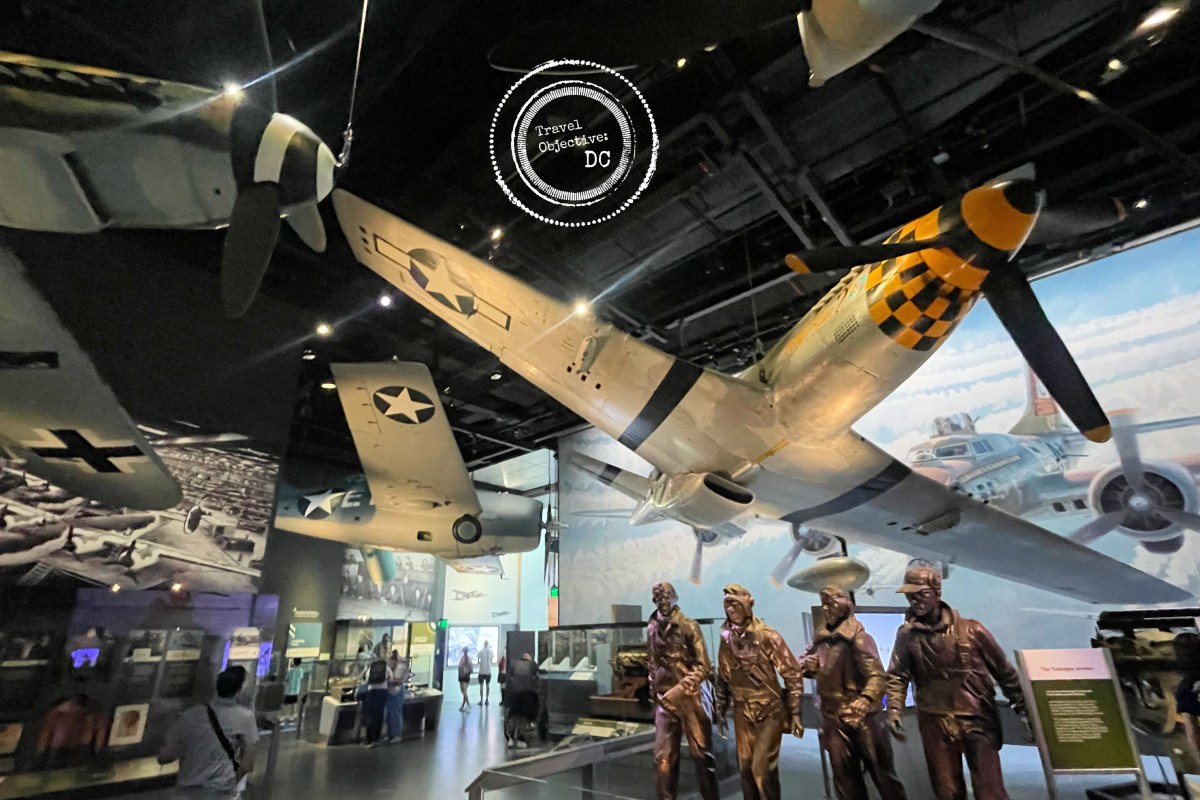
As it nears the end of an eight-year renovation, the Smithsonian Institute’s National Air and Space Museum (NASM) has opened a newly refurbished exhibit dedicated to aviation during the Second World War.
Housed in the Jay I. Kislak Gallery, World War II in the Air is a well-curated, comprehensive exhibit that excels at conveying the impact of wartime aviation from the Battle of Britain to the introduction of self-piloted “wonder weapons” at war’s end.
Amazingly, it does so in a rather limited 6,000-square-foot space.
The most impressive part of any NASM exhibit is the painstakingly restored aircraft, freshly detailed as they were in their heydays. World War II in the Air is no exception with five notable aircraft flown by four different air services.
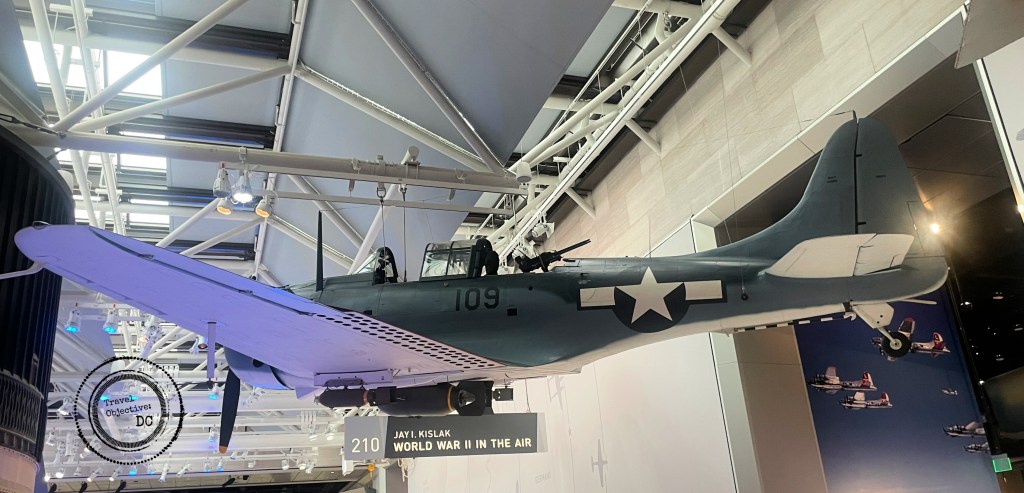
A Douglas SBD-6 Dauntless Dive Bomber
A Douglas SBD-6 Dauntless dive bomber, which helped the U.S. Navy win the Battle of Midway, draws visitors inside the gallery. It is paired with a General Motors FM-1 Wildcat. In the war’s early days, the Navy and Marine Corps flew this rugged fighter aircraft against more maneuverable Japanese Zeros. Together, these two aircraft introduce the first large display area focusing on the Pacific Theater.
WWII aerial combat in the Pacific established the aircraft carrier as the critical surface warship in a navy’s fleet. US Navy mission planners chose carriers of different sizes and capabilities, along with the mix of fighters, dive bombers and torpedo bombers, in order to meet their objectives. It was a radical departure from the days when battleships ruled the waves.
A North American P-51D Mustang transitions the exhibit to the European theater. The P-51’s wing design, powerful engine and expanded fuel capacity provided the Mustang with an extended range, high altitude speed and excellent maneuverability. Introduced into US Army Air Forces combat fighter squadrons in late 1943, the P-51 had more victories over enemy aircraft than any other Allied fighter plane.
A Messerschmitt Bf 109
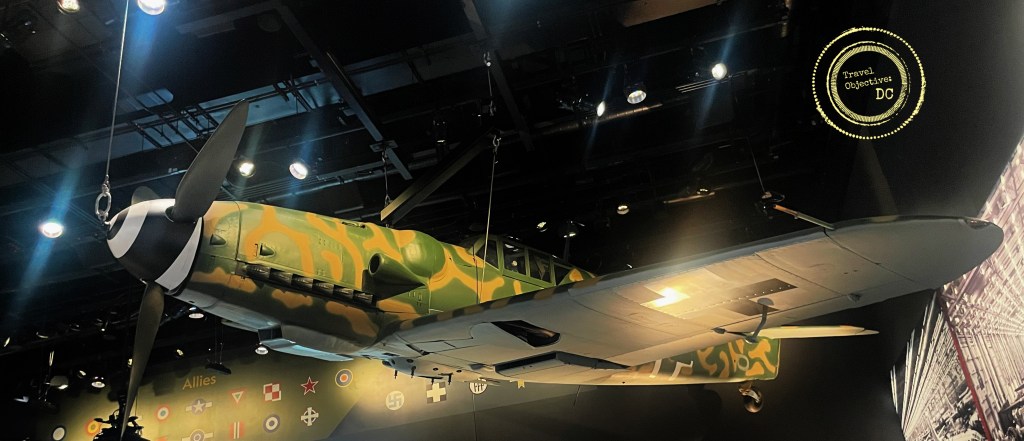
A rival aircraft, the German Messerschmitt Bf 109 is suspended nearby. The Bf 109 was a highly versatile fighter first introduced in 1935. Manufactured on a mass scale, it is the most produced fighter aircraft in history. Widely deployed across Europe on all combat fronts, many German pilots became aces behind its controls.
While fighter pilots and aircraft always garner a great deal of interest, the exhibit importantly covers wartime aviation’s other missions.
A very rare Ilyuschin II-2 Shturmovik exemplifies the mission of ground support aircraft. While fighters engaged in dog fights above the battlefield, ground support airplanes provided additional firepower to infantry and armor units engaged in combat or they attacked bridges, docks and rail yards. Such missions were especially dangerous, with airplanes approaching their targets at lower altitudes. More pilots were killed conducting ground support missions than in aerial dogfights.
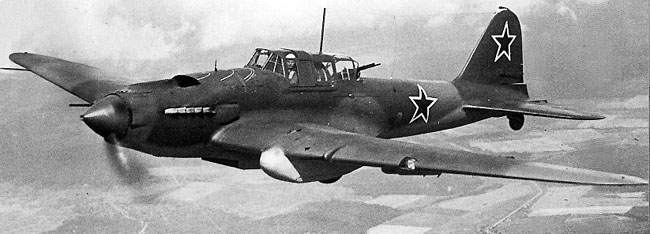
The Ilyuschin II-2 in flight
The Soviet-built Ilyuschin II-2 was specially designed with an armored frame and panels making it highly resistant to German ground fire. Known as the “Flying Tank,” the Ilyuschin II-2 frequently attacked German armor columns on the Eastern Front.
Unlike the limited and largely experimental use of bomber aircraft in World War I, bombing campaigns were developed and used to target an enemy’s military, industrial and economic resources. The small size of the Jay Kilsak gallery makes it impractical to place a heavy or even medium bomber on display. However, the exhibit employs a variety of artifacts along with detailed infographics and photographs to explain the role of strategic bombing as carried out by both the Allied and Axis air forces.
The backdrop of this area is a large renowned mural entitled Fortresses Under Fire painted by famed aviation artist Keith Ferris, depicting B-17 Flying Fortresses.
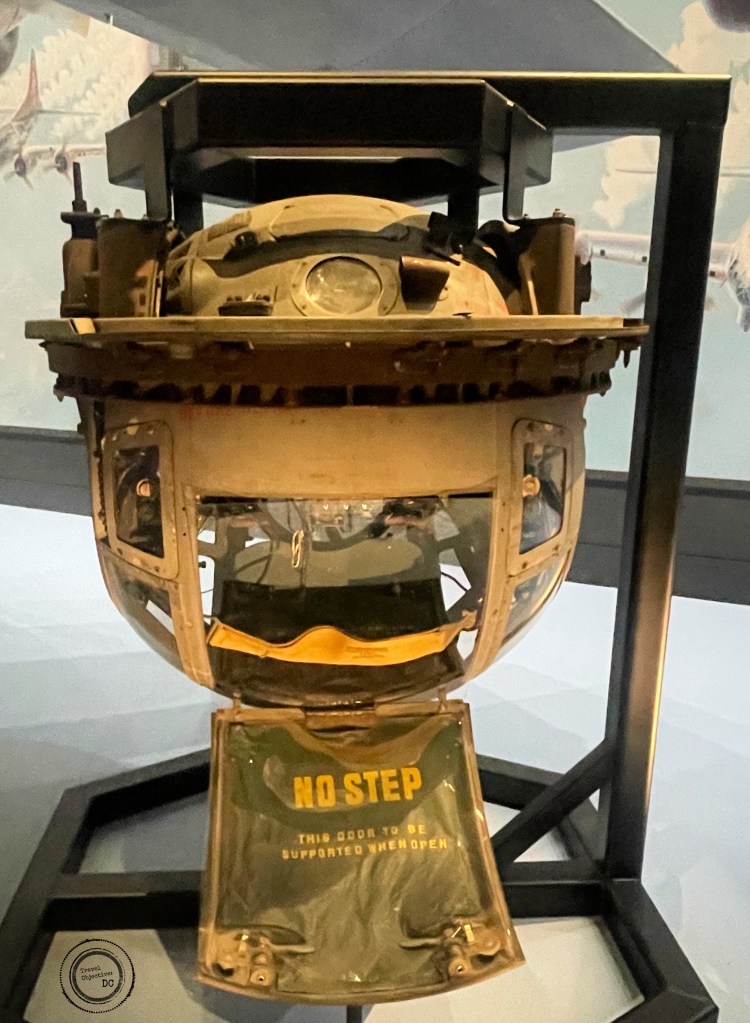
A Sperry Ball Turret for a B-24 Bomber. B-17s and B-24s had ball turrets with machine guns underneath the body of the aircraft.
A very prominent World War II era aircraft that was neither a fighter nor bomber was the Douglas C-47 Skytrain. Based on the design of the venerable civilian airliner the Douglas DC-3, this very durable, versatile aircraft supported airborne operations, towed gliders and moved essential equipment and personnel around the world. During the Normandy invasion alone, over 1,000 C-47s towed 6,000 gliders and dropped 23,000 paratroopers.
On the other side of the world, C-47 pilots distinguished themselves for three years flying “over the Hump” (the Himalayan Mountains) ferrying vital supplies from India to China. The brave pilots flew at 20,000 feet (5,000+ feet over the ceiling of a C-47), braved severe thunderstorms, rock-sized hale and 100 mile downdraft winds. After flying six hours in very difficult conditions, they landed in China, refueled and returned to India. These and other critical supply missions laid the foundation for the air transport system the U.S. military uses today.
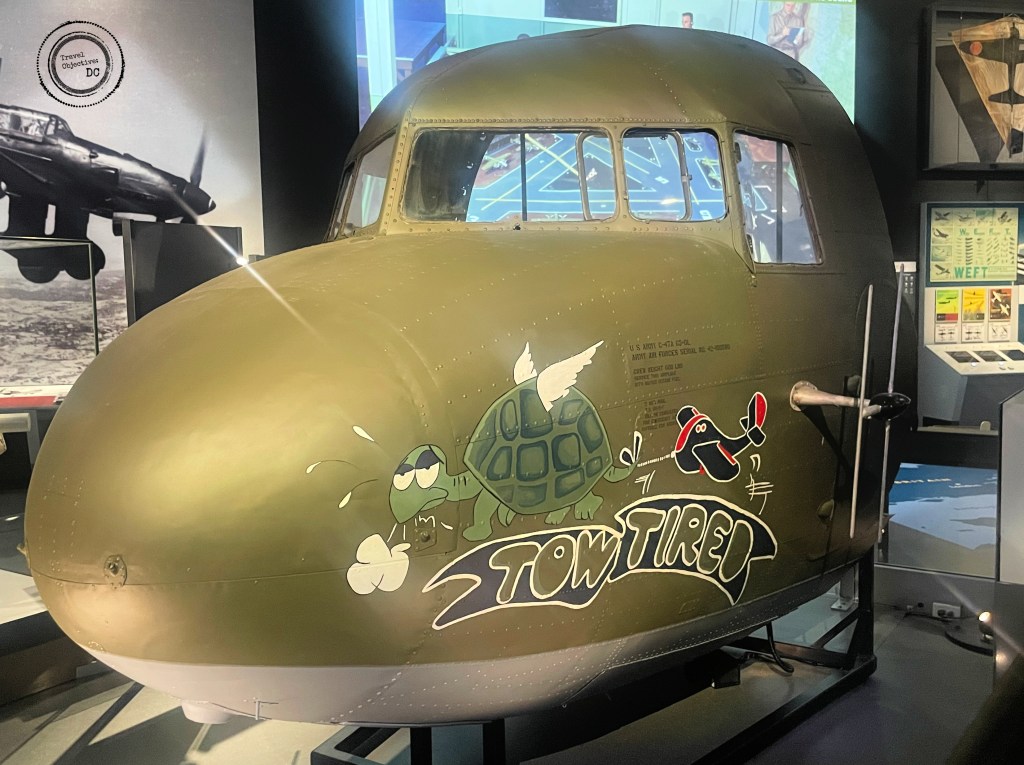
A nose of a C-47 is the center of a display on air transport explaining the role of the critical aircraft.
The nose of a Douglas C-47 Skytrain, with nose art depicting a glider towing aircraft.
The story of WWII aviation would not be complete without mentioning how America designed and produced such large numbers of remarkable aircraft. World War II in the Air explores how the aviation workforce systematically expanded to meet wartime demands.
In 1941, there were only about 100,000 aviation workers in America, but the workforce grew to over 2,000,000 by 1945. With younger men entering the military, such growth depended on hiring women, retirees, minorities, and others not previously employed in airplane factories. Together, these workers produced over 300,000 aircraft and over 700,000 engines.
The production portion of World War II in the Air is very creatively designed. There are a number of clever, interactive features, such as punching a time clock then getting to “meet” workers on the factory floor.
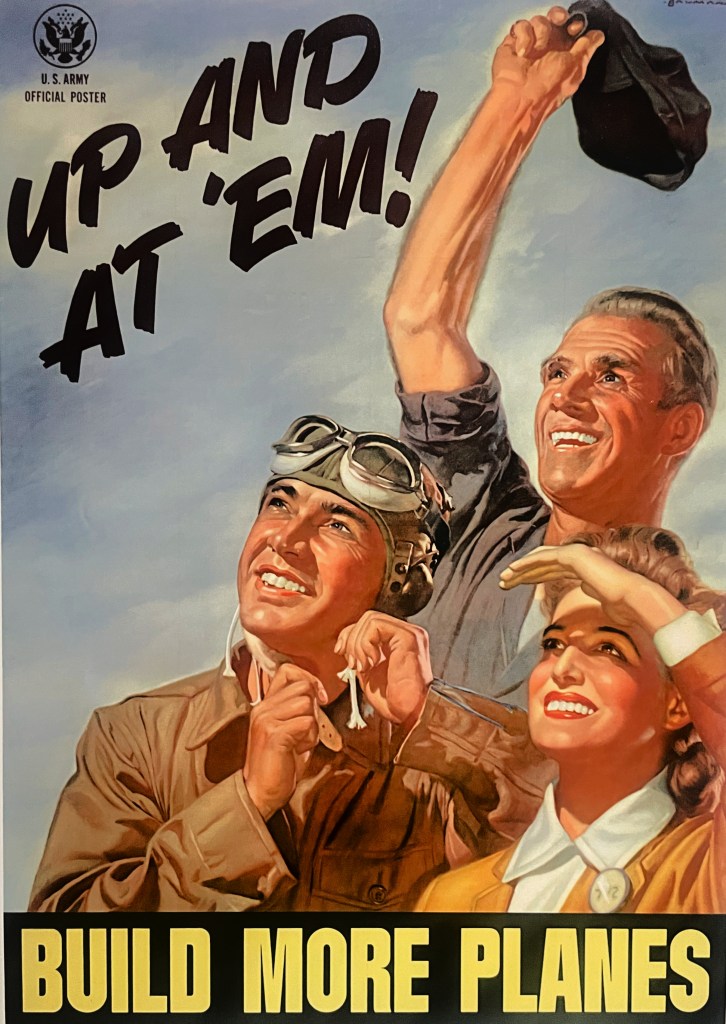
World War II in the Air reminds the visitor how everyone had a part to play supporting the war effort. People from all walks of life, backgrounds, and regions of the country became involved in aviation as pilots, air crew members, mechanics, designers and production workers.
While the Second World War ended many decades ago, its size and scope still commands a presence in America’s collective memory. Through its many artifacts, graphics and 21st century storytelling, World War II in the Air keeps alive for later generations the timeless stories and sacrifices of so many along with the wonder of the aircraft.
* * *
Route Recon
The Smithsonian Institute’s National Air and Space Museum (NASM) is located on the National Mall bordered by Independence Avenue, Jefferson Drive, and 4th and 7th Streets, SW. The entrance is on the north side of the building facing the National Mall. You cannot access the museum from the south side along Independence Avenue.
Free timed tickets are required for entry into NASM. Tickets can be acquired through the NASM website. Ticket holders will line up near the entrance on the Mall side of the Museum building prior to their entrance time. Entry prior to the time on the ticket is not allowed, but ticket holders can enter after the ticket time.
Parking – Very limited metered street parking is available around the museum. Parking is available in several commercial parking lots in the neighborhood.
Public Transportation
Metrorail – The closest Metro station is L’Enfant Plaza, along the blue, orange, silver, and green lines. From the L’Enfant Plaza Station, take the “A” exit for Maryland Avenue and 7th Street.
Metrobus – Bus stops are located on Independence Avenue, SW, and along 7th Street, SW. Visit the Washington Metropolitan Area Transit Authority for more information.

