In his poem, The Secret of the Sea, Henry Wadsworth Longfellow wrote: Wouldst thou … learn the secret of the sea? Only those who brave its dangers, comprehend its mystery!
Fortunately for us landlubbers, a new exhibit at the Smithsonian Institution’s National Museum of American History (NMAH) featuring the Gunboat Philadelphia is sharing some of those secrets of the sea by helping us learn about the early history of the Continental Navy without braving any dangers — or even getting our feet wet.
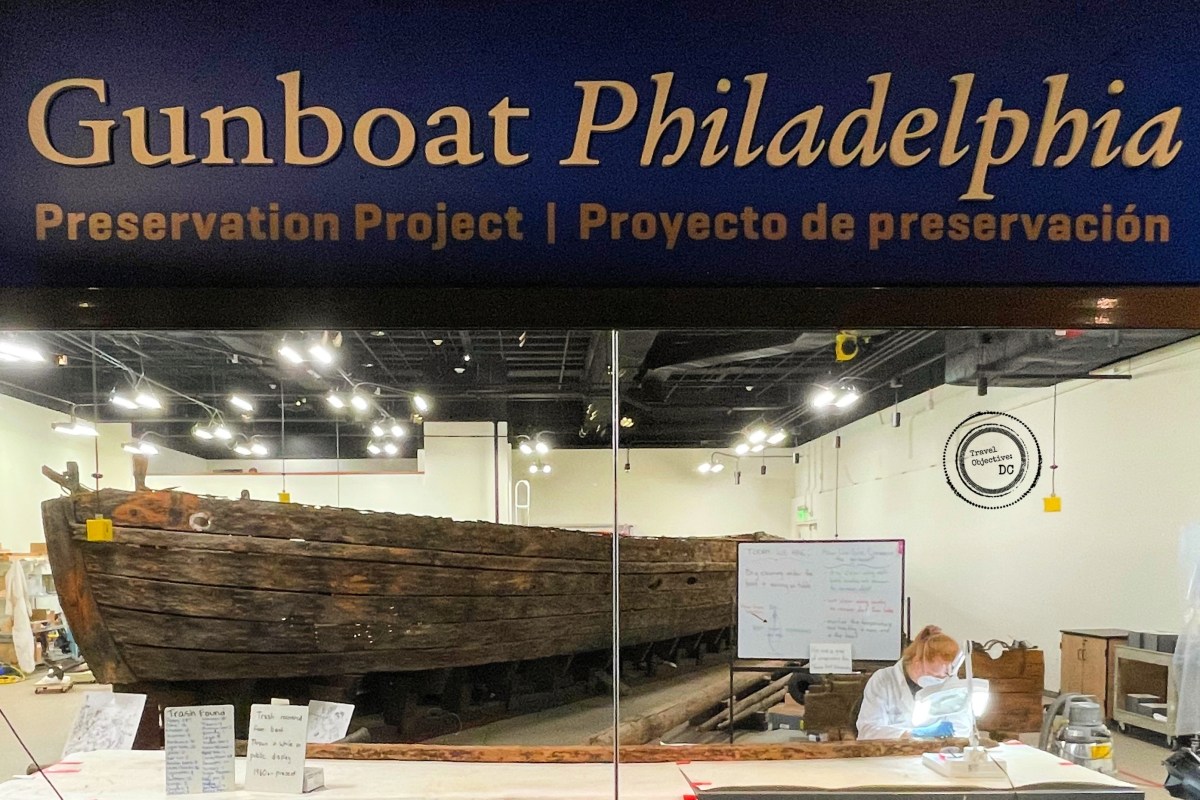
On the third floor of NMAH, visitors can see the Philadelphia, the Navy’s oldest known surviving warship, and her ongoing restoration work. The gallery sits just opposite from the Price of Freedom exhibit on the American military.
The story of the Philadelphia begins in the summer of 1776 when 15 warships for the new Continental Navy were constructed to engage the Royal Navy for the defense of Lake Champlain.
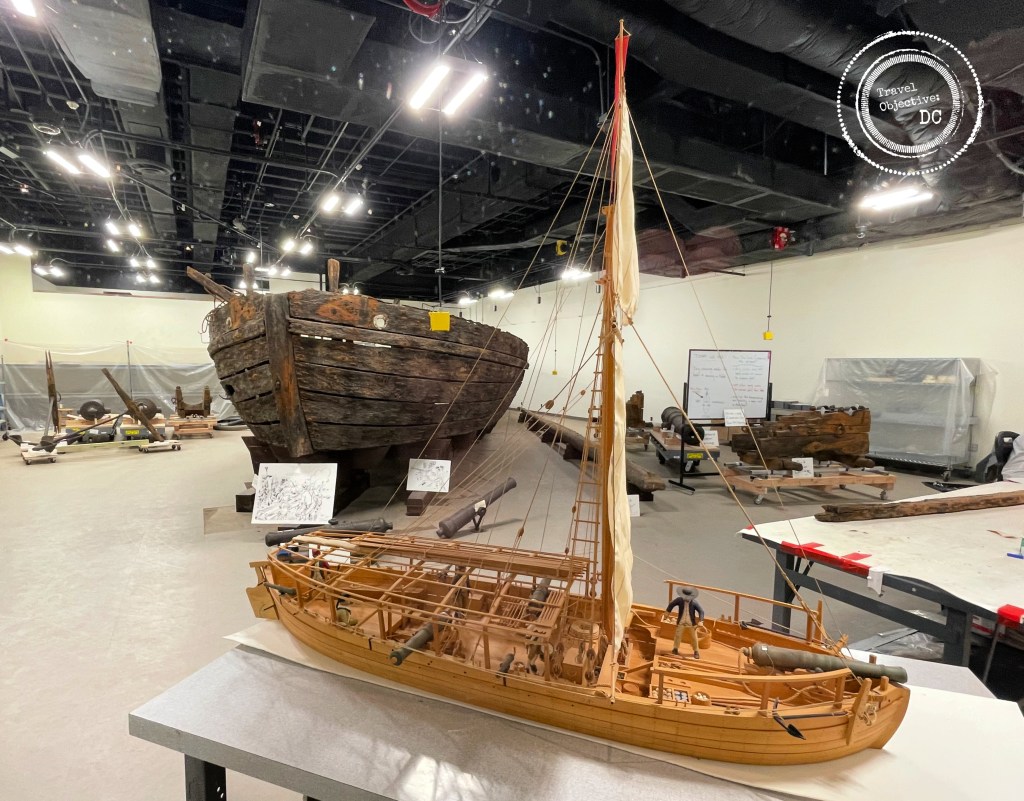
A model of the Gunboat Philadelphia is displayed alongside the actual Philadelphia undergoing restoration.
Today, this narrow lake forms the border between northern New York and Vermont. Maintaining strategic control of Lake Champlain was important to forestall a likely British ground force invading New York from Canada.
The Philadelphia is a gundalow, a flat-bottomed boat often used as a commercial barge along the rivers in New England. Since it has no keel, a gundalow can sail close to the shoreline in shallow waters. The Philadelphia was built from oak and was 51 feet long and 15 feet at its widest. She had a 36-foot-high mast and three cannons.
The American fleet was under the command of Benedict Arnold. While best known today as a traitor to the cause for independence, in early 1776 Arnold was still a loyal patriot who had distinguished himself as an effective commander during the Continental Army’s unsuccessful invasion of Canada. Arnold was also a successful merchant who had captained sailing ships. He was the logical choice to lead the mission.
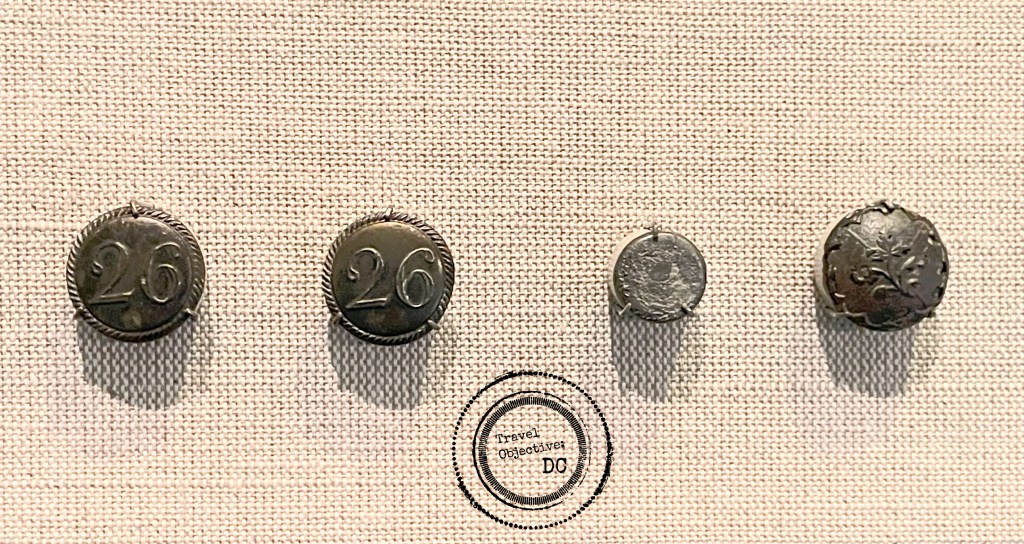
Pewter buttons recovered from the Gunboat Philadelphia. The buttons were from the uniform coats of the British Army’s 26th Regiment of Foot. The Regiment garrisoned Fort Ticonderoga when it was captured by Ethan Allen and Benedict Arnold in May of 1775. The coats were likely confiscated and worn by the American sailors.
By October of 1776, both sides had fitted out their fleets and were prepared to engage. Arnold had located the American fleet in the southern part of the lake, in a narrow bay between Valcour Island and the shoreline. The location limited the British flotilla’s ability to maneuver or concentrate their cannon fire on the American ships.
On October 11, the two fleets deployed in lines in Valcour Bay. Cannon volleys between the ships roared through the afternoon. The Philadelphia was struck by a 24-pound cannon ball in its forward bow and sunk around 6:30 pm.
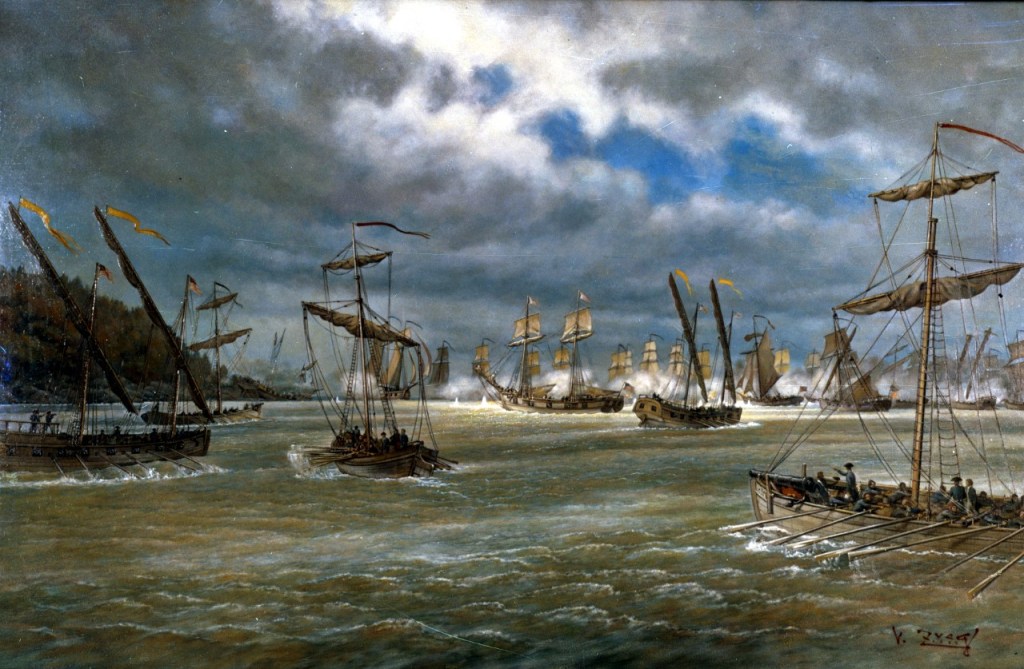
The maritime battles would continue for two more days. Although crews fought valiantly, the American fleet was heavily damaged. Arnold knew he could not defeat the British and he withdrew from the lake.
While the battle had been lost, winter was setting in and the British decided to delay the invasion of New York until the following year. The Battle of Valcour Bay later proved to be quite consequential as the delayed British invasion force, led by General John Burgoyne, was ultimately defeated at Saratoga
After sinking, the Philadelphia would stay on the bottom of Lake Champlain until she was raised in 1935 by Lorenzo F. Haggulund, a salvage expert who had grown up in the area.
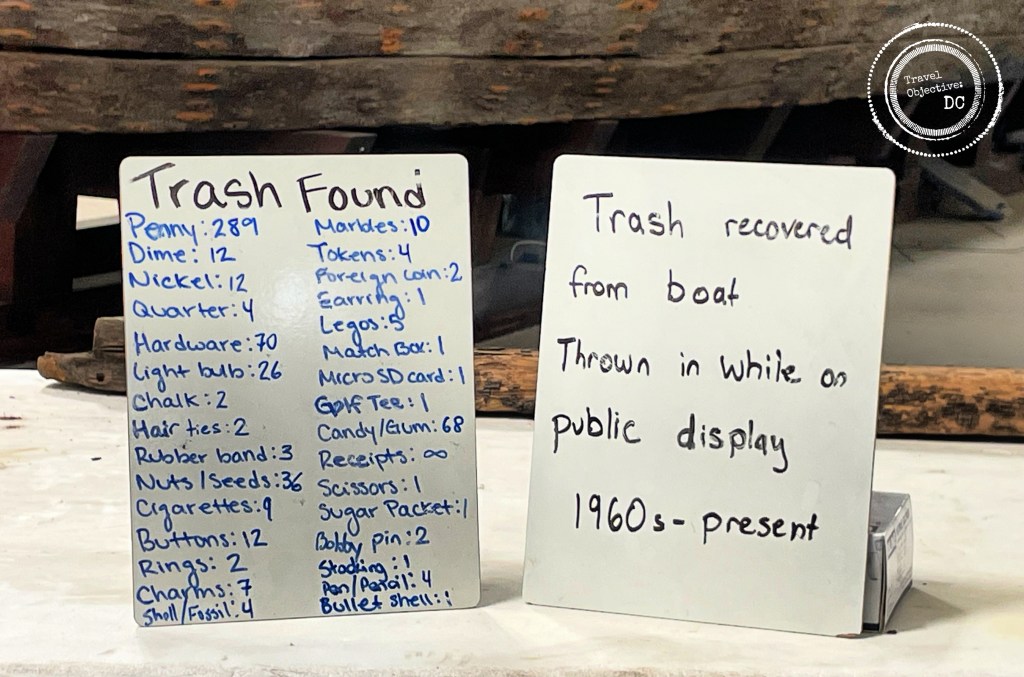
A tally of items found tossed into the Gunboat Philadelphia while on display at the National Museum of American History.
The gunboat was displayed locally until 1961 when the Philadelphia was donated to the Smithsonian Institution. It was a featured exhibit at the NMAH from its opening in 1964 until 2019 when it was removed for initial restoration. At the same time, historians and researchers dove into contemporary records to learn more about the Philadelphia’s construction and crew.
Today, visitors to NMAH can see lab-coated technicians from Texas A&M University continue the delicate work of cleaning and preserving the ship’s wooden planking and metal fittings. A whiteboard describes the restorers’ current tasks. Adjacent displays provide some of the interesting artifacts found on the gunboat as well as from the corresponding research.
The effort to construct the Philadelphia and her sister ships to defend the lake is often referred to as the birth of the United States Navy. Looking back from the 21st century, it might seem a simple task. However, it was a highly organized and professional effort involving skilled international tradespeople working with materials sourced from around the globe.
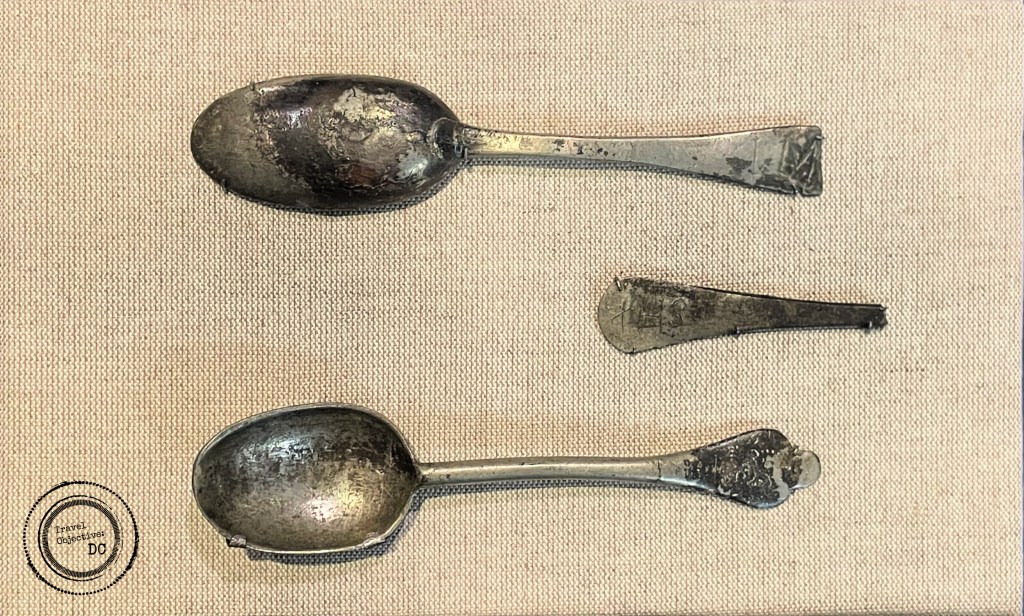
Spoons and other cooking articles found on board the Gunboat Philadelphia indicate the crew cooked aboard ship.
A payroll roster lists the names of the Philadelphia’s experienced 44-member crew who hailed primarily from New Hampshire where gundalows were frequently used. Cooking utensils, uniform buttons, leather shoe remnants and buckles provide insight into how the crew lived on the Philadelphia, the food they ate and the clothes they wore. Together, the stories of the Philadelphia and the fleet paint a picture of the tremendous effort of early Patriots to fight the British Empire on their own terms.
Although the Philadelphia’s active naval service was short-lived, her mission today continues as she slowly gives up her secrets.
Route Recon
The Smithsonian Institution’s National Museum of American History is open every day except December 25 from 10:00 a.m. to 5:30 p.m. Admission is free. No tickets are required.
The museum is located on the National Mall at Constitution Avenue, NW between 12th and 14th Streets, Washington, D.C.
Museum entrances are located on Constitution Avenue on the first floor and Madison Drive (National Mall side) on the second floor.
The closest Washington Metropolitan Area Transit Authority (Metro) stations are the Federal Triangle and Smithsonian stations on the Blue, Orange and Silver lines.
There is no public parking facility at the Smithsonian Museums on the National Mall. There are a very limited number of 3-hour on-street parking spaces near National Mall museums along Jefferson and Madison Drives.
Mess Call
The LeRoy Neiman Jazz Cafe, located inside the museum, is open daily from 10 a.m. to 5 p.m. The cafe features seasonal favorites, desserts, and hot and cold beverages, alongside music and photographs from the museum’s collection.
Eat at America’s Table Cafe is located on the museum’s lower level and open daily from 11 a.m. to 3 p.m. This is the museum’s main eatery and features a revolving menu of regional favorites. See the current menu here.

