After 250 Years, The Gunboat Philadelphia Shares Her Secrets

In his poem, The Secret of the Sea, Henry Wadsworth Longfellow wrote: Wouldst thou … learn the secret of the sea? Only those who brave its dangers, comprehend its mystery!

Fortunately for us landlubbers, a new exhibit at the Smithsonian Institution’s National Museum of American History (NMAH) featuring the Gunboat Philadelphia is sharing some of those secrets of the sea by helping us learn about the early history of the Continental Navy without braving any dangers — or even getting our feet wet. 

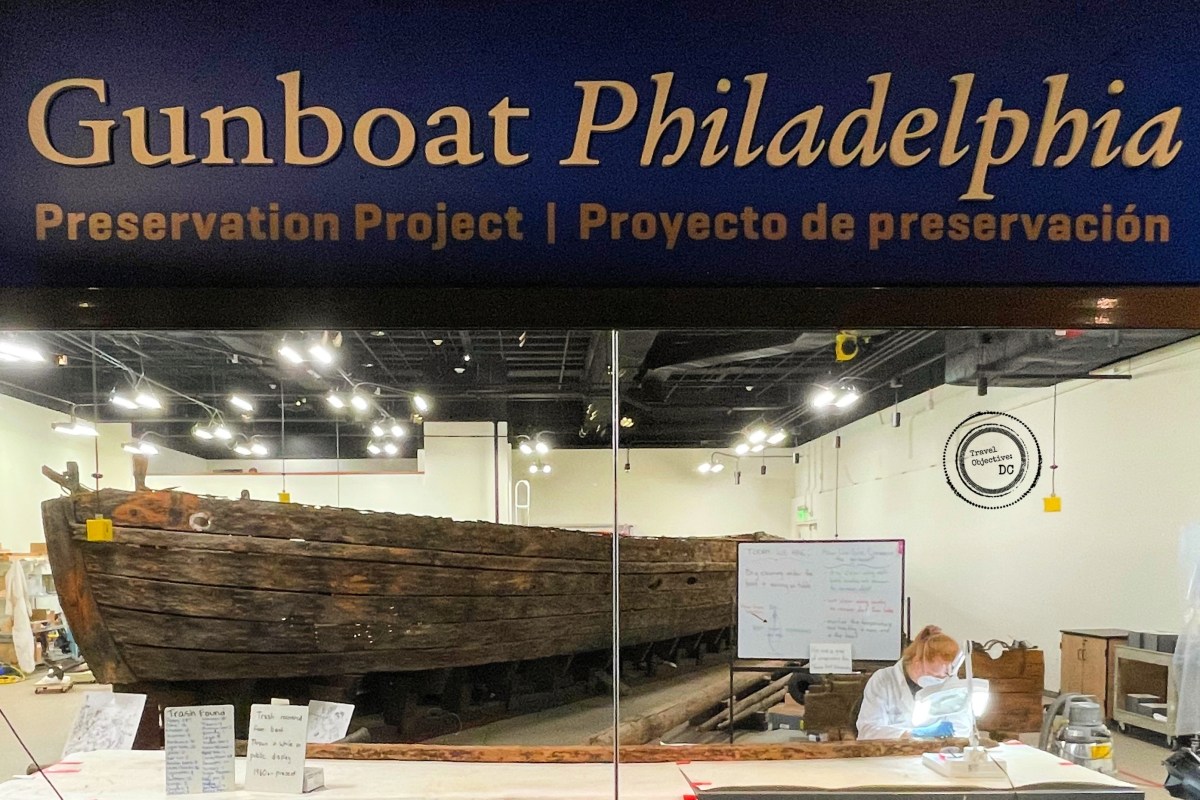
On the third floor of NMAH, visitors can see the Philadelphia, the Navy’s oldest known surviving warship, and her ongoing restoration work. The gallery sits just opposite from the Price of Freedom exhibit on the American military.

The story of the Philadelphia begins in the summer of 1776 when 15 warships for the new Continental Navy were constructed to engage the Royal Navy for the defense of Lake Champlain.
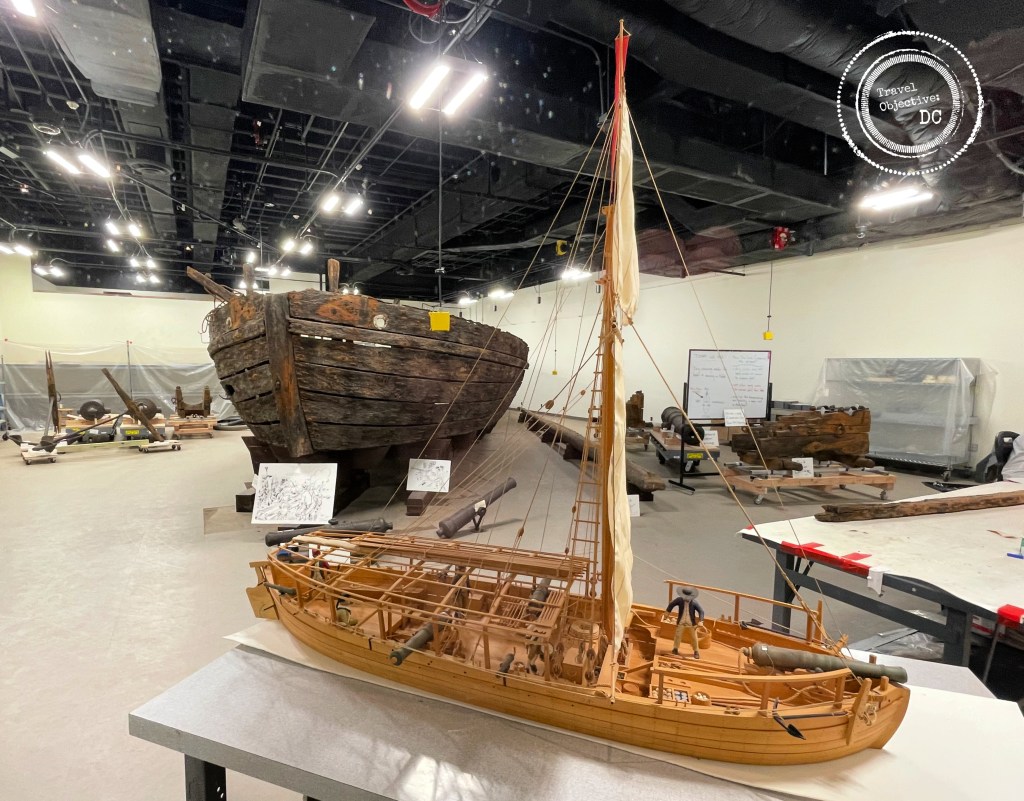
A model of the Gunboat Philadelphia is displayed alongside the actual Philadelphia undergoing restoration at the National Museum of American History in Washington DC.

A model of the Gunboat Philadelphia is displayed alongside the actual Philadelphia undergoing restoration.

Today, this narrow lake forms the border between northern New York and Vermont. Maintaining strategic control of Lake Champlain was important to forestall a likely British ground force invading New York from Canada. 

The Philadelphia is a gundalow, a flat-bottomed boat often used as a commercial barge along the rivers in New England. Since it has no keel, a gundalow can sail close to the shoreline in shallow waters. The Philadelphia was built from oak and was 51 feet long and 15 feet at its widest. She had a 36-foot-high mast and three cannons.

The American fleet was under the command of Benedict Arnold. While best known today as a traitor to the cause for independence, in early 1776 Arnold was still a loyal patriot who had distinguished himself as an effective commander during the Continental Army’s unsuccessful invasion of Canada. Arnold was also a successful merchant who had captained sailing ships. He was the logical choice to lead the mission.

Pewter buttons recovered from the Gunboat Philadelphia. The buttons were from the uniform coats of the British Army’s 26th Regiment of Foot. The Regiment garrisoned Fort Ticonderoga when it was captured by Ethan Allen and Benedict Arnold in May of 1775. The coats were likely confiscated and worn by the American sailors.
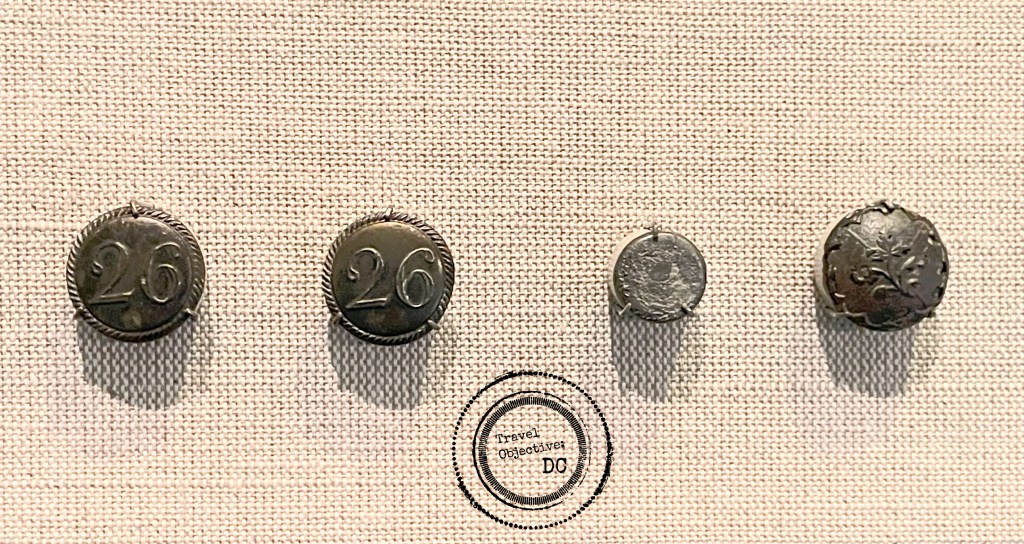
Pewter buttons from uniforms recovered from the Gunboat Philadelphia.

By October of 1776, both sides had fitted out their fleets and were prepared to engage. Arnold had located the American fleet in the southern part of the lake, in a narrow bay between Valcour Island and the shoreline. The location limited the British flotilla’s ability to maneuver or concentrate their cannon fire on the American ships.

On October 11, the two fleets deployed in lines in Valcour Bay. Cannon volleys between the ships roared through the afternoon. The Philadelphia was struck by a 24-pound cannon ball in its forward bow and sunk around 6:30 pm. 
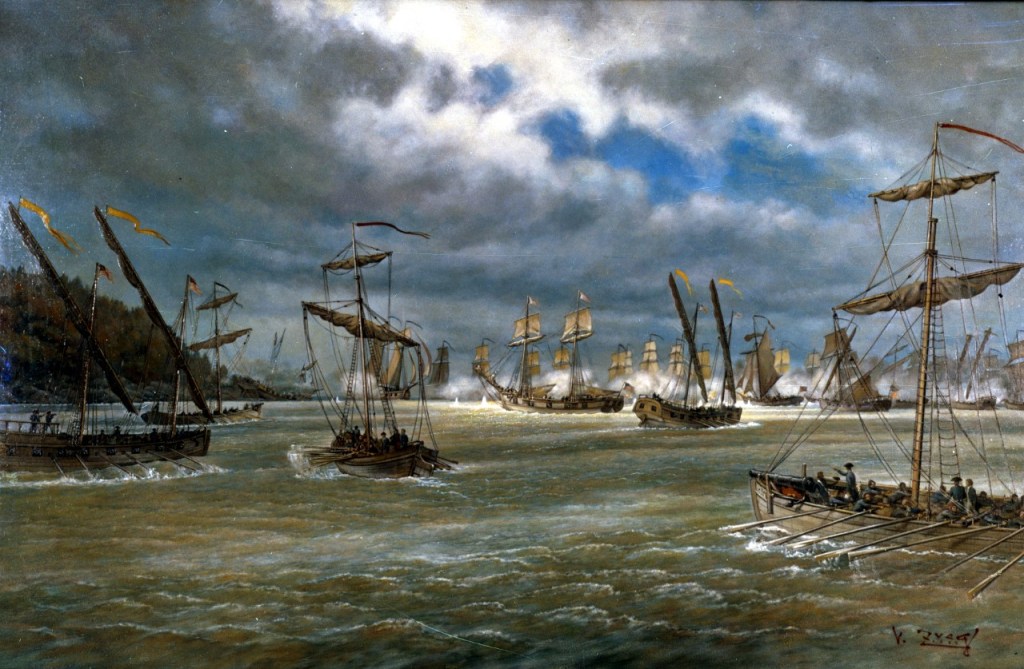
Painting of a ship battle on a stormy lake. The Battle of Valcour Island by V. Sverg.
The Battle of Valcour Island by V. Sveg. Source: US Naval History & Heritage Command. Note the gundalow to the right.

The maritime battles would continue for two more days. Although crews fought valiantly, the American fleet was heavily damaged. Arnold knew he could not defeat the British and he withdrew from the lake. 

While the battle had been lost, winter was setting in and the British decided to delay the invasion of New York until the following year. The Battle of Valcour Bay later proved to be quite consequential as the delayed British invasion force, led by General John Burgoyne, was ultimately defeated at Saratoga

After sinking, the Philadelphia would stay on the bottom of Lake Champlain until she was raised in 1935 by Lorenzo F. Haggulund, a salvage expert who had grown up in the area.
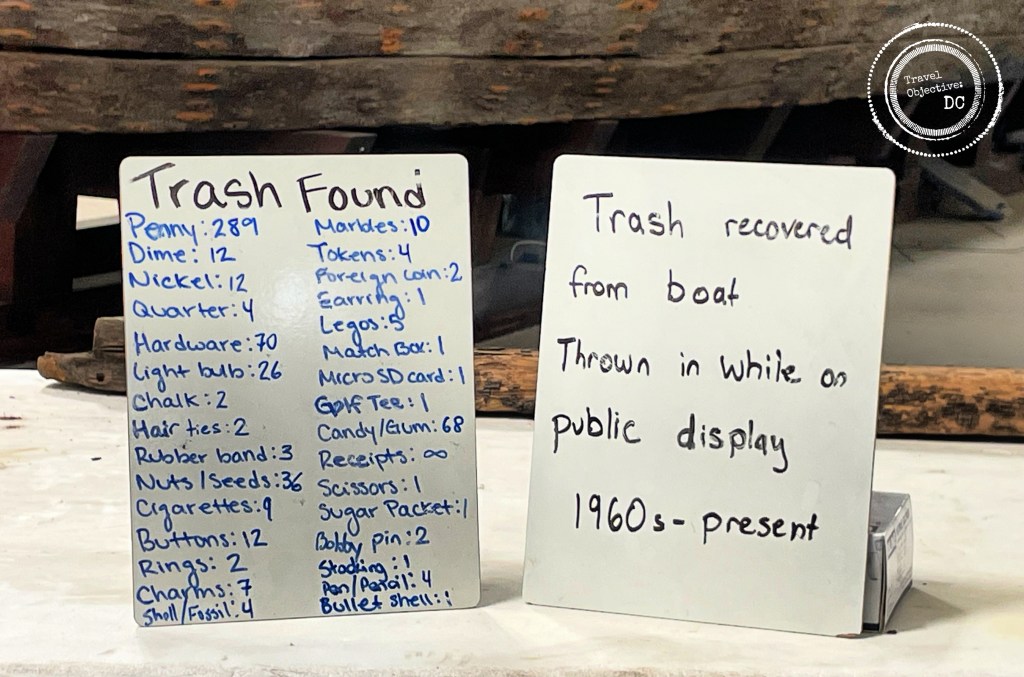
Whiteboard signs showing the items of trash thrown onto the Gunboat Philadelphia while it was on display.

A tally of items found tossed into the Gunboat Philadelphia while on display at the National Museum of American History.

The gunboat was displayed locally until 1961 when the Philadelphia was donated to the Smithsonian Institution. It was a featured exhibit at the NMAH from its opening in 1964 until 2019 when it was removed for initial restoration. At the same time, historians and researchers dove into contemporary records to learn more about the Philadelphia’s construction and crew. 

Today, visitors to NMAH can see lab-coated technicians from Texas A&M University continue the delicate work of cleaning and preserving the ship’s wooden planking and metal fittings. A whiteboard describes the restorers’ current tasks. Adjacent displays provide some of the interesting artifacts found on the gunboat as well as from the corresponding research.

The effort to construct the Philadelphia and her sister ships to defend the lake is often referred to as the birth of the United States Navy. Looking back from the 21st century, it might seem a simple task. However, it was a highly organized and professional effort involving skilled international tradespeople working with materials sourced from around the globe.

Spoons and other cooking articles found on board the Gunboat Philadelphia indicate the crew cooked aboard ship.
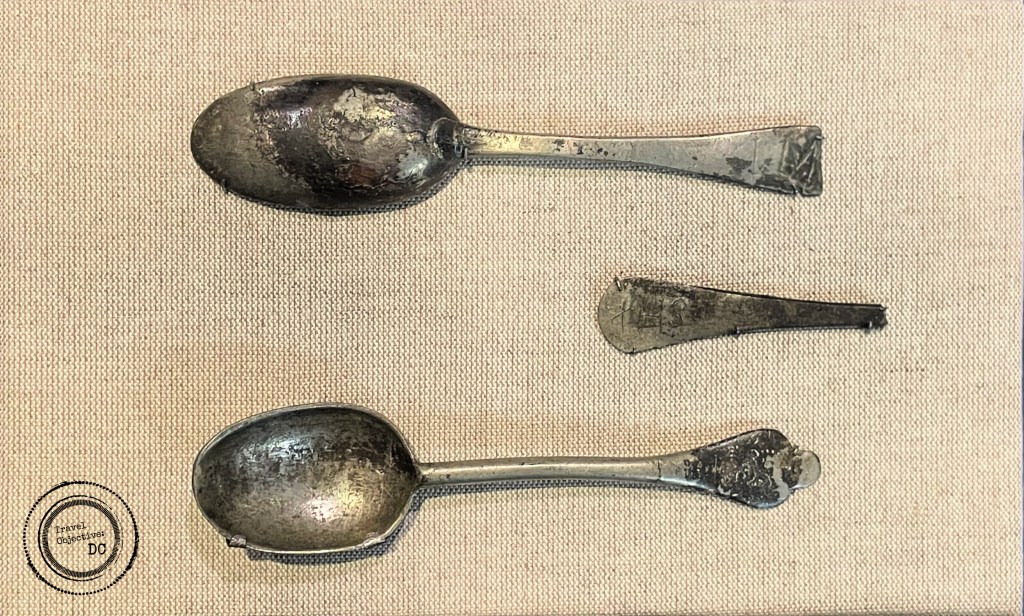
Spoons and other cooking utensils found on board the Gunboat Philadelphia.

A payroll roster lists the names of the Philadelphia’s experienced 44-member crew who hailed primarily from New Hampshire where gundalows were frequently used. Cooking utensils, uniform buttons, leather shoe remnants and buckles provide insight into how the crew lived on the Philadelphia, the food they ate and the clothes they wore. Together, the stories of the Philadelphia and the fleet paint a picture of the tremendous effort of early Patriots to fight the British Empire on their own terms. 

Although the Philadelphia’s active naval service was short-lived, her mission today continues as she slowly gives up her secrets.

Route Recon

The Smithsonian Institution’s National Museum of American History is open every day except December 25 from 10:00 a.m. to 5:30 p.m. Admission is free. No tickets are required.

The museum is located on the National Mall at Constitution Avenue, NW between 12th and 14th Streets, Washington, D.C. 

Museum entrances are located on Constitution Avenue on the first floor and Madison Drive (National Mall side) on the second floor.

The closest Washington Metropolitan Area Transit Authority (Metro) stations are the Federal Triangle and Smithsonian stations on the Blue, Orange and Silver lines.

There is no public parking facility at the Smithsonian Museums on the National Mall. There are a very limited number of 3-hour on-street parking spaces near National Mall museums along Jefferson and Madison Drives.

Mess Call

The LeRoy Neiman Jazz Cafe, located inside the museum, is open daily from 10 a.m. to 5 p.m. The cafe features seasonal favorites, desserts, and hot and cold beverages, alongside music and photographs from the museum’s collection.

Eat at America’s Table Cafe is located on the museum’s lower level and open daily from 11 a.m. to 3 p.m. This is the museum’s main eatery and features a revolving menu of regional favorites. See the current menu here.
Giving Benedict the Boot at Saratoga

Saratoga National Historical Park sits tucked up against the Hudson River along the rolling foothills of the Adirondack Mountains in upstate New York. The park preserves the sites of the First and Second Battles of Saratoga (also known as the Battle of Freeman’s Farm and the Battle of Bemis Heights respectively) fought in the autumn of 1777.

Saratoga is often described as the turning point of the American Revolution. For the first time, an entire British Army had surrendered to the Americans. The victory persuaded European powers, especially France, to come to support of the fledging nation fighting for its independence from Great Britain. 

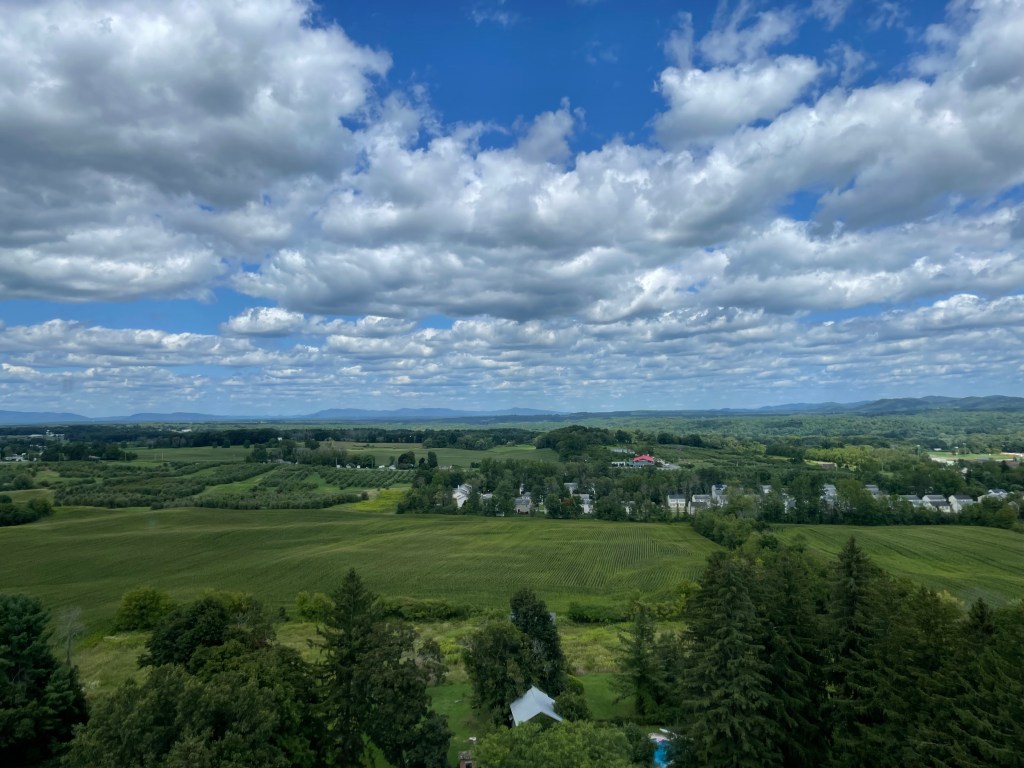
Farms, fields and forests mark the landscape of Upstate New York near Saratoga National Historical Park.

Like many battlefields, various stone markers and monuments dot these famous fields, commemorating leaders, units or events. On a small ridge sits a distinctive piece of American statuary, as unique as can be found on any American battlefield. 

The statue marks the location where during the Second Battle of Saratoga, on October 7, 1777, the infamous Benedict Arnold was critically wounded in his left leg. He was leading his men in multiple charges against British and Hessian troops who were well defended behind tall, thick wooden redoubts.

It was on the last charge as Arnold and his men captured the redoubt that the final volley of retreating Hessians would find its mark. The bullets tore into Arnold’s left leg and killed his horse, which collapsed on and shattered the leg as the horse and rider dropped to the ground. 

The painting Battle of Saratoga: General Arnold Wounded in the Attack on the Hessian Redoubt by Alonzo Chappel, 1860

Arnold’s contributions at Saratoga would secure an important American victory, yet lead him down the path to treachery. 

In the United States, the name Benedict Arnold is still synonymous with traitor. Yet this was not always true. 

Arnold was born in Connecticut, the son of a successful barrel maker. He grew up living a comfortable life in Colonial America. At a young age, Arnold apprenticed in a relative’s apothecary shop. He later became a shipper and merchant, occupations where he could seek adventure and profits at the same time. 

As the colonies moved closer to revolution, Arnold became a colonial militia leader in Connecticut. He repeatedly demonstrated tremendous courage in battle, an adroit grasp of tactics and outstanding military leadership. Arnold, along with Ethan Allen, captured Fort Ticonderoga in 1775. He led a colonial force in the attacks on Montreal and Quebec, commanded a fleet of ships on Lake Champlain and relieved a British siege of Fort Stanwix in Western New York. Arnold would receive tributes and promotions for his actions.

Benedict Arnold, depicted as a colonel by English artist Thomas Hart, 1776

Yet Arnold was also a very difficult person, vain, distrustful of others, and easily offended. He especially chafed when others took or received the credit he thought he deserved.

At Saratoga he was often in conflict with his more cautionary commander, Horatio Gates. After the battle, Gates took credit for Arnold’s actions, which enraged Arnold. Arnold’s business was also struggling and he resented the promotion of other officers over him. 

After a long, difficult and painful convalescence (he never regained full use of his leg), Arnold was placed in command of American forces around Philadelphia. There he met and eventually married the daughter of a prominent loyalist family. It was in Philadelphia where Arnold began to communicate with British officials regarding switching sides.

In 1780, Arnold was named the commander of the U.S. fortifications at West Point, an important stronghold on the Hudson River. Arnold arranged for the surrender of West Point to the British in exchange for money and a commission in the British Army, negotiating the terms with his British interlocutor, Major John André.

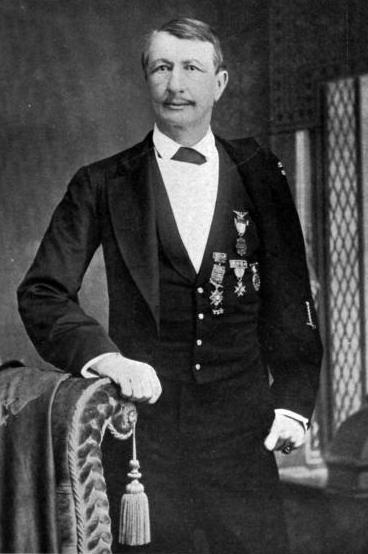
John Watts de Peyster, scion of a prominent New York family, was an author, commentator on military affairs and Adjutant General of the New York Militia.

After a meeting with Arnold, André was captured by New York militiamen. While André was searched, the surrender terms and other documents were discovered in his boot. As he was not in uniform, André was arrested and later hung as a spy.  With his treachery exposed, Arnold fled to New York City. While he received a major general’s commission, his British superior, Sir Henry Clinton had little trust in Arnold. He did not have many opportunities for success on the battlefield. After the final victory at Yorktown, Arnold and his family moved to London. 

Arnold revived his merchant business after the war with mixed results. Although he had established good relationships with King George III and members of the British aristocracy, Arnold was not highly regarded in England, and he remained despised in the United States.

He died in London in 1801, a rather bitter man.

Nevertheless, a century later, a New York military and community leader named John Watts de Peyster commissioned a monument commemorating Arnold’s actions on the Saratoga battlefield. de Peyster was the author of several works of military history, including two books on the Battle of Saratoga.

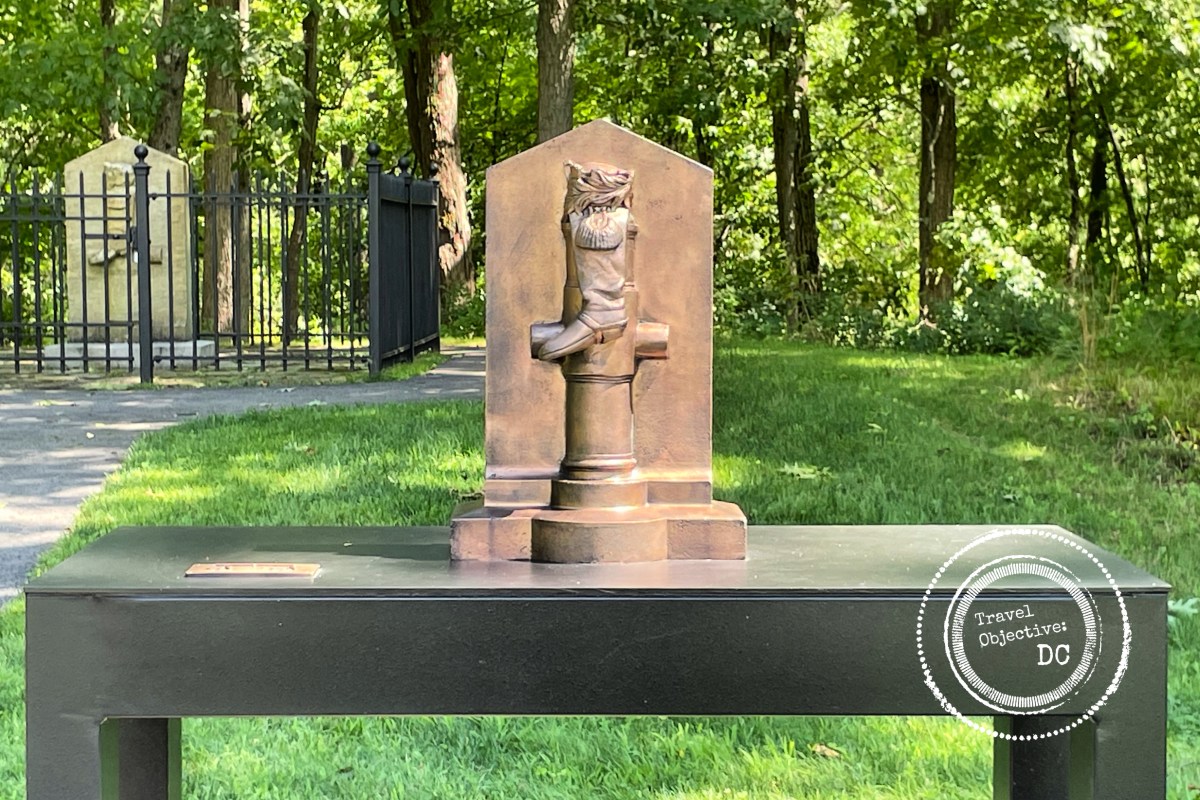
The Boot Monument, commissioned by John Watts de Peyster and sculpted by George Edwin Bissell.

de Peyster admired the courage Arnold displayed at Saratoga and its contributions to the American victory, and the subsequent assistance to the cause the victory brought about. He believed Arnold’s actions deserved recognition. de Peyster collaborated with a prominent sculptor named George Edwin Bissell to create a statue recognizing Arnold’s actions, but not his treachery.

Approaching the statue, known as the Boot Monument, the four foot high white marble sculpture almost resembles a grave marker especially as it is enclosed by a black iron fence. The front of the monument is really rather simple. It bears no inscriptions, only simple yet expressive imagery. A rider’s boot, with the toe pointing left (to symbolize Arnold’s left leg), topped by a major general’s fringed epaulet, further crowned by a laurel wreath. The vertically aligned images all seem to hang from a downward pointed howitzer. 

On the reverse of the monument is this inscription:

Erected 1887 By

JOHN WATTS de PEYSTER

Brev: Maj: Gen: S.N.Y.

2nd V. Pres’t Saratoga Mon’t Ass’t’n:

In memory of

the “most brilliant soldier” of the

Continental Army

who was desperately wounded

on this spot the sally port of

BURGOYNES GREAT WESTERN REDOUBT

7th October, 1777

winning for his countrymen

the decisive battle of the

American Revolution

and for himself the rank of

Major General.

While Arnold is not mentioned anywhere on the statue, a nearby interpretive sign summarizes his story, so there is no question to whom the phrase “the most brilliant soldier of the Continental Army” refers. It is worth noting that Arnold was already a major general at the time of the battle. He was however, promoted to a more senior status as a result of his conduct at Saratoga. 

The Saratoga Battle Monument in the village of Victory, New York

Perhaps de Peyster’s interest in recognizing Arnold with a separate statue stems from his work as part of the Saratoga Monument Association (referred to as “Saratoga Mon’t Ass’t’n” on the inscription), which purposefully snubbed Arnold in another monument. 

To mark the Battle of Saratoga’s centennial in 1877, the Saratoga Monument Association, a private group, raised funds to build a prominent monument near the battlefield.

Completed in 1883, the Saratoga Battle Monument is a 155 foot high obelisk made of dark granite. It is located in the nearby village of Victory, New York. 

The empty statue niche on the Saratoga Battle Monument.

The monument has a door on each of its four sides, and above each door is a niche for a statue. Three of the niches contain statues of the senior commanders at Saratoga: General Horatio Gates, General Philip Schuyler and Colonel Daniel Morgan.  The fourth niche, facing south toward the battlefield, is purposefully empty. It is where a statue of Benedict Arnold would have been placed had he stayed true to the cause. 

When the monument is open, visitors can climb the 188 stairs to the top and take in the very picturesque countryside with views of local farms, rolling hills and the Adirondack Mountains in the distance. Along the way, there are sixteen bas relief plaques cast in bronze with scenes from the time of the battle along with stained glass windows and mosaic tiled floors. 

The bas relief sculpture of the wounding of Benedict Arnold inside the Saratoga Battle Monument.

The Saratoga battlefield and Monument are only two of five sites comprising the Saratoga National Historical Park. Other venues include Victory Woods, where the British Army made its final encampment, the Saratoga Surrender Site, and the Philip Schuyler mansion. (Schuyler was a New York patrician who commanded the Continental forces opposing Burgoyne prior to Gates. He is probably best known today as Alexander Hamilton’s father-in-law). The park recently completed a $6 million dollar improvement project that added interpretive signage, tactile maps and other objects, along with upgraded roadways and trailheads. 

As the national mark’s the 250th anniversary of the American revolution, new generations of historians, students and visitors will research and learn about the early American Patriots. They will discover how complex these men and women were. Perhaps one of the most complex was Benedict Arnold. Although he eventually chose a dishonorable path, he fought very bravely for the cause of independence at a critical time of the Revolutionary War. de Peyster’s statue reminds us of this Arnold — an Arnold that is too important to be forgotten or ignored. 

Route Recon

Start your trip to the Saratoga National Historical Park at the park’s Visitor Center where you will find information about the battle, the park’s various venues, upcoming programs and weather advisories.  

The Visitor’s Center is located at 648 New York State Route 32, Stillwater, NY 12170.

The park is approximately 40 miles north of Albany, NY and 14 miles southeast of Saratoga Springs, NY. 

More detailed directions are available here.  

The park is open year-round, with the exception of several holidays. Some park features are only open seasonally. Check the Saratoga National Historical Park website for more information about seasonal operating hours.

There is a one-way, 10-mile road circumventing the battlefield area. The road has ten tour stops at significant places in the battlefield. The Boot Monument is located at Stop 7. 

Mess Call

Fortify yourself for your day of exploration at the Saratoga National Historical Park at Mama Bear’s Diner (formerly Sweeney’s) in Schuylerville, NY. Mama Bear’s serves hearty breakfast and generous sandwiches for lunch in a modern yet homey setting. The eatery recently changed ownership with a long-time server taking ownership. She is continuing the traditions of generous portions that Sweeney’s had established while adding a focus on sourcing more ingredients from local farms. 

Mama Bear’s Diner is located at 106 Broad Street, Schuylerville, NY, 12871.

Open Wednesday through Sunday from 7:00 AM to 2:00 PM.

Command Reading

Saratoga: A Military History of the Decisive Campaign of the American Revolution

Author John Lauder drew upon his years of experience as a researcher and historian for the National Park Service (he developed the interpretation plan for Saratoga National Historical Park) to write a comprehensive yet readable history of British General John Burgoyne’s Albany Campaign of 1777. Lauder’s work carefully examines the strategic and tactical aspects of the campaign along with the parallel political machinations which shaped the campaign and the Americans’ defensive response. Lauder thoroughly examines Benedict Arnold’s actions, from his participation in the 1775 attack on Quebec to his command of the fleet on Lake Champlain to his leadership at Saratoga.