After 250 Years, The Gunboat Philadelphia Shares Her Secrets

In his poem, The Secret of the Sea, Henry Wadsworth Longfellow wrote: Wouldst thou … learn the secret of the sea? Only those who brave its dangers, comprehend its mystery!

Fortunately for us landlubbers, a new exhibit at the Smithsonian Institution’s National Museum of American History (NMAH) featuring the Gunboat Philadelphia is sharing some of those secrets of the sea by helping us learn about the early history of the Continental Navy without braving any dangers — or even getting our feet wet. 

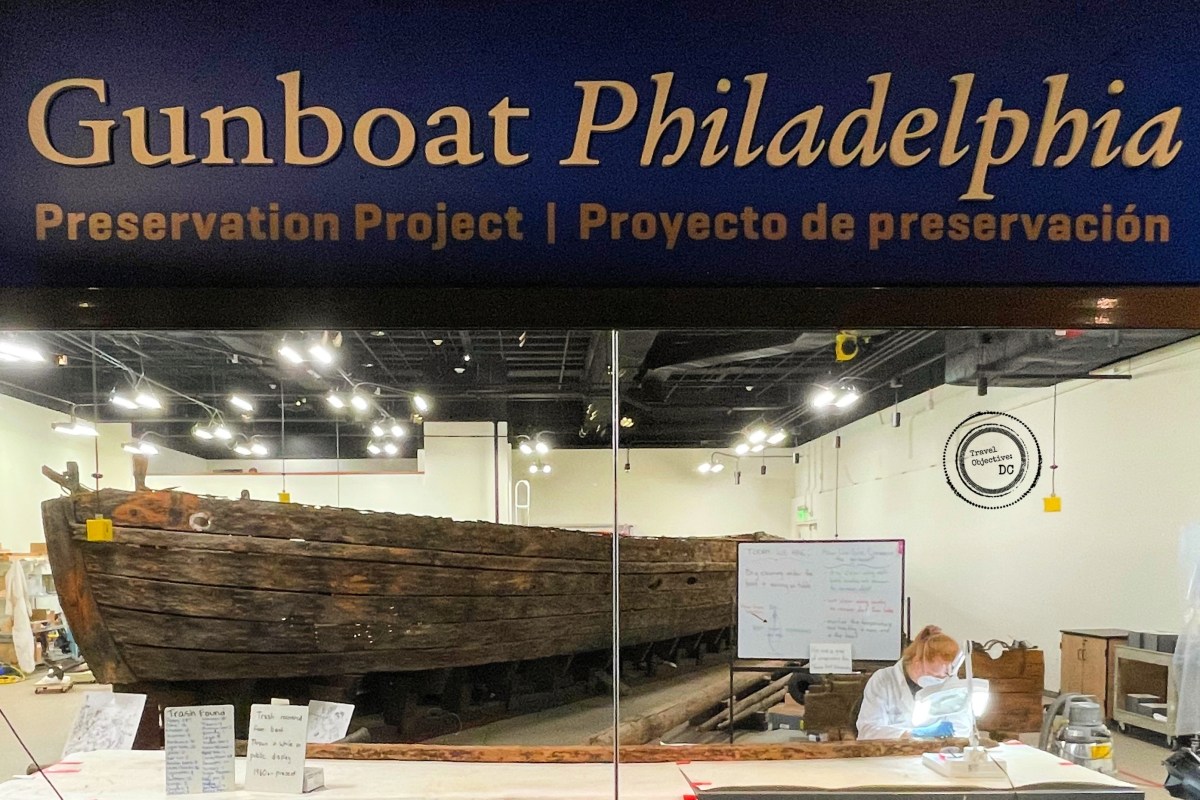
On the third floor of NMAH, visitors can see the Philadelphia, the Navy’s oldest known surviving warship, and her ongoing restoration work. The gallery sits just opposite from the Price of Freedom exhibit on the American military.

The story of the Philadelphia begins in the summer of 1776 when 15 warships for the new Continental Navy were constructed to engage the Royal Navy for the defense of Lake Champlain.
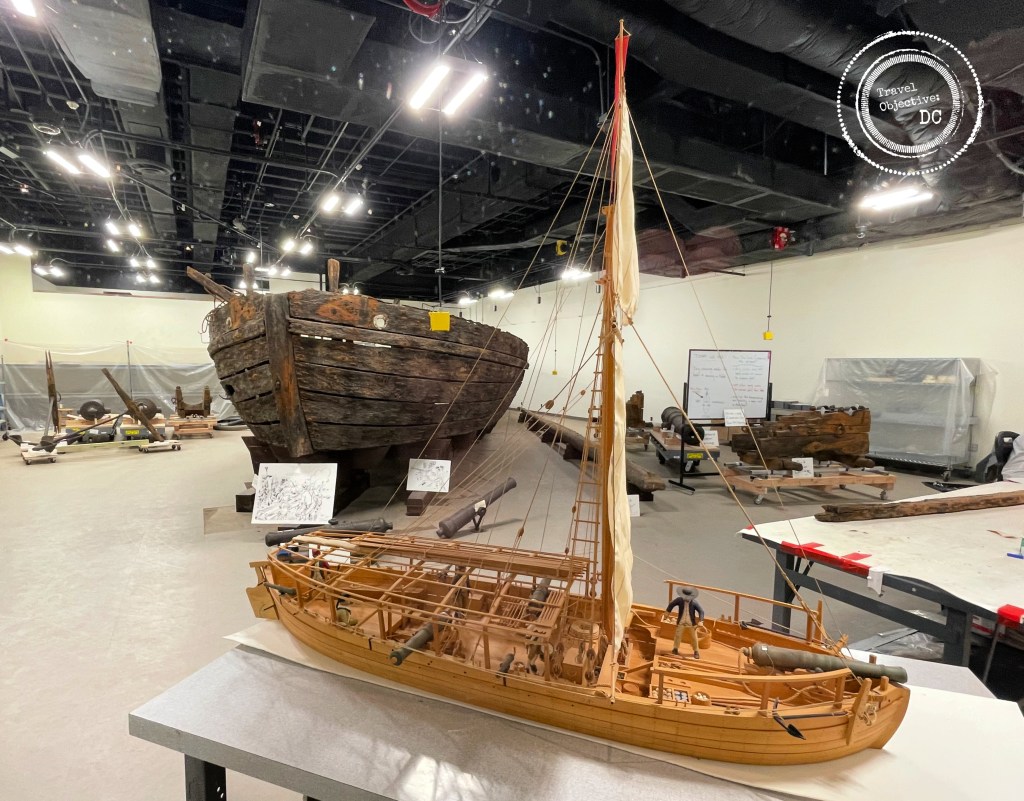
A model of the Gunboat Philadelphia is displayed alongside the actual Philadelphia undergoing restoration at the National Museum of American History in Washington DC.

A model of the Gunboat Philadelphia is displayed alongside the actual Philadelphia undergoing restoration.

Today, this narrow lake forms the border between northern New York and Vermont. Maintaining strategic control of Lake Champlain was important to forestall a likely British ground force invading New York from Canada. 

The Philadelphia is a gundalow, a flat-bottomed boat often used as a commercial barge along the rivers in New England. Since it has no keel, a gundalow can sail close to the shoreline in shallow waters. The Philadelphia was built from oak and was 51 feet long and 15 feet at its widest. She had a 36-foot-high mast and three cannons.

The American fleet was under the command of Benedict Arnold. While best known today as a traitor to the cause for independence, in early 1776 Arnold was still a loyal patriot who had distinguished himself as an effective commander during the Continental Army’s unsuccessful invasion of Canada. Arnold was also a successful merchant who had captained sailing ships. He was the logical choice to lead the mission.

Pewter buttons recovered from the Gunboat Philadelphia. The buttons were from the uniform coats of the British Army’s 26th Regiment of Foot. The Regiment garrisoned Fort Ticonderoga when it was captured by Ethan Allen and Benedict Arnold in May of 1775. The coats were likely confiscated and worn by the American sailors.
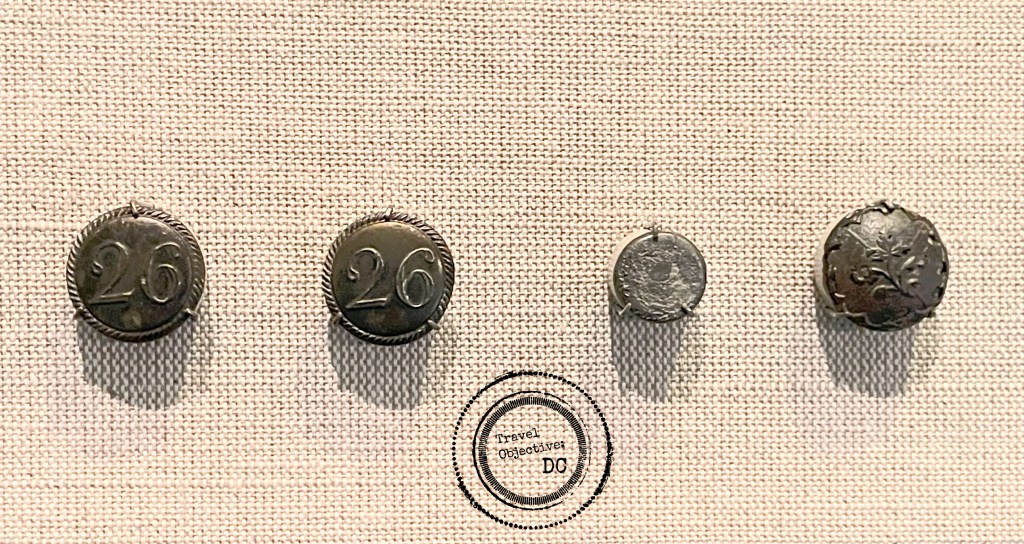
Pewter buttons from uniforms recovered from the Gunboat Philadelphia.

By October of 1776, both sides had fitted out their fleets and were prepared to engage. Arnold had located the American fleet in the southern part of the lake, in a narrow bay between Valcour Island and the shoreline. The location limited the British flotilla’s ability to maneuver or concentrate their cannon fire on the American ships.

On October 11, the two fleets deployed in lines in Valcour Bay. Cannon volleys between the ships roared through the afternoon. The Philadelphia was struck by a 24-pound cannon ball in its forward bow and sunk around 6:30 pm. 
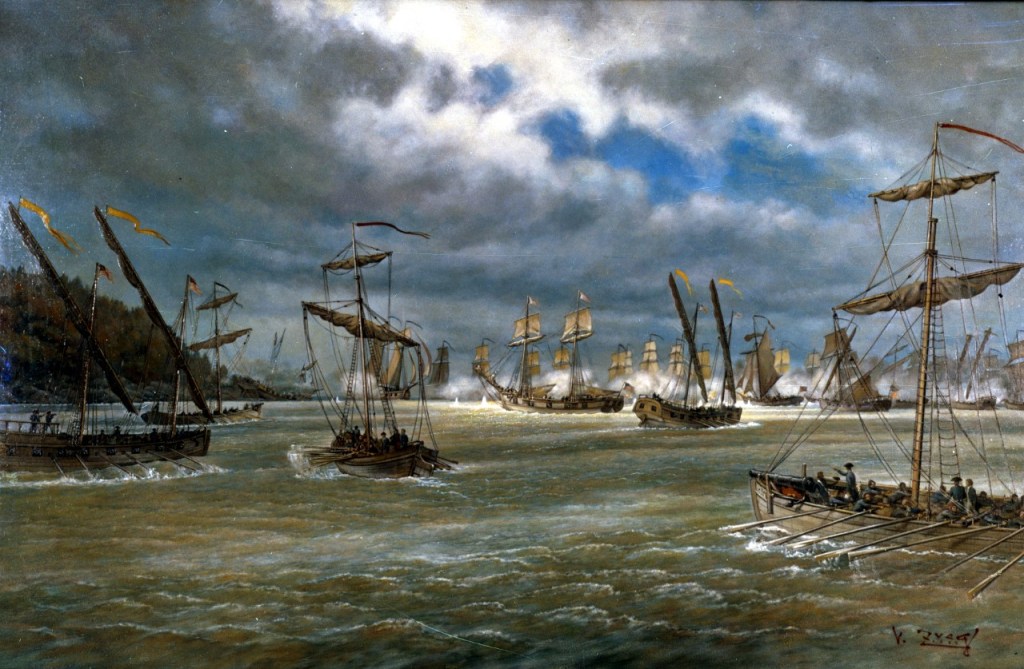
Painting of a ship battle on a stormy lake. The Battle of Valcour Island by V. Sverg.
The Battle of Valcour Island by V. Sveg. Source: US Naval History & Heritage Command. Note the gundalow to the right.

The maritime battles would continue for two more days. Although crews fought valiantly, the American fleet was heavily damaged. Arnold knew he could not defeat the British and he withdrew from the lake. 

While the battle had been lost, winter was setting in and the British decided to delay the invasion of New York until the following year. The Battle of Valcour Bay later proved to be quite consequential as the delayed British invasion force, led by General John Burgoyne, was ultimately defeated at Saratoga

After sinking, the Philadelphia would stay on the bottom of Lake Champlain until she was raised in 1935 by Lorenzo F. Haggulund, a salvage expert who had grown up in the area.
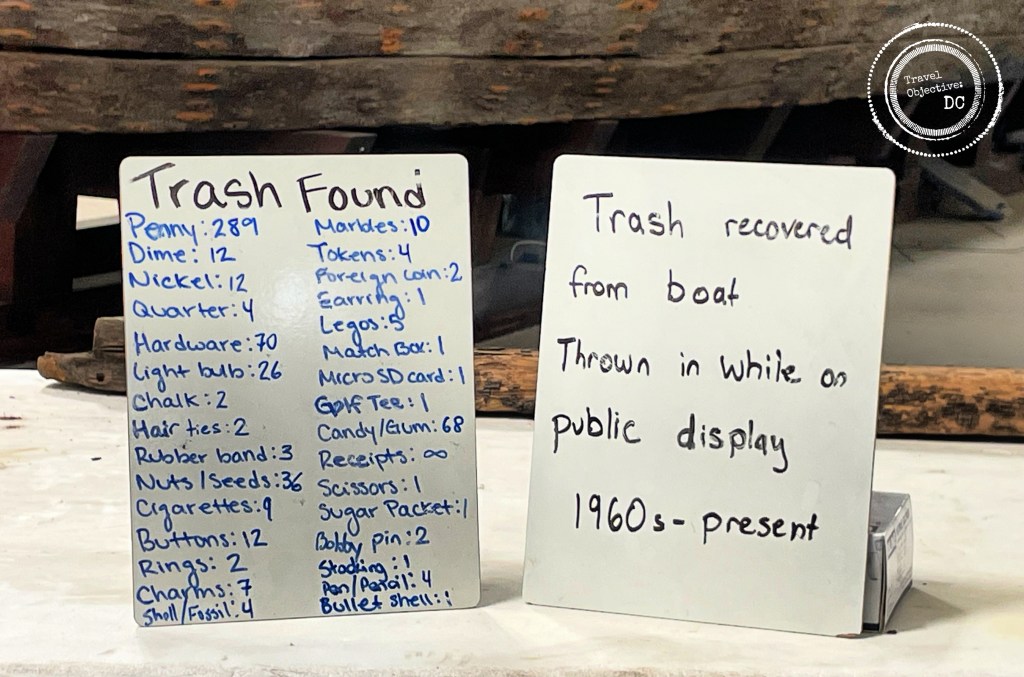
Whiteboard signs showing the items of trash thrown onto the Gunboat Philadelphia while it was on display.

A tally of items found tossed into the Gunboat Philadelphia while on display at the National Museum of American History.

The gunboat was displayed locally until 1961 when the Philadelphia was donated to the Smithsonian Institution. It was a featured exhibit at the NMAH from its opening in 1964 until 2019 when it was removed for initial restoration. At the same time, historians and researchers dove into contemporary records to learn more about the Philadelphia’s construction and crew. 

Today, visitors to NMAH can see lab-coated technicians from Texas A&M University continue the delicate work of cleaning and preserving the ship’s wooden planking and metal fittings. A whiteboard describes the restorers’ current tasks. Adjacent displays provide some of the interesting artifacts found on the gunboat as well as from the corresponding research.

The effort to construct the Philadelphia and her sister ships to defend the lake is often referred to as the birth of the United States Navy. Looking back from the 21st century, it might seem a simple task. However, it was a highly organized and professional effort involving skilled international tradespeople working with materials sourced from around the globe.

Spoons and other cooking articles found on board the Gunboat Philadelphia indicate the crew cooked aboard ship.
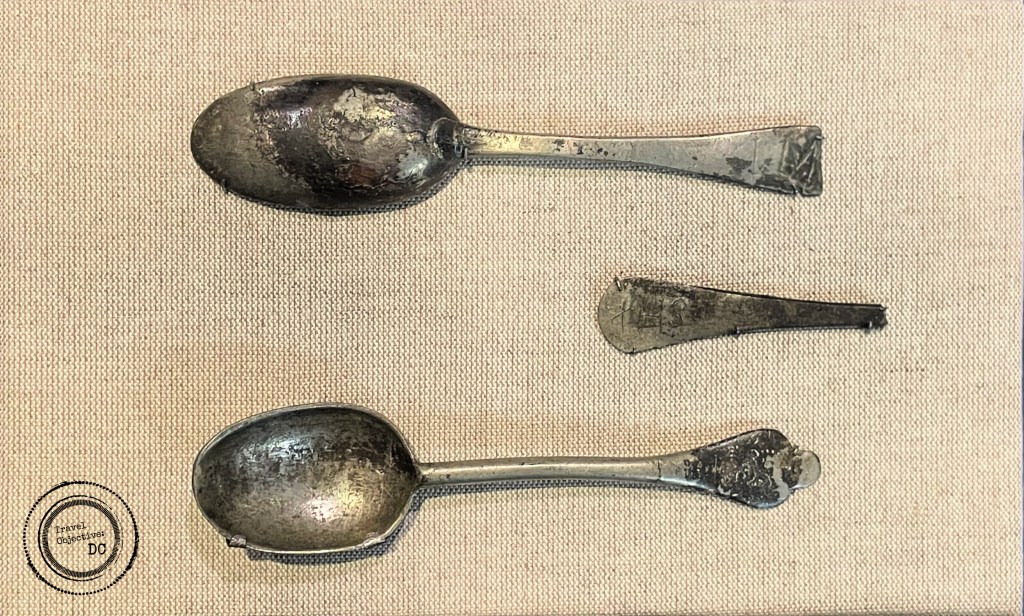
Spoons and other cooking utensils found on board the Gunboat Philadelphia.

A payroll roster lists the names of the Philadelphia’s experienced 44-member crew who hailed primarily from New Hampshire where gundalows were frequently used. Cooking utensils, uniform buttons, leather shoe remnants and buckles provide insight into how the crew lived on the Philadelphia, the food they ate and the clothes they wore. Together, the stories of the Philadelphia and the fleet paint a picture of the tremendous effort of early Patriots to fight the British Empire on their own terms. 

Although the Philadelphia’s active naval service was short-lived, her mission today continues as she slowly gives up her secrets.

Route Recon

The Smithsonian Institution’s National Museum of American History is open every day except December 25 from 10:00 a.m. to 5:30 p.m. Admission is free. No tickets are required.

The museum is located on the National Mall at Constitution Avenue, NW between 12th and 14th Streets, Washington, D.C. 

Museum entrances are located on Constitution Avenue on the first floor and Madison Drive (National Mall side) on the second floor.

The closest Washington Metropolitan Area Transit Authority (Metro) stations are the Federal Triangle and Smithsonian stations on the Blue, Orange and Silver lines.

There is no public parking facility at the Smithsonian Museums on the National Mall. There are a very limited number of 3-hour on-street parking spaces near National Mall museums along Jefferson and Madison Drives.

Mess Call

The LeRoy Neiman Jazz Cafe, located inside the museum, is open daily from 10 a.m. to 5 p.m. The cafe features seasonal favorites, desserts, and hot and cold beverages, alongside music and photographs from the museum’s collection.

Eat at America’s Table Cafe is located on the museum’s lower level and open daily from 11 a.m. to 3 p.m. This is the museum’s main eatery and features a revolving menu of regional favorites. See the current menu here.

Navy Pride on Pennsylvania Avenue: The United States Navy Memorial


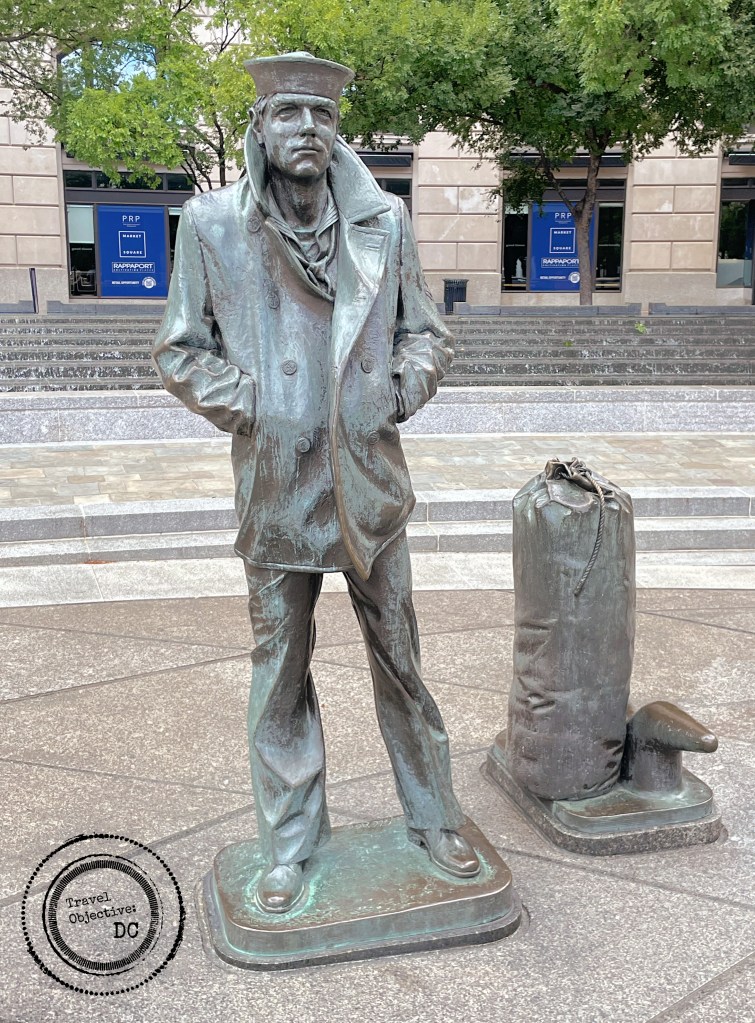
In a large open plaza stands a statue of a solitary figure.

He is a sailor in a dress unform. He stands straight and tall wearing a service “dixie cup” sailor hat. A buttoned up peacoat with a flipped up collar protects him from the chill of the ocean air. His hands are plunged deep into his pockets. His packed sea bag stands by his side. The determined look on his face denotes his readiness to deploy anywhere and perform his duty.

The statue is known as The Lone Sailor and serves as the centerpiece of the US Navy Memorial.

The Lone Sailor Statue at the US Navy Memorial

The Lone Sailor Statue

For centuries, considerable discussion was had regarding a suitable monument paying tribute to the United States Navy. Pierre L’Enfant had included a Memorial Column for the Navy in his original plans for Washington, DC.  Other memorials were built to honor the Navy during specific conflicts, but nothing existed to honor all American sailors. 

This all began to change in the spring of 1977 as Admiral Arleigh Burke urged Navy senior leaders and veterans to get serious by proclaiming: “We have talked long enough about a Navy Memorial, and it’s time we did something about it.”

When Admiral Burke–a distinguished World War II war hero and three-time Chief of Naval Operations–spoke, Navy personnel listened. The Navy Memorial Foundation was quickly organized and Rear Admiral William Thompson was named its first president. Admiral Thompson proved an excellent choice for the job and quickly set to work.

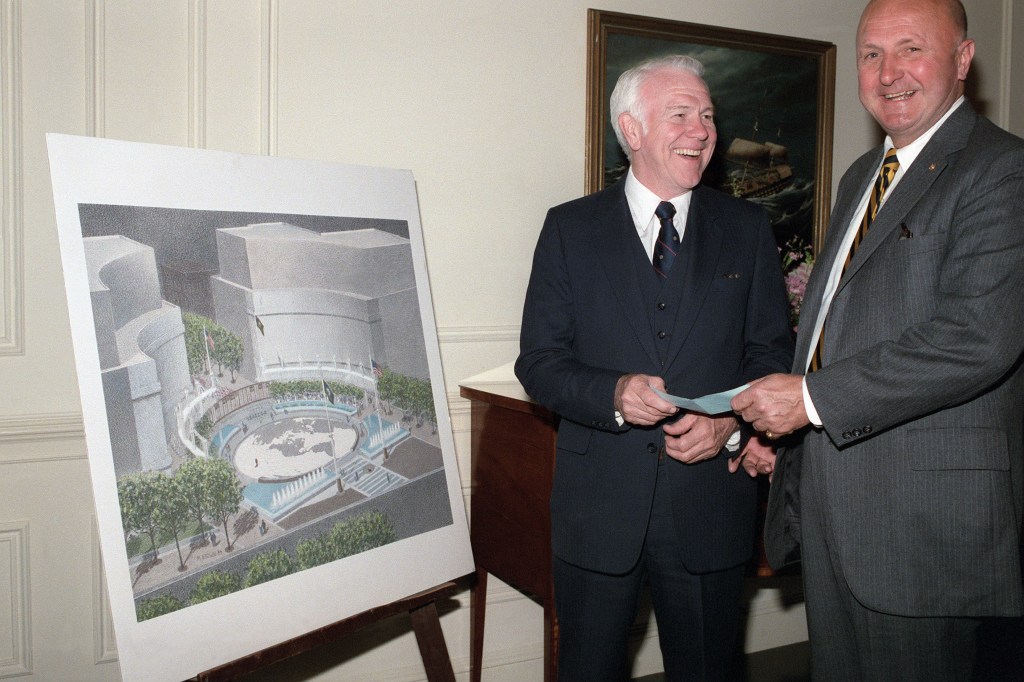
Rear Admiral William Thompson (ret.), on left, receiving a donation for the US Navy Memorial. Note the artist’s rendition of the Memorial.

-Department of Defense Photo

Rear Admiral William Thompson (ret.), on left, receiving a donation for the US Navy Memorial.

He first helped shape the enabling legislation Congress would pass in 1980. He then led the foundation through selecting the memorial’s designers, determining the memorial’s location, raising money and overseeing construction.

Admiral Thompson also helped select the sculptor Stanley Bleifeld to design and sculpt The Lone Sailor Statue. In recognition of Admiral Thompson’s significant contributions to building the memorial, Bleifield included Thompson’s initials on the Lone Sailor’s sea bag. 

The Navy Memorial Plaza

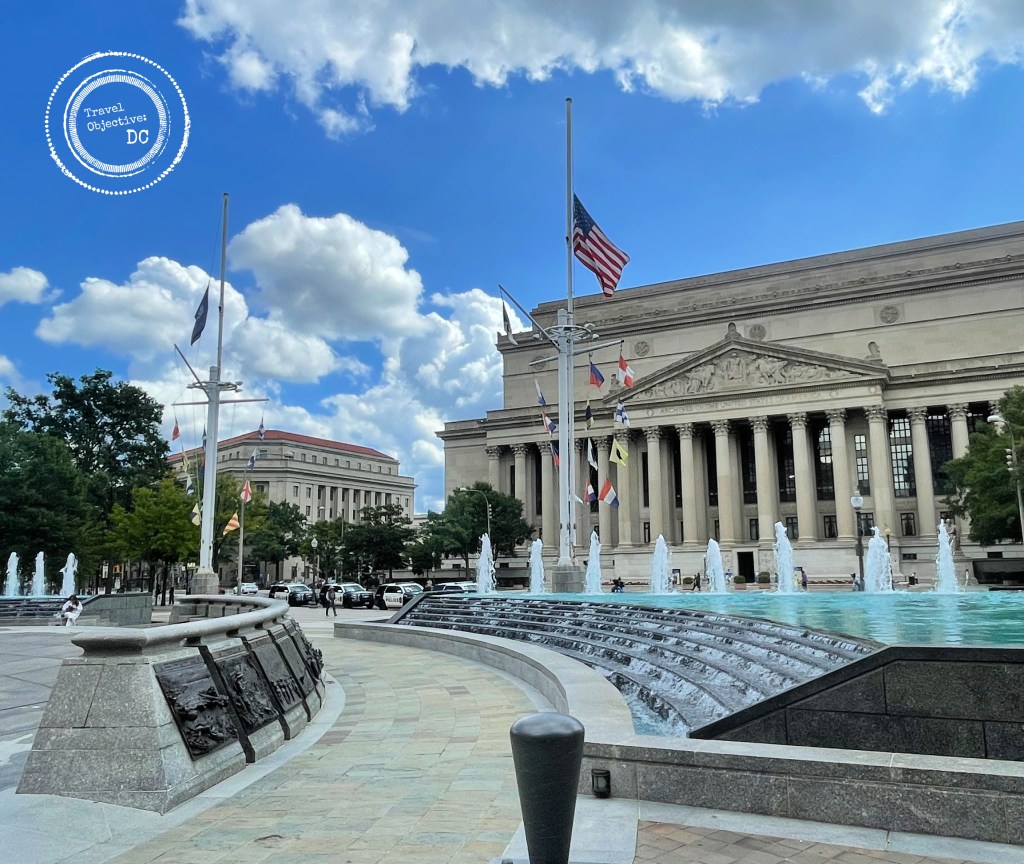
The Navy Memorial Plaza looking south toward the National Archives

The whole process from the founding of the memorial to its completion stretched to almost a decade. The Navy Memorial was formally dedicated on October 13, 1987 by President Ronald Reagan. He devoted it to all who have served, are serving or will serve in the United States Navy, Marine Corps, Coast Guard and Merchant Marine. 

The memorial is set within a broad circular plaza to the northwest of the intersection between 7th Street and Pennsylvania Avenue. Early designs for the memorial favored a more traditional approach, but they were discarded in favor of a memorial with a more open space resembling a seascape.

The floor or base of the plaza depicts a large world map.  With a diameter of 100 feet, it is said to be the largest map in the world.

Fountains at the US Navy Memorial

A set of fountains at the US Navy Memorial

Fountains skirt the southern perimeter of the map. The water flowing through the fountains comes not from Washington DC’s water supply but is collected from the world’s oceans and the Great Lakes.

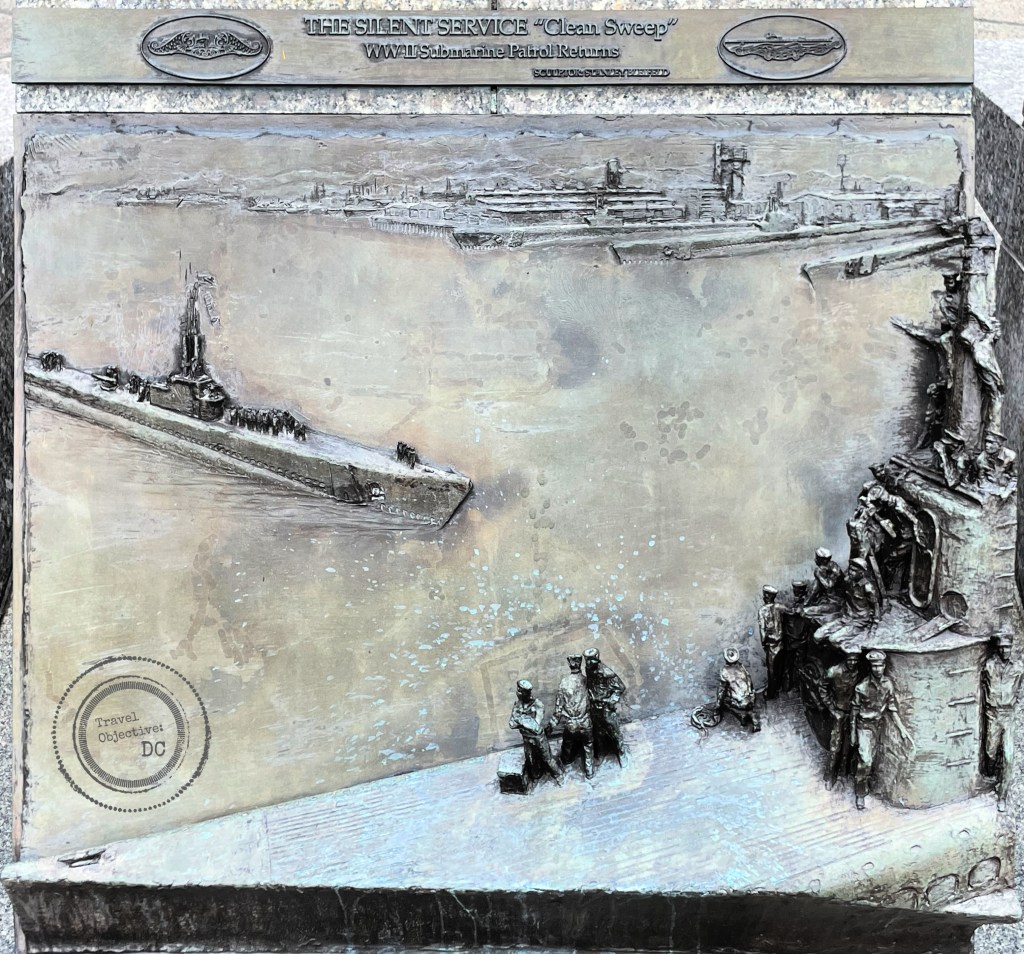
A semicircular wall inside the fountains contains a series of 26 bas-relief figures depicting scenes of Navy history and Navy life as well as the contributions of maritime partners. 

Arrayed around the memorial are quotes about the Navy from sailors at all levels. Six masts fly the flags of the United States, the Navy, Marine Corps, Coast Guard, Merchant Marine and the POW/MIA flag.

Bas Relief sculpture of Navy submarines in World War II.

Bas Relief sculpture of Navy submarines in World War II

Sweeping arches incorporated into the design of two mixed-use commerical buildings suggest a northern perimiter to the memorial, balancing the fountains and sculpture walls on the southern side. The neoclassical design of these buildings seemingly provides a sense of the shore or anchorage to the airy, open plaza.

Amidst all this stands The Lone Sailor. The statue has been so enthusiastically received by the Navy community, there are 18 more Lone Sailor statues across the United States (and one at Utah Beach in Normandy). In each location, the statue reminds the community of the dedication and professionalism of the American sailor. 

Bas Relief Sculpture of Captain John Paul Jones

Bas Relief Sculpture of Captain John Paul Jones

Early in the design phase, the Navy identified a desire to have a “living memorial,” a place where people would gather and return to time and again. The open space makes the memorial a popular venue for summer concerts, reenlistments, promotion ceremonies, wreath layings and reunions.

In keeping with the desire for a living memorial, the Navy Memorial Foundation located a visitor center in one of the adjoining buildings. Part research facility, part musuem and part community center, the visitor center brings the Navy experience alive for the landlubber while instilling pride in all Navy sailors. There are exhibits on the missions of the post 9/11 Navy, multiple Navy leaders, and the important role played by chief petty officers.

The visitor center also houses the Arleigh Burke Theater. In addition to running several short movies on Navy life throughout the day, as well as periodic feature films, the theater hosts guest speaker programs. Visitors can find a variety of mementos from all the US military services at the Ship’s Store gift shop.

A video screen displays the Navy Log.

A video screen displays the Navy Log throughout the day.

There is also a feature known as the Navy Log, an online archive with details of the men and women who have served in all the sea services. There are currently over 750,000 entries. Active members, veterans or their loved ones are invited to add to this number and enter a service member’s information as an ongong tribute to their time in uniform.

As the US Navy observes its 250th Anniversary, the US Navy Memorial is a place for everyone to discover and honor America’s rich naval heritage. Whether you are active, retired, reserve or the relative or friend of someone who has served, the Navy Memorial is an important and worthwhile destination for any visit to Washington, DC.

***

 I can imagine no more rewarding a career. And any man who may be asked in this century what he did to make his life worthwhile, I think can respond with a good deal of pride and satisfaction: ‘I served in the United States Navy.’

President John F. Kennedy

Route Recon

The US Navy Memorial is located at 701 Pennsylvania Ave, NW Washington, DC 20004. 

The Memorial is accessible 24 hours a day.

The Visitor Center is open seven days a week from 9:30 AM to 5:00 PM.

The Navy Memorial hosts numerous events throughout the year. Some events may close the Visitor Center to the public. Be sure to check the Memorial’s website and find additional information about upconing events on the calendar

The closest Metro Station is Archives-Navy Memorial-Penn Quarter on the Green and Yellow Lines.

Parking:
Validated parking is available at PMI Garage, 875 D Street, NW.
Parking can be validated for $13 inside the Ship’s Store, located in the Navy Memorial Visitor Center.

The National Native American Veterans Memorial, A Welcoming Place


In 1942,  the US Marine Corps recruited Chester Nez, and twenty-eight fellow members of the Navajo tribe for a special mission. After basic training, they were sent to Camp Elliot, California where they developed a cipher code for transmitting radio messages based on the Navajo language. Each member committed the straightforward code to memory. 

With the code complete, the platoon members then deployed to units in the Pacific Theater. Nez was assigned to the 1st Marine Division on Guadalcanal. His first encoded transmission led to an artillery strike which destroyed an enemy machine gun nest. 

Nez would later see combat at Bougainville, Guam and Peleliu, all the while relaying messages in a radio code the Japanese could never crack. For their contributions in developing such an unbreakable code, as well as their bravery in the field,  Chester Nez and his twenty-eight fellow Marines were awarded the Congressional Gold Medal in 2001. 

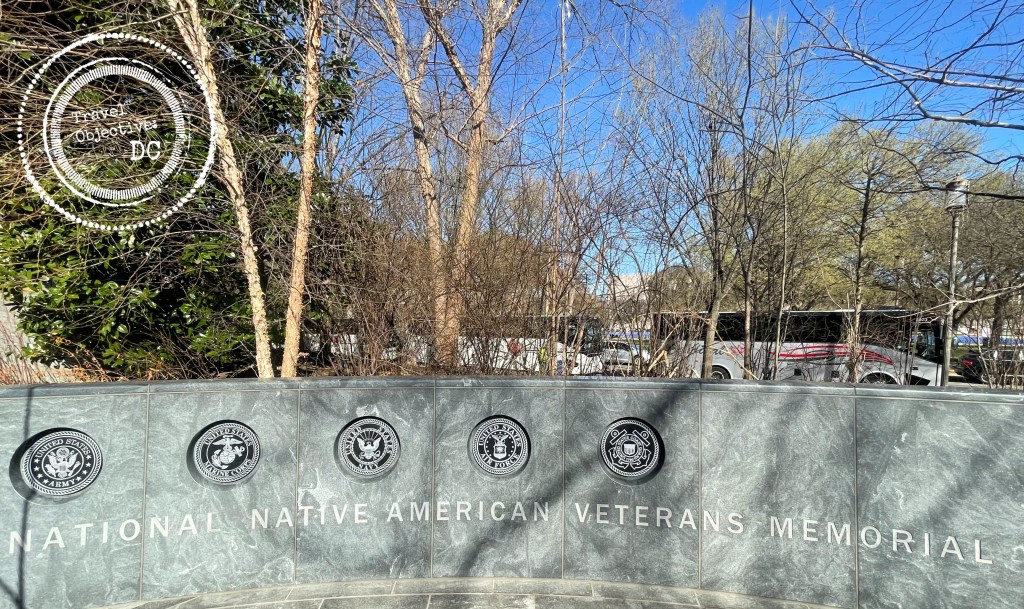
A stone wall with the seals of five of the armed forces marks the entryway to the National Native American Veterans Memorial.
Native Americans have served in all branches of the American military throughout our history.

The code talkers, as these men were known, are today one of the better known examples of Native Americans serving in the American military. However, Native Americans, Alaskans and Hawaiians have long served in the Armed Forces, from Valley Forge through Iwo Jima to Iraq and Afghanistan. Today there are approximately 140,000 veterans of Native heritage. 

In 2013, Congress amended legislation to direct the National Museum of the American Indian to build a memorial so all Americans can learn “of the proud and courageous tradition of service of Native Americans”.

As part of a nationwide competition, a design committee selected a proposal entitled Warrior’s Circle of Honor submitted by Harvey Pratt, a self-taught artist and Marine veteran from Oklahoma and a member of the Cheyenne and Arapahoe Tribes.  As the name suggests, the circle is the prominent shape of the memorial’s features.

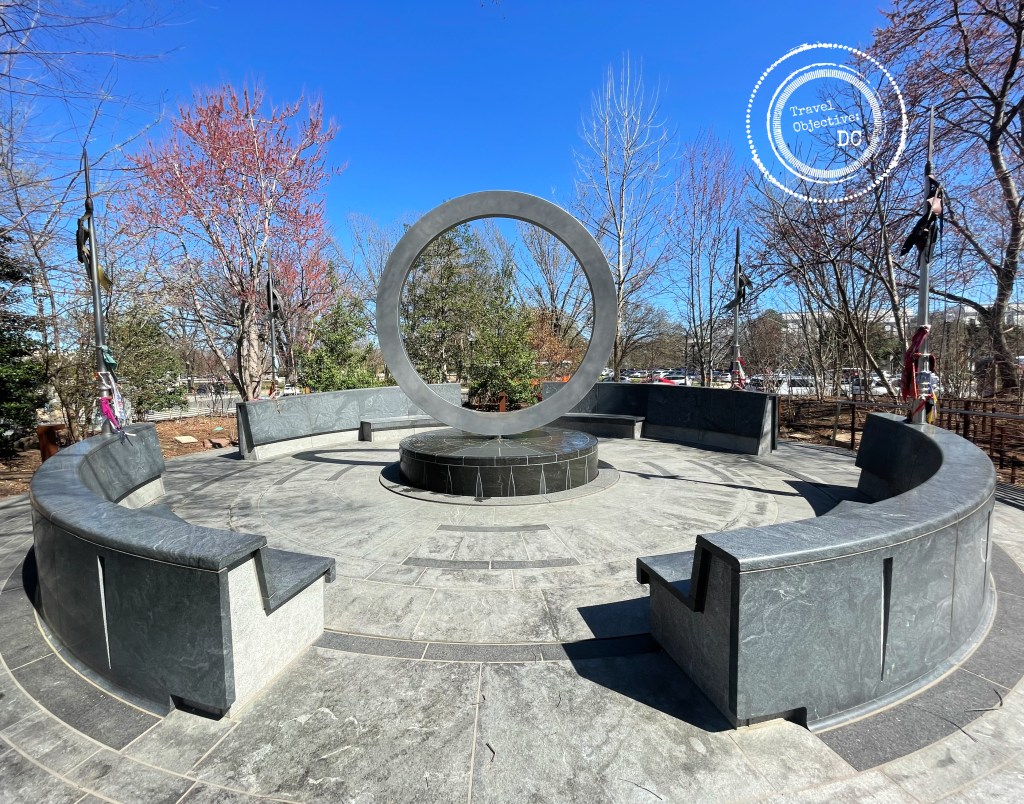
The focus of the memorial is a vertically oriented stainless-steel circle, situated on a carved stone drum surrounded by circular seating area

The focus of the memorial is a vertically oriented stainless-steel circle, situated on a carved stone drum surrounded by circular seating area and gathering space.

The circle is relevant in many Native American cultures. It represents the cycle of life, as well as the four seasons, the sun, the moon and the orbits of the planets and stars. Native communities also gather in circles for ceremonies, festivals and storytelling. 

The memorial design is about more than the circle of course. Pratt also sought to create a space for servicemen and women, veterans and their families to heal by combining the elements of water, wind, and earth into the memorial’s design. 

Water glistens as it flows over the carved stone drum at the National Nafive American Veterans Memorial.

Flowing water glistens atop the carved stone drum at the National Native American Veterans Memorial

Water pulses across the surface of the stone drum and flows down its side creating a central fountain. The stone work around the drum contains a visual echo of the water, with concentric rings in the stone walkways around the drum. The depiction represents the beating of the drum, hearkening all to gather in the space.

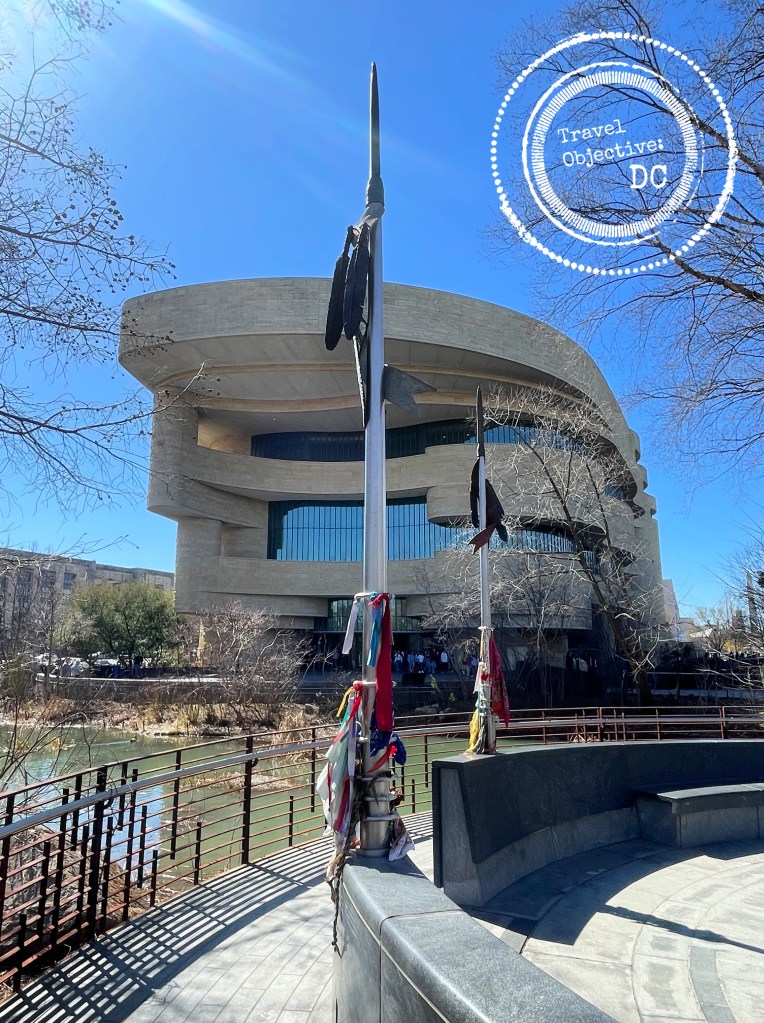
Around the seating area are four spears pointed skyward. The spears hold prayer cloths visitors have tied to the base of the spears allowing the wind to carry the intentions of the prayer cloths to the heavens.

Finally, a park-like setting is built around the memorial combining hardwood trees and a wetland pond. The setting is intended to provide privacy for visitors while a soundtrack of Native American veterans songs aids in reflection. 

Two spears, pointed toward the heavens with prayer cloths tied to their bases.

Two spears, pointed toward the heavens with prayer cloths tied to their bases.


The memorial is located to the east of the main entrance plaza of the National Museum of the American Indian. A large stone marker with the emblems of the five branches of the Armed Forces marks the way.

Within the museum, an exhibit entitled Why We Serve provides background, rationale and compelling examples through history of the military service of Native Americans, Alaskan Natives and Native Hawaiians to the United States. The exhibit is also available online.  

The memorial is above all a welcoming place. Welcoming to Native Americans and their families to heal and reflect. Welcoming to other visitors as well to learn, to rest and also to consider the meaning of service to country and community. 

A white ribbon prayer cloth tied to the base of a spear.

* * *

Route Recon

The National Museum of the American Indian is located on the south side of the National Mall at the intersection of Fourth Street & Independence Avenue, SW Washington, DC 20560. The main entrance faces east toward the US Capitol Building. 

The nearest Metro stations are L’Enfant Plaza and Federal Center SW.

The museum does not have parking. There is limited metered public parking on the surrounding streets. There are also several commercial parking garages nearby the museum.

The National Native American Veterans Memorial is accessible 24 hours a day. 

Learn more about Chester Nez and his fellow Navajo Code Talkers from the Veterans History Project of the Library of Congress.  

Mess Call

The Mitsitam Cafe, located within the National Museum of the American Indian offers a very broad menu of entrees, sandwiches and desserts reflecting Native American cuisines from across the country, such as grilled salmon, bison burgers and lobster roll. The cafe offers some of the tastiest food to be found on the National Mall. 

Command Reading

Why We Serve by Alexandra N. Harris and Mark G. Hirsh.  Why We Serve was published by the National Museum of the American Indian to commemorate the opening of the National Native American Veterans Memorial in 2020. The book explores the complex history of Native Americans serving in the US military with intriguing photographs, maps and artwork combined with compelling first person accounts.