Commemorating John Barry, the Father of the United States Navy

In 1797, President George Washington signed Commission Number 1 naming John Barry as a senior captain in the newly reconstituted United States Navy.  

For Barry, it was the culmination of a very distinguished career of over 30 years as a maritime sailor, ship’s captain, naval officer and combat commander. 

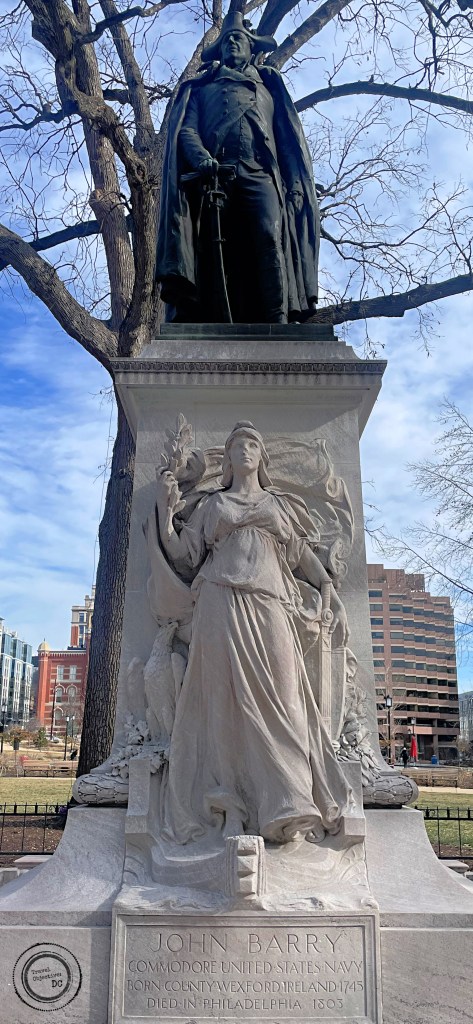
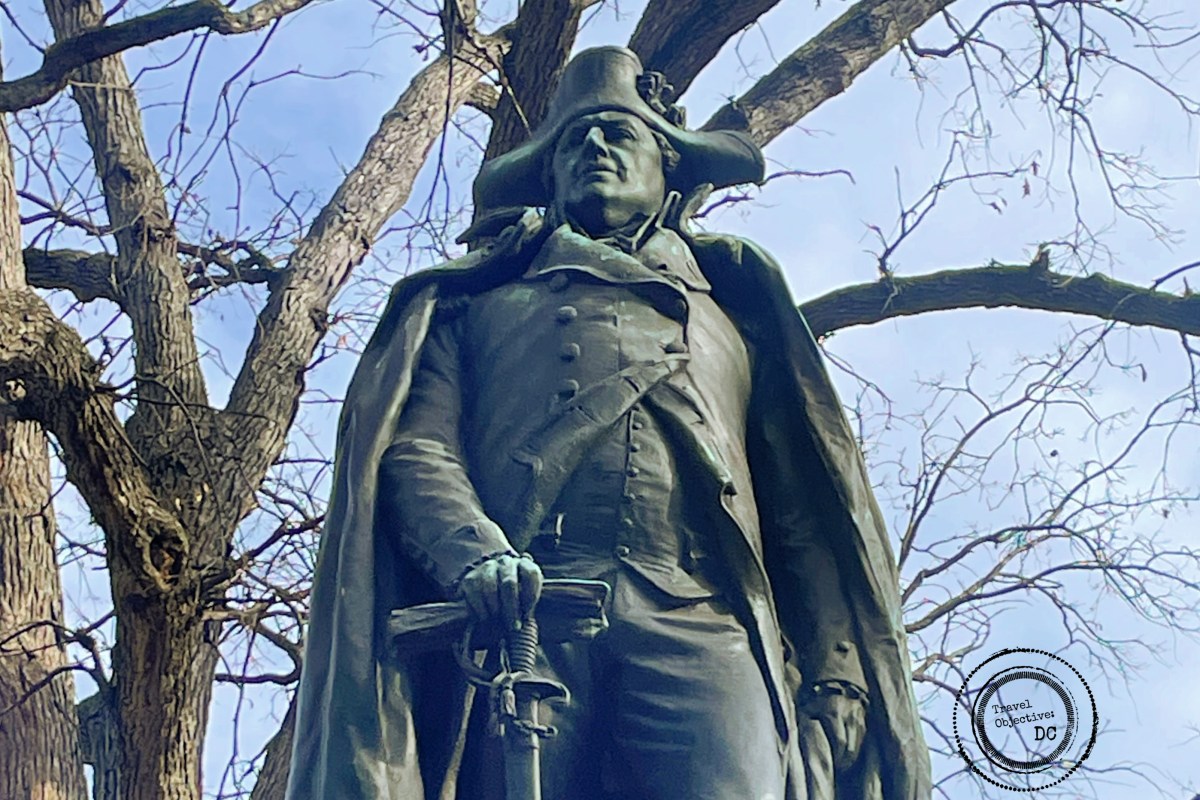
Today, a monument to John Barry stands on the western edge of Franklin Park in downtown Washington, DC. Passersby on busy 14th Street proceed each day under his watchful gaze, likely unaware of the man who earned the sobriquet The Father of the United States Navy

The monument to Commodore John Barry in Frankin Park in Washington, DC

Barry was not a native of our American shores.

He was born in County Wexford on Ireland’s southeast coast in 1745. It was a difficult time in Ireland. English penal laws limited the civil, religious and property rights of Irish Catholics.

Barry’s family was forced from their farmland when he was a young boy. He began working with his uncle, a fishing boat captain, where he developed a love for the sea. He went on to work as a cabin boy and sailor on a number of merchant vessels. 

Barry settled in Philadelphia around 1760. The affluent colonial capital of Pennsylvania was a logical choice for the young mariner. It was a busy port city with a tolerance for Catholic immigrants, allowing Barry to ply his trade.

After mastering his seamanship skills, Barry was appointed a ship’s captain for the first time at the age of 21. 

Barry’s stature and comportment certainly contributed to his success. At 6’4″ Barry towered over his sailors. He walked a ship’s decks with a confident, commanding stride and gave clear orders in a deep Irish brogue. His great attention to detail and technical proficiency earned him wide respect as did his reputation for taking care of his crews.

In 1775, Barry volunteered for the cause of independence from Britain. Already an experienced and highly regarded sailor, Barry was commissioned as a captain in the Continental Navy and given command of a series of warships.  

He captured a number of British vessels and their cargos, providing much needed supplies for the Continental Army and Navy. His success commanding naval vessels caught the attention of the British, who offered him a Royal Navy commission and a hefty bribe to leave the Continental Navy.

He promptly refused. 
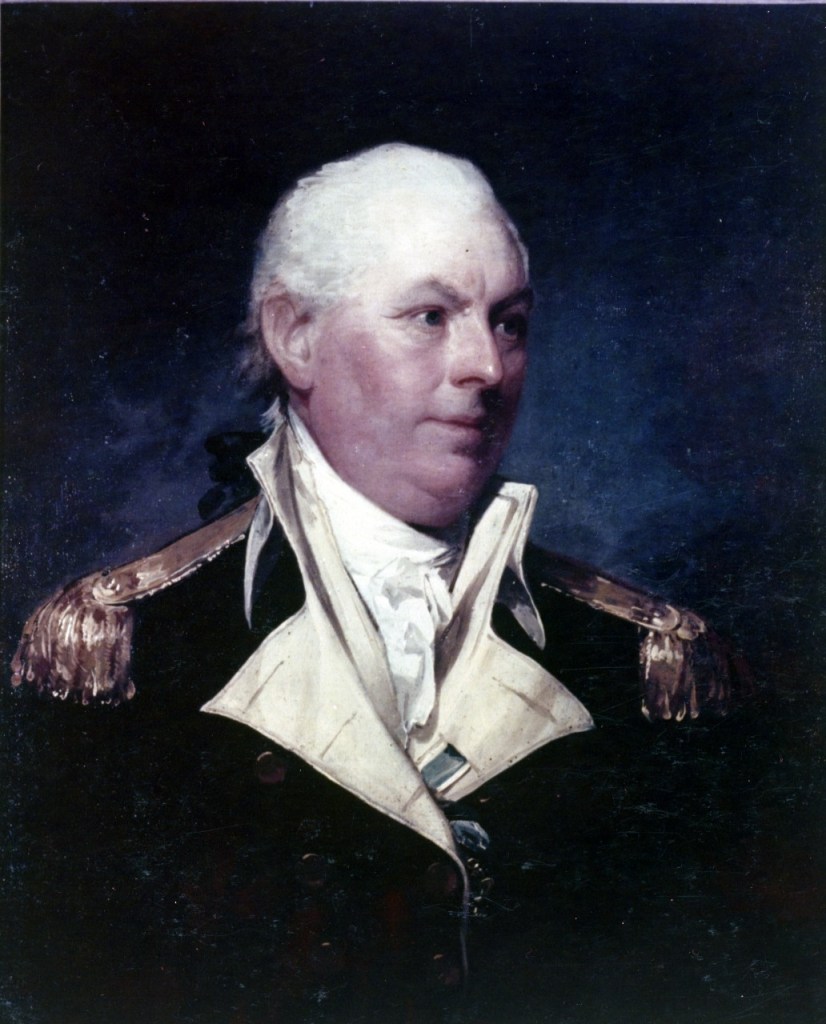
A portrait of John Barry painted by Gilbert Stuart in 1801.

A portrait of John Barry painted by Gilbert Stuart in 1801.

The USS Alliance was a 36-gun frigate of the Continental Navy, commanded at different times by both John Barry and John Paul Jones. She was the last ship of the Continental Navy to be decommissioned.
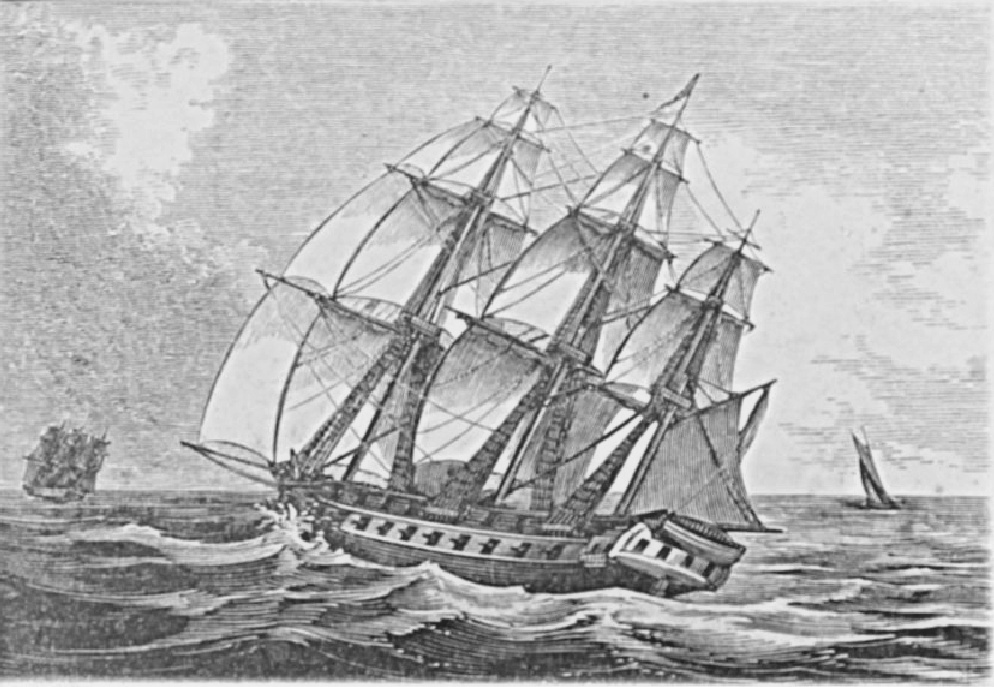
A picture of the USS Alliance, a three-masted sailing ship

Throughout the war, Barry devoted his technical skills, wit and personal connections to the fight for independence. When not in command at sea, he joined up with the Continental Army, personally supporting George Washington during the crossing of the Delaware River and at the Battles of Trenton and Princeton.

In the final sea battle of the Revolutionary War, Barry’s ship the USS Alliance was engaged by three British warships. Barry and his crew destroyed one vessel and outmaneuvered the other two.

Aside from his operational duties, he also supervised the construction of warships and authored a manual on ship-to-ship communications. 
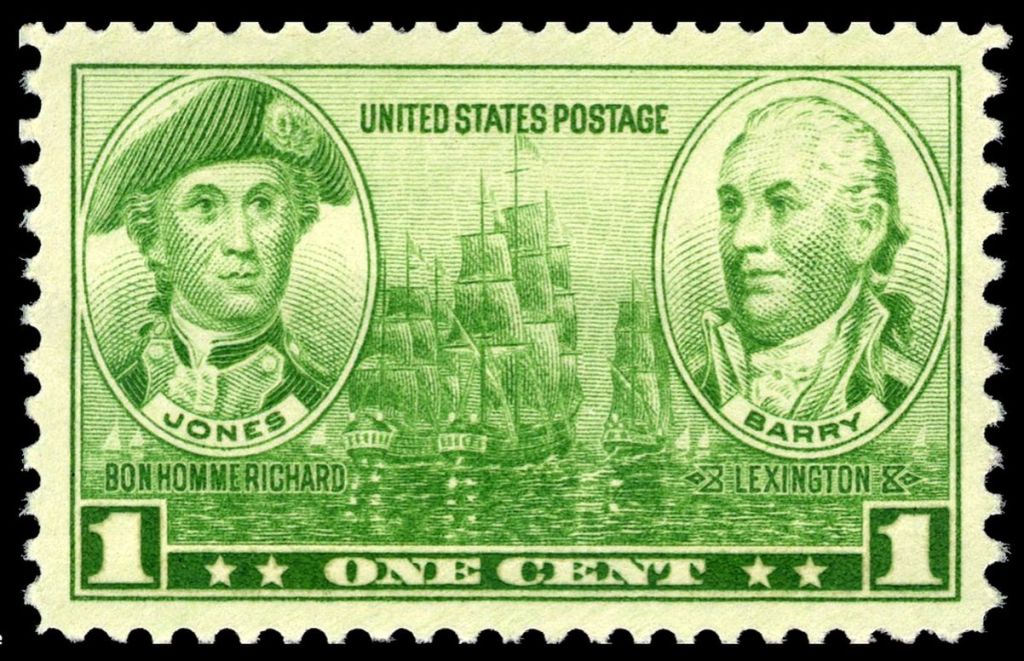
A 1936 postage stamp featuring naval heros John Barry and John Paul Jones

A 1936 US postage stamp featuring naval heros John Barry and John Paul Jones

After the Revolutionary War ended and the Continental Navy was disbanded, Barry returned to merchant shipping. While not at sea, Barry was well known around Philadelphia for his generosity. He and his wife Sarah raised his two orphaned nephews, cared for other Irish immigrants in town and helped provide for destitute seamen. 

Once Washington recalled Barry to active naval service, he began laying the foundation for a permanent United States Navy.  He again supervised the construction of new warships (including his own flagship, the USS United States), wrote regulations and mentored the next generation of American naval leaders.

From 1798 to 1801, Barry commanded a naval flotilla in the West Indies, earning him the title Commodore. He is considered the Navy’s first flag officer. 

Barry ended his active service in 1801, but would remain in charge of the Navy until his death in Philadelphia in 1803. 

An 1840 lithograph entitled The Army and Navy, Gen’l Washington presenting Capt Barry with his Commission, 22 Feb 1797, by Alfred Holly.
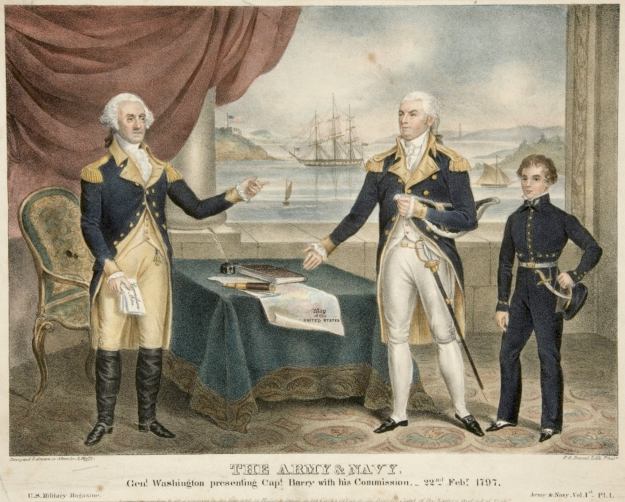
An 1840 lithograph with George Washington and John Barry

A century later, buoyed by robust Irish immigration to the United States, the Irish community in America sought to recognize one of their own from the War of Independence. 

In 1906, Congress approved $50,000 for a Barry statue. Ultimately, a design by sculptor John J. Boyle was selected for the memorial placed in Franklin Park in northwest Washington.

The monument consists of an 8-foot bronze statue of Barry wearing his dress uniform with his right hand resting on his sword. The statue stands on a pink marble base, which in turn rests on steps of pink granite. On the base is a figure of a woman on the bow of a ship. Her raised right hand holds an olive branch with a sword and shield at her left side.  
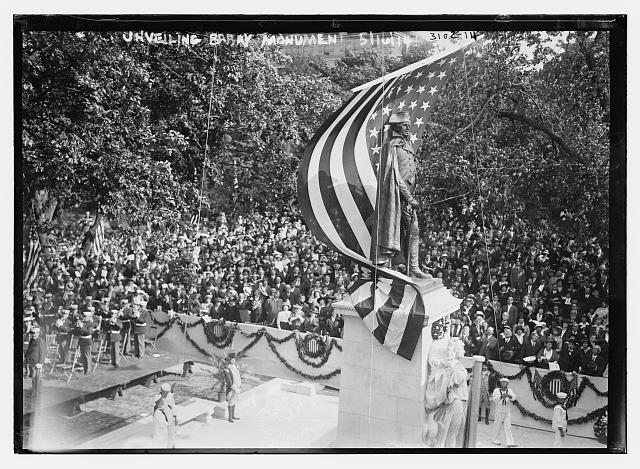
A 1914 photograph of the unveiling of the John Barry Memorial

A photograph entitled Unveiling Barry Monument, published by Bain News Service on May 16, 1914

The statue was dedicated by President Woodrow Wilson on May 16, 1914 in a ceremony attended by over 10,000 people. Admiral George Dewey offered remarks and the US Marine Corps Band played patriotic songs.

Through the 20th century, Barry was widely commemorated. There are statues to him in front of Independence Hall in Philadelphia, in his hometown in Ireland, and at the University of Notre Dame. His name is found on academic buildings, plaques, elementary schools and a bridge over the Delaware River. Notably, the U.S. Navy has named four warships for Barry. The most recent is the USS Barry, a guided missile destroyer commissioned in 1992.

His statue in Franklin Park, along with all of these other tributes, fittingly reminds us of the enduring legacy of John Barry — sailor, captain, commodore and proud son of Ireland, who was an even prouder American. 

The guided missile destroyer USS Barry (DDG 52)

– Photograph by ST3 Christopher Brewer, US Navy
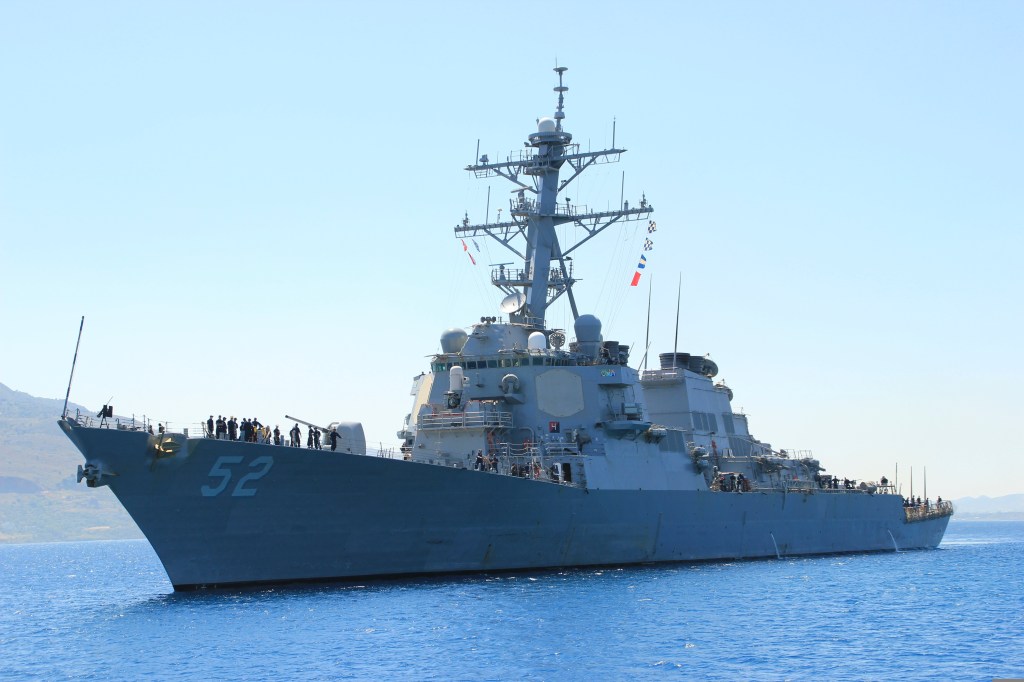
The modern USS Barry, a guided missile destroyer

# # #

Route Recon

The Commodore John Barry Memorial stands along the western edge of Franklin Park in Northwest Washington, DC. Franklin Park is bordered by 13th and 14th Streets on the east and west, and I and K Streets on the south and north. The 5-acre park was renovated in 2021 and now features multiple seating areas, a central fountain plaza and playgrounds.

The closest Washington, DC Metro Station is McPherson Square on the Blue, Orange and Silver lines. The station has an exit at the corner of 14th and I Streets.
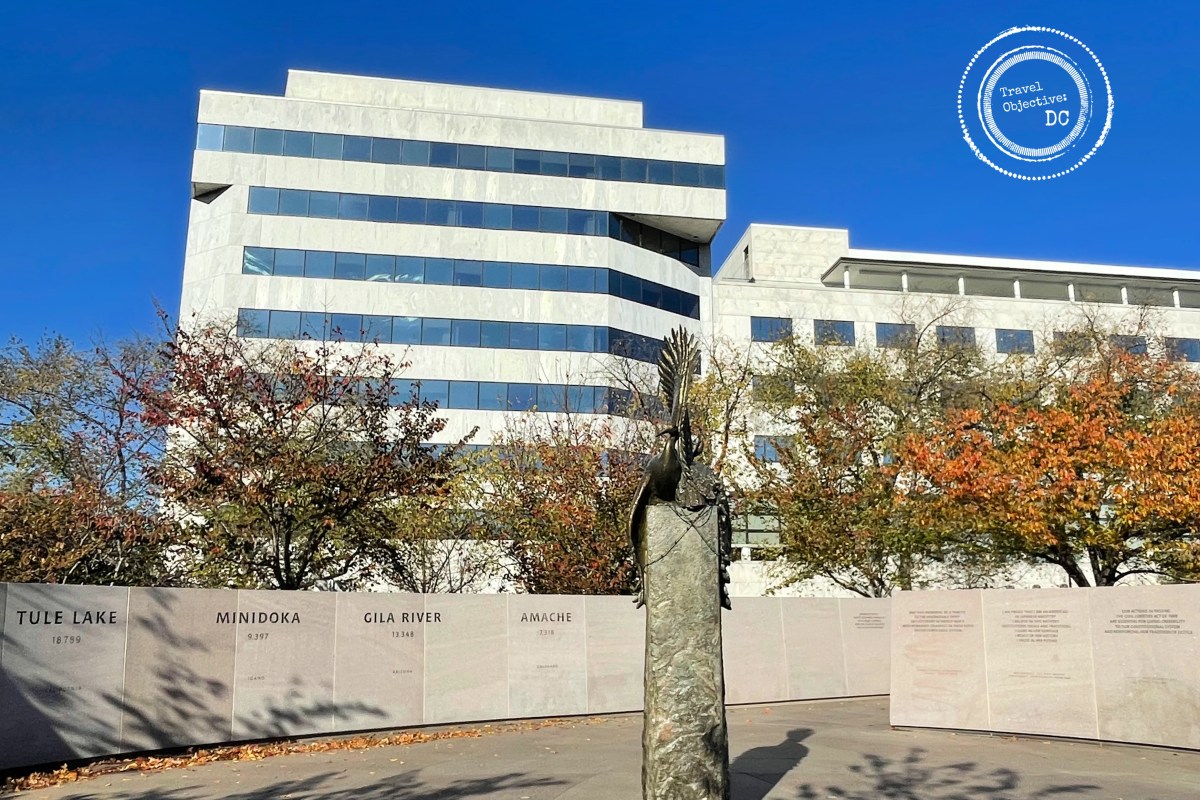
Examining the Price of Patriotism

On July 15, 1944, Staff Sergeant Kazuo Otani and his unit Company G, 2nd Battalion, 442nd Regimental Combat team were pinned down by enemy machine gun and sniper fire in a field near the Italian village of Pieve di Sante Luce in Tuscany.  

The 442nd had arrived in Italy just three weeks prior and was part of the American advance against heavy German defenses.

Photo of Staff Sergeant Kazuo Otani

Staff Sergeant Kazuo Otani of the 442nd Regimental Combat Team was awarded the Medal of Honor for his actions in Italy during World War II.

Otani’s unit objective was a hill adjoining the open field where his platoon was located. After killing one sniper, Otani repeatedly exposed himself to enemy fire while engaging multiple machine gun positions. Otani’s tactics provided cover for his platoon to maneuver. While preparing the platoon to assault the hill, one of his men was severely wounded.  Otani ran back across the open field to render first aid, but was killed by an enemy machine gun blast. 

Staff Sergeant Otani was ultimately awarded the Medal of Honor for his actions that day. His name, along with the names of more than 800 other Japanese American soldiers who were killed in action in World War II, is inscribed on a series of stone panels at a unique monument in Washington, DC.

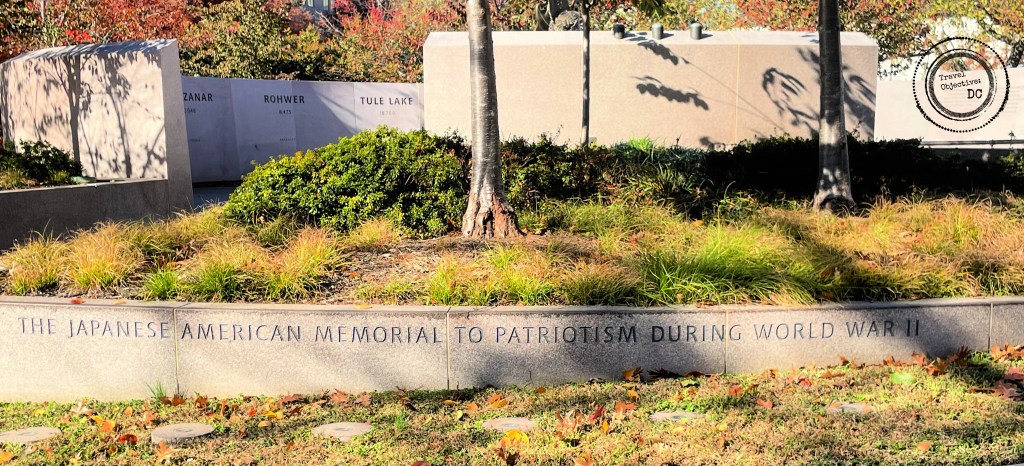
The Japanese American Memorial to Patriotism in World War II is tucked into a 3/4 acre triangular space created by the intersection of D Street, New Jersey Avenue and Louisiana Avenue in Northwest Washington, DC, just north of the US Capitol. 

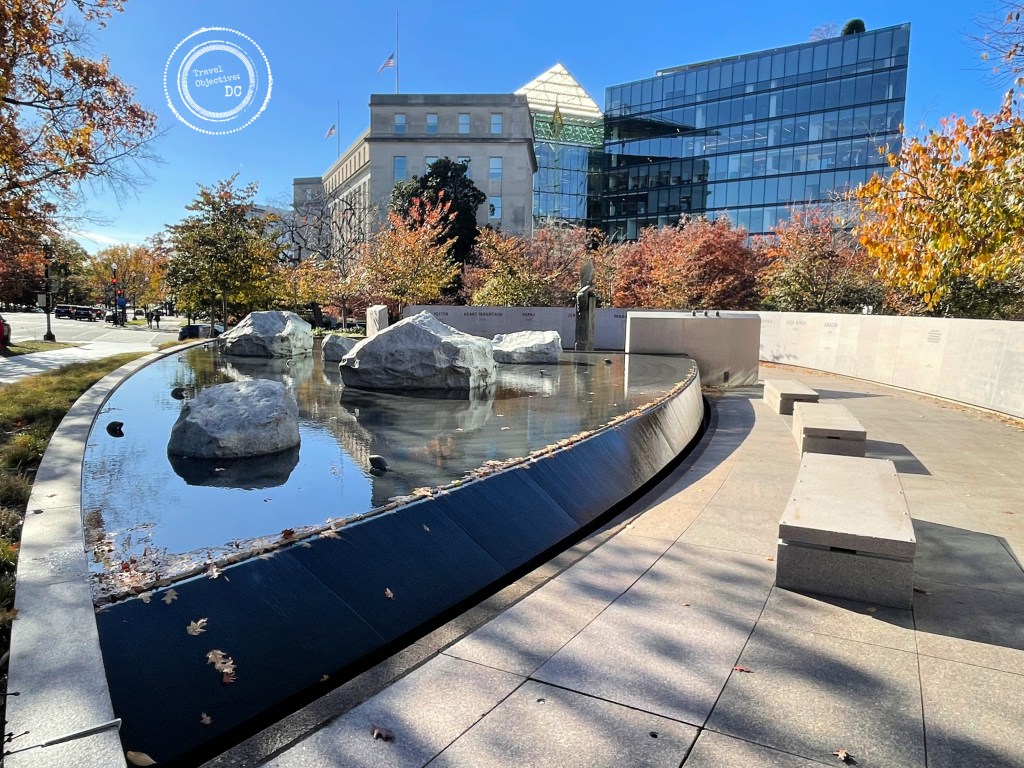
The Reflecting Pool at the Japanese American Memorial to Patriotism in World War II.

The Reflecting Pool at the Japanese American Memorial to Patriotism in World War II.

A large curved granite wall forms the perimeter around most of the memorial while the side facing Louisiana Avenue remains open, encouraging everyone passing by to enter the memorial’s space. 

Opposite the memorial panels where the 800 names are inscribed is a reflecting pool. Within the pool are five large rough boulders representing the five generations of Japanese Americans impacted by World War II. Water from the pool gently flows down an angled edge, producing a calming background sound while carefully placed trees and bushes help to muffle the sounds of the bustling nearby neighborhood. 

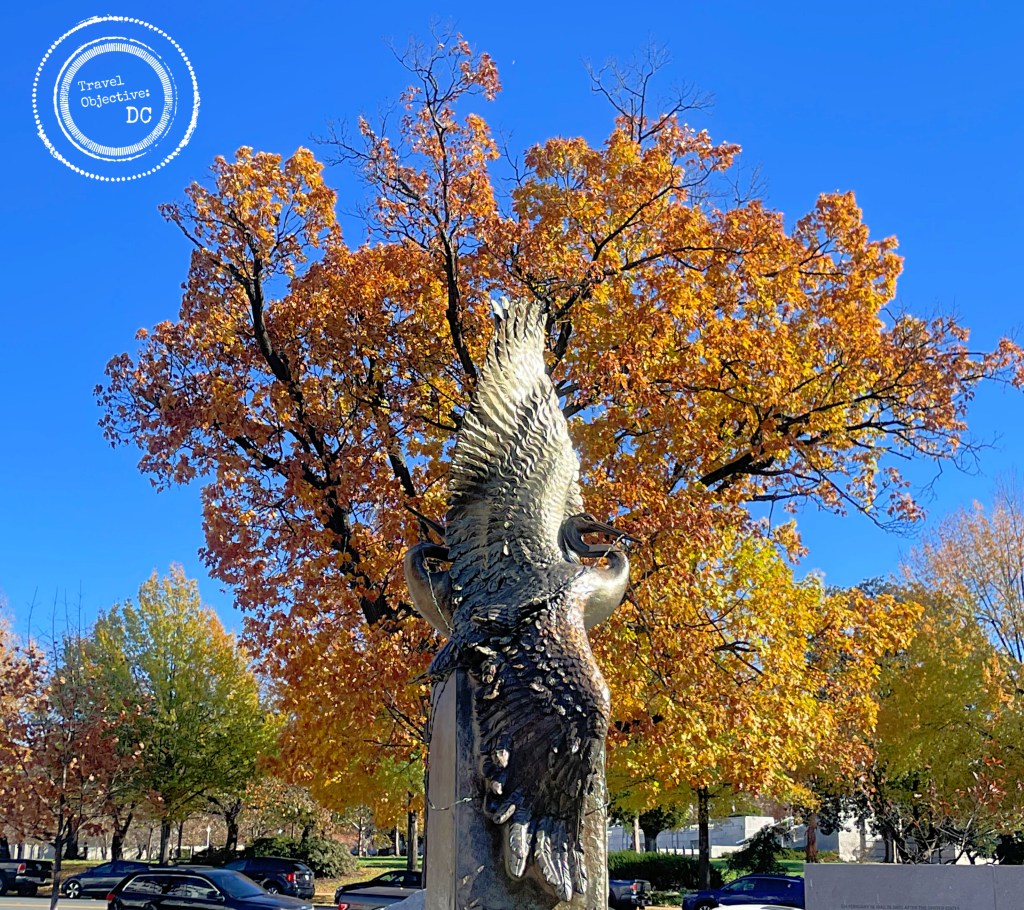
The Cranes Sculpture shines in the sun on a brilliant autumn afternoon.
The two cranes depicted in the sculpture represent both individual effort and community.

The centerpiece of the memorial is a tall bronze sculpture of two cranes. Their bodies mirror each other as they face opposite directions. Both cranes raise one wing high, the other kept low. A single strand of barbed wire wraps around them.

Cranes are featured prominently in the art and literature of East Asian cultures. In Japan especially, cranes are said to grant favors in return for acts of sacrifice.

The two cranes, bound by the wire, express the dual mission of this unique memorial: to recognize the heroric contributions of Japanese Americans on the battlefield while acknowledging the internment of tens of thousands Japanese Americans during the war.

A wreath laid in honor of Veterans Day

A wreath laid in honor of Veterans Day

Three engraved stones by the memorial’s entrance nearest the crane statue provide helpful historical context.

Shortly after the attack on Pearl Harbor, President Franklin Roosevelt signed Executive Order 9066 directing the internment of Americans of Japanese ancestry. Ultimately, over 120,000 people were incarcerated under harsh conditions in camps located in the American west and south.

Encircling the crane statue are ten large stone panels each depicting the name of one of those camps and the number of people detained there. Many internees would remain at these facilities until March 1946. Other wording along the memorial’s walls includes quotes from Japanese American writers, veterans and Presidents Truman and Reagan.

Mike Masaoka of Fresno, CA was a longtime advocate for the Japanese American community as well as a soldier in the 442nd Regimental Combat Team.

A quote by Mike Masaoka inscribed in stone.

While initially excluded from military service, younger Japanese Americans eagerly enlisted once allowed. The men served primarily in several segregated units, such as the 100th Infantry Battalion, the 442nd Regimental Combat Team and the 1399th Engineer Construction Battalion. 

Some joined the Military Intelligence Service. Serving in the Pacific Theater, these soldiers used their language capabilities in many ways. They landed on beaches with invasion forces to capture enemy documents, deployed on special operations behind enemy lines, and interrogated prisoners. 

After November 1943, Japanese American women were allowed to join the military as well. They served within the Women’s Army Corps, often working as linguists. Others became nurses. 

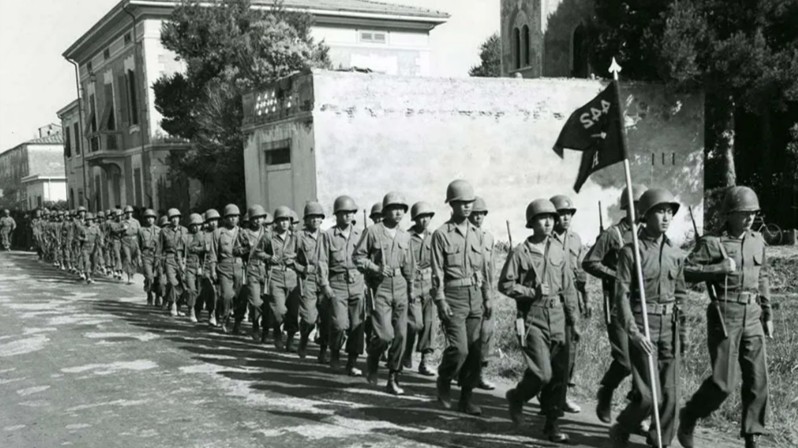
U.S. Fifth Army soldiers of Company M, 100th Infantry Battalion, 442nd Regiment march through Vada, Italy,

U.S. Fifth Army soldiers of Company M, 100th Infantry Battalion, 442nd Regiment march through Vada, Italy, to an area where Lt. Gen. Mark W. Clark would present the Presidential Citation for outstanding action in combat to the 100th Infantry Battalion, which was composed of Japanese-American troops.

– US Army Photo

The 442nd Regimental Combat Team with the attached 100th Infantry Battalion fought together in Europe, initially in Italy, then Southern France and later Germany. 

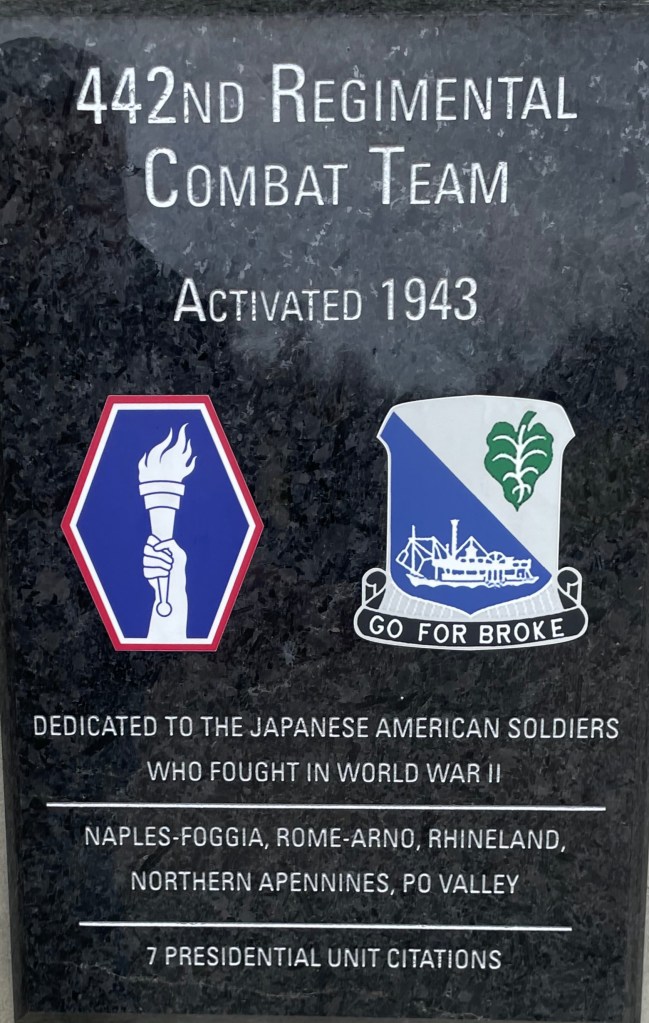
They repeatedly distinguished themselves in combat, becoming the most decorated military unit in US history for its size and duration of service. Soldiers of the unit earned over 18,000 individual decorations, including 4,000 Purple Hearts and 21 Medals of Honor. Collectively, the unit earned seven Presidential Unit Citations.   

They truly embodied the regimental motto of Go for Broke.

A Unit Tribute Plaque dedicated to the 442nd Regimental Combat Team on display at the National Museum of the United States Army at Fort Belvoir, VA.

A Unit Tribute Placque dedicated to the 442nd Regimental Combat Team on display at the National Musuem of the United States Army at Fort Belvoir, VA.

Decades after the final victory in 1945, the US Government took a series of steps to examine and reconsider the wartime internment of Japanese Americans. 

In 1983, Congress appointed a special commission to review the language and implementation of Executive Order 9066. After several years of detailed research and over 700 interviews, the commission concluded in their final report that the relocation was based on “race prejudice, war hysteria and failure of political leadership” without any benefit to national security.

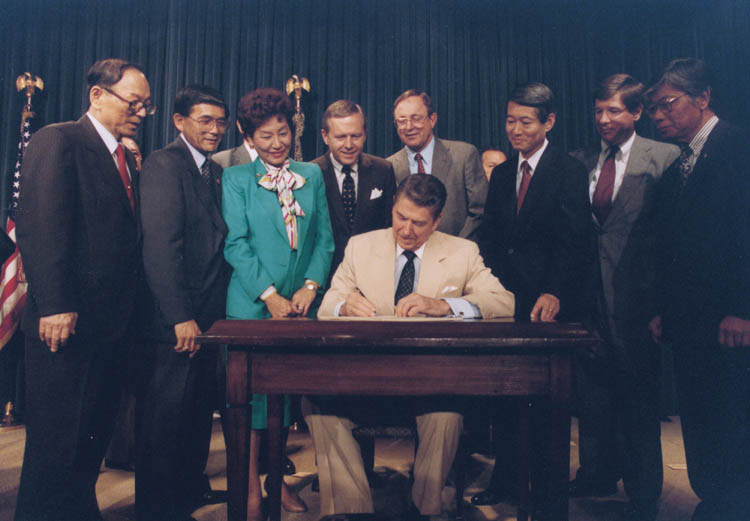
One of the commission’s recommendations was signed into law by President Ronald Reagan in 1988.  The Civil Liberties Act, included a formal apology on the part of the US Government and pledged restitution to the former internees. Ultimately, in the early 1990’s most surviving internees would receive $20,000 in reparations.  

President Ronald Reagan signs the Civil Liberties Act of 1988 into law on August 10, 1988

President Ronald Reagan signs the Civil Liberties Act of 1988 into law.

That same year, the Go For Broke  National Veterans Association Foundation, later renamed the National Japanese American Memorial Foundation, began the process of building a memorial in Washington, DC. In 1992, President George Bush signed legislation authorizing the building of the memorial on Federal land. 

The memorial was formally dedicated on November 9, 2000.

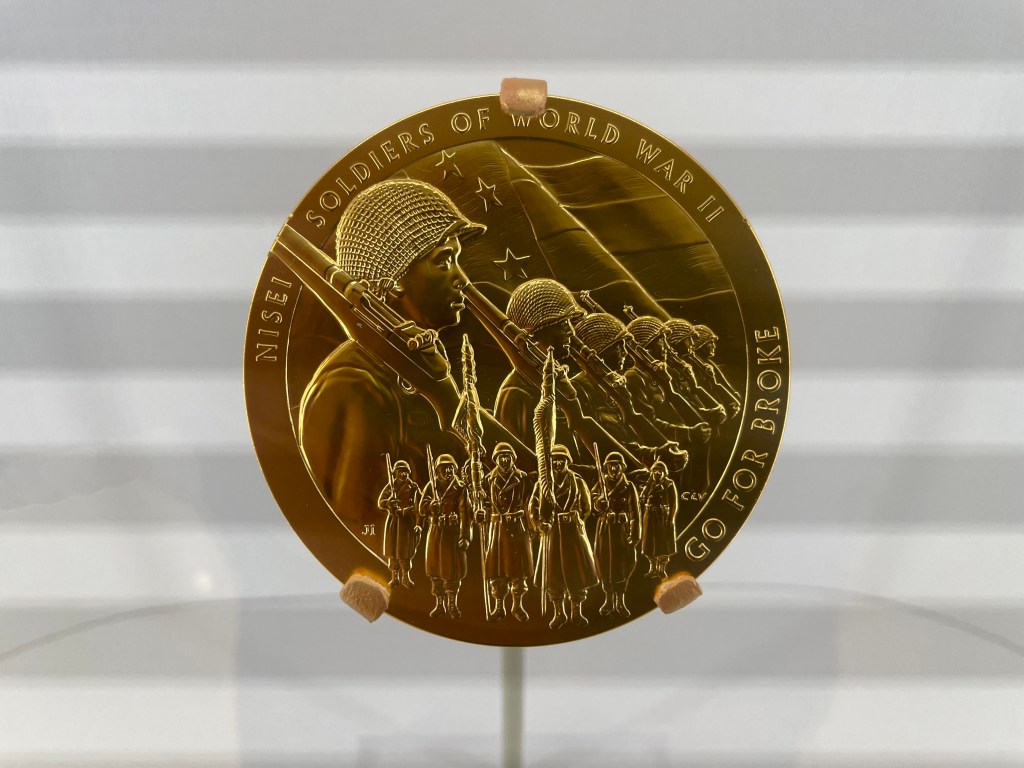
In 2011, Congress collectively awarded the Congressional Gold Medal, its highest honor, on the soldiers of the 100th Infantry Battalion, the 442nd Regimental Combat Team and the Military Intelligence Service.

The Congressional Gold Medal honoring the Japanese American World War II soldiers who fought in the service of the United States

The Congressional Gold Medal honoring the Japanese American World War II soldiers who fought in the service of the United States

As is the case with most memorials in Washington, DC, the Japanese American Memorial to Patriotism in World War II can be sobering as well as inspirational. Upon a visit, one cannot help but reflect on the fragility of our Constitutional rights and need for vigilance in defending them. 

At the same time, there is also a sense of resiliency of the human spirit, courage in the face of grave danger, and the importance of community in good times and bad. 

The memorial also reminds us of the unfinished work undertaken by Sergeant Otani on that July day long ago and the need to continually tend to our task of building a more perfect union. 

* * *

Route Recon

The National Japanese American Memorial to Patriotism During World War II is located at the intersection of New Jersey Avenue, Louisiana Avenue, and D Street in Washington, D.C. It is accessible 24 hours a day.

The closest Metrorail (subway) stop is Union Station. The memorial is a 10-15 minute walk from Union Station.

The National Japanese American Memorial Foundation hosts a number of events at the memorial and around the area to commemorate the history and contributions of Japanese Americans.  See their website for more information.  

Further details on the Congressional Gold Medal honoring the Japanese American soldiers of World War II soldiers can be found at this Smithsonian Institute website.

Immerse Yourself in History at the National Museum of the Marine Corps


Making Marines is the first gallery visitors encounter in their journey through the National Museum of the Marine Corps (NMMC). It describes the 13-week Marine Recruit Training program where young men and women begin their journeys to become United States Marines. 

The gallery floor is lined with painted yellow footprints. These footprints demonstrate for the new recruit exactly where to place their feet to stand at the position of attention. Visitors are invited to also place their feet in these yellow figures, literally following in the footsteps of generations of Marines who have gone before. 

The yellow footprints at the Marine Corps Recruit Depot Parris Island, South Carolina

The yellow footprints at the Marine Corps Recruit Depot Parris Island, South Carolina (July 2004)

-USMC Photo by Lance Corporal Brian Kester

This is one of the main themes of the Marine Corps’s fine museum where the exhibits and displays are designed to immerse the visitor in the Marine Corps’s distinguished history and cherished traditions. 

The NMMC opened in 2006 in Triangle, Virginia. The town is located near Marine Corps Base Quantico, about 32 miles south of Washington, DC. The museum is tremendously successful, attracting over 500,000 visitors each year. 

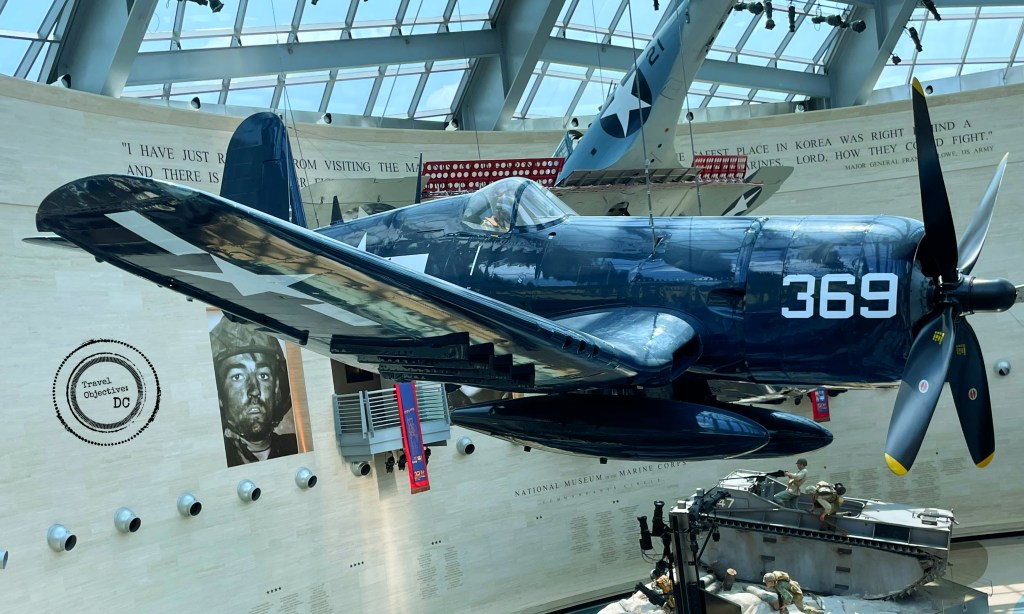
Visitor immersion starts upon walking in the front door and entering the open Leatherneck Gallery housed under the uniquely designed roof.  Seven restored Marine aircraft are suspended from the ceiling and inspirational quotes regarding the Marine Corps line the walls.

The front entrance of the National Musuem of the Marine Corps
The front entrance of the National Museum of the Marine Corps

The conical roof of the NMMC with its protruding shaft, reminiscent of the flagpole depicted in the famous photograph of the Iwo Jima flag raising, has been a familiar site to motorists on Interstate 95 in Northern Virginia for the past two decades. 

NMMC has expanded steadily through the years, adding new features and displays. In October 2024,  two new galleries opened focusing on Iraq and Afghanistan. NMMC now features twelve galleries and two theaters encompassing the Marine Corps’s 250-year history.

Curators and exhibit designers used a wide variety of tools and techniques to tell the Marine Corps’s story. More than one thousand artifacts are on display, including weapons, aircraft, vehicles, uniforms and various pieces of Marine gear. These historic objects are skillfully supplemented by interpretive signage, historic photos, period newsreels, modern videos and films, posters and works of art.

USMC F4U-4 Corsair on display at the National Museum of the Marine Corps

USMC F4U-4 Corsair on display at the National Museum of the Marine Corps

After learning about Marine Recruit Training (vistors can test their marksmanship on a laser rifle range), the Legacy Walk corridor leads to the chronologically arranged historical galleries. The galleries explain the Marine Corps’s role in shaping American history. 

On November 10, 1775, Congress directed the raising of two battalions of Continental Marines. From the start, the Marines were designed to be an expeditionary force, accompanying the US Navy on warships and providing a ground-based fighting capability.

Early Marines provided security onboard US Navy ships for the captain and other officers, while also enforcing discipline among the crew. During ship-to-ship combat, Marines were posted on the ships masts and rigging, acting as sharpshooters targeting the opposing captain and crew. 

A display showing early Marines positioned on a ship's mast.

A display showing early Marines positioned on a ship’s mast.

Marines also acted as infantry conducting a raid on Nassau, Bahamas in early 1776 and attacking a barbary pirate fortress in Libya at the Battle of Derna in 1805 (wherein comes the reference to the “Shores of Tripoli” in the Marine Corps Hymn). 

Marines fought alongside the US Army in the Mexican War and helped to suppress John Brown’s raid on Harpers Ferry in 1859. A 350-Marine battalion engaged Confederate forces at the first Battle of Bull Run in June 1861. 

Through the 19th and early 20th centuries, the Marines performed a number of expeditionary missions in various parts of the world where American interests were deemed threatened. Well-trained Marines were easily deployed and avoided the political ramifications of sending the Army, which could be equated with declaring war on another country.

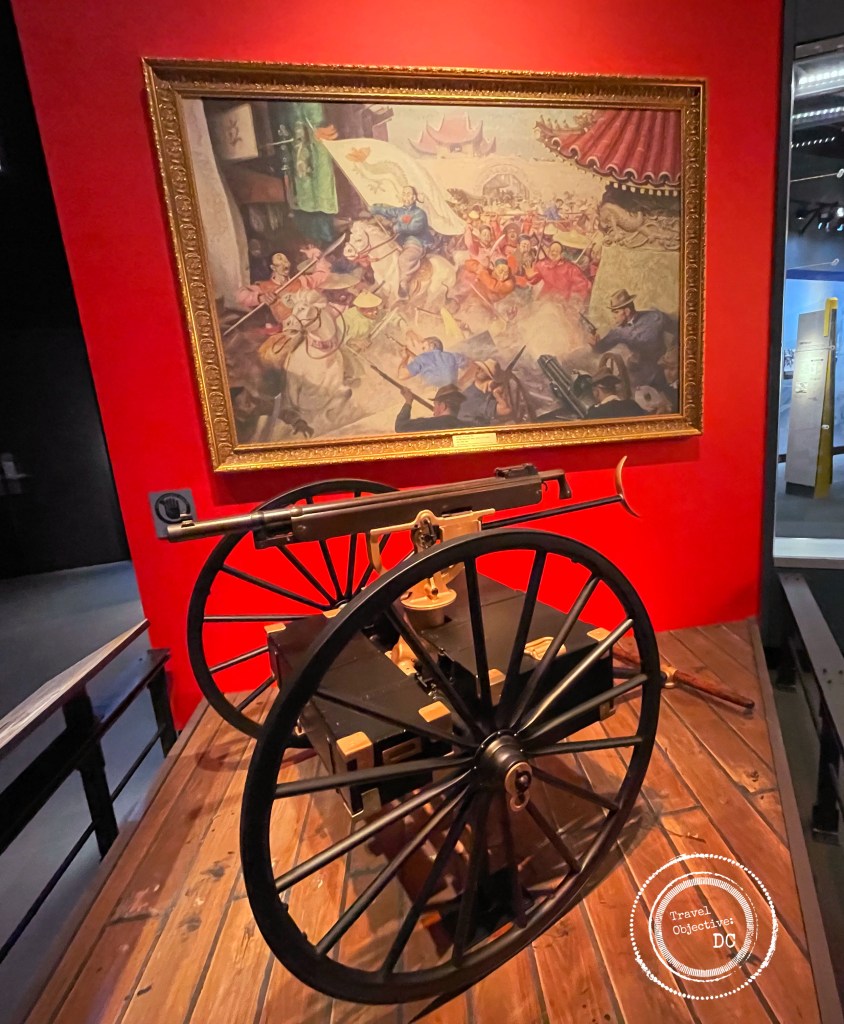
M1895 Colt Machine Gun in front of The Defense of Peking-1900 by Staff Sergeant John Clymer, USMCR

M1895 Colt Machine Gun in front of The Defense of Peking-1900 by Staff Sergeant John Clymer, USMCR

While the decision to deploy Marines may have been easy, the missions were not. Marines were expected to establish order, disarm insurgents and train local military or police forces. The Marines referred to these operations as Small Wars.

Difficult as they were, these deployments were covered extensively by American newspapers at the time and provided a positive portrayal for the Marines to the American public. That narrative grew exponentially for the Marine Corps following the Battle of Belleau Wood in 1918.

To tell the story of of Belleau Wood and later Marine battles, the NMMC galleries covering World War I through today all incorporate large-scale immersive exhibits. Sight, sound and other effects (such as cold air in the Chosin Reservoir exhibit) are combined to draw the visitor into the Marine Corps’s story. 

These large immersive scenes are a major feature of the museum. 

Life-sized cast figures depicting hand-to- hand combat during World War I

Life-sized cast figures depicting hand-to- hand combat during World War I

Visitors can step right into the scenes and experience an attack at Belleau Wood, a pre-deployment briefing before the invasion of Iwo Jima, deploying from a CH-46 helicopter at Khe San in Vietnam, and patrolling the streets in Iraq. The scenes convey a potent sense of realism with posted signs advising visitors of the intensity of these exhibits.

In a scene depicting the Battle of Hue, a Navy corpsman treats a Vietnamese girl beside an M50A1 Onos anti-tank vehicle.

In a scene depicting the Battle of Hue, a Navy corpsman treats a Vietnamese girl beside an M50A1 Onos anti-tank vehicle.

To NMMC’s credit, it understands its displays may overwhelm some visitors. In 2024, a restroom was converted into the Respite Room, a quiet, private space away from the galleries. 

Decorated in wood tones and calm colors, the room has soundproofing, soothing music and is devoid of any military symbols or references. Museum staff are trained on the best ways to steer visitors to the room as appropriate.

As proud as the Marines are of their heritage, the museum’s displays are not just about the past. In 2020, the Museum opened exhibits on contemporary missions such as Marines performing humanitarian operations, providing security at US embassies, and about the structure and functions of Marine Air Ground Task Forces, the principal organizational unit for today’s Marine Corps forces.

There is also an important display on Marine Corps families, which emphasizes how service in the Marine Corps is a family-wide commitment deserving of the Corps’s continued support and dedication.

Inside the Semper Fidelis Memorial Chapel

Inside the Semper Fidelis Memorial Chapel

While there is much to see, the NMMC experience is not confined to the building. On the museum grounds is the 40-acre Semper Fidelis Memorial Park. A 1.2-mile paved walking trail through this manicured green space is dotted with plaques, sculptures, benches and other features commemorating individual Marines, units and battles, as well as Marine families and broader communities. 

The centerpiece of the park is the Semper Fidelis Memorial Chapel, which serves as a quiet place for reflection and community events. 

An immersive visit to the NMMC is well worth the investment of several hours to explore its offerings. Those interested in history or who have a connection to the Corps will find it especially intriguing. Young people considering joining the Marine Corps will find it informative. They will leave knowing what Marine Corps service is about and what their leaders will expect from them. 

However, the Marine Corps Museum isn’t just for Marines–It’s a museum for everybody.

Any visitor should leave with a good understanding of how the Marines fit uniquely into American history, and what their role is today.

A World War I era US Marine Corps recruiting poster

A World War I era US Marine Corps recruiting poster

* * *

Route Recon

The National Museum of the Marine Corps is located at 1775 Semper Fidelis Way, Triangle, VA 22172.

The Museum is open every day from 9:00 AM until 5:00 PM except Thanksgiving and Christmas. Visit the museum’s website for more information about temporary exhibits and special programming.

Triangle, VA is located just off I-95, about 36 miles south of Washington, DC and 76 miles north of Richmond, VA.

From I-95 heading south, take Exit 150A to Route 1 (Richmond Highway); turn right (south) onto Route 1; travel approximately ¼ mile; the Museum’s entrance is on the right.

From I-95 heading north, take Exit 150 (619 East Triangle/Quantico); turn right (south) onto Route 1; travel approximately ¼ mile; the Museum’s entrance is on the right.

Admission is free and there is no charge for parking at the Museum. 

Mess Call

There are two dining options at the National Museum of the Marine Corps.

The Devil Dog Diner provides cafeteria service with a selection of hamburgers, hotdogs and chicken sandwiches. It is open 10:00 AM – 4:00 PM daily.

The Tun Tavern is a full-service restaurant with an 18th century colonial atmosphere. It is open 11:00 AM – 4:00 PM daily.

Find the menus for both restaurants on the museum’s concessions webpage.

Navy Pride on Pennsylvania Avenue: The United States Navy Memorial


In a large open plaza stands a statue of a solitary figure.

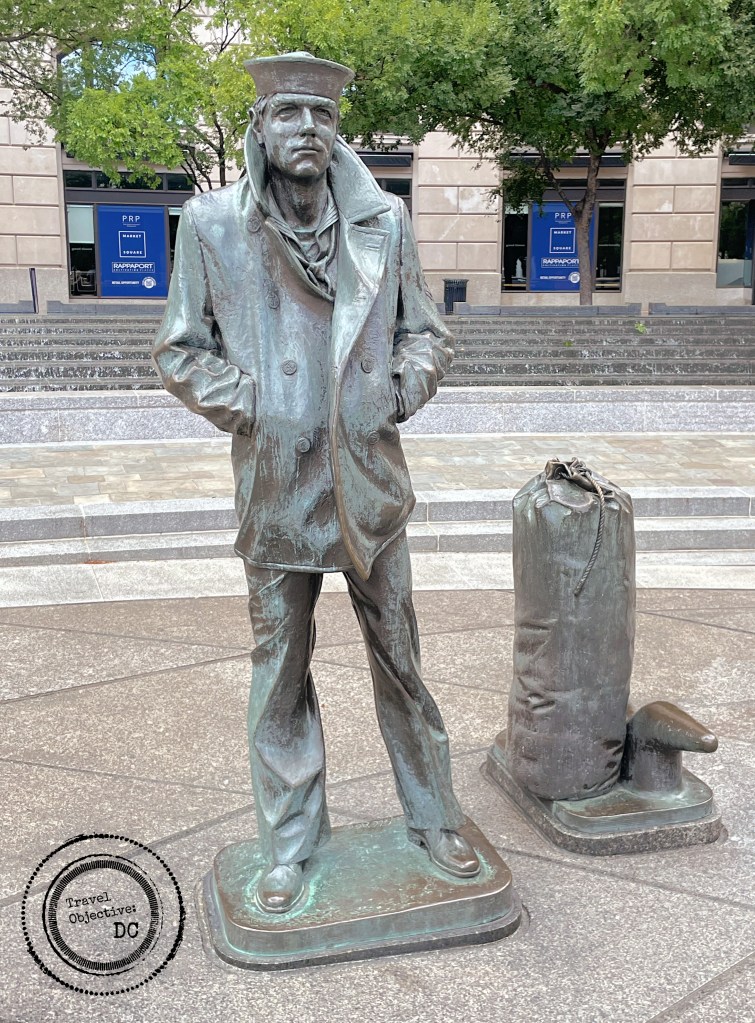
He is a sailor in a dress unform. He stands straight and tall wearing a service “dixie cup” sailor hat. A buttoned up peacoat with a flipped up collar protects him from the chill of the ocean air. His hands are plunged deep into his pockets. His packed sea bag stands by his side. The determined look on his face denotes his readiness to deploy anywhere and perform his duty.

The statue is known as The Lone Sailor and serves as the centerpiece of the US Navy Memorial.

The Lone Sailor Statue at the US Navy Memorial

The Lone Sailor Statue

For centuries, considerable discussion was had regarding a suitable monument paying tribute to the United States Navy. Pierre L’Enfant had included a Memorial Column for the Navy in his original plans for Washington, DC.  Other memorials were built to honor the Navy during specific conflicts, but nothing existed to honor all American sailors. 

This all began to change in the spring of 1977 as Admiral Arleigh Burke urged Navy senior leaders and veterans to get serious by proclaiming: “We have talked long enough about a Navy Memorial, and it’s time we did something about it.”

When Admiral Burke–a distinguished World War II war hero and three-time Chief of Naval Operations–spoke, Navy personnel listened. The Navy Memorial Foundation was quickly organized and Rear Admiral William Thompson was named its first president. Admiral Thompson proved an excellent choice for the job and quickly set to work.

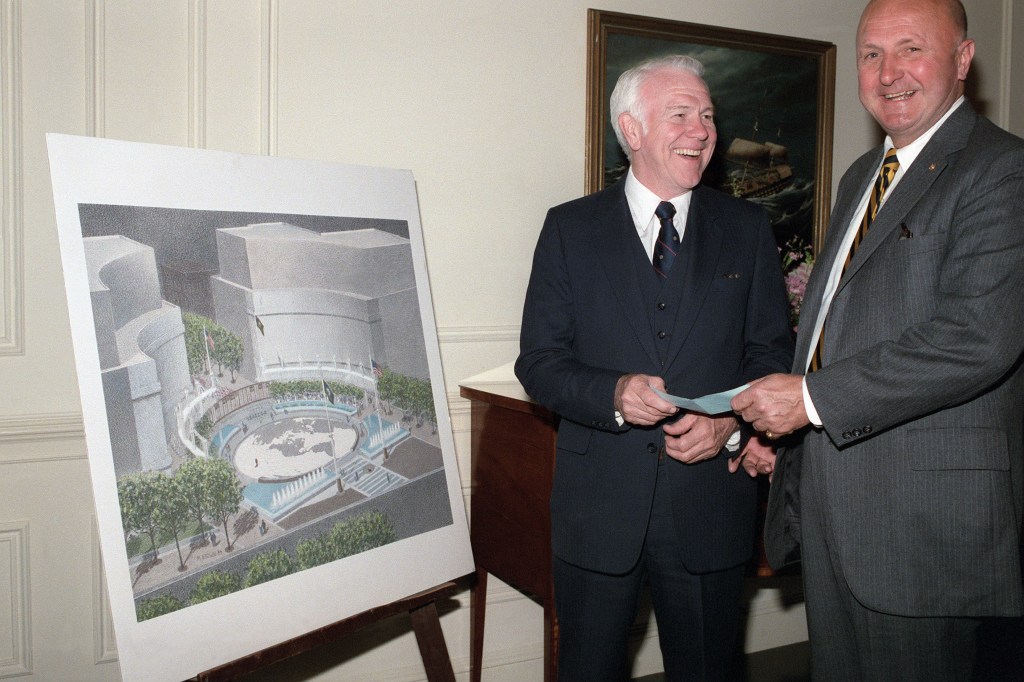
Rear Admiral William Thompson (ret.), on left, receiving a donation for the US Navy Memorial. Note the artist’s rendition of the Memorial.

-Department of Defense Photo

Rear Admiral William Thompson (ret.), on left, receiving a donation for the US Navy Memorial.

He first helped shape the enabling legislation Congress would pass in 1980. He then led the foundation through selecting the memorial’s designers, determining the memorial’s location, raising money and overseeing construction.

Admiral Thompson also helped select the sculptor Stanley Bleifeld to design and sculpt The Lone Sailor Statue. In recognition of Admiral Thompson’s significant contributions to building the memorial, Bleifield included Thompson’s initials on the Lone Sailor’s sea bag. 

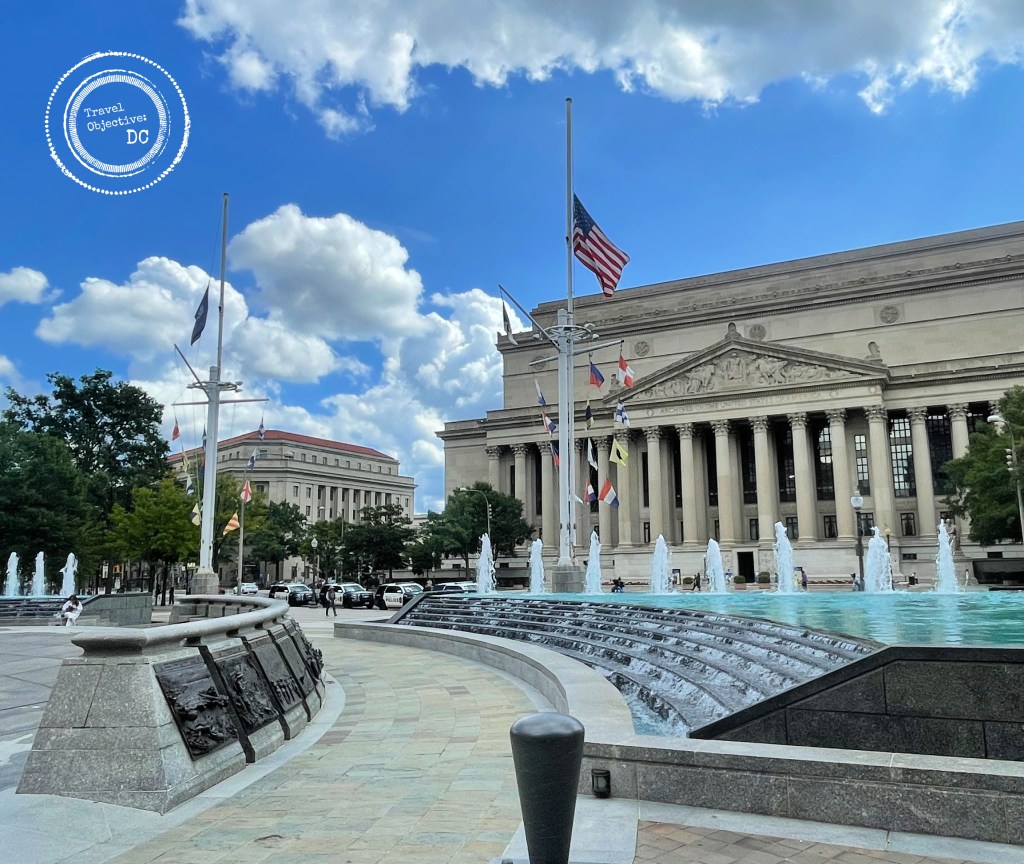
The Navy Memorial Plaza

The Navy Memorial Plaza looking south toward the National Archives

The whole process from the founding of the memorial to its completion stretched to almost a decade. The Navy Memorial was formally dedicated on October 13, 1987 by President Ronald Reagan. He devoted it to all who have served, are serving or will serve in the United States Navy, Marine Corps, Coast Guard and Merchant Marine. 

The memorial is set within a broad circular plaza to the northwest of the intersection between 7th Street and Pennsylvania Avenue. Early designs for the memorial favored a more traditional approach, but they were discarded in favor of a memorial with a more open space resembling a seascape.

The floor or base of the plaza depicts a large world map.  With a diameter of 100 feet, it is said to be the largest map in the world.

Fountains at the US Navy Memorial

A set of fountains at the US Navy Memorial

Fountains skirt the southern perimeter of the map. The water flowing through the fountains comes not from Washington DC’s water supply but is collected from the world’s oceans and the Great Lakes.

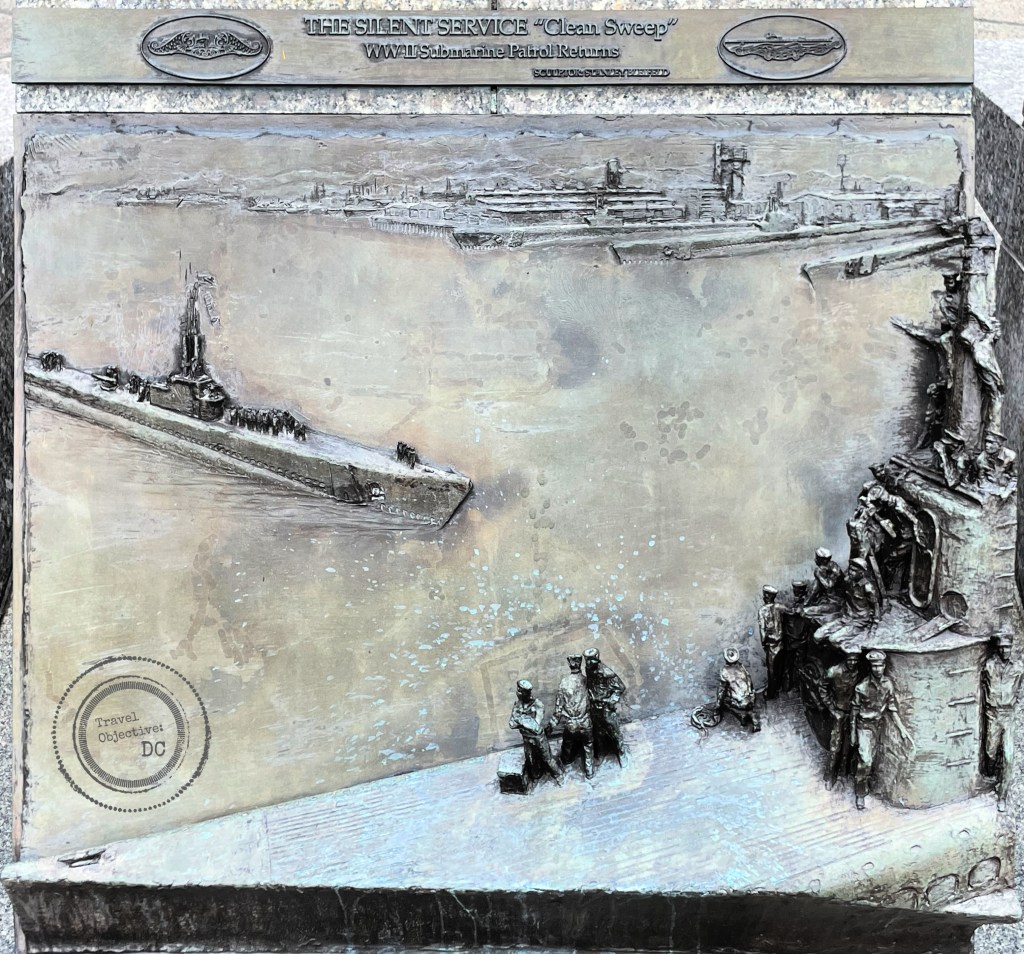
A semicircular wall inside the fountains contains a series of 26 bas-relief figures depicting scenes of Navy history and Navy life as well as the contributions of maritime partners. 

Arrayed around the memorial are quotes about the Navy from sailors at all levels. Six masts fly the flags of the United States, the Navy, Marine Corps, Coast Guard, Merchant Marine and the POW/MIA flag.

Bas Relief sculpture of Navy submarines in World War II.

Bas Relief sculpture of Navy submarines in World War II

Sweeping arches incorporated into the design of two mixed-use commerical buildings suggest a northern perimiter to the memorial, balancing the fountains and sculpture walls on the southern side. The neoclassical design of these buildings seemingly provides a sense of the shore or anchorage to the airy, open plaza.

Amidst all this stands The Lone Sailor. The statue has been so enthusiastically received by the Navy community, there are 18 more Lone Sailor statues across the United States (and one at Utah Beach in Normandy). In each location, the statue reminds the community of the dedication and professionalism of the American sailor. 

Bas Relief Sculpture of Captain John Paul Jones

Bas Relief Sculpture of Captain John Paul Jones

Early in the design phase, the Navy identified a desire to have a “living memorial,” a place where people would gather and return to time and again. The open space makes the memorial a popular venue for summer concerts, reenlistments, promotion ceremonies, wreath layings and reunions.

In keeping with the desire for a living memorial, the Navy Memorial Foundation located a visitor center in one of the adjoining buildings. Part research facility, part musuem and part community center, the visitor center brings the Navy experience alive for the landlubber while instilling pride in all Navy sailors. There are exhibits on the missions of the post 9/11 Navy, multiple Navy leaders, and the important role played by chief petty officers.

The visitor center also houses the Arleigh Burke Theater. In addition to running several short movies on Navy life throughout the day, as well as periodic feature films, the theater hosts guest speaker programs. Visitors can find a variety of mementos from all the US military services at the Ship’s Store gift shop.

A video screen displays the Navy Log.

A video screen displays the Navy Log throughout the day.

There is also a feature known as the Navy Log, an online archive with details of the men and women who have served in all the sea services. There are currently over 750,000 entries. Active members, veterans or their loved ones are invited to add to this number and enter a service member’s information as an ongong tribute to their time in uniform.

As the US Navy observes its 250th Anniversary, the US Navy Memorial is a place for everyone to discover and honor America’s rich naval heritage. Whether you are active, retired, reserve or the relative or friend of someone who has served, the Navy Memorial is an important and worthwhile destination for any visit to Washington, DC.

***

 I can imagine no more rewarding a career. And any man who may be asked in this century what he did to make his life worthwhile, I think can respond with a good deal of pride and satisfaction: ‘I served in the United States Navy.’

President John F. Kennedy

Route Recon

The US Navy Memorial is located at 701 Pennsylvania Ave, NW Washington, DC 20004. 

The Memorial is accessible 24 hours a day.

The Visitor Center is open seven days a week from 9:30 AM to 5:00 PM.

The Navy Memorial hosts numerous events throughout the year. Some events may close the Visitor Center to the public. Be sure to check the Memorial’s website and find additional information about upconing events on the calendar

The closest Metro Station is Archives-Navy Memorial-Penn Quarter on the Green and Yellow Lines.

Parking:
Validated parking is available at PMI Garage, 875 D Street, NW.
Parking can be validated for $13 inside the Ship’s Store, located in the Navy Memorial Visitor Center.

Revisiting the War Above the Trenches at the National Air and Space Musuem

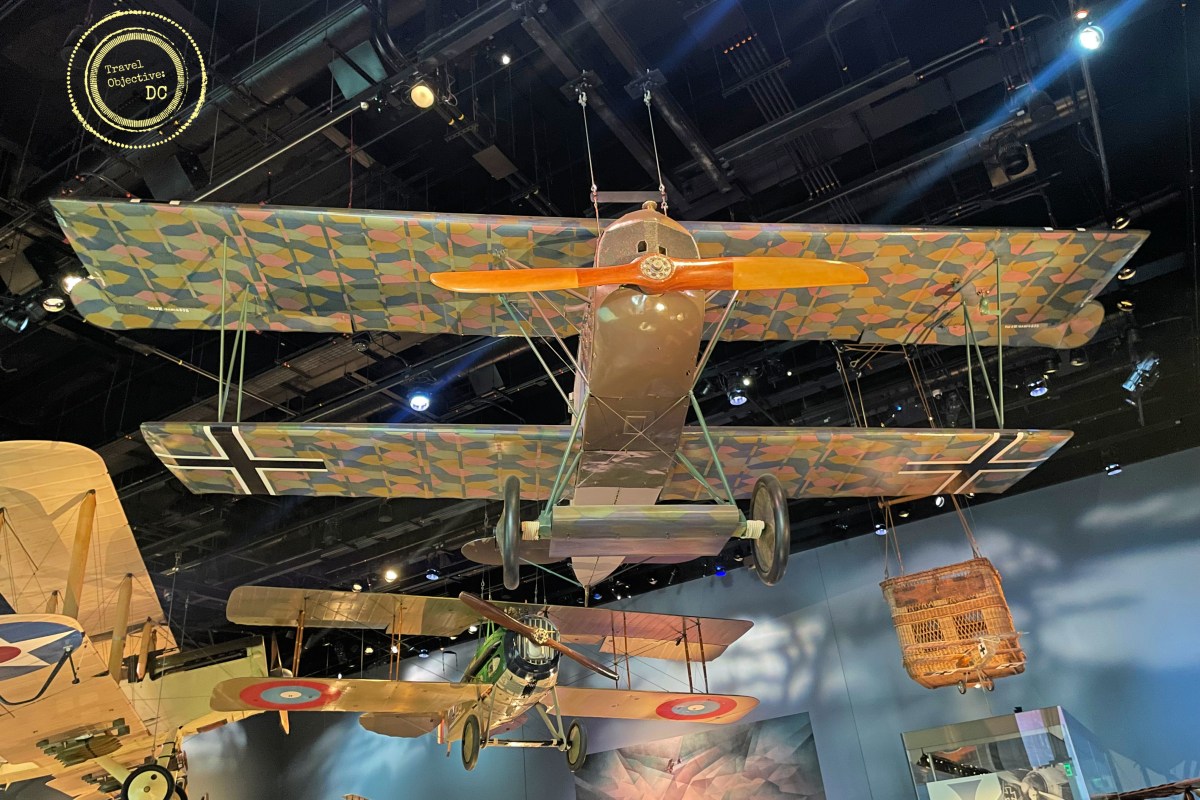
A German Fokker D.VII Fighter

Lieutenant Arthur Raymond Brooks, US Army Air Service, knew he was in for a fight.

In the skies above Mars-la-Tour, France on September 14, 1918, Brooks and his squadron of six SPAD XIII fighters encountered four squadrons of German Fokker D.VIIs. As the fighter planes engaged each other, Brooks flew directly into German machine gun fire. He then quickly pulled away from his main formation with eight German fighters in pursuit. 

Brooks next used all the maneuver capabilities the SPAD could provide to avoid being caught in a Fokker’s line of fire. He did barrel rolls. He flew in loops. He quickly climbed, then rapidly dove.  

As the melee continued, Brooks fired on multiple Fokkers as they all weaved through the sky, downing two. German fire shattered his windshield and damaged one of his two machine guns. His SPAD was riddled with bullet holes.  Yet he stayed in the fight. Brooks anecdotally shot down four German fighters that day (although he was only credited with two) and was awarded the Distinguished Service Cross for his actions.

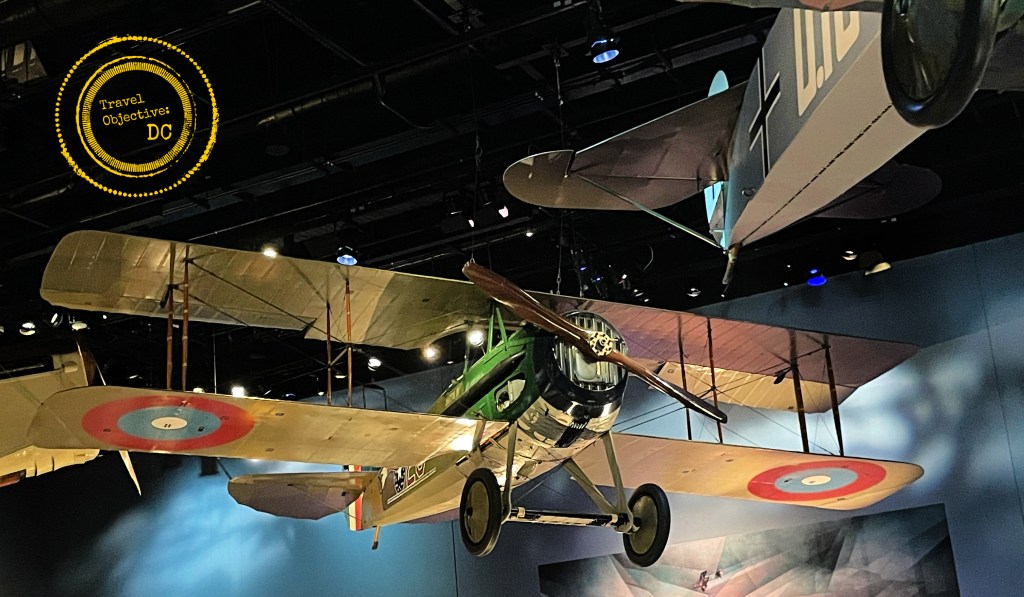
A SPAD XIII Fighter at the National Air and Space Musuem

The SPAD XIII FighterBuilt by the Société Pour L’Aviation et ses Dérivés (SPAD) company, the SPAD XIII was preferred by French aces. The US Army Air Service also flew SPADs. Ray Brooks flew this SPAD in October 1918.

Ray Brooks is just one pilot whose aerial exploits are recounted in the Smithsonian Institute’s National Air and Space Museum’s (NASM’s) redesigned World War I aviation exhibit entitled World War I, the Birth of Military Aviation.

This is NASM’s third exhibit dedicated to the aircraft and aerial warfare of the First World War.  The earlier exhibit, entitled Legend, Memory and the Great War in the Air, closed in 2018 as NASM prepared for a musuem-wide refurbishment. The new iteration explores the twin themes of how “the Great War” defined the on-going nature of military aviation as well as the remarkable experiences of World War I aviators.

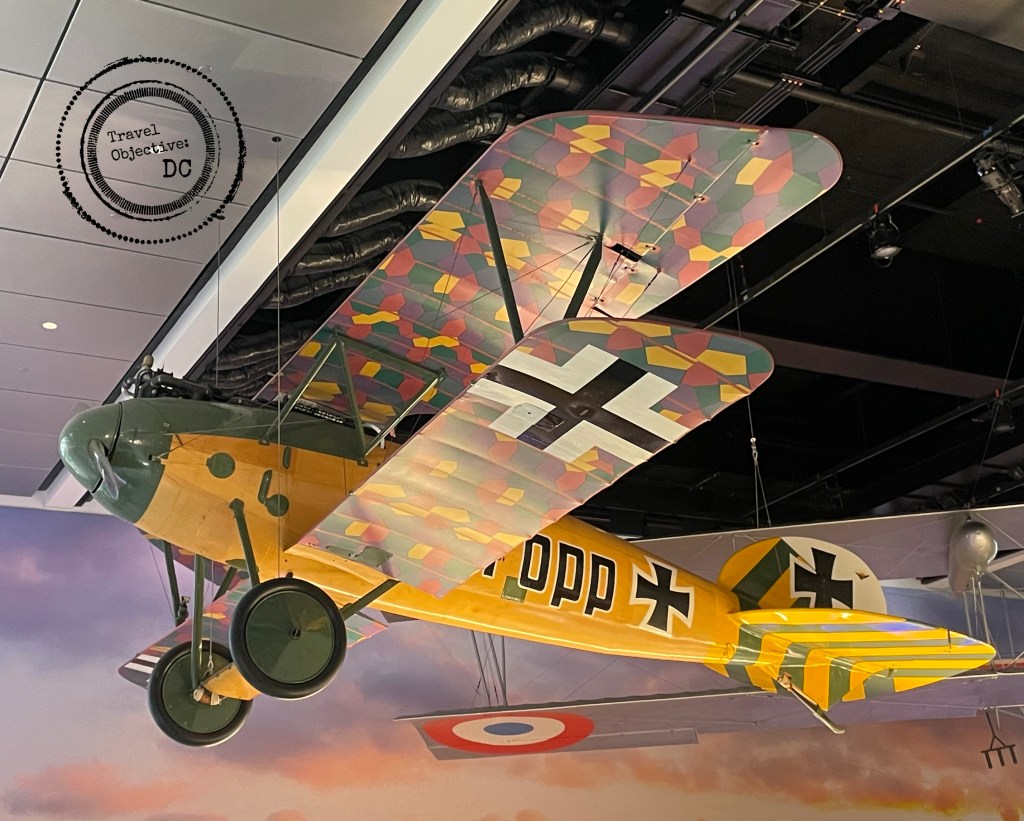
There is much to see in the new gallery, but the meticulously restored World War I aircraft are the main attraction. Many of the World War I airplanes previously displayed are back. Greeting you from overhead as you enter the exhibit hall are the French Voisin Type 8 nighttime bomber and the German Albatross D.VA, a fighter that debuted in 1917. Other aircraft include the Fokker D.VII German fighter, Ray Brooks’ SPAD XIII fighter and the DH-4 Liberty Plane.

A German Albatross D.Va Fighter – These fighters were introducted in 1917.

A German Albatross D.Va Fighter at the National AIr and Space Musuem

The latest exhibit occupies a smaller footprint than its predecessor, but NASM’s designers have filled the space with a wide range of intriguing artifacts, vintage aircraft, airplane models and other displays. 

The exhibit timeline from 1914 through the post-war period is arranged in a counterclockwise manner around a beautifully restored Sopwith F.1 Camel (the last surviving Camel fighter produced by the Sopwith Aviation Company).  Once a pilot mastered the British-made aircraft’s finicky controls, the Camel was a highly versatile fighter. It is credited with downing more enemy aircraft than any other Allied plane.

Unlike other aircraft on display, the Sopwith Camel is placed on the floor making it the easiest to see and admire.

Adjoining the Camel is a large movie screen surrounded by a tent-like frame, suggesting an early aerial hanger. A four-part narrated film plays on a loop showing period aircraft in flight. The film provides a wonderful sense of motion to these beautiful but otherwise static aircraft.

A Sopwith F.1 Camel at the National Air and Space Musuem

The Sopwith F.1 CamelThis aircraft is the last surviving F.1 Camel built by the UK’s Sopwith Aviation Company.

Through the war years, three distinct types of military aircraft evolved–reconnaissance planes, fighters and bombers–reflecting the three original mission areas of military aviation.

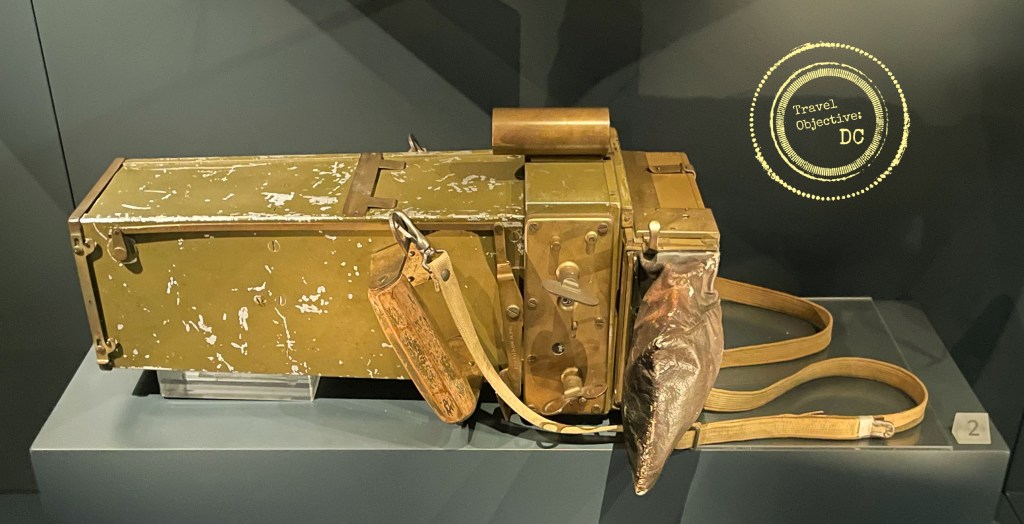
To battlefield commanders, the airplanes’ most critical function was reconnaissance and observation. Trench warfare had ended the traditional scouting role of horse cavalry, but aircraft could find, fix and observe the enemy from above. Reconnaissance aircraft were built to direct artillery fire, track troop deployment, assess damage and relay messages over long distances. Planes were fitted with cameras and communications equipment, essentially becoming the commanders’ eyes and ears. Pilots and observers risked their lives to take photographs, which were now an important element of military planning.

A Kodak A-2 Oblique Aerial Camera. A 4″x5″ glass plate was changed out each time a picture was taken.

A Kodak A-2 Oblique Aerial Camera at the National Air and Space Musuem

Fighter aircraft were first developed to protect the reconnaissance planes. Ultimately, the fighters would engage each other to control the airspace over the trenches. Later in the war, Britain and Germany formed special fighter squadrons to directly attack troops on the ground.

Airships also conducted reconnaissance as well as bombing missions. However, their large size and slow speed made them susceptible to attack by fighters. They were generally replaced on bombing missions with specialized aircraft capable of flying further and higher while carrying heavier bomb loads.

 A German aviation insignia

Cross insignia from a German airship – This design was the official emblem of the German Air Service until mid-1918.

World War I gave rise to the military aviator as a distinct specialty. Some aviators, especially pursuit (later called fighter) pilots, took on a mythic status in their home countries.  Flying high above the mud and blood of the trenches, these pilots were heirs to the chivalrous legacy of knights in armor. Pilots were written about in newspapers, appeared on magazine covers and made public appearances.

Prominent pilots included in the exhibit include Eddie Rickenbacker (America’s most decorated WWI ace), Manfred von Richtofen (The Red Barron), Eugene Bullard (African-American pilot flying for the French), Raol Lufbrey (a French-American ace), and Snoopy. (OK, Snoopy was not a real pilot, but he does have his own display, which is, of course, by the Sopwith Camel).

Among all the aircraft and artifacts, there are many interactive features as well. You can use a light table to analyze period photo imagery from a reconnaissance aircraft, learn how a synchronizer allowed machine gun bullets to miss propeller blades, and take the controls of a Sopwith Camel to experience the sounds of this highly maneuverable fighter. An immersive exhibit on trench warfare at first seems rather two dimensional. However, a look through trench periscopes provides some basic context on the infantryman’s view of aviation.

Snoopy first imagined himself flying his doghouse in 1965. Through the comic pages, as well as books, games, cartoons, and toys, Snoopy has been a consistent reminder of World War I aviation.

A collecton of artifacts celebrating Snoopy, the World War I ace.

At the beginning of the war in the Summer of 1914, the airplane was still a novel invention, a little more than a decade old. Very few aircraft were designed for any military purposes. As the war progressed, rudimentary flying machines quickly became faster, more maneuverable and better armed.

Airplanes were also needed on a large scale. Over 215,000 aircraft were built between 1914 to 1918. A myriad of new products were developed or adapted for use in aviation such as specialized cameras, radios, and aerial bombs. Many items first developed in World War I are still used in modern aviation, like the artificial horizon instrument, flight suits, and oxygen masks to name just a few. This sudden and sustained demand for combat aircraft and accessories gave rise to a new industry filled with highly skilled workers, an industry we rely on today.  

A collection of World War I aircraft propellers

American, British and French propellers

Although World War I ended over a century ago, its impact is still very much felt today. World War I, the Birth of Military Aviation provides valuable insight into an important but not altogether well understood period in the history of aviation. The gallery’s opening is also an important and welcome step toward the completion of NASM’s comprehensive, multi-year renovation.

* * *

Route Recon

The Smithsonian Institute’s National Air and Space Museum (NASM) is located on the National Mall bordered by Independence Avenue, Jefferson Drive, and 4th and 7th Streets, SW. The entrance is on the north side of the building facing the National Mall. You cannot access the museum from the south side along Independence Avenue. Free timed tickets are required for entry into NASM. Tickets can be acquired through the NASM website. Ticket holders will line up near the entrance on the Mall side of the Museum building prior to their entrance time. Entry prior to the time on the ticket is not allowed, but ticket holders can enter after the ticket time.

Parking – Very limited metered street parking is available around the museum. Parking is available in several commercial parking lots in the neighborhood.

Public Transportation

Metrorail – The closest Metro station is L’Enfant Plaza, along the blue, orange, silver, and green lines. From the L’Enfant Plaza Station, take the exit for Maryland Avenue and 7th Street.

Metrobus – Bus stops are located on Independence Avenue, SW, and along 7th Street, SW. Visit the Washington Metropolitan Area Transit Authority for more information.

Command Reading

Capt. Arthur Ray Brooks, America’s Quiet Ace of W.W.I by Walter A. Musciano – Originally published in 1963, Musciano’s concise work provides a brief overview of Brooks’ life with some straightforward accounts of World War I aerial combat. It also includes an interesting assortment of historic World War I photographs of Brooks and his fellow aviators as well as detailed informaton on the aircraft Brooks flew.

Remembering President James Garfield


Today, few Americans could tell you very much about James Abram Garfield, our 20th President. A few people with an interest in history might recall that Garfield was assassinated early in his presidency by a “disgrunted office seeker”. Professional historians generally rank his shortened presidency as “below average” or do not rank him at all. 

This is rather regrettable as Garfield was a courageous and dedicated leader who died for fighting what he believed in. Fortunately, he has one distinction the vast majority of presidents will never have: his own memorial on the US Capitol grounds. 

One of three monuments on the west side of the Capitol building adjoining the National Mall–along with the Ulysses S. Grant Memorial and the Peace Monument–Garfield’s monument is located within a traffic circle at the intersection of First Street SW and Maryland Avenue near the US Botanic Garden.

The Garfield Memorial on the west grounds of the US Capitol

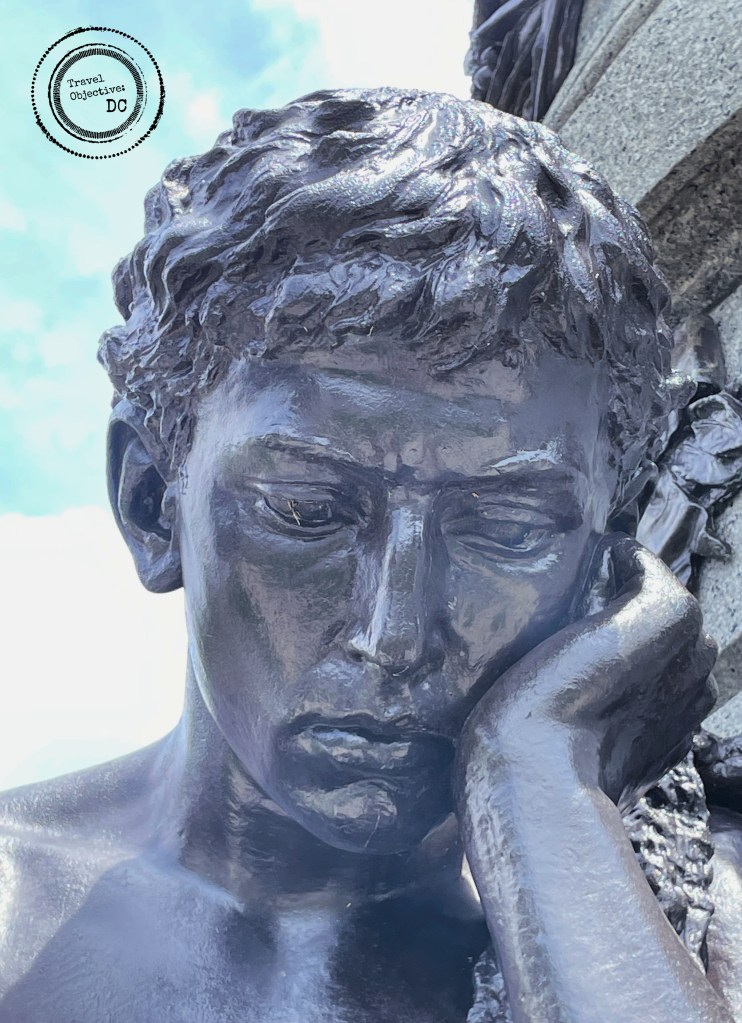
John Quincy Adams Ward, a prominent 19th century sculptor and friend of Garfield designed the monument. Ward depicted Garfield in bronze atop a round, tapered granite pedestal. He is shown giving a speech, grasping a scroll in his left hand and gazing intently at his audience. His foot is placed slightly off the platform and meant to symbolize Garfield as a man of action. At the base of the pedestal are three classical Roman figures representing the key phases of Garfield’s life as a young scholar, military leader and statesman.

Garfield personified the American success story, so much so that renowned author Horatio Alger wrote his biography. Alger published From Canal Boy to President in 1881.  

James Garfield was born in 1831 in a log cabin in northeastern Ohio. His family was poor and his father died when Garfield was a young man. He went to work to support his family, taking a variety of jobs including helping tow canal boats. While recovering from a serious bout of malaria contracted on the canal, Garfield’s mother convinced him to return to school. Garfield was an excellent student with a strong work ethic. He took to his studies and worked his way through the Western Reserve Eclectic Institute as a janitor and school teacher.  After graduation, he became a preacher. Garfield then studied law at Williams College in Williamstown, MA. 

The face of the young scholar figure on the Garfield Monument

Between his jobs as a preacher, teacher and lawyer, Garfield became a skilled orator. He entered politics and was elected to the Ohio State Senate as a Republican in 1860. As the Civil War broke out, Garfield was an abolitionist dedicated to the Union’s cause. He led fundraising and recruitment efforts for Ohio volunteer regiments. 

Eager to enter the Army, Garfield began studying military tactics.

Garfield commanded a Union Army brigade at the Battle of Middle Creek near Prestonsburg, KY in January 1862. Under his steady leadership, Garfield’s troops routed the rebel forces who retreated into Virginia. Although not considered a major battle today, the victory was an important boost to Union morale and brought Garfield widespread recognition. 

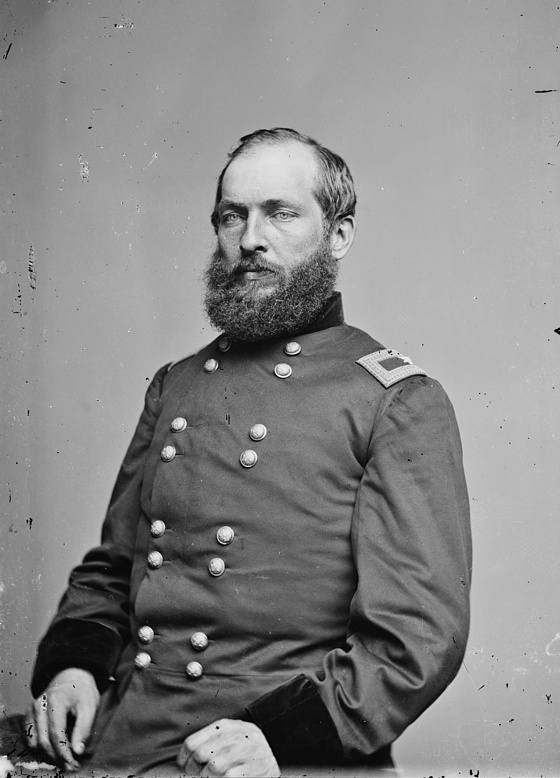
After the battle, Garfield was promoted to brigadier general. He was later assigned as Chief of Staff to General William Rosencrans of the Army of the Cumberland. After the decisive Union loss at the Battle of Chickamauga, Ulysses S. Grant relieved Rosencrans of command. Rather than Garfield, Grant appointed George H. Thomas to succeed Rosencrans. Although Garfield was later promoted to Major General, being passed over for the army command led him to consider a return to politics.

Photograph of James Garfield as Brigadier General

Brigadier General James Garfield, circa 1862

-Retrieved from the Library of Congress

In 1862, Garfield won an election for a seat in the House of Representatives. Garfield would serve nine terms in the House representing his home state of Ohio. While in Congress, Garfield was known for supporting civil rights for African Americans, the gold standard for the US dollar, and improving education for all. He helped establish the Federal Bureau of Education in 1870 to study and enhance educational methods across the country.

Garfield excelled as a Congressman, chairing powerful committees and mastering the nuanced details of legislation, especially on financial matters. At the same time, he was affable, a good conversationalist and considered one of the nicest men in Washington. 

At the deadlocked Republican presidential convention in 1880, Garfield was nominated on the 36th ballot. He defeated his fellow veteran Winfield Scott Hancock in the general election and was sworn in as the 20th President of the United States on March 4, 1881.  (He is the only president to be elected while a serving member of the House).

Republican Campaign Poster from the 1880 Presidential Election

During his presidency, Garfield fought one very significant battle.

His victory in that battle still impacts us today.

It had long been the practice in America that Federal employees were selected based on their demonstrated loyalty to political parties. Senators and representatives from a newly elected president’s party would act as “patrons” and recommend party workers, relatives and financial backers to the administration for government jobs.  

In the 1870’s, the issue of patronage was splitting the Republican party. Many wanted to maintain patronage while others wanted reform. Garfield opposed the patronage system and was a proponent of a professional, apolitical civil service. He knew it would make the Federal government much more efficient, limit corruption, and relieve elected officials from constant demands for jobs.

Garfield staged a showdown with New York’s two powerful Republican senators who were both savvy practitioners of the patronage system. Garfield nominated his own candidate for the important position of customs collector in the Port of New York. The two New York senators resigned in protest fully expecting to be quickly returned to office by the New York legislature. However, during their absence from Washington, Garfield pushed his nomination through the US Senate, embarrassing the two senators.

Sadly, this important victory over patronage directly contributed to Garfield’s death.

On July 2, 1881, Garfield was preparing to board a train at Washington’s Baltimore and Potomac Railroad Station. Suddenly, two shots rang out, striking Garfield in the arm and back.  Garfield’s assailant was Charles Guiteau, who may forever be known in history books as the “disgruntled office seeker”.  

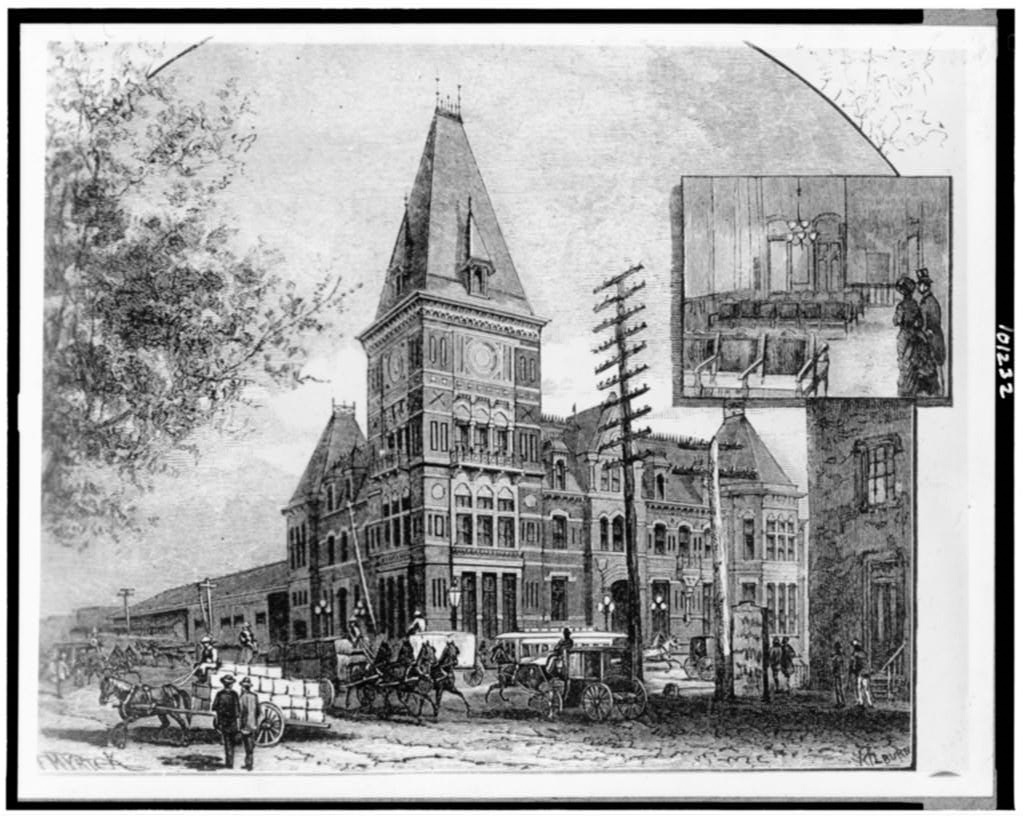
The old Baltimore and Potomac Railroad Station. The station was demolished in 1907 after Union Station was opened. The station was located where the West Building of the National Gallery of Art stands today. [Undated photo]

-Retrieved from the Library of Congress

Photograph of the old Baltimore and Potomac Railroad Station in Washington, DC

Guiteau had written, delivered and published a speech supporting Garfield in the election. He thought this entitled him to a consular job at the US Embassy in Paris. While Guiteau had no dislike for Garfield as a person, he believed he would help preserve the patronage system by killing the president. Guiteau was quickly apprehended in the train station. He was later found guilty of murder and executed about 18 months after the shooting. 

The cover of Puck, a 19th century satirical magazine from July 13, 1881 with an image of Garfield's assassin Charles Guiteau

The cover of Puck, a 19th century satirical magazine from July 13, 1881 with an image of Garfield’s assassin Charles Guiteau holding an extortion note.

Garfield would linger on for the next two months. On September 19, 1881, he died from sepsis poisoning, just five and an half months into his presidency.

In the wake of Garfield’s death, Congress passed the Pendleton Act, which established a merit-based system for hiring and promoting Federal employees. The Pendleton Act was signed into law by the new president, Chester A. Arthur, who previously had been a supporter of the patronage system. As a surprise to many, Arthur quickly set about implementing its provisions to reform the civil service. 

The country closely followed Garfield’s deterioration and he was widely mourned after his death. Work then quickly began on building him a suitable memorial. The Society of the Army of the Cumberland, a Union veterans’ organization, formed a fundraising committee and ultimately raised over $28,000. They also successfully lobbied Congress for additional funds for the statue and the pedestal.

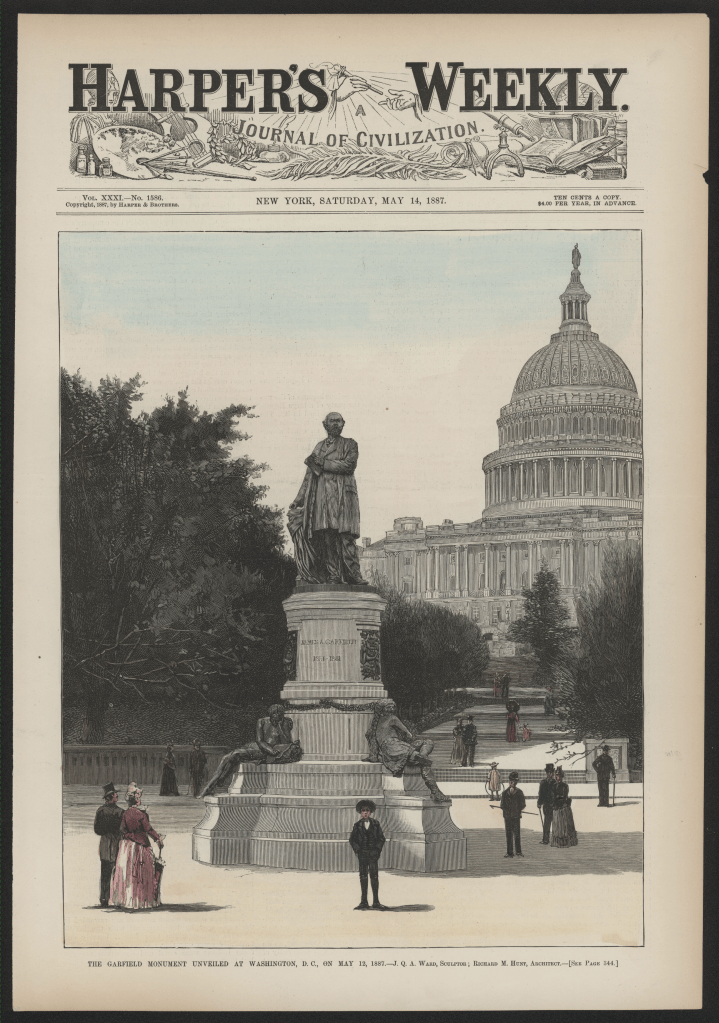
The newly unveiled Garfield Memorial was prominently placed on the cover of Harper’s Weekly on May 14, 1887.

The cover of Harper's Weekly from May 14, 1887.

The memorial was dedicated on May 12, 1887, in a grand ceremony attended by President Grover Cleveland, many senior government officials, military leaders and veterans from the Society of the Army of the Cumberland and the Grand Army of the Republic. Cannon salutes were fired and the US Marine Corps Band played stirring patriotic music.

Today, the Garfield Memorial remains a prominent and visible reminder of the talented, resourceful and considerate man who was our 20th president. 

* * *

Route Recon

The Garfield Memorial is located within a traffic circle at the intersection of First Street SW and Maryland Avenue near the US Botanic Garden.

There is limited street parking nearby near the Botanic Garden.

The closest Metro Station is at L’Enfant Plaza. Exit the station through Entrance A for 7th Street and Maryland Avenue. Follow Maryland Avenue to the northwest, pass the Dwight D. Eisenhower Memorial and the US Botanic Garden.

They Answered the Call to Arms

As the smoke cleared at Lexington and Concord on that fateful April day in 1775, supporters of American independence relished in the successes of the brave militia forces. 

But they well understood the cause for independence would take a well-trained regular army capable of defeating the British on an open battlefield. Furthermore, this army needed to represent all of America and not dominated by a single colony or region. 

On June 14, 1775, the Continental Congress established the Continental Army and appointed George Washington as its commander in chief. In recognition of the Army’s 250th Anniversary, the National Museum of the US Army, at Fort Belvoir, Virginia has opened a special exhibit entitled Call to Arms: The Soldier and the Revolutionary War. 

A pair of epilettes belonging to Jeddidiah Huntington of Connecticut.

This pair of major general epilettes belonged to Jeddidiah Huntington of Connecticut. Huntington had encouraged George Washington to adopt this design for general officers’ epilettes.

To tell their stories, museum curators sought and received an abundance of unique and important Revolutionary War era pieces from state governments, private collectors and international organizations. The resulting assemblage of weapons, uniforms, colors and everyday articles includes items that have not before been on public display in the United States. 

The 5,000 square foot exhibit is laid out in roughly chronological order. Two innovative topographical battle maps–one of Bunker Hill, the other of Yorktown–bookend the exhibit representing the first and the final battles for the Continental Army.  Similar to the twinkle light maps of the past, these three dimensional representations depict the operational plans and troop movements of each battle, accompanied by slick videos providing additional context. 

Other battles and campaigns are briefly described with corresponding artifacts, maps and illustrations to connect the visitor to the period. The early struggles in New York and Pennsylvania, the successes in New Jersey, the turning point at Saratoga and the Southern Campaign are put in context and placed in a timeline. Videos enhance these displays describing aspects of 18th century warfare, such as weapons and battlefield tactics.

These displays with brief summaries are a reminder that these battles were fought by soldiers from across the new country. In an era when few people traveled very far from their homes, New Englanders fought in South Carolina and Virginians fought in Pennsylvania. The seeds of our national identity were planted on the battlefields of the Revolutionary War.

A British 3-Pounder gun tube captured at the Battle of Saratoga

A British 3-Pounder gun tube captured at the Battle of Saratoga

Those interested in 18th century weaponry will not be disappointed in their visit. There are many splendid muskets, rifles, carbines, pistols, swords and bayonets. However, the real focus of Call to Arms is the lives of Continental Army soldiers, their motivations, successes, experiences and how they emerged as an effective fighting force.

The lot of a soldier in the Continental Army was a difficult one. Living conditions were challenging, pay was inconsistent, rations and supplies were usually in short supply. These rigors of military life were shared by soldiers from every state.

Still, Americans from the north and south, coastal cities and frontier homesteads answered the call. Then, as now, soldiers enlisted for different reasons. They fought for independence, but also for their communities, comradery, pay, a sense of adventure or because other family members or friends also enlisted.

A plaster casting of Anna Maria Lane, wife of Private John Lane.

A plaster casting of Anna Maria Lane, wife of Private John Lane. She followed her husband to camp when he enlisted in the Continental Army in 1776. She took up arms herself and was wounded at the Battle of Germantown in 1777.

Over the eight years of Revolutionary War, about 231,000 men (and some women) served in the Continental Army.  Enlistments would ebb and flow based on any number of factors, such as the time of year, local economic conditions and success of the army in the field. The maximum size of the army at any one time was about 48,000 troops.

A portion of the exhibit entitled Camp Life explores the life of the Continental Army soldier away from the battlefield. What soldiers ate, where they lived and their daily activities, such as drill, guard duty and the building of fortifications, are all examined.

A notebook belonging to British Major John Andre. His capture in 1780 led to the identification of General Benedict Arnold as a traitor.

A notebook belonging to British Major John Andre.

One of the more intriguing group of artifacts are a display of powder horns. These hollowed-out animal horns were essential kit for 18th century soldiers, allowing them to quickly add gunpowder to the flashpans of their flintlock muskets.  Soldiers often decorated their powder horns or used them to record important dates or locations.

Accompanying the display is a video screen where digitized images of the complete powder horns can be viewed by visitors to more clearly see the intricate designs. Information about the original owner is also available. The richly decorated powder horns remind us these early soldiers were more than faded names on yellowed muster rolls, but real people fighting for something they believed in. 

A powder horn belonging to Private John Bond of Massashusetts.

A powder horn belonging to Private John Bond of Massachusetts. Bond enlisted in the Continental Army on July 4, 1775 and served for five years. He fought at the Battle of Bennington in 1777.

Also included in the exhibit are several very detailed cast figures representing specific individuals who served with the Continental Army. There is southern aristocrat, a Native American tribal chief, even a married couple who served together. They add an important human element to the exhibit’s interesting array of artifacts, well-designed graphics and use of technology.

Continental Army soldiers met many struggles during their service. Sadly, they encountered more upon returning home.

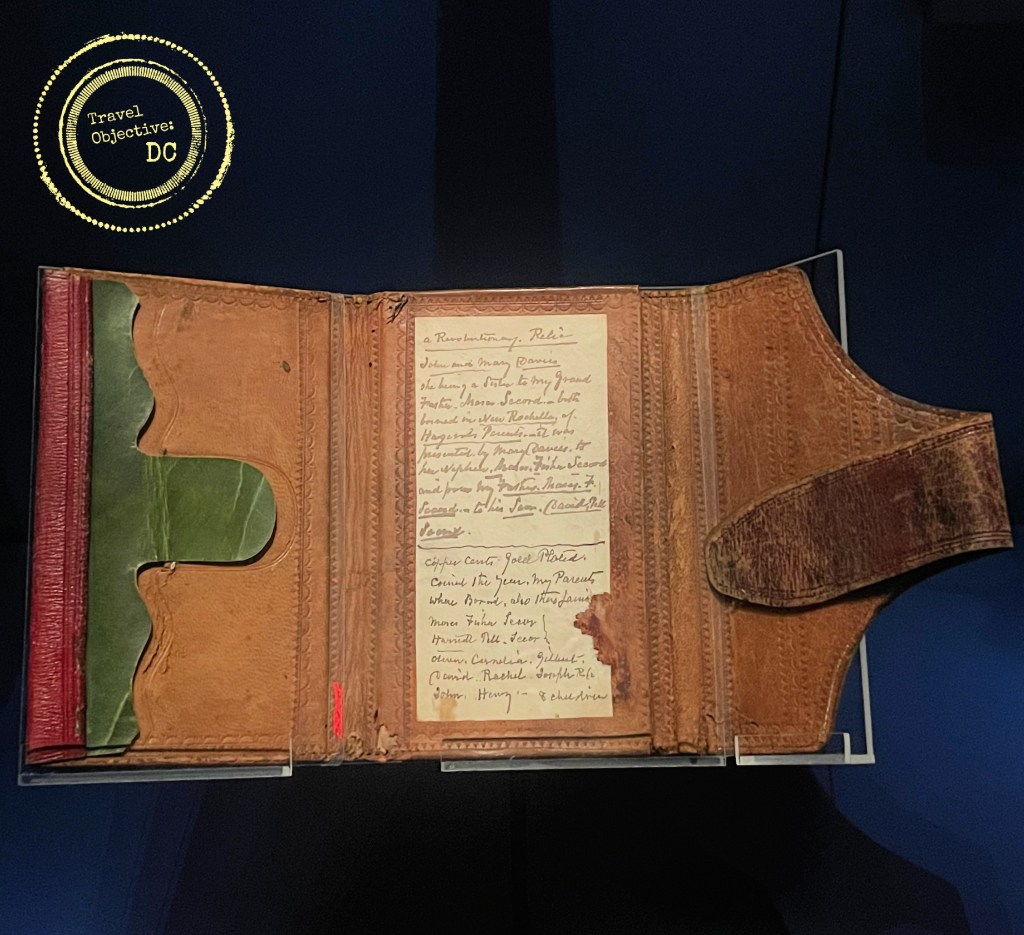
At the end of the exhibit is a collection of documentation which mark the beginning of the process well known to today’s veterans and their families, applying for benefits.  At the end of the war, many soldiers went home with promissory notes in lieu of their pay and they struggled economically. Legislation to provide pensions to veterans was slow in coming.

Congress did not pass legislation providing pensions to common soldiers until 1818, thirty-five years after the end of the Revolutionary War. By this time, many veterans had died or lost important records that proved their service.  This display though shows pension applications and examples of the documents that Continental Army veterans or their survivors would provide, such as muster roles, discharge papers, and pay records.

The discharge document of Drummer Benjamin Loring of the 2nd New York Artillery.

Discharge document of Drummer Benjamin Loring

Call to Arms artfully tells the story of the Continental Army, with its wonderful artifacts and state of the art technology. It reminds us of an important lesson first demonstrated by the Continental Army and continued in today’s United States Army.

George Washington reflected on it in his farewell message to his troops as he wrote: Who that was not a witness would imagine … that Men who came from different parts of the Continent … would become but one patriotic band of Brothers.

Washington well understood the unity forged among his soldiers was crucial for achieving their shared goal of victory.

250 years later, it is still a lesson to remember.

* * *

Route Recon

Call to Arms is on display at the National Musuem of the United States Army until June 2027. The musuem is open daily from 9:00 AM – 5:00 PM except on Christmas Day. Visit the museum’s website for free entry tickets.

The musuem is located in a publically accessible portion of Fort Belvoir, Virginia. The museum address is 1775 Liberty Drive, Fort Belvoir, VA 22060, but be aware not all GPS systems recognize the Museum’s street address.

You can download a map with directions here.

Logan’s Legacy

The heavily mustachioed bronze visage of Major General John Alexander Logan gazes down upon his namesake park and traffic circle in Northwest Washington, DC.

Logan Circle sits at the confluence of four busy thoroughfares. Enclosed within the circle is a popular and well-tended 1.8 acre park with ample benches shaded by oak trees and dotted by interpretive signage. 

These landmarks ensure Logan’s name is familiar to many Washington-area residents. Unfortunately, few may know his story, which is replete with service to our country. 

Photograph of John A. Logan, circa 1880.

John Alexander Logan, circa 1880

-Dewitt C. Pratt, Photographer; Photo Courtesy of the Library of Congress

During the Civil War, Logan was considered a “political general”. He began his political career as a Democrat in the Illinois legislature, aligning himself closely with the state’s leading political figure at the time, Stephen Douglas. Representing a district in southern Illinois, he strongly supported the enactment and enforcement of fugitive slave laws.

In 1858, he was elected to the US House of Representatives. After the firing on Fort Sumter and the succession of several Southern states, however, Logan used his tremendous oratorical skills both in Congress and in communities across his home region to promote the importance of a strong Union.

In June of 1861, while still a member of Congress, Logan attached himself as a civilian volunteer with a Michigan regiment and saw combat at the First Battle of Bull Run. In the aftermath of the battle, he eluded rebel fire while retrieving and caring for the wounded. Now determined to fight for a Union victory, he returned to his district in Illinois, raised a volunteer regiment and was appointed its colonel. 

John Logan's equistrian statue in Logan Circle Park in Washington, DC.
Statue of John A. Logan in Logan Circle Park

Unlike many of his contemporary politicans who donned military uniforms, Logan distinguished himself on the battlefield as a troop commander and tactical leader. He led his troops to victories in multiple battles, including Fort Donelson, Vicksburg, and Atlanta, and was seriously wounded on several occasions. He rose to the rank of Major General of Volunteers and briefly commanded the Union Army of the Tennessee. 

Logan inspired tremendous loyalty and dedication in his soldiers. His colleague General Mortimer Leggett said of Logan: He … seemed to have the power to call out of the men every particle of fight that was in them.

After the war, Logan returned to Congress. Switching parties, he was elected to three more terms in the House of Representatives and three terms in the Senate, representing Illinois as a Republican. His views on race seemed to switch as well. During this period, he was a strident advocate for African American rights and urged passage of the 14th and 15th Amendments. 

Bas-relief sculpture of John Logan’s swearing in as a United States Senator from his statue in Logan Circle Park

Bas-relief sculpture of John Logan's swearing in as a United States Senator from his statue in Logan Circle Park

He was also an early supporter of women’s suffrage, backed public education for all, and worked tirelessly to secure greater pensions and other benefits for veterans. 

Logan was considered by many Republicans as a potential presidential candidate. In 1884, he unsuccessfully ran for Vice President on the Republican ticket headed by James G. Blaine of Maine, losing to Grover Cleveland and Thomas Hendricks. 

His veterans advocacy led to his selection as the National Commander of the Grand Army of the Republic (GAR), the powerful Union veterans’ organization. It is here that Logan left his best known mark on American culture. In 1868, Logan directed GAR posts nationwide to decorate the graves of Union war veterans on May 30 when an abudance of flowers would be in bloom. 

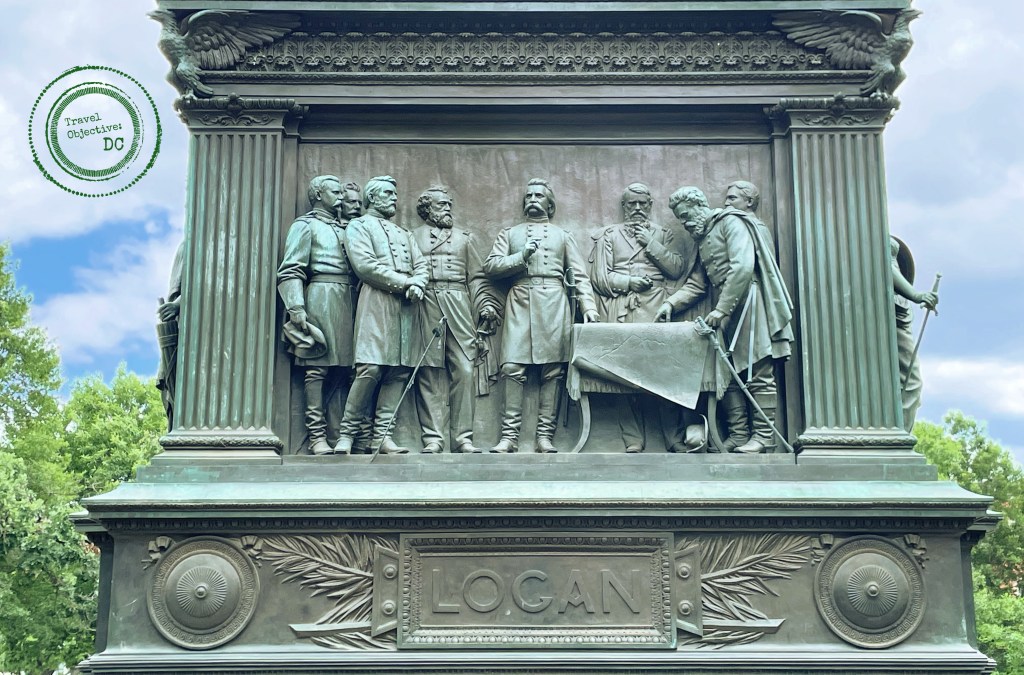
Bas-relief sculpture of John Logan conferring with fellow officers from his statue in Logan Circle Park

Bas-relief sculpture of John Logan conferring with fellow officers from his statue in Logan Circle Park

While decorating the graves of Civil War soliders was already occurring in both the North and the South, Logan’s order to the GAR expanded the practice nationwide and set a definitive date for its observance. 

In his order, Logan stressed the importance of veterans adopting and continuing this practice as he wrote: If other eyes grow dull and other hands slack, and other hearts cold in the solemn trust, ours shall keep it well as long as the light and warmth of life remains in us. 

GAR Posts readily adopted the order and organized community observances, which continued to grow in size and scope. In 1938, Congress designated Decoration Day as a national holiday on May 30.  After World War II, the term Memorial slowly replaced Decoration in the name for the day. In 1967, Congress officially changed the name of the holiday to Memorial Day. Four years later, Congress adjusted the date of Memorial Day to the last Monday in May. 

Bas-relief sculpture of Peace from John Logan’s statue in Logan Circle Park

Bas-relief sculpture of Peace from John Logan's statue in Logan Circle Park

After Logan’s death in 1886, the Society of the Army of the Tennessee led the effort to commemorate his service to the country as both soldier and statesman. Sculptor Franklin Simmons, who designed the Peace Memorial, was selected to craft a bronze equestrian statue. Logan’s figure appears atop the 25-foot-high bronze statue with bronze bas-relief panels on each side. Facing north and south are figures representing War and Peace, respectively. 

Along the eastern and western sides of the base are events from Logan’s life. Facing east is a portrayal of Logan conferring with fellow officers, while Logan’s swearing in as a US senator looks toward the west. Initially, these two images caused a minor uproar as the public realized they were factually inaccurate until Logan’s widow, Mary, explained these depictions were intended to be more illustrative rather than representing distinct historical events.   

The statue was dedicated in a grand ceremony led by President William McKinley in 1901. A large circular park known as Iowa Circle was selected as the location of the statue as Logan and his family had lived nearby. The area was emerging in the 1880’s as a fashionable middle-class neighborhood. Congress officially changed the name to Logan Circle in 1930.  While the late 20th century was a difficult time for the neighborhood, today Logan Circle is known as a trendy, gentrified area with popular restaurants, theaters and many rehabilitated historic properties. 

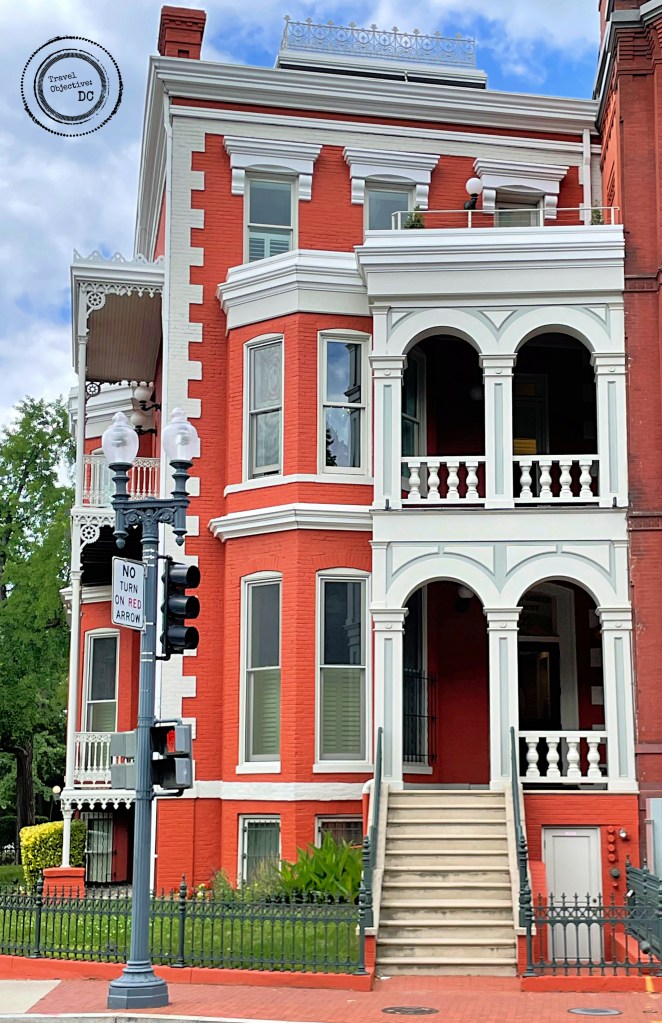
John Logan's post-war home at 4 Logan Circle NW in Washington, DC

John Logan’s post-war home at 4 Logan Circle NW in Washington, DC

Washington, DC is not alone in naming landmarks after John Logan. Across the country, there are counties, schools, plazas, a junior college, a former military post and even a national cemetery all named for John Logan.

While he might be best remembered for his contribution to creating Memorial Day, his real legacy is one of leadership and service to our country.  Whether on the battlefield, in the halls of Congress, or across Illinois, John Logan was a dedicated public servent who fought hard for a stronger country and better society. 

Route Recon

Logan Circle is located at the intersection of 13th Street, P Street, Rhode Island Avenue and Vermont Avenue in Northwest Washington.

The nearest Metro Station is Mount Vernon Square/Convention Center on the Green and Yellow Lines. It is a 15-minute walk from the station to Logan Circle.

There is street parking in the area.

Military History on the Mall


For the past 250 years, Americans have consistently answered the call to war.  

To answer that call, they often left behind civilian lives, families, and communities. Wars are never fought in a vacuum. With each conflict, there are corresponding impacts on American life and society.

On Veterans Day, 2004, the Smithsonian Institute’s National Musuem of American History, located on the National Mall, opened an ambitious military history exhibit to explore not just battles and campaigns, but rather the many ways wars have physically, culturally and economically shaped America throughout its history.

French cannon

A French four pounder field cannon, a gift to the Americans from the Marquis de Lafayette

Entitled The Price of Freedom, Americans at War, the exhibit was designed to be extensive, occuping over 18,000 square feet and examining 16 conflicts in nine different galleries. Visitors follow a maze-like path through these chronologically arranged galleries, from the French and Indian War through Iraq and Afghanistan.

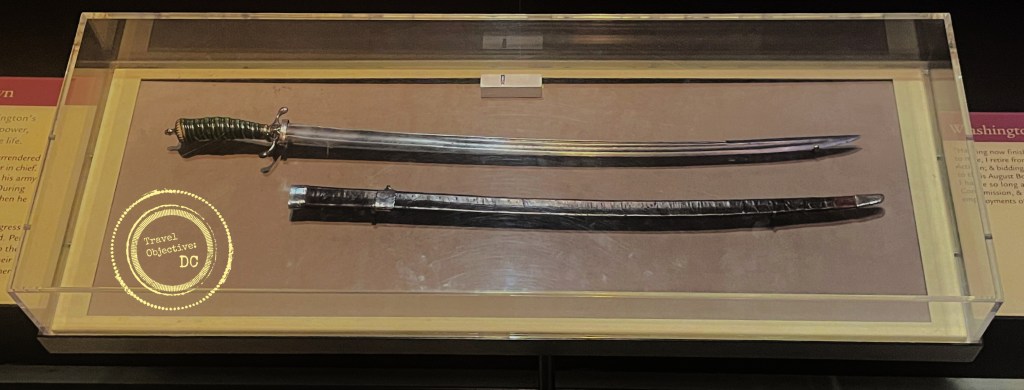
In designing The Price of Freedom, curators stayed away from displays comprised largely of weapons and uniforms (although there are still plenty of those). Rather, they identified over 800 unique artifacts from the Smithsonian’s extensive collection. Some of the more notable items on display include George Washington’s sword and scabbard, the chairs used by Ulysses S. Grant and Robert E. Lee at Appomattox and a Willys Jeep from World War II.

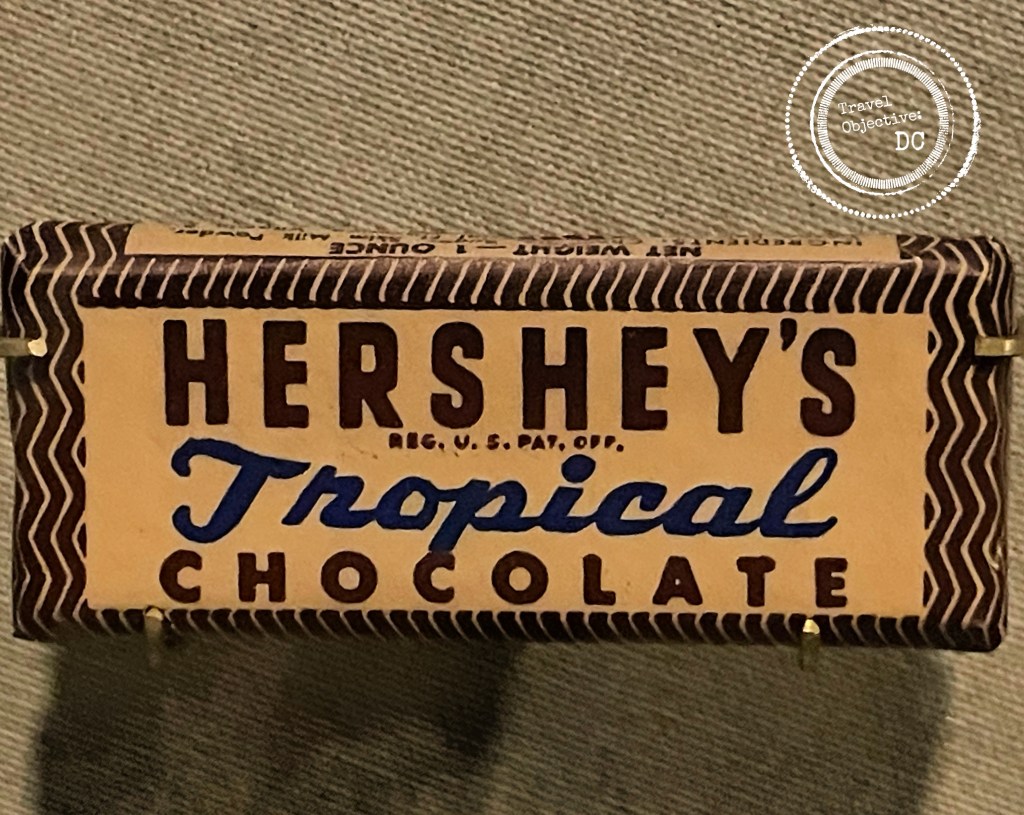
A melt resistant chocolate bar developed by the Hershey Company and provided to US servicemembers in the Pacific Theater during World War II

Hershey's Tropical Chocolate Candy Bar

However, head curator David Allison sought a symmetry in the selection of the artifacts. He wanted to display noteworthy items along with more common articles reflecting the service members and their times, such as rations, books and playing cards.

In addition to the artifacts, exhibit designers use photographs, contemporary illustrations, videos, interactive stations, and other features to help interpret the wartime experience and immerse the musuem visitor in the time. 

The most unique display is in the Vietnam War gallery where 16 different 1960’s-era television sets show contemporary footage and commentary depicting how Americans experienced the Vietnam War at home. The viewing area for the televisions is reminiscent of a mid-century living room, complete with a blocky couch and chair covered in thick clear plastic as your grandmother or aunt might have had. 

1960's era televisions
An array of 1960’s era televisions used in a display in the Vietnam War gallery in the Price of Freedom exhibit at the Smithsonian National American History Musuem

The Revolutionary War, Civil War, World War II and Vietnam War galleries are the largest. These spaces immerse you in the story of the war and how it impacted soldier and civilian alike.

The Wars of Expansion Gallery is smaller, but provides important context and accounts for a series of 19th century conflicts, such as the Battle of Little Bighorn and the Spanish-American War, which may be less familiar to many visitors.

The mix of artifacts and displays broadens the appeal of The Price of Freedom to a wider audience. Those with less interest in military subject matter should still enjoy viewing some of the more unique items while serious students of history are sure to come away having learned something new. 

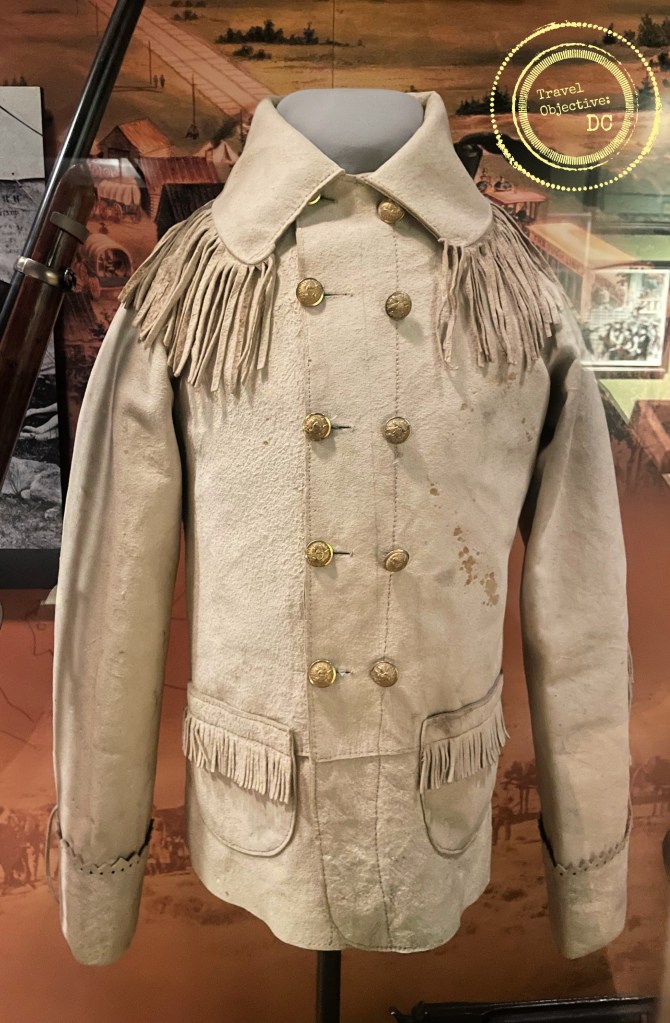
General George Custer’s buckskin coat

Custer's Buckskin Coat

While in most cases The Price of Freedom achieves its aims, there are a few shortcomings. 

Unfortunately, the exhibit space for World War I is too limited. The display misses or minimizes some important themes, such as the rapid expansion of the Army, the mobilization of the American economy, the changing role of women in the military, and the emergence of the United States as a world power. 

The Gulf War display is similarly small, seemingly limited to uniforms worn by Colin Powell and Norman Schwarzkopf. 

There is also an unfinished feel to the exhibition space for the wars in Iraq and Afghanistan. This is understandable as the original exhibit opened in 2004 before those conflicts ended. However, there is space for a more complete examination of both those conflicts than is currently provided. 

Chairs used by Grant and Lee at Appomattox.

The chairs used by Ulysses S. Grant and Robert E. Lee at Appomattox.

At the conclusion of The Price of Freedom is a short film with veterans reflecting on their motivations and sacrifices of their service in the American military. The film concludes with scenes from U.S. military cemeteries showing orderly tombstones and listing the number of interments. 

There are also recurring references to casualites throughout the galleries in keeping with the intent of the exhibit principal funder, Kenneth Behring. He desired the exhibit specifically to recognize the ultimate sacrifices made by American men and women who died in wartime. 

Even with a few flaws, two decades after its opening, the Price of Freedom remains true to its original mission. As America prepares to celebrate its 250th anniverary, this important exhibit gives visitors a thorough synopsis of America’s military heritage and its significant influence on our national character. 

Washington's sword and scabbard
George Washington’s sword and scabbard from the American Revolution

* * *

Route Recon


The Smithsonian National Museum of American History is located at 1300 Constitution Avenue N.W., Washington, D.C. 20560

The nearest Washington DC Metro Stations are Federal Triangle and Smithsonian. Both stations are on the Metro Blue, Orange and Silver lines.

There is no public parking facility for the Smithsonian museums on the National Mall. A limited number of city-operated metered parking spaces along adjoining streets are available.  

The Musuem is open daily (except Christmas Day) from 10:00 AM to 5:30 PM.

Consult the Musuem’s website for more information about other exhibits.

Please note: The Price of Freedom, Americans at War exhibit includes some graphic images of war and casualties.

A guide to the exhibit is available here.

The National Native American Veterans Memorial, A Welcoming Place


In 1942,  the US Marine Corps recruited Chester Nez, and twenty-eight fellow members of the Navajo tribe for a special mission. After basic training, they were sent to Camp Elliot, California where they developed a cipher code for transmitting radio messages based on the Navajo language. Each member committed the straightforward code to memory. 

With the code complete, the platoon members then deployed to units in the Pacific Theater. Nez was assigned to the 1st Marine Division on Guadalcanal. His first encoded transmission led to an artillery strike which destroyed an enemy machine gun nest. 

Nez would later see combat at Bougainville, Guam and Peleliu, all the while relaying messages in a radio code the Japanese could never crack. For their contributions in developing such an unbreakable code, as well as their bravery in the field,  Chester Nez and his twenty-eight fellow Marines were awarded the Congressional Gold Medal in 2001. 

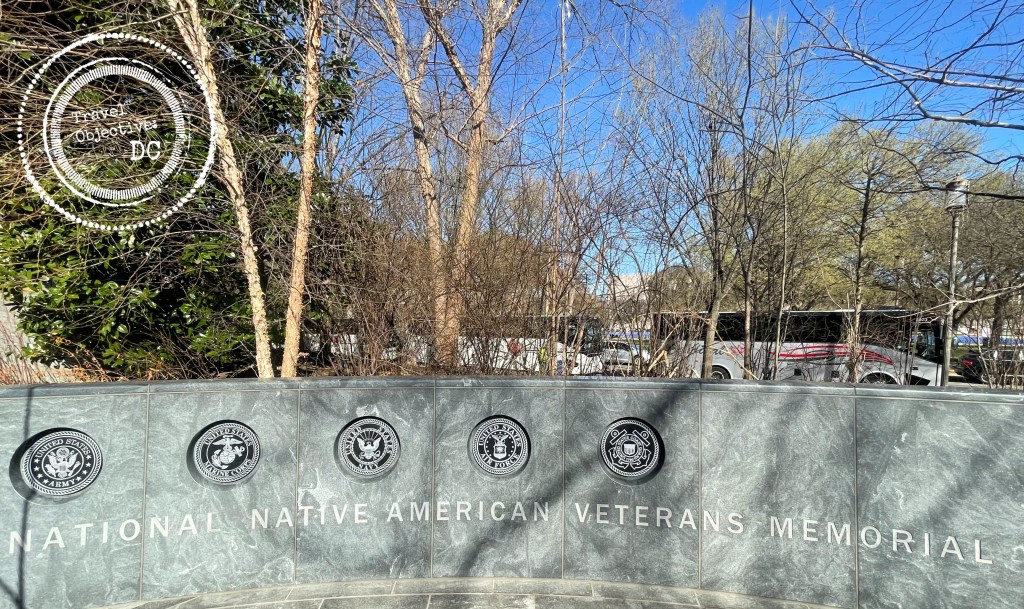
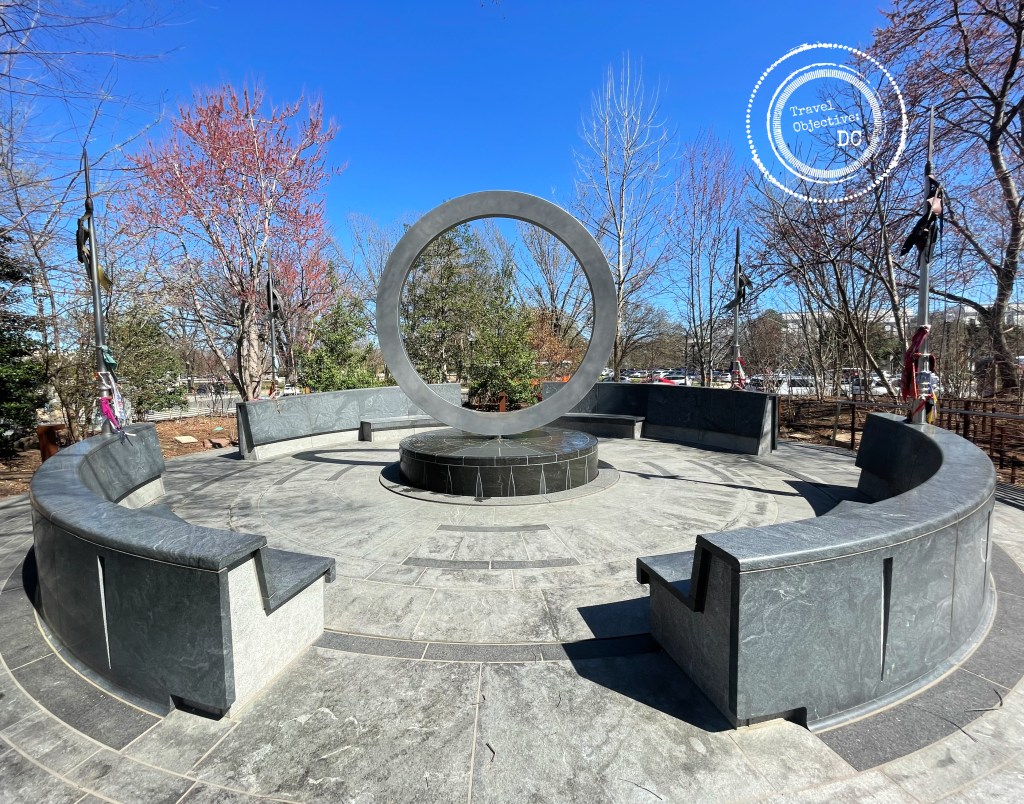
A stone wall with the seals of five of the armed forces marks the entryway to the National Native American Veterans Memorial.
Native Americans have served in all branches of the American military throughout our history.

The code talkers, as these men were known, are today one of the better known examples of Native Americans serving in the American military. However, Native Americans, Alaskans and Hawaiians have long served in the Armed Forces, from Valley Forge through Iwo Jima to Iraq and Afghanistan. Today there are approximately 140,000 veterans of Native heritage. 

In 2013, Congress amended legislation to direct the National Museum of the American Indian to build a memorial so all Americans can learn “of the proud and courageous tradition of service of Native Americans”.

As part of a nationwide competition, a design committee selected a proposal entitled Warrior’s Circle of Honor submitted by Harvey Pratt, a self-taught artist and Marine veteran from Oklahoma and a member of the Cheyenne and Arapahoe Tribes.  As the name suggests, the circle is the prominent shape of the memorial’s features.

The focus of the memorial is a vertically oriented stainless-steel circle, situated on a carved stone drum surrounded by circular seating area

The focus of the memorial is a vertically oriented stainless-steel circle, situated on a carved stone drum surrounded by circular seating area and gathering space.

The circle is relevant in many Native American cultures. It represents the cycle of life, as well as the four seasons, the sun, the moon and the orbits of the planets and stars. Native communities also gather in circles for ceremonies, festivals and storytelling. 

The memorial design is about more than the circle of course. Pratt also sought to create a space for servicemen and women, veterans and their families to heal by combining the elements of water, wind, and earth into the memorial’s design. 

Water glistens as it flows over the carved stone drum at the National Nafive American Veterans Memorial.

Flowing water glistens atop the carved stone drum at the National Native American Veterans Memorial

Water pulses across the surface of the stone drum and flows down its side creating a central fountain. The stone work around the drum contains a visual echo of the water, with concentric rings in the stone walkways around the drum. The depiction represents the beating of the drum, hearkening all to gather in the space.

Around the seating area are four spears pointed skyward. The spears hold prayer cloths visitors have tied to the base of the spears allowing the wind to carry the intentions of the prayer cloths to the heavens.

Finally, a park-like setting is built around the memorial combining hardwood trees and a wetland pond. The setting is intended to provide privacy for visitors while a soundtrack of Native American veterans songs aids in reflection. 

Two spears, pointed toward the heavens with prayer cloths tied to their bases.

Two spears, pointed toward the heavens with prayer cloths tied to their bases.


The memorial is located to the east of the main entrance plaza of the National Museum of the American Indian. A large stone marker with the emblems of the five branches of the Armed Forces marks the way.

Within the museum, an exhibit entitled Why We Serve provides background, rationale and compelling examples through history of the military service of Native Americans, Alaskan Natives and Native Hawaiians to the United States. The exhibit is also available online.  

The memorial is above all a welcoming place. Welcoming to Native Americans and their families to heal and reflect. Welcoming to other visitors as well to learn, to rest and also to consider the meaning of service to country and community. 

A white ribbon prayer cloth tied to the base of a spear.

* * *

Route Recon

The National Museum of the American Indian is located on the south side of the National Mall at the intersection of Fourth Street & Independence Avenue, SW Washington, DC 20560. The main entrance faces east toward the US Capitol Building. 

The nearest Metro stations are L’Enfant Plaza and Federal Center SW.

The museum does not have parking. There is limited metered public parking on the surrounding streets. There are also several commercial parking garages nearby the museum.
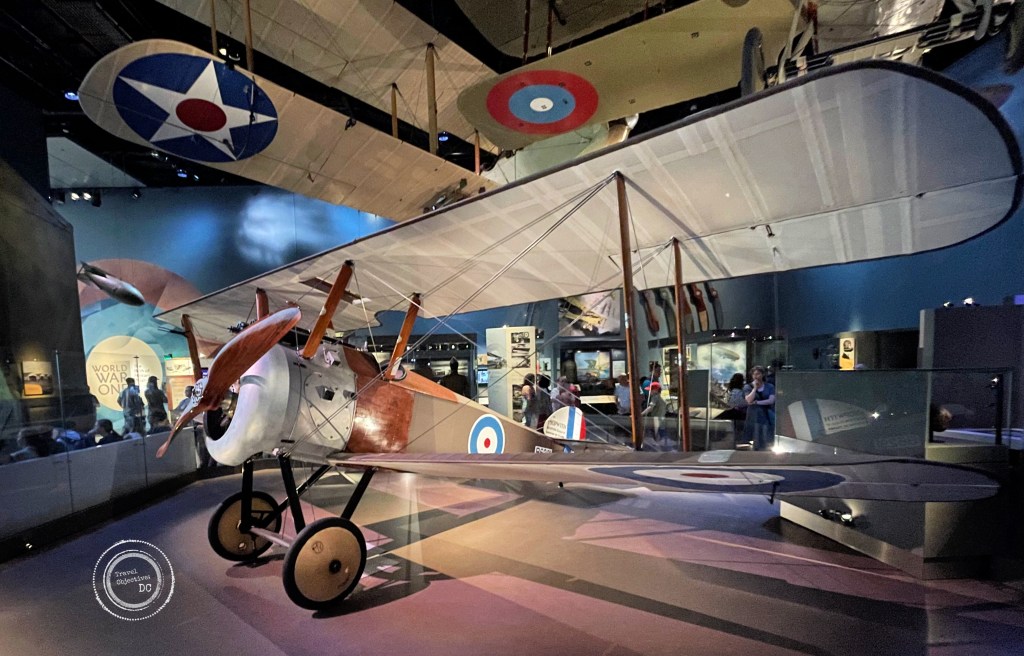
The National Native American Veterans Memorial is accessible 24 hours a day. 

Learn more about Chester Nez and his fellow Navajo Code Talkers from the Veterans History Project of the Library of Congress.  

Mess Call

The Mitsitam Cafe, located within the National Museum of the American Indian offers a very broad menu of entrees, sandwiches and desserts reflecting Native American cuisines from across the country, such as grilled salmon, bison burgers and lobster roll. The cafe offers some of the tastiest food to be found on the National Mall. 

Command Reading

Why We Serve by Alexandra N. Harris and Mark G. Hirsh.  Why We Serve was published by the National Museum of the American Indian to commemorate the opening of the National Native American Veterans Memorial in 2020. The book explores the complex history of Native Americans serving in the US military with intriguing photographs, maps and artwork combined with compelling first person accounts.