Examining the Price of Patriotism

On July 15, 1944, Staff Sergeant Kazuo Otani and his unit Company G, 2nd Battalion, 442nd Regimental Combat team were pinned down by enemy machine gun and sniper fire in a field near the Italian village of Pieve di Sante Luce in Tuscany.  

The 442nd had arrived in Italy just three weeks prior and was part of the American advance against heavy German defenses.

Photo of Staff Sergeant Kazuo Otani

Staff Sergeant Kazuo Otani of the 442nd Regimental Combat Team was awarded the Medal of Honor for his actions in Italy during World War II.

Otani’s unit objective was a hill adjoining the open field where his platoon was located. After killing one sniper, Otani repeatedly exposed himself to enemy fire while engaging multiple machine gun positions. Otani’s tactics provided cover for his platoon to maneuver. While preparing the platoon to assault the hill, one of his men was severely wounded.  Otani ran back across the open field to render first aid, but was killed by an enemy machine gun blast. 

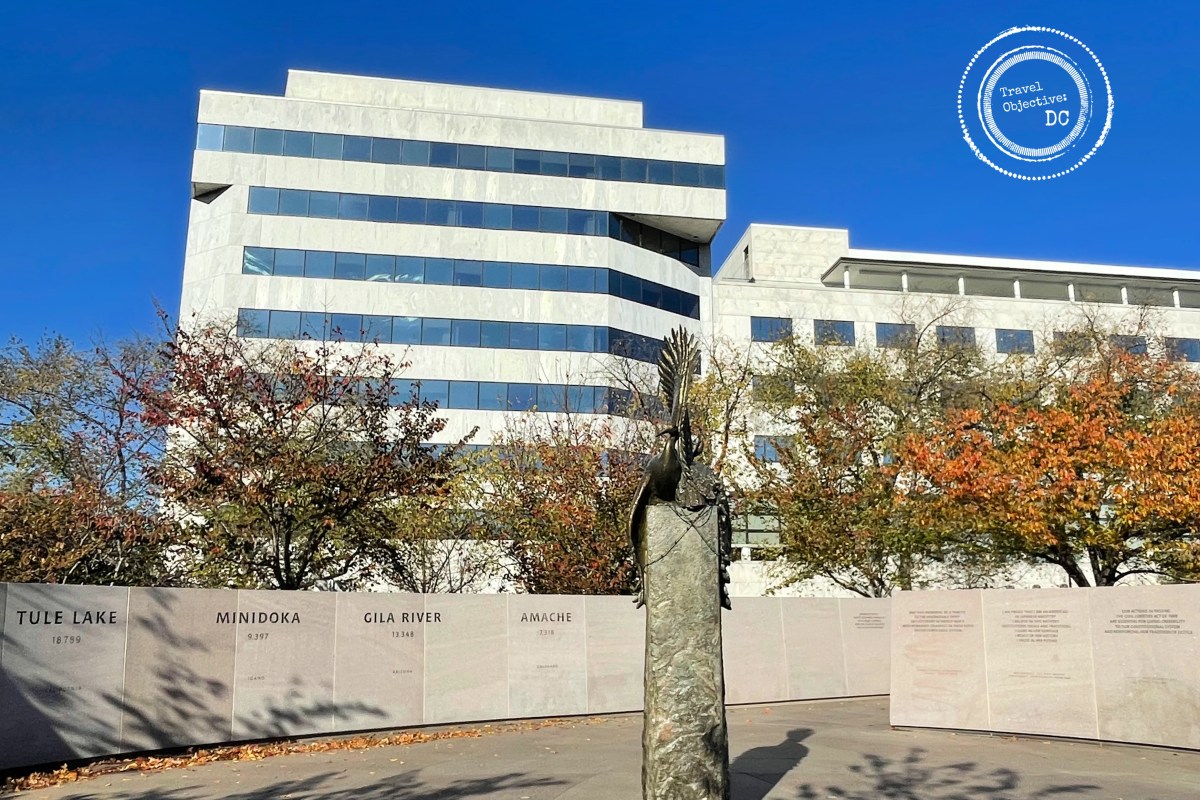
Staff Sergeant Otani was ultimately awarded the Medal of Honor for his actions that day. His name, along with the names of more than 800 other Japanese American soldiers who were killed in action in World War II, is inscribed on a series of stone panels at a unique monument in Washington, DC.

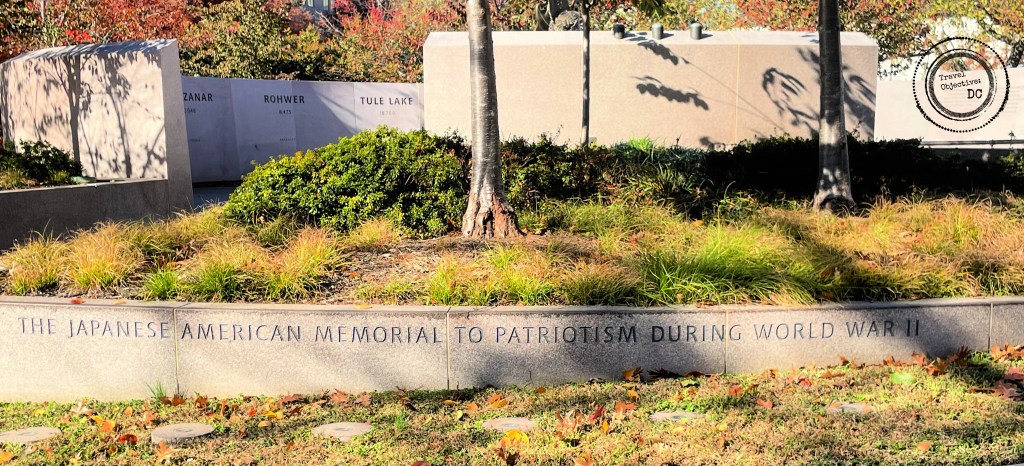
The Japanese American Memorial to Patriotism in World War II is tucked into a 3/4 acre triangular space created by the intersection of D Street, New Jersey Avenue and Louisiana Avenue in Northwest Washington, DC, just north of the US Capitol. 

The Reflecting Pool at the Japanese American Memorial to Patriotism in World War II.
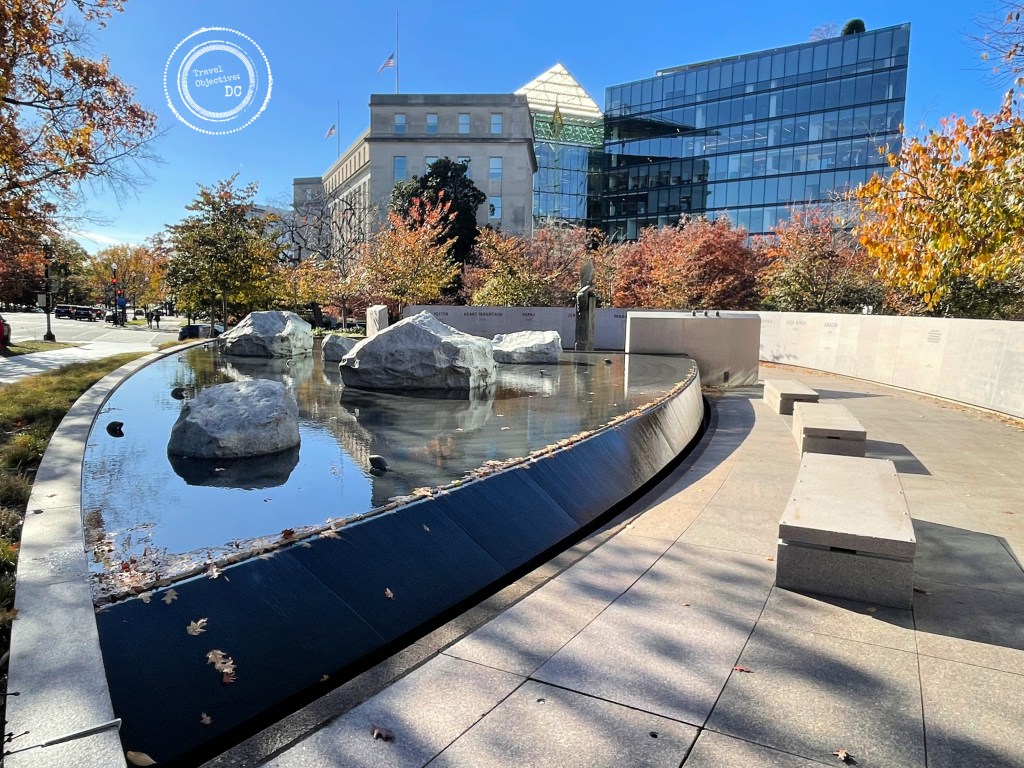
The Reflecting Pool at the Japanese American Memorial to Patriotism in World War II.

A large curved granite wall forms the perimeter around most of the memorial while the side facing Louisiana Avenue remains open, encouraging everyone passing by to enter the memorial’s space. 

Opposite the memorial panels where the 800 names are inscribed is a reflecting pool. Within the pool are five large rough boulders representing the five generations of Japanese Americans impacted by World War II. Water from the pool gently flows down an angled edge, producing a calming background sound while carefully placed trees and bushes help to muffle the sounds of the bustling nearby neighborhood. 
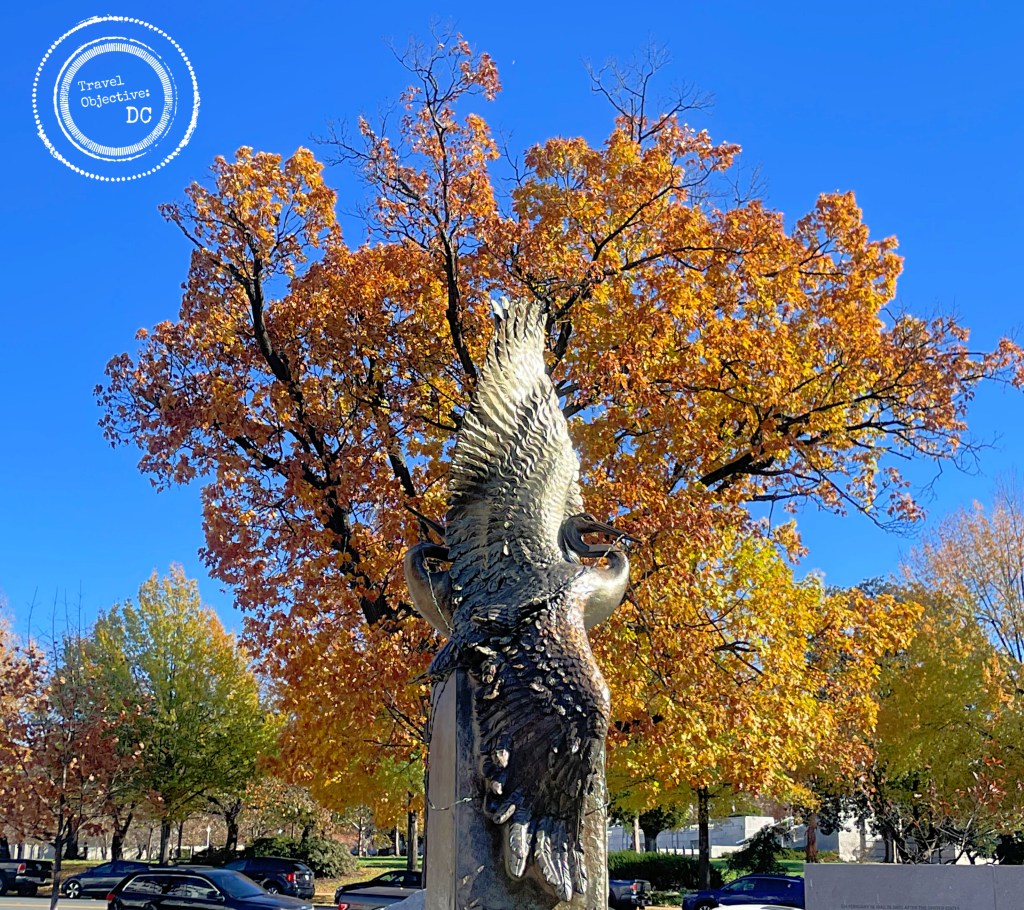
The Cranes Sculpture shines in the sun on a brilliant autumn afternoon.
The two cranes depicted in the sculpture represent both individual effort and community.

The centerpiece of the memorial is a tall bronze sculpture of two cranes. Their bodies mirror each other as they face opposite directions. Both cranes raise one wing high, the other kept low. A single strand of barbed wire wraps around them.

Cranes are featured prominently in the art and literature of East Asian cultures. In Japan especially, cranes are said to grant favors in return for acts of sacrifice.

The two cranes, bound by the wire, express the dual mission of this unique memorial: to recognize the heroric contributions of Japanese Americans on the battlefield while acknowledging the internment of tens of thousands Japanese Americans during the war.

A wreath laid in honor of Veterans Day

A wreath laid in honor of Veterans Day

Three engraved stones by the memorial’s entrance nearest the crane statue provide helpful historical context.

Shortly after the attack on Pearl Harbor, President Franklin Roosevelt signed Executive Order 9066 directing the internment of Americans of Japanese ancestry. Ultimately, over 120,000 people were incarcerated under harsh conditions in camps located in the American west and south.

Encircling the crane statue are ten large stone panels each depicting the name of one of those camps and the number of people detained there. Many internees would remain at these facilities until March 1946. Other wording along the memorial’s walls includes quotes from Japanese American writers, veterans and Presidents Truman and Reagan.

Mike Masaoka of Fresno, CA was a longtime advocate for the Japanese American community as well as a soldier in the 442nd Regimental Combat Team.

A quote by Mike Masaoka inscribed in stone.

While initially excluded from military service, younger Japanese Americans eagerly enlisted once allowed. The men served primarily in several segregated units, such as the 100th Infantry Battalion, the 442nd Regimental Combat Team and the 1399th Engineer Construction Battalion. 

Some joined the Military Intelligence Service. Serving in the Pacific Theater, these soldiers used their language capabilities in many ways. They landed on beaches with invasion forces to capture enemy documents, deployed on special operations behind enemy lines, and interrogated prisoners. 

After November 1943, Japanese American women were allowed to join the military as well. They served within the Women’s Army Corps, often working as linguists. Others became nurses. 
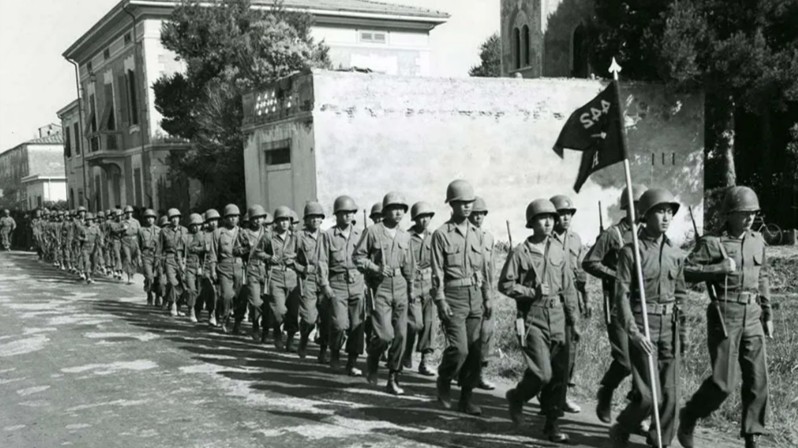
U.S. Fifth Army soldiers of Company M, 100th Infantry Battalion, 442nd Regiment march through Vada, Italy,

U.S. Fifth Army soldiers of Company M, 100th Infantry Battalion, 442nd Regiment march through Vada, Italy, to an area where Lt. Gen. Mark W. Clark would present the Presidential Citation for outstanding action in combat to the 100th Infantry Battalion, which was composed of Japanese-American troops.

– US Army Photo

The 442nd Regimental Combat Team with the attached 100th Infantry Battalion fought together in Europe, initially in Italy, then Southern France and later Germany. 

They repeatedly distinguished themselves in combat, becoming the most decorated military unit in US history for its size and duration of service. Soldiers of the unit earned over 18,000 individual decorations, including 4,000 Purple Hearts and 21 Medals of Honor. Collectively, the unit earned seven Presidential Unit Citations.   

They truly embodied the regimental motto of Go for Broke.

A Unit Tribute Plaque dedicated to the 442nd Regimental Combat Team on display at the National Museum of the United States Army at Fort Belvoir, VA.
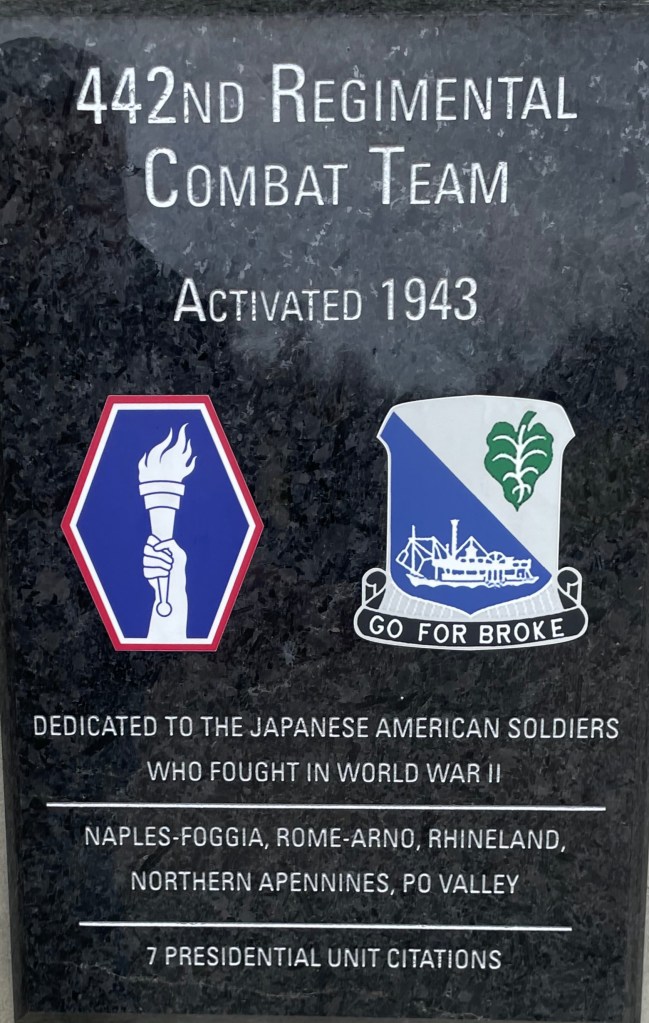
A Unit Tribute Placque dedicated to the 442nd Regimental Combat Team on display at the National Musuem of the United States Army at Fort Belvoir, VA.

Decades after the final victory in 1945, the US Government took a series of steps to examine and reconsider the wartime internment of Japanese Americans. 

In 1983, Congress appointed a special commission to review the language and implementation of Executive Order 9066. After several years of detailed research and over 700 interviews, the commission concluded in their final report that the relocation was based on “race prejudice, war hysteria and failure of political leadership” without any benefit to national security.

One of the commission’s recommendations was signed into law by President Ronald Reagan in 1988.  The Civil Liberties Act, included a formal apology on the part of the US Government and pledged restitution to the former internees. Ultimately, in the early 1990’s most surviving internees would receive $20,000 in reparations.  
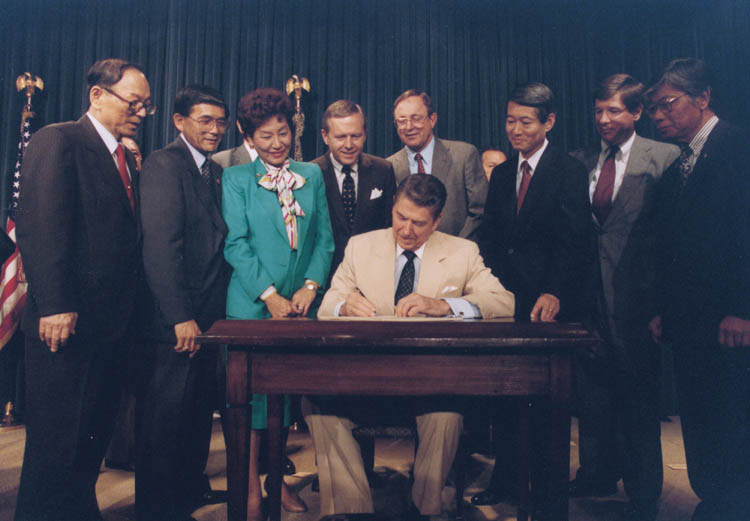
President Ronald Reagan signs the Civil Liberties Act of 1988 into law on August 10, 1988

President Ronald Reagan signs the Civil Liberties Act of 1988 into law.

That same year, the Go For Broke  National Veterans Association Foundation, later renamed the National Japanese American Memorial Foundation, began the process of building a memorial in Washington, DC. In 1992, President George Bush signed legislation authorizing the building of the memorial on Federal land. 

The memorial was formally dedicated on November 9, 2000.

In 2011, Congress collectively awarded the Congressional Gold Medal, its highest honor, on the soldiers of the 100th Infantry Battalion, the 442nd Regimental Combat Team and the Military Intelligence Service.

The Congressional Gold Medal honoring the Japanese American World War II soldiers who fought in the service of the United States
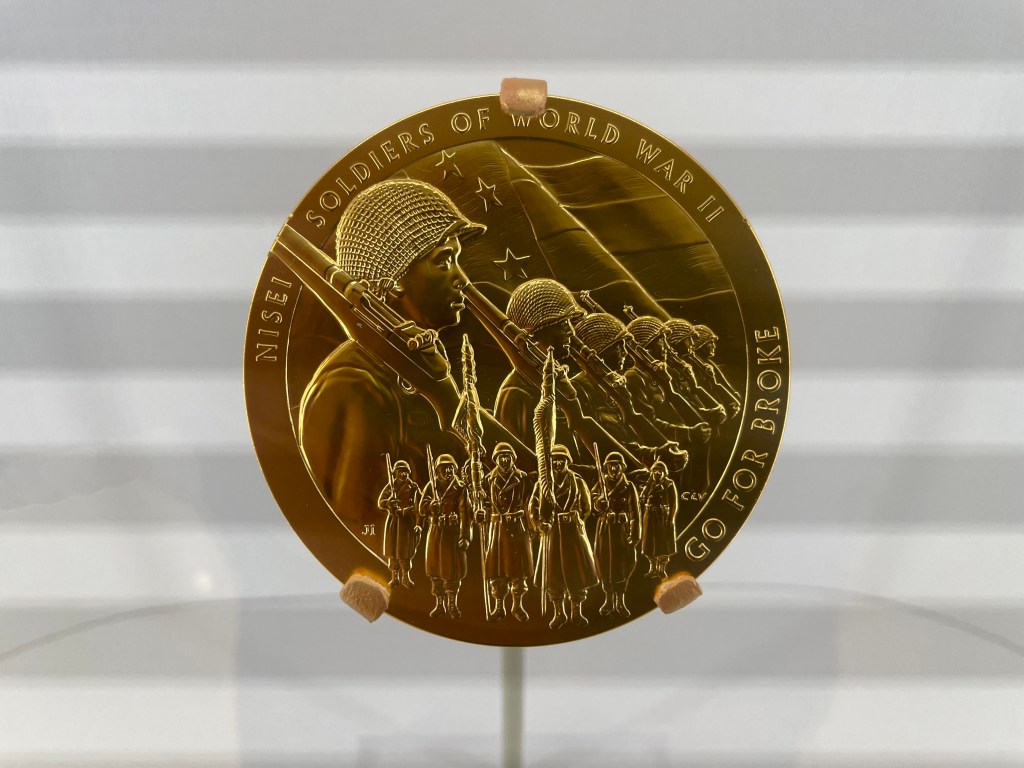
The Congressional Gold Medal honoring the Japanese American World War II soldiers who fought in the service of the United States

As is the case with most memorials in Washington, DC, the Japanese American Memorial to Patriotism in World War II can be sobering as well as inspirational. Upon a visit, one cannot help but reflect on the fragility of our Constitutional rights and need for vigilance in defending them. 

At the same time, there is also a sense of resiliency of the human spirit, courage in the face of grave danger, and the importance of community in good times and bad. 

The memorial also reminds us of the unfinished work undertaken by Sergeant Otani on that July day long ago and the need to continually tend to our task of building a more perfect union. 
* * *

Route Recon

The National Japanese American Memorial to Patriotism During World War II is located at the intersection of New Jersey Avenue, Louisiana Avenue, and D Street in Washington, D.C. It is accessible 24 hours a day.

The closest Metrorail (subway) stop is Union Station. The memorial is a 10-15 minute walk from Union Station.

The National Japanese American Memorial Foundation hosts a number of events at the memorial and around the area to commemorate the history and contributions of Japanese Americans.  See their website for more information.  

Further details on the Congressional Gold Medal honoring the Japanese American soldiers of World War II soldiers can be found at this Smithsonian Institute website.

Navy Pride on Pennsylvania Avenue: The United States Navy Memorial


In a large open plaza stands a statue of a solitary figure.

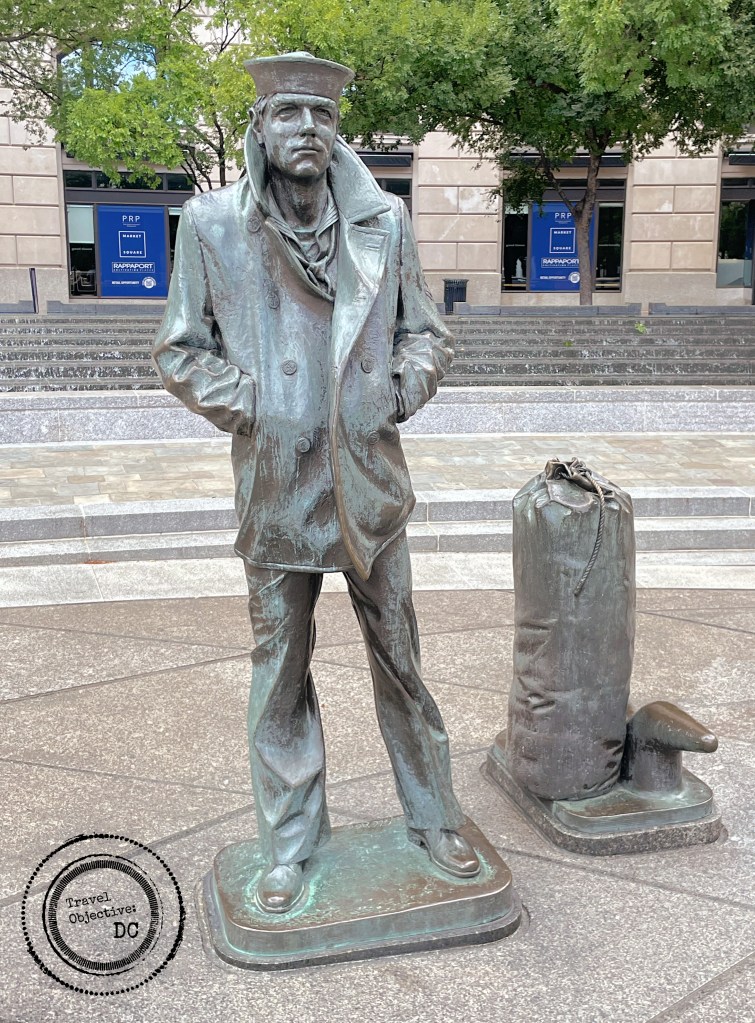
He is a sailor in a dress unform. He stands straight and tall wearing a service “dixie cup” sailor hat. A buttoned up peacoat with a flipped up collar protects him from the chill of the ocean air. His hands are plunged deep into his pockets. His packed sea bag stands by his side. The determined look on his face denotes his readiness to deploy anywhere and perform his duty.

The statue is known as The Lone Sailor and serves as the centerpiece of the US Navy Memorial.

The Lone Sailor Statue at the US Navy Memorial

The Lone Sailor Statue

For centuries, considerable discussion was had regarding a suitable monument paying tribute to the United States Navy. Pierre L’Enfant had included a Memorial Column for the Navy in his original plans for Washington, DC.  Other memorials were built to honor the Navy during specific conflicts, but nothing existed to honor all American sailors. 

This all began to change in the spring of 1977 as Admiral Arleigh Burke urged Navy senior leaders and veterans to get serious by proclaiming: “We have talked long enough about a Navy Memorial, and it’s time we did something about it.”

When Admiral Burke–a distinguished World War II war hero and three-time Chief of Naval Operations–spoke, Navy personnel listened. The Navy Memorial Foundation was quickly organized and Rear Admiral William Thompson was named its first president. Admiral Thompson proved an excellent choice for the job and quickly set to work.

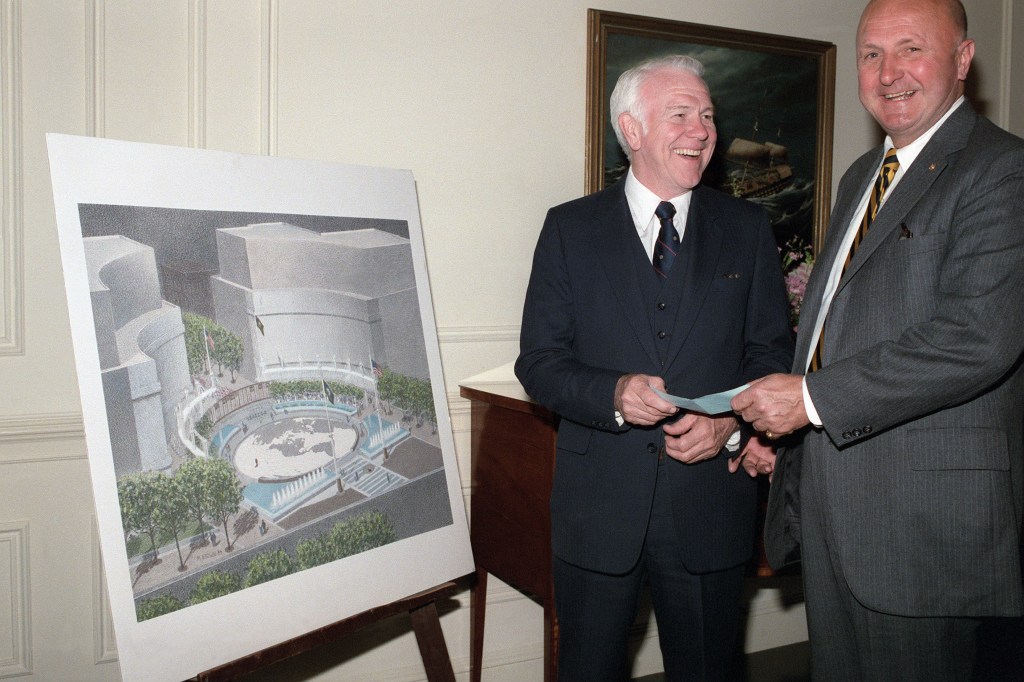
Rear Admiral William Thompson (ret.), on left, receiving a donation for the US Navy Memorial. Note the artist’s rendition of the Memorial.

-Department of Defense Photo

Rear Admiral William Thompson (ret.), on left, receiving a donation for the US Navy Memorial.

He first helped shape the enabling legislation Congress would pass in 1980. He then led the foundation through selecting the memorial’s designers, determining the memorial’s location, raising money and overseeing construction.

Admiral Thompson also helped select the sculptor Stanley Bleifeld to design and sculpt The Lone Sailor Statue. In recognition of Admiral Thompson’s significant contributions to building the memorial, Bleifield included Thompson’s initials on the Lone Sailor’s sea bag. 

The Navy Memorial Plaza

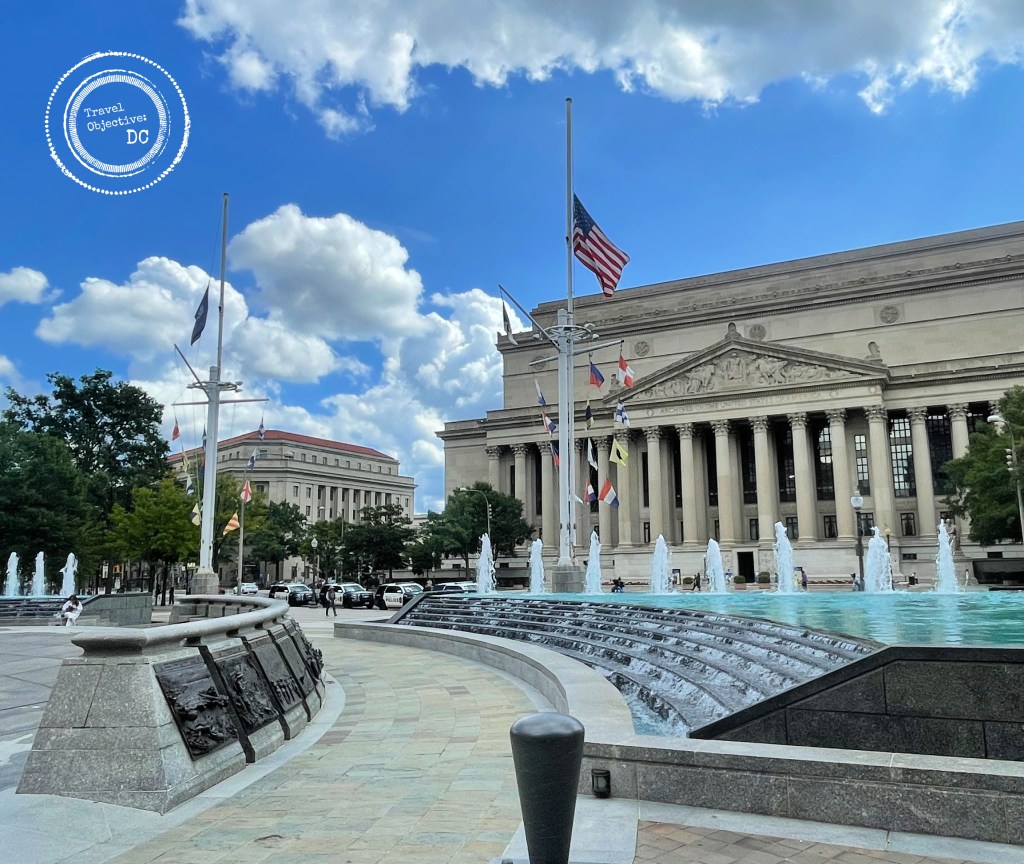
The Navy Memorial Plaza looking south toward the National Archives

The whole process from the founding of the memorial to its completion stretched to almost a decade. The Navy Memorial was formally dedicated on October 13, 1987 by President Ronald Reagan. He devoted it to all who have served, are serving or will serve in the United States Navy, Marine Corps, Coast Guard and Merchant Marine. 

The memorial is set within a broad circular plaza to the northwest of the intersection between 7th Street and Pennsylvania Avenue. Early designs for the memorial favored a more traditional approach, but they were discarded in favor of a memorial with a more open space resembling a seascape.

The floor or base of the plaza depicts a large world map.  With a diameter of 100 feet, it is said to be the largest map in the world.

Fountains at the US Navy Memorial

A set of fountains at the US Navy Memorial

Fountains skirt the southern perimeter of the map. The water flowing through the fountains comes not from Washington DC’s water supply but is collected from the world’s oceans and the Great Lakes.

A semicircular wall inside the fountains contains a series of 26 bas-relief figures depicting scenes of Navy history and Navy life as well as the contributions of maritime partners. 

Arrayed around the memorial are quotes about the Navy from sailors at all levels. Six masts fly the flags of the United States, the Navy, Marine Corps, Coast Guard, Merchant Marine and the POW/MIA flag.

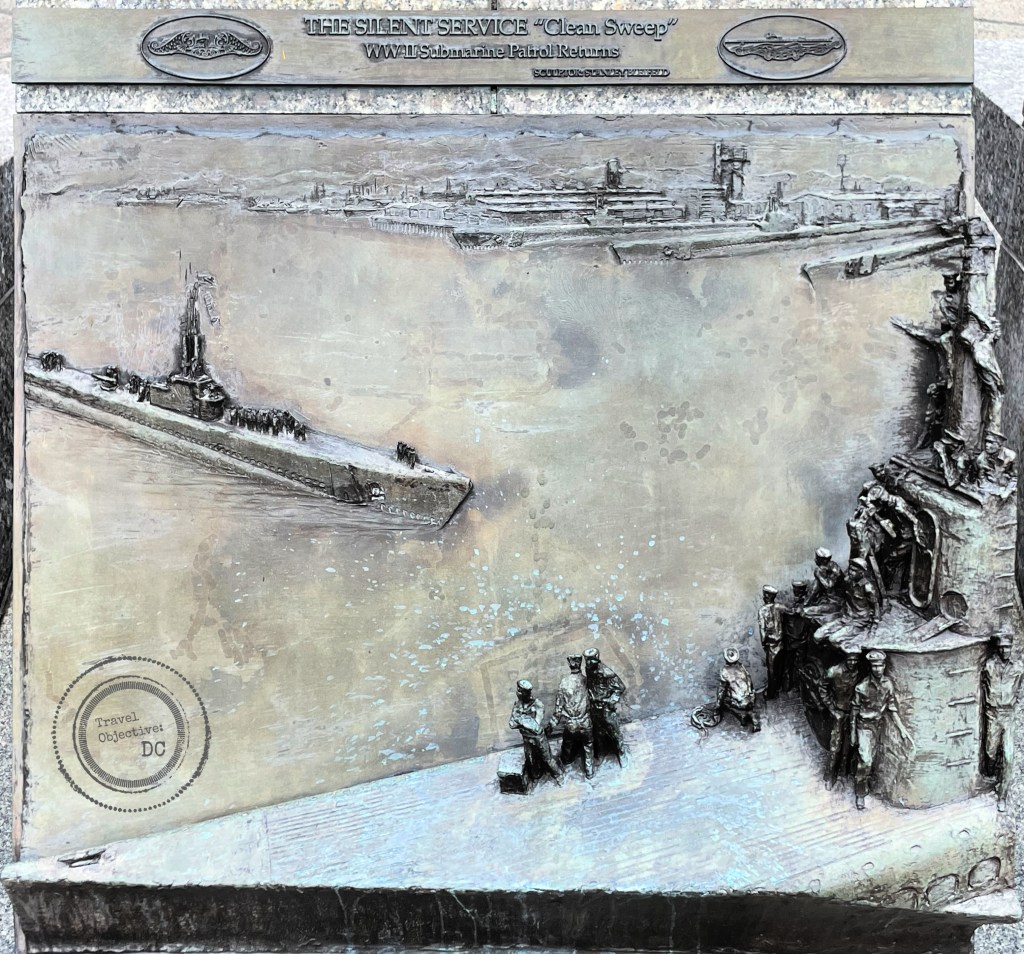
Bas Relief sculpture of Navy submarines in World War II.

Bas Relief sculpture of Navy submarines in World War II

Sweeping arches incorporated into the design of two mixed-use commerical buildings suggest a northern perimiter to the memorial, balancing the fountains and sculpture walls on the southern side. The neoclassical design of these buildings seemingly provides a sense of the shore or anchorage to the airy, open plaza.

Amidst all this stands The Lone Sailor. The statue has been so enthusiastically received by the Navy community, there are 18 more Lone Sailor statues across the United States (and one at Utah Beach in Normandy). In each location, the statue reminds the community of the dedication and professionalism of the American sailor. 

Bas Relief Sculpture of Captain John Paul Jones

Bas Relief Sculpture of Captain John Paul Jones

Early in the design phase, the Navy identified a desire to have a “living memorial,” a place where people would gather and return to time and again. The open space makes the memorial a popular venue for summer concerts, reenlistments, promotion ceremonies, wreath layings and reunions.

In keeping with the desire for a living memorial, the Navy Memorial Foundation located a visitor center in one of the adjoining buildings. Part research facility, part musuem and part community center, the visitor center brings the Navy experience alive for the landlubber while instilling pride in all Navy sailors. There are exhibits on the missions of the post 9/11 Navy, multiple Navy leaders, and the important role played by chief petty officers.

The visitor center also houses the Arleigh Burke Theater. In addition to running several short movies on Navy life throughout the day, as well as periodic feature films, the theater hosts guest speaker programs. Visitors can find a variety of mementos from all the US military services at the Ship’s Store gift shop.

A video screen displays the Navy Log.

A video screen displays the Navy Log throughout the day.

There is also a feature known as the Navy Log, an online archive with details of the men and women who have served in all the sea services. There are currently over 750,000 entries. Active members, veterans or their loved ones are invited to add to this number and enter a service member’s information as an ongong tribute to their time in uniform.

As the US Navy observes its 250th Anniversary, the US Navy Memorial is a place for everyone to discover and honor America’s rich naval heritage. Whether you are active, retired, reserve or the relative or friend of someone who has served, the Navy Memorial is an important and worthwhile destination for any visit to Washington, DC.

***

 I can imagine no more rewarding a career. And any man who may be asked in this century what he did to make his life worthwhile, I think can respond with a good deal of pride and satisfaction: ‘I served in the United States Navy.’

President John F. Kennedy

Route Recon

The US Navy Memorial is located at 701 Pennsylvania Ave, NW Washington, DC 20004. 

The Memorial is accessible 24 hours a day.

The Visitor Center is open seven days a week from 9:30 AM to 5:00 PM.

The Navy Memorial hosts numerous events throughout the year. Some events may close the Visitor Center to the public. Be sure to check the Memorial’s website and find additional information about upconing events on the calendar

The closest Metro Station is Archives-Navy Memorial-Penn Quarter on the Green and Yellow Lines.

Parking:
Validated parking is available at PMI Garage, 875 D Street, NW.
Parking can be validated for $13 inside the Ship’s Store, located in the Navy Memorial Visitor Center.

It’s Not Too Late to Commemorate D-Day!

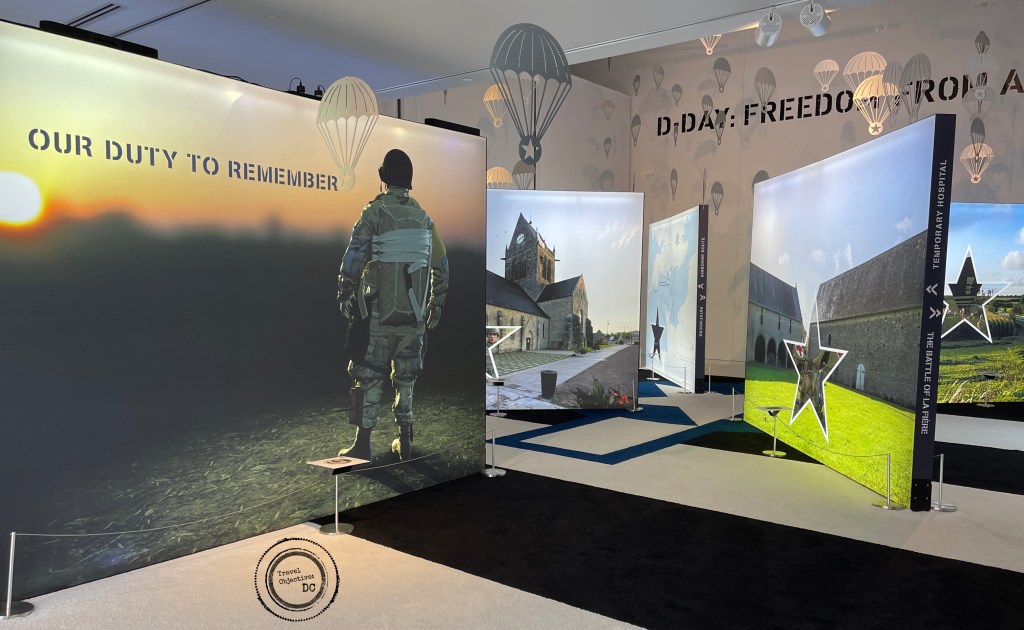
Are you heading to Washington, DC this summer rather than the beaches at Normandy, but still want to commemorate the D-Day anniversary?  Then save time for a visit to the National Museum of the US Army at Ft. Belvoir, VA for a very unique and compelling temporary exhibit entitled Freedom From Above.

This highly interactive experience uses advanced technology combining powerful, realistic imagery with key background information, allowing the viewer to develop a broader perspective than might be possible using a map or book, or viewing a movie or single artifact.

As the title suggests, the exhibit focuses on the experience of US airborne forces on June 6, 1944.

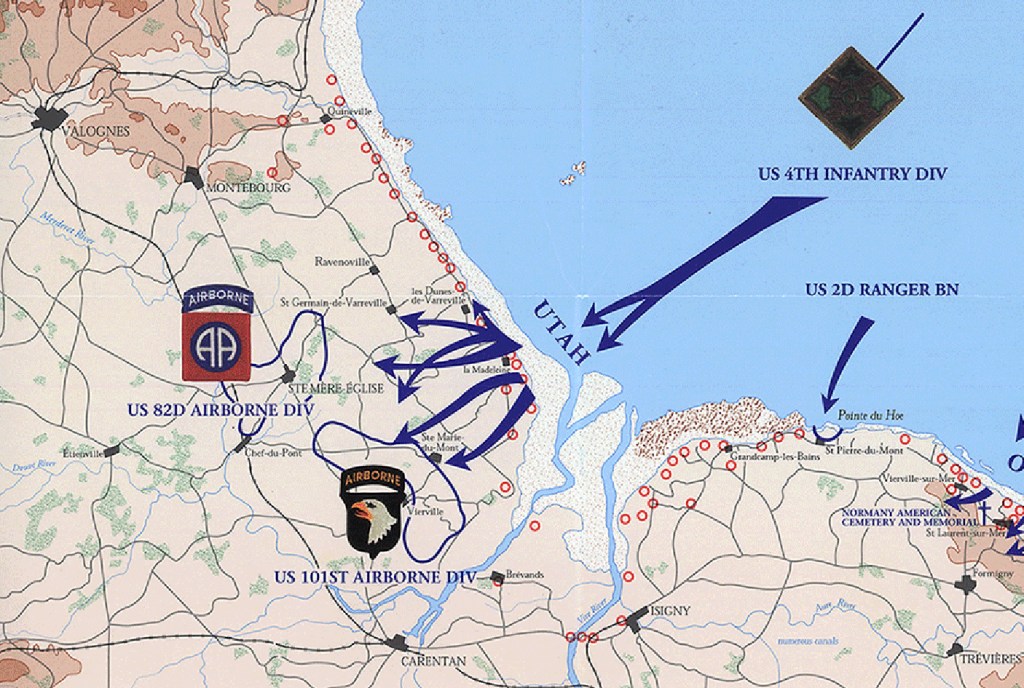
Detail of Utah Beach Area from US Army Center for Military History D-Day Commemorative Map

Early on D-Day morning, paratroopers from the 82nd and 101st Airborne Divisions deployed to areas to the rear of Utah Beach. Their mission was to secure road junctions, bridges and causeways behind Utah to facilitate the ground forces breakout from the beach, as well as to hinder German reinforcements from reaching the area. Poor weather conditions, anti-aircraft fire and confusion often lead to the paratroopers jumping far from their designated drop zones. Some paratroopers drowned landing in flooded fields or were shot after being caught on trees or buildings.

Yet they rallied.

Over the next few days, the airborne troops reestablished some unit cohesion, engaged the German defenders and were able to achieve some important mission objectives.

Freedom From Above exhibit space

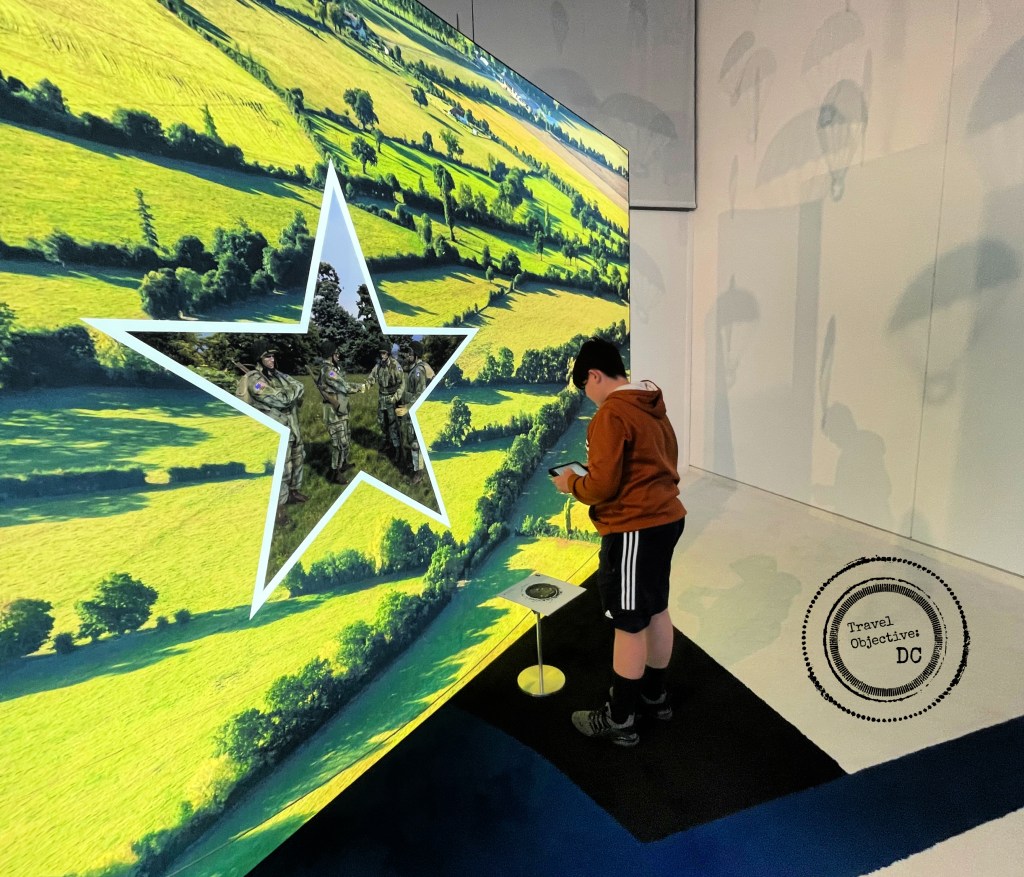
Through the Freedom From Above exhibit, visitors encounter 16 large screens depicting images and scenery related to the paratroopers’ final preparations, transport, deployment and initial operations in Normandy. Visitors experience each scene with a small tablet computer called a Histopad. 

By using the Histopad to scan an image on a small platform adjacent to each large screen, visitors access the details, imagery and stories contained within the scene. Links embedded in the scene provide the viewer with additional details regarding people, objects or images portrayed on the Histopad’s screen.

Using the Histopad, a visitor unlocks the historical details and stories contained in the scene in front of them.

By turning completely around with the Histopad, the viewer gets a 360 degree perspective on the scene. Several of the scenes have a time travel scale, allowing the viewer to compare what an area looked like in 1944 to the same area today. Other scenes are more informational, depicting aircraft cockpits, the large (and heavy) amount of equipment a paratrooper carried and the routes the planes flew from bases in the United Kingdom into Normandy. 

The exhibit designers have embedded a digital relic hunt within the scenes. Find the ten relics, spread over the sixteen scenes and, after providing an email address, you can receive a special relic collectors certificate. It’s important to remember the Histopad allows you multiple vantage points within a scene. If you are relic hunting, be sure to look all around.

Successful digital relic collectors can earn a certificate.

The historic scenes begin in the briefing room housed in a Quonset hut on an airbase in England. Here paratroopers of the 101st Airborne Division received their pre-deployment briefing. Around the room are short benches arranged in neat rows, and the walls are covered in flags, informational posters, signs and official notices. Visitors can open a field desk and explore its contents. (Hint: You might find a relic there.)

Additional scenes include well known events as well as planned operations such as Pathfinders marking a drop zone, glider aircraft deploying troops and heavy equipment, and a field hospital.

One scene is dedicated to the landing of Private John M. Steele of the 82nd Airborne Division at the village of Sainte-Mère-Église. Steele’s experience was prominently included in the 1962 film The Longest Day. Just after midnight Steele and his “stick” (a squad of Airborne soldiers jumping from an airplane) began landing in and around the center of the town. Steele’s parachute was caught on the Church’s steeple and he was suspended for two hours. He was eventually captured by German soldiers, but managed to escape four days later. 

Steele survived the war and became a local celebrity in the town. A replica of him and his parachute hang on the church today.

The stanchion with the photograph and story of Private John M. Steele, whose parachute was caught on the steeple of the church at Sainte-Mère-Église.

The Histopad provides a simulated view of how the town might have looked to Steele as he descended. Unfortunately, German soldiers were already on the town square that morning and many of Steele’s fellow stick members were quickly caught or killed as they landed. 

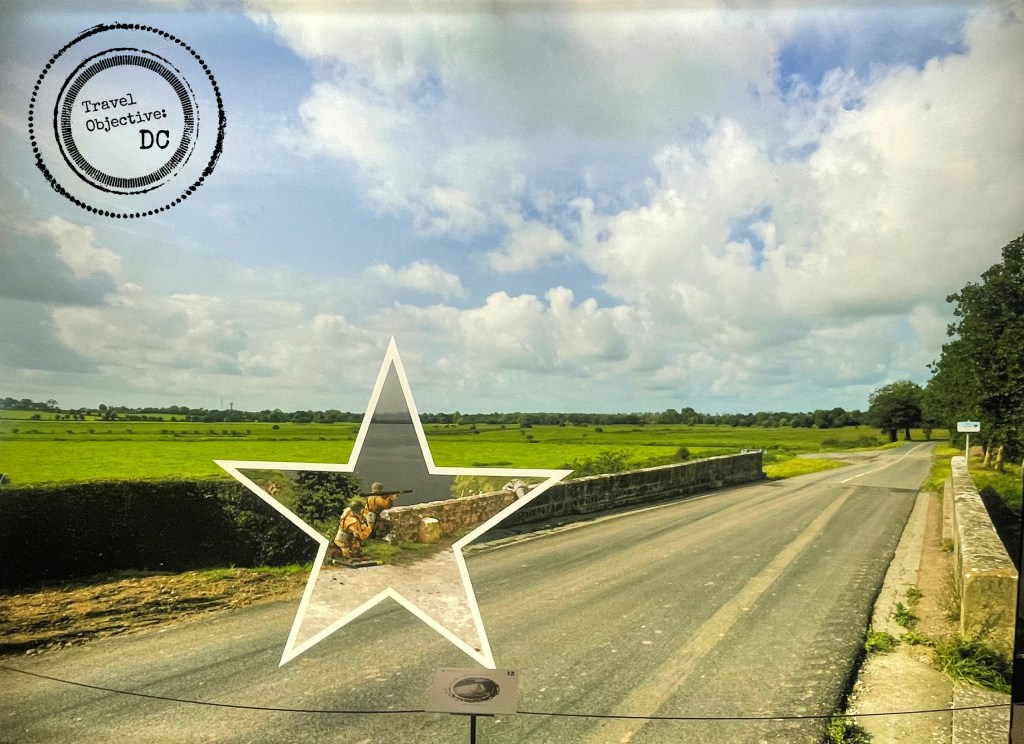
Although not as well known as landings and liberation of Sainte-Mère-Église, the battle at the La Fière bridge was an important, but costly victory for the 82nd Airborne in the days following the landings. The bridge was one of the principle objectives for the 82nd Airborne troops. 

By holding the bridge as well as eastern and western banks of the river it spanned, the paratroopers would allow ground forces on Utah Beach to quickly move inland while forestalling a wider German counterattack on American landing forces. Elements of 82nd engaged in an intense battle with German defenders over four days to capture and hold the bridge. The Histopad provides detailed information about the troop deployments around the bridge and allows the viewer to see up close some of the equipment used in the fight. 

The Freedom From Above exhibit scene depicting the bridge at La Fière.

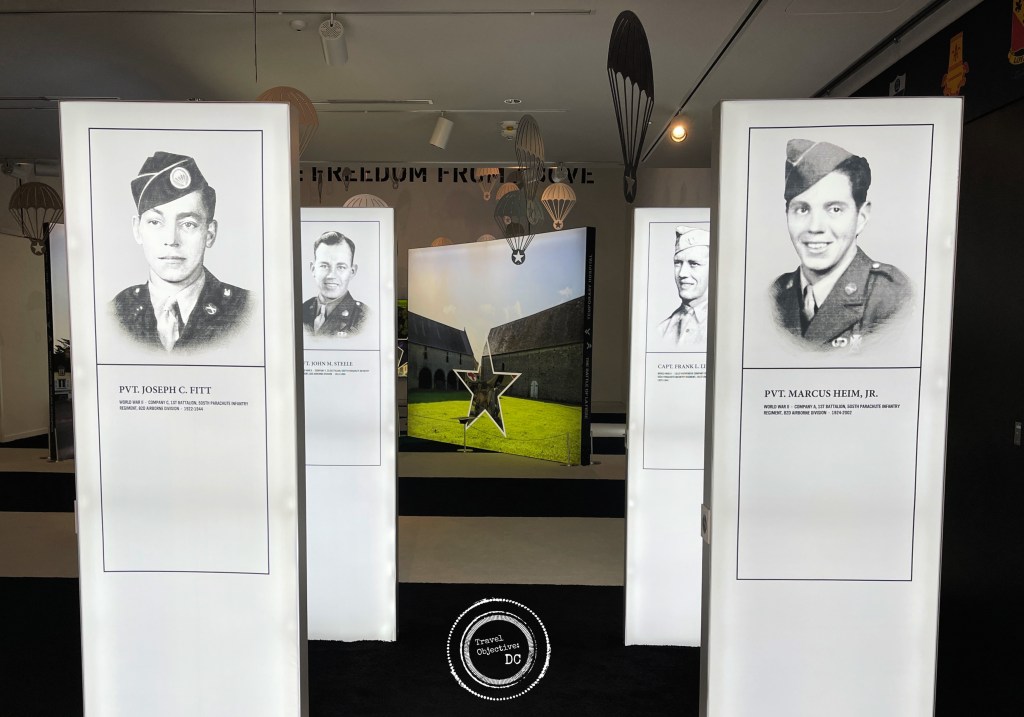
In addition to the interactive experiences, stationary displays tell the unique stories of ten paratroopers who fought bravely on D-Day. These soldier stanchions include an image of the soldiers along with an excerpt of their story. Small images on the stanchions are also scannable, leading to a visual depiction of the soldier’s experiences, along with additional biographical information and, in some cases, period news footage.

Soldier stanchions with the images and details of D-Day paratroopers.

While the augmented reality of the exhibit is engaging, the National Museum of the US Army added a very moving feature to the exhibit. Only four Medals of Honor were awarded for heroic actions on June 6th, each to a US Army soldier. All four medals are on display together and each soldier’s story is presented at the entrance to the exhibit. This lends a sobering reminder of the courage and sacrifices made by all the Allied soldiers on D-Day.

To complete the D-Day experience at the museum, visitors should certainly visit the Global War gallery on the first floor. The gallery’s World War II displays contain a number of artifacts from D-Day as well as equipment used by airborne forces during the war. 

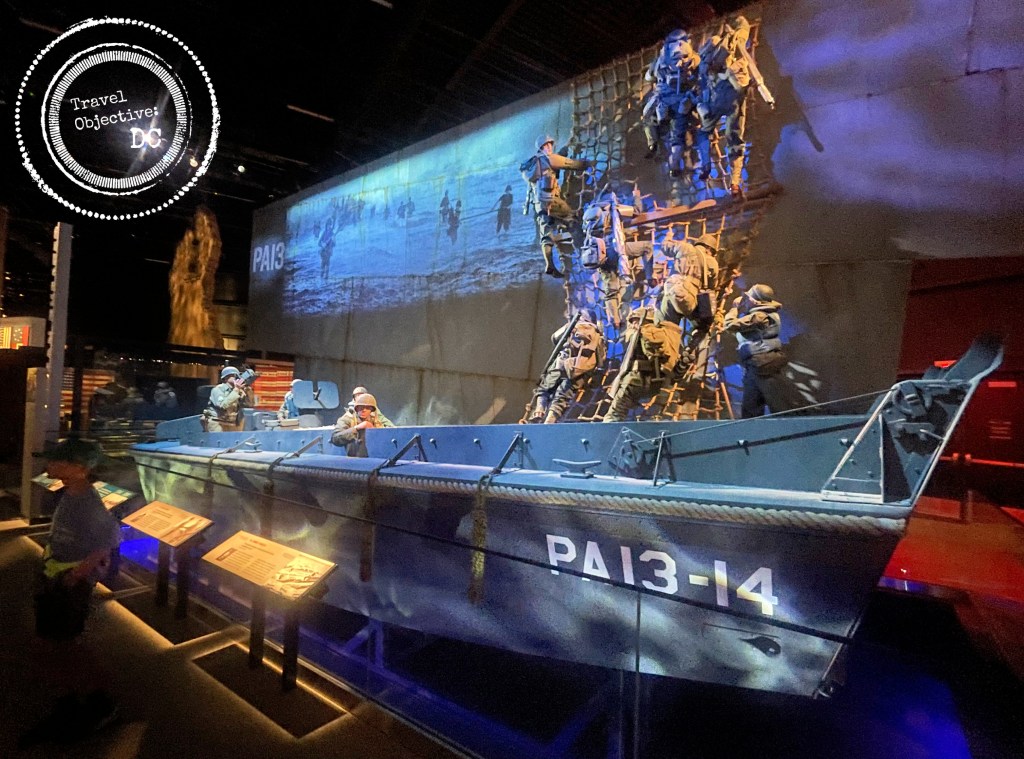
The largest artifact is an LCVP, (Landing Craft, Vehicle, Personnel), also known as a Higgins Boat. Andrew Higgins was a successful manufacturer of small maritime craft built to operate in marshes or swamps. He designed this type of landing craft with a very shallow draft, enabling it to operate in only two feet of water. The front ramp would drop down allowing up to 36 soldiers in combat gear to literally “hit the beach” then return to a ship for more men. The Higgins Boat was also widely used in both the Atlantic and Pacific Theaters. More than 23,000 Higgins Boats were produced, but fewer than a dozen are known to exist today. 

The display scene at the museum shows soldiers being loaded onto the Higgins Boat before it heads to shore. 

Given their sheer size and scope–over 150,000 troops, 5,000 ships and 11,000 aircraft were involved–the Allied landings on D-Day continue to captivate the mind even eight decades later. The National Museum of the US Army has prepared an impressive exhibit dedicated to the D-Day experience. While the Histopad and augmented reality are no substitute for a visit to France, visitors to Freedom From Above will take away a deeper sense of the paratroopers’ courage and sacrifice at Normandy.  

NOTE: Freedom From Above at the National Museum of the United States Army is open until November 15, 2024.

Route Recon

The National Museum of the United States Army is located at 1775 Liberty Drive, Fort Belvoir, VA, 22060

The museum is located on a publicly accessible portion of Fort Belvoir. Parking is free.

The museum is free, but tickets are required. Access tickets here.

Download a map with written directions here.

Traveling by car:

From Washington (traveling south)

Follow Interstate 395 South toward Richmond, Va. Merge onto Interstate 95 South. Take exit 166A toward VA-286 South/Fairfax County Parkway. Continue for 2.5 miles and turn left onto Liberty Drive.

From Baltimore (traveling south)

Follow MD-295 South, Baltimore-Washington Parkway. Exit onto Interstate 495 South/Interstate 95 South toward Richmond Va./Andrews Air Force Base. Follow signs for Interstate 95 South toward Richmond, Va. Take exit 166A toward VA-286 South/Fairfax County Parkway. Continue for 2.5 miles and turn left onto Liberty Drive.

From Richmond (traveling north)

Follow Interstate 95 North toward Washington. Take exit 166A toward VA-286 South/Fairfax County Parkway. Continue for 2.5 miles and turn left onto Liberty Drive.

Traveling by Bus:

The Fairfax Connector bus service travels to the Museum via two different routes:
Route 171 : Weekends ONLY
Route 334 : Monday – Friday ONLY
Please check the Fairfax County Website for the most current bus schedules.

Traveling by Metro:

The Franconia-Springfield Metro Station, on Metro’s blue line, is the closest station to the Museum. From the metro station, take Fairfax County Connector Bus Route 334 on weekdays or Route 171 on weekends to the museum.

Mess Call

The Museum Café is open daily from 9:00 – 4:00 pm. The Café provides daily grill service for breakfast and lunch as well as a variety of grab and go items.

While at Arlington, “Remember the Maine!”

“Remember the Maine, to Hell with Spain” became a rallying cry for war in the spring of 1898. As a simmering independence movement in Cuba was becoming increasingly violent that January, President William McKinley sent the USS Maine to Havana to watch after American lives as well as political and business interests. Tensions between the United States and Spain had been growing over independence movements in Cuba, Puerto Rico and the Philippines; McKinley was hoping for a peaceful resolution.

The USS Maine circa 1895-1898

-US Naval History and Heritage Command Photograph

However, it was not to be. The Maine arrived in Havana on January 25th with approximately 26 officers, 290 sailors and 39 Marines on board. Just after the bugle call Taps on February 15th, an explosion detonated the five tons of gunpowder charges for the Maine’s large guns. The forward section of the ship, containing the enlisted men’s quarters, blew apart. An estimated 266 men died either during the explosion or in the days afterward.

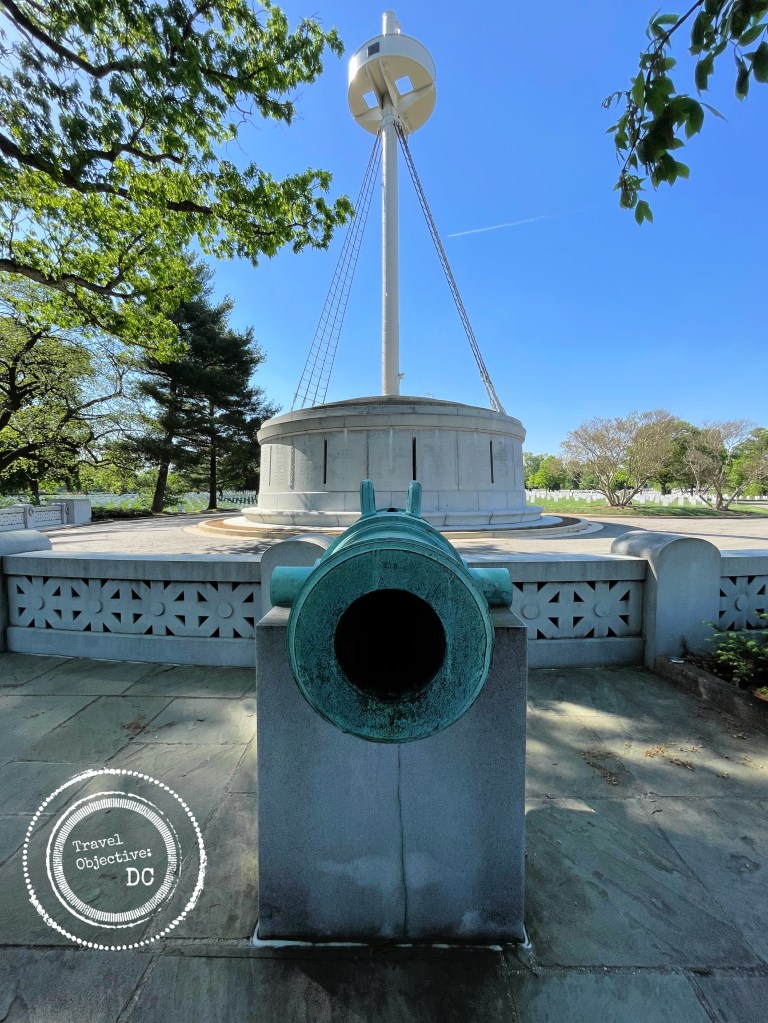
The USS Maine Memorial at Arlington National Cemetery

How the explosion occurred was not immediately apparent. Several different investigations and reviews could not concur on a definitive cause. Though the combustion of coal dust was one possibility, several prominent newspapers of the time blamed a Spanish naval mine. A vocal element of the population was ready to use force against Spain and Congress declared war on April 25th. The war would end quickly and favorably for the United States as Spain ceded Guam, Puerto Rico and the Philippines. 

Even with the war’s prompt conclusion, America did not forget about the Maine. In 1899, the remains of 165 sailors who died in the explosion were exhumed from a Cuban graveyard and reinterred at Arlington National Cemetery.  In 1912, the Army Corps of Engineers recovered the twisted remains of the Maine’s hull from Havana Harbor and towed her further away from the Cuban coast. After recovering an additional 66 bodies, the Maine was then scuttled in deeper waters while Taps played and escort ships offered a 21-gun salute. The ship’s masts were salvaged and the main mast sent to Arlington National Cemetery. 

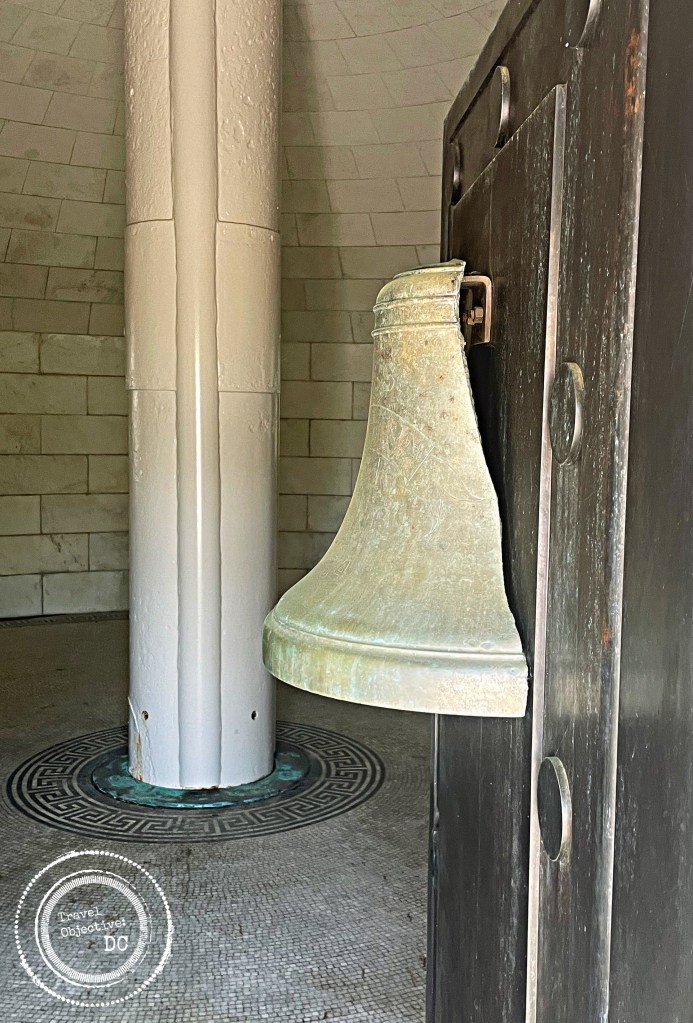
The mast of the USS Maine passes through the stone structure and is embedded into the floor. A surviving piece of the ship’s bell is hung on the front door.

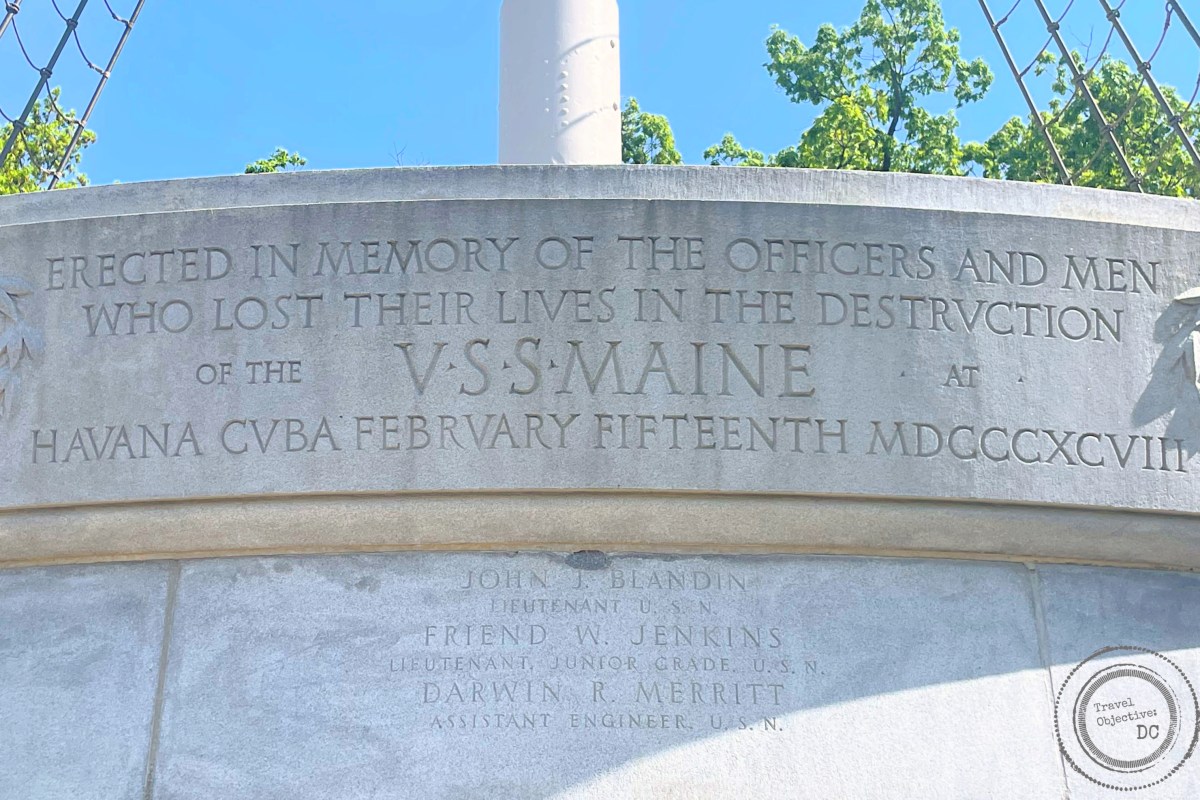
Efforts to build a memorial to the Maine began shortly after the explosion and about twenty monuments or special exhibits of the ship’s artifacts exist around the United States. President Woodrow Wilson dedicated the current memorial at Arlington National Cemetery in 1915, adjoining the burial site of the USS Maine sailors. The centerpiece of the memorial is a circular stone structure, 90 feet in diameter, built around the ship’s main mast. The shape of the structure suggests the warship’s gun turret, but it also has served as a temporary mausoleum. Rigging extends from the top of the structure up to a crow’s next atop the mast. On the circumference of the building are names and ratings of the sailors who died in the explosion. The front door of the structure holds a piece of the ship’s bell, which was broken in half during the explosion. 

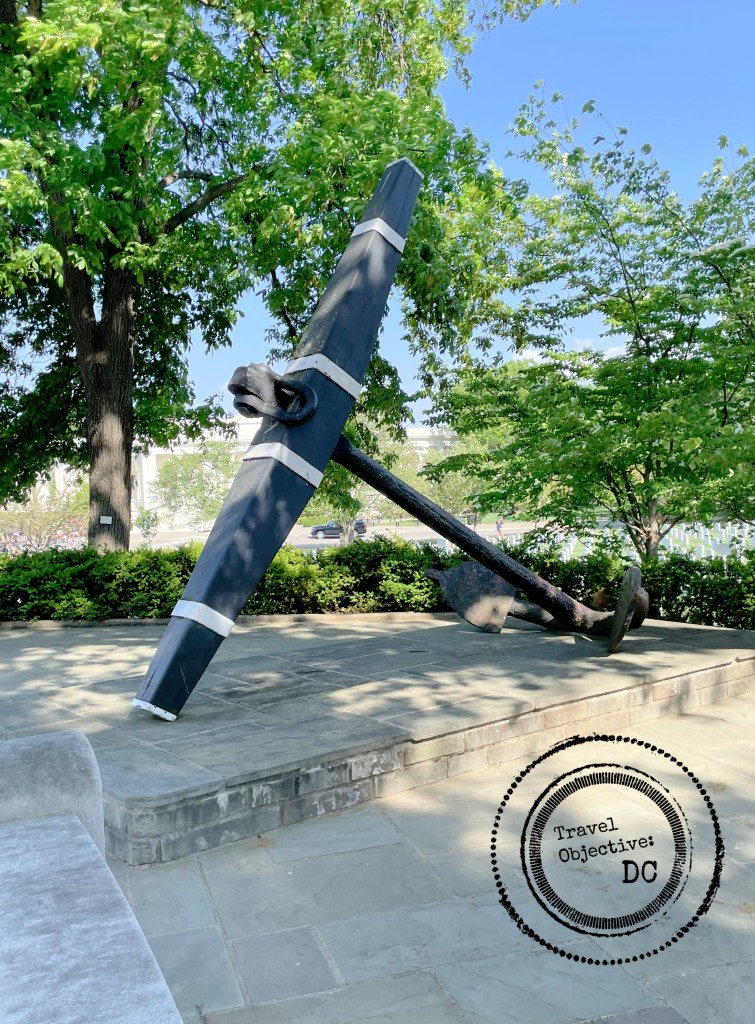
A paved lane encircles the memorial. To the east is an anchor made specifically for the memorial but resembling the anchor onboard the Maine.  Positioned along the back of the memorial are two bronze Spanish mortars, cast in the 1700s and captured by Admiral George Dewey in the Philippines during the Spanish–American War. 

The replica anchor was the centerpiece of an earlier memorial to the USS Maine. It weighs about two tons.

Most auspiciously, in the twelve decades since that fateful February night, the USS Maine is still not forgotten. There have been periodic reinvestigations and new studies into the cause of her sinking, reexamining the available evidence and using modern technologies and computer simulations. In 2000, a marine exploration firm unexpectedly came upon her wreck at a depth of 4,000 feet. Yet a definitive cause of the explosion remains elusive.

Next to the USS Maine Memorial, Section 24 at Arlington National Cemetery contains the graves of 229 sailors lost on the USS Maine.

Fortunately, any visitor to Arlington National Cemetery can also “Remember the Maine”. A short walk from the Tomb of the Unknown Soldier will lead to the USS Maine memorial.  Observe the neatly organized graves and note the names along the memorial’s wall.

Their sacrifice endures.  

* * *

Route Recon

Arlington National Cemetery is open daily from 8:00 am to 5:00 pm. 

Arlington National Cemetery is located across the Potomac River from Washington, D.C. at the end of Memorial Avenue, which extends from Memorial Bridge. Arlington is accessible from the major roadways in the D.C. area: Interstate 95, the Capital Beltway (I-495), and the George Washington Memorial Parkway.

Parking: A parking garage is located near the cemetery’s entrance on Memorial Avenue.

Metro: Arlington Cemetery station is stop on the Washington Metropolitan Area Transit Authority Blue Line.

Both the Parking Garage and Metro station are a short walk from the Welcome Center. Please note there is a 100% security check for visitors entering the cemetery.

The USS Maine Memorial is located to the west of the Tomb of the Unknown Soldier and the Memorial Amphitheater. You can view a map of Arlington National Cemetery here.

Something is Missing at the National Air and Space Museum

It was August 1961 in the hot California desert. Jacqueline Cochran was strapped into her Northrop T-38A Talon, flying a nine mile closed loop aeronautical course. She was followed by Chuck Yeager, flying an F-100. Cochran kept the aircraft in perfect alignment around the course and topped out at 844 miles per hour, setting a new speed record for that distance. That was only one of the eight speed records the fifty-five year old Cochran would set that summer.

Cochran was no stranger to flying records. She set her first speed record in 1937 and won a number of airplane races prior to World War II. In 1943, General of the Air Force Harold “Hap” Arnold appointed Cochran the first director of the Women Airforce Service Pilots (WASPs). In 1953, she was the first woman to break the sound barrier. The T-38A she flew now hangs in the Smithsonian Institute’s “new” National Air and Space Museum (NASM). 

Northrop T-38A Talon | Jacqueline Cochran | airspeed record | National Air and Space Museum | Washington DC

The Northrop T-38A Talon flown by Jacqueline Cochran.

Since its opening on the National Mall in 1976, the NASM has been a stop for many visitors to Washington, DC. It is easy to understand why. Even for those only marginally interested in space or aviation, the museum is full of interesting artifacts and displays. The original Wright Flyer, the Spirit of St. Louis, and Neil Armstrong’s spacesuit are but a few of the items that provide not only a sense of pride in American innovation, but also in humanity’s ongoing exploration of the heavens.

In 2018, the NASM began an historic seven-year, $250 million renovation focusing on creating a more immersive and enjoyable experience. The Smithsonian holds the world’s largest collection of artifacts related to aviation and space exploration, and the renovation includes over 1,400 new items for public display.  Through this process, all the museum’s galleries are due for renovation, redesign or complete replacement.

The NASM reopened to the public on October 14, 2022 with eight new or redesigned galleries on the west end of the museum’s building. While there are certainly some interesting exhibits and displays, the museum is still a work in progress.

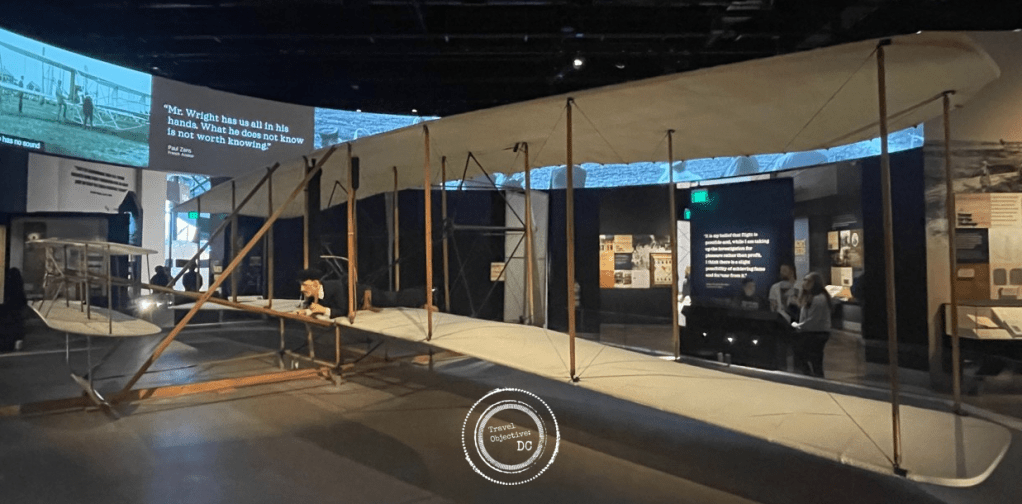
Wright Brothers | Wright Flyer | first airplane | Air and Space Museum
The Wright Flyer on display in the Wright Brothers gallery.

What Galleries Are Now Open?

The Wright Brothers – The centerpiece of the gallery devoted to Orville and Wilbur Wright remains the Wright Flyer, the brothers’ heavier than air machine which first took flight on December 17, 1903 in Kitty Hawk, North Carolina. The redesigned gallery adds further details to their lives before and after they achieved fame as inventors of the airplane.  There are leaflets from their printing business, tools from their bicycle shop, early models, experimental aircraft parts and furnishings from their cabin in North Carolina.

Early Flight – Following their successful flight, the Wright Brothers led many others in continued experimentation on early aircraft. A budding aviation community took hold around the world as the human passion for flying grew. The gallery highlights this earliest period of aviation innovation.

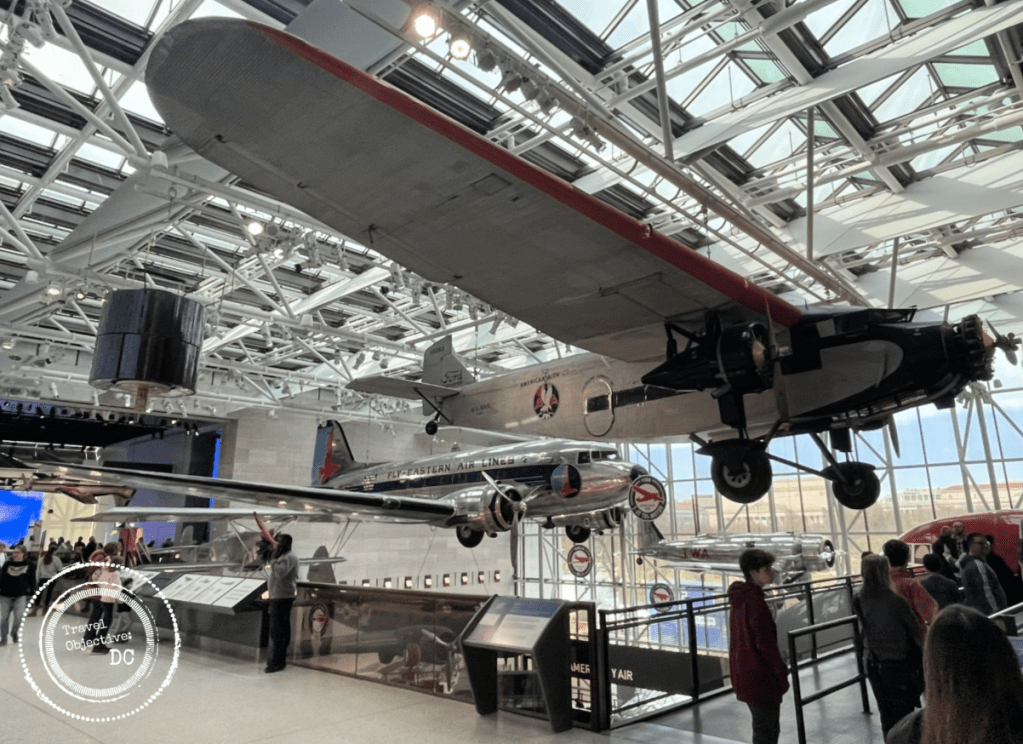
America by Air – In 1918, the U.S. Government formally initiated airmail service, a decision that led to the commercial passenger aviation industry. The America by Air gallery tracks air travel in the United States from the early days of open cockpits to the deregulated, post-9/11 era we know today.

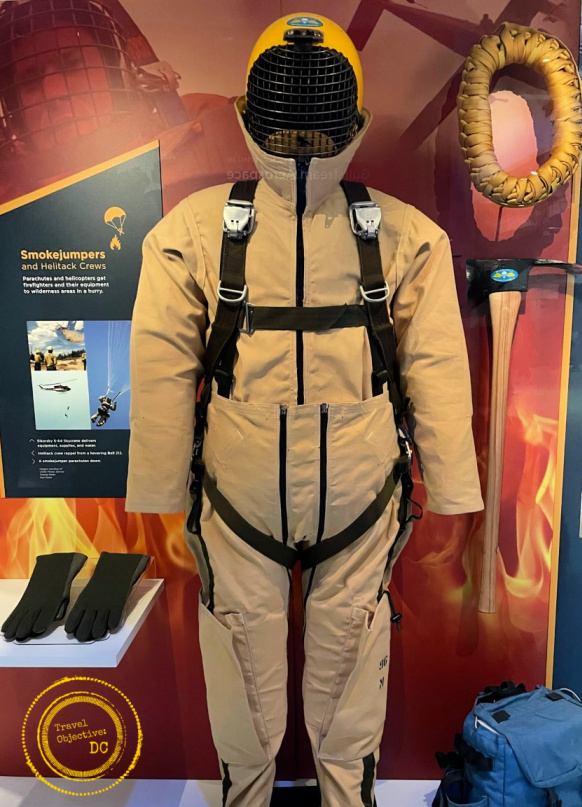
A smokejumper’s protective suit and other gear on display in the Why We Fly gallery.

Smokejumper protective suit | National Air and Space Museum | NASM | Washington DC

Why We Fly – About 80% of aircraft in the United States are considered General Aviation, meaning they are not connected to scheduled passenger service, the military or the Federal government. Why We Fly exhibits reflect the great diversity of this sector. Medical flights, crop dusting, aerial firefighting and humanitarian response are all included.

Nation of Speed – A collaborative effort with the Smithsonian’s National Museum of American History, Nation of Speed presents the American experience of the desire to move faster in the air, on the water and over land with the technology and machines that made it possible.

Destination Moon – Some of the Smithsonian Institute’s most iconic artifacts are found in Destination Moon, which traces the history of the US lunar programs and missions.

Exploring the Planets – Beyond the moonshots of the 1960s and 1970s, this gallery explores current space exploration programs and future plans for exploring our solar system.

Apollo 11 Command Module Columbia | moon landing return vehicle | Neil Armstrong | Buzz Aldrin | Michael Collins | NASM Washington DC

The Apollo 11 Command Module Columbia. The command module was the living quarters and return vehicle for Neil Armstrong, Buzz Aldrin and Michael Collins.

One World Connected – Explores how the advancements of aircraft, satellites and technology have revolutionized communications, navigation, weather forecasting and other aspects of life on earth.

Mixed Results

It is quite evident tremendous effort went into the design (or redesign) of these galleries, but the results seem mixed. On the positive side, the new features in the Wright Brothers gallery fill in more details on the lives of the two brothers, making them seem more human, while still maintaining their iconic stature. America by Air provides ample details and activities telling the story of commercial passenger aviation in America. The shiny and brightly painted early airliners suspended above the displays add a sense of majesty to the storytelling below. 

Ford-5 Tri-Motor | Douglas DC-3 | airplanes on display at National Air and Space Museum | Washington DC tourism | Smithsonian Institute
A Ford-5 Tri-Motor and a Douglas DC-3 above the American by Air gallery.

Within Destination Moon, the artifacts and displays are now neatly and chronologically arranged allowing visitors to walk through the decades of manned lunar exploration. Along the way, they get a sense of the dedication of the people involved, the power of the rocket engines, and at the same time, reckoning how all this was accomplished with less technology than the cellphones in our pockets today.

However, the Nation of Speed gallery is much more suited to the Smithsonian’s National Museum of American History. For some reason, profiles of early pilots and aviation record holders are notably absent with most of the artifacts related to auto or motorcycle racing. 

Exploring the Planets is understandably lighter on artifacts (many are still in use or irretrievable) and there are indeed some interesting examples of the Mars rovers. However, other displays simply describe the current scientific understanding of the other planets seeming more akin to a science fair rather than the immersive experience NASM’s renovation was to bring about.

The One World Connected gallery celebrates the interconnected life on planet Earth in this 21st Century. Yet the exhibits do not mention much about the the limits nor downsides of the technology that brought us this interconnectivity, such as cyber crime, disinformation or political polarization, and how we can overcome them.   

An early Global Positioning System (GPS) unit circa 1993 from the Magellan Corporation on display in the One World Connected gallery.

Smithsonian Institute | GPS on display at NASM

What’s Missing?

Notably absent from the eight renovated galleries are newly restored and presented aircraft, which is rather confounding as the Smithsonian prides itself on its collection of historically significant aircraft. My 11-year-old son summed it up best when he said: “There aren’t any cool planes to look at.”

Most of the aircraft on display were previously viewable before NASM started the renovations. Military aircraft are especially lacking. Aside from Jacqueline Cochran’s T-38A, the only other prominent military aircraft is the Wright Military Flyer, a two-seat observation aircraft built by the Wright Brothers and purchased by the US Army in 1909. 

Closed are galleries that previously included aircraft from both world wars, Legend, Memory and the Great War in the Air and WWII: Sea-Air Operations (featuring a reproduction of a carrier hanger deck from WWII). In their absence, a lone Rebel Alliance X-wing Starfighter from the movie Star Wars hangs suspended from the ceiling over one of the walkways, with little accompanying information.

Jacqueline Cochran | Jackie Cochran | female pilot | Women Airforce Service Pilots WASPS | aviation record holder

Jacqueline Cochran (circa 1943) in her Women Airforce Service Pilots uniform. When she died in 1980, Cochran held more speed, distance and altitude flying records than any other pilot.

What is also missing, with the exception of the Wright Brothers, Jacqueline Cochran and the astronauts, are the profiles of humans who took to the skies and to space, pushing themselves and their equipment to the limits to accomplish something for us all. Indeed, the redesign seems to remove the human element in aviation and space exploration, replacing it with technology and process. One leaves NASM better informed, but not inspired.

What’s Next?

These are hopefully just temporary drawbacks. NASM’s renovation is set for completion in 2025. Approximately fifteen more galleries are still under renovation. Publicly available information on the new galleries seems scarce, but one new gallery entitled Pioneers of Aviation will feature the iconic Spirt of St. Louis. Another will depict aerial combat and tactics during World War II with the North American P-51, Grumman Wildcat and Messerschmitt 109 on display. Perhaps the X-wing Starfighter suggests a Star Wars or space fantasy gallery is in the works?

Star Wars X-Wing Starfighter on display at Smithsonian
A Rebel Alliance X-Wing Starfighter from the Star Wars movies

In the meantime, those with a serious interest in military aircraft should visit the Smithsonian Institute’s Steven F. Udvar-Hazy Center in Chantilly, VA near Washington Dulles International Airport instead. At this 17-acre facility, military and civilian aircraft from World War I until today, as well as space equipment, are on display. 

* * *

Route Recon

The Smithsonian Institute’s National Air and Space Museum is located on the National Mall bordered by Independence Avenue, Jefferson Drive, and 4th and 7th Streets, SW. The entrance is on the south side of the building along Independence Avenue. You cannot access the museum from the north side along the National Mall.

Parking – Very limited metered street parking is available around the museum. Parking is available in several commercial parking lots in the neighborhood.

Public Transportation

Metrorail – The closest Metro station is L’Enfant Plaza, along the blue, orange, silver, and green lines. From the L’Enfant Plaza Station, take the exit for Maryland Avenue and 7th Street.

Metrobus – Bus stops are located on Independence Avenue, SW, and along 7th Street, SW. Visit the Washington Metropolitan Area Transit Authority for more information.

Circulator Bus – The National Mall Circulator Loop bus provides easy access around the National Mall and convenient connections to other Circulator buses for visits to uptown sites. The NASM is a short walk from the Jefferson Drive and 7th Street SW stop on the National Mall route, or the D Street SW and 7th Street SW stop on the Eastern Market – L’Enfant Plaza route.

Bicycle Sharing – Capital Bikeshare  is metro DC’s bicycle sharing service. There are Bikeshare stations around the National Mall. There is Bikeshare station on 4th Street, just south of the intersection with Independence Avenue.

Intel Brief

Free timed tickets are required for entry into NASM. Tickets can be acquired through the NASM website. Ticket holders will line up near the Independence Avenue entrance prior to their entrance time. The line can become quite long, but it moves quickly once ticket holders are allowed to enter the building.    

NASM is not currently offering guided tours for individual parties. Tours are available for school groups of 10 or more and adult groups of 20 or more. Tours should be requested 3 weeks in advance. Reservation and group visit information is available at NASMs Group Tours webpage.

Mess Call

The Mars Café is located on the “Launch Pad” (lower level) It is open daily from 10:00 am to 5:00 pm. The café has a coffee bar and sells sandwiches, salads, and pastries.  There are only twenty five tables currently available so seating is challenging at mid-day.