Remembering President James Garfield


Today, few Americans could tell you very much about James Abram Garfield, our 20th President. A few people with an interest in history might recall that Garfield was assassinated early in his presidency by a “disgrunted office seeker”. Professional historians generally rank his shortened presidency as “below average” or do not rank him at all. 

This is rather regrettable as Garfield was a courageous and dedicated leader who died for fighting what he believed in. Fortunately, he has one distinction the vast majority of presidents will never have: his own memorial on the US Capitol grounds. 

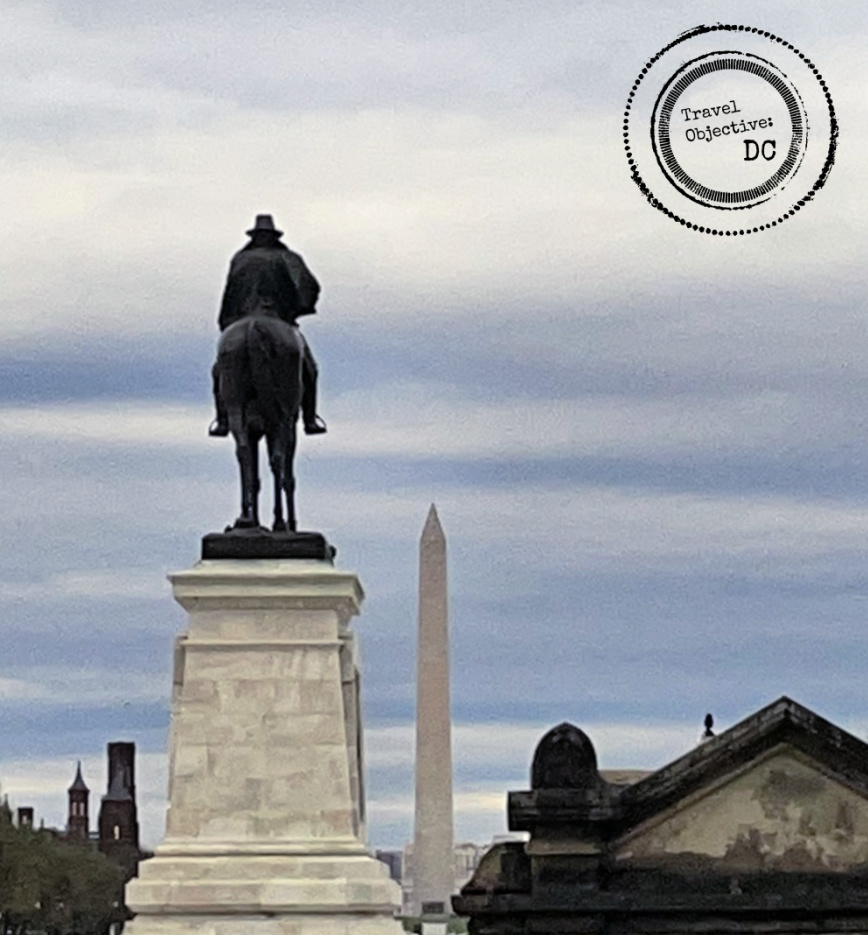
One of three monuments on the west side of the Capitol building adjoining the National Mall–along with the Ulysses S. Grant Memorial and the Peace Monument–Garfield’s monument is located within a traffic circle at the intersection of First Street SW and Maryland Avenue near the US Botanic Garden.

The Garfield Memorial on the west grounds of the US Capitol

John Quincy Adams Ward, a prominent 19th century sculptor and friend of Garfield designed the monument. Ward depicted Garfield in bronze atop a round, tapered granite pedestal. He is shown giving a speech, grasping a scroll in his left hand and gazing intently at his audience. His foot is placed slightly off the platform and meant to symbolize Garfield as a man of action. At the base of the pedestal are three classical Roman figures representing the key phases of Garfield’s life as a young scholar, military leader and statesman.

Garfield personified the American success story, so much so that renowned author Horatio Alger wrote his biography. Alger published From Canal Boy to President in 1881.  

James Garfield was born in 1831 in a log cabin in northeastern Ohio. His family was poor and his father died when Garfield was a young man. He went to work to support his family, taking a variety of jobs including helping tow canal boats. While recovering from a serious bout of malaria contracted on the canal, Garfield’s mother convinced him to return to school. Garfield was an excellent student with a strong work ethic. He took to his studies and worked his way through the Western Reserve Eclectic Institute as a janitor and school teacher.  After graduation, he became a preacher. Garfield then studied law at Williams College in Williamstown, MA. 

The face of the young scholar figure on the Garfield Monument
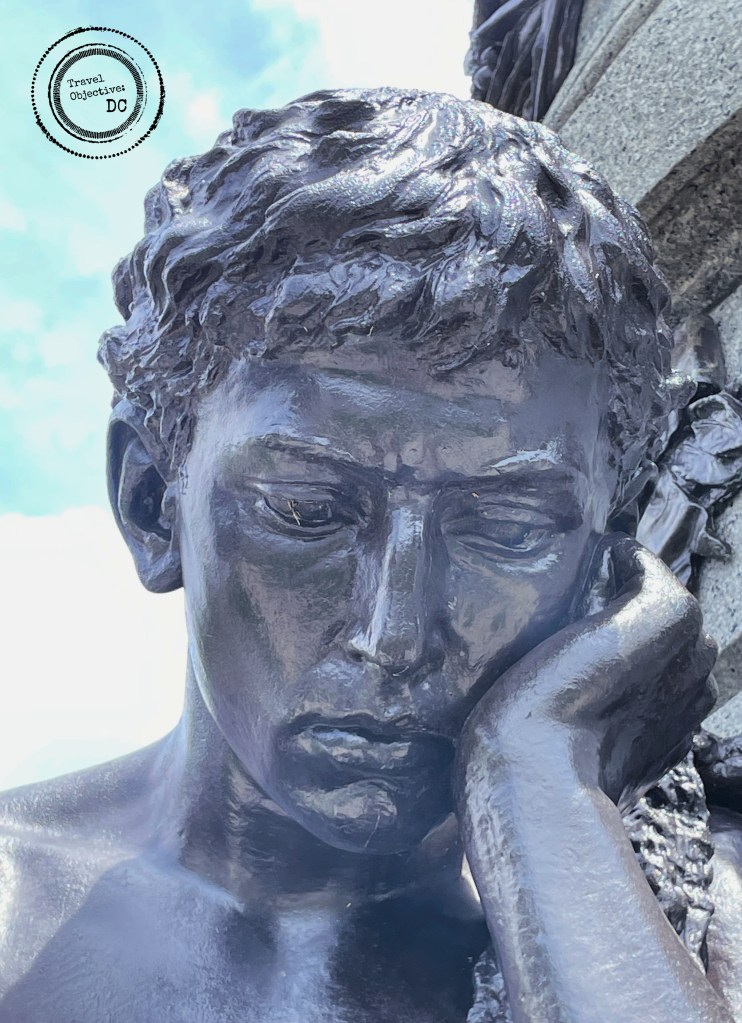
Between his jobs as a preacher, teacher and lawyer, Garfield became a skilled orator. He entered politics and was elected to the Ohio State Senate as a Republican in 1860. As the Civil War broke out, Garfield was an abolitionist dedicated to the Union’s cause. He led fundraising and recruitment efforts for Ohio volunteer regiments. 

Eager to enter the Army, Garfield began studying military tactics.

Garfield commanded a Union Army brigade at the Battle of Middle Creek near Prestonsburg, KY in January 1862. Under his steady leadership, Garfield’s troops routed the rebel forces who retreated into Virginia. Although not considered a major battle today, the victory was an important boost to Union morale and brought Garfield widespread recognition. 

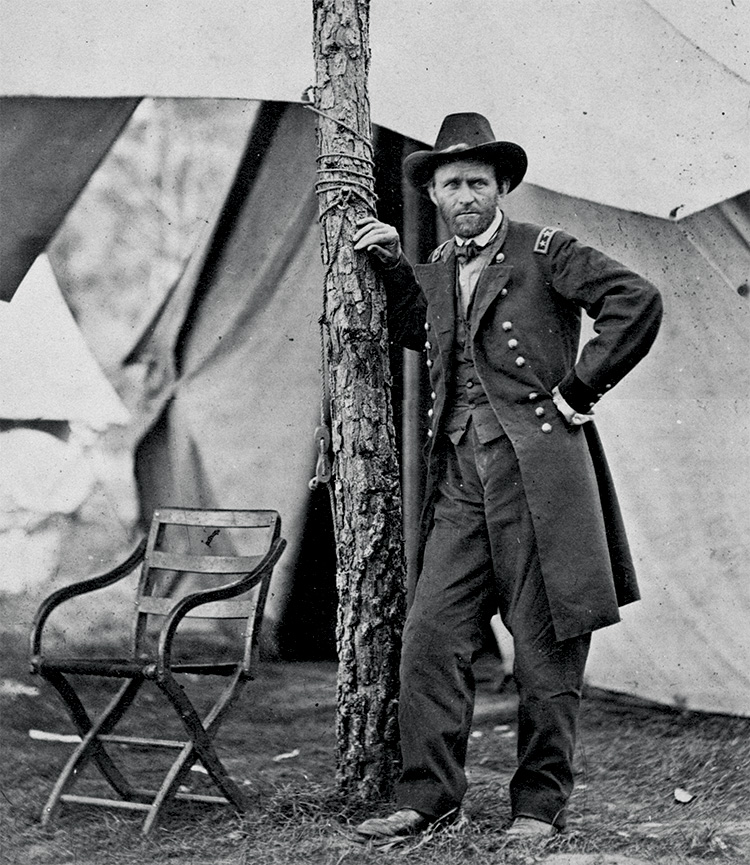
After the battle, Garfield was promoted to brigadier general. He was later assigned as Chief of Staff to General William Rosencrans of the Army of the Cumberland. After the decisive Union loss at the Battle of Chickamauga, Ulysses S. Grant relieved Rosencrans of command. Rather than Garfield, Grant appointed George H. Thomas to succeed Rosencrans. Although Garfield was later promoted to Major General, being passed over for the army command led him to consider a return to politics.
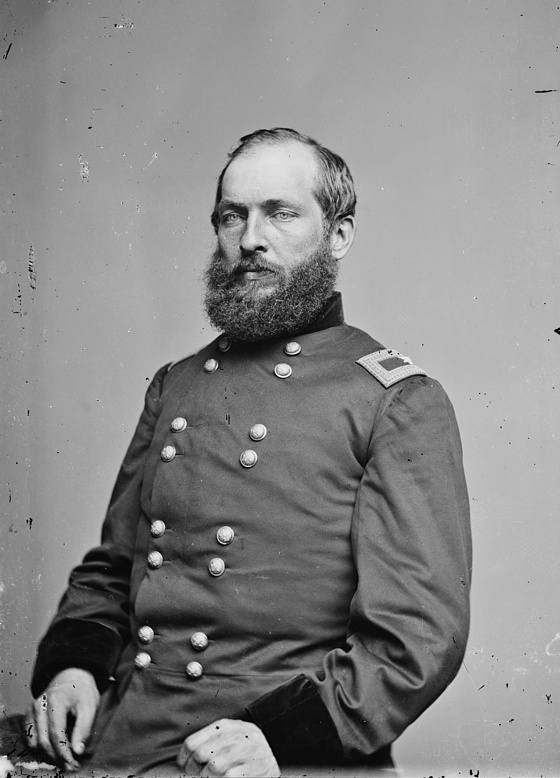
Photograph of James Garfield as Brigadier General

Brigadier General James Garfield, circa 1862

-Retrieved from the Library of Congress

In 1862, Garfield won an election for a seat in the House of Representatives. Garfield would serve nine terms in the House representing his home state of Ohio. While in Congress, Garfield was known for supporting civil rights for African Americans, the gold standard for the US dollar, and improving education for all. He helped establish the Federal Bureau of Education in 1870 to study and enhance educational methods across the country.

Garfield excelled as a Congressman, chairing powerful committees and mastering the nuanced details of legislation, especially on financial matters. At the same time, he was affable, a good conversationalist and considered one of the nicest men in Washington. 

At the deadlocked Republican presidential convention in 1880, Garfield was nominated on the 36th ballot. He defeated his fellow veteran Winfield Scott Hancock in the general election and was sworn in as the 20th President of the United States on March 4, 1881.  (He is the only president to be elected while a serving member of the House).

Republican Campaign Poster from the 1880 Presidential Election

During his presidency, Garfield fought one very significant battle.

His victory in that battle still impacts us today.

It had long been the practice in America that Federal employees were selected based on their demonstrated loyalty to political parties. Senators and representatives from a newly elected president’s party would act as “patrons” and recommend party workers, relatives and financial backers to the administration for government jobs.  

In the 1870’s, the issue of patronage was splitting the Republican party. Many wanted to maintain patronage while others wanted reform. Garfield opposed the patronage system and was a proponent of a professional, apolitical civil service. He knew it would make the Federal government much more efficient, limit corruption, and relieve elected officials from constant demands for jobs.

Garfield staged a showdown with New York’s two powerful Republican senators who were both savvy practitioners of the patronage system. Garfield nominated his own candidate for the important position of customs collector in the Port of New York. The two New York senators resigned in protest fully expecting to be quickly returned to office by the New York legislature. However, during their absence from Washington, Garfield pushed his nomination through the US Senate, embarrassing the two senators.

Sadly, this important victory over patronage directly contributed to Garfield’s death.

On July 2, 1881, Garfield was preparing to board a train at Washington’s Baltimore and Potomac Railroad Station. Suddenly, two shots rang out, striking Garfield in the arm and back.  Garfield’s assailant was Charles Guiteau, who may forever be known in history books as the “disgruntled office seeker”.  

The old Baltimore and Potomac Railroad Station. The station was demolished in 1907 after Union Station was opened. The station was located where the West Building of the National Gallery of Art stands today. [Undated photo]

-Retrieved from the Library of Congress
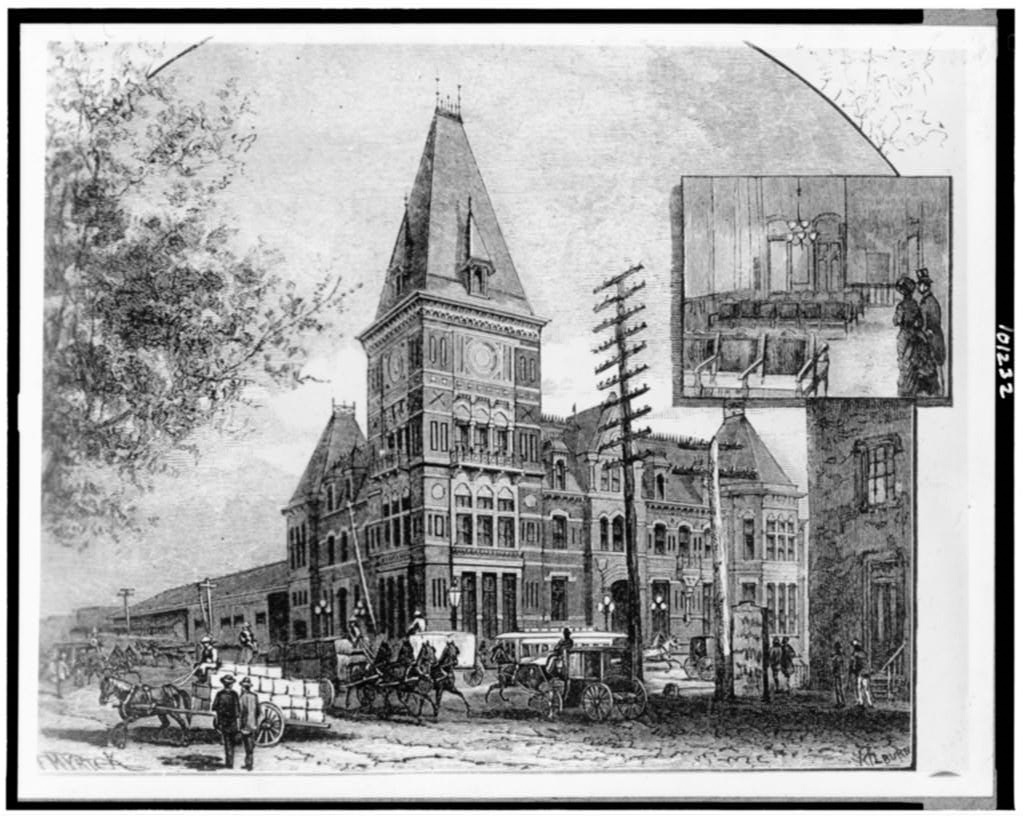
Photograph of the old Baltimore and Potomac Railroad Station in Washington, DC

Guiteau had written, delivered and published a speech supporting Garfield in the election. He thought this entitled him to a consular job at the US Embassy in Paris. While Guiteau had no dislike for Garfield as a person, he believed he would help preserve the patronage system by killing the president. Guiteau was quickly apprehended in the train station. He was later found guilty of murder and executed about 18 months after the shooting. 

The cover of Puck, a 19th century satirical magazine from July 13, 1881 with an image of Garfield's assassin Charles Guiteau

The cover of Puck, a 19th century satirical magazine from July 13, 1881 with an image of Garfield’s assassin Charles Guiteau holding an extortion note.

Garfield would linger on for the next two months. On September 19, 1881, he died from sepsis poisoning, just five and an half months into his presidency.

In the wake of Garfield’s death, Congress passed the Pendleton Act, which established a merit-based system for hiring and promoting Federal employees. The Pendleton Act was signed into law by the new president, Chester A. Arthur, who previously had been a supporter of the patronage system. As a surprise to many, Arthur quickly set about implementing its provisions to reform the civil service. 

The country closely followed Garfield’s deterioration and he was widely mourned after his death. Work then quickly began on building him a suitable memorial. The Society of the Army of the Cumberland, a Union veterans’ organization, formed a fundraising committee and ultimately raised over $28,000. They also successfully lobbied Congress for additional funds for the statue and the pedestal.

The newly unveiled Garfield Memorial was prominently placed on the cover of Harper’s Weekly on May 14, 1887.
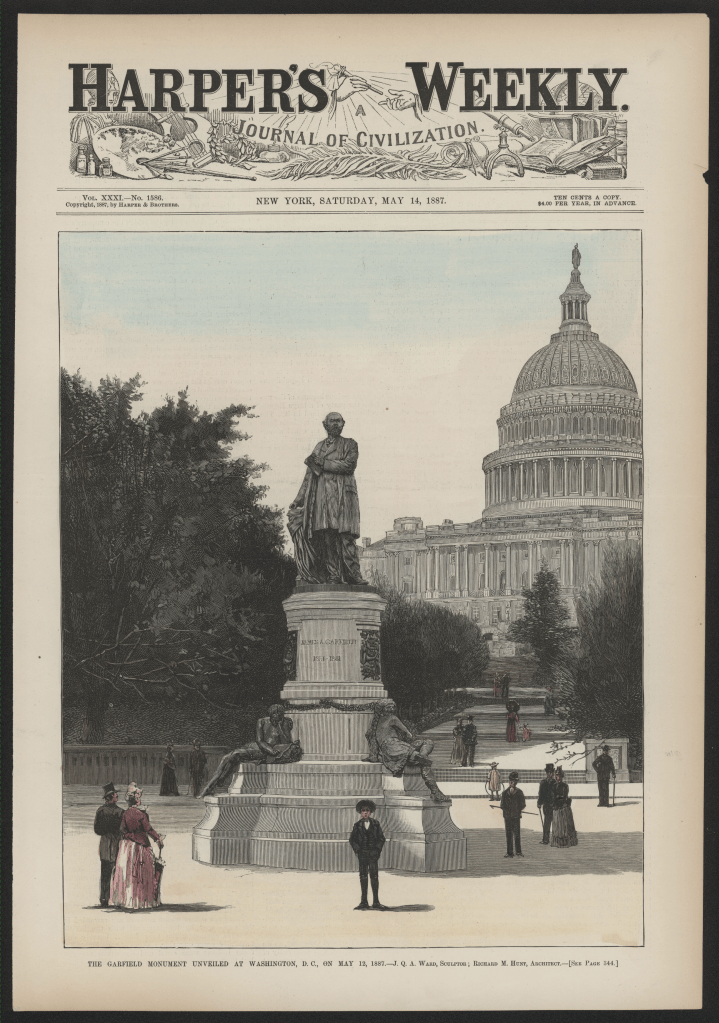
The cover of Harper's Weekly from May 14, 1887.

The memorial was dedicated on May 12, 1887, in a grand ceremony attended by President Grover Cleveland, many senior government officials, military leaders and veterans from the Society of the Army of the Cumberland and the Grand Army of the Republic. Cannon salutes were fired and the US Marine Corps Band played stirring patriotic music.

Today, the Garfield Memorial remains a prominent and visible reminder of the talented, resourceful and considerate man who was our 20th president. 

* * *

Route Recon

The Garfield Memorial is located within a traffic circle at the intersection of First Street SW and Maryland Avenue near the US Botanic Garden.

There is limited street parking nearby near the Botanic Garden.

The closest Metro Station is at L’Enfant Plaza. Exit the station through Entrance A for 7th Street and Maryland Avenue. Follow Maryland Avenue to the northwest, pass the Dwight D. Eisenhower Memorial and the US Botanic Garden.

Military History on the Mall


For the past 250 years, Americans have consistently answered the call to war.  

To answer that call, they often left behind civilian lives, families, and communities. Wars are never fought in a vacuum. With each conflict, there are corresponding impacts on American life and society.

On Veterans Day, 2004, the Smithsonian Institute’s National Musuem of American History, located on the National Mall, opened an ambitious military history exhibit to explore not just battles and campaigns, but rather the many ways wars have physically, culturally and economically shaped America throughout its history.

French cannon

A French four pounder field cannon, a gift to the Americans from the Marquis de Lafayette

Entitled The Price of Freedom, Americans at War, the exhibit was designed to be extensive, occuping over 18,000 square feet and examining 16 conflicts in nine different galleries. Visitors follow a maze-like path through these chronologically arranged galleries, from the French and Indian War through Iraq and Afghanistan.

In designing The Price of Freedom, curators stayed away from displays comprised largely of weapons and uniforms (although there are still plenty of those). Rather, they identified over 800 unique artifacts from the Smithsonian’s extensive collection. Some of the more notable items on display include George Washington’s sword and scabbard, the chairs used by Ulysses S. Grant and Robert E. Lee at Appomattox and a Willys Jeep from World War II.

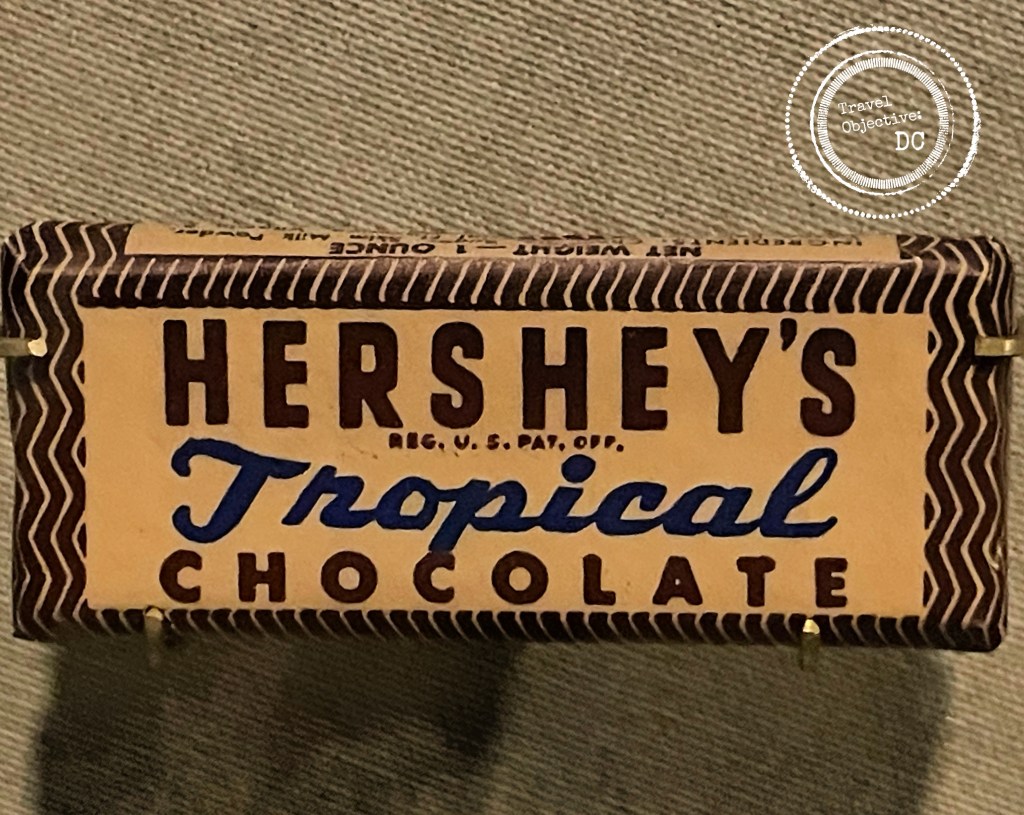
A melt resistant chocolate bar developed by the Hershey Company and provided to US servicemembers in the Pacific Theater during World War II

Hershey's Tropical Chocolate Candy Bar

However, head curator David Allison sought a symmetry in the selection of the artifacts. He wanted to display noteworthy items along with more common articles reflecting the service members and their times, such as rations, books and playing cards.

In addition to the artifacts, exhibit designers use photographs, contemporary illustrations, videos, interactive stations, and other features to help interpret the wartime experience and immerse the musuem visitor in the time. 

The most unique display is in the Vietnam War gallery where 16 different 1960’s-era television sets show contemporary footage and commentary depicting how Americans experienced the Vietnam War at home. The viewing area for the televisions is reminiscent of a mid-century living room, complete with a blocky couch and chair covered in thick clear plastic as your grandmother or aunt might have had. 

1960's era televisions
An array of 1960’s era televisions used in a display in the Vietnam War gallery in the Price of Freedom exhibit at the Smithsonian National American History Musuem

The Revolutionary War, Civil War, World War II and Vietnam War galleries are the largest. These spaces immerse you in the story of the war and how it impacted soldier and civilian alike.

The Wars of Expansion Gallery is smaller, but provides important context and accounts for a series of 19th century conflicts, such as the Battle of Little Bighorn and the Spanish-American War, which may be less familiar to many visitors.

The mix of artifacts and displays broadens the appeal of The Price of Freedom to a wider audience. Those with less interest in military subject matter should still enjoy viewing some of the more unique items while serious students of history are sure to come away having learned something new. 

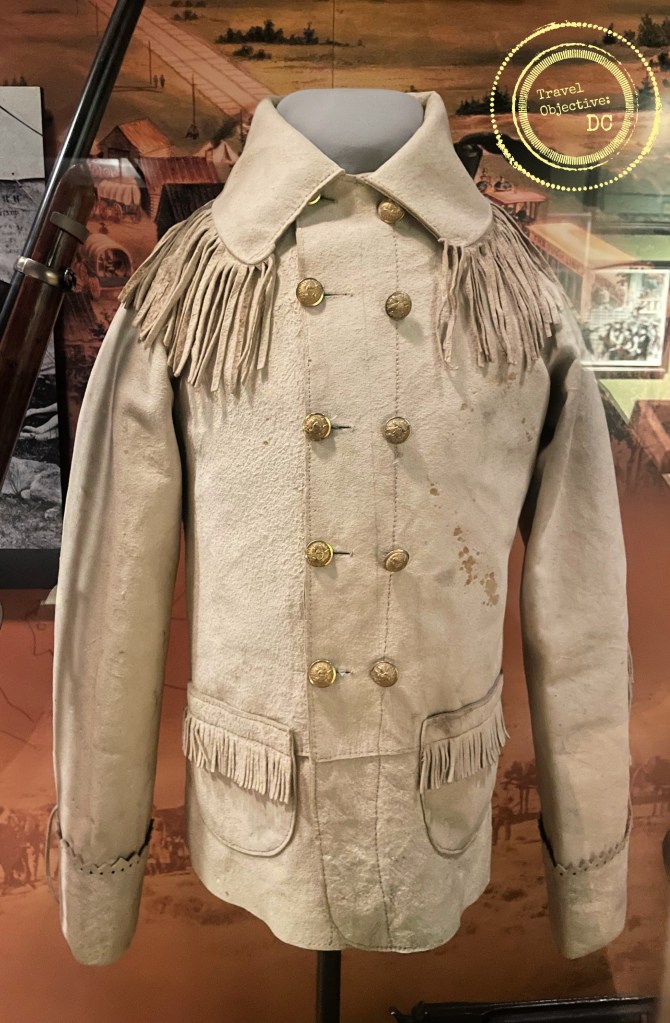
General George Custer’s buckskin coat

Custer's Buckskin Coat

While in most cases The Price of Freedom achieves its aims, there are a few shortcomings. 

Unfortunately, the exhibit space for World War I is too limited. The display misses or minimizes some important themes, such as the rapid expansion of the Army, the mobilization of the American economy, the changing role of women in the military, and the emergence of the United States as a world power. 

The Gulf War display is similarly small, seemingly limited to uniforms worn by Colin Powell and Norman Schwarzkopf. 

There is also an unfinished feel to the exhibition space for the wars in Iraq and Afghanistan. This is understandable as the original exhibit opened in 2004 before those conflicts ended. However, there is space for a more complete examination of both those conflicts than is currently provided. 

Chairs used by Grant and Lee at Appomattox.

The chairs used by Ulysses S. Grant and Robert E. Lee at Appomattox.

At the conclusion of The Price of Freedom is a short film with veterans reflecting on their motivations and sacrifices of their service in the American military. The film concludes with scenes from U.S. military cemeteries showing orderly tombstones and listing the number of interments. 

There are also recurring references to casualites throughout the galleries in keeping with the intent of the exhibit principal funder, Kenneth Behring. He desired the exhibit specifically to recognize the ultimate sacrifices made by American men and women who died in wartime. 

Even with a few flaws, two decades after its opening, the Price of Freedom remains true to its original mission. As America prepares to celebrate its 250th anniverary, this important exhibit gives visitors a thorough synopsis of America’s military heritage and its significant influence on our national character. 

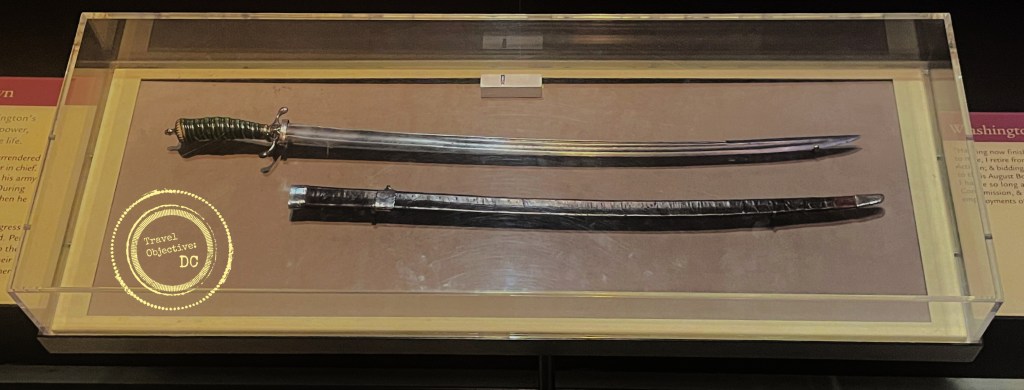
Washington's sword and scabbard
George Washington’s sword and scabbard from the American Revolution

* * *

Route Recon


The Smithsonian National Museum of American History is located at 1300 Constitution Avenue N.W., Washington, D.C. 20560

The nearest Washington DC Metro Stations are Federal Triangle and Smithsonian. Both stations are on the Metro Blue, Orange and Silver lines.

There is no public parking facility for the Smithsonian museums on the National Mall. A limited number of city-operated metered parking spaces along adjoining streets are available.  

The Musuem is open daily (except Christmas Day) from 10:00 AM to 5:30 PM.

Consult the Musuem’s website for more information about other exhibits.

Please note: The Price of Freedom, Americans at War exhibit includes some graphic images of war and casualties.

A guide to the exhibit is available here.

The National Native American Veterans Memorial, A Welcoming Place


In 1942,  the US Marine Corps recruited Chester Nez, and twenty-eight fellow members of the Navajo tribe for a special mission. After basic training, they were sent to Camp Elliot, California where they developed a cipher code for transmitting radio messages based on the Navajo language. Each member committed the straightforward code to memory. 

With the code complete, the platoon members then deployed to units in the Pacific Theater. Nez was assigned to the 1st Marine Division on Guadalcanal. His first encoded transmission led to an artillery strike which destroyed an enemy machine gun nest. 

Nez would later see combat at Bougainville, Guam and Peleliu, all the while relaying messages in a radio code the Japanese could never crack. For their contributions in developing such an unbreakable code, as well as their bravery in the field,  Chester Nez and his twenty-eight fellow Marines were awarded the Congressional Gold Medal in 2001. 

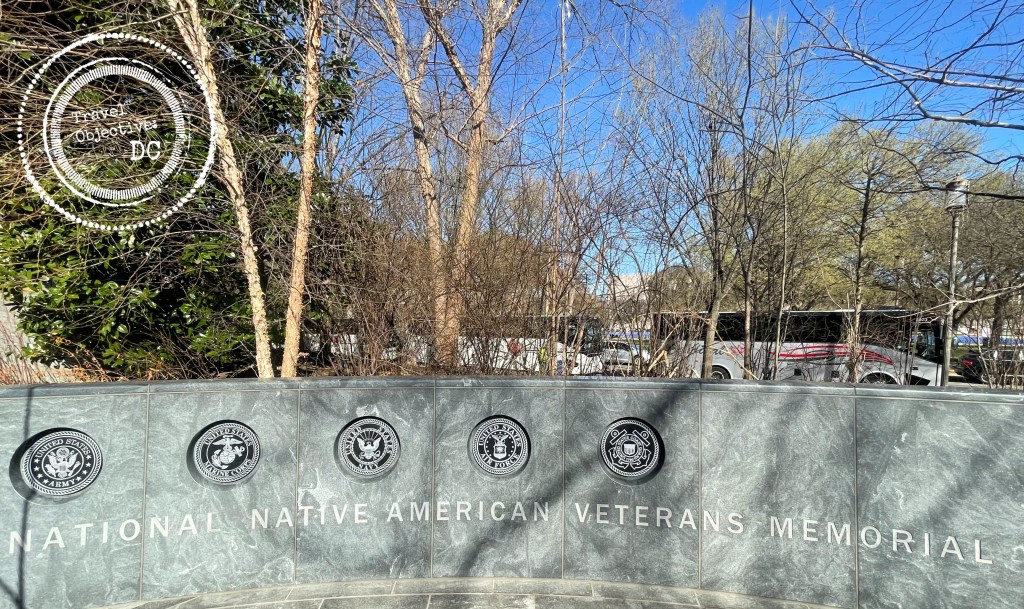
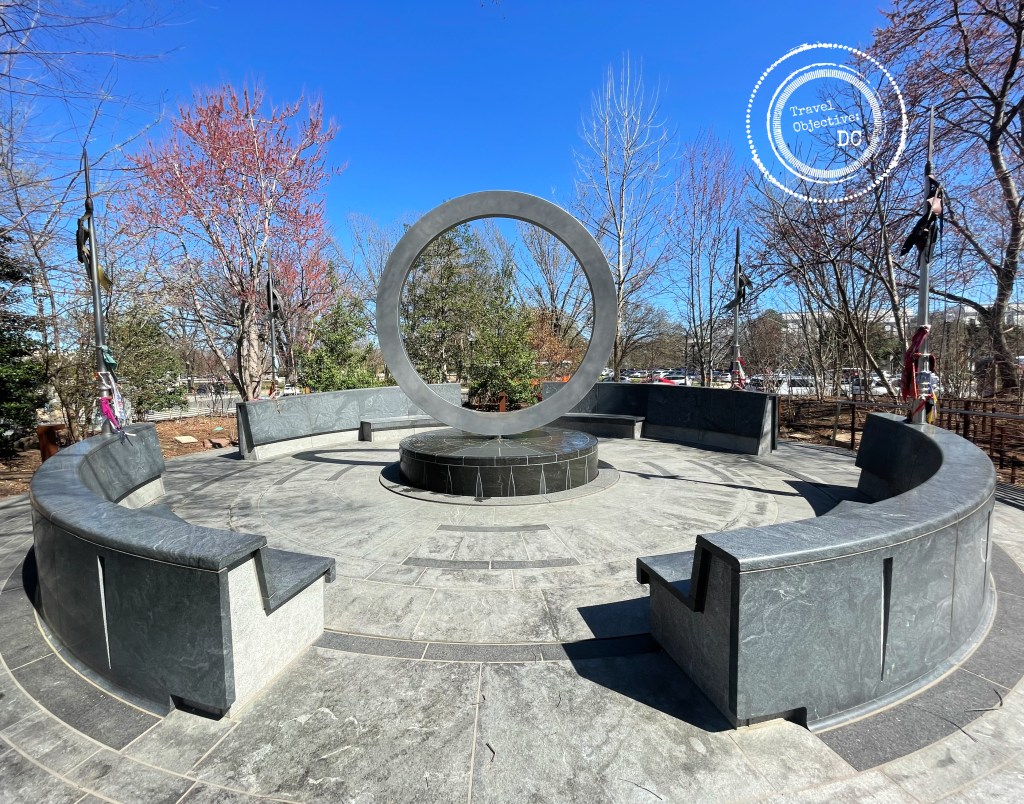
A stone wall with the seals of five of the armed forces marks the entryway to the National Native American Veterans Memorial.
Native Americans have served in all branches of the American military throughout our history.

The code talkers, as these men were known, are today one of the better known examples of Native Americans serving in the American military. However, Native Americans, Alaskans and Hawaiians have long served in the Armed Forces, from Valley Forge through Iwo Jima to Iraq and Afghanistan. Today there are approximately 140,000 veterans of Native heritage. 

In 2013, Congress amended legislation to direct the National Museum of the American Indian to build a memorial so all Americans can learn “of the proud and courageous tradition of service of Native Americans”.

As part of a nationwide competition, a design committee selected a proposal entitled Warrior’s Circle of Honor submitted by Harvey Pratt, a self-taught artist and Marine veteran from Oklahoma and a member of the Cheyenne and Arapahoe Tribes.  As the name suggests, the circle is the prominent shape of the memorial’s features.

The focus of the memorial is a vertically oriented stainless-steel circle, situated on a carved stone drum surrounded by circular seating area

The focus of the memorial is a vertically oriented stainless-steel circle, situated on a carved stone drum surrounded by circular seating area and gathering space.

The circle is relevant in many Native American cultures. It represents the cycle of life, as well as the four seasons, the sun, the moon and the orbits of the planets and stars. Native communities also gather in circles for ceremonies, festivals and storytelling. 

The memorial design is about more than the circle of course. Pratt also sought to create a space for servicemen and women, veterans and their families to heal by combining the elements of water, wind, and earth into the memorial’s design. 

Water glistens as it flows over the carved stone drum at the National Nafive American Veterans Memorial.

Flowing water glistens atop the carved stone drum at the National Native American Veterans Memorial

Water pulses across the surface of the stone drum and flows down its side creating a central fountain. The stone work around the drum contains a visual echo of the water, with concentric rings in the stone walkways around the drum. The depiction represents the beating of the drum, hearkening all to gather in the space.

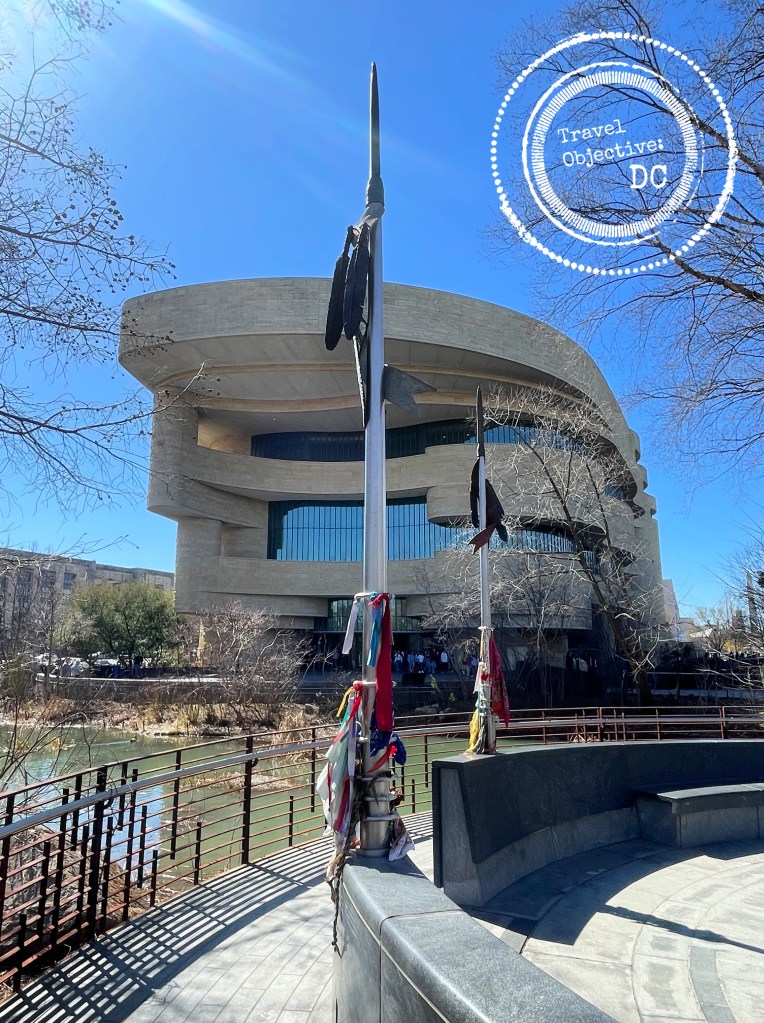
Around the seating area are four spears pointed skyward. The spears hold prayer cloths visitors have tied to the base of the spears allowing the wind to carry the intentions of the prayer cloths to the heavens.

Finally, a park-like setting is built around the memorial combining hardwood trees and a wetland pond. The setting is intended to provide privacy for visitors while a soundtrack of Native American veterans songs aids in reflection. 

Two spears, pointed toward the heavens with prayer cloths tied to their bases.

Two spears, pointed toward the heavens with prayer cloths tied to their bases.


The memorial is located to the east of the main entrance plaza of the National Museum of the American Indian. A large stone marker with the emblems of the five branches of the Armed Forces marks the way.

Within the museum, an exhibit entitled Why We Serve provides background, rationale and compelling examples through history of the military service of Native Americans, Alaskan Natives and Native Hawaiians to the United States. The exhibit is also available online.  

The memorial is above all a welcoming place. Welcoming to Native Americans and their families to heal and reflect. Welcoming to other visitors as well to learn, to rest and also to consider the meaning of service to country and community. 

A white ribbon prayer cloth tied to the base of a spear.

* * *

Route Recon

The National Museum of the American Indian is located on the south side of the National Mall at the intersection of Fourth Street & Independence Avenue, SW Washington, DC 20560. The main entrance faces east toward the US Capitol Building. 

The nearest Metro stations are L’Enfant Plaza and Federal Center SW.

The museum does not have parking. There is limited metered public parking on the surrounding streets. There are also several commercial parking garages nearby the museum.

The National Native American Veterans Memorial is accessible 24 hours a day. 

Learn more about Chester Nez and his fellow Navajo Code Talkers from the Veterans History Project of the Library of Congress.  

Mess Call

The Mitsitam Cafe, located within the National Museum of the American Indian offers a very broad menu of entrees, sandwiches and desserts reflecting Native American cuisines from across the country, such as grilled salmon, bison burgers and lobster roll. The cafe offers some of the tastiest food to be found on the National Mall. 

Command Reading

Why We Serve by Alexandra N. Harris and Mark G. Hirsh.  Why We Serve was published by the National Museum of the American Indian to commemorate the opening of the National Native American Veterans Memorial in 2020. The book explores the complex history of Native Americans serving in the US military with intriguing photographs, maps and artwork combined with compelling first person accounts.

African American Military History on the National Mall

From Bunker Hill in 1775 to Bagdad in 2005, African Americans have served in the American military throughout our history.  Their experiences are told as part of the larger African American saga at the Smithsonian’s newest museum, the National Museum of African American History and Culture.

Decades in the making, this museum opened in 2016 and attendance has now grown to over 1.6 million annual visitors. With over 3,500 artifacts on display, the museum’s broad expanse of exhibits reflect critical aspects of African American life such as slavery, civil rights, sports, music and military service. 

A “soup bowl” style helmet worn during World War I. Soldiers of the US 369th Infantry Regiment, the Harlem Hellfighters, are pictured behind the helmet.

Situated on the National Mall, the exterior features a distinctive bronze colored filigree, a tribute to the timeless work of African American metal artisans. It sets this structure apart from the neoclassical and modernist designs of the neighboring government buildings.

The bright, spacious lobby, known as Heritage Hall, features diverse artwork with copper metallic and gray walls, complimenting the museum’s unique exterior. From here, the visitor may choose their entryway into the African American experience presented in the museum. The escalator down leads to the History Galleries while upstairs are the Community and Culture Galleries, which reflect more contemporary times and themes.

Tracing African American military history will ultimately lead in both directions. 

Begin the journey in the downstairs galleries, which present over 400 years of African American history, from the establishment of the African slave trade through the Civil Rights era. African American military service during America’s wars is presented chronologically as part of the larger narrative of African American life. The galleries and exhibits devoted to four major conflicts all convey the recurring theme of how time and again African Americans fought bravely in wars for freedoms they themselves did not possess.

A large gallery dedicated to the Revolutionary War explores how enslaved Blacks served on both sides, motivated by promises of freedom. 

The flag of the Bucks of America, a Black paramilitary group founded in the Boston area. It is believed the group protected the property of Patriot merchants who had left Boston to fight in the Revolutionary War.

Historians estimate approximately 5,000 –  6,000 Blacks served in the Continental Army or in colonial militias. They were involved in every major Revolutionary War battle and most smaller engagements. Units such as the First Rhode Island Regiment, comprised mostly of Blacks, gained renown for their discipline and skills as soldiers. Additionally, experienced Black seamen were actively recruited by the Continental and Royal Navies and served in many different operational capacities.

The war’s conclusion in 1783 brought freedom for some Black soldiers and sailors, but many were returned to slavery, either in America or other portions of the British Empire. 

The Civil War gallery focuses largely on the many contributions of the US Colored Troops to the Union war effort. While newly freed slaves could receive paid work from the Army as early as 1861, they could not serve as Army soldiers until January 1863.  

A kepi cap worn by a soldier from the 4th Regiment Heavy Artillery, US Colored Troops

Ultimately, about 179,000 African Americans enlisted in the Army from both the North and South. They were organized into segregated infantry, cavalry and artillery regiments with white officers and designated as US Colored Troops. Initially, they were paid less than white soldiers and given menial jobs to perform. In time though they earned full pay and distinguished themselves in many battles. Sixteen African American soldiers would earn the Medal of Honor. 

Unlike the Army, the Navy was integrated before the Civil War. About 20,000 African Americans served aboard U.S Navy ships during the Civil War alongside White sailors.

The exhibits devoted to World War I and II are notably smaller than the Revolutionary and Civil War galleries.  They broadly describe the segregated service of African Americans during these wars and the hostile environment to which they often returned.

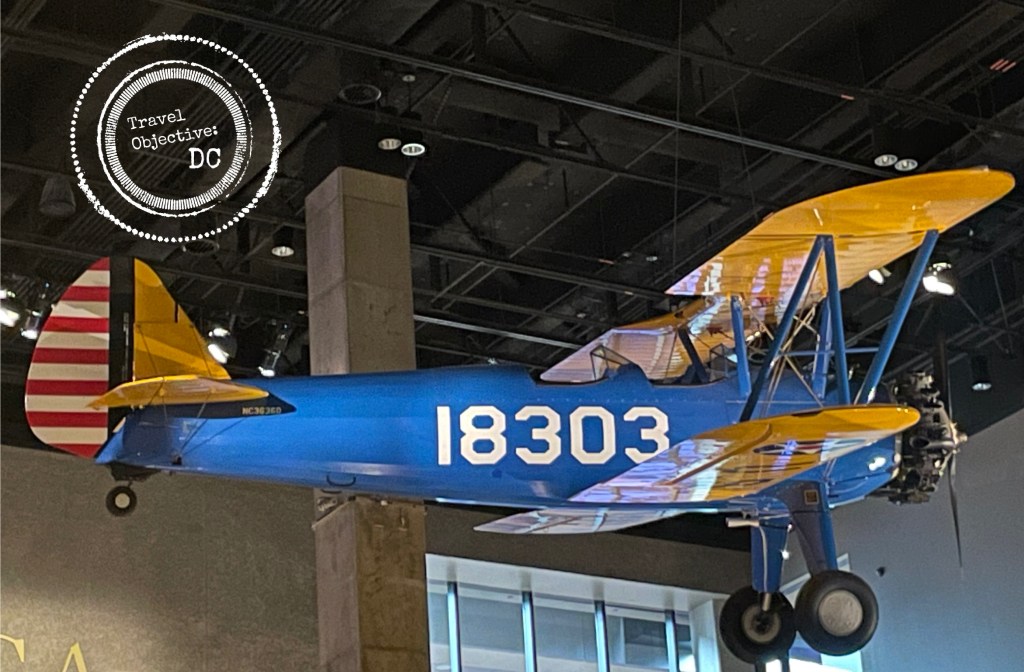
One of the highlights in the History Galleries is a beautifully restored Stearman Keydet training aircraft used by the Tuskegee Airmen. The two seat bi-plane was the primary pilot training aircraft for the US Armed Forces in the 1930’s and 1940’s. The accompanying display also includes an excellent five minute introductory video on the origins and accomplishments of the Tuskegee Airmen, which was established in 1941 to demonstrate that African Americans could perform the jobs required in the Army Air Forces. The Tuskegee Airmen included pilots, as well as navigators, flight engineers, bombardiers, mechanics and other essential support positions. 

A PT-13D Stearman Kaydet training aircraft used to train Tuskegee Airmen

One of the most notable units comprised of Tuskegee Airmen was the 332nd Fighter Group. From their base in Italy, the 332nd escorted heavy bombers on raids into central Europe from May 1944 through April 1945. They flew more than 15,000 sorties, losing but 25 escorted bombers to enemy fire. 

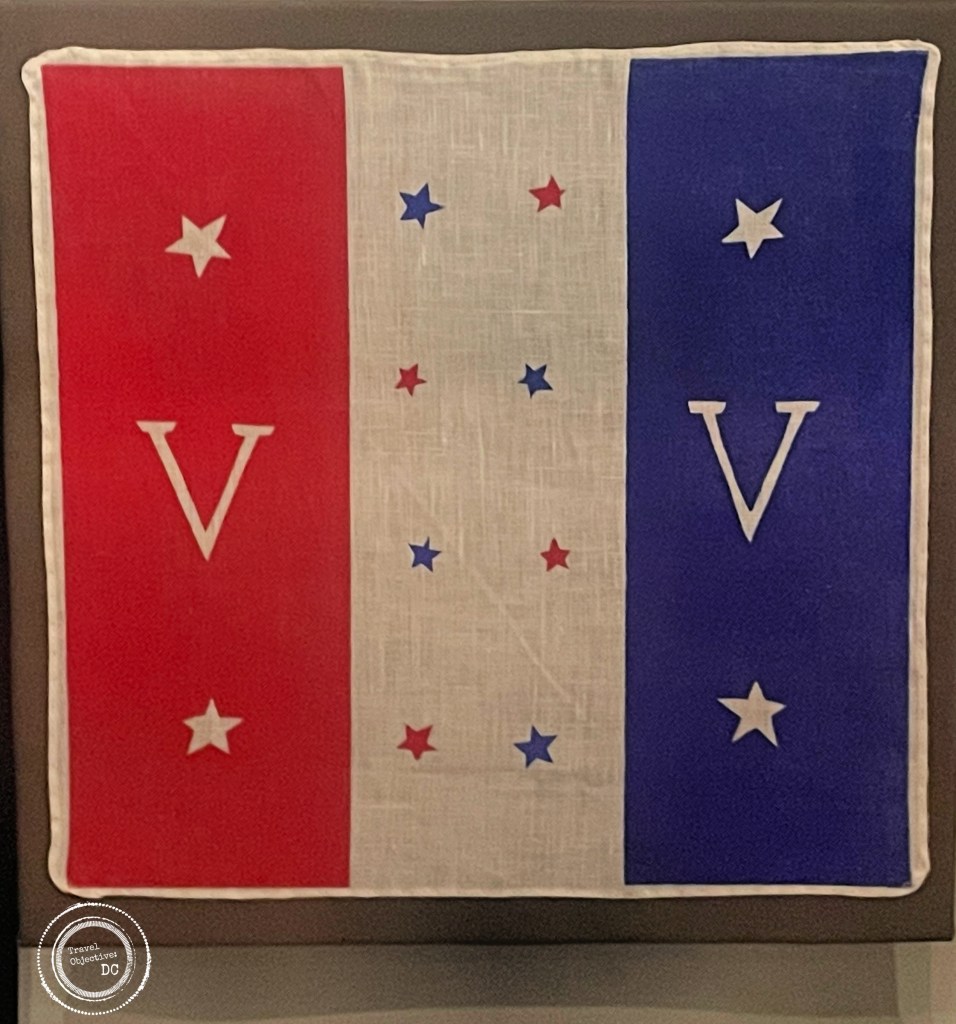
In the museum’s Community Gallery on the third floor is an exhibit entitled Double Victory: the African American Military Experience. The gallery takes its name from the Pittsburg Courier’s Double Victory campaign during World War II, which promoted America’s victory over the Axis Powers and an African American victory over discrimination at home. 

This exhibit expands on the themes first introduced in the below-ground History Galleries. Here the emphasis goes beyond historical facts of African American military service to how that service changed through the years and its impact on the larger African American community. 

A handkerchief with the emblem of the Pittsburgh Courier’s Double Victory campaign.

Also included are more artifacts, such as documents, weapons and equipment. These highlight what military service for African Americans entailed at the time, such as a seaman’s certificate issued in 1826 to a Black sailor named Robert Barnaby. Barnaby carried the certificate with him at all times to prove he was a sailor in the US Navy and avoid being seized as a runaway slave. 

This exhibits introduces the accomplishments of some notable African American units such as the 54th Massachusetts, the Buffalo Soldiers, the Harlem Hellfighters, and the Red Ball Express, among others. 

President Harry Truman officially ended segregation in the US Armed Forces in 1948, upon signing Executive Order 9981. Change came, but slowly. Racial tension continued in the following decades in parallel with the civil rights movement occurring across American society. However, the integration of the services opened new opportunities for African American service members.  

A horse saddle used by B Troop , 9th US Cavalry Regiment (A Buffalo Soldiers Regiment)

The final part of the Double Victory exhibit portrays one of the most important of those opportunities, the long rise of African Americans to senior ranks within the military. Two hundred years after the Battle of Lexington and Concord, Daniel “Chappie” James, a fighter pilot and Tuskegee Airman became the first African American four star general in history.

The exhibit includes Colin Powell’s dress uniform from his tenure as Chairman of the Joint Chiefs of Staff. It denotes the pinnacle of that long rise and attests to what is now possible in the military.

Although they might not have always been treated fairly, military service has long been an important part of African American life. Today, African Americans comprise 17% of the ranks of soldiers, sailors, airmen and Marines and continue a tradition begun over 200 years ago. Through that time, the unique relationship between African Americans and the American military was a rather complex picture. Curators have designed and assembled some revealing exhibits exploring the nuances of those complexities. It is an important collection and well worth seeing for anyone desiring a more complete picture of American military history. 

* * *

Route Recon

The Museum is located on the National Mall at Constitution Avenue, NW, between 14th and 15th Streets, Washington, D.C. The street address is 1400 Constitution Avenue, NW, Washington, DC, 20560.

Click here for a map of all the Smithsonian Institute Museums around the National Mall.

The museum is open Tuesdays – Sundays from 10:00 AM until 5:30 PM. On Monday, the museum is open from 12 Noon until 5:30 PM.

 Free timed-entry passes are required for entry.

Using public transportation is advised for those visiting the museum.

Metrorail – The closest Metro station is Federal Triangle, along the blue, orange, and silver lines.

Metrobus – Bus stops are located on Constitution Avenue. Visit the Washington Metropolitan Area Transit Authority for more information.

Circulator Bus – The National Mall Circulator Loop bus provides easy access around the National Mall and convenient connections to other Circulator buses for visits to uptown sites.

Mess Call

If your schedule allows, plan for lunch or a snack at the Sweet Home Café, the museum’s restaurant. It features a variety of food items reflective of African American culinary traditions as well as many modern day favorites. The Sweet Home Café is open daily, from 11:00 AM to 3:00 PM with the exception of Mondays (12:00 Noon – 3:00 PM).

What’s Peace Got To Do With It?

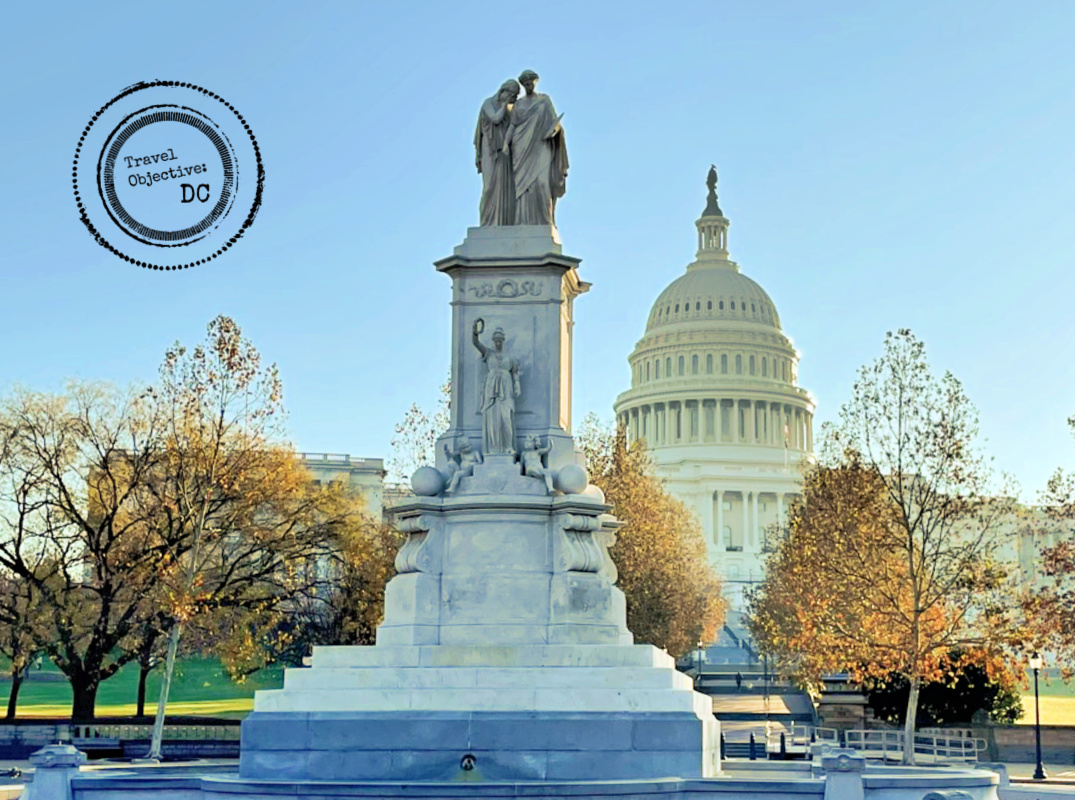
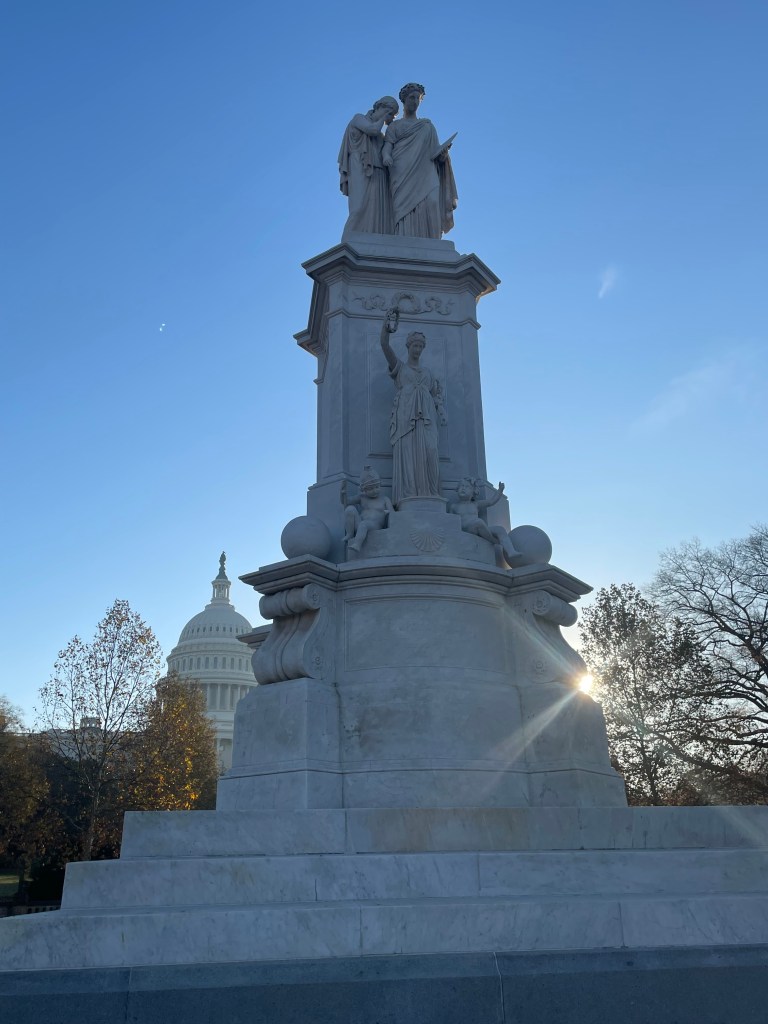
In a city abundant with statues, monuments and memorials, a few stand out for their uniqueness. One of these sits to the northwest of the US Capitol in the middle of a traffic circle formed where Pennsylvania Avenue terminates at First Street, NW. It is one of three pieces of statuary, along with memorials to Ulysses S. Grant and James Garfield, that form a visual connection between the US Capitol Grounds and the National Mall. 

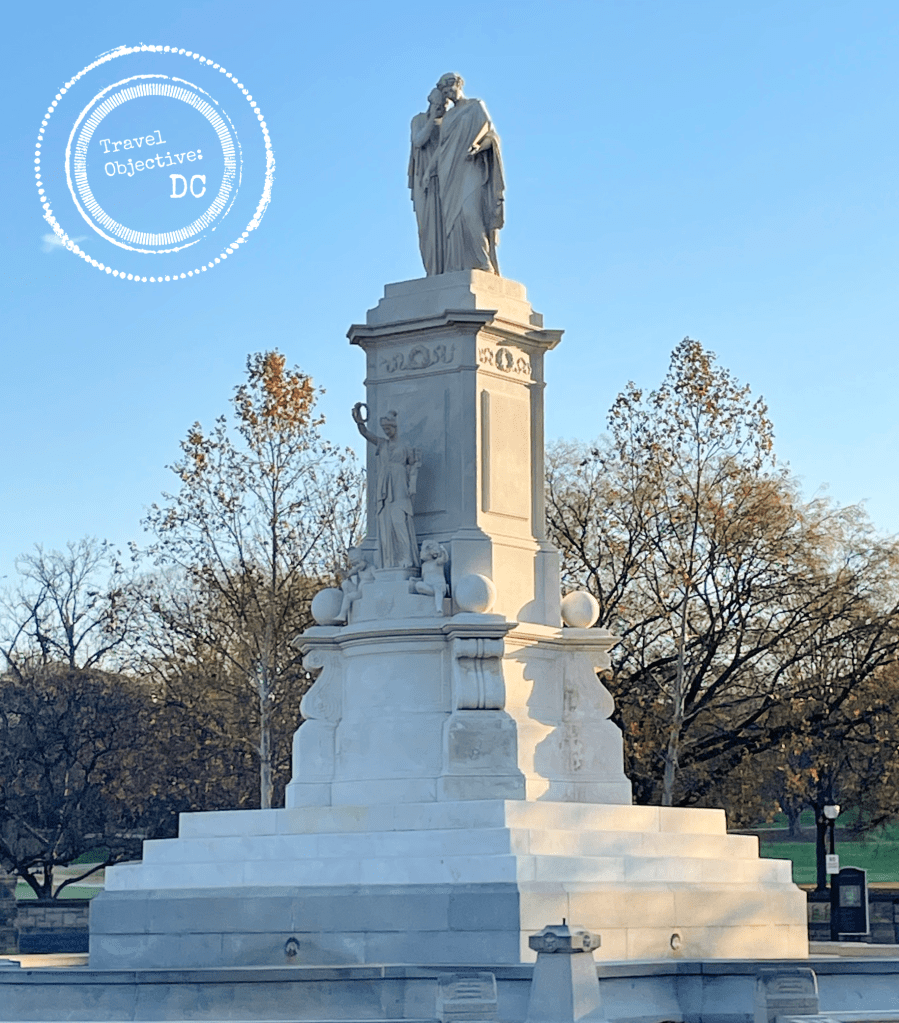
Dedicated to the sailors and Marines who died during the Civil War, the statue is known as the Navy Monument or Peace Monument. Unlike its neighboring statues which feature American statesmen cast in bronze, the Peace Monument mixes a variety of classical figures arrayed around an upright bloc, all captured in Italian marble.

The Peace Monument from the National Mall

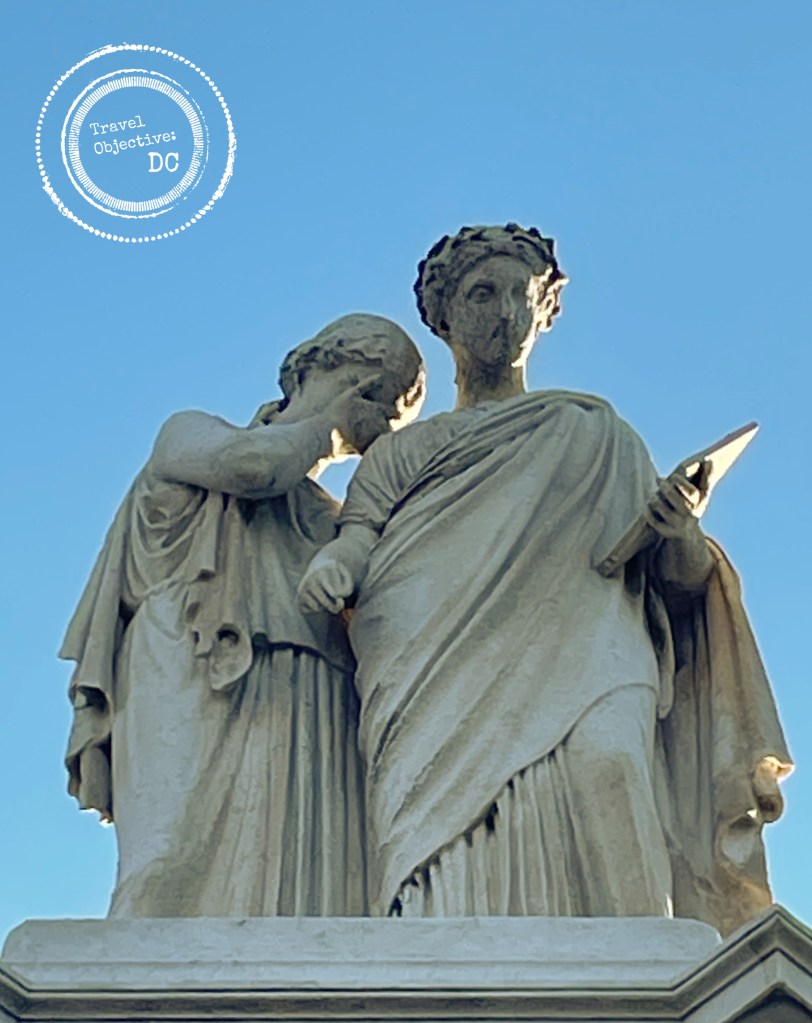
At the top of the 44 foot high monument are two robed figures facing the National Mall to the west. One is Grief, who buries her head in one hand, while resting her other on the shoulder of History, who stands bearing a pen and scroll inscribed with the words: They died that their country might live. 

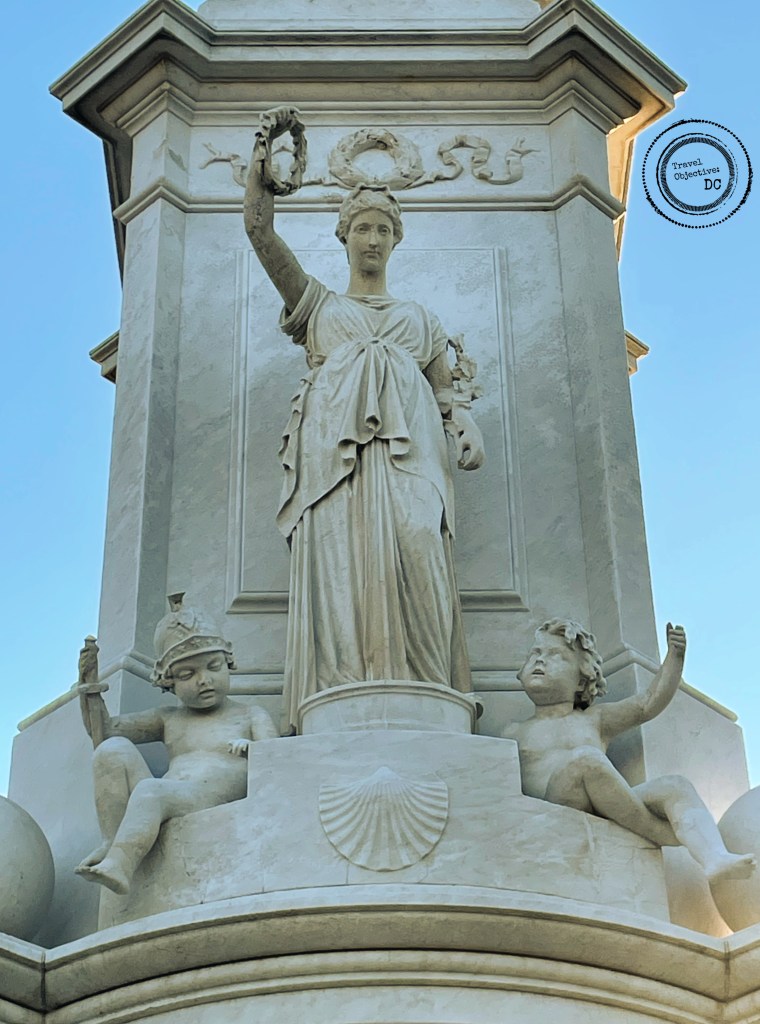
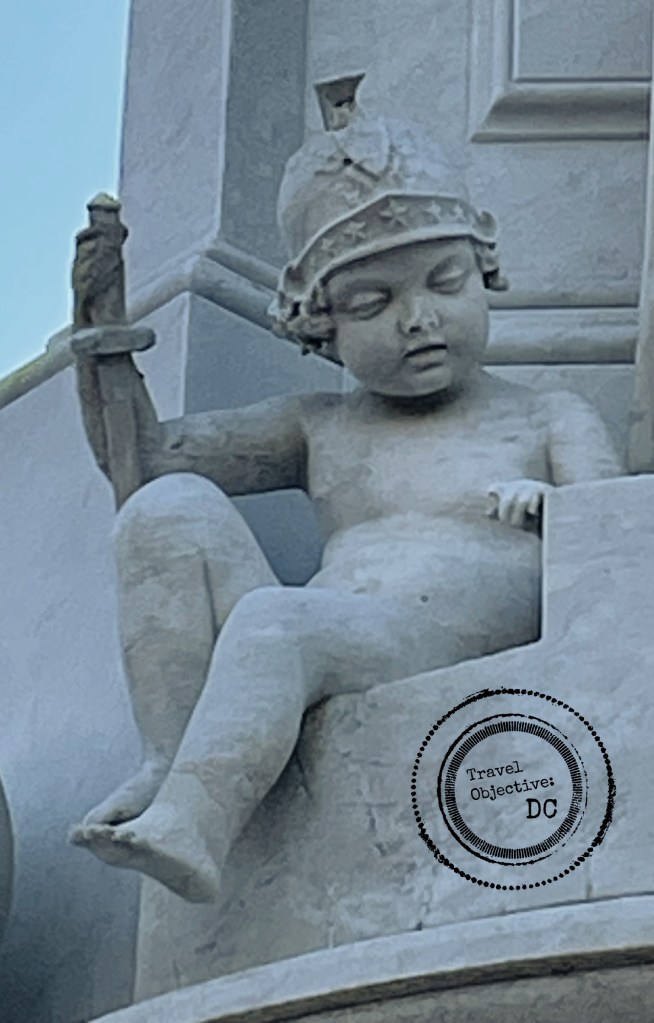
Midway down the monument, Victory holds her laurel high in her right hand, while a very young Mars (the god of war) and Neptune (the god of the sea) sit at her feet.

Victory with Mars and Neptune

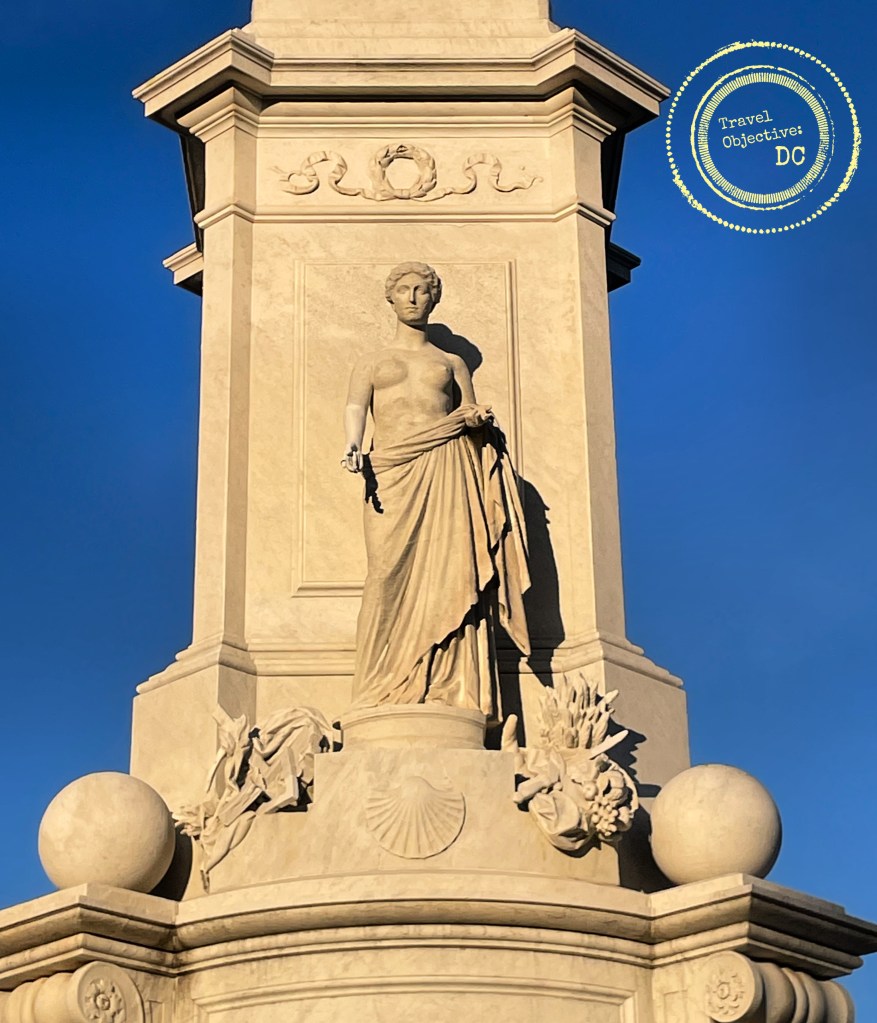
On the reverse side of the statue, the figure of Peace looks towards the US Capitol. At her feet are a collection of items symbolic of the benefits of peace. There is a cornucopia and a sickle representing agricultural bounty while a gear and a book represent industry and the pursuit of knowledge. 

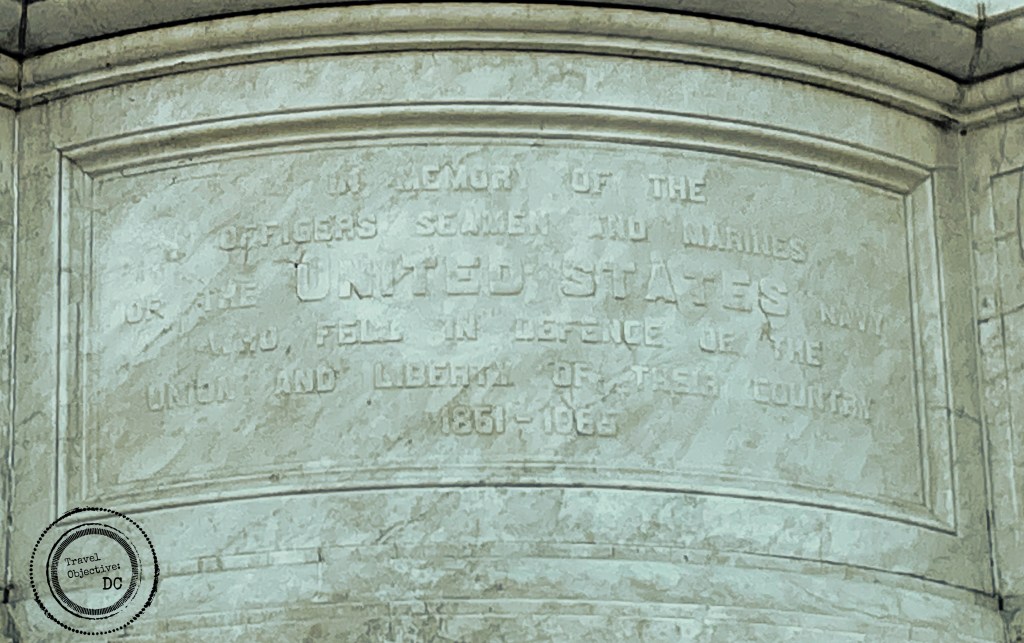
Four large marble spheres on their own bracket-shaped pedestals are found on the corners of the monument along with classical adornments, such as wreaths, scrolling and scallop shells. Below the monument, jets of water shoot into a giant basin. On the west side an inscription reads: In memory of the Officers, Seamen and Marines of the United States Navy who fell in defence [sic] of the Union and liberty of their country, 1861–1865.

While it looks as if it might have been designed by a committee, the statue was the idea of one man: US Navy Admiral David Porter. 

Admiral Porter was the scion of a distinguished naval family. His father, Commodore David Porter, was a hero of the War of 1812 and his adopted brother was David Glasgow Farragut (of “Damn the Torpedos” fame). Admiral Porter first served as a midshipman at age ten under his father. He would serve in the Navy for over sixty years. 

Admiral David Dixon Porter

-Photograph by Mathew Brady, Library of Congress Collection

Porter sketched the original figures of Grief and History as early as 1865, then raised money from private sources for its construction. Porter was likely inspired by his father, who undertook a similar project. Commodore Porter commissioned a statue dedicated to the lives of six naval heroes who died fighting the Barbary Pirates in the early 19th century. At one time this statue was displayed near the US Capitol; it was ultimately moved to the US Naval Academy at Annapolis in 1860.

For his monument, Admiral Porter worked with Franklin Simmons, an accomplished sculptor known for his work in sculpting political and historical figures. Simmons carved the statues at his studio in Rome, working with another team of Italian sculptors to carve the monument’s shaft. He consulted frequently with Admiral Porter on including additional figures and embellishments. 

After its unveiling, an art critic remarked, “Porter knows more about the high seas than high art.”

While that may well have been true, Porter’s conglomeration of figures and mixed symbology seems quite appropriate for a monument to the U.S. Navy during the Civil War.

Close-up of the Statue of Mars. Note the erosion on the fingers of right hand where he grips his sword, and on nose.

In April of 1861, the Navy had but 42 commissioned ships. It needed to expand quickly and it required many new and different types of vessels for the missions it now faced.  Specialized ships were necessary for enforcing President Lincoln’s blockade of Southern ports, defeating the Confederate Navy in open waters, supporting US Army ground operations and patrolling interior rivers. This was also a transitional period as wooden sailing ships gave way to ironclads powered by steam. 

The Navy set about a massive program of refitting current naval vessels, building new ones and acquiring civilian ships, which were converted for military use. By war’s end, the Navy had over over 600 vessels, some very distinct in design and purpose.

During the Civil War, the US Navy also rewrote doctrines focusing on flotilla operations rather than single ship actions, adopted new combat tactics, and revised its command structure. 

Admiral Porter was on the forefront of some of these developments. He commanded a flotilla of ships in the Union capture of New Orleans. He transported Ulysses S. Grant’s army down the Mississippi River prior to the assault on Vicksburg. He also commanded naval forces in the attack on Fort Fisher, North Carolina. After a two-day long bombardment of the fort, Porter contributed a force of sailors and Marines to join US Army soldiers on a multi-pronged ground attack. 

 The Bombardment and Capture of Fort Fisher, N.C. Jany. 15th, 1865. [Published by Currier & Ives, between 1865 and 1872] Library of Congress Collection


While historians devote more attention to land campaigns and the Army’s epic battles, the Navy made significant contributions to the Union victory in the Civil War. During those years, 4,523 sailors lost their lives. The Marine Corps played their role as well, participating in some major land battles, enforcing blockades and conducting patrols along the rivers. During the Civil War, 148 Marines were killed in combat.

After his Civil War service, Porter served as the Superintendent of the US Naval Academy where he implemented a number of reforms to better prepare midshipmen to become naval officers. He originally intended the monument to be placed at Annapolis as was his father’s. However, the Secretary of the Navy at the time disagreed. 

Congress though did approve of the statue being placed near the Capitol. Funds were appropriated for the construction of the monument’s platform and a basin for the fountain, which were made from Maine blue granite.  

The monument was shipped in pieces to Washington in 1876. The next year, the monument was assembled and installed at its current site. The last statue of Peace was added in 1878. A formal dedication ceremony was delayed until the statue was completed. Dolphins were also to be incorporated as were bronze lamps, but these were never added and no formal dedication was ever held.

The Statue of Peace facing the US Capitol.

The statue was built of Italian Carrara marble, which unfortunately has not stood up to the weather or the pollution in Washington, DC. Erosion of the faces on different figures is clearly evident and various features have broken off. For example, the young Neptune is missing his trident.

Additionally, protestors have repeatedly climbed the Peace Monument during demonstrations on the Mall, further damaging the statues. A major restoration effort was made in 1991, where the marble was carefully cleaned, strengthened and missing pieces replaced. Similar work was conducted in 1999 and 2010. 

Close up of the Statues of Grief and History. Note the erosion on History’s face and the missing pen from History’s right hand.

It is easy to be dismissive of the Peace Monument as something antiquated–or not related to peace at all–since it memorializes war dead. Indeed, the monument may not work as “high art”. But the monument’s story is compelling and offers some rich analogies to peace worth considering.

Like this monument’s creation, peace may take a long time. Peace might look different from what you expected. Peace may never be complete. Peace is fragile and needs constant tending.  Peace may not be heralded with a formal ceremony, yet it exists nonetheless. Peace may flabbergast some, but it can endure.

* * *

Route Recon

The Navy Monument or Peace Monument is located within a traffic circle at the intersection of Pennsylvania Avenue and First Street, NW, to the northwest of the US Capitol building. The best way to get to the monument (and the Capitol) is by taking Metro.

Three Metro stops are within walking distance of the memorial and the Capitol:

  • Union Station – Located at First Street, NW, and Massachusetts Avenue.
  • Capitol South – Located at First Street between C and D Streets, SE.
  • Federal Center, SW – Located at the southwest corner of Third and D Streets, SW.

Additional information on riding Metro, is available at the Washington Metropolitan Area Transit Authority.

The DC Circulator, a public bus system with routes through Washington’s downtown area includes stops near the Memorial. Find more information about Circulator busses at www.dccirculator.com.

There is very little public parking available near the Capitol. The nearest public parking facility is at Union Station, to the north of the Capitol. Very limited metered street parking is found along the Mall to the west of the Capitol.

Something is Missing at the National Air and Space Museum

It was August 1961 in the hot California desert. Jacqueline Cochran was strapped into her Northrop T-38A Talon, flying a nine mile closed loop aeronautical course. She was followed by Chuck Yeager, flying an F-100. Cochran kept the aircraft in perfect alignment around the course and topped out at 844 miles per hour, setting a new speed record for that distance. That was only one of the eight speed records the fifty-five year old Cochran would set that summer.

Cochran was no stranger to flying records. She set her first speed record in 1937 and won a number of airplane races prior to World War II. In 1943, General of the Air Force Harold “Hap” Arnold appointed Cochran the first director of the Women Airforce Service Pilots (WASPs). In 1953, she was the first woman to break the sound barrier. The T-38A she flew now hangs in the Smithsonian Institute’s “new” National Air and Space Museum (NASM). 

Northrop T-38A Talon | Jacqueline Cochran | airspeed record | National Air and Space Museum | Washington DC

The Northrop T-38A Talon flown by Jacqueline Cochran.

Since its opening on the National Mall in 1976, the NASM has been a stop for many visitors to Washington, DC. It is easy to understand why. Even for those only marginally interested in space or aviation, the museum is full of interesting artifacts and displays. The original Wright Flyer, the Spirit of St. Louis, and Neil Armstrong’s spacesuit are but a few of the items that provide not only a sense of pride in American innovation, but also in humanity’s ongoing exploration of the heavens.

In 2018, the NASM began an historic seven-year, $250 million renovation focusing on creating a more immersive and enjoyable experience. The Smithsonian holds the world’s largest collection of artifacts related to aviation and space exploration, and the renovation includes over 1,400 new items for public display.  Through this process, all the museum’s galleries are due for renovation, redesign or complete replacement.

The NASM reopened to the public on October 14, 2022 with eight new or redesigned galleries on the west end of the museum’s building. While there are certainly some interesting exhibits and displays, the museum is still a work in progress.

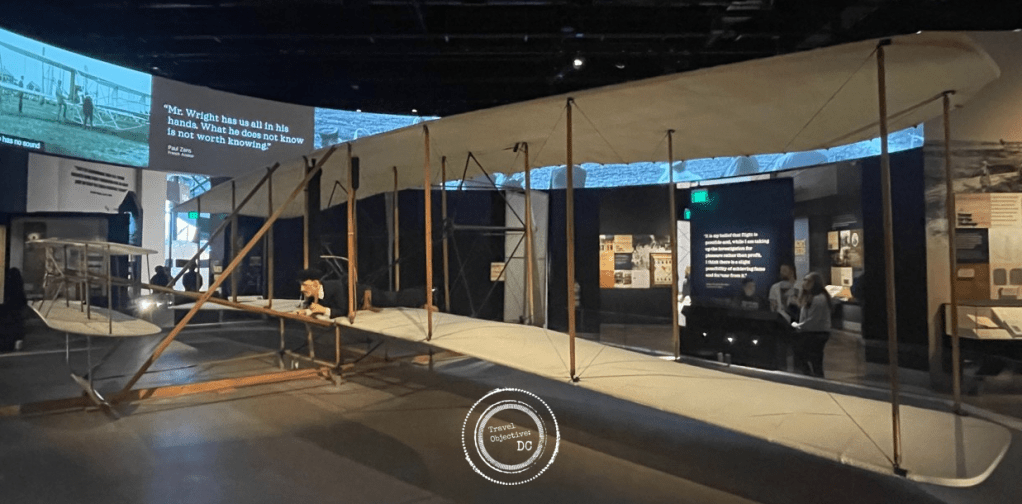
Wright Brothers | Wright Flyer | first airplane | Air and Space Museum
The Wright Flyer on display in the Wright Brothers gallery.

What Galleries Are Now Open?

The Wright Brothers – The centerpiece of the gallery devoted to Orville and Wilbur Wright remains the Wright Flyer, the brothers’ heavier than air machine which first took flight on December 17, 1903 in Kitty Hawk, North Carolina. The redesigned gallery adds further details to their lives before and after they achieved fame as inventors of the airplane.  There are leaflets from their printing business, tools from their bicycle shop, early models, experimental aircraft parts and furnishings from their cabin in North Carolina.

Early Flight – Following their successful flight, the Wright Brothers led many others in continued experimentation on early aircraft. A budding aviation community took hold around the world as the human passion for flying grew. The gallery highlights this earliest period of aviation innovation.

America by Air – In 1918, the U.S. Government formally initiated airmail service, a decision that led to the commercial passenger aviation industry. The America by Air gallery tracks air travel in the United States from the early days of open cockpits to the deregulated, post-9/11 era we know today.

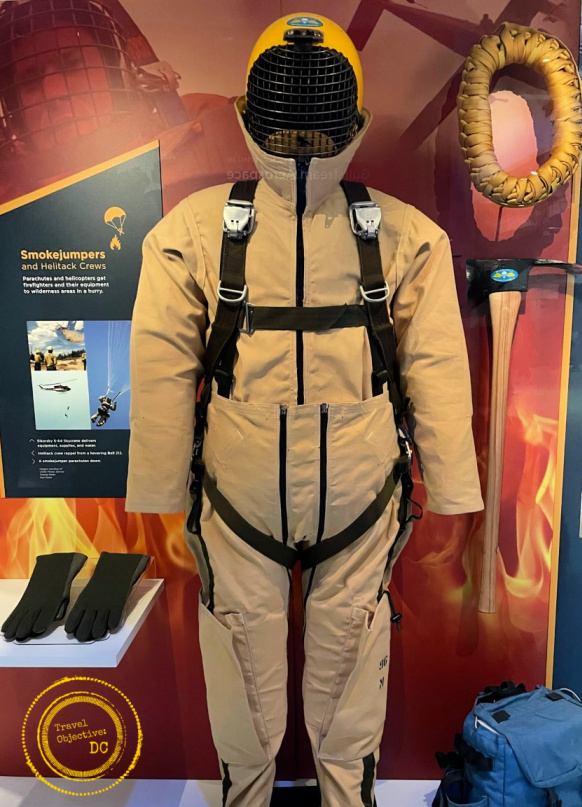
A smokejumper’s protective suit and other gear on display in the Why We Fly gallery.

Smokejumper protective suit | National Air and Space Museum | NASM | Washington DC

Why We Fly – About 80% of aircraft in the United States are considered General Aviation, meaning they are not connected to scheduled passenger service, the military or the Federal government. Why We Fly exhibits reflect the great diversity of this sector. Medical flights, crop dusting, aerial firefighting and humanitarian response are all included.

Nation of Speed – A collaborative effort with the Smithsonian’s National Museum of American History, Nation of Speed presents the American experience of the desire to move faster in the air, on the water and over land with the technology and machines that made it possible.

Destination Moon – Some of the Smithsonian Institute’s most iconic artifacts are found in Destination Moon, which traces the history of the US lunar programs and missions.

Exploring the Planets – Beyond the moonshots of the 1960s and 1970s, this gallery explores current space exploration programs and future plans for exploring our solar system.

Apollo 11 Command Module Columbia | moon landing return vehicle | Neil Armstrong | Buzz Aldrin | Michael Collins | NASM Washington DC

The Apollo 11 Command Module Columbia. The command module was the living quarters and return vehicle for Neil Armstrong, Buzz Aldrin and Michael Collins.

One World Connected – Explores how the advancements of aircraft, satellites and technology have revolutionized communications, navigation, weather forecasting and other aspects of life on earth.

Mixed Results

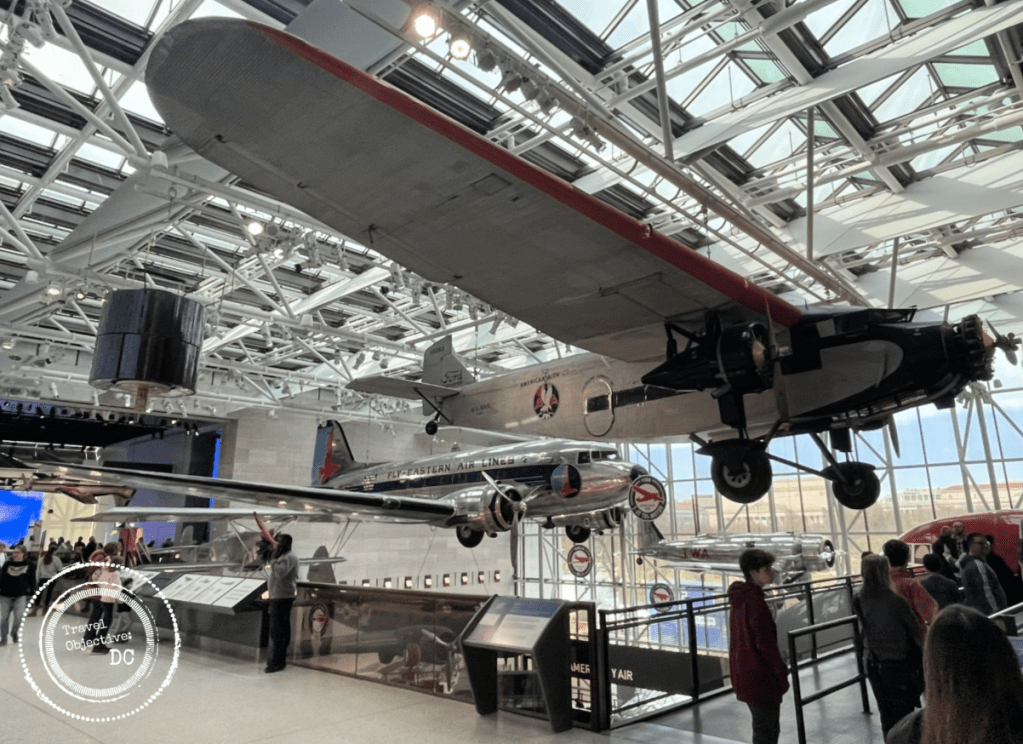
It is quite evident tremendous effort went into the design (or redesign) of these galleries, but the results seem mixed. On the positive side, the new features in the Wright Brothers gallery fill in more details on the lives of the two brothers, making them seem more human, while still maintaining their iconic stature. America by Air provides ample details and activities telling the story of commercial passenger aviation in America. The shiny and brightly painted early airliners suspended above the displays add a sense of majesty to the storytelling below. 

Ford-5 Tri-Motor | Douglas DC-3 | airplanes on display at National Air and Space Museum | Washington DC tourism | Smithsonian Institute
A Ford-5 Tri-Motor and a Douglas DC-3 above the American by Air gallery.

Within Destination Moon, the artifacts and displays are now neatly and chronologically arranged allowing visitors to walk through the decades of manned lunar exploration. Along the way, they get a sense of the dedication of the people involved, the power of the rocket engines, and at the same time, reckoning how all this was accomplished with less technology than the cellphones in our pockets today.

However, the Nation of Speed gallery is much more suited to the Smithsonian’s National Museum of American History. For some reason, profiles of early pilots and aviation record holders are notably absent with most of the artifacts related to auto or motorcycle racing. 

Exploring the Planets is understandably lighter on artifacts (many are still in use or irretrievable) and there are indeed some interesting examples of the Mars rovers. However, other displays simply describe the current scientific understanding of the other planets seeming more akin to a science fair rather than the immersive experience NASM’s renovation was to bring about.

The One World Connected gallery celebrates the interconnected life on planet Earth in this 21st Century. Yet the exhibits do not mention much about the the limits nor downsides of the technology that brought us this interconnectivity, such as cyber crime, disinformation or political polarization, and how we can overcome them.   

An early Global Positioning System (GPS) unit circa 1993 from the Magellan Corporation on display in the One World Connected gallery.

Smithsonian Institute | GPS on display at NASM

What’s Missing?

Notably absent from the eight renovated galleries are newly restored and presented aircraft, which is rather confounding as the Smithsonian prides itself on its collection of historically significant aircraft. My 11-year-old son summed it up best when he said: “There aren’t any cool planes to look at.”

Most of the aircraft on display were previously viewable before NASM started the renovations. Military aircraft are especially lacking. Aside from Jacqueline Cochran’s T-38A, the only other prominent military aircraft is the Wright Military Flyer, a two-seat observation aircraft built by the Wright Brothers and purchased by the US Army in 1909. 

Closed are galleries that previously included aircraft from both world wars, Legend, Memory and the Great War in the Air and WWII: Sea-Air Operations (featuring a reproduction of a carrier hanger deck from WWII). In their absence, a lone Rebel Alliance X-wing Starfighter from the movie Star Wars hangs suspended from the ceiling over one of the walkways, with little accompanying information.

Jacqueline Cochran | Jackie Cochran | female pilot | Women Airforce Service Pilots WASPS | aviation record holder

Jacqueline Cochran (circa 1943) in her Women Airforce Service Pilots uniform. When she died in 1980, Cochran held more speed, distance and altitude flying records than any other pilot.

What is also missing, with the exception of the Wright Brothers, Jacqueline Cochran and the astronauts, are the profiles of humans who took to the skies and to space, pushing themselves and their equipment to the limits to accomplish something for us all. Indeed, the redesign seems to remove the human element in aviation and space exploration, replacing it with technology and process. One leaves NASM better informed, but not inspired.

What’s Next?

These are hopefully just temporary drawbacks. NASM’s renovation is set for completion in 2025. Approximately fifteen more galleries are still under renovation. Publicly available information on the new galleries seems scarce, but one new gallery entitled Pioneers of Aviation will feature the iconic Spirt of St. Louis. Another will depict aerial combat and tactics during World War II with the North American P-51, Grumman Wildcat and Messerschmitt 109 on display. Perhaps the X-wing Starfighter suggests a Star Wars or space fantasy gallery is in the works?

Star Wars X-Wing Starfighter on display at Smithsonian
A Rebel Alliance X-Wing Starfighter from the Star Wars movies

In the meantime, those with a serious interest in military aircraft should visit the Smithsonian Institute’s Steven F. Udvar-Hazy Center in Chantilly, VA near Washington Dulles International Airport instead. At this 17-acre facility, military and civilian aircraft from World War I until today, as well as space equipment, are on display. 

* * *

Route Recon

The Smithsonian Institute’s National Air and Space Museum is located on the National Mall bordered by Independence Avenue, Jefferson Drive, and 4th and 7th Streets, SW. The entrance is on the south side of the building along Independence Avenue. You cannot access the museum from the north side along the National Mall.

Parking – Very limited metered street parking is available around the museum. Parking is available in several commercial parking lots in the neighborhood.

Public Transportation

Metrorail – The closest Metro station is L’Enfant Plaza, along the blue, orange, silver, and green lines. From the L’Enfant Plaza Station, take the exit for Maryland Avenue and 7th Street.

Metrobus – Bus stops are located on Independence Avenue, SW, and along 7th Street, SW. Visit the Washington Metropolitan Area Transit Authority for more information.

Circulator Bus – The National Mall Circulator Loop bus provides easy access around the National Mall and convenient connections to other Circulator buses for visits to uptown sites. The NASM is a short walk from the Jefferson Drive and 7th Street SW stop on the National Mall route, or the D Street SW and 7th Street SW stop on the Eastern Market – L’Enfant Plaza route.

Bicycle Sharing – Capital Bikeshare  is metro DC’s bicycle sharing service. There are Bikeshare stations around the National Mall. There is Bikeshare station on 4th Street, just south of the intersection with Independence Avenue.

Intel Brief

Free timed tickets are required for entry into NASM. Tickets can be acquired through the NASM website. Ticket holders will line up near the Independence Avenue entrance prior to their entrance time. The line can become quite long, but it moves quickly once ticket holders are allowed to enter the building.    

NASM is not currently offering guided tours for individual parties. Tours are available for school groups of 10 or more and adult groups of 20 or more. Tours should be requested 3 weeks in advance. Reservation and group visit information is available at NASMs Group Tours webpage.

Mess Call

The Mars Café is located on the “Launch Pad” (lower level) It is open daily from 10:00 am to 5:00 pm. The café has a coffee bar and sells sandwiches, salads, and pastries.  There are only twenty five tables currently available so seating is challenging at mid-day.

The Vietnam Veterans Memorial – Sacred Space on the National Mall

Jan Scruggs understood that the Vietnam veterans needed a different kind of memorial. As he first set about his effort to build a memorial in Washington, DC, he envisioned a place that could bring healing, reconciliation and respect for veterans of the Vietnam War.

Scruggs knew first hand of the need for healing and reconciliation. He served a tour in Vietnam as an Army mortarman. Badly wounded after only thirty days, he spent three months recovering in the hospital. He lost 12 friends and comrades when a mortar round detonated while ammunition was loaded into a truck.  Scruggs was not physically injured and he was first on the scene to help, but the carnage he witnessed stayed with him. As did many other veterans, he struggled upon his return to the United States in 1970.

After seeing the movie The Deer Hunter, he committed himself to building a memorial in the nation’s capital to honor the men and women who did not come home from Vietnam. In 1979, Scruggs established the Vietnam Veterans Memorial Fund and enlisted the help of other veterans in raising money, lobbying Congress and negotiating the process of building a memorial on the National Mall.

The Memorial Plaque was added to the Vietnam Veterans Memorial in 2004.

One day, a discussion with a fellow Vietnam veteran led to an important feature of the memorial. Although Scruggs and his fellow veteran did not know each other, they realized they had served in the same unit, separated by only a few months’ time. They remembered many of the same people, yet they struggled to recall soldiers’ names, especially several soldiers who died. The conversation convinced Scruggs of the importance of including names on the memorial so the dead would not be forgotten. 

As the work for the memorial advanced, the Vietnam Veterans Memorial Fund organized a nationwide competition to select the design. Scruggs’s vision for the memorial shaped the selection criteria. The memorial needed to be reflective and contemplative, harmonize with other memorials on the National Mall, bear the names of the dead and missing, and be apolitical. As Scruggs would say, it was important to “separate the war from the warrior”. The memorial was about recognizing the bravery and sacrifice of American soldiers, sailors, airmen, Marines and Coast Guardsmen.

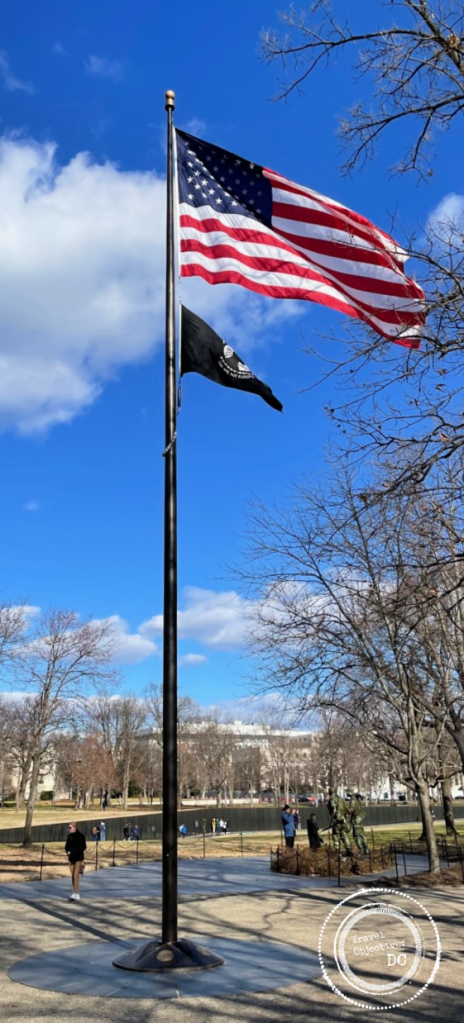
The flagpole at the Vietnam Veterans Memorial flies the United States and POW/MIA Flag.

On May 1, 1981, a panel of eight distinguished artists, architects and designers unanimously selected the “V” shaped wall design submitted by a young Yale University student named Maya Lin from over 1,400 submissions. Over the past forty years, the reflective black granite wall bearing the names of the dead and missing from the Vietnam War has become one of Washington, DC’s most recognizable landmarks.

The Vietnam Veterans Memorial is located on the National Mall’s northwest corner.  Approaching from the neighboring Lincoln Memorial, a National Park Service ranger station and the flagpole are what first come into view. Then the top of the wall becomes visible, protruding from a shallow ravine. Finally, the entirety of the almost 500-foot wall reveals itself.

Lin’s design is deceptive in its simplicity, a black granite wall with the names of those service members who died or were missing in Southeast Asia from 1959 through 1975. As Lin said,” the names would become the memorial”.

The “wall” is actually composed of 144 black granite panels. Seventy-two of these panels, numbered 1E to 70E comprise the eastern section of the wall, which point to the Washington Monument. The western panels are similarly numbered (1W to 70W) and point to the Lincoln Memorial. There are two empty panels on either end.

A National Park Service Volunteer (wearing a yellow jacket) speaks with visitors at the Vietnam Veterans Memorial.

The names, listed chronologically from 1959, begin at the center on Panel 1E. After the last name on Panel 70E, they resume in chronological order on Panel 70W and continue back toward the center of the wall. The names beginning and ending in the center represents a circle, signifying the end of the war. Additionally, Lin’s selection of polished black granite draws the visitor into the memorial. The stone retains its mirror-like quality, wherein the visitors sees themselves as they view the names.

At its dedication, the wall had 57,939 names. Thorough reviews of medical reports and personnel records led to the addition of over 300 more names. A small diamond or cross accompanies each name. A diamond means the service member has been declared deceased. A cross means the service member was missing or a prisoner at the war’s end. (On the west side, the symbol precedes the name; on the east wall, it follows). A diamond is added to the cross if the service member is at some point declared deceased. A circle is added to the cross should the service member ever return alive.

Dedication day for the Vietnam Veterans Memorial was November 13, 1982, with decidedly mixed reviews. Many prominent critics disparaged the design as unpatriotic and defeatist. After two years of discussion among the several communities involved in building the memorial, there was a consensus to recognize others beyond the dead and missing. A flagpole and statue adjacent to the wall were added to the memorial in 1984.

The Three Soldiers Statue

Local Washington, DC sculptor Frederick Hart designed and sculpted the bronze statue showing three young male soldiers wearing fatigues and carrying combat gear. Known as The Three Soldiers or The Three Service Members statue, it honors those who served and returned home from Vietnam. The statue stands a short distance away from the wall with the soldiers looking respectfully toward the names so as not to distract from Maya Lin’s original intent.

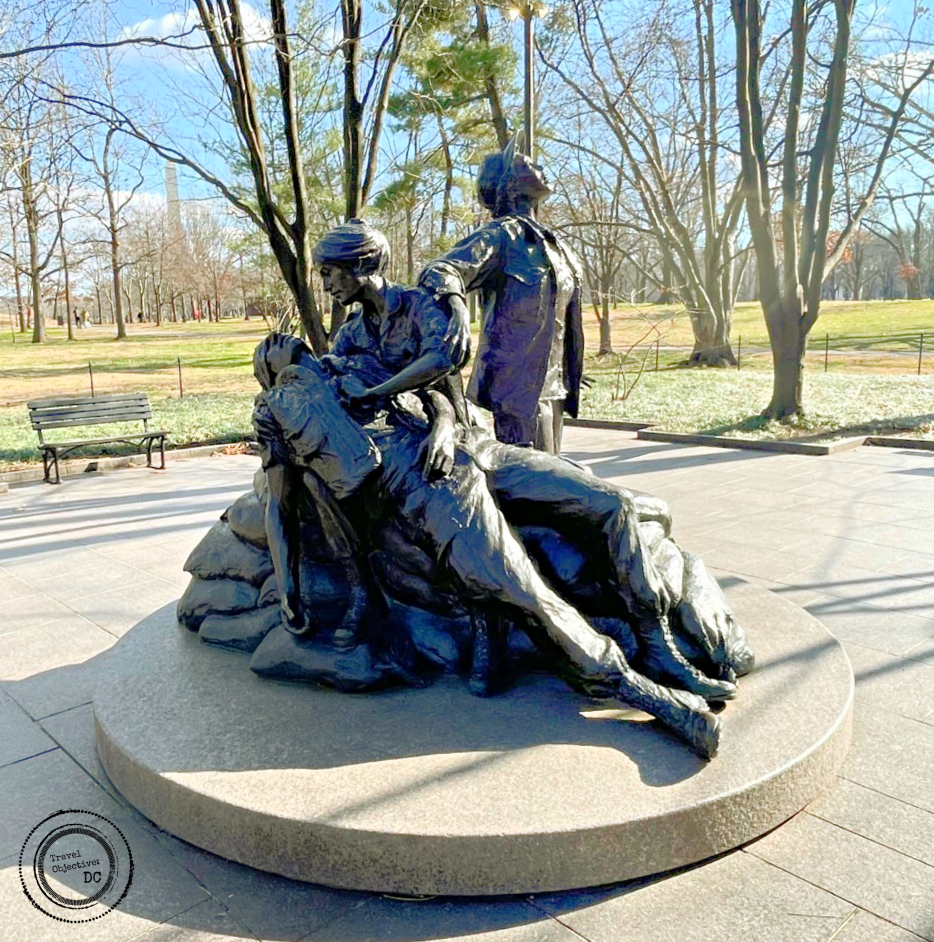
A second statue recognizing women’s service in Vietnam was dedicated in 1993. About 11,500 women served in Vietnam. Most were nurses, but they also served as doctors, air traffic controllers, intelligence personnel and in certain administrative roles. The Vietnam Women’s Memorial statue depicts three women rendering assistance to a wounded male soldier. A unique feature of Glenna Goodacre’s sculpture is that there is no front nor back. The three female figures stand on a round pedestal so from any angle the women are seen performing their duty. Eight yellowwood trees surrounded the statue representing the eight female service members who died in Vietnam.

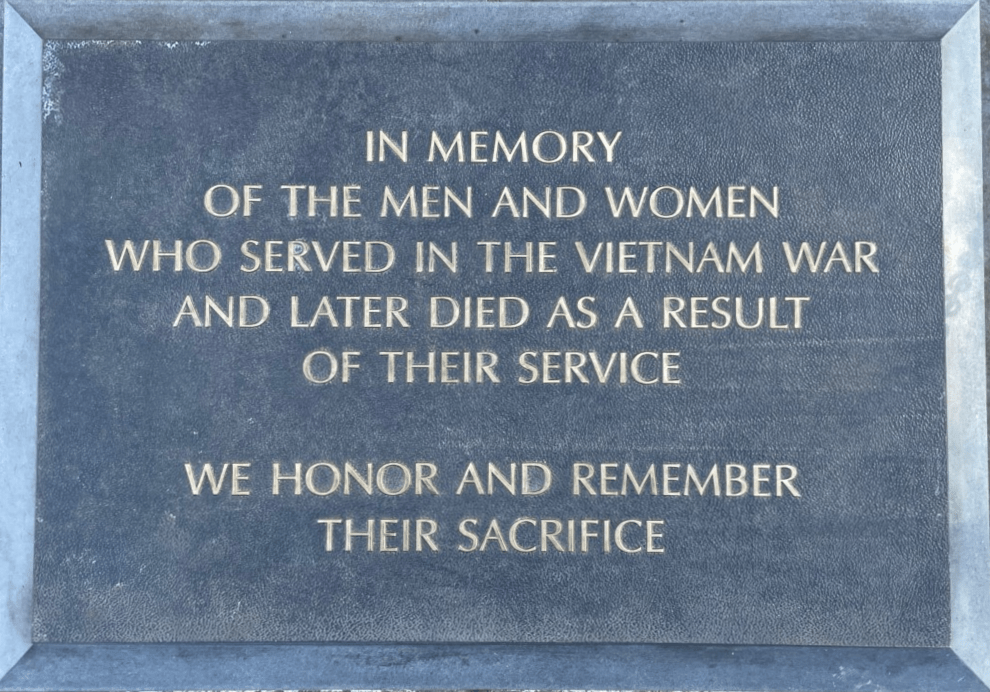
The final component of the memorial is the In Memory Plaque, added in 2004. The plaque acknowledges those Vietnam veterans who returned home, but who died of causes resulting  from their wartime service. The stone helps to remember those whose names are not on the wall.

The Vietnam Women’s Memorial statue

As the components of the memorial expanded, so has its number of visitors. People of all backgrounds are drawn to the wall: Vietnam veterans, relatives, friends, and colleagues, even those with little background or no immediate connection to the war. Currently, the Vietnam Veterans Memorial draws over five million people a year, making it one of the most visited sites in Washington, DC. 

A dedicated cadre of National Park Service rangers as well as volunteers are generally present at the memorial and ready to share stories of the memorial, help visitors find names and maintain the dignified environment. Paper directories with names listed alphabetically are available on adjoining walkways.

Visits to the memorial have generated two unique cultural practices. Tracing names using paper and pencils or charcoal has become a common ritual. This simple keepsake honors the fallen and commemorates or shares one’s time at the wall. Placing mementos of all kinds (medals, letters, documents, uniform items, even service member remains) at the foot of the panels is another practice. Since its opening in 1982, the National Park Service recorded over 400,000 items left in tribute. (Visit the Vietnam Veterans Memorial Fund website to see a sample of items found at the wall).

A detail of the nurse tending to a wounded US soldier at the Vietnam Women’s Memorial.

As the Vietnam Veterans Memorial enters its fifth decade, it lives up to the vision Jan Scruggs intended years ago, a place to go for healing, for peace. Wanda Ruffin, a widow whose husband James Ruffin is listed on the memorial, summed it up in writing: The Wall opens people up to their feelings. … There is something about the place that says, “It’s okay to show your feeling when [you] are down there.”

Indeed, this memorial’s attribute for healing is not exclusive to Vietnam veterans. It is not uncommon to see American veterans of later wars visiting the memorial to find peace and meaning in their service. Other visitors gather there for serenity and refection. In a city with many monuments, the Vietnam Veterans Memorial is decidedly different.

It is America’s sacred space on the National Mall.

Route Recon

The Vietnam Veterans Memorial is located on the northwest end of the National Mall, adjacent to the Lincoln Memorial, near the intersection of 23rd Street NW and Constitution Ave. NW. The official address of the memorial is 5 Henry Bacon Drive NW, Washington, DC 20002.

Hours: Open 24 hours a day, seven days a week. A kiosk on the Lincoln Memorial side is staffed from 9 a.m. to 5 p.m. each day except for Thanksgiving, Christmas and New Year’s Day.

The closest Metro station is Foggy Bottom/GWU (blue, orange and silver line trains) at 23rd and I Streets NW. It’s about a 15-minute walk southeast to the memorial. You can find bus and subway schedules at the Washington Metropolitan Area Transit Authority website.

The National Mall Circulator Loop bus stops just north of the memorial at 21st Street NW and Constitution Avenue NW and provides easy access around the National Mall.

Street parking along Constitution Avenue can be hard to find and is usually limited to two hours.

Capital Bikeshare has stations across the Mall, including two at the Lincoln Memorial and three behind the memorial on Constitution Avenue. The Mall is flat, so it’s easy for biking, and you’ll find bike racks at every memorial and monument.

National Park Service Rangers offer tours of the Vietnam Veterans Memorial and the Korean War Memorial on weekends. Find more information about events at all the memorials on the National Mall at the National Parks Service online calendar.

Learning Why We Liked Ike at the Dwight D. Eisenhower Memorial

Dwight Eisenhower’s life reflected the classic American success story. Born of humble origins, he chose an Army career in order to serve his country. Through his own talent, hard work and quiet ambition, he rose through the ranks to command one of the mightiest military forces ever assembled.  The victories achieved by that force would bring him worldwide acclaim. With the campaign slogan of I Like Ike, Eisenhower would go on to be overwhelmingly elected to two terms as President of the United States.

In 2020, a new memorial to Eisenhower was unveiled in Washington, DC. The monument’s designer, Frank Gehry, carefully researched his subject. He was so taken with Eisenhower the man, he wanted the memorial to emphasize not only Eisenhower’s accomplishments, but also his humanity and his interaction with others.  Unlike other presidential memorials, there is no large, neoclassical edifice. Rather, Eisenhower’s memorial is more akin to that of Franklin Roosevelt’s with statuary and scenes telling the story of the man and his times.

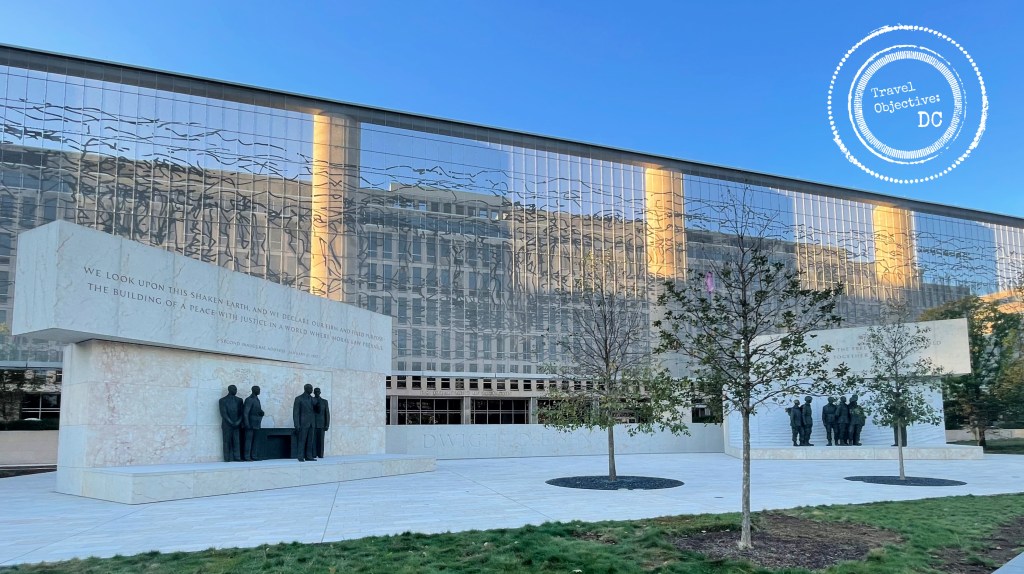
Located just off the National Mall, the memorial’s broad, open expanse forms a four-acre plaza between two Smithsonian Museums and several Federal office buildings. The memorial is composed of four central elements. Three elements portray Eisenhower, the person: as a young man, as Commander of the D-Day forces, and as President. The final element is a grand tapestry of stainless steel representing the Pointe du Hoc cliffs over the Normandy coast and covering the front of the Department of Education building. The space also includes trees, lawns, benches and two stone columns detailing Ike’s accomplishments.

The backdrop to the memorial is a 450 foot-wide woven wire tapestry depicting the cliffs of Pointe du Hoc in Normandy. On D-Day, US Army Rangers scaled the cliffs to prevent German artillery from firing on Allied troops landing on the beaches below.

As is often the case, work on the memorial took decades. Congress first authorized the Memorial in 2003 and Gehry’s designs were revised several times due to impassioned input from the Eisenhower family, historians and bureaucrats. While Gehry’s final work has not won universal acclaim, its central features invite the visitor to learn more about Eisenhower and the traits that not only made America “like Ike” but also made him such a pivotal figure of the 20th century.   

Born in Texas, Ike grew up in Abilene, Kansas where he and his five brothers were raised by hard working parents to value a strong work ethic, responsibility and education.

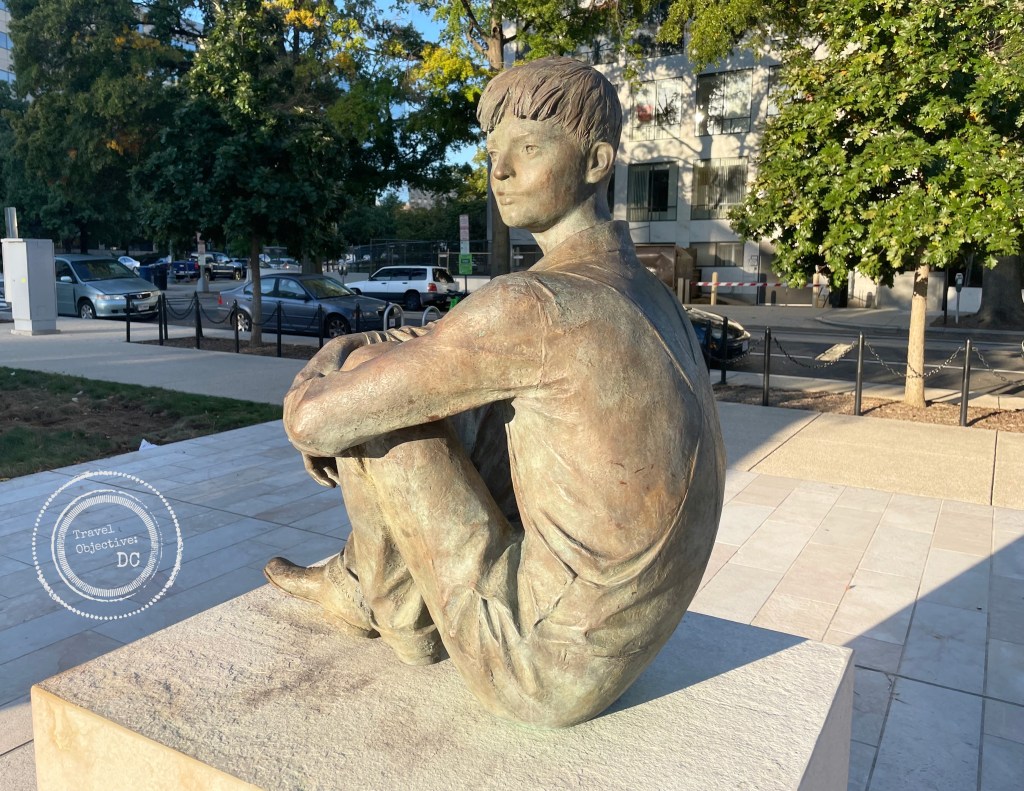
Eisenhower was proud of his origins and Geary thought it very important to include Ike’s image as a young man. The memorial shows a young Eisenhower, sitting in overalls and boots, looking off into the distance and imagining his future.  

The statue of Eisenhower as a young man, imagining his future.

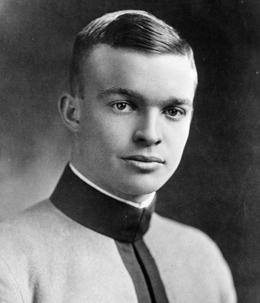
Perhaps to the dismay of his pacifist Mennonite parents, Eisenhower sought an appointment to West Point. Initially attracted by the free education, he proved a competent student, but a sometimes rebellious cadet who earned more than his share of demerits. He graduated in 1915 and chose to stay in the Army as a way of serving his country.

During World War I, Ike remained in the United States assigned to training commands. He studied the use of a new combat weapon, the tank. He gained valuable experience not only in armor tactics, but also military logistics, administration and training.

Army service during the two decades after World War I was challenging. The Army contracted quickly and defense budgets were small. Promotion was slow. Ike spent twelve years as a major, but stayed focused. He continued his professional development and was skillfully mentored by Major General Fox Conner.

Conner tutored Eisenhower on military history and operational matters. He also instructed his protégé on his principles for how democratic governments should wage war – Never fight unless you have to. Never fight alone. Never fight for long. Conner also emphasized his belief that a second “great war” was coming, and this time, the US Army would need to know how to fight as part of an international coalition.

Dwight Eisenhower as a cadet at West Point.

Ike continued working hard, making himself indispensable to his bosses. He wanted them to miss him when he moved on to his next assignment. One of those bosses would be General George Marshall, the Army Chief of Staff who approved several promotions for Eisenhower and first sent him to London in June of 1942. Eisenhower would receive several more promotions as his responsibilities grew, overseeing Allied military operations in North Africa and Italy. As a commander of troops from other nations, not just the United States, Eisenhower mastered the balance and patience necessary to work with political leaders and diplomats as well as senior officers from other militaries.  President Roosevelt selected Eisenhower to be the Supreme Allied Commander in Europe in December 1943 with responsibility for the planning and execution of the invasion of France.

The memorial sculpture depicting Dwight Eisenhower as the commander of the D-Day invasion.

Through this all, Ike never lost his common touch with his soldiers. The memorial depicts Eisenhower as the D-Day commander speaking with paratroopers from the 101st Airborne Division, based on a real encounter the day before the invasion. Ike always took time to talk to soldiers. In addition to offering encouragement, he wanted to hear from them. He wanted to ensure they had been briefed on their mission, were properly fed and had all the equipment they needed.

This famous photograph of General Eisenhower speaking with paratroopers from the 101st Airborne Division inspired the World War II sculpture at the Eisenhower Memorial.

After the war ended, Ike held a series of high profile positions: Army Chief of Staff, President of Columbia University, and the first military commander of the North Atlantic Treaty Organization.  

In 1952, a “Draft Eisenhower for President” movement began to sweep the country. Americans were attracted to Eisenhower’s proven leadership. Over 25,000 people intent on drafting Eisenhower and proclaiming “I like Ike” attended a rally at Madison Square Garden.  He even won the New Hampshire primary before he declared his candidacy.

As a career soldier, Ike had initially eschewed politics. But he had concerns about a growing sense of isolationism in America. As the Supreme Allied Commander in Europe, Ike clearly understood the need to contain Soviet aggression with a strong military presence in Europe and through close cooperation with the European allies. He resigned from the Army and announced his candidacy for the Republican Party’s nomination for president. In November, he won a landslide election.

The memorial portrays Eisenhower as president, with three advisors, before a large map of the world.

The map emphasizes the central role global affairs played during Eisenhower’s tenure, which saw many global calamities, the Korean War, the Suez Crisis, and the Hungarian Revolution to name a few.  Through it all, Ike aggressively pursued peace. Already well known to international leaders, Ike was a reassuring figure on the world stage. He drew heavily on the skills he honed as a wartime commander: patience, careful planning, collaboration and the ability to balance the interests of many. Today the 1950’s are remembered as a period of relative calm, resulting from Ike’s success in navigating so many potential pitfalls.

Domestically, Ike governed as a moderate. He maintained FDR’s New Deal programs, maintained balanced Federal budgets, founded the Interstate Highway System and helped establish several different Federal agencies. (These agencies, or their successors, are present in the buildings surrounding the memorial, Health and Human Services, Education, the Federal Aviation Administration, and the National Aeronautics and Space Administration within the National Air and Space Museum.)   

Dwight Eisenhower’s official portrait as President of the United States in 1959.

As a political leader, Ike believed in moving gradually and keeping to the middle ground. One of the advisors depicted behind Eisenhower in the memorial is an African-American, which represents Eisenhower’s early success on civil rights. Some historians believe Ike’s approach limited progress on civil rights. Eisenhower did not write or speak very often on the subject. Nevertheless, he knew his responsibilities as president. The steps he took on civil rights, completing the racial integration of the Armed Forces, signing the first civil rights legislation since Reconstruction, and enforcing the desegregation at Little Rock High School more than matched his predecessors and set the stage for continued progress during the 1960’s.

Ike’s memorial is testimony to his biggest accomplishments on the beaches of Normandy and in the corridors of power in Washington, DC. Ike shaped much of the world we live in today, but how he did it is impressive as well. The values Ike demonstrated are timeless. It was decades of selfless public service, hard work, humility, integrity, and a belief in others that enabled his successes and endeared him so much to others. No wonder than that everyone “liked Ike”.

Nighttime at the Dwight D. Eisenhower Memorial

Route Recon

The Dwight D. Eisenhower Memorial is located across Independence Avenue from the Smithsonian Air and Space Museum. There is limited street parking in the area. This National Park Service website has a map with metered parking locations around the National Mall. Public transportation is the best option for reaching the Dwight D. Eisenhower Memorial, as well as the other monuments and museums that line the National Mall. The Washington, DC Metro system is conveniently located near the memorial. From the L’Enfant Plaza station, exit via Maryland Avenue & 7th Street; from the top of the escalator, the memorial is one block straight ahead.

The National Mall Circulator Loop bus provides access around the National Mall. The Dwight D. Eisenhower Memorial is a short walk from the Jefferson Drive and 7th Street SW stop on the National Mall route, or the D Street SW and 7th Street SW stop on the Eastern Market – L’Enfant Plaza route.

Capital Bikeshare is metro DC’s Bikeshare service, with 4,500 bikes and 500+ stations across the region, a number of which are located close to sites on the National Mall. There is Bikeshare station on 4th Street, just south of the Dwight D. Eisenhower Memorial visitor contact station.

Command Reading List

Many books have been written on Dwight Eisenhower’s life and career. Here are just a few:

Eisenhower: Soldier and President (The Renowned One-Volume Life) by Stephen E. Ambrose

Ambrose’s one volume edition focuses on Eisenhower’s most notable roles as president and D-Day commander.

Eisenhower in War and Peace by Jean Edward Smith

Smith reviews Eisenhower’s life in great detail from Kansas through the presidency, while examining how Ike’s different personality traits of hard work, dedication, intelligence, and the ability to get people working together propelled his success.

Crusade in Europe by Dwight D. Eisenhower

Prior to his presidency, Ike wrote this book to tell his own story of the strategies he followed, battles he fought and decisions he made to secure victory in World War II.

Additional Resources

You can access the audio guide to the Dwight D. Eisenhower Memorial here.

The Eisenhower Foundation has a series of informative videos about Dwight D. Eisenhower, his times and the memorial on their website.

Grant Immemorial

Ulysses S Grant Memorial | Washington DC

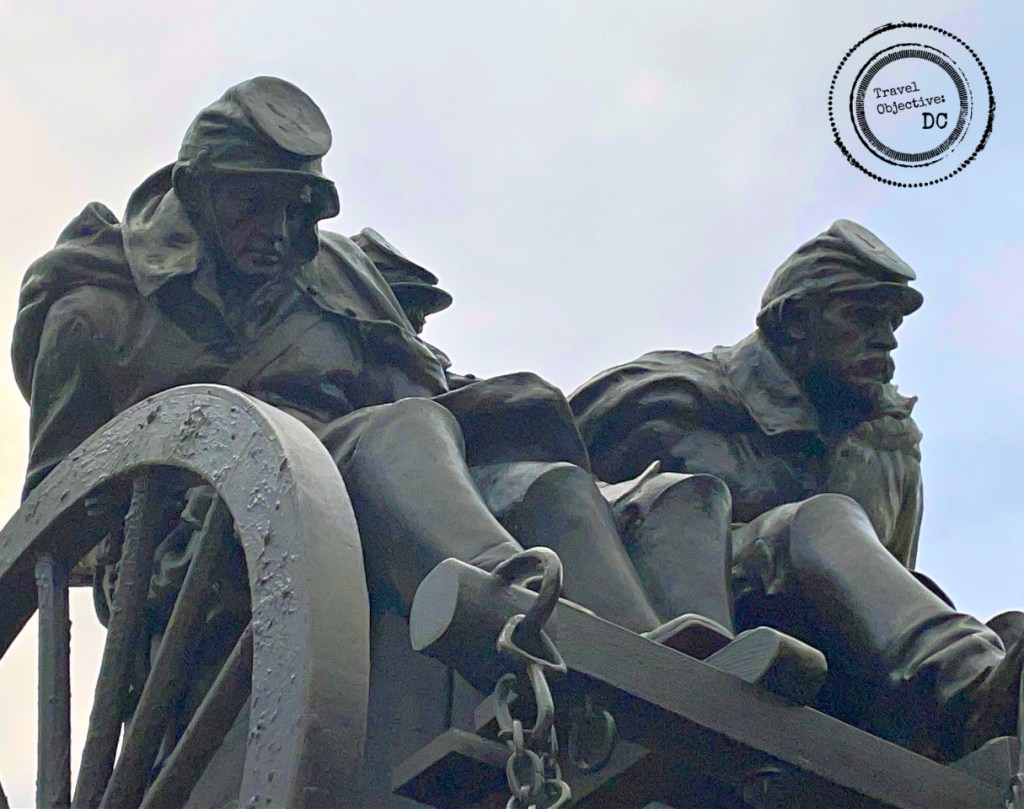
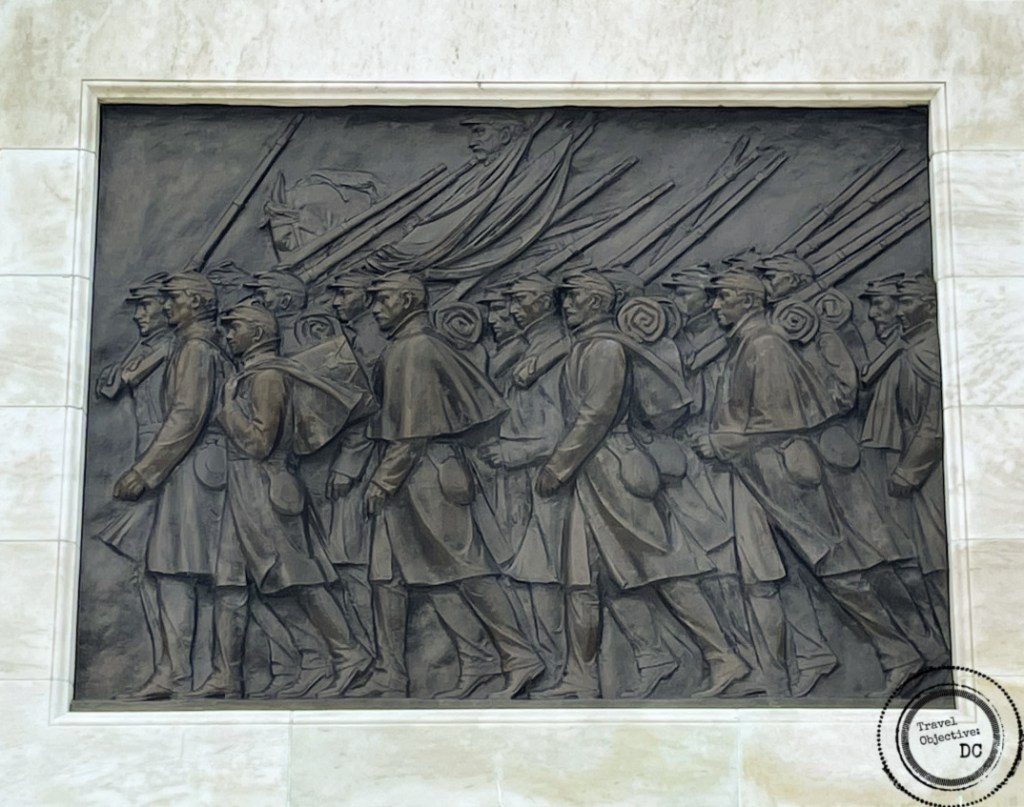
The sculpted face of Ulysses S. Grant looks across the National Mall with dispassionate determination. Around him a battle rages. A cavalry unit charges forward, an artillery detail hurries to emplace a cannon, infantry continue their forward march. Yet Grant, in his simple uniform and campaign hat, sits atop his war horse Cincinnati, looking forward, studying the situation and planning several steps ahead.

Such is the image portrayed in Washington, DC’s memorial dedicated to the Civil War General-In-Chief and 18th President of the United States. The memorial is located in Union Square, a plaza located just west of the U.S. Capitol grounds.

The move to commemorate Grant in Washington, DC began in the decade after his death in 1885, spearheaded by surviving veterans of the Union Army of the Tennessee. In 1902, Congress ultimately selected the ambitious designs of sculptor Henry Merwin Shrady and architect Edward Pierce Casey who envisioned a large multifaceted memorial in bronze and stone. 

A native of New York City and a graduate of Columbia University, Shrady took up art while recuperating from typhoid fever. Although Shrady had no formal training as an artist or sculptor, some of his early works earned him much acclaim. He focused on sculpture and studied anatomy very carefully in order to portray realistic figures in his statues. In 1901, he completed a famous equestrian statue of George Washington located in Brooklyn.

Men and horses advance in the statue entitled Calvary Charge, part of the Ulysses S. Grant Memorial.

After winning the Grant award, he engaged himself even more thoroughly in researching his subjects. He studied New York City Police Department horses. He examined Grant’s death mask. He observed military drills and exercises. He analyzed Civil War uniforms, weaponry and equipment to enhance the detail in his work. He drew upon his father’s recollections as a physician who attended to Grant in his final year. His architect partner, Edward Casey, was a veteran of the New York National Guard and lent some of his military experience to the project.

Shrady and Casey’s memorial dominates the Union Square area. The centerpiece statue of Grant, reaching 44 feet high, is one of the largest equestrian statues in the world. Two bronze bas-relief sculptures depicting advancing infantry adorn opposite sides of the statue’s pedestal. Four bronze lions on their own pedestals guard Grant’s statue adding a sense of majesty. The statues and pedestals sit upon a terraced marble platform about 240 feet from end to end. At both sides along that platform are additional bronze sculptures depicting the randomness and chaos of combat. 

An artillery detachment races to place a cannon in Henry Shrady’s statue Artillery at the Ulysses S. Grant memorial.

The sculpture known as Artillery presents a team of soldiers and horses racing to position a cannon. The guidon bearer has signaled a turn to the right, yet a bridle on the lead horse has broken and the horse continues to lunge forward. 

At the opposite end of the memorial, the statue entitled Cavalry Charge depicts cavalry troopers on the move.  An officer raises his sword ordering the advance, the buglar sounds the charge, a soldier bears the colors. Yet tragedy is about to strike as a trooper has fallen from his mount and will be trampled. Shrady is said to have portrayed himself as the ill-fated soldier. 

Shrady had worked relentlessly for twenty years on the memorial, undertaking some of the most ambitious and complex sculpting work of the time. He obsessed over every detail of the massive statues, each of which took years to produce and were some of the largest bronze castings of their time. Sadly, Shrady died about two weeks before the final dedication of the statue in April of 1922 commemorating the 100th Anniversary of Grant’s birth.

The face of the fallen trooper in the Cavalry Charge statue, said to be that of the sculptor Henry Shrady. The Grant Memorial project consumed twenty years of Shrady’s life.

Given the interest both Shrady and Grant had in horses, it is not surprising how prominent they are in this memorial. This seems fitting as Grant was an accomplished rider and horseman.

Grant learned to care for and work with horses as a young man growing up in Ohio. His father was a well-connected businessman who secured his eldest son an appointment to West Point. Grant was not especially enthused about attending the military academy, but knew it was likely his best opportunity for a university education. 

Ironically, it was an accident of paperwork at West Point that he got his name Ulysses Simpson Grant. He was born Hiram Ulysses, but his Congressman wrote Ulysses Simpson (his mother’s maiden name) on his appointment documents. When he reported to West Point in 1839, he was told the appointment was for Ulysses Simpson Grant, so he assumed the name, rather than reapplying. 

 He was a capable, but unambitious student who graduated in the middle of his class in 1843.   

Originally thinking he might go on to teach college math, Grant decided on a military career following his service in the Mexican-American War. During the war, Grant was recognized several times for his bravery in combat. He learned some important skills during his service in Mexico, developing a proficiency in military logistics, and witnessing the leadership styles of several commanders, including Zachary Taylor and Winfield Scott. 

Detail of the two artillerymen riding the wagon in the Artillery statue.

After the war, Grant found aspects of the peacetime Army difficult, especially the separation from his family. Unfortunately, he looked for solace in alcohol and developed a reputation as a problem drinker. That reputation followed him his entire life. He resigned his commission in 1854 and unsuccessfully pursued a string of civilian jobs, ultimately going back to work for his father in Galena, Illinois. 

Following the attack at Fort Sumter in April 1861, Grant was determined to return to military service. He sought and received a commission and the command of the 21st Illinois Volunteer Infantry Regiment. He restored discipline and effectively trained the unit to make it combat ready. A promotion to brigadier general followed in August 1861.  

A bronze bas-relief plaque of marching infantry soldiers on the pedestal of the Grant equestrian statue.

In February 1862, Grant led his troops to successful engagements at Fort Henry and Fort Donelson in western Tennessee. His successes gave the Union some badly needed victories. They also gained him the nickname “Unconditional Surrender” Grant, because he demanded his enemies surrender without terms. His actions led to his promotion as a Major General of volunteers and he was appointed commander of the Army of the Tennessee.  

In April 1863, Grant’s army was attacked by Confederate forces; the resulting fight at the Battle of Shiloh made plain the painful truth that a long war awaited both sides. The losses were staggering, a combined 23,000 causalities. But Grant’s deft leadership in sustaining the rebel assault and successfully counterattacking led to a Union victory. Grant received criticism for being unprepared for the Confederate attack; some even calling for his removal.  Lincoln famously responded “I can’t spare this man, he fights.”

After Shiloh, Grant and his Army pushed further south from Tennessee, aiming to take the Mississippi River port city of Vicksburg, a vital logistics hub for the Confederacy. Grant would demonstrate strategic prowess in this campaign, coordinating his troop’s movements with the Navy, splitting his forces to fend off a rebel reinforcement, and ultimately accepting the surrender of Vicksburg and its 30,000 Confederate defenders on July 4, 1863 after a 48-day siege.  

In October 1863, Grant was given command of all Union armies in the West. He moved quickly to break a Confederate siege of a Union Army in Chattanooga, Tennessee. His success led Lincoln to appoint Grant to the rank of Lieutenant General (the first officer to hold this rank since George Washington) and as General-in-Chief of the Armies of the United States in March 1864.

As General-in-Chief, Grant provided Lincoln with a campaign plan for a multiple front operation wherein Federal Armies would pursue the remaining major Confederate formations and degrade the South’s ability to wage war.  

Through the spring of 1864 and into 1865, Grant would accompany General George Meade and the Army of the Potomac, engaging in a brutal campaign which ultimately lead to the surrender of Robert E. Lee at Appomattox, Virginia on April 9, 1865. 

Ulysses S. Grant at his Cold Harbor, Virginia Headquarters in June 1864.

-Civil War Photographs, 1861-1865, Library of Congress, Prints and Photographs Division.

After the war, Grant would serve as Secretary of War under President Andrew Johnson. In 1868, he was elected president and served two terms. Unfortunately for President Grant, although he was personally honest and upright, those around him were not and his administrations were tainted by corruption. Still, there were several notable accomplishments during his administration such as the ratification of the 14th Amendment, passage of early civil rights legislation, establishment of the Department of Justice, and the creation of Yellowstone National Park.

Despite the scandals, Grant remained very popular. Like Washington, he chose not to run for a third term. He left office, and embarked on a grand tour of America and the world. His later years proved quite difficult. An unscrupulous investor took advantage of Grant and he lost much of his money in bad investments. He was diagnosed with throat cancer in 1884. Wanting to leave his wife with sufficient means to support herself, he worked tirelessly up to his death to complete his memoirs.  When the Personal Memoirs of U.S. Grant was finally published, it was a major success, heralded by critics, historians and the public alike.

Grant died on July 23, 1885 in upstate New York. Over a quarter of a million people viewed his funeral train as it traveled down the Hudson River valley to New York City. Tens of thousands of Union Army veterans accompanied Grant’s casket in a procession sometimes seven miles long. Confederate generals Joseph Johnston and Simon Buckner were among his pall bearers. 

For a time, Grant’s legacy suffered from debatable stories related to his drinking, supposed indifference to losing soldiers in combat and scandalous presidency. Over the past several decades though, historians and scholars have more closely examined Grant’s characteristics as a strategic leader, effective manager, and skilled tactician.

Like Grant’s reputation, his memorial in Washington, DC has also undergone refurbishment over the past few years. In 2011, the Architect of the Capitol accepted responsibility for the memorial from the National Park Service and began to restore the statuary and stonework. Signs of corrosion and weathering were removed, the marble and bronze polished, missing or broken features from the statues, such as swords and chains, were replaced. Eight ornate bronze lamps were also installed around the memorial.  

Portrait Photograph of President Ulysses S. Grant, circa 1870

-Matthew Brady; Library of Congress Prints and Photograph’s Division

At the top of that memorial, as the face of General Grant gazes west, he can see the memorial to his wartime president, Abraham Lincoln. Through the Civil War years, Ulysses Grant and Abraham Lincoln developed a close working relationship. The two were westerners with a common touch and similarly humble origins. Lincoln appreciated Grant’s leadership, his willingness to maintain the offense and his sense of responsibility. Grant wrote: “No general could want better backing for the president was a man of great wisdom and moderation.” Now their memorials bookend our National Mall, a fitting testimonial to the president and his general who fought so hard to preserve the Union.

Route Recon

The Ulysses S. Grant Memorial is located along First Street, NW, just to the west of the U.S. Capitol building. The best way to get to the memorial (and the Capitol) is by taking Metro.

Three Metro stops are within walking distance of the memorial and the Capitol:

  • Union Station – Located at First Street, NW, and Massachusetts Avenue.
  • Capitol South – Located at First Street between C and D Streets, SE.
  • Federal Center, SW – Located at the southwest corner of Third and D Streets, SW.

Additional information on riding Metro, is available at the Washington Metropolitan Area Transit Authority.

The DC Circulator, a public bus system with routes through Washington’s downtown area includes stops near the Memorial. Find more information about Circulator busses at www.dccirculator.com.

There is very little public parking available near the Capitol. The nearest public parking facility is at Union Station, to the north of the Capitol. Very limited metered street parking is found along the Mall to the west of the Capitol.

Command Reading List

Many books have been written on Ulysses S. Grant. The below works offer new insights into Grant’s character and leadership.

Grant by Ron Chenow

Noted biographer covers Grant’s entire life and career, from his Ohio childhood through his presidency and beyond.

The Presidency of Ulysses S. Grant by Charles Calhoun

This book by historian Charles Calhoun produced a very comprehensive analysis of the Grant presidency, with detailed research that challenges some of the early criticisms of Grant which are often repeated by historians and biographers.  

The Personal Memoirs of Ulysses S. Grant, edited by John F. Marszalek with David S. Nolan and Louie P. Gallow

Grant’s memoirs were immensely popular when published in 1885. This annotated version provides extensive background and context to Grant’s original writing.

* * *

“Freedom is Not Free” Remembering Why at the Korean War Veterans Memorial


Nineteen figures, dressed in combat uniforms and moving in formation, cut a silent, ghostly silhouette against the seasonal colors of the National Mall.  Tall in stature and gray in color, these figures represent an American infantry unit from the Korean War.  

The statues are the most prominent feature of the Korean War Veterans Memorial. Sitting just to the southeast of the Lincoln Memorial, it is one of the National Mall’s most intriguing sites. 

The Korean War began on June 25, 1950, when North Korean forces of the Korean People’s Army, with the backing of Soviet and Chinese leaders, poured over the 38th parallel, attacking south with the goal of reuniting a divided Korea under the leadership of Kim Il Sung. Within 48 hours, the United States committed air and sea forces to the defense of South Korea. On June 27, the United Nations Security Council passed Resolution 83, calling on “Members of the United Nations furnish such assistance to the Republic of Korea as may be necessary to repel the armed attack…”. 

Fighting would last 38 months, during the years from 1950-1953. United Nations forces were able to repel the initial North Korean invasion. The last two years was largely a stalemate, even though there was fierce fighting and direct engagement between US and Chinese ground troops. An armistice halting the fighting was signed on July 27, 1953 in Panmunjom, Korea.

By the end of hostilities, over 5.8 million Americans served in the US armed forces and 36,574 Americans died as a result of hostile actions in the Korean War theater.  In addition, 103,284 were wounded during the conflict. Losses were especially high among the Korean combatants. Over 162,000 South Korean soldiers and 526,000 North Korean soldiers were killed. Civilian deaths during the Korean War on both sides are estimated at between 2-3 million. 

The details of the Korean War may not be known to many of the visitors, but the memorial vividly weaves together symbolism and imagery to portray the conflict’s sacrifices and significance.  

An image of a US Navy nurse from the Mural Wall

For full effect, the statues should be viewed in conjunction with the Mural Wall, which adds a unique, two dimensional feature to the memorial. The 164-foot long wall is constructed of a highly polished black granite and stands to the statues’ right side. It bears the images of over 2,400 troops and different specialties from each branch of the Armed Forces that supported the infantry during the Korean War. Both the faces of the statues and the visages on the wall are based on actual Korean War veterans, taken from photographs supplied by the National Archives and Records Administration and other renderings. Viewed from a distance, the service member images on the wall resemble the mountains of Korea.  The wall vividly reflects the statues, suggesting 38 servicemen moving in formation and symbolizing the 38th parallel and the 38 months of the war.

On the left side of the statues is the United Nations curb, a stone edge to a paved walkway with the name of the 22 Countries that, like the United States, fought or provided material support in Korea under the auspices of the United Nations.  

An engraving of the the United Nations seal as depicted on the United Nations Curb.

The statues appear to be moving toward an American flag flying from a flag pole next to a reflecting pool shaded by a grove of linden trees. At the base of the flag pole is a small stone with the inscription “Our nation honors her sons and daughters who answered the call to defend a country they never knew and a people they never met.” 

The pool is inscribed with the numbers of casualties sustained during the war by both the United States and the United Nations. The area is known formally as the Pool of Remembrance; the pool and the adjoining benches shaded by linden trees invites quiet contemplation of the war and its costs. 

* * *

For the United States, the Korean War was unlike any other before it. 

Congress made no declaration of war. Rather, the US fought under the auspices of the new United Nations and provided most of the UN combat forces. The Korean War would be more limited, without the general mobilization of American society as was seen in the First and Second World Wars. A new branch of the armed forces, the US Air Force, would organize and conduct air campaigns.  And for the first time since the American Revolution, the war was fought with a racially integrated military. (Notice the 19 statues represent multiple racial and ethnic groups and all four branches of the armed forces).

Statue depicting a US Air Force Air-Ground Controller

It was also fought in a very far away land, not well known to many Americans, to contain the spread of communism, the growth of which in Eastern Europe and China immediately following World War II was seen as a threat to the American democracy and capitalism. 

The Korean War remains with us today. The armistice of 1953 only ended the fighting, but not formally the war. A demilitarized zone marks the current border between the two Koreas. Tensions remain high. Korea is never very far from the headlines or newsfeeds and remains a major focus of US diplomacy and foreign policy. The US is still committed to the defense of South Korea and maintains a force of approximately 24,000 troops in the country. 

Over 7,600 US service members are still listed by the Pentagon as missing in action. The North Korean government periodically returns remains of US service members. In 2018, 55 boxes of remains were presented to US officials and taken to the Defense POW/MIA Accounting Agency in Hawaii for identification.  Potentially, 80 US service members may be identified from these sets of remains. Some already have. One was US Army Corporal Charles S. Lawler, 19, of Traverse City, Michigan.  Corporal Lawler was a member of the 1st Cavalry Division. He was reported missing in action on Nov. 2, 1950, after his unit was attacked near Unsan, North Korea. He was buried in his hometown on July 27, 2019. 

A group photo from the 8225th M*A*S*H*. The concept of forward deployed military hospitals was successfully implemented during the Korean War.

Popular narratives sometime label the Korean War as “the Forgotten War”, which seems misleading. It certainly was never forgotten by the Korean people, nor by the veterans who fought there and certainly not by the families of those who died there. The US military community has not forgotten as there has been a large military presence in Korea for decades. And the 1968 novel M*A*S*H*, about an Army field hospital which became a successful motion picture, then later a very popular television show, continued to remind the American public of the Korean War.

And now for over a quarter century, an exceptional and dignified memorial stands on the National Mall to help us remember. 


Route Recon:

The Korean War Veterans Memorial is located at the western end of the National Mall. It is two miles walking distance from the U.S. Capitol. A paved footpath connects the Korean War Veterans Memorial to the Lincoln Memorial area. The nearest metro stations are Foggy Bottom (23rd St. &I St. NW) and Smithsonian (12th St. & Independence Ave. SW).

Visitor parking is available along Ohio Drive, SW between the Lincoln and Thomas Jefferson Memorials. 

The Korean War Veterans Memorial is accessible 24 hours a day. Some visitors especially like to visit at night or in foggy or rainy weather, when the statues take on a surreal nature. 

There are many online resources regarding the Korean War. A good place to start is the US Army Center for Military History’s Korean War Commemorative Website .   

One Last Note: The Department of Defense (DoD) currently lists the number of US service members killed during the Korean War as 36,574. For many years, the Department of Defense had listed the number as 54,260, which is the number included on the memorial. Later research conducted by DoD determined the higher number included deaths of US service members who died on active duty during the 38 months of the war, although not necessarily as a result of combat operations in Korea. The higher number is included on the memorial as it honors all US service members who served during the Korean War.