Immerse Yourself in History at the National Museum of the Marine Corps


Making Marines is the first gallery visitors encounter in their journey through the National Museum of the Marine Corps (NMMC). It describes the 13-week Marine Recruit Training program where young men and women begin their journeys to become United States Marines. 

The gallery floor is lined with painted yellow footprints. These footprints demonstrate for the new recruit exactly where to place their feet to stand at the position of attention. Visitors are invited to also place their feet in these yellow figures, literally following in the footsteps of generations of Marines who have gone before. 

The yellow footprints at the Marine Corps Recruit Depot Parris Island, South Carolina

The yellow footprints at the Marine Corps Recruit Depot Parris Island, South Carolina (July 2004)

-USMC Photo by Lance Corporal Brian Kester

This is one of the main themes of the Marine Corps’s fine museum where the exhibits and displays are designed to immerse the visitor in the Marine Corps’s distinguished history and cherished traditions. 

The NMMC opened in 2006 in Triangle, Virginia. The town is located near Marine Corps Base Quantico, about 32 miles south of Washington, DC. The museum is tremendously successful, attracting over 500,000 visitors each year. 

Visitor immersion starts upon walking in the front door and entering the open Leatherneck Gallery housed under the uniquely designed roof.  Seven restored Marine aircraft are suspended from the ceiling and inspirational quotes regarding the Marine Corps line the walls.

The front entrance of the National Musuem of the Marine Corps
The front entrance of the National Museum of the Marine Corps

The conical roof of the NMMC with its protruding shaft, reminiscent of the flagpole depicted in the famous photograph of the Iwo Jima flag raising, has been a familiar site to motorists on Interstate 95 in Northern Virginia for the past two decades. 

NMMC has expanded steadily through the years, adding new features and displays. In October 2024,  two new galleries opened focusing on Iraq and Afghanistan. NMMC now features twelve galleries and two theaters encompassing the Marine Corps’s 250-year history.

Curators and exhibit designers used a wide variety of tools and techniques to tell the Marine Corps’s story. More than one thousand artifacts are on display, including weapons, aircraft, vehicles, uniforms and various pieces of Marine gear. These historic objects are skillfully supplemented by interpretive signage, historic photos, period newsreels, modern videos and films, posters and works of art.

USMC F4U-4 Corsair on display at the National Museum of the Marine Corps
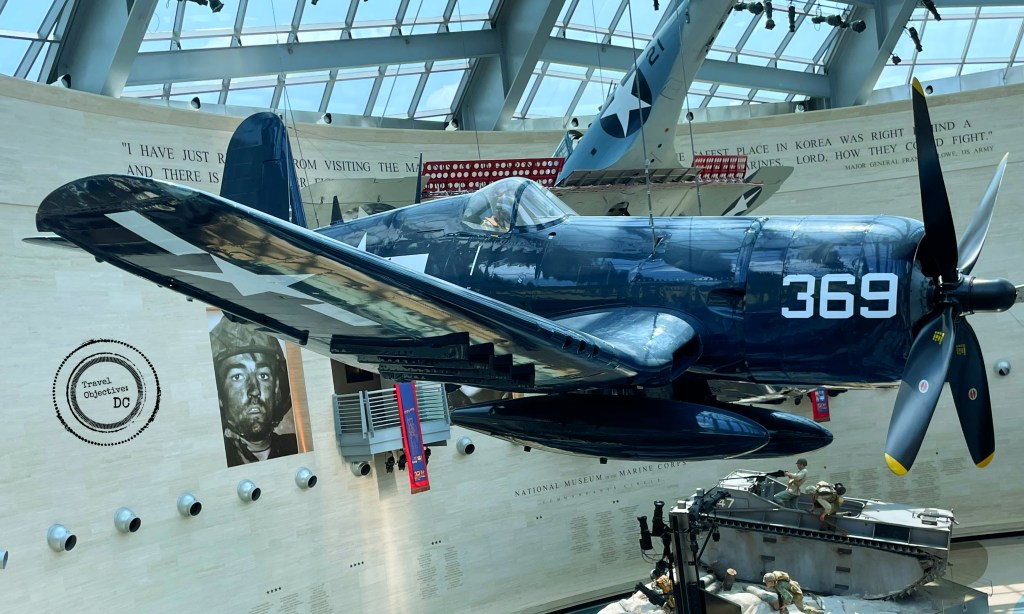
USMC F4U-4 Corsair on display at the National Museum of the Marine Corps

After learning about Marine Recruit Training (vistors can test their marksmanship on a laser rifle range), the Legacy Walk corridor leads to the chronologically arranged historical galleries. The galleries explain the Marine Corps’s role in shaping American history. 

On November 10, 1775, Congress directed the raising of two battalions of Continental Marines. From the start, the Marines were designed to be an expeditionary force, accompanying the US Navy on warships and providing a ground-based fighting capability.

Early Marines provided security onboard US Navy ships for the captain and other officers, while also enforcing discipline among the crew. During ship-to-ship combat, Marines were posted on the ships masts and rigging, acting as sharpshooters targeting the opposing captain and crew. 

A display showing early Marines positioned on a ship's mast.

A display showing early Marines positioned on a ship’s mast.

Marines also acted as infantry conducting a raid on Nassau, Bahamas in early 1776 and attacking a barbary pirate fortress in Libya at the Battle of Derna in 1805 (wherein comes the reference to the “Shores of Tripoli” in the Marine Corps Hymn). 

Marines fought alongside the US Army in the Mexican War and helped to suppress John Brown’s raid on Harpers Ferry in 1859. A 350-Marine battalion engaged Confederate forces at the first Battle of Bull Run in June 1861. 

Through the 19th and early 20th centuries, the Marines performed a number of expeditionary missions in various parts of the world where American interests were deemed threatened. Well-trained Marines were easily deployed and avoided the political ramifications of sending the Army, which could be equated with declaring war on another country.

M1895 Colt Machine Gun in front of The Defense of Peking-1900 by Staff Sergeant John Clymer, USMCR
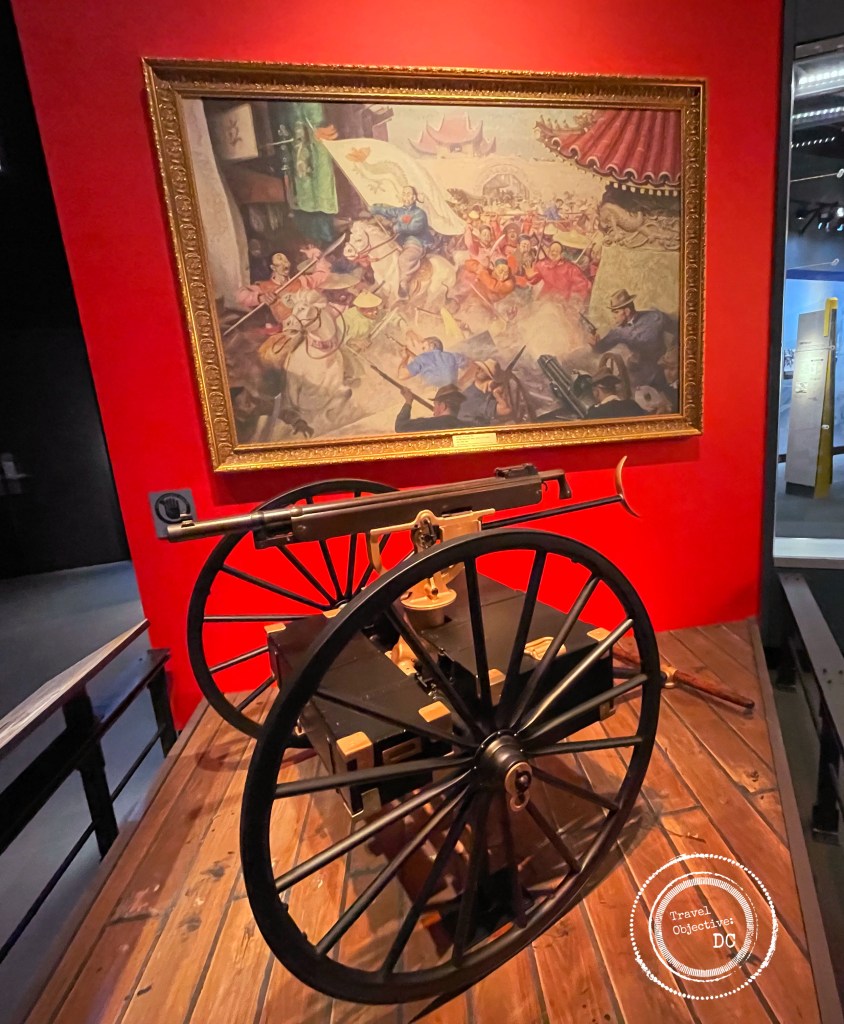
M1895 Colt Machine Gun in front of The Defense of Peking-1900 by Staff Sergeant John Clymer, USMCR

While the decision to deploy Marines may have been easy, the missions were not. Marines were expected to establish order, disarm insurgents and train local military or police forces. The Marines referred to these operations as Small Wars.

Difficult as they were, these deployments were covered extensively by American newspapers at the time and provided a positive portrayal for the Marines to the American public. That narrative grew exponentially for the Marine Corps following the Battle of Belleau Wood in 1918.

To tell the story of of Belleau Wood and later Marine battles, the NMMC galleries covering World War I through today all incorporate large-scale immersive exhibits. Sight, sound and other effects (such as cold air in the Chosin Reservoir exhibit) are combined to draw the visitor into the Marine Corps’s story. 

These large immersive scenes are a major feature of the museum. 

Life-sized cast figures depicting hand-to- hand combat during World War I

Life-sized cast figures depicting hand-to- hand combat during World War I

Visitors can step right into the scenes and experience an attack at Belleau Wood, a pre-deployment briefing before the invasion of Iwo Jima, deploying from a CH-46 helicopter at Khe San in Vietnam, and patrolling the streets in Iraq. The scenes convey a potent sense of realism with posted signs advising visitors of the intensity of these exhibits.

In a scene depicting the Battle of Hue, a Navy corpsman treats a Vietnamese girl beside an M50A1 Onos anti-tank vehicle.

In a scene depicting the Battle of Hue, a Navy corpsman treats a Vietnamese girl beside an M50A1 Onos anti-tank vehicle.

To NMMC’s credit, it understands its displays may overwhelm some visitors. In 2024, a restroom was converted into the Respite Room, a quiet, private space away from the galleries. 

Decorated in wood tones and calm colors, the room has soundproofing, soothing music and is devoid of any military symbols or references. Museum staff are trained on the best ways to steer visitors to the room as appropriate.

As proud as the Marines are of their heritage, the museum’s displays are not just about the past. In 2020, the Museum opened exhibits on contemporary missions such as Marines performing humanitarian operations, providing security at US embassies, and about the structure and functions of Marine Air Ground Task Forces, the principal organizational unit for today’s Marine Corps forces.

There is also an important display on Marine Corps families, which emphasizes how service in the Marine Corps is a family-wide commitment deserving of the Corps’s continued support and dedication.

Inside the Semper Fidelis Memorial Chapel

Inside the Semper Fidelis Memorial Chapel

While there is much to see, the NMMC experience is not confined to the building. On the museum grounds is the 40-acre Semper Fidelis Memorial Park. A 1.2-mile paved walking trail through this manicured green space is dotted with plaques, sculptures, benches and other features commemorating individual Marines, units and battles, as well as Marine families and broader communities. 

The centerpiece of the park is the Semper Fidelis Memorial Chapel, which serves as a quiet place for reflection and community events. 

An immersive visit to the NMMC is well worth the investment of several hours to explore its offerings. Those interested in history or who have a connection to the Corps will find it especially intriguing. Young people considering joining the Marine Corps will find it informative. They will leave knowing what Marine Corps service is about and what their leaders will expect from them. 

However, the Marine Corps Museum isn’t just for Marines–It’s a museum for everybody.

Any visitor should leave with a good understanding of how the Marines fit uniquely into American history, and what their role is today.

A World War I era US Marine Corps recruiting poster

A World War I era US Marine Corps recruiting poster

* * *

Route Recon

The National Museum of the Marine Corps is located at 1775 Semper Fidelis Way, Triangle, VA 22172.

The Museum is open every day from 9:00 AM until 5:00 PM except Thanksgiving and Christmas. Visit the museum’s website for more information about temporary exhibits and special programming.

Triangle, VA is located just off I-95, about 36 miles south of Washington, DC and 76 miles north of Richmond, VA.

From I-95 heading south, take Exit 150A to Route 1 (Richmond Highway); turn right (south) onto Route 1; travel approximately ¼ mile; the Museum’s entrance is on the right.

From I-95 heading north, take Exit 150 (619 East Triangle/Quantico); turn right (south) onto Route 1; travel approximately ¼ mile; the Museum’s entrance is on the right.

Admission is free and there is no charge for parking at the Museum. 

Mess Call

There are two dining options at the National Museum of the Marine Corps.

The Devil Dog Diner provides cafeteria service with a selection of hamburgers, hotdogs and chicken sandwiches. It is open 10:00 AM – 4:00 PM daily.

The Tun Tavern is a full-service restaurant with an 18th century colonial atmosphere. It is open 11:00 AM – 4:00 PM daily.

Find the menus for both restaurants on the museum’s concessions webpage.
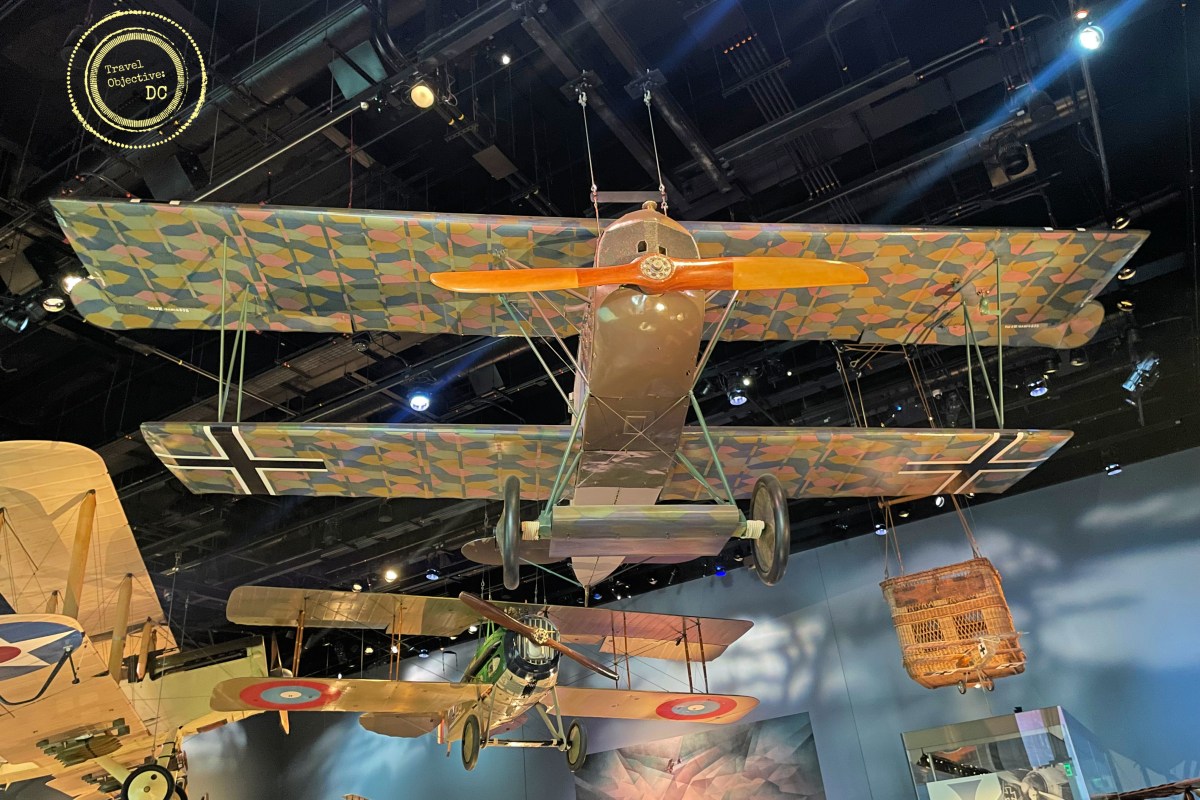
Revisiting the War Above the Trenches at the National Air and Space Musuem

A German Fokker D.VII Fighter

Lieutenant Arthur Raymond Brooks, US Army Air Service, knew he was in for a fight.

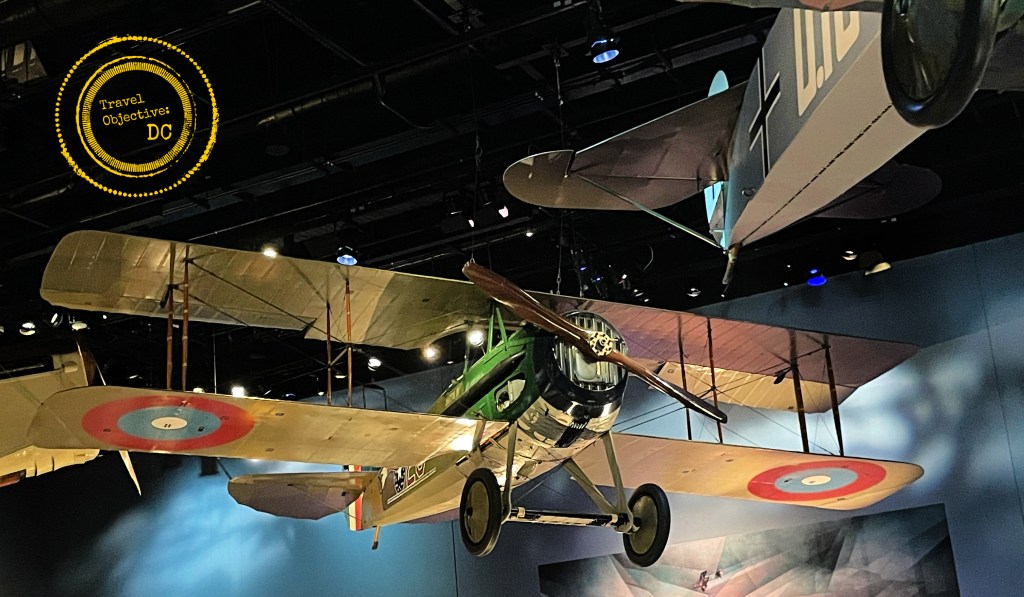
In the skies above Mars-la-Tour, France on September 14, 1918, Brooks and his squadron of six SPAD XIII fighters encountered four squadrons of German Fokker D.VIIs. As the fighter planes engaged each other, Brooks flew directly into German machine gun fire. He then quickly pulled away from his main formation with eight German fighters in pursuit. 
Brooks next used all the maneuver capabilities the SPAD could provide to avoid being caught in a Fokker’s line of fire. He did barrel rolls. He flew in loops. He quickly climbed, then rapidly dove.  

As the melee continued, Brooks fired on multiple Fokkers as they all weaved through the sky, downing two. German fire shattered his windshield and damaged one of his two machine guns. His SPAD was riddled with bullet holes.  Yet he stayed in the fight. Brooks anecdotally shot down four German fighters that day (although he was only credited with two) and was awarded the Distinguished Service Cross for his actions.

A SPAD XIII Fighter at the National Air and Space Musuem

The SPAD XIII FighterBuilt by the Société Pour L’Aviation et ses Dérivés (SPAD) company, the SPAD XIII was preferred by French aces. The US Army Air Service also flew SPADs. Ray Brooks flew this SPAD in October 1918.

Ray Brooks is just one pilot whose aerial exploits are recounted in the Smithsonian Institute’s National Air and Space Museum’s (NASM’s) redesigned World War I aviation exhibit entitled World War I, the Birth of Military Aviation.

This is NASM’s third exhibit dedicated to the aircraft and aerial warfare of the First World War.  The earlier exhibit, entitled Legend, Memory and the Great War in the Air, closed in 2018 as NASM prepared for a musuem-wide refurbishment. The new iteration explores the twin themes of how “the Great War” defined the on-going nature of military aviation as well as the remarkable experiences of World War I aviators.

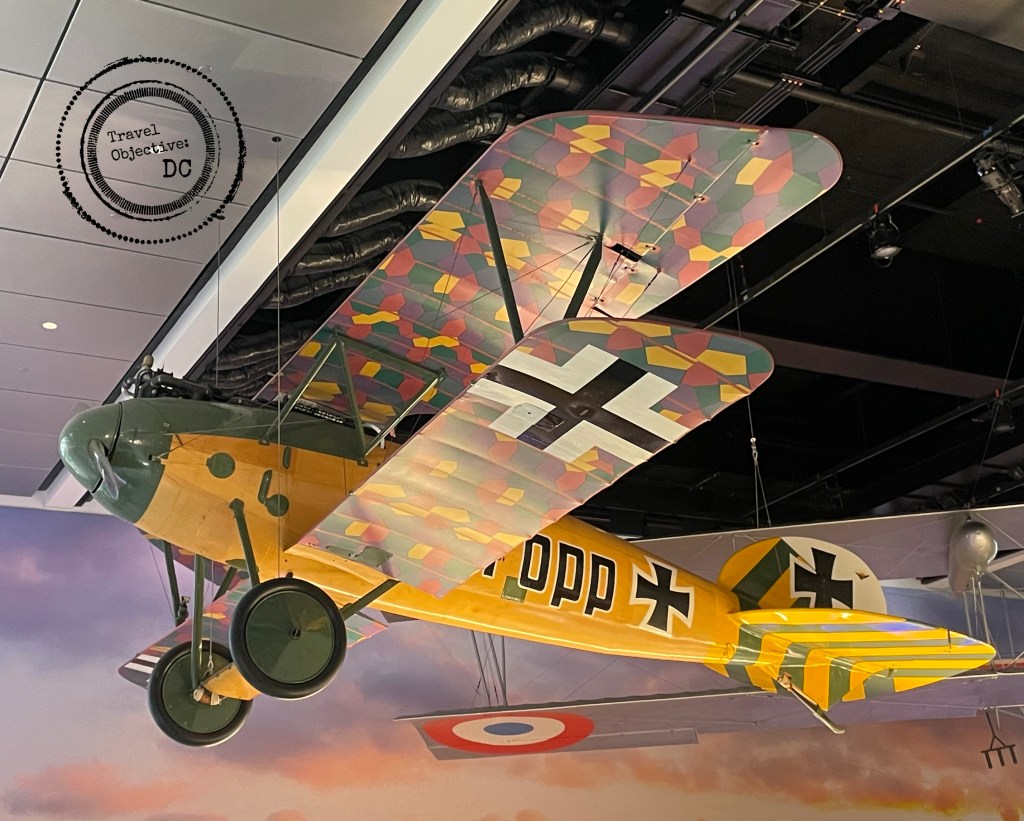
There is much to see in the new gallery, but the meticulously restored World War I aircraft are the main attraction. Many of the World War I airplanes previously displayed are back. Greeting you from overhead as you enter the exhibit hall are the French Voisin Type 8 nighttime bomber and the German Albatross D.VA, a fighter that debuted in 1917. Other aircraft include the Fokker D.VII German fighter, Ray Brooks’ SPAD XIII fighter and the DH-4 Liberty Plane.

A German Albatross D.Va Fighter – These fighters were introducted in 1917.

A German Albatross D.Va Fighter at the National AIr and Space Musuem

The latest exhibit occupies a smaller footprint than its predecessor, but NASM’s designers have filled the space with a wide range of intriguing artifacts, vintage aircraft, airplane models and other displays. 

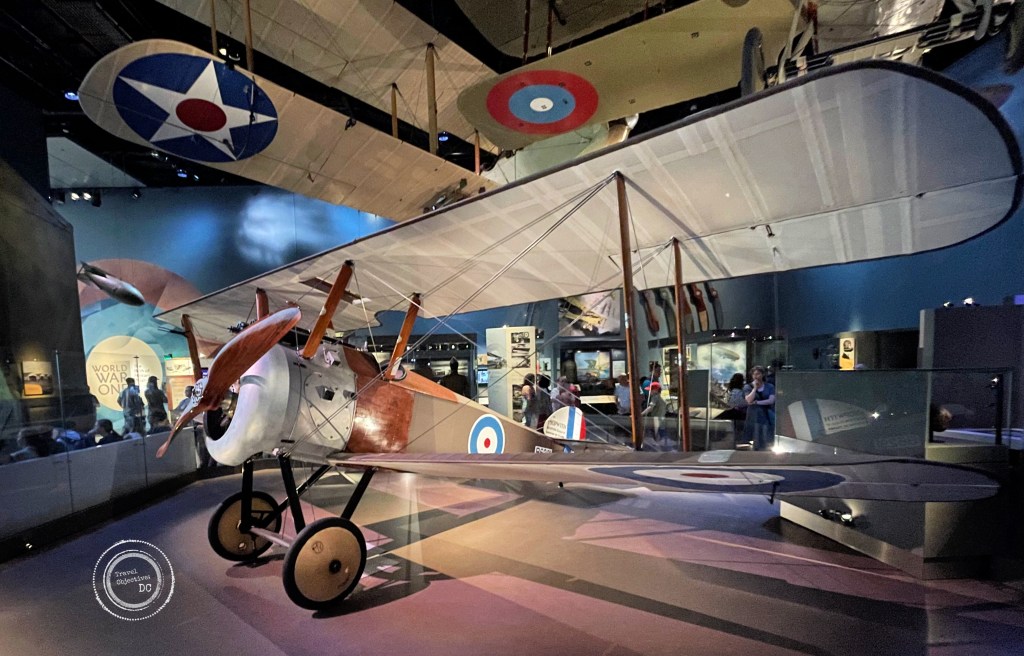
The exhibit timeline from 1914 through the post-war period is arranged in a counterclockwise manner around a beautifully restored Sopwith F.1 Camel (the last surviving Camel fighter produced by the Sopwith Aviation Company).  Once a pilot mastered the British-made aircraft’s finicky controls, the Camel was a highly versatile fighter. It is credited with downing more enemy aircraft than any other Allied plane.

Unlike other aircraft on display, the Sopwith Camel is placed on the floor making it the easiest to see and admire.

Adjoining the Camel is a large movie screen surrounded by a tent-like frame, suggesting an early aerial hanger. A four-part narrated film plays on a loop showing period aircraft in flight. The film provides a wonderful sense of motion to these beautiful but otherwise static aircraft.

A Sopwith F.1 Camel at the National Air and Space Musuem

The Sopwith F.1 CamelThis aircraft is the last surviving F.1 Camel built by the UK’s Sopwith Aviation Company.

Through the war years, three distinct types of military aircraft evolved–reconnaissance planes, fighters and bombers–reflecting the three original mission areas of military aviation.

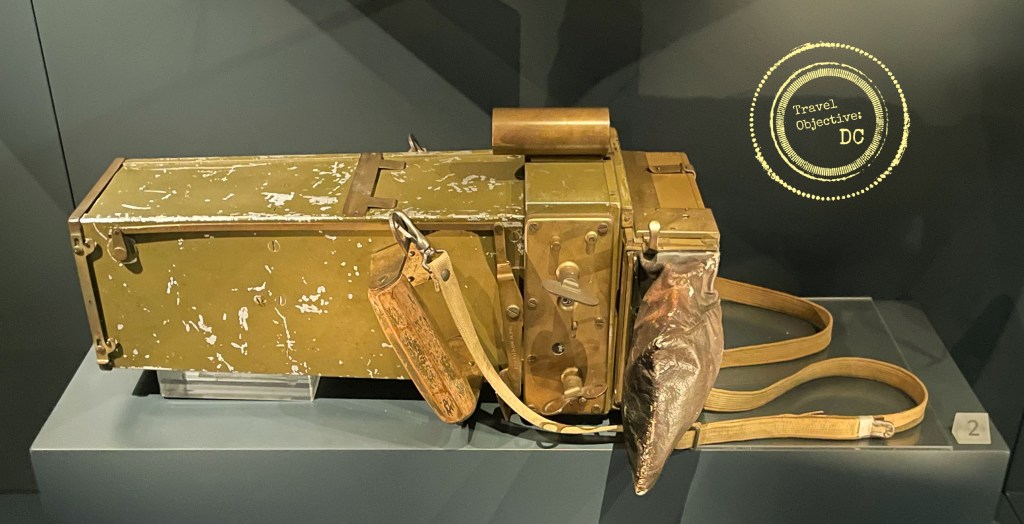
To battlefield commanders, the airplanes’ most critical function was reconnaissance and observation. Trench warfare had ended the traditional scouting role of horse cavalry, but aircraft could find, fix and observe the enemy from above. Reconnaissance aircraft were built to direct artillery fire, track troop deployment, assess damage and relay messages over long distances. Planes were fitted with cameras and communications equipment, essentially becoming the commanders’ eyes and ears. Pilots and observers risked their lives to take photographs, which were now an important element of military planning.

A Kodak A-2 Oblique Aerial Camera. A 4″x5″ glass plate was changed out each time a picture was taken.

A Kodak A-2 Oblique Aerial Camera at the National Air and Space Musuem

Fighter aircraft were first developed to protect the reconnaissance planes. Ultimately, the fighters would engage each other to control the airspace over the trenches. Later in the war, Britain and Germany formed special fighter squadrons to directly attack troops on the ground.

Airships also conducted reconnaissance as well as bombing missions. However, their large size and slow speed made them susceptible to attack by fighters. They were generally replaced on bombing missions with specialized aircraft capable of flying further and higher while carrying heavier bomb loads.

 A German aviation insignia

Cross insignia from a German airship – This design was the official emblem of the German Air Service until mid-1918.

World War I gave rise to the military aviator as a distinct specialty. Some aviators, especially pursuit (later called fighter) pilots, took on a mythic status in their home countries.  Flying high above the mud and blood of the trenches, these pilots were heirs to the chivalrous legacy of knights in armor. Pilots were written about in newspapers, appeared on magazine covers and made public appearances.

Prominent pilots included in the exhibit include Eddie Rickenbacker (America’s most decorated WWI ace), Manfred von Richtofen (The Red Barron), Eugene Bullard (African-American pilot flying for the French), Raol Lufbrey (a French-American ace), and Snoopy. (OK, Snoopy was not a real pilot, but he does have his own display, which is, of course, by the Sopwith Camel).

Among all the aircraft and artifacts, there are many interactive features as well. You can use a light table to analyze period photo imagery from a reconnaissance aircraft, learn how a synchronizer allowed machine gun bullets to miss propeller blades, and take the controls of a Sopwith Camel to experience the sounds of this highly maneuverable fighter. An immersive exhibit on trench warfare at first seems rather two dimensional. However, a look through trench periscopes provides some basic context on the infantryman’s view of aviation.

Snoopy first imagined himself flying his doghouse in 1965. Through the comic pages, as well as books, games, cartoons, and toys, Snoopy has been a consistent reminder of World War I aviation.

A collecton of artifacts celebrating Snoopy, the World War I ace.

At the beginning of the war in the Summer of 1914, the airplane was still a novel invention, a little more than a decade old. Very few aircraft were designed for any military purposes. As the war progressed, rudimentary flying machines quickly became faster, more maneuverable and better armed.

Airplanes were also needed on a large scale. Over 215,000 aircraft were built between 1914 to 1918. A myriad of new products were developed or adapted for use in aviation such as specialized cameras, radios, and aerial bombs. Many items first developed in World War I are still used in modern aviation, like the artificial horizon instrument, flight suits, and oxygen masks to name just a few. This sudden and sustained demand for combat aircraft and accessories gave rise to a new industry filled with highly skilled workers, an industry we rely on today.  

A collection of World War I aircraft propellers

American, British and French propellers

Although World War I ended over a century ago, its impact is still very much felt today. World War I, the Birth of Military Aviation provides valuable insight into an important but not altogether well understood period in the history of aviation. The gallery’s opening is also an important and welcome step toward the completion of NASM’s comprehensive, multi-year renovation.

* * *

Route Recon

The Smithsonian Institute’s National Air and Space Museum (NASM) is located on the National Mall bordered by Independence Avenue, Jefferson Drive, and 4th and 7th Streets, SW. The entrance is on the north side of the building facing the National Mall. You cannot access the museum from the south side along Independence Avenue. Free timed tickets are required for entry into NASM. Tickets can be acquired through the NASM website. Ticket holders will line up near the entrance on the Mall side of the Museum building prior to their entrance time. Entry prior to the time on the ticket is not allowed, but ticket holders can enter after the ticket time.

Parking – Very limited metered street parking is available around the museum. Parking is available in several commercial parking lots in the neighborhood.

Public Transportation

Metrorail – The closest Metro station is L’Enfant Plaza, along the blue, orange, silver, and green lines. From the L’Enfant Plaza Station, take the exit for Maryland Avenue and 7th Street.

Metrobus – Bus stops are located on Independence Avenue, SW, and along 7th Street, SW. Visit the Washington Metropolitan Area Transit Authority for more information.

Command Reading

Capt. Arthur Ray Brooks, America’s Quiet Ace of W.W.I by Walter A. Musciano – Originally published in 1963, Musciano’s concise work provides a brief overview of Brooks’ life with some straightforward accounts of World War I aerial combat. It also includes an interesting assortment of historic World War I photographs of Brooks and his fellow aviators as well as detailed informaton on the aircraft Brooks flew.

Hancock, the Superb


Statues of military leaders on horseback are a common site in plazas and squares around Washington, DC. While the statues might seem ordinary, the men featured on them are usually not. This is certainly the case with the statue of General Winfield Scott Hancock in the Penn Quarter neighborhood near the Navy Memorial.

It is hard to imagine a military career today as the one experienced by this 19th century Army leader.

As the Union Army was quickly expanding to meet the grim realities of the Civil War, Major General George McClellan, Commander of the Army of the Potomac, promoted his long-time acquaintance Hancock from captain to brigadier general and assigned him to brigade command. 

Hancock would go onto distinguish himself during the war, earning the nickname “Hancock the Superb”. He ultimately served 42 years on active duty and 25 years as a general officer. 

The equestrian statue of Winfield Scott Hancock.
The statue of General Winfield Scott Hancock

In 1896, the equestrian statue was dedicated to Hancock portraying the famous general in his more senior years. But the simple monument does not tell the full story of this highly respected Union Army general.

Hancock hailed from Montgomeryville, Pennsylvania. He was the son of a lawyer in a locally prominent Democratic family. His parents named him after Winfield Scott, the Army’s most senior officer at the time. His name was apt. From an early age, the young Winfield demonstrated a keen interest in military affairs. He could often be found leading young boys in a “youth militia company” on marches through town.

At the age of 16, he was accepted at West Point, graduating in 1844.

Assignments followed in the west and in Mexico during the Mexican-American War. After the war, Hancock often received Quartermaster assignments which taught him important lessons in logistics, organization and how to navigate the Army’s bureaucracy. His affable nature, technical proficiency and dashing good looks earned him an excellent reputation among his soldiers, colleagues and superiors.

Photograph of Winfield Scott Hancock.

A photograph of General Winfield Scott Hancock taken sometime between 1861-1865 by Brady’s National Photographic Portrait Galleries

-Library of Congress

Militarily, Hancock is probably best remembered for his actions as a corps commander in the Union Army of the Potomac at the Battle of Gettysburg in 1863. In the prelude to the fighting, Hancock arranged Union troops in a broad defensive position along high ground south of the town. Once the fighting began in earnest, Hancock led from the front, quickly maneuvering his troops to reinforce positions along the Union line. On the third day of the battle, Hancock was severely wounded in the thigh during Confederate General George Pickett’s famous charge against the Union center. 

Hancock would not leave the field until rebel troops had been repulsed. He would take five months to convalesce and would never completely heal from the wound. 

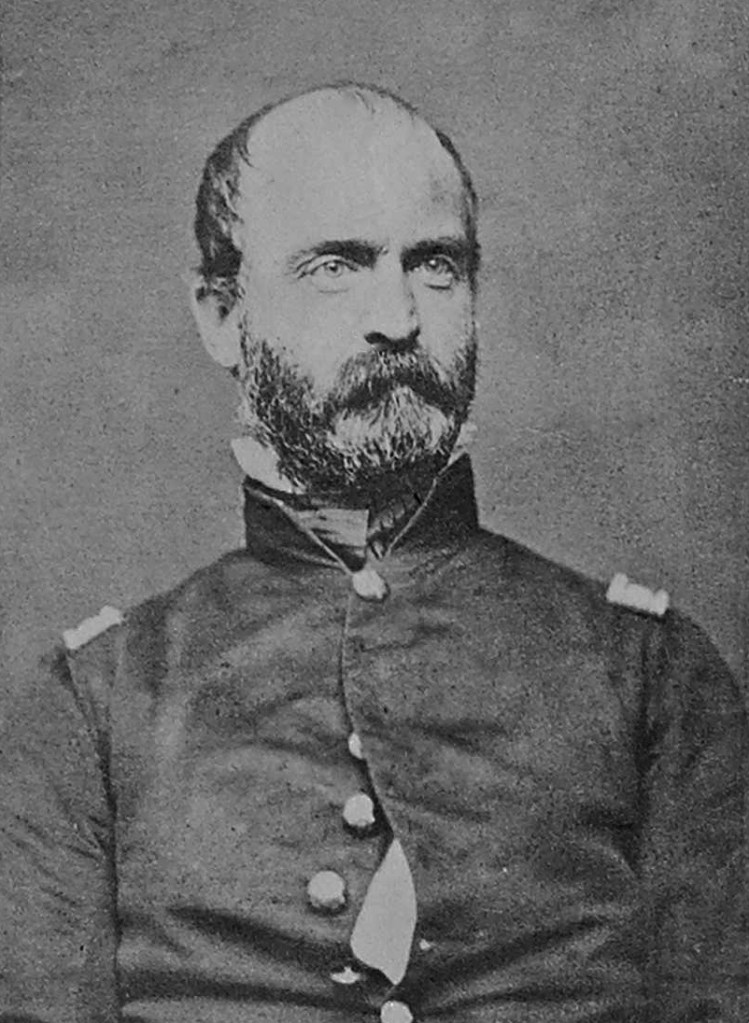
Early in his career, Hancock became very good friends with a North Carolina-born officer named Lewis Armistead. However, in 1861, while both were stationed in California, they said their good-byes and headed east, destined to fight on different sides. The two faced each other on the final day of Gettysburg when Armistead led a brigade as part of Pickett’s Charge against troops commanded by Hancock. Armistead was fatally wounded during the battle and died two days later. 

A photograph of Lewis Armistead, taken between 1861 and 1865, by an unknown photographer.

Photograph of Lewis Armistead

Both Hancock and Armistead are portrayed in Michael Shaara’s historical novel The Killer Angels and his son Jeffrey Shaara’s similar novels The Last Full Measure and Gods and Generals, as well as the films Gettysburg (1993) and Gods and Generals (2003).

There is scant historical evidence to support some of the depictions and dialog of the friendship between Armistead and Hancock portrayed in the novels and films. However, Captain John Bingham, an officer on Hancock’s staff, spoke with Armistead before he died. He would later write to Hancock with Armistead’s parting words to him: “Tell General Hancock for me that I have done him and done you all an injury, which I shall regret the longest day I live.” 

In July of 1865, it was Hancock who supervised the execution of several of John Wilkes Booth’s conspirators in the assassination of President Lincoln. He would later be assigned as military governor of Louisiana and Texas during Reconstruction. His Democratic leanings, including his endorsement of the quick return of civil authorities, put him at odds with Republicans in Washington and with his former commander (and later President) Ulysses S. Grant. 

A commemorative  handkerchief featuring the images of Democratic Presidential candidate Winfield Scott Hancock and Vice Presidential candidate William English.

A commemorative handkerchief featuring the images of Democratic Presidential candidate Winfield Scott Hancock and Vice Presidential candidate William English

-Library of Congress

While remaining in the Army, Hancock tested politics several times. After two attempts, he secured the Democratic nomination for president in 1880, but lost to a Republican (and former Union General) James Garfield. 

Hancock died at age 61 in 1886 from an infection and complications of diabetes while serving as Commander of the US Army’s Department of the Atlantic. His death surprised the country as the condition of his health was unknown to most everyone. 

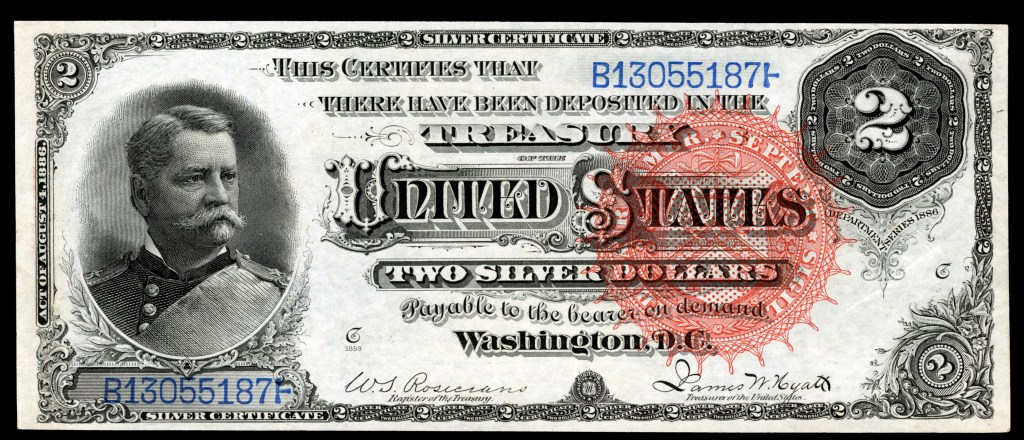
$2 Silver Certificate with portrait of Winfield Scott Hancock.
Following his death, Hancock was placed on the $2 Silver Certificate bill

Tributes to Hancock poured in from military, civic and political leaders from across the country. Perhaps the most stirring came from a political rival and former president, Rutherford B. Hayes:

“If, when we make up our estimate of a public man, conspicuous, as a soldier and in civil life, we are to think first and chiefly of his manhood, his integrity, his purity, his singleness of purpose, and his unselfish devotion, we can say truthfully of Hancock that he was through and through pure gold.”

Hancock’s statue is made of bronze, not gold, but he was the gold standard of an officer and a gentlemen.

* * *

Route Recon

The Statue of Winfield Scott Hancock is located just south of the Archives-Navy Memorial-Penn Quarter Metro Station.

Command Reading

Armistead and Hancock: Behind the Gettysburg Legend of Two Friends at the Turning Point of the Civil War by Tom McMillan. This dual biography of two leading Civil War generals provides new scholarship and analysis of their lives and careers and specifically details their friendship from its earliest days up to the Battle of Gettysburg.

The Grand Army of the Republic: the Legacy Lingers


The latter half of the 18th century saw a heyday for fraternal organizations in the United States. These associations provided their largely male memberships with opportunities to share common cultural, occupational, and religious backgrounds while often hosting social and recreational events for members and their families. 

One of the most prominent and powerful of these organizations was known as the Grand Army of the Republic (GAR). Membership in the GAR was open to all honorably discharged personnel, both officers or enlisted, from the Union Army, Navy, Marine Corps and Revenue Cutter Service (forerunner of the Coast Guard) who served during the Civil War. 

The GAR was founded in 1866 by Dr. Benjamin Stephenson who served as a surgeon with the 14th Illinois Volunteer Infantry Regiment. After the war he established a medical practice in Springfield, Illinois. Working with several veteran colleagues, he helped organize the first GAR post in nearby Decatur. 

The Grand Army of the Republic memorial in Washington, DC
A Union soldier and sailor represent Fraternity on the Grand Army of the Republic memorial at Indiana Plaza.

The GAR Memorial

One of the GAR’s principal activities was building and dedicating monuments to the sacrifices of Union forces and to the work of the GAR itself. As Union veterans aged, the GAR stepped up their efforts to build such memorials. In Washington DC, a GAR monument is located in Indiana Plaza in Washington’s Penn Quarter neighborhood. Several historic buildings frame the plaza and the Archives-Navy Memorial-Penn Quarter Metro Station brings consistent foot traffic to this busy area. 

The GAR Memorial, also known as the Benjamin Stephenson Memorial, is triangularly shaped to reflect the GAR’s motto of Fraternity, Charity and Loyalty. Each side of the 25-foot high sand colored granite block has a bronze sculpture, featuring a weathered green patina. 

The southern facing side reflects Fraternity with a sculpture of a Union soldier and sailor standing side by side. Below the sculpture is an oval image of Dr. Stephenson in his Army uniform, also rendered in bronze, surrounded by a laurel wreath carved into the granite. 

The Northeast side of the Grand Army of the Republic memorial, depicting the statue of Loyalty.

A statue of a woman with a sword and a shield represents Loyalty on the Grand Army of the Republic Memorial.

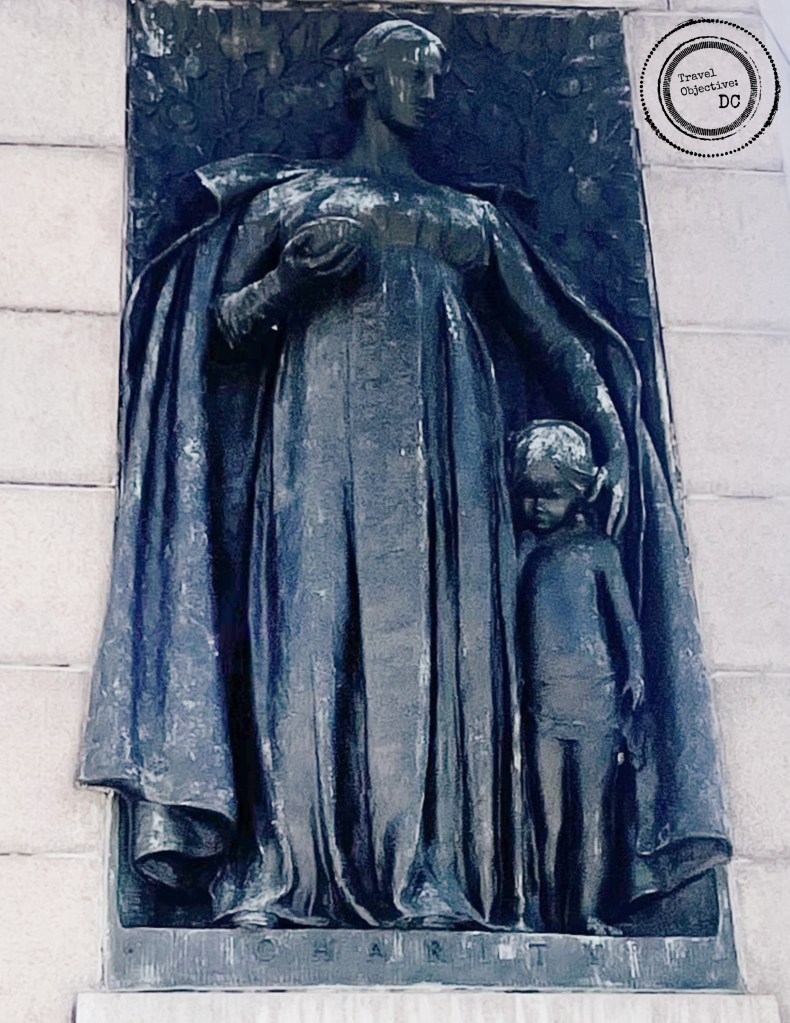
Charity is portrayed on the northwest side by a woman wearing a robe and protecting a young child. Unfortunately, a thick coat of urban grime makes viewing this statue more difficult. Finally, Loyalty is represented on the northeast side by a statue of a woman bearing a sword and holding a shield.

The monument was dedicated on July 2, 1909 in a ceremony attended by President William Howard Taft and hundreds of aging Civil War veterans. The GAR Members in the crowd that day may not have realized it, but they were part of one of America’s earliest and most powerful single-issue advocacy societies.

The Legacy of the GAR

When Dr. Stephens founded the GAR, the original focus was to raise money and organize relief efforts for wounded veterans, as well as surviving widows and children. But in short order the GAR would move to lobbying State and Federal officials for expanded pensions for Union veterans, hiring preferences for government jobs, and the building of veterans homes and hospitals. Membership soared, reaching its peak in 1890, when the GAR boasted more than 400,000 members. 

A woman and small child represent Charity on the Grand Army of the Republic Memorial.

The statue depicting charity on the Grand Army of the Republic Memorial in Washington, DC.

The GAR grew politically prominent and was especially influential within the Republican Party. In the second half of the 19th century, five Republican GAR members were elected to the presidency. Many more GAR members were elected to Congress, governorships and state legislatures. 

One reason the GAR was so politically effective was its formal structure of organized components across the country. State level units were known as departments and local bodies were known as posts. Every state had a department and posts were found in communities nationwide. GAR posts were also found in US territories and international locations. 

The national headquarters, state departments and local posts operated under a common set of by-laws and had an established chain-of-command. Each year from 1868 through 1949, the GAR organized national reunions known as encampments. These encampments were so well attended they grew larger than the political conventions of the day. Encampments were moved from state to state and localities welcomed the gatherings for the positive economic impact they provided. 

The bronze relieve figure of Dr. Benjamin Stephenson, founder of the Grand Army of the Republic.

The bronze relief of Dr. Benjamin Stephenson, founder of the Grand Army of the Republic.


Locally, posts raised money, built memorials, organized commemorations and ceremonially buried deceased veterans. They also assumed important civic functions not always tied to veterans, directing fundraising to local causes, organizing the broader community to address local issues, and sponsoring recreational events open to all. The GAR’s organizational model and many of its practices were later adopted by the Veterans of Foreign Wars (founded in 1899) and the American Legion (founded in 1919) and are still in use today.  

At at time when membership in fraternal organizations was often limited by race, GAR membership was open to all veterans, including the African Americans who fought as U.S. Colored Troops or had enlisted in the other services.

Membership in the GAR was exclusive to veterans and therefore only open to men. However, there were at least three female members: Kady Bromwell, who served along with her husband in two different Rhode Island Infantry Regiments; Sarah Edmond, who disguised herself as a man and fought with the 2nd Michigan Infantry Regiment; and Dr. Mary Edward Walker who served as a Union Army surgeon. 


The GAR formally disbanded in 1956 upon the death of its last member, Albert Woolson. Woolson, whose father had died of his combat wounds, enlisted in the 1st Minnesota Heavy Artillery Company as a drummer boy in 1864. He was about 14 years old the time. After his death, Life magazine ran a seven page story about his life.

While the GAR has been gone for over seventy years, its legacy remains. Many patriotic acts we practice today, such as placing flags on veterans graves, observing Memorial Day each May, standing for the National Anthem and saluting the flag all originated with the GAR. 

While the GAR may only be seen today through its monuments, its boot steps still echo through our stadiums, cemeteries, Legion posts and veterans homes. 

* * *

Route Recon

The memorial is located at Indiana Plaza in the Penn Quarter neighborhood. The small public plaza, located across the street from the Archives-Navy Memorial-Penn Quarter Metro station, is bounded by 7th Street to the west, Indiana Avenue to the north, and Pennsylvania Avenue to the south. 

Over 100 Years Later, DC’s World War I Memorial Is Now Complete

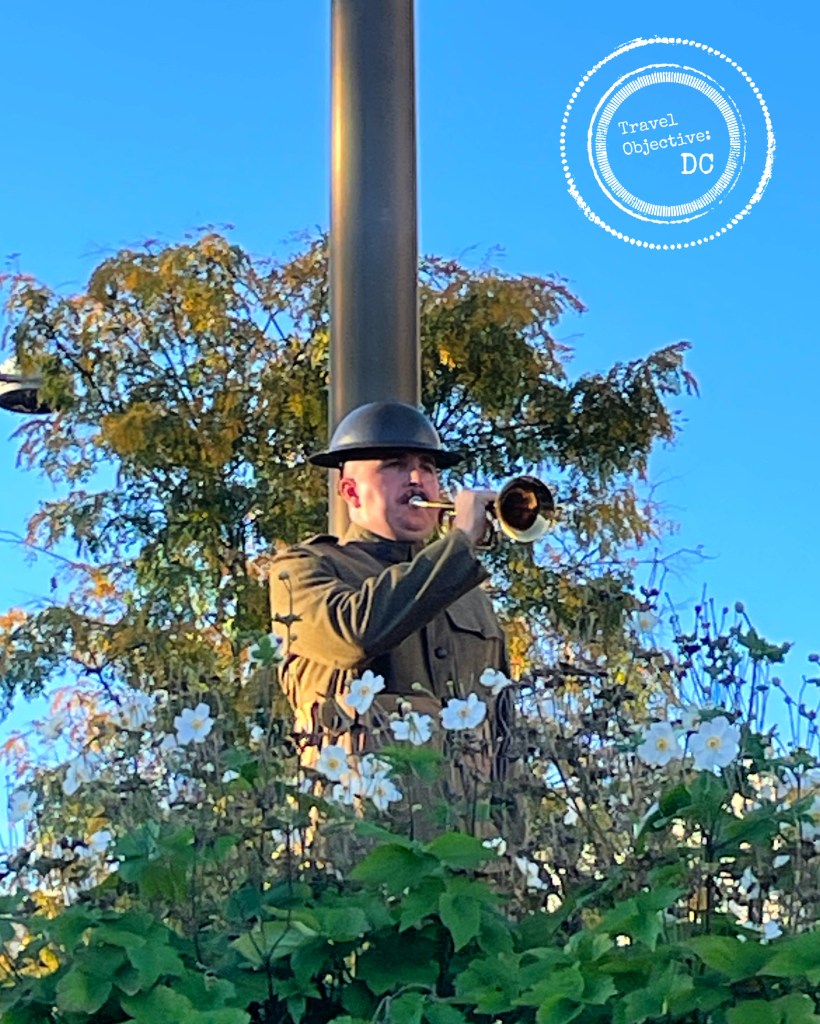
Each day, shortly before 5:00 pm, an individual in a First World War U.S. Army “Doughboy” uniform exits the stately Willard Hotel and crosses Pennsylvania Avenue, bound for the Washington DC area’s newest memorial, the National World War I Memorial.

The Doughboy carries a bugle, and positions themselves under the memorial’s flagpole. Precisely at 5:00 o’clock, the bugler plays the mournful notes of Taps. The bugle notes echo through the plaza inviting all who hear to pause and remember the 4.7 million American men and women who fought in World War I and especially the estimated 126,000 Americans who gave their lives in the “war to end all wars”.

Bugler in World War I uniform - World War I Memorial - Washington DC

A bugler in his World War I uniform

In a bit of irony, for over a century there has not been a national memorial in the capital city to World War I. There are other important World War I monuments in and around Washington, but not a single, focused and comprehensive national memorial to the war that shaped so much of the 20th century and America’s role within it. Yet that changed in 2021 when a partially constructed memorial was dedicated and opened to the public. Three years later, the final and dramatic piece of the memorial was installed capping a years long effort and bringing Washington, DC’s National World War I Memorial to fruition.

Pershing Park

The National WWI Memorial is located in what was formerly known as Pershing Park, a parcel of land originally laid out as part of the redevelopment of Pennsylvania Avenue in the 1970s.  Located between 14th and 15th Streets and Pennsylvania Avenue, the park was dedicated to General of the Armies John J. Pershing and the American Expeditionary Force (AEF) and formally opened in 1981.

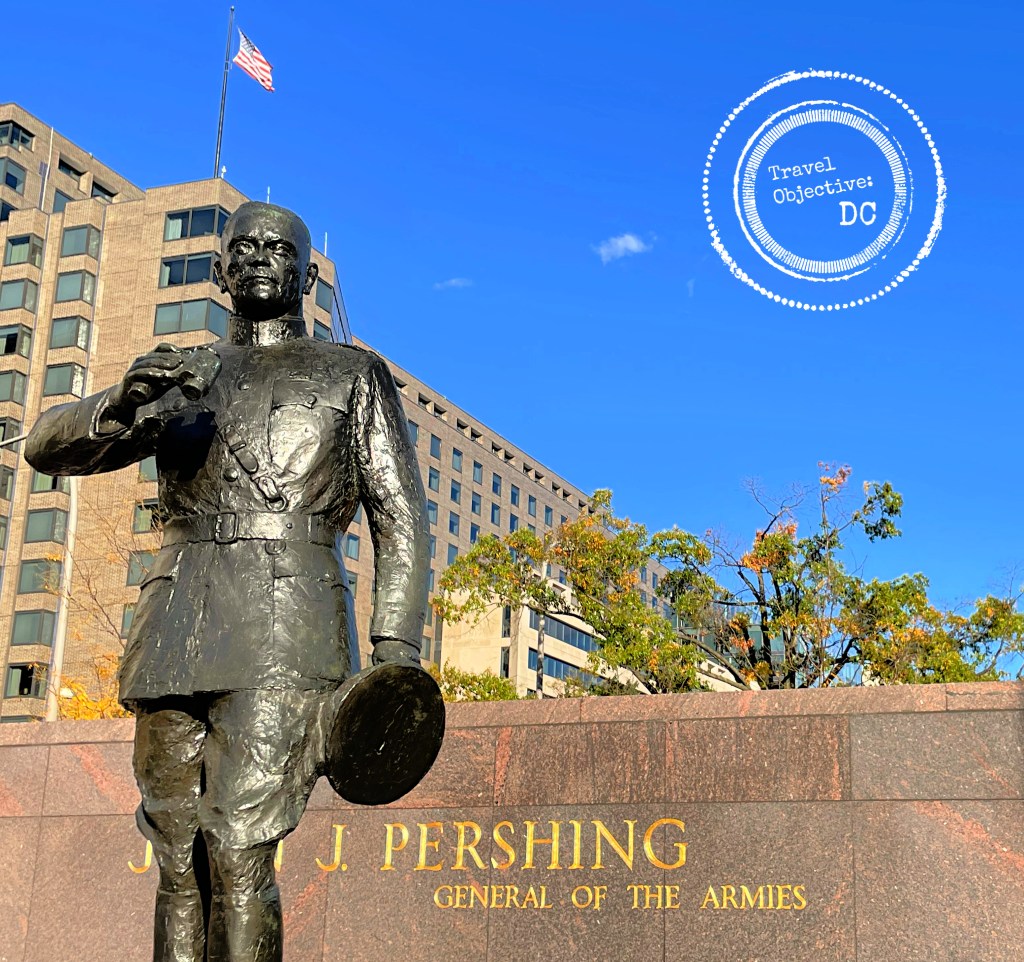
The park featured an eight-foot-tall statue of Pershing standing straight and surveilling the horizon with his binoculars in hand. A wall perpendicular to the statue displayed maps and details of the AEF’s operations in Europe. 

The statue of General of the Armies John J. Pershing at the National World I Memorial

General John J. Pershing statue - National World War I Memorial - Washington DC

Also included were a fountain that could be converted to a skating rink during the winter months, a glass concession stand and sitting areas. Abundant landscaping was added to provide a natural setting within a busy urban corridor. Earthen berms covered with grass surrounded the park on three sides, shielding the grounds from traffic noise.  

Unfortunately, maintenance funds for the park’s unique features were scarce. Some aspects of the park fell into disrepair, trash accumulated and the landscaping neglected. 

However, when the World War I Centennial Commission went in search of a venue for a national memorial to World War I in the nation’s capital, it ultimately decided on a redesigned Pershing Park as the best location.  

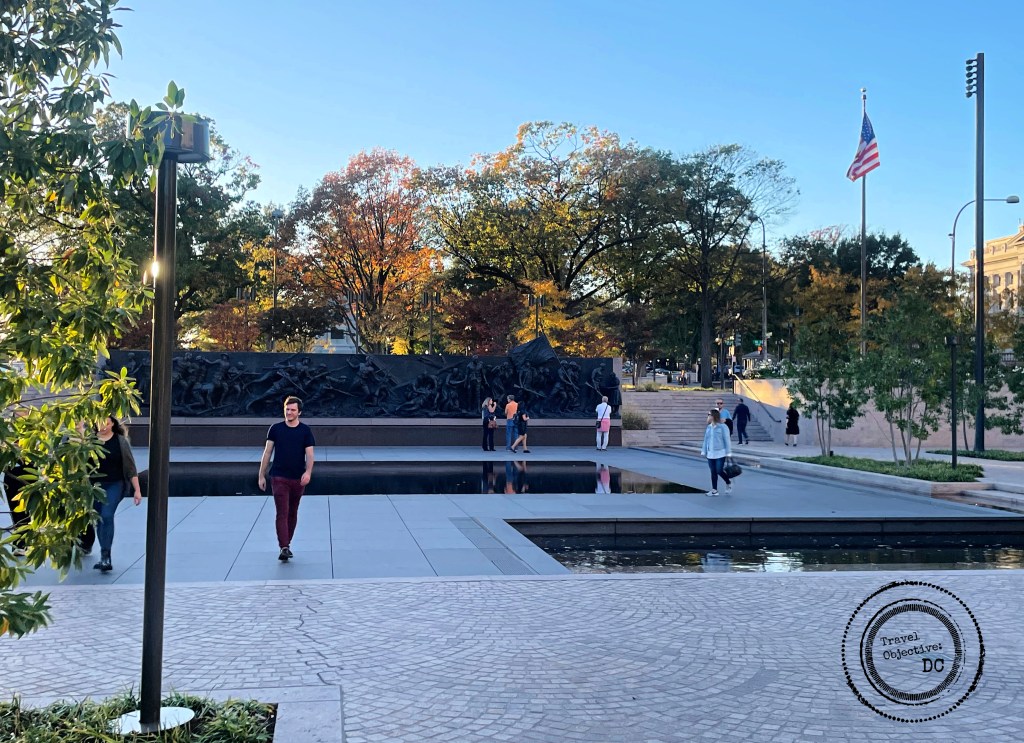
Visitors walk through an open plaza at the National World War I Memorial.

Visitors walk through an open plaza at the National World War I Memorial.

With the clock ticking on the 100th Anniversary of the armistice, the commission expedited the truly lengthy process for approving new landmarks in Washington. The approach was not without controversy. Community and architectural groups grew concerned the new designs abandoned the original intent of an open green space in the middle of the city. 

Ultimately, in 2016, a design submitted by architect Joseph Weishaar was selected. His approach was to use the existing footprint of the 1.76 acre park situated in a busy downtown area just southeast of the White House. Weishaar retained Pershing’s statue, the AEF Wall and the earthen berms but planned new features that expanded the interpretation of World War I.

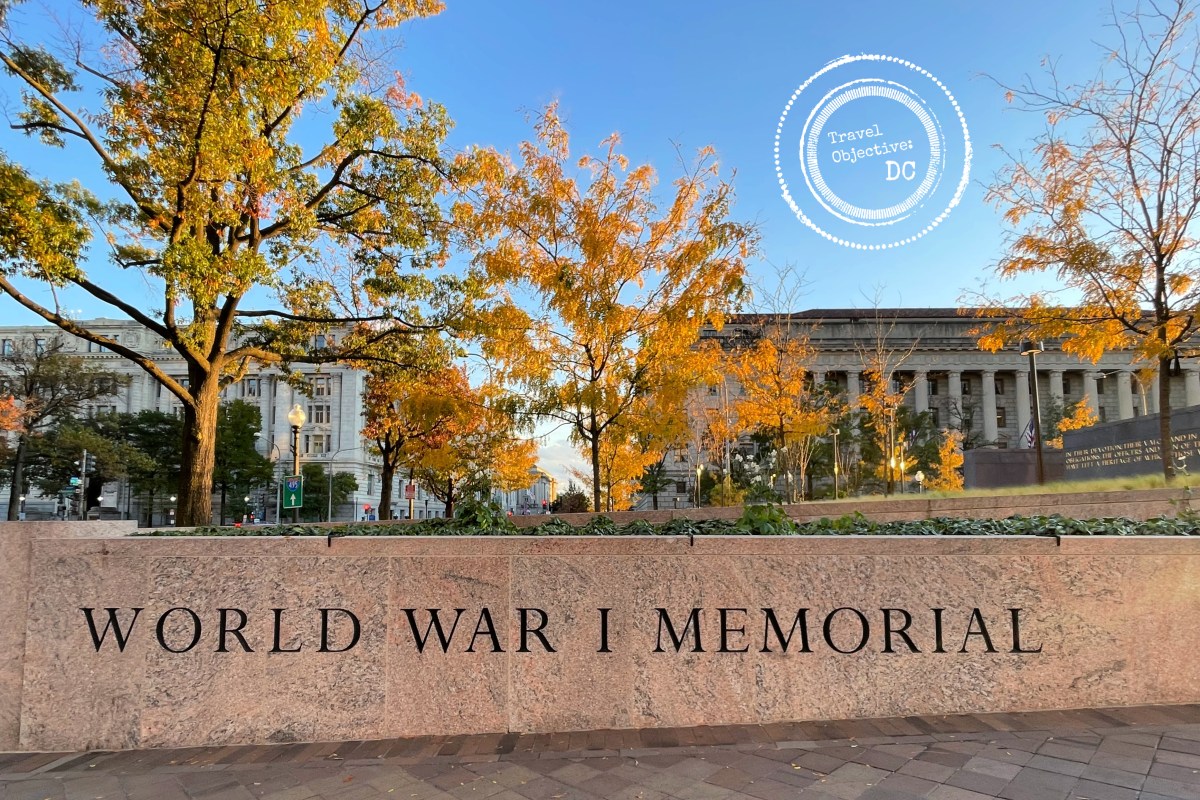
One new addition is known as the belvedere, a raised, enclosed circular area located near the northeastern entrance of the park.  The belvedere serves as the memorial’s orientation center. Interpretive signage installed along the interior of the wall familiarizes the visitor to “the Great War” and the roles played by American forces. The belvedere’s elevation provides clear lines of sight to the memorial’s features. 

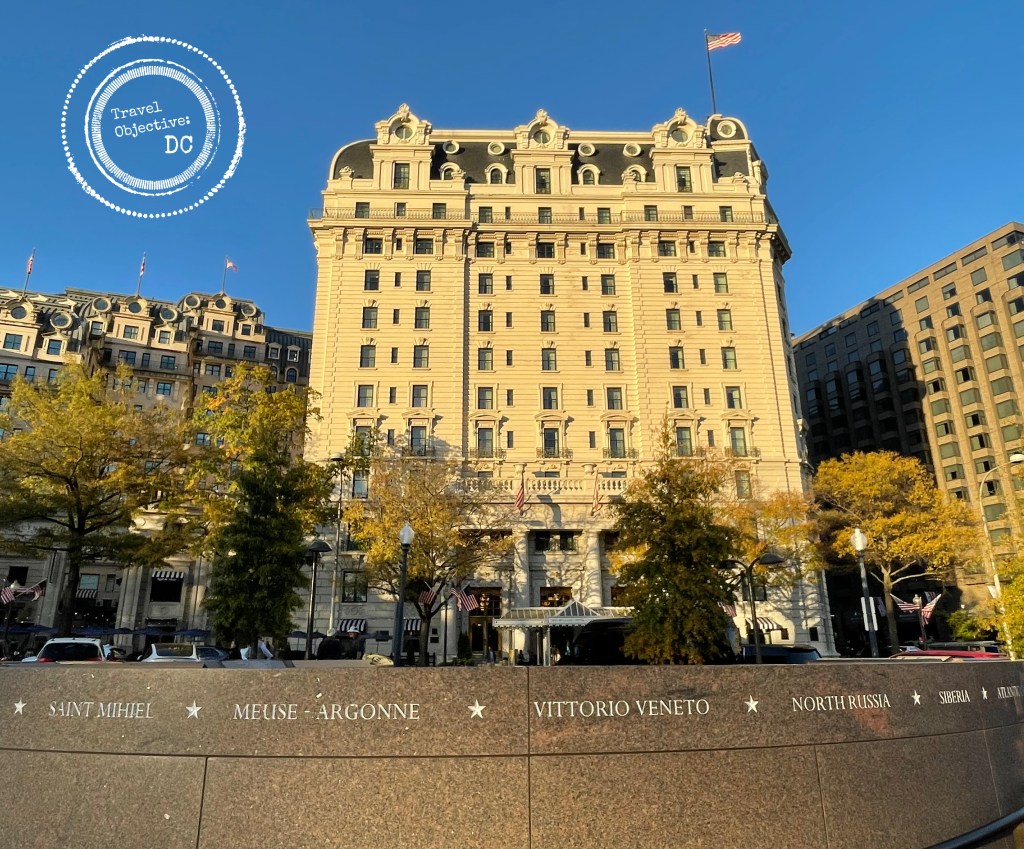
Willard Hotel in the background of the belvedere at First World War Memorial.

The circular wall of the belvedere is inscribed with the campaign names of the First World War. In the background is the Willard Hotel.

A Soldier’s Journey

Across the plaza from the belvedere, over a shallow reflection pool is the most prominent aspect of the the new memorial, a large relief sculpture entitled A Soldier’s Journey by Sabine Howard.  The sculpture’s installation in September of 2024 completes the National World War I Memorial.

The sculpture stretches 58-feet long and includes 38 separate statues. Designed to be viewed from left to right, the sculpture tells the story of an American soldier’s experience across a series of tableaus. 

Howard and his team followed a meticulous process beginning with over 12,000 drawings and photographs of models in various poses, which he used to create foam models. These foam models were then covered in clay so accurately that every uniform crease, garment wrinkle, weapon detail, and facial expression were painstakingly rendered. The clay-covered models were then used to create the molds in which the bronze statues were cast.

Sabine Howard - sculpture - A Soldier's Journey
Sabine Howard’s sculpture “A Soldier’s Journey”

Howard used combat veterans as his models, believing their faces would more accurately portray the effects of war. All the uniforms and equipment used by the models were century-old artifacts, not reproductions. Through this extensive detail, Howard invites the viewer into the story.

The effort took about eight years to complete.  

The story begins with the soldier receiving his helmet from his young daughter. He then joins fellow soldiers as they march off. The next scene shows them charging at the enemy through no-mans land. The costs of war, both physical and psychological, are shown next as nurses comfort the afflicted while our soldier looks blankly at the viewer with a harrowing gaze. 

In a dramatic scene from the sculpture entitled the Ordeal, American soldiers charge the enemy.

A dramatic scene from the sculpture A Soldier's Journey at WWI Memorial in Washington DC

The soldier then returns home as part of a victory parade. In the last scene, the soldier hands the helmet back to his daughter. Rather than depicting a joyous scene, this one is foreboding. The soldier has a look of deep resolve on his face. The daughter stares into the helmet, wearing a troubled expression. She represents the Greatest Generation, who would soon take up the mantle once again and fight another war. 

Howard’s work is powerful and thought provoking, but the story told through the sculpture is a familiar one. With some changes to the uniforms and equipment, the story could be about any war. 

This was Howard’s desired effect.  He wanted a sculpture that asks the questions any war memorial should ask: Was it worth it? What did we gain? What did we lose? What did we learn? 

Other Features

On the reverse of the sculpture wall, water gently cascades over an inscription taken from a haunting poem entitled The Young Soldiers Do Not Speak by Archibald MacLeash. MacLeash’s poem is written from the perspective of deceased soldiers who tell the living that it is up to the them to give meaning to the lives the soldiers lost. MacLeash was a veteran of the First World War who became a noted writer, poet and editor. President Roosevelt appointed MacLeash as the Librarian of Congress in 1939. He wrote a poem in 1940 in honor of the Library of Congress staff who died in World War I. 


“We were young, they say, we have died, remember us”

From The Young Soldiers Do Not Speak by Archibald MacLeash

A unique aspect of the memorial are the circular benches arrayed around the southern and western edges of the memorial plaza. Unlike similar war memorials in Washington, the inclusion of these sitting areas provides an appointed space available for rest and reflection, a gathering spot for friends or even an area for discussion about World War I. Trees and ornamental grasses around the memorial plaza provide a peaceful sense to aid in reflection.

Additionally, the live playing of Taps daily adds a human element to the stone and bronze of the memorial. The daily bugler initiative is coordinated by the Doughboy Foundation. Through the foundation’s website, members of the public can sponsor each day’s rendition in remembrance of an individual. The name of the day’s honoree and the scheduled bugler can be learned by scanning a QR code on a sign near the memorial’s flagpole. 

Bugler - Doughboy Foundation - bugler playing Taps

Taps is sounded daily at the National World War I Memorial.

The evolution of Pershing Park into Washington DC’s National World War I Memorial has brought new life and purpose into this downtown space. The area is now more inviting and interesting, drawing more people in to learn about the American role in World War I and to remember those who fought and died. 

At the dedication ceremony for the sculpture, Architect Joseph Weishaar remarked: “We don’t build memorials for the dead. They are for the living. We build them to protect and preserve our memories and our stories.”

While it seems so long ago, World War I continues to impact issues of the 21st century, such as the geopolitical situations of Eastern Europe and the Middle East, the immigration system we know today, defense spending, women’s rights, and the role of America on the world stage to name only a few.

However, as World War I moves deeper into history, maintaining the stories and learning its lessons becomes imperative. For if we lose them, we lose a big piece of who we are.

Route Recon

The World War I Memorial is accessible 24 hours a day, seven days a week. The memorial is located in downtown Washington, DC between the intersections of 14th and 15th Streets Northwest and Pennsylvania Avenue.

The closest Metro Station is Federal Triangle, located about three blocks away on the Blue, Orange and Silver Lines. Metro Center Station on the Red Line is located about flour blocks away to the north.

A Century Later, Belgium Reflects on Its Recovery

Belgian Soldier
Belgian Soldier Statue at the Royal Museum of the Armed Forces and Military History in Brussels

Belgium is a relatively young country by European standards, declaring independence from the Netherlands in 1830.

Its flat landscapes and location along major trading—and invasion—routes placed it at the center of many military conflicts through the centuries, including World War I.

The Belgian Royal Museum of the Armed Forces and Military History in Brussels is a fascinating stop with exhibits spanning from medieval to contemporary times.

The museum has a very impressive collection of artifacts, including suits of armor, uniforms, flags, and weapons organized into eleven galleries. The museum takes the traditional approach to organizing its exhibitions by displaying entire collections of items with little narrative.

Exhibit Hall
The Historic Gallery where more than 8,000 items from 1831 to 1914 are on display.

The World War I exhibit is no exception. Display cases with uniforms from all the combatant countries except Greece and Bulgaria line the wall of the large exhibit hall. Machine guns, artillery pieces, tanks and vehicles are featured in the hall’s center.

Although the collection is large and contains many unique and interesting pieces, its arrangement seems haphazard. Uniforms are displayed on older department store mannequins. Equipment is randomly clustered together. There is little explanation of how the war unfolded for Belgium, the role of Belgian military units or how the equipment was used on the battlefield.

A planned renovation for the museum’s World War I gallery had to be postponed and several pieces of the collection are currently loaned out for other exhibits marking the war’s centennial.

Fokker Triplane
A German Fokker Triplane displayed above the World War I Exhibit Hall.

The Western Front

Remmeber Belgium
Remember Belgium Poster: Young, E. (ca. 1918) [Photograph] Retrieved from the Library of Congress
The exhibit does not reflect the significance of Belgium’s prominent role in World War I. Germany invaded Belgium in August 1914 in order to quickly attack France. By going through Belgium, the German army hoped to catch the French unprepared and take Paris.

They were unsuccessful and the Western Front became a stalemate.

The Germans occupied much of Belgium throughout the war. Belgian citizens were subject to forced labor and Belgian resources were used to support the German war effort.

Stories of atrocities against the Belgian population by German soldiers became propaganda for recruitment efforts in France, the United Kingdom and the U.S.

Belgium was the site of a number of World War I engagements: the Frontiers, Mons, Ypres, and Passchendaele are only a few.

Beyond The Great War

By contrast, a sleek new exhibit on post-war Belgium offers a more immersive experience, making extensive use of multimedia. Beyond The Great War 1918-1928 is a temporary exhibit marking the 100th anniversary of the 1918 armistice.

The post-war exhibit departs from military themes and covers a myriad of political, social and economic issues Belgium had to navigate following World War I. Those challenges were stark. The Belgium military concluded hostilities–taking tremendous losses in the final days of the war–before transitioning to occupation duty, then demobilization.

Cannon
A period Schneider 155 Howitzer used by the Belgian Army

King Albert I and his ministers returned to Brussels and reestablished civil authority. All types of ordinance needed to be cleared from cities, towns and farms. More than 700,000 Belgian refugees tried to resettle. The dead needed to be buried, the wounded cared for, and destroyed infrastructure rebuilt. The Belgian economy needed to be reorganized as Belgium was brought into a new international order.

The look and experience of Beyond the Great War is different from many of the other exhibits found throughout the museum. It is brighter and more colorful with well curated displays which draw the eye. Archived photos, art, film and statuary are used to tell Belgium’s post-war story along with video and an impressive visual replica of the Hall of Mirrors at Versailles.

French Sailor
Statue of a French sailor, part of a monument to French sailors erected in Melle, Belgium. Belgium built many monuments to Belgian and Allied troops after the war.

The Museum

The Royal Museum of the Armed Forces and Military History was established in the early 1920’s, expanding upon a small, but well-received, military exhibit at the Brussels World Fair in 1910. In 1923, the museum moved to its current location in the Cinquantenaire (50th Anniversary) Park in central Brussels.

The park was developed from a former military parade ground to mark the 50th Anniversary of Belgium’s independence. A large triumphal arch and classical arcade dominate the park, which also houses several other museums.

Arch
Triumphal Arch, the centerpiece of Cinquantenaire Park in central Brussels. The entrance to the Royal Museum of the Armed Forces and Military History is located near the base of the arch.

The military history museum’s World War II galleries are currently closed for renovation in preparation for the 75thAnniversary of the end of the Second World War. The current exhibits are being refurbished and a new hall is being built to chronical Belgium’s second occupation.

What will emerge? It is not entirely clear, but replicating the approach of Beyond the Great War will surely make the stories of Belgium’s World War II experiences more compelling.

* * *

Beyond the Great War 1918-1928 is open through September 22, 2019 at the Royal Museum of the Armed Forces and Military History in Brussels, Belgium.  

The museum is open daily, except Mondays, from 0900 – 1700. The museum is also closed on January 1, May 1, November 1, and December 25.  Admission is 5 Euros, payable only by debit or credit card. Discounts are also available for certain groups. See the Royal Museum of the Armed Forces and Military History for more information.

ROUTE RECON

The Royal Museum of the Armed Forces and Military History is located in Cinquantenaire (50th Anniversary) Park. The park is located in central Brussels and accessible by multiple bus, subway and streetcar lines.  The Merode or Schuman Stations are each about a ten-minute walk from the museum.

There are also several car parking lots in the park.

MESS CALL

The Sky Café inside the museum offers snacks, sandwiches and a variety of beverages, including beer and wine. It is open from 1000 – 1600 each day.  However, the kitchen closes early so arrive before 1400 if you want to order food.


Happy 75th Birthday Pentagon!

The Puzzle Palace, Fort Fumble, the Big Spoke, Bat Cave on the Basin, the Concrete Carousel.

The world’s most famous five sided building has many nicknames, but the headquarters of the U.S. Department of Defense is more simply known as the Pentagon.

1 Pentagon Aerial View
Overhead view of the Pentagon 2008 Photo by David Gleason from Chicago, IL. (CC BY-SA 2.0)

2018 marks the 75th anniversary of this iconic Washington, DC landmark.

In the late 1930’s, as the world edged closer to war, Secretary of War Henry Stimson and War Department leaders knew they needed a new building to house the department’s expanding workforce. At that time, employees were scattered in multiple buildings around the District of Columbia, Maryland and Virginia.

2 Munitions and Main Navy Buildings
An overhead view of the Main Navy and Munitions Buildings.  Built at the beginning of World War I, these buildings housed a large number of War and Navy Department workers. The buildings were located on the Mall in the vicinity of the current Viet Nam Memorial. The buildings were demolished in 1970. Photo: Histories of the National Mall, accessed 25 January 2018, http://mallhistory.org/items/show/57.

Designing and planning the new building began in earnest in 1940, with two proposed sites selected in Arlington, Virginia, just over the Potomac River from Washington. The first proposed site was the U.S.Department of Agriculture’s Arlington Experimental Farm. The other was Hoover Field, an early Washington area commercial airport. The Pentagon owes its particular five-sided shape to the irregular layout of the experimental farm location. The unique design of five pentagons nested together connected by radiating hallways allowed planners to maximize the structure’s available work space.

3 Pentagon Ramps
Pentagon concourse in 1944. In order to save steel, building designers used concrete ramps, rather than elevators, for workers to move floor to floor. Photo: U.S. War Department

Ultimately, the Hoover Field site was selected over the farm location, but the five-sided design was kept. The building was to be made of concrete, to minimize the need for steel, which was needed for war production. Limestone facades over the concrete completed the neoclassical look of the Pentagon we know today.

The final contracts were signed and ground was immediately broken on September 11, 1941. The attack on Pearl Harbor three months later only added to the urgency to complete the Pentagon’s construction, which took just sixteen months. When construction was completed on January 15, 1943, some War Department workers had already moved in.

The Pentagon was the headquarters for the War Department from 1943 through 1947, when the National Security Act formally established the Department of Defense (DoD). Then the Pentagon became the headquarters for this new department as well as for each of the armed services. As the size, budget and influence of the military grew during the Cold War, the term “the Pentagon” would become synonymous with the DoD and American military bureaucracy, with all of its successes and excesses, strengths and weaknesses, victories and mistakes.

 * * *

Members of the general public have been able to tour the Pentagon since 1976, when the tour program was implemented as part of America’s bicentennial. Today Pentagon tours are still available, but they do require some planning ahead.

Tours are by reservation only, which can be made by visiting the Pentagon Tours website. Reservations must be made at least two weeks before the tour date. The DoD is very careful about who is allowed into their headquarters so follow all the instructions on the website carefully.

On the day of the tour, arrive at the Pentagon Visitor Center (near the entrance to the Pentagon Metro Station) with sufficient time to clear an airport style security checkpoint. The Pentagon tours website recommends arriving one hour ahead of time.

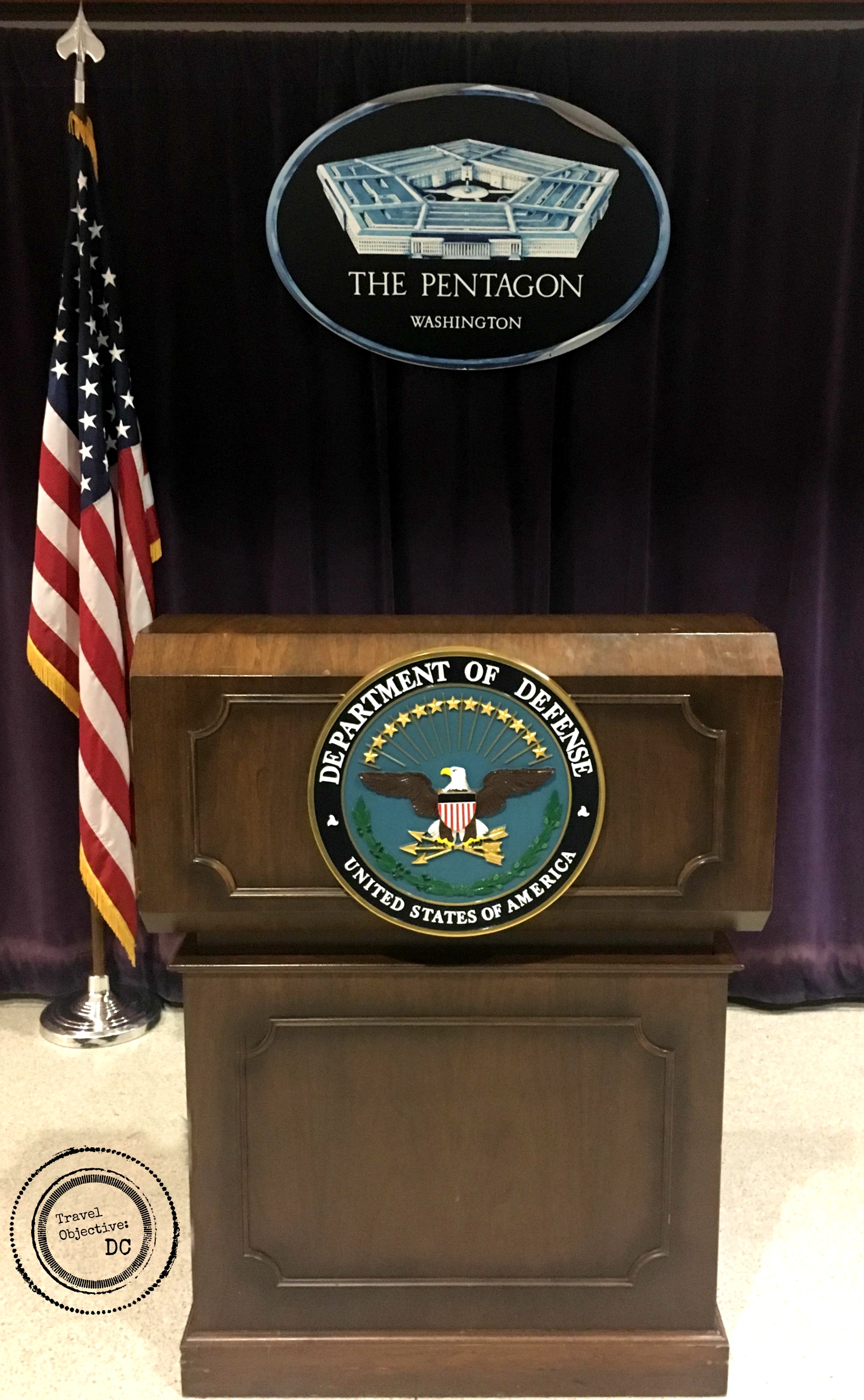
After clearing security, there is a waiting area, also used by other Pentagon visitors. The waiting area has a gift shop with the expected collection of hats, key chains, post cards and other trinkets with Pentagon or military service themes. (If something catches your eye, be sure to buy it before the tour begins as you will not pass by the gift shop again). There is also a mockup Pentagon briefing podium and backdrop for taking selfies or group photos, sure to impress friends and family.4 Pentagon Podium

Tours are led by junior enlisted service members. One cannot help but feel a bit of pride in these young men and women, dressed in their class A uniforms with crisp creases and polished brass. Guides are selected from the military services various honor guard units stationed in the area. One guide confided it is a good job to have, working in a climate controlled building with weekends and holidays off. The biggest challenge he said was memorizing all the facts and walking backwards for most of the mile-long tour.

As one of the world’s largest office buildings, the guide had many facts about the Pentagon to share. They are recited effortlessly, with machine gun-like repetition. The Pentagon is five stories tall, with an additional two stories underground and covers 28.7 acres. Today there are over 17 miles of corridors, 54 escalators, 70 elevators, 131 stairways, 284 restrooms, 8,979 parking spaces, 16,250 lighting fixtures and 26,000 employees.

The tour followed the guide up one of the 54 escalators to the Pentagon’s extensive retail area. The original building designers wisely included extensive retail space so workers would not have to leave the building for common necessities. Today the Pentagon’s  workers can visit about 20 fast food restaurants, three banks, a clothing store, drug store, barber shop, hair salon, dry cleaners, jewelers, post office, vision center, even an office of the Virginia Department of Motor Vehicles.

5 ANZUS Corridor
The displays in the ANZUS Corridor, on the Pentagon’s second floor, commemorate the 1951 Security treaty between Australia, New Zealand and the U.S. Photo: U.S. Department of Defense

But the tour is more than just facts, figures and shopping. Many Pentagon corridors have special defense-related themes with museum quality displays. However, the tour is only about 60 minutes long. While the tour group keeps moving most of that time, the size of the building makes it impossible to see every special exhibit in that amount of time. The tour planners though selected a route that allows the guides to broadly focus on the missions of the U.S. Armed Forces and their storied pasts.

The center piece of the Air Force displays is a series of scale models of Air Force aircraft, past and present. After the guide discussed the size of the C-5 Galaxy transport aircraft, the capabilities of the F-22 Raptor fighter and the stealthiness of the B-2 Spirit bomber, he pointed out his favorite aircraft, the Waco CG-4A Combat Glider.

6 Waco_CG-4A_USAF
A Waco CG-4A-GN (45-27948) Combat Glider on display at the National Museum of the U.S. Air Force  Photo: U.S. Air Force

The guide explained how the gliders saw service during World War II. The light bodied aircraft earned the nickname “the Flying Coffin” due to their precarious mission of flying unarmed while carrying troops and equipment deep behind enemy lines as a precursor to invasions and large advances. Gliders and their crews served with distinction in Sicily, Burma, Normandy, Southern France and Bastogne among other places.

Somewhat surprisingly, the tour next passed the displays of the United States Coast Guard. The Coast Guard is a component of the Department of Homeland Security, not the DoD. But at several times through its history, especially during wartime, the Coast Guard has served as part of the Navy. The displays trace the Coast Guard’s history from its forerunners first establishment in 1790 as the Revenue Cutter Service. Naval aviation followed the Coast Guard, then a corridor dedicated to Dwight D. Eisenhower represented the Army.

8 Memorial
Inside the Pentagon’s interior 9/11 Memorial. Photo: U.S. Department of Defense

The one stop the tour does make is at Pentagon’s interior 9/11 Memorial. The memorial is located on the first floor of the outer ring, in the area struck by American Airlines Flight 77. The walls of the memorial feature a textured metallic finish with black stone tablets recognizing the sacrifices made that day, commemorating the names of those who died and detailing the medals awarded to the military and civilian casualties. Adjoining the memorial is the Pentagon Memorial Chapel, which opened in 2002.

9 DEF_Medal_for_the_Defense_of_Freedom
The Secretary of Defense Medal for the Defense of Freedom was established after the 9/11 attacks for civilian employees of the DoD killed or wounded in the line of duty.

The corridor leading to the memorial and chapel has one of the Pentagon’s most unique displays, the Pentagon Memorial Quilts. In the months and years after the attack, individuals and groups from across the United States (and some foreign countries as well) sewed then donated quilts to the Pentagon to mark the tragedy and aid in recovery. The quilts reflect a variety of themes but most reflect patriotism, loss, memorializing the fallen, gratitude for the responders and support for the military. There are about 120 quilts in the collection. Around fifty are displayed at the Pentagon with others rotated and loaned for display in communities and military facilities around the world.

Because of the security precautions, visiting the Pentagon takes a special effort, but it is well worth it. The Pentagon’s size, shape and mission certainly make it a unique location to visit. But walking its hallways, hearing its history, seeing its occupants walk briskly about, and seeing the exhibits remind us all of what it takes to serve.

* * *

Route Recon

The best way to reach the Pentagon is by taking the Metro Rail system. There is a Metro station at the Pentagon, served by the Blue and Yellow lines.  As you exit the metro gates, make a left and proceed up the escalator. The Pentagon Visitors’ Center will be on your right.

There is NO public parking at the Pentagon. If traveling by car, park in the parking garage at the Pentagon City Mall. The Pentagon is about a 10-minute walk away. After exiting the parking garage or mall, cross Army-Navy drive and take a pedestrian tunnel  over to the Pentagon. When you exit the tunnel, follow signs for the Metro, which will lead you to the Pentagon Visitor’s Center. Visit the Pentagon Tours website for more information.

Mess Call

There is no eating during the Pentagon tour and unless you have an escort, you will not be able to visit any of the Pentagon’s eating establishments. The nearby Pentagon City Mall and neighborhood have a wide variety of dining options

Serving with Paint, Paper and Pencils

Weapon? – Check!

Gas Mask? – Check!

Paint Brush? – Check!

Sketch Book? – Wait! WHAT???

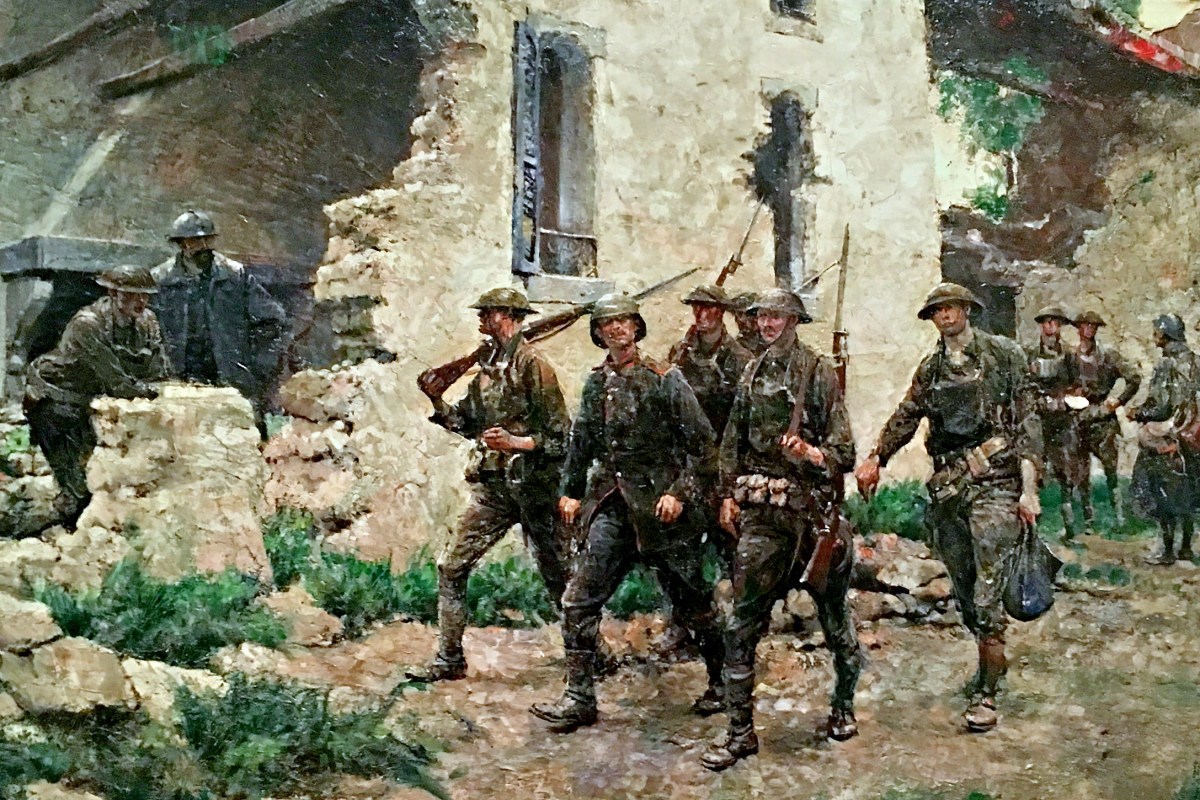
Paint brushes, sketch books and charcoal pencils are usually thought of as implements of art, not of war. But a very special exhibit of combat art from World War I currently hosted at the Smithsonian National Air and Space Museum demonstrates how they can be both. The exhibit, entitled Artist Soldiers, is a collaboration between the Air and Space Museum and the Smithsonian National Museum of American History.

While art depicting combat has been around probably as long as there has been combat, what makes this exhibit unique is the featured artists.

877 Dunn
Battle of the Marne by Harvey Dunn; Watercolor and Pastel on Paper, 1918

Shortly after the U.S. entered World War I, military policymakers decided to recruit artists directly into the Army, due in part to similar British and French programs. Visual images in posters, newspapers and magazines would be important for maintaining the morale and support of the American public. British and French military artists had generated some impressive work for their governments in this regard.

The task of recommending specific artists for this duty fell to Charles Dana Gibson, an accomplished artist and illustrator who headed the Division of Pictorial Publicity of the Committee on Public Information. Gibson recommended illustrators, artists who can usually draw or sketch quickly, an important skill for someone working in combat.

882 Townsend
Helping A Wounded Ally by Harvey Everett Townsend; Charcoal on Paper, 1918

In early 1918, eight of these successful commercial artists were commissioned as Reserve captains in the Corps of Engineers and assigned to the American Expeditionary Force (AEF).

It was the first time the War Department incorporated artists directly into the Army’s ranks and sent them into combat areas for the expressed purpose of “making a complete pictorial record of the American Army’s participation in the war”.

Many of the artists already knew each other before arriving in France with the AEF, having studied at the same art schools such as the Art Institute of Chicago or the Art Students League in New York.

The eight artist-soldiers were:

William James Aylward – A successful book, magazine, and advertising illustrator, he grew up around docks and often portrayed maritime subjects. As a combat artist, he focused on ports, of course, but also landscapes.

896 Aylward
Unloading Ships at Bassen Docks by William Aylward; Charcoal and Gouache on Paper, 1919

Walter Jack Duncan – Also a noted illustrator before the war, he often depicted the soldier’s life in rear areas.

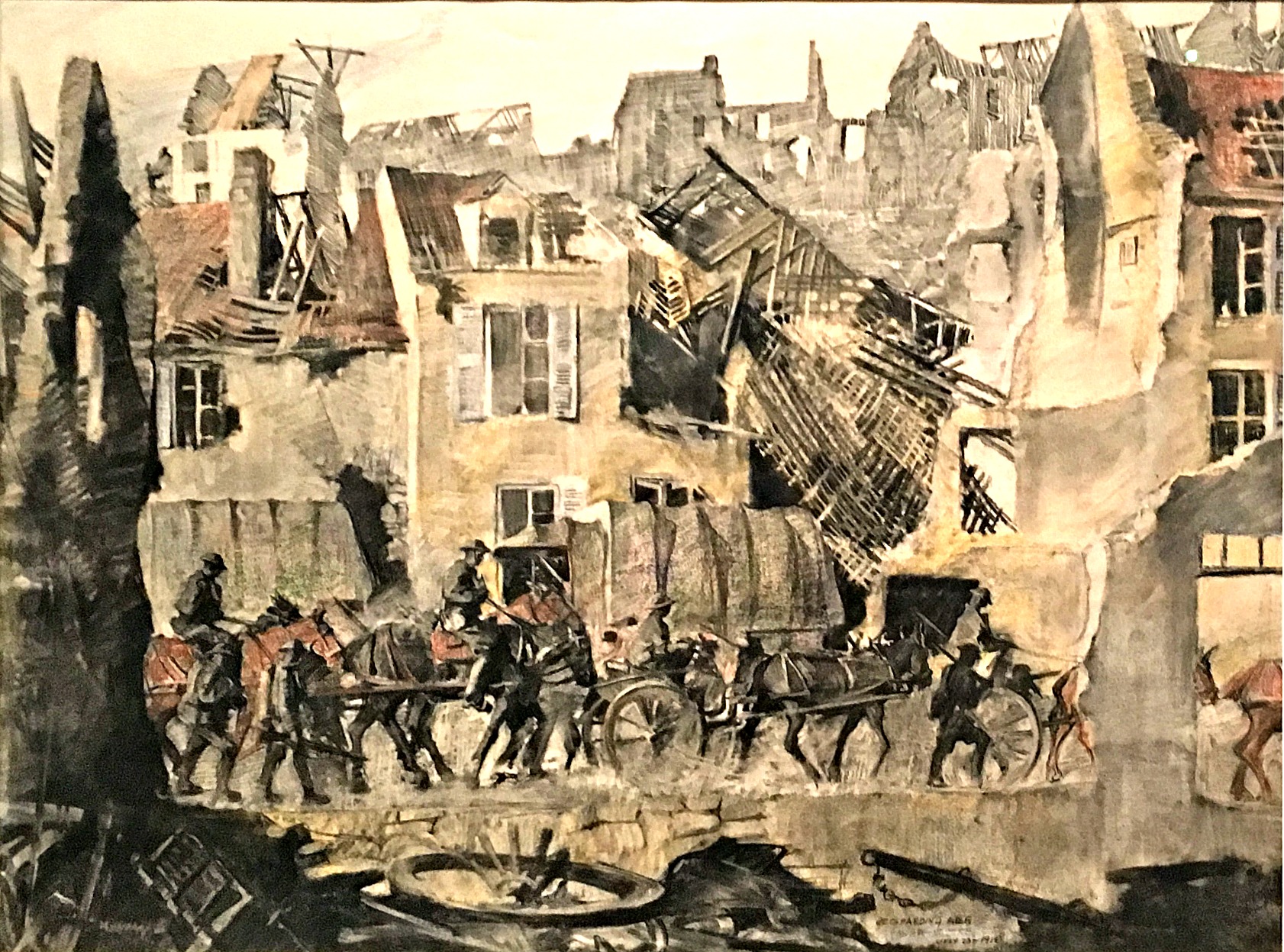
George Matthews Harding – During World War I, Harding produced combat scenes incorporating many new technologies introduced in World War I, such as aircraft and tanks. Harding would serve as an official combat artist again during World War II.

Wallace Morgan – Prior to the war, Morgan worked for many of the major magazines of the day, such as Colliers’ and the Saturday Evening Post. He was especially well known for his black and white drawings.

897 Peixotto
Tressing Nets for Artillery Emplacements by Ernest Peixotto; Pen and Ink Wash and Charcoal on Paper, 1918

Ernest Clifford Peixotto – The “old man’ of the group at 48 upon his commissioning, Peixotto worked in France, painting landscapes and illustrating travel books prior to the war. Peixotto stayed in France for several years after the armistice. He taught art in an AEF’s educational program for soldiers remaining in Europe.

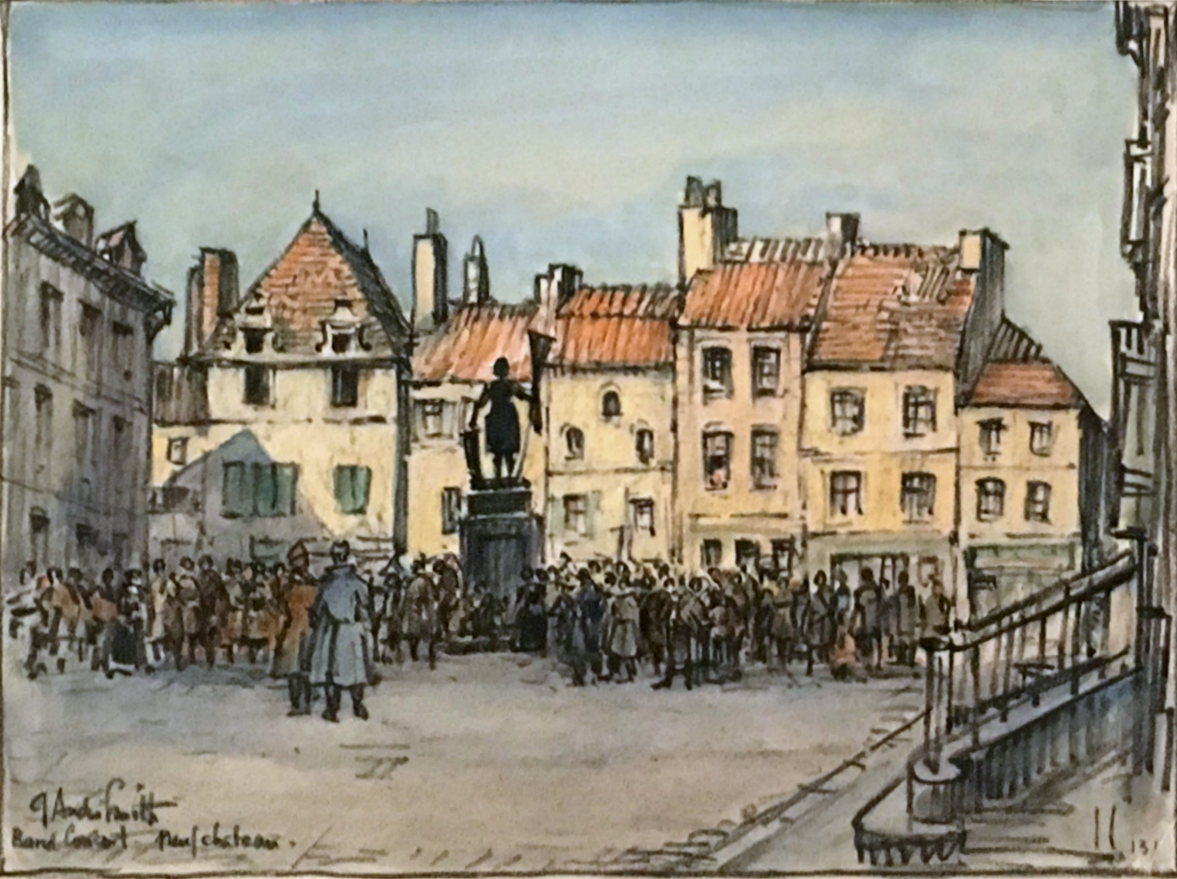
J. Andre Smith – Trained in architecture, he actually preferred to draw and etch. Smith was the only one of the artists who received military training before he deployed, having served briefly in a camouflage unit. He also became the group’s commanding officer.

879 Smith
Band concert at Neufchatel by J. Andre Smith; Watercolor and Charcoal on Paper, 1918

Harry Everett Townsend – He returned to the U.S. from Europe in 1914 to draw war posters, then volunteered for Army service. Townsend lost a brother early in the war in a plane crash. He focused much of his work on aviation and other new technologies. Townsend later worked at the Paris Peace conference and taught art at the AEF’s training center.

Harvey Thomas Dunn – He was a daring combat artist who usually worked in close proximity to the front lines.

Upon arriving in France in May 1918, the artists were assigned to the AEF Intelligence Section, Press and Censorship Division. For several weeks after their deployment–as U.S. forces continued to drill and train for combat missions–the artists oriented themselves to Army life, toured the battlefields, and prepared themselves for what was to come.

889 Morgan
The Morning Wash Up Neufmaison by Wallace Morgan; Charcoal on Paper, 1918

They established a studio in the French town of Neufchateau, halfway between the AEF’s Headquarters and the front. There they could complete or refine their drawings into finished pieces. The artists were directed to submit their images to the War Department at the end of each month, along with a report on anticipated follow-on pieces.

Once deployed, they had the authority to move freely around both the forward and rear areas to do their work. While there is no record of any of the artists going “over the top”, they took their mission very seriously. They positioned themselves at the front, lived in the trenches, got wet in the rain, missed meals, and exposed themselves to enemy fire many times in order to do their work.

In the nine months of service with the AEF, the artist soldiers produced over 700 pieces. They drew, painted and sketched scenes from the front, rear areas, the use of new technologies, soldiers both on and off duty, landscapes, civilians, in short, all they were exposed to.

878 Aylward
Returning Refugees at Hattonchatel by William Aylward; Charcoal and Gouache on Paper, 1919

For all their efforts, however, the brass in Washington was not always happy with their work. While skillfully prepared, the pictures and their subject matter were not always easily transferred to home front use in boosting morale. But they do provide a challenging and thought-provoking contemporary rendering of the daily life of American soldiers and French civilians in 1918.

Following the war, all the artists continued their successful art careers. The War Department transferred about 500 of their works to the Smithsonian Institute which displayed them at various times through the 1920’s. Since then however, the paintings have not been exhibited very often, making this a rare opportunity to see a portion of these unique and historic works.

887 Harding
American Artillery and Machine Guns by George Harding, Charcoal on Maison, 1918

An accompanying exhibit entitled Soldier Artists displays some impressive photography of stone carvings created by soldiers while living in the underground trenches, along with other World War I period artifacts from the Smithsonian collections.

Both exhibits are currently on display until November 2018.

While you are at the Smithsonian Air and Space Museum, be sure to visit the permanent exhibit on World War I combat aviation.

* * *

ROUTE RECON

The NASM is located at the intersection of Independence Avenue and 6th Street, Southwest. There is no onsite parking, but there are several commercial lots nearby. The nearest Washington Metro stations are the L’Enfant Plaza Station on the Yellow and Green Lines and the Smithsonian Station on the Blue and Orange lines. Both stations are about a two block walk to the NASM.

MESS CALL

The Wright Place Food Court offers a variety of fast food meal options from Boston Market, Donatos Pizza and McDonald’s.

* * *

Featured Image: The Prisoner by Harvey Dunn, Oil on Canvas, 1918

Celebrating 70 Years of “Aiming High” at the U.S. Air Force Memorial

September 2017 marks the 70th Anniversary of the United States Air Force, which was formally established as a separate military service by the National Security Act of 1947. Previously, various ground-based air reconnaissance, combat and support units had existed as part of the U.S. Army.

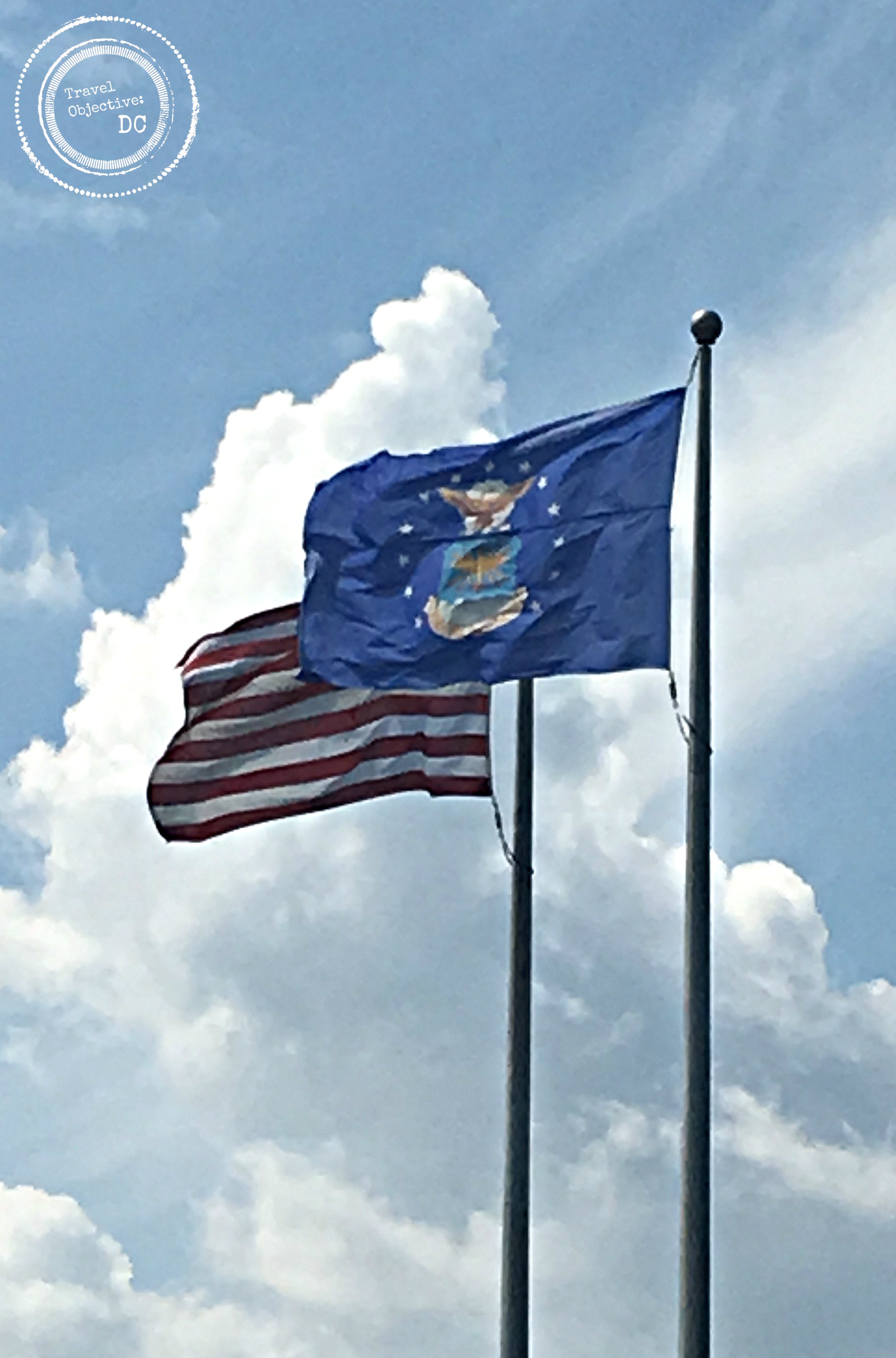
Flags
The U.S. Air Force celebrates its 70th Anniversary in 2017.

What better way to mark the 70th Anniversary of the Air Force than to visit the Air Force Memorial?

Given the relative young age of the Air Force (compared to Army, Navy and Marine Corps, which were all established in 1775), it is rather understandable that for most of its existence, the Air Force had no memorial of its own.

In 1991, leaders of two Air Force veterans’ organizations began an effort to build a memorial to those who served in the Air Force and its predecessor organizations.

The memorial sits in Arlington, Virginia along a high ridge adjoining Interstate 395, the main southern arterial into Washington, D.C. With views of the Potomac River, Pentagon, and other official buildings spread out below, this location fittingly evokes the aerial nature of the Air Force mission. Arriving and departing aircraft from nearby Reagan National Airport add to the effect.

View with flags 2
Official Washington as seen from the U.S. Air Force Memorial.

Architect James Ingo Freed, (who also designed Washington’s Holocaust Museum) studied how to use the physical location to capture the essence of the Air Force and the dedication of the men and women who have served in its ranks. The resulting venue is sleek and streamlined, with minimal adornment and flourish, as if inspired by a modern aircraft.

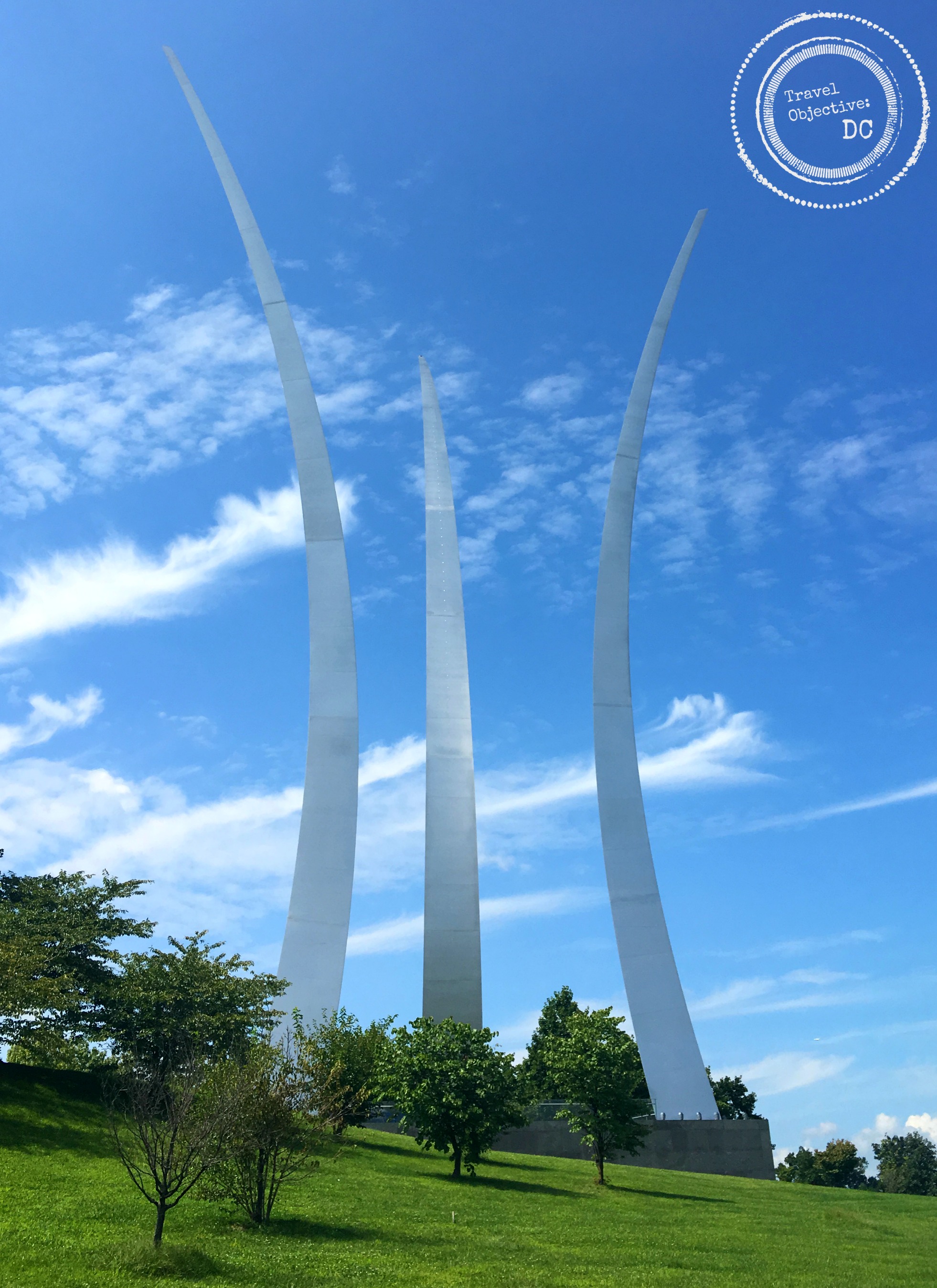
The most prominent feature of the memorial is three vertical, arc shaped steel spires, meant to evoke the image of soaring flight. The spires are arranged in a triangular pattern with the highest reaching up to 270 feet.

Spires from hill
The Air Force Memorial’s most prominent feature, three steel spires reaching skyward.

N/A
The U.S. Air Force “Thunderbirds” perform the High Bomb Burst maneuver.  (U.S. Air Force photo/Staff Sgt. Larry E. Reid Jr.)

The spires are also reminiscent of a contrail pattern formed by the U.S. Air Force Thunderbird Air Demonstration Squadron as they perform their “breaking bomb” maneuver. The lack of a fourth spire alludes to the “missing man” formation, used by Air Force flying units at funerals and other events to mark the loss of a comrade. Given their height and prominence, the spires have also added an additional landmark to the Washington, D.C. skyline.

Just to the west of the spires is a wide walkway connecting two highly polished granite inscription walls. The northern wall lists Air Force Medal of Honor winners. In front of it is a small glass contemplation wall to remember our airmen who are no longer present.

Commemoration Wall
Mementos left at the base of the memorial’s contemplation wall

Airman
The visage of one airman from the honor guard sculpture.

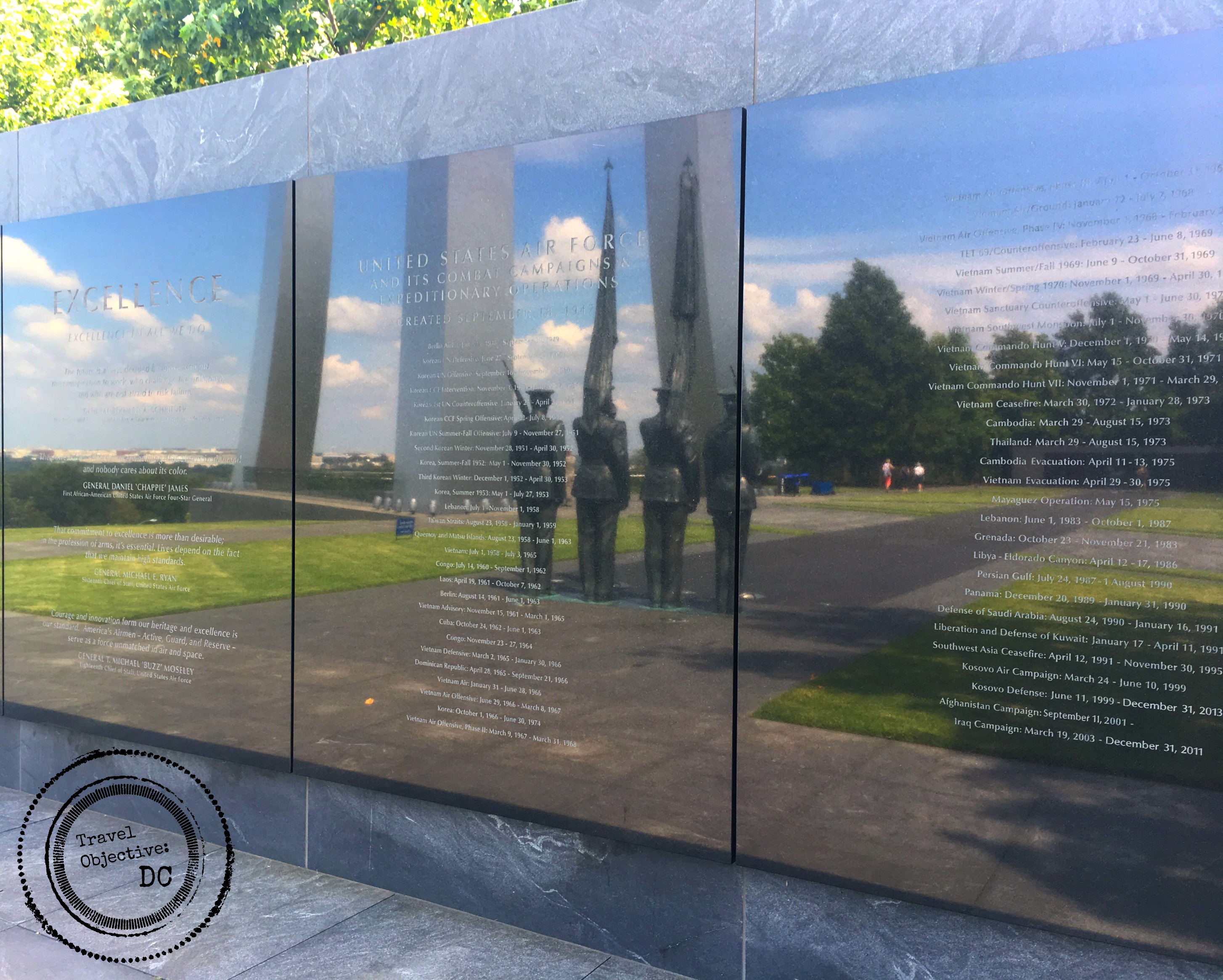
On the opposite southern wall are displayed the Air Force’s core values:

Integrity first,

Service before self,

Excellence in all we do

In front of the southern wall is a sculpture of a four-member Air Force honor guard, keeping watch over the Memorial and adding a human element to the lofty arches and inspired words.

The colors of the Memorial’s features are muted, again like a modern aircraft, metallic spires, polished dark granite walls, gray statues, and the glass contemplation wall. The only other prominent color is green, from the manicured lawn and the trees ringing the parking lot.

HG in Wall
The honor guard sculpture and spires reflected in the southern inscription wall.

Woman and FlagsWhile most aspects of the memorial are clearly visible, one is not: silence.

A certain stillness permeates the venue, bringing a sense of quiet to a busy corner of Arlington. Given this setting, along with the views, designs and significance of the memorial to members of the Air Force, it is a common location for promotions, concerts and other special ceremonies, so you may be sharing your visit with larger gatherings and even the Air Force Band.

(You can check event calendar for a listing of special events at the memorial.)

Some visitors, upon seeing the Memorial for the first time, remark about its unique designs and features and how they are relevant to the Air Force experience. President George W. Bush addressed this in his remarks at the memorial’s dedication on October 14, 2006.

He said: “A soldier can walk the battlefields where he once fought, a Marine can walk the beaches he once stormed; but an airman can never visit the patch of sky he raced across on a mission to defend freedom. And so, it’s fitting that…the men and women of the Air Force will have this memorial, a place here on the ground that recognizes their achievements and sacrifices in the skies above”.

Spires and Sky

The U.S. Air Force Memorial is located at 1 Air Force Memorial Drive, Arlington, VA, 22204. The memorial is free and open every day but December 25. Daily hours of operation from October 1 through March 31 are 8:00 AM – 8:00 PM and from April 1 through September 30 are 9:00 AM – 9:00 PM.

* * *

Route Recon

The Air Force Memorial is easily reached by car, from the Pentagon or Pentagon City Metro stations or bus. From Visit the Air Force District of Washington Website for more information.

* * *

Mess Call

The nearby Pentagon City neighborhood has a wide variety of dining options. Pentagon City is located about 1 mile from the Air Force Memorial. When exiting the Memorial, take a left onto Columbia Pike. At the first intersection, take a right on Joyce Street and cross underneath I-395 and you will enter Pentagon City. Take a left on Army-Navy Drive and you will see several parking garages on your right.

Mount Vernon: An Admiral’s Namesake, A General’s Home

First in war, first in peace, first in the hearts of his countrymen…

So wrote General “Light Horse Harry” Lee in tribute to his colleague George Washington. And this is how George Washington is usually thought of: lofty, dignified, and somewhat remote.

Flag
A flag with 13 six-pointed stars is said to be George Washington’s personal standard as Commander-in-Chief of the Continental Army. The flag and its bearer would follow General Washington wherever he would go.

Folklore repeats the familiar stories of Washington as Commander-in-Chief of the Continental Army, heroic and virtuous crossing the Delaware, valiantly leading his troops at freezing Valley Forge and in the final victory at Yorktown. As our country’s first president, he set the tenor and established customs still adhered to today.

But a visit to his home at Mount Vernon in Alexandria, Virginia portrays George Washington the man–rather than the myth–with insight into his roles as a planter, businessman and private citizen as well as the military and political leader.

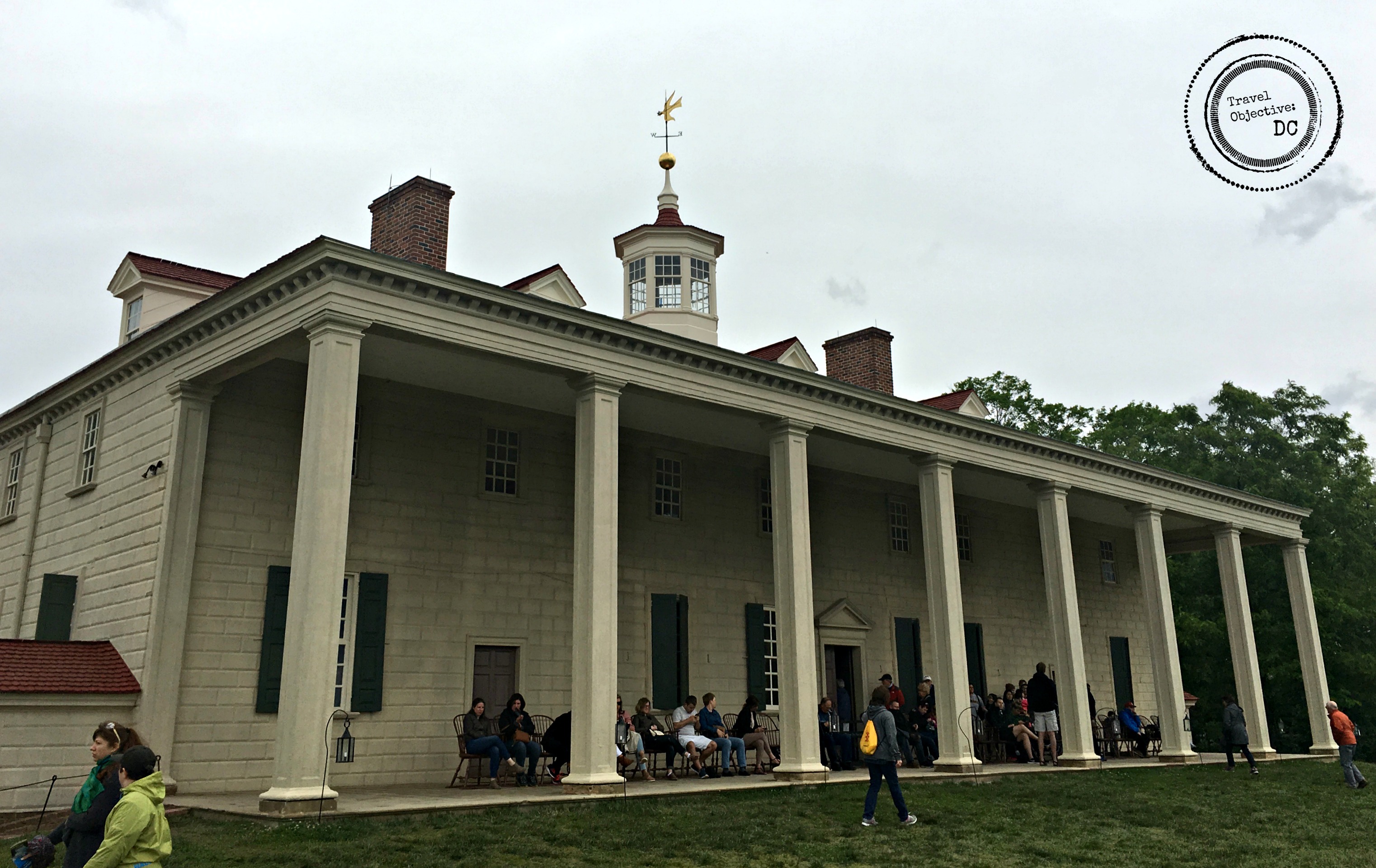
George Washington loved his home at Mount Vernon and it is easy to see why. The graceful manor house, symmetrically arrayed outbuildings, tended gardens, rolling landscape and beautiful vistas of the Potomac River would appeal to any founding father (or mother!)

MtV West
The historic mansion’s two story piazza facing the Potomac River to the east.

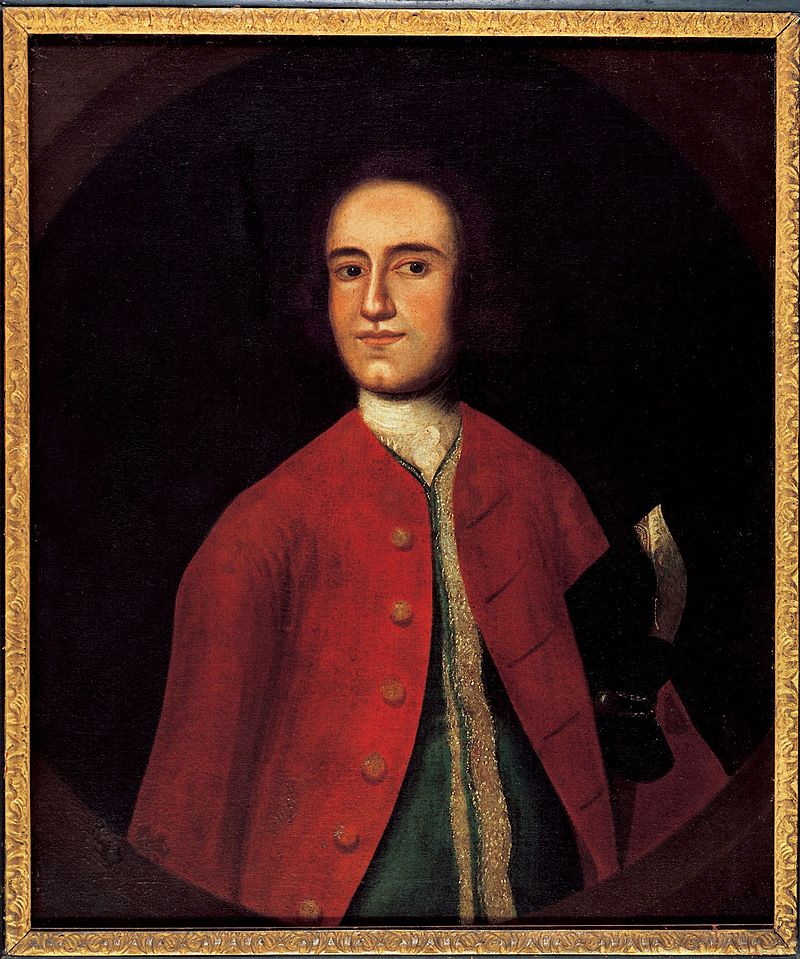
The Washington family had owned the land comprising Mount Vernon since 1674, when George Washington’s great-grandfather, John, was granted a right to the property. It would pass to George’s father Augustine in 1726. George’s half-brother Lawrence inherited the property in 1743. It was Lawrence who gave it the name Mount Vernon after his commanding officer in the Royal Navy, Vice Admiral Edward Vernon.

Lawrence_Washington
Lawrence Washington, circa 1738. After their father died in 1743, Lawrence became a mentor and close friend to his younger half-brother, guiding him toward a military career.

Lawrence served under Vernon’s command in an attack on a Spanish fortress in present day Columbia in 1741. During the engagement, Lawrence commanded a regiment of volunteers from Virginia. It was the first time a regiment of Americans fought as a component of the British Regular Army outside of North America. George would command the same regiment from 1755 through 1758, when he resigned and moved to Mount Vernon. He would inherit Mount Vernon in 1761 upon the death of Lawrence’s widow.

Through his adult life, George Washington was devoted to Mount Vernon’s development and commercial growth. As a plantation, Washington relied on income from the plantation’s operations to support himself and his family.

Today’s Mount Vernon is comprised of approximately 500 acres, but in Washington’s time his estate occupied close to 8,000 acres, organized into four farms producing a variety of agricultural products for resale. Washington also raised livestock, milled grains, fished commercially and distilled whiskey. He was an entrepreneur, not afraid to take risks or invest in new technologies.

Sheep
Washington was an enthusiastic breeder of animals. Many of the same breeds of animals, such as these sheep, can be found at Mount Vernon today.

A walk through the manor house is the centerpiece of a visit to Mount Vernon. Through the years, Washington fashioned an ennobled mansion from the more modest farm house his father built, befitting his stature as a wealthy Virginia planter. Though he made improvements over time, Washington’s keen eye and attention to detail made the property, its buildings and landscaping seem consistent and whole. Today’s manor house has been carefully restored to resemble how it looked in 1799, the year Washington died.

MtV West copy
The Manor House at Mount Vernon facing west. The door is slightly off center to accommodate for a staircase added by Washington in 1758.

The tour enters through the “New Room”, the last room added to the house and completed around 1787. This large, double-story room, papered and painted in elegant and fashionable greens, was meant to impress Washington’s guests.

“When it was completed”, the docent explains, “most houses in Virginia could fit into this room.”

The New Room served as a reception room, ballroom, and dining room, as well as a studio for portrait sitting. The room’s decorations reflect Washington’s love of the land. Farm instruments decorate the mantel piece, molding and plaster ceiling while paintings of pastoral river scenes dot the walls.

Cuppola
Washington added the cupola to help draw hot air out the mansion in the summer time. Note the dove shaped weathervane, representing peace, atop the cupola.

On the opposite side of the house is Washington’s study. Unlike the New Room, this was a private space where Washington would manage his personal, public and business affairs. Washington brought the chair from his presidential office back to Mount Vernon and installed it here (where it is now on display). The room also houses a portion of his library; Washington was self-taught, and a voracious reader. His library collection reflected his many interests: agriculture, political philosophy, government, and military history, to name a few.

The Washingtons maintained six bedrooms at Mount Vernon, with additional attic rooms available as well. The Washingtons were accustomed to hosting many house guests and even more daily visitors. Washington openly welcome them. In a letter to his farm manager Washington wrote: “I have no objection to any sober or orderly person’s gratifying their curiosity in viewing the buildings, Gardens, & ca. about Mount Vernon.”

The year after his presidency he and Martha received some 600 guests. Not all would stay in the mansion. This required a certain social standing or letter of introduction from a friend, relative or well-known acquaintance. But all visitors were provided with Martha’s trademark hospitality and overnight accommodations somewhere on the grounds, if necessary.

Kitchen
Mount Vernon’s kitchen is the closest outbuilding to the mansion. The kitchen was kept separate to limit the impact of heat and the threat of fire in the house.

The Mount Vernon Ladies Association, which has owned and maintained Mount Vernon for over 150 years, opened the Donald Reynolds Museum and Education Center in 2006 for a more in depth examination of Washington’s life. Here Washington moves beyond the two dimensional figure read about in history books.

The museum skillfully employs modern display technologies with life sized dioramas, professionally produced films, and over 700 artifacts to tell Washington’s story as a surveyor, military officer, husband, stepfather, grandfather, slave owner and president. His brief retirement and untimely death at Mount Vernon are also portrayed.

Valley Forge
This statue of Washington at Valley Forge is part of a special research project to present Washington’s appearance as realistically as possible. Scientists and researchers examined artifacts, archives, and artistic renderings in order to depict Washington at three different ages: as a young man, at age 45 at Valley Forge, and as he assumed the Presidency.

If your visit to Washington, DC involves learning more about George Washington, then time at Mount Vernon will make your trip complete. Join the legions of guests who have visited Mount Vernon over the centuries. Walk the grounds, tour the mansion, explore the many exhibits or take part in some of the special events hosted each year. After all, General Washington would want you to!

* * *

Route Recon:

Mount Vernon is open every day, although hours do vary by season. The estate is located at 3200 Mount Vernon Memorial Highway, Mount Vernon, VA 22121, approximately 15 miles south of Washington, DC, at the end of the George Washington Memorial Parkway. Parking is free, but if you visit during a busy time, you may be directed to more remote overflow parking.

You can also reach Mount Vernon by public transportation. Take the Metro Yellow Line to Huntington. Exit downstairs to Huntington Avenue. Take a Fairfax Connector Bus #101 to Mount Vernon.

More information on the Fairfax Connector System can be found here.

Please note: Photography is not permitted in the mansion or the museum.

* * *

Mess Call:

There are two dining options at Mount Vernon. The Food Court offers a variety of sandwiches, pizza, salads, snacks, desserts and beverages. Breakfast is also available during the morning.

A more formal dining experience can be had at the Mount Vernon Inn Restaurant which provides sit-down meal service with a menu including both contemporary and colonial era dishes.

Both are located in the vicinity of the main entrance.