From Bunker Hill in 1775 to Bagdad in 2005, African Americans have served in the American military throughout our history. Their experiences are told as part of the larger African American saga at the Smithsonian’s newest museum, the National Museum of African American History and Culture.
Decades in the making, this museum opened in 2016 and attendance has now grown to over 1.6 million annual visitors. With over 3,500 artifacts on display, the museum’s broad expanse of exhibits reflect critical aspects of African American life such as slavery, civil rights, sports, music and military service.

A “soup bowl” style helmet worn during World War I. Soldiers of the US 369th Infantry Regiment, the Harlem Hellfighters, are pictured behind the helmet.
Situated on the National Mall, the exterior features a distinctive bronze colored filigree, a tribute to the timeless work of African American metal artisans. It sets this structure apart from the neoclassical and modernist designs of the neighboring government buildings.
The bright, spacious lobby, known as Heritage Hall, features diverse artwork with copper metallic and gray walls, complimenting the museum’s unique exterior. From here, the visitor may choose their entryway into the African American experience presented in the museum. The escalator down leads to the History Galleries while upstairs are the Community and Culture Galleries, which reflect more contemporary times and themes.
Tracing African American military history will ultimately lead in both directions.
Begin the journey in the downstairs galleries, which present over 400 years of African American history, from the establishment of the African slave trade through the Civil Rights era. African American military service during America’s wars is presented chronologically as part of the larger narrative of African American life. The galleries and exhibits devoted to four major conflicts all convey the recurring theme of how time and again African Americans fought bravely in wars for freedoms they themselves did not possess.
A large gallery dedicated to the Revolutionary War explores how enslaved Blacks served on both sides, motivated by promises of freedom.
The flag of the Bucks of America, a Black paramilitary group founded in the Boston area. It is believed the group protected the property of Patriot merchants who had left Boston to fight in the Revolutionary War.

Historians estimate approximately 5,000 – 6,000 Blacks served in the Continental Army or in colonial militias. They were involved in every major Revolutionary War battle and most smaller engagements. Units such as the First Rhode Island Regiment, comprised mostly of Blacks, gained renown for their discipline and skills as soldiers. Additionally, experienced Black seamen were actively recruited by the Continental and Royal Navies and served in many different operational capacities.
The war’s conclusion in 1783 brought freedom for some Black soldiers and sailors, but many were returned to slavery, either in America or other portions of the British Empire.
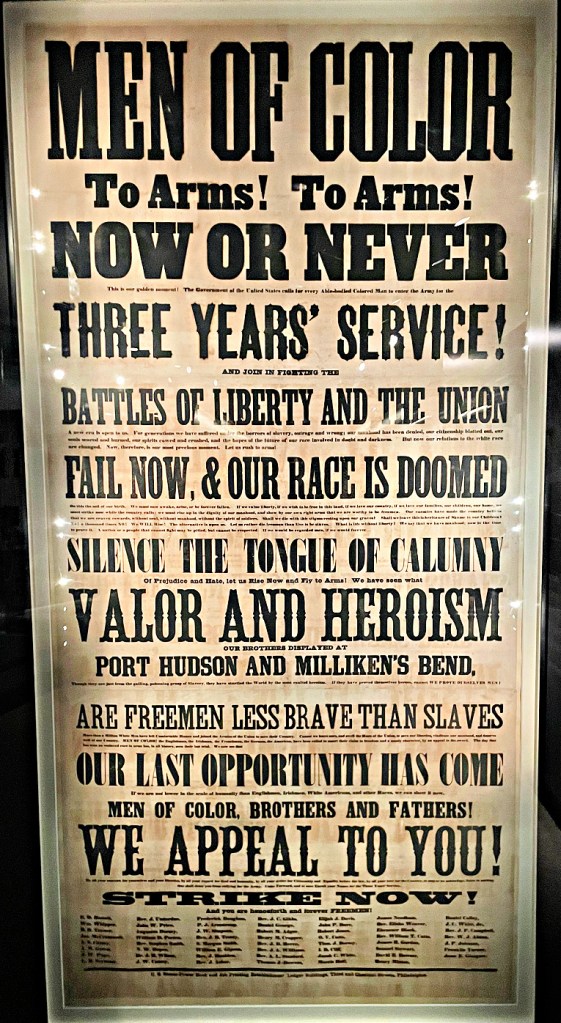
The Civil War gallery focuses largely on the many contributions of the US Colored Troops to the Union war effort. While newly freed slaves could receive paid work from the Army as early as 1861, they could not serve as Army soldiers until January 1863.

A kepi cap worn by a soldier from the 4th Regiment Heavy Artillery, US Colored Troops
Ultimately, about 179,000 African Americans enlisted in the Army from both the North and South. They were organized into segregated infantry, cavalry and artillery regiments with white officers and designated as US Colored Troops. Initially, they were paid less than white soldiers and given menial jobs to perform. In time though they earned full pay and distinguished themselves in many battles. Sixteen African American soldiers would earn the Medal of Honor.
Unlike the Army, the Navy was integrated before the Civil War. About 20,000 African Americans served aboard U.S Navy ships during the Civil War alongside White sailors.
The exhibits devoted to World War I and II are notably smaller than the Revolutionary and Civil War galleries. They broadly describe the segregated service of African Americans during these wars and the hostile environment to which they often returned.
One of the highlights in the History Galleries is a beautifully restored Stearman Keydet training aircraft used by the Tuskegee Airmen. The two seat bi-plane was the primary pilot training aircraft for the US Armed Forces in the 1930’s and 1940’s. The accompanying display also includes an excellent five minute introductory video on the origins and accomplishments of the Tuskegee Airmen, which was established in 1941 to demonstrate that African Americans could perform the jobs required in the Army Air Forces. The Tuskegee Airmen included pilots, as well as navigators, flight engineers, bombardiers, mechanics and other essential support positions.
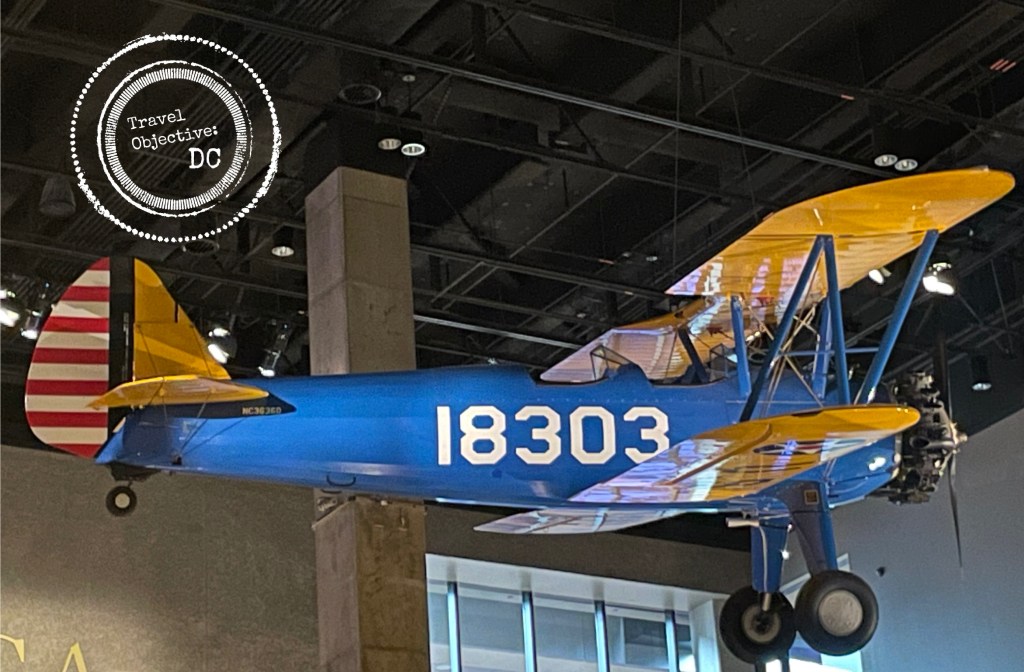
A PT-13D Stearman Kaydet training aircraft used to train Tuskegee Airmen
One of the most notable units comprised of Tuskegee Airmen was the 332nd Fighter Group. From their base in Italy, the 332nd escorted heavy bombers on raids into central Europe from May 1944 through April 1945. They flew more than 15,000 sorties, losing but 25 escorted bombers to enemy fire.
In the museum’s Community Gallery on the third floor is an exhibit entitled Double Victory: the African American Military Experience. The gallery takes its name from the Pittsburg Courier’s Double Victory campaign during World War II, which promoted America’s victory over the Axis Powers and an African American victory over discrimination at home.
This exhibit expands on the themes first introduced in the below-ground History Galleries. Here the emphasis goes beyond historical facts of African American military service to how that service changed through the years and its impact on the larger African American community.
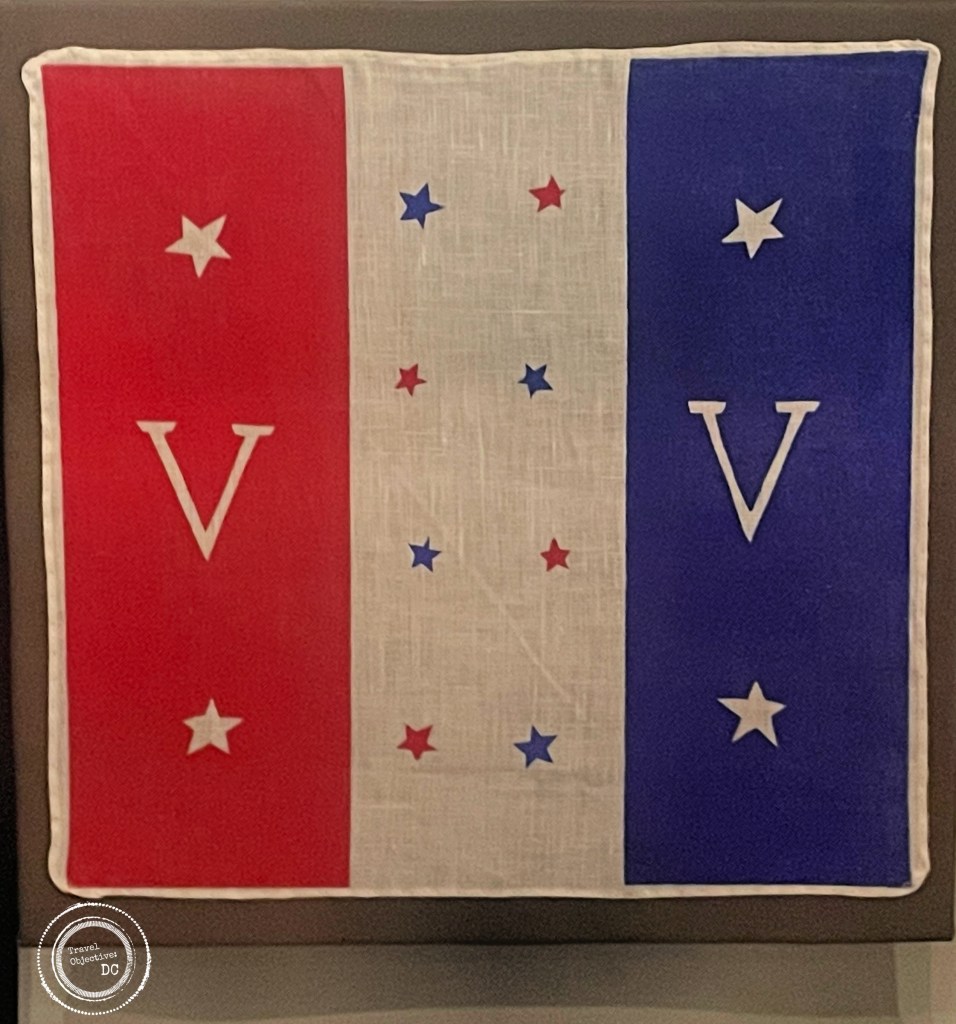
A handkerchief with the emblem of the Pittsburgh Courier’s Double Victory campaign.
Also included are more artifacts, such as documents, weapons and equipment. These highlight what military service for African Americans entailed at the time, such as a seaman’s certificate issued in 1826 to a Black sailor named Robert Barnaby. Barnaby carried the certificate with him at all times to prove he was a sailor in the US Navy and avoid being seized as a runaway slave.
This exhibits introduces the accomplishments of some notable African American units such as the 54th Massachusetts, the Buffalo Soldiers, the Harlem Hellfighters, and the Red Ball Express, among others.
President Harry Truman officially ended segregation in the US Armed Forces in 1948, upon signing Executive Order 9981. Change came, but slowly. Racial tension continued in the following decades in parallel with the civil rights movement occurring across American society. However, the integration of the services opened new opportunities for African American service members.

A horse saddle used by B Troop , 9th US Cavalry Regiment (A Buffalo Soldiers Regiment)
The final part of the Double Victory exhibit portrays one of the most important of those opportunities, the long rise of African Americans to senior ranks within the military. Two hundred years after the Battle of Lexington and Concord, Daniel “Chappie” James, a fighter pilot and Tuskegee Airman became the first African American four star general in history.
The exhibit includes Colin Powell’s dress uniform from his tenure as Chairman of the Joint Chiefs of Staff. It denotes the pinnacle of that long rise and attests to what is now possible in the military.
Although they might not have always been treated fairly, military service has long been an important part of African American life. Today, African Americans comprise 17% of the ranks of soldiers, sailors, airmen and Marines and continue a tradition begun over 200 years ago. Through that time, the unique relationship between African Americans and the American military was a rather complex picture. Curators have designed and assembled some revealing exhibits exploring the nuances of those complexities. It is an important collection and well worth seeing for anyone desiring a more complete picture of American military history.
* * *
Route Recon
The Museum is located on the National Mall at Constitution Avenue, NW, between 14th and 15th Streets, Washington, D.C. The street address is 1400 Constitution Avenue, NW, Washington, DC, 20560.
Click here for a map of all the Smithsonian Institute Museums around the National Mall.
The museum is open Tuesdays – Sundays from 10:00 AM until 5:30 PM. On Monday, the museum is open from 12 Noon until 5:30 PM.
Free timed-entry passes are required for entry.
Using public transportation is advised for those visiting the museum.
Metrorail – The closest Metro station is Federal Triangle, along the blue, orange, and silver lines.
Metrobus – Bus stops are located on Constitution Avenue. Visit the Washington Metropolitan Area Transit Authority for more information.
Circulator Bus – The National Mall Circulator Loop bus provides easy access around the National Mall and convenient connections to other Circulator buses for visits to uptown sites.
Mess Call
If your schedule allows, plan for lunch or a snack at the Sweet Home Café, the museum’s restaurant. It features a variety of food items reflective of African American culinary traditions as well as many modern day favorites. The Sweet Home Café is open daily, from 11:00 AM to 3:00 PM with the exception of Mondays (12:00 Noon – 3:00 PM).