They Answered the Call to Arms

As the smoke cleared at Lexington and Concord on that fateful April day in 1775, supporters of American independence relished in the successes of the brave militia forces. 

But they well understood the cause for independence would take a well-trained regular army capable of defeating the British on an open battlefield. Furthermore, this army needed to represent all of America and not dominated by a single colony or region. 

On June 14, 1775, the Continental Congress established the Continental Army and appointed George Washington as its commander in chief. In recognition of the Army’s 250th Anniversary, the National Museum of the US Army, at Fort Belvoir, Virginia has opened a special exhibit entitled Call to Arms: The Soldier and the Revolutionary War. 

A pair of epilettes belonging to Jeddidiah Huntington of Connecticut.

This pair of major general epilettes belonged to Jeddidiah Huntington of Connecticut. Huntington had encouraged George Washington to adopt this design for general officers’ epilettes.

To tell their stories, museum curators sought and received an abundance of unique and important Revolutionary War era pieces from state governments, private collectors and international organizations. The resulting assemblage of weapons, uniforms, colors and everyday articles includes items that have not before been on public display in the United States. 

The 5,000 square foot exhibit is laid out in roughly chronological order. Two innovative topographical battle maps–one of Bunker Hill, the other of Yorktown–bookend the exhibit representing the first and the final battles for the Continental Army.  Similar to the twinkle light maps of the past, these three dimensional representations depict the operational plans and troop movements of each battle, accompanied by slick videos providing additional context. 

Other battles and campaigns are briefly described with corresponding artifacts, maps and illustrations to connect the visitor to the period. The early struggles in New York and Pennsylvania, the successes in New Jersey, the turning point at Saratoga and the Southern Campaign are put in context and placed in a timeline. Videos enhance these displays describing aspects of 18th century warfare, such as weapons and battlefield tactics.

These displays with brief summaries are a reminder that these battles were fought by soldiers from across the new country. In an era when few people traveled very far from their homes, New Englanders fought in South Carolina and Virginians fought in Pennsylvania. The seeds of our national identity were planted on the battlefields of the Revolutionary War.

A British 3-Pounder gun tube captured at the Battle of Saratoga

A British 3-Pounder gun tube captured at the Battle of Saratoga

Those interested in 18th century weaponry will not be disappointed in their visit. There are many splendid muskets, rifles, carbines, pistols, swords and bayonets. However, the real focus of Call to Arms is the lives of Continental Army soldiers, their motivations, successes, experiences and how they emerged as an effective fighting force.

The lot of a soldier in the Continental Army was a difficult one. Living conditions were challenging, pay was inconsistent, rations and supplies were usually in short supply. These rigors of military life were shared by soldiers from every state.

Still, Americans from the north and south, coastal cities and frontier homesteads answered the call. Then, as now, soldiers enlisted for different reasons. They fought for independence, but also for their communities, comradery, pay, a sense of adventure or because other family members or friends also enlisted.

A plaster casting of Anna Maria Lane, wife of Private John Lane.

A plaster casting of Anna Maria Lane, wife of Private John Lane. She followed her husband to camp when he enlisted in the Continental Army in 1776. She took up arms herself and was wounded at the Battle of Germantown in 1777.

Over the eight years of Revolutionary War, about 231,000 men (and some women) served in the Continental Army.  Enlistments would ebb and flow based on any number of factors, such as the time of year, local economic conditions and success of the army in the field. The maximum size of the army at any one time was about 48,000 troops.

A portion of the exhibit entitled Camp Life explores the life of the Continental Army soldier away from the battlefield. What soldiers ate, where they lived and their daily activities, such as drill, guard duty and the building of fortifications, are all examined.

A notebook belonging to British Major John Andre. His capture in 1780 led to the identification of General Benedict Arnold as a traitor.
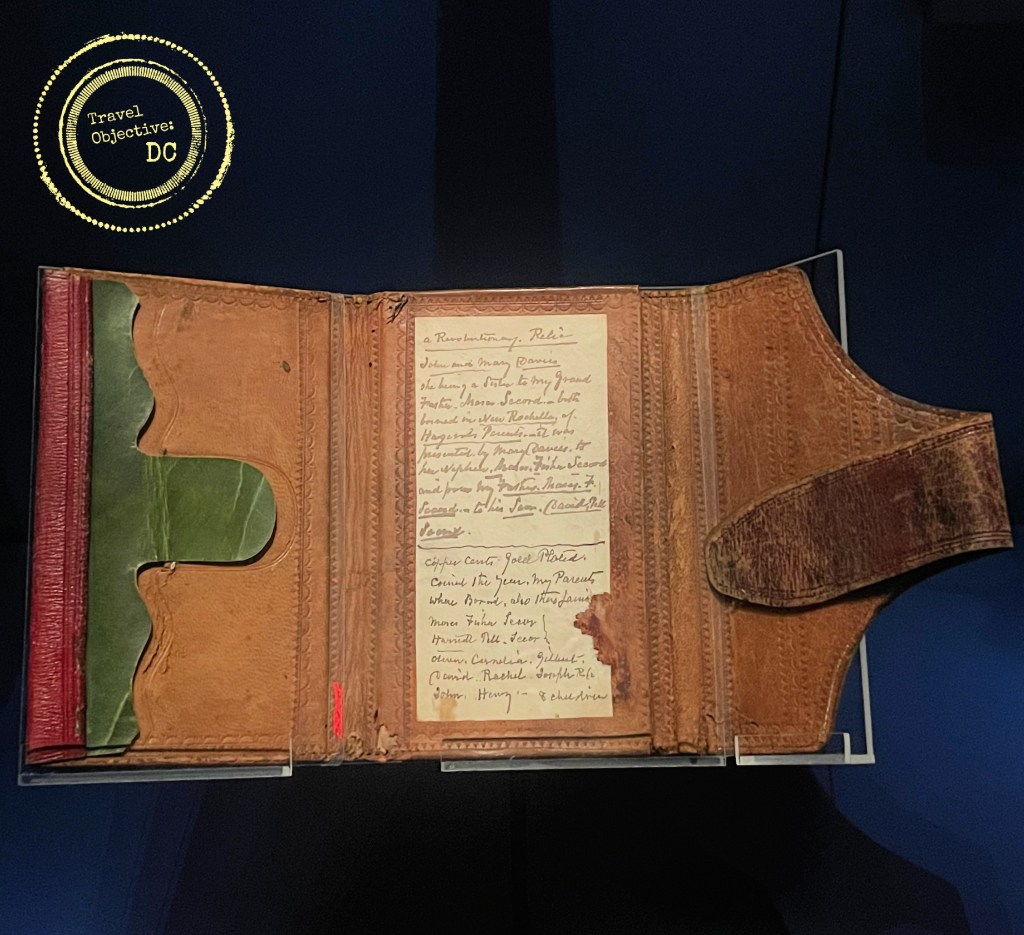
A notebook belonging to British Major John Andre.

One of the more intriguing group of artifacts are a display of powder horns. These hollowed-out animal horns were essential kit for 18th century soldiers, allowing them to quickly add gunpowder to the flashpans of their flintlock muskets.  Soldiers often decorated their powder horns or used them to record important dates or locations.

Accompanying the display is a video screen where digitized images of the complete powder horns can be viewed by visitors to more clearly see the intricate designs. Information about the original owner is also available. The richly decorated powder horns remind us these early soldiers were more than faded names on yellowed muster rolls, but real people fighting for something they believed in. 

A powder horn belonging to Private John Bond of Massashusetts.

A powder horn belonging to Private John Bond of Massachusetts. Bond enlisted in the Continental Army on July 4, 1775 and served for five years. He fought at the Battle of Bennington in 1777.

Also included in the exhibit are several very detailed cast figures representing specific individuals who served with the Continental Army. There is southern aristocrat, a Native American tribal chief, even a married couple who served together. They add an important human element to the exhibit’s interesting array of artifacts, well-designed graphics and use of technology.

Continental Army soldiers met many struggles during their service. Sadly, they encountered more upon returning home.

At the end of the exhibit is a collection of documentation which mark the beginning of the process well known to today’s veterans and their families, applying for benefits.  At the end of the war, many soldiers went home with promissory notes in lieu of their pay and they struggled economically. Legislation to provide pensions to veterans was slow in coming.

Congress did not pass legislation providing pensions to common soldiers until 1818, thirty-five years after the end of the Revolutionary War. By this time, many veterans had died or lost important records that proved their service.  This display though shows pension applications and examples of the documents that Continental Army veterans or their survivors would provide, such as muster roles, discharge papers, and pay records.

The discharge document of Drummer Benjamin Loring of the 2nd New York Artillery.

Discharge document of Drummer Benjamin Loring

Call to Arms artfully tells the story of the Continental Army, with its wonderful artifacts and state of the art technology. It reminds us of an important lesson first demonstrated by the Continental Army and continued in today’s United States Army.

George Washington reflected on it in his farewell message to his troops as he wrote: Who that was not a witness would imagine … that Men who came from different parts of the Continent … would become but one patriotic band of Brothers.

Washington well understood the unity forged among his soldiers was crucial for achieving their shared goal of victory.

250 years later, it is still a lesson to remember.

* * *

Route Recon

Call to Arms is on display at the National Musuem of the United States Army until June 2027. The musuem is open daily from 9:00 AM – 5:00 PM except on Christmas Day. Visit the museum’s website for free entry tickets.

The musuem is located in a publically accessible portion of Fort Belvoir, Virginia. The museum address is 1775 Liberty Drive, Fort Belvoir, VA 22060, but be aware not all GPS systems recognize the Museum’s street address.

You can download a map with directions here.
Giving Benedict the Boot at Saratoga

Saratoga National Historical Park sits tucked up against the Hudson River along the rolling foothills of the Adirondack Mountains in upstate New York. The park preserves the sites of the First and Second Battles of Saratoga (also known as the Battle of Freeman’s Farm and the Battle of Bemis Heights respectively) fought in the autumn of 1777.

Saratoga is often described as the turning point of the American Revolution. For the first time, an entire British Army had surrendered to the Americans. The victory persuaded European powers, especially France, to come to support of the fledging nation fighting for its independence from Great Britain. 

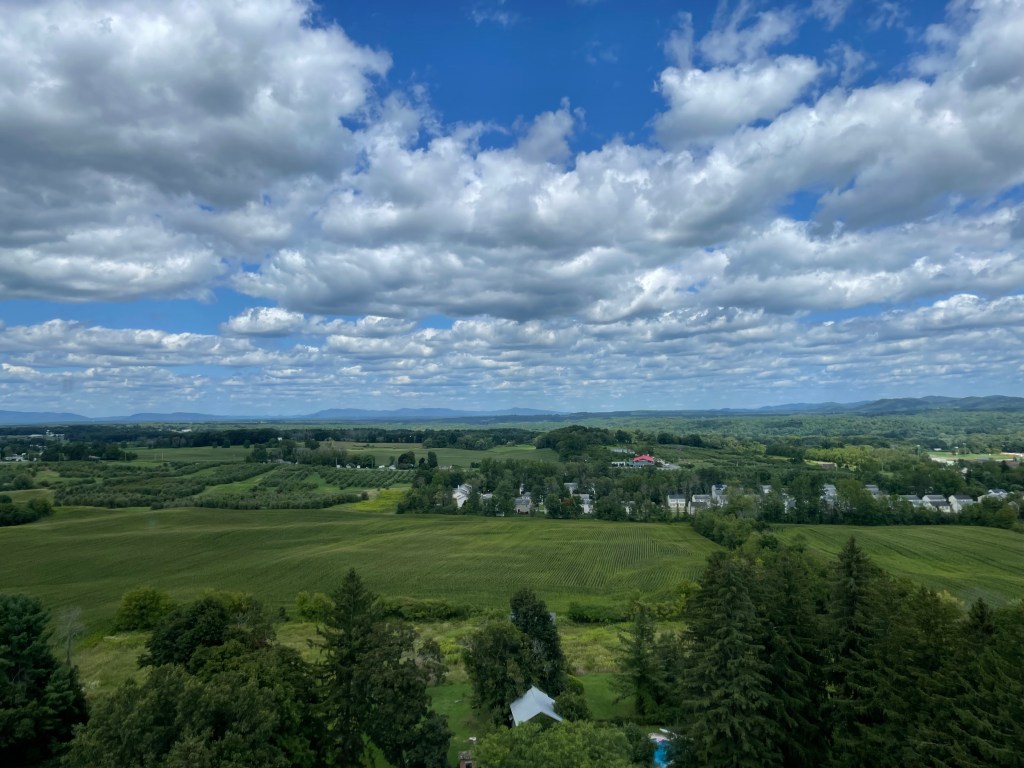
Farms, fields and forests mark the landscape of Upstate New York near Saratoga National Historical Park.

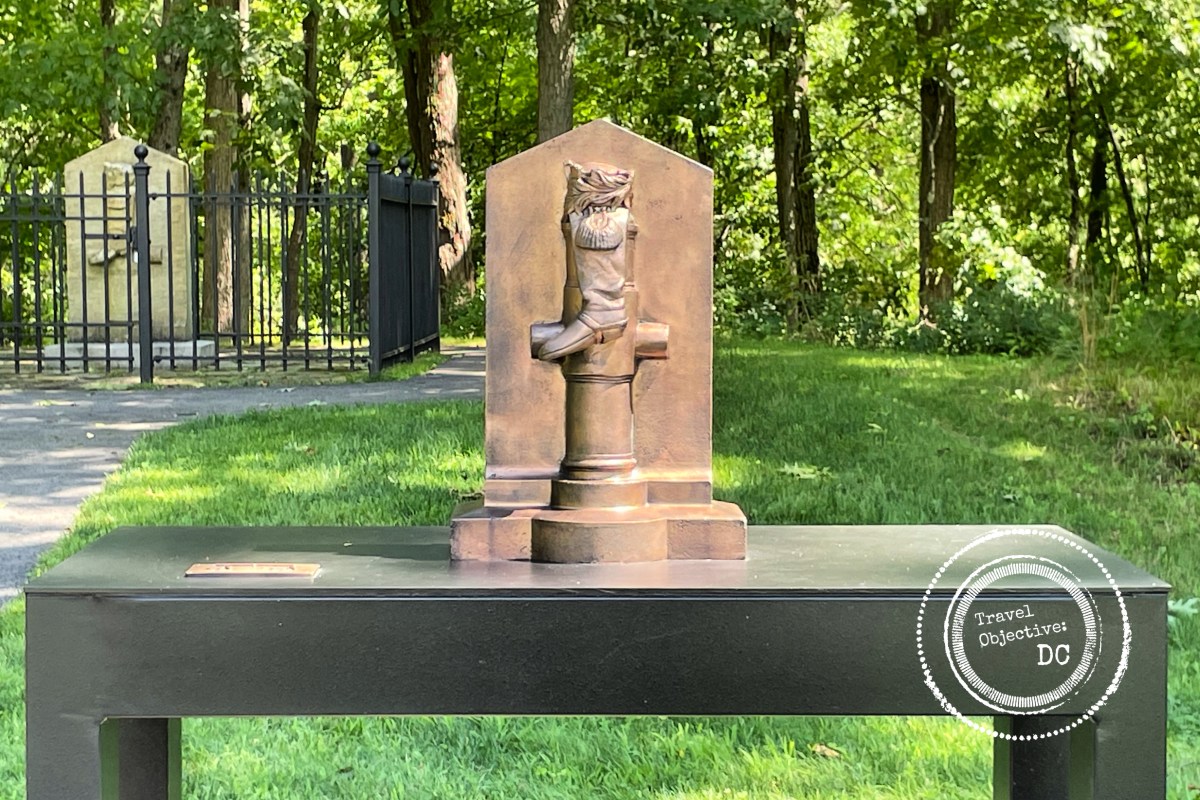
Like many battlefields, various stone markers and monuments dot these famous fields, commemorating leaders, units or events. On a small ridge sits a distinctive piece of American statuary, as unique as can be found on any American battlefield. 

The statue marks the location where during the Second Battle of Saratoga, on October 7, 1777, the infamous Benedict Arnold was critically wounded in his left leg. He was leading his men in multiple charges against British and Hessian troops who were well defended behind tall, thick wooden redoubts.

It was on the last charge as Arnold and his men captured the redoubt that the final volley of retreating Hessians would find its mark. The bullets tore into Arnold’s left leg and killed his horse, which collapsed on and shattered the leg as the horse and rider dropped to the ground. 

The painting Battle of Saratoga: General Arnold Wounded in the Attack on the Hessian Redoubt by Alonzo Chappel, 1860

Arnold’s contributions at Saratoga would secure an important American victory, yet lead him down the path to treachery. 

In the United States, the name Benedict Arnold is still synonymous with traitor. Yet this was not always true. 

Arnold was born in Connecticut, the son of a successful barrel maker. He grew up living a comfortable life in Colonial America. At a young age, Arnold apprenticed in a relative’s apothecary shop. He later became a shipper and merchant, occupations where he could seek adventure and profits at the same time. 

As the colonies moved closer to revolution, Arnold became a colonial militia leader in Connecticut. He repeatedly demonstrated tremendous courage in battle, an adroit grasp of tactics and outstanding military leadership. Arnold, along with Ethan Allen, captured Fort Ticonderoga in 1775. He led a colonial force in the attacks on Montreal and Quebec, commanded a fleet of ships on Lake Champlain and relieved a British siege of Fort Stanwix in Western New York. Arnold would receive tributes and promotions for his actions.

Benedict Arnold, depicted as a colonel by English artist Thomas Hart, 1776

Yet Arnold was also a very difficult person, vain, distrustful of others, and easily offended. He especially chafed when others took or received the credit he thought he deserved.

At Saratoga he was often in conflict with his more cautionary commander, Horatio Gates. After the battle, Gates took credit for Arnold’s actions, which enraged Arnold. Arnold’s business was also struggling and he resented the promotion of other officers over him. 

After a long, difficult and painful convalescence (he never regained full use of his leg), Arnold was placed in command of American forces around Philadelphia. There he met and eventually married the daughter of a prominent loyalist family. It was in Philadelphia where Arnold began to communicate with British officials regarding switching sides.

In 1780, Arnold was named the commander of the U.S. fortifications at West Point, an important stronghold on the Hudson River. Arnold arranged for the surrender of West Point to the British in exchange for money and a commission in the British Army, negotiating the terms with his British interlocutor, Major John André.

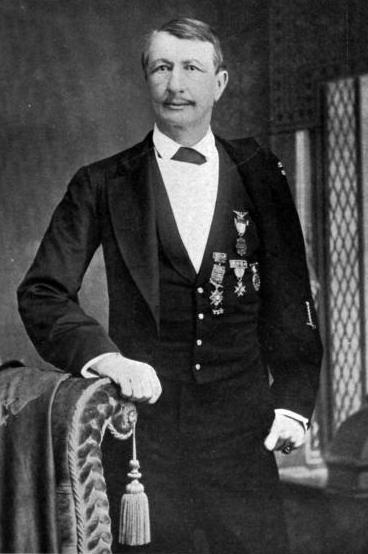
John Watts de Peyster, scion of a prominent New York family, was an author, commentator on military affairs and Adjutant General of the New York Militia.

After a meeting with Arnold, André was captured by New York militiamen. While André was searched, the surrender terms and other documents were discovered in his boot. As he was not in uniform, André was arrested and later hung as a spy.  With his treachery exposed, Arnold fled to New York City. While he received a major general’s commission, his British superior, Sir Henry Clinton had little trust in Arnold. He did not have many opportunities for success on the battlefield. After the final victory at Yorktown, Arnold and his family moved to London. 

Arnold revived his merchant business after the war with mixed results. Although he had established good relationships with King George III and members of the British aristocracy, Arnold was not highly regarded in England, and he remained despised in the United States.

He died in London in 1801, a rather bitter man.

Nevertheless, a century later, a New York military and community leader named John Watts de Peyster commissioned a monument commemorating Arnold’s actions on the Saratoga battlefield. de Peyster was the author of several works of military history, including two books on the Battle of Saratoga.

The Boot Monument, commissioned by John Watts de Peyster and sculpted by George Edwin Bissell.

de Peyster admired the courage Arnold displayed at Saratoga and its contributions to the American victory, and the subsequent assistance to the cause the victory brought about. He believed Arnold’s actions deserved recognition. de Peyster collaborated with a prominent sculptor named George Edwin Bissell to create a statue recognizing Arnold’s actions, but not his treachery.

Approaching the statue, known as the Boot Monument, the four foot high white marble sculpture almost resembles a grave marker especially as it is enclosed by a black iron fence. The front of the monument is really rather simple. It bears no inscriptions, only simple yet expressive imagery. A rider’s boot, with the toe pointing left (to symbolize Arnold’s left leg), topped by a major general’s fringed epaulet, further crowned by a laurel wreath. The vertically aligned images all seem to hang from a downward pointed howitzer. 

On the reverse of the monument is this inscription:

Erected 1887 By

JOHN WATTS de PEYSTER

Brev: Maj: Gen: S.N.Y.

2nd V. Pres’t Saratoga Mon’t Ass’t’n:

In memory of

the “most brilliant soldier” of the

Continental Army

who was desperately wounded

on this spot the sally port of

BURGOYNES GREAT WESTERN REDOUBT

7th October, 1777

winning for his countrymen

the decisive battle of the

American Revolution

and for himself the rank of

Major General.

While Arnold is not mentioned anywhere on the statue, a nearby interpretive sign summarizes his story, so there is no question to whom the phrase “the most brilliant soldier of the Continental Army” refers. It is worth noting that Arnold was already a major general at the time of the battle. He was however, promoted to a more senior status as a result of his conduct at Saratoga. 

The Saratoga Battle Monument in the village of Victory, New York

Perhaps de Peyster’s interest in recognizing Arnold with a separate statue stems from his work as part of the Saratoga Monument Association (referred to as “Saratoga Mon’t Ass’t’n” on the inscription), which purposefully snubbed Arnold in another monument. 

To mark the Battle of Saratoga’s centennial in 1877, the Saratoga Monument Association, a private group, raised funds to build a prominent monument near the battlefield.

Completed in 1883, the Saratoga Battle Monument is a 155 foot high obelisk made of dark granite. It is located in the nearby village of Victory, New York. 

The empty statue niche on the Saratoga Battle Monument.

The monument has a door on each of its four sides, and above each door is a niche for a statue. Three of the niches contain statues of the senior commanders at Saratoga: General Horatio Gates, General Philip Schuyler and Colonel Daniel Morgan.  The fourth niche, facing south toward the battlefield, is purposefully empty. It is where a statue of Benedict Arnold would have been placed had he stayed true to the cause. 

When the monument is open, visitors can climb the 188 stairs to the top and take in the very picturesque countryside with views of local farms, rolling hills and the Adirondack Mountains in the distance. Along the way, there are sixteen bas relief plaques cast in bronze with scenes from the time of the battle along with stained glass windows and mosaic tiled floors. 

The bas relief sculpture of the wounding of Benedict Arnold inside the Saratoga Battle Monument.

The Saratoga battlefield and Monument are only two of five sites comprising the Saratoga National Historical Park. Other venues include Victory Woods, where the British Army made its final encampment, the Saratoga Surrender Site, and the Philip Schuyler mansion. (Schuyler was a New York patrician who commanded the Continental forces opposing Burgoyne prior to Gates. He is probably best known today as Alexander Hamilton’s father-in-law). The park recently completed a $6 million dollar improvement project that added interpretive signage, tactile maps and other objects, along with upgraded roadways and trailheads. 

As the national mark’s the 250th anniversary of the American revolution, new generations of historians, students and visitors will research and learn about the early American Patriots. They will discover how complex these men and women were. Perhaps one of the most complex was Benedict Arnold. Although he eventually chose a dishonorable path, he fought very bravely for the cause of independence at a critical time of the Revolutionary War. de Peyster’s statue reminds us of this Arnold — an Arnold that is too important to be forgotten or ignored. 

Route Recon

Start your trip to the Saratoga National Historical Park at the park’s Visitor Center where you will find information about the battle, the park’s various venues, upcoming programs and weather advisories.  

The Visitor’s Center is located at 648 New York State Route 32, Stillwater, NY 12170.

The park is approximately 40 miles north of Albany, NY and 14 miles southeast of Saratoga Springs, NY. 

More detailed directions are available here.  

The park is open year-round, with the exception of several holidays. Some park features are only open seasonally. Check the Saratoga National Historical Park website for more information about seasonal operating hours.

There is a one-way, 10-mile road circumventing the battlefield area. The road has ten tour stops at significant places in the battlefield. The Boot Monument is located at Stop 7. 

Mess Call

Fortify yourself for your day of exploration at the Saratoga National Historical Park at Mama Bear’s Diner (formerly Sweeney’s) in Schuylerville, NY. Mama Bear’s serves hearty breakfast and generous sandwiches for lunch in a modern yet homey setting. The eatery recently changed ownership with a long-time server taking ownership. She is continuing the traditions of generous portions that Sweeney’s had established while adding a focus on sourcing more ingredients from local farms. 

Mama Bear’s Diner is located at 106 Broad Street, Schuylerville, NY, 12871.

Open Wednesday through Sunday from 7:00 AM to 2:00 PM.

Command Reading

Saratoga: A Military History of the Decisive Campaign of the American Revolution

Author John Lauder drew upon his years of experience as a researcher and historian for the National Park Service (he developed the interpretation plan for Saratoga National Historical Park) to write a comprehensive yet readable history of British General John Burgoyne’s Albany Campaign of 1777. Lauder’s work carefully examines the strategic and tactical aspects of the campaign along with the parallel political machinations which shaped the campaign and the Americans’ defensive response. Lauder thoroughly examines Benedict Arnold’s actions, from his participation in the 1775 attack on Quebec to his command of the fleet on Lake Champlain to his leadership at Saratoga.