While at Arlington, “Remember the Maine!”

“Remember the Maine, to Hell with Spain” became a rallying cry for war in the spring of 1898. As a simmering independence movement in Cuba was becoming increasingly violent that January, President William McKinley sent the USS Maine to Havana to watch after American lives as well as political and business interests. Tensions between the United States and Spain had been growing over independence movements in Cuba, Puerto Rico and the Philippines; McKinley was hoping for a peaceful resolution.

The USS Maine circa 1895-1898

-US Naval History and Heritage Command Photograph

However, it was not to be. The Maine arrived in Havana on January 25th with approximately 26 officers, 290 sailors and 39 Marines on board. Just after the bugle call Taps on February 15th, an explosion detonated the five tons of gunpowder charges for the Maine’s large guns. The forward section of the ship, containing the enlisted men’s quarters, blew apart. An estimated 266 men died either during the explosion or in the days afterward.

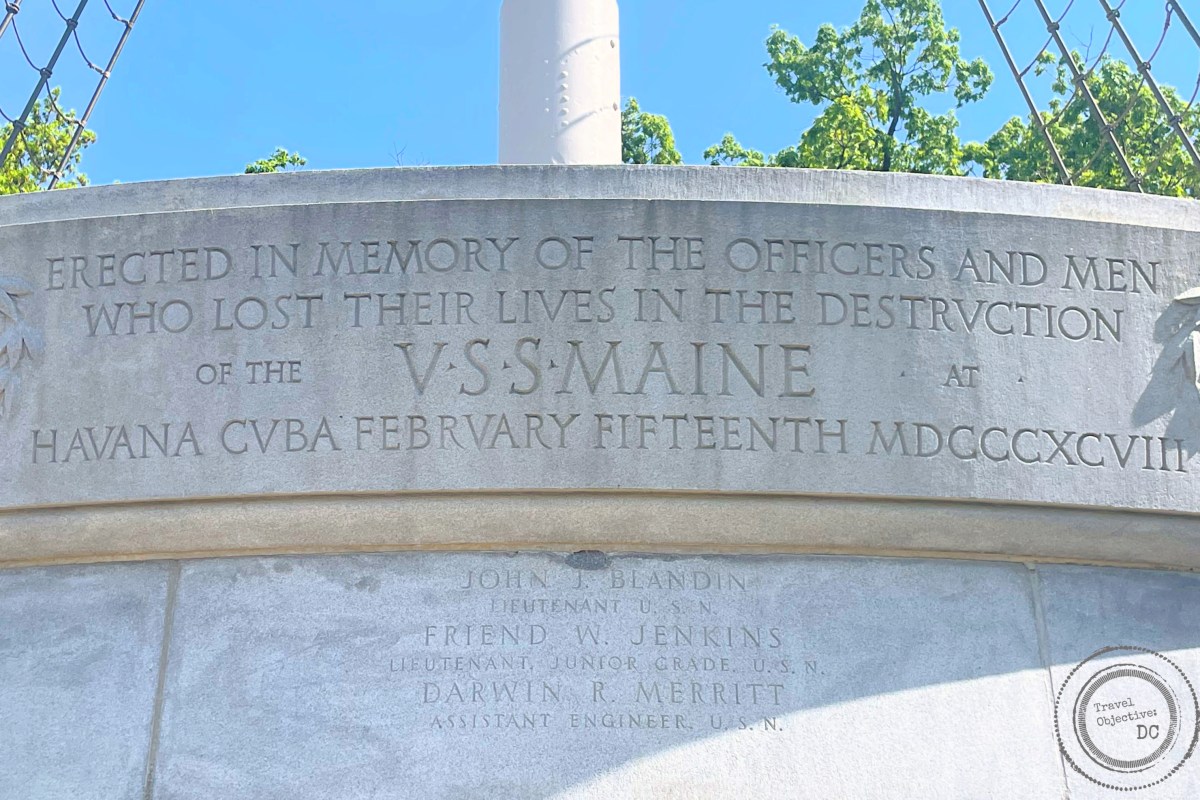
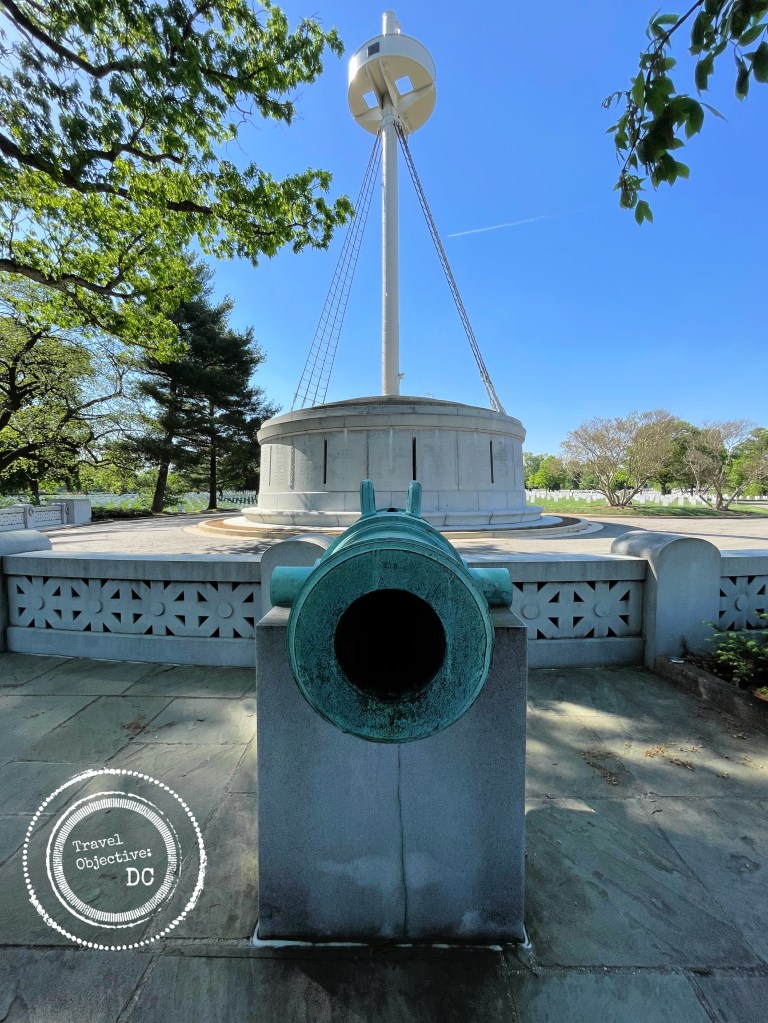
The USS Maine Memorial at Arlington National Cemetery

How the explosion occurred was not immediately apparent. Several different investigations and reviews could not concur on a definitive cause. Though the combustion of coal dust was one possibility, several prominent newspapers of the time blamed a Spanish naval mine. A vocal element of the population was ready to use force against Spain and Congress declared war on April 25th. The war would end quickly and favorably for the United States as Spain ceded Guam, Puerto Rico and the Philippines. 

Even with the war’s prompt conclusion, America did not forget about the Maine. In 1899, the remains of 165 sailors who died in the explosion were exhumed from a Cuban graveyard and reinterred at Arlington National Cemetery.  In 1912, the Army Corps of Engineers recovered the twisted remains of the Maine’s hull from Havana Harbor and towed her further away from the Cuban coast. After recovering an additional 66 bodies, the Maine was then scuttled in deeper waters while Taps played and escort ships offered a 21-gun salute. The ship’s masts were salvaged and the main mast sent to Arlington National Cemetery. 

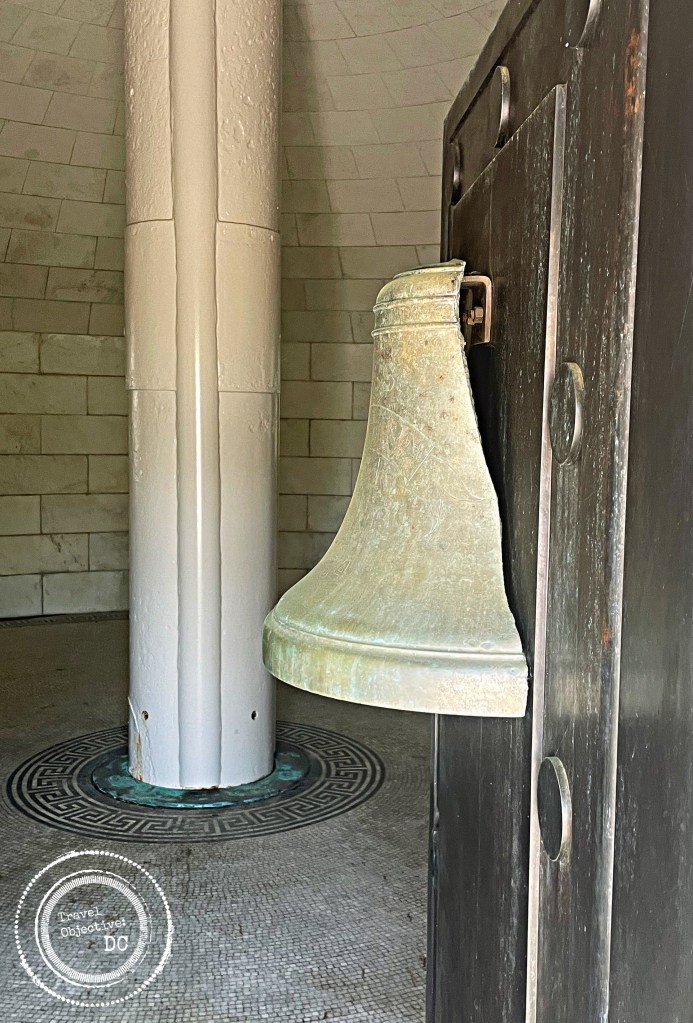
The mast of the USS Maine passes through the stone structure and is embedded into the floor. A surviving piece of the ship’s bell is hung on the front door.

Efforts to build a memorial to the Maine began shortly after the explosion and about twenty monuments or special exhibits of the ship’s artifacts exist around the United States. President Woodrow Wilson dedicated the current memorial at Arlington National Cemetery in 1915, adjoining the burial site of the USS Maine sailors. The centerpiece of the memorial is a circular stone structure, 90 feet in diameter, built around the ship’s main mast. The shape of the structure suggests the warship’s gun turret, but it also has served as a temporary mausoleum. Rigging extends from the top of the structure up to a crow’s next atop the mast. On the circumference of the building are names and ratings of the sailors who died in the explosion. The front door of the structure holds a piece of the ship’s bell, which was broken in half during the explosion. 

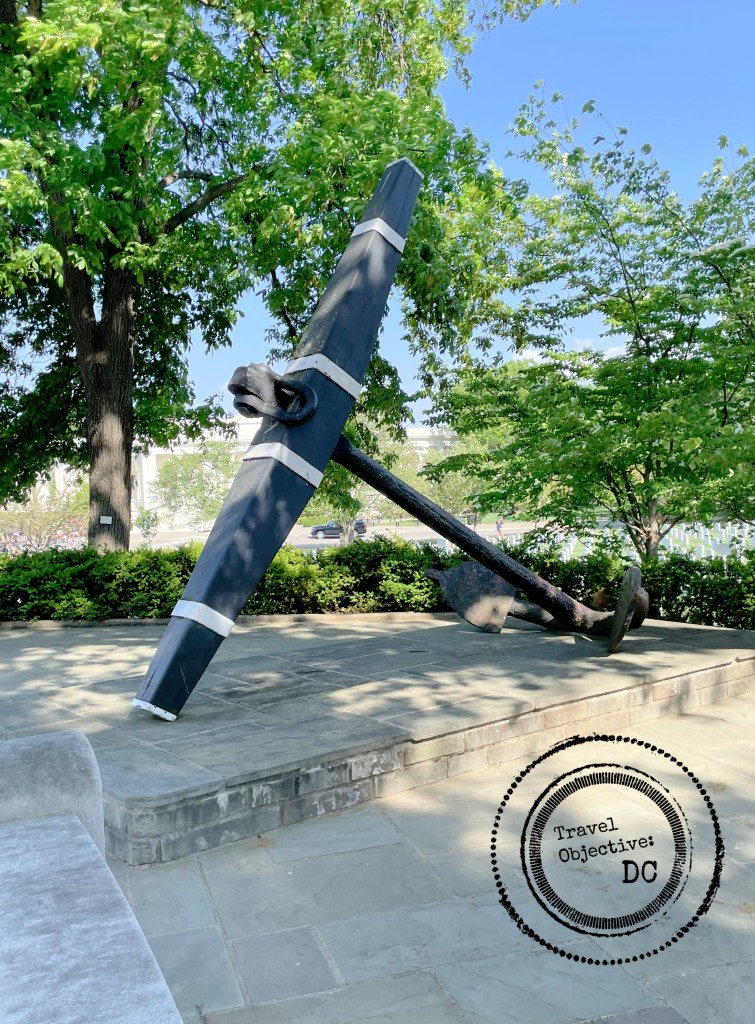
A paved lane encircles the memorial. To the east is an anchor made specifically for the memorial but resembling the anchor onboard the Maine.  Positioned along the back of the memorial are two bronze Spanish mortars, cast in the 1700s and captured by Admiral George Dewey in the Philippines during the Spanish–American War. 

The replica anchor was the centerpiece of an earlier memorial to the USS Maine. It weighs about two tons.

Most auspiciously, in the twelve decades since that fateful February night, the USS Maine is still not forgotten. There have been periodic reinvestigations and new studies into the cause of her sinking, reexamining the available evidence and using modern technologies and computer simulations. In 2000, a marine exploration firm unexpectedly came upon her wreck at a depth of 4,000 feet. Yet a definitive cause of the explosion remains elusive.

Next to the USS Maine Memorial, Section 24 at Arlington National Cemetery contains the graves of 229 sailors lost on the USS Maine.

Fortunately, any visitor to Arlington National Cemetery can also “Remember the Maine”. A short walk from the Tomb of the Unknown Soldier will lead to the USS Maine memorial.  Observe the neatly organized graves and note the names along the memorial’s wall.

Their sacrifice endures.  

* * *

Route Recon

Arlington National Cemetery is open daily from 8:00 am to 5:00 pm. 

Arlington National Cemetery is located across the Potomac River from Washington, D.C. at the end of Memorial Avenue, which extends from Memorial Bridge. Arlington is accessible from the major roadways in the D.C. area: Interstate 95, the Capital Beltway (I-495), and the George Washington Memorial Parkway.

Parking: A parking garage is located near the cemetery’s entrance on Memorial Avenue.

Metro: Arlington Cemetery station is stop on the Washington Metropolitan Area Transit Authority Blue Line.

Both the Parking Garage and Metro station are a short walk from the Welcome Center. Please note there is a 100% security check for visitors entering the cemetery.

The USS Maine Memorial is located to the west of the Tomb of the Unknown Soldier and the Memorial Amphitheater. You can view a map of Arlington National Cemetery here.

Cleared for Takeoff at the Steven F. Udvar-Hazy Center

The sliding glass doors retract and beckon you inside.  Passing the metal detectors, navy blue jacketed security officers nod a quiet greeting. Walk through a cavernous entryway and on to a balcony overlooking the massive Boeing Hanger. On the gallery floor the world’s fastest jet powered aircraft, the SR-71 Blackbird stares back at you, sleek and silent.  On the left, the toothy grin nose art of a P-40 Kitty Hawk welcomes you while an F4U Corsair dips its bent wing in a friendly gesture as if to say, “We’re glad you’re here, but you better get started. There is a lot to see!” Indeed, within the Steven F. Udvar-Hazy Center’s hangers are the products and byproducts of over two hundred years of aviation history. 

For anyone interested in aviation and space exploration, it doesn’t get much better than this.

For most visitors to the Washington DC area, the Smithsonian Institute’s National Air and Space Museum is synonymous with the building on the National Mall.  Currently undergoing renovation, that museum building can only hold a small portion of the Smithsonian Institute’s massive collection of artifacts and materials related to aviation and space travel. 

A US Coast Guard Sikorsky HH-52A Seaguard Helicopter

The Steven F. Udvar-Hazy Center is the other main component of the Smithsonian Institute’s National Air and Space Museum. Located in Chantilly, Virginia, it adjoins Washington Dulles International Airport. Conceived as additional space for the display of the Smithsonian’s extensive collection of aviation and space travel artifacts, it opened to the public in 2003. Between the National Air and Space Museum’s building on the National Mall and the Udvar-Hazy Center, approximately 80 percent large aircraft and spacecraft from the Smithsonian’s holdings are on display.

The center’s namesake Steven F. Udvar-Hazy is a Hungarian-born immigrant who came to the United States in 1958. A lifelong lover of aviation, Udvar-Hazy eventually became chairman of the International Lease Finance Corporation, one of the world’s largest aircraft leasing firms. He donated $66 million of his personal fortune to the Smithsonian for the purposes of building this impressive facility with its three main galleries: the Boeing Aviation Hanger, the James McDonnell Space Hanger and the Mary Barker Engen Restoration Hanger.  

The Boeing Gallery boasts nearly 200 aircraft in a space comparable to the flight deck on a Nimitz-class aircraft carrier.  Curators very carefully arranged the aircraft to maximize the available display space within the hanger. Organized into collections, the aircraft are situated either on the hanger floor or suspended from the ceiling. Balconies on multiple levels help visitors to see the meticulously restored aircraft up close.

The Air France Concorde FA, within the south side of the Boeing Hanger at the Udvar-Hazy Center.

The Udvar-Hazy Center features tours most days. Over 60 to 90 minutes, the volunteer docents lead visitors around the World War I fighters and reconnaissance aircraft, inter-war trainers and prototypes, Allies and Axis aircraft from World War II, early passenger airliners, experimental aircraft, general aviation planes, Cold War jets, helicopters and more. Some of the highlights of the collection include:

SR-71 Blackbird – The SR-71 is the fastest jet engine propelled aircraft. First flown in 1964, the operational performance and technological sophistication of the Blackbird is still impressive today. The centerpiece of the Boeing Gallery, the SR-71 Blackbird on display logged about 2,800 hours of flight time over 24 years. The U.S. Air Force donated this Blackbird to the Smithsonian. On its final flight, the Blackbird set a speed record flying from Los Angeles to Washington-Dulles International Airport in 1 hour, 4 minutes, and 20 seconds (about 2,124 miles per hour) 

B-29 Enola Gay – The Boeing B-29 Superfortress was first conceived in the 1930s as bomber with a greater range and capacity than the B-17. The B-29’s extended range of about 4,000 miles when loaded made it especially suitable for use in the Pacific Theater during World War II. On August 6, 1945, the Enola Gay dropped the first atomic bomb on Hiroshima, Japan.  

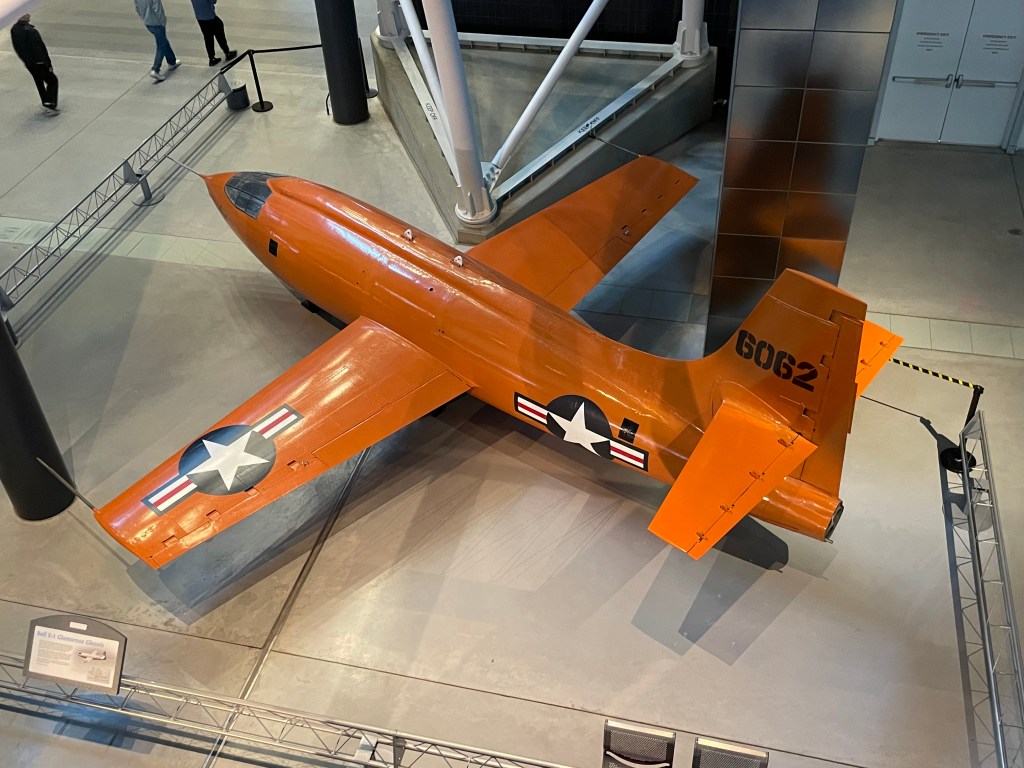
The Bell X-1 Glamorous Glennis

Bell X-1 Glamorous Glennis – On October 14, 1947, Captain Chuck Yaeger became the first person to fly faster than the speed of sound after he was drop launched in the X-1 from a B-29 Superfortress. He named the aircraft after his wife. 

F-14 D Tomcat – A naval fighter aircraft, this plane became well known to moviegoers following the release of the 1986 film Top Gun. 

Boeing 367-80 – The Boeing four-engine jet powered aircraft was the prototype for the US Air Force’s KC-135 tanker and the Boeing 707 jetliner. 

Concorde – The first supersonic airliner, the Concorde was flown by both Air France and British Air, serving customers willing to pay a premium for a faster flight. Unfortunately, higher fuel prices made the very sophisticated aircraft too expensive to operate. This Air France Fox Alpha Concorde on display was donated to the Smithsonian Institute on June 12, 2003 after its final flight from Paris to Dulles International Airport. 

The Space Shuttle Orbiter Discovery

Compared to the Boeing Aviation Hanger, the McDonnell Space Hanger, arrayed with satellites, rockets, probes and other cosmic equipment seems less crowded. However, one artifact stands out from all the rest, the Space Shuttle Orbiter Discovery.  Space shuttles were a unique reusable spacecraft, designed to take off like a rocket, land back on earth like a glider, and carry a variety of payloads. Discovery was the workhorse of the shuttle fleet, flying 39 missions and logging 365 days in space during its service life between 1984 and 2011.    

Displaying aircraft and space equipment is but one mission of the National Air and Space Museum. Before anything is placed into a hanger or gallery, museum preservationists painstakingly restore the aircraft and prepare it for its new life in the museum. Much of this refurbishment work is conducted in the Mary Baker Engen Restoration Hangar.

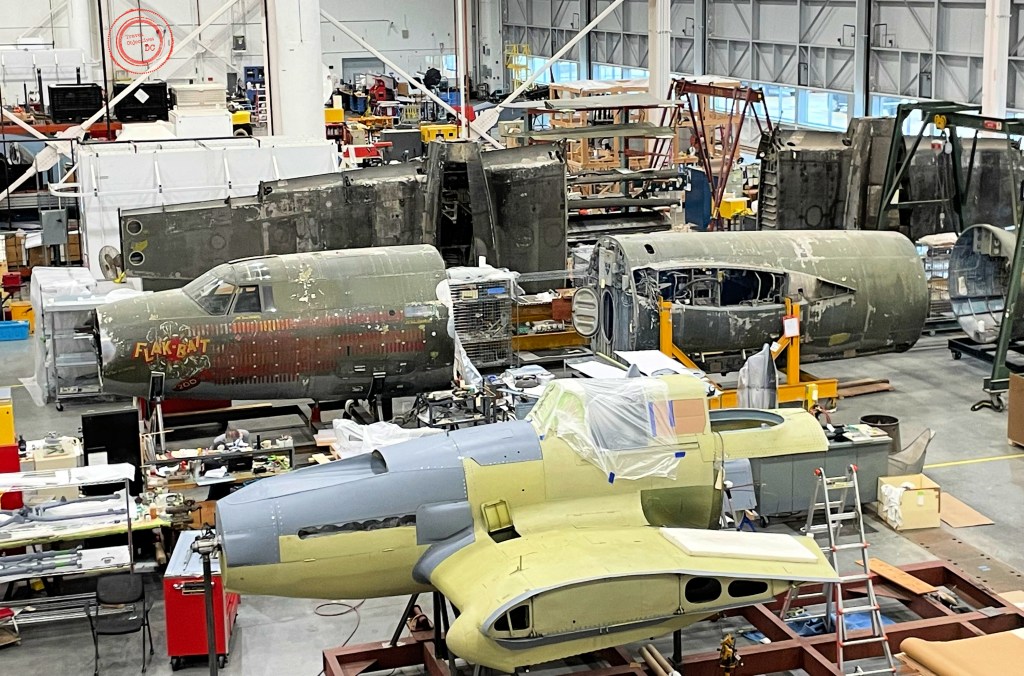
The large open hanger space accommodates several restoration projects at a time. An observation area on the mezzanine above the hanger floor allows visitors to watch the restorers at work.  One major restoration project currently underway in the hanger is on a Martin B-26B medium bomber from World War II named Flak-Bait. This bomber flew more than 200 missions over Germany from August 1943 until April 1945, more than any other American plane.

The Martin B-26B Bomber Flak-Bait holds the record for the number of bombing missions survived in World War II.

As captivating as they are, the Udvar-Hazy Center offers a few additional activities beyond just looking at the restored air and space craft. 

Observation Tower – The Donald Engen Observation Tower provides a commanding view of the area, including the main operational runways at Washington Dulles International Airport. Watch the planes take off and land throughout the day. The tower also includes a quick lesson in the functioning of the air traffic control system, adding some helpful context to the highly choreographed movement of aircraft through the region’s airspace.  

Simulators – After viewing so many exciting aircraft, a collection of simulators provides the realistic feeling of taking to the skies and beyond.  

Theater – The Airbus IMAX Theater at Udvar-Hazy, the largest in Northern Virginia, shows a combination of current Hollywood releases as well as documentaries on different aspects of aviation and space exploration.

Additionally, the Smithsonian maintains a regular schedule of educational programs, lectures, and events for young people, such as the annual Air & Scare held the Saturday before Halloween. 

The B-29 Superfortresss Enola Gay.

After a visit, it is easy to understand why the Udvar-Hazy Center is one of the top destinations not only in the Washington, DC area, but in all of Virginia. The building is expansive, easy to navigate and the exhibits are tantalizing to the eye with multiple legendary air and spacecraft on display. Beyond the artifacts, other aviation related activities are available to expand your understanding of flight and helpful staff are available to answer questions. For admirers of aviation, adventure or innovation, there are few better places (on the ground) to spend a day than the Steven F. Udvar-Hazy Center

* * *

Route Recon

The Steven F. Udvar-Hazy Center is located just south of Washington Dulles International Airport, along Virginia Route 28 in Chantilly, Virginia. 

The address is: 14390 Air and Space Museum Parkway, Chantilly, VA 20151

By car:

From Washington, DC, and points south: Take Interstate 66 West to Route 28 North (Exit 53B): Travel on Route 28 North for 5.3 miles. Exit at Air and Space Museum Parkway and follow the signs to the Udvar-Hazy Center.

From Washington, DC, and points north: Take Interstate 495 West (the Capital Beltway) to the Dulles Toll Road West (Virginia Route 267). Exit the toll road at Route 28 South (Exit 9A) and travel south 3.5 miles. Exit at Air and Space Museum Parkway and follow the signs to the Udvar-Hazy Center.

NOTE: Online mapping apps may direct you to enter the Udvar-Hazy Center from US Route 50. This is not a public entrance. You must enter from Virginia Route 28. 

Admission to the museum is free, but parking costs $15 before 4:00 pm. Free parking is available for all cars arriving after 4:00 pm.  Vehicles dropping off or picking up visitors are not charged if staying less than 30 minutes. 

By Bus: 

From Washington Dulles International Airport to the Udvar-Hazy Center in VA:

From Ground Transportation bay #5E (lower level exit #6), take Fairfax Connector No. 983 one stop to Steven F. Udvar-Hazy Center. Buses run every 25 minutes during peak times and every hour during non-peak times and weekends. Bus fares paid with SmarTrip card or cash. Bus drivers do not carry change. The bus ride from Dulles Airport takes approximately 25 minutes. 

By Metro: 

Take Metro Silver Line to Innovation Center station. 

Fairfax Connector provides connecting bus service from the Silver Line’s Innovation Center Metro station. More information is available on the Fairfax Connector No. 983 website Buses run every 25 minutes during peak times and every hour during non-peak times and weekends. Trips between Innovation Center and the Udvar-Hazy Center take about 12-15 minutes.

Exit bus at Steven F. Udvar-Hazy Center stop.

Plan for an approximately 1 hour and 35 minute trip from Washington, DC to the Udvar-Hazy Center using Metro. 

Mess Call

Shake Shack restaurant provides onsite dining at the Udvar-Hazy Center. The Shake Shack is open from 11:00 am to 5:00 pm daily. The restaurant serves burgers, hot dogs, chicken sandwiches, fries, frozen custard, shakes, and coffee. There are two shakes exclusive to the museum, the Constellation Crunch Concrete and Out of This World Shake. Additionally, pre-packaged salads and sandwiches are available from an automated vendor kiosk. 

The Vietnam Veterans Memorial – Sacred Space on the National Mall

Jan Scruggs understood that the Vietnam veterans needed a different kind of memorial. As he first set about his effort to build a memorial in Washington, DC, he envisioned a place that could bring healing, reconciliation and respect for veterans of the Vietnam War.

Scruggs knew first hand of the need for healing and reconciliation. He served a tour in Vietnam as an Army mortarman. Badly wounded after only thirty days, he spent three months recovering in the hospital. He lost 12 friends and comrades when a mortar round detonated while ammunition was loaded into a truck.  Scruggs was not physically injured and he was first on the scene to help, but the carnage he witnessed stayed with him. As did many other veterans, he struggled upon his return to the United States in 1970.

After seeing the movie The Deer Hunter, he committed himself to building a memorial in the nation’s capital to honor the men and women who did not come home from Vietnam. In 1979, Scruggs established the Vietnam Veterans Memorial Fund and enlisted the help of other veterans in raising money, lobbying Congress and negotiating the process of building a memorial on the National Mall.

The Memorial Plaque was added to the Vietnam Veterans Memorial in 2004.

One day, a discussion with a fellow Vietnam veteran led to an important feature of the memorial. Although Scruggs and his fellow veteran did not know each other, they realized they had served in the same unit, separated by only a few months’ time. They remembered many of the same people, yet they struggled to recall soldiers’ names, especially several soldiers who died. The conversation convinced Scruggs of the importance of including names on the memorial so the dead would not be forgotten. 

As the work for the memorial advanced, the Vietnam Veterans Memorial Fund organized a nationwide competition to select the design. Scruggs’s vision for the memorial shaped the selection criteria. The memorial needed to be reflective and contemplative, harmonize with other memorials on the National Mall, bear the names of the dead and missing, and be apolitical. As Scruggs would say, it was important to “separate the war from the warrior”. The memorial was about recognizing the bravery and sacrifice of American soldiers, sailors, airmen, Marines and Coast Guardsmen.

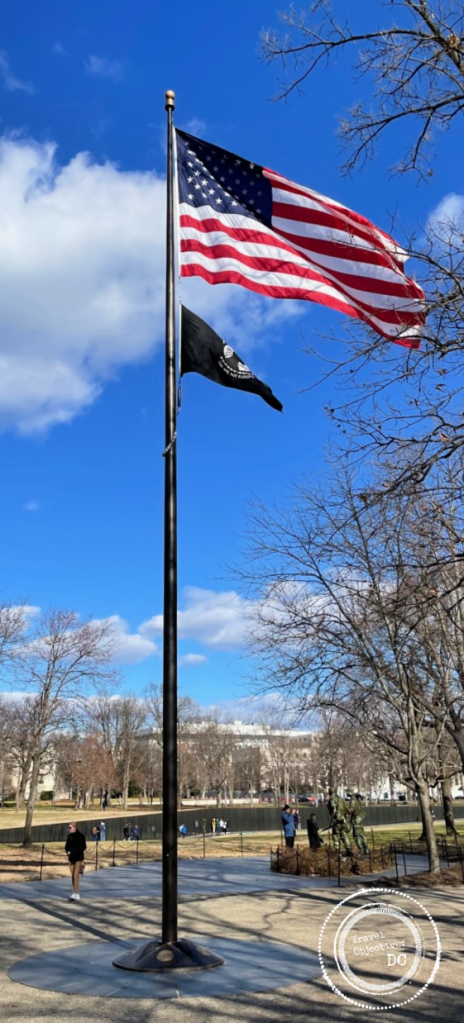
The flagpole at the Vietnam Veterans Memorial flies the United States and POW/MIA Flag.

On May 1, 1981, a panel of eight distinguished artists, architects and designers unanimously selected the “V” shaped wall design submitted by a young Yale University student named Maya Lin from over 1,400 submissions. Over the past forty years, the reflective black granite wall bearing the names of the dead and missing from the Vietnam War has become one of Washington, DC’s most recognizable landmarks.

The Vietnam Veterans Memorial is located on the National Mall’s northwest corner.  Approaching from the neighboring Lincoln Memorial, a National Park Service ranger station and the flagpole are what first come into view. Then the top of the wall becomes visible, protruding from a shallow ravine. Finally, the entirety of the almost 500-foot wall reveals itself.

Lin’s design is deceptive in its simplicity, a black granite wall with the names of those service members who died or were missing in Southeast Asia from 1959 through 1975. As Lin said,” the names would become the memorial”.

The “wall” is actually composed of 144 black granite panels. Seventy-two of these panels, numbered 1E to 70E comprise the eastern section of the wall, which point to the Washington Monument. The western panels are similarly numbered (1W to 70W) and point to the Lincoln Memorial. There are two empty panels on either end.

A National Park Service Volunteer (wearing a yellow jacket) speaks with visitors at the Vietnam Veterans Memorial.

The names, listed chronologically from 1959, begin at the center on Panel 1E. After the last name on Panel 70E, they resume in chronological order on Panel 70W and continue back toward the center of the wall. The names beginning and ending in the center represents a circle, signifying the end of the war. Additionally, Lin’s selection of polished black granite draws the visitor into the memorial. The stone retains its mirror-like quality, wherein the visitors sees themselves as they view the names.
At its dedication, the wall had 57,939 names. Thorough reviews of medical reports and personnel records led to the addition of over 300 more names. A small diamond or cross accompanies each name. A diamond means the service member has been declared deceased. A cross means the service member was missing or a prisoner at the war’s end. (On the west side, the symbol precedes the name; on the east wall, it follows). A diamond is added to the cross if the service member is at some point declared deceased. A circle is added to the cross should the service member ever return alive.

Dedication day for the Vietnam Veterans Memorial was November 13, 1982, with decidedly mixed reviews. Many prominent critics disparaged the design as unpatriotic and defeatist. After two years of discussion among the several communities involved in building the memorial, there was a consensus to recognize others beyond the dead and missing. A flagpole and statue adjacent to the wall were added to the memorial in 1984.

The Three Soldiers Statue

Local Washington, DC sculptor Frederick Hart designed and sculpted the bronze statue showing three young male soldiers wearing fatigues and carrying combat gear. Known as The Three Soldiers or The Three Service Members statue, it honors those who served and returned home from Vietnam. The statue stands a short distance away from the wall with the soldiers looking respectfully toward the names so as not to distract from Maya Lin’s original intent.

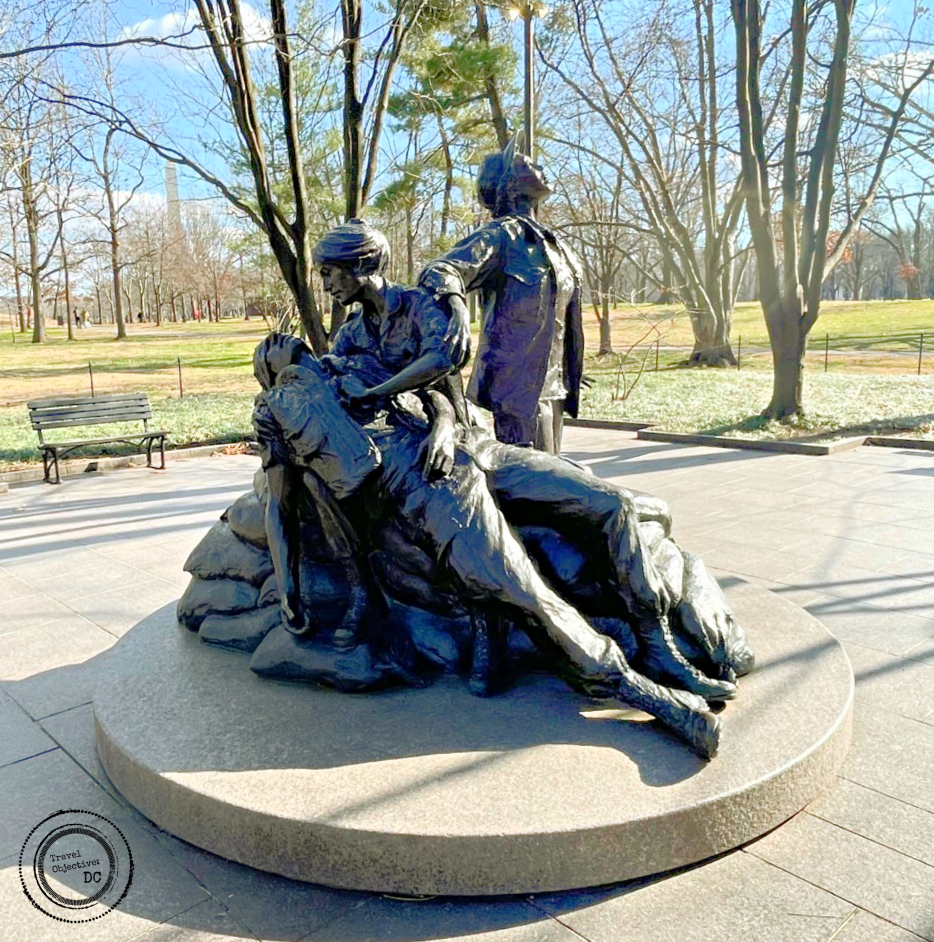
A second statue recognizing women’s service in Vietnam was dedicated in 1993. About 11,500 women served in Vietnam. Most were nurses, but they also served as doctors, air traffic controllers, intelligence personnel and in certain administrative roles. The Vietnam Women’s Memorial statue depicts three women rendering assistance to a wounded male soldier. A unique feature of Glenna Goodacre’s sculpture is that there is no front nor back. The three female figures stand on a round pedestal so from any angle the women are seen performing their duty. Eight yellowwood trees surrounded the statue representing the eight female service members who died in Vietnam.

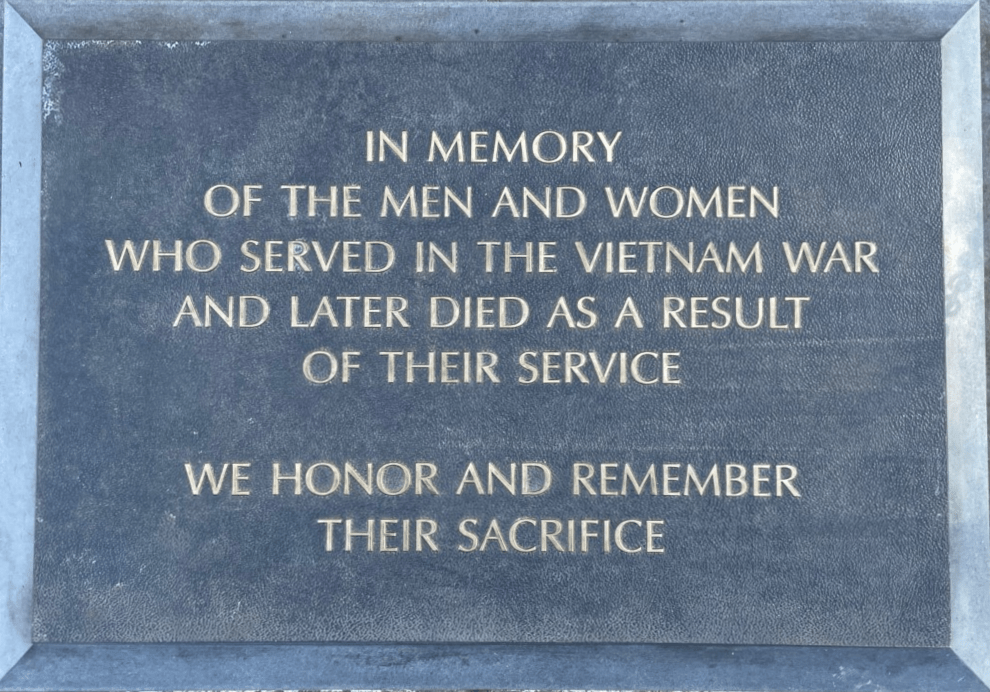
The final component of the memorial is the In Memory Plaque, added in 2004. The plaque acknowledges those Vietnam veterans who returned home, but who died of causes resulting  from their wartime service. The stone helps to remember those whose names are not on the wall.

The Vietnam Women’s Memorial statue

As the components of the memorial expanded, so has its number of visitors. People of all backgrounds are drawn to the wall: Vietnam veterans, relatives, friends, and colleagues, even those with little background or no immediate connection to the war. Currently, the Vietnam Veterans Memorial draws over five million people a year, making it one of the most visited sites in Washington, DC. 

A dedicated cadre of National Park Service rangers as well as volunteers are generally present at the memorial and ready to share stories of the memorial, help visitors find names and maintain the dignified environment. Paper directories with names listed alphabetically are available on adjoining walkways.

Visits to the memorial have generated two unique cultural practices. Tracing names using paper and pencils or charcoal has become a common ritual. This simple keepsake honors the fallen and commemorates or shares one’s time at the wall. Placing mementos of all kinds (medals, letters, documents, uniform items, even service member remains) at the foot of the panels is another practice. Since its opening in 1982, the National Park Service recorded over 400,000 items left in tribute. (Visit the Vietnam Veterans Memorial Fund website to see a sample of items found at the wall).

A detail of the nurse tending to a wounded US soldier at the Vietnam Women’s Memorial.

As the Vietnam Veterans Memorial enters its fifth decade, it lives up to the vision Jan Scruggs intended years ago, a place to go for healing, for peace. Wanda Ruffin, a widow whose husband James Ruffin is listed on the memorial, summed it up in writing: The Wall opens people up to their feelings. … There is something about the place that says, “It’s okay to show your feeling when [you] are down there.”

Indeed, this memorial’s attribute for healing is not exclusive to Vietnam veterans. It is not uncommon to see American veterans of later wars visiting the memorial to find peace and meaning in their service. Other visitors gather there for serenity and refection. In a city with many monuments, the Vietnam Veterans Memorial is decidedly different.

It is America’s sacred space on the National Mall.

Route Recon

The Vietnam Veterans Memorial is located on the northwest end of the National Mall, adjacent to the Lincoln Memorial, near the intersection of 23rd Street NW and Constitution Ave. NW. The official address of the memorial is 5 Henry Bacon Drive NW, Washington, DC 20002.

Hours: Open 24 hours a day, seven days a week. A kiosk on the Lincoln Memorial side is staffed from 9 a.m. to 5 p.m. each day except for Thanksgiving, Christmas and New Year’s Day.

The closest Metro station is Foggy Bottom/GWU (blue, orange and silver line trains) at 23rd and I Streets NW. It’s about a 15-minute walk southeast to the memorial. You can find bus and subway schedules at the Washington Metropolitan Area Transit Authority website.

The National Mall Circulator Loop bus stops just north of the memorial at 21st Street NW and Constitution Avenue NW and provides easy access around the National Mall.

Street parking along Constitution Avenue can be hard to find and is usually limited to two hours.

Capital Bikeshare has stations across the Mall, including two at the Lincoln Memorial and three behind the memorial on Constitution Avenue. The Mall is flat, so it’s easy for biking, and you’ll find bike racks at every memorial and monument.

National Park Service Rangers offer tours of the Vietnam Veterans Memorial and the Korean War Memorial on weekends. Find more information about events at all the memorials on the National Mall at the National Parks Service online calendar.

Every Soldier Has A Story At The National Museum of the US Army

Levi Gassett enlisted in the Northborough Minutemen at age 28 in April 1775. He answered the alarm on April 19 for Lexington and Concord, and would serve through the summer and fall in the American colonists’ siege of Boston. While on Dorchester Heights, an area of Boston on high ground with views of the harbor, Gassett took time to personalize his powder horn. He inscribed the date, the name Dorchester, made reference to the war and engraved pictures of trees and soldiers, leaving a short and very personal record of his service. His powder horn is now one of hundreds of artifacts on display at the National Museum of the United States Army that reveal intriguing stories of what it means to be an American soldier.   

The powder horn of Levi Gassett

Every soldier has a story is more than just a slogan here. Telling the stories of American soldiers, such as Sergeant Gassett, is the purpose, the reason, the rationale for this museum. It is a hallmark of how the museum goes about its mission, spread through eleven galleries over three floors.

The Army currently operates many museums in various locations on Army facilities around the world. Indeed, preserving its history has been an Army mission since 1814 when Congress passed a law directing both the Army and the Navy to “provide for the collection and preservation of flags, standards and colours…”.

A casting of a Buffalo Soldier, a sergeant from the 9th United States Cavalry Regiment. The faces and the hands for the castings were made from the likenesses of modern day US Army soldiers.

But this museum, sitting south of Washington, DC on Fort Belvoir, Virginia, is unique. While other Army museums preserve and convey the history of particular units, branches, posts or portions of the Army, this is the first museum to take a whole-of-Army approach and comprehensively tell some of the stories of the 30 million men and women who have donned the uniform of the U.S. Army, while also recognizing their service and sacrifices.  

Upon entering the museum, the black granite Campaign Wall dominates the gleaming white two-story entrance hall. Along the wall are listed the 191 separate campaigns that the U.S. Army has participated in since 1775. Across the ceiling are rows of colored glass panels depicting campaign ribbons represented on the Campaign Wall. Across the floor is a 21-foot wide inlaid seal of the U.S. Army.

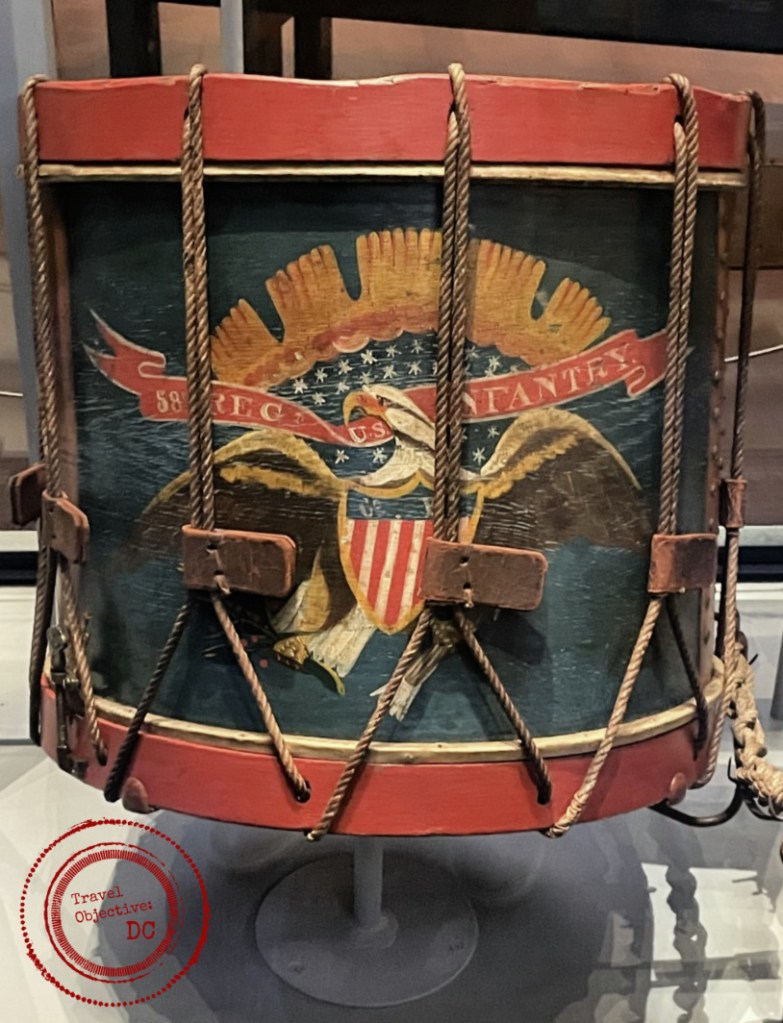
A Civil War-era snare drum used to keep cadence as soldiers marched and relay commands.

From the Entrance Hall a corridor leads to the first floor galleries, where seven-foot tall steel pylons begin telling soldier stories. The pylons are all inscribed with a soldier’s name, portrait, and a brief account of their service in their own words. They represent all types of soldiers from all walks of life throughout the Army’s history. They greet the visitor, almost like an honor guard in formation, presenting themselves for inspection.

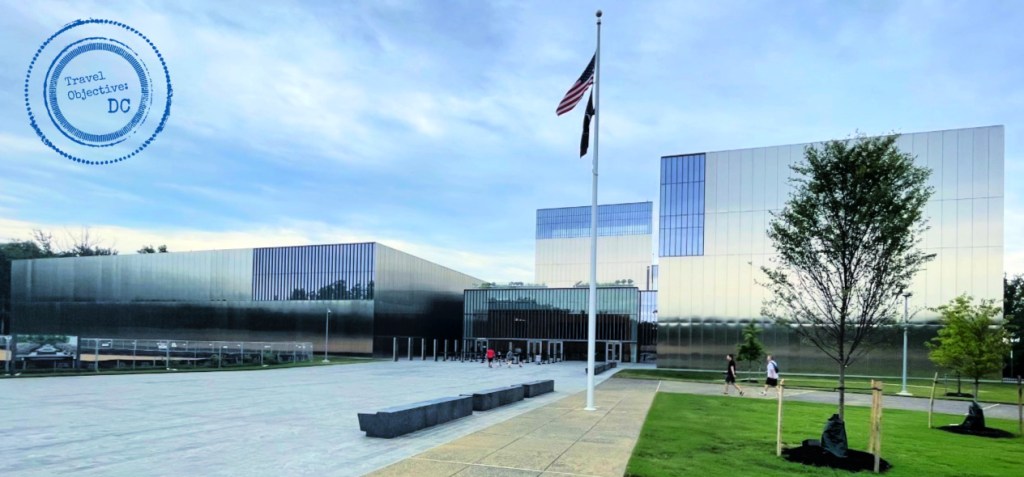
Entrance Hall of the National Museum of the United States Army at Fort Belvoir, Virginia

The corridor opens up to the Army Concourse which provides access to the seven first-floor galleries. Six of the seven are referred to as the Fighting for the Nation* galleries. These galleries describe how the Army has evolved through the experiences of individual soldiers, expanding to fight major conflicts, adapting new technologies and responding to or sometimes leading changes found across America. The seventh gallery is entitled The Army and Society, which illustrates the interactions between the Army and the broader American civilian population and its culture.

To complete the galleries, museum planners, curators, and designers scoured through the 580,000 available artifacts from the Army’s 247+ year history and selected approximately 1,400, which were then integrated with authentically detailed reproductions, maps, dioramas, life-like cast figures and other vestiges of Army life to produce some very eye-catching multi-media displays.

Electronic map of the General Defense Plan for Western Europe from the Cold War

The artifacts are not just weapons and uniforms, although there are many of those, but other objects such as musical instruments, mess kits, radios, surgical tools, books and other routine articles that were part of soldier experiences. A display found in most galleries is entitled A Soldier’s Load, which exhibits the gear, weapons and personal items a typical soldier would have used or carried through each conflict. Museum staff will periodically set up displays with reproductions, describing the equipment and allowing visitors to handle the items for themselves.

Cobra King, an M4 Sherman Tank, led the armored column which broke through German lines and relieved the 101st Airborne Division at Bastogne, Belgium on December 26, 1944 during the Battle of the Bulge.

Large artifacts, such as restored cannons, tanks, helicopters and jeeps are present as well. Taken in total, the artifacts provide a picture of what life was like for soldiers of all ranks and provide compelling context for the soldiers’ stories.

On the second and third floors are galleries devoted to rotating exhibits. One of these galleries is currently dedicated to the experiences of the Nisei Soldiers, the first generation of Japanese-American soldiers who fought valiantly during World War II.  Initially prevented from serving because of their Japanese origins, young Japanese-American men and women responded overwhelmingly once authorized to join the military. In 2010, Congress recognized the contributions of the Nisei, awarding them the Congressional Gold Medal for their outstanding achievements and service to the United States.

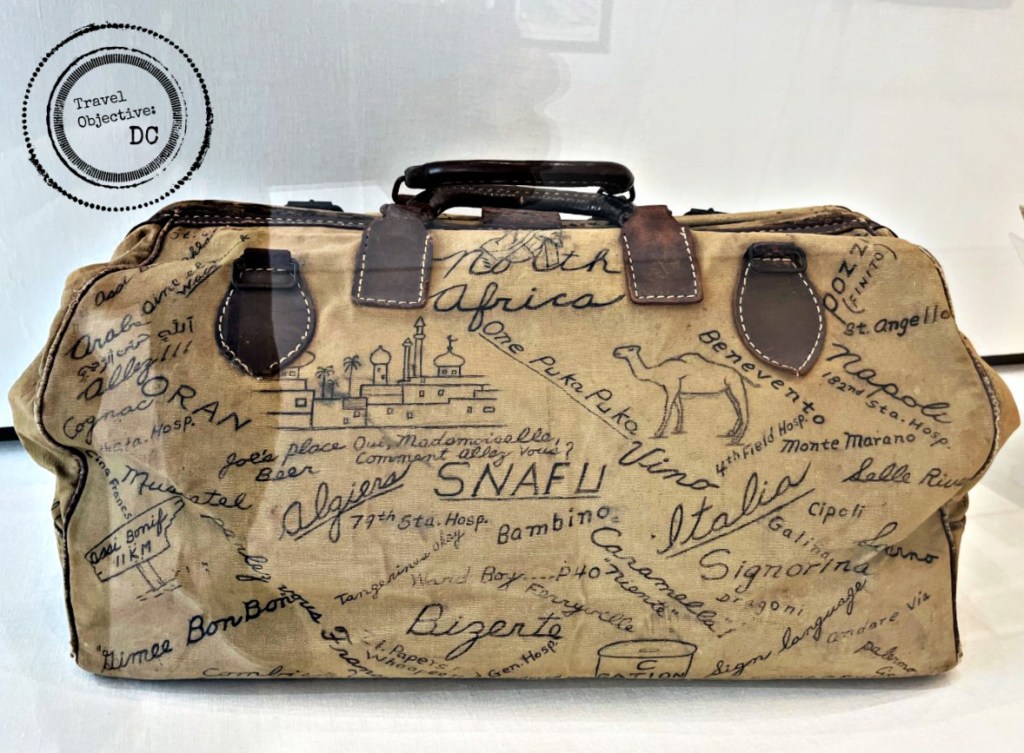
The travel bag owned by Sergeant Gary Uchida, a Nisea soldier of the 100th Infantry Battalion. He recorded his travels around Europe and North Africa on the bag.

A unique mixed-use space on the third floor is devoted to a permanent exhibit about the Medal of Honor, the nation’s highest military award. The display examines the Army version of the medal (the Navy and Air Force have their own versions), the history of the decoration and the circumstances under which it is awarded. Adjoining the exhibit space is a large, outdoor garden with a granite wall bearing the names of all the soldiers who have been awarded the Medal. Overlooking the museum’s grounds, the garden is a serene place to consider not only the selflessness and sacrifices of the Medal of Honor awardees, but on all of the many stories told throughout the Museum.

The Experiential Learning Center (ELC) allows visitors of all ages to experience some of the current technical skills required for today’s solders. Visitors in organized groups can then test these skills in a simulated response to a humanitarian crisis. A portion of the ELC especially designed for the younger visitors called Fort Discover explains about Army life by following the adventures of two Army mules, Spartacus and Buckshot. 

A diorama of modern day U.S. Army Brigade’s Tactical Operations Center

Additionally, the Museum hosts book talks, battle briefs, field trips and staff rides with authors and other speakers from the military history community.  Options for virtual participation in many of these events are also included.

Sitting on a quiet corner of Fort Belvoir, the Museum’s highly reflective steel exterior is meant to represent the Army’s strength and how the Army reflects American society. American society certainly has its controversies, and the Army does too. Descriptions of Mai Lai and Wounded Knee massacres, and what happened there, are depicted at the Museum. Some critics may argue they are not addressed comprehensively enough. However, they are included and invite further discussion among museum visitors as well as through the Museum’s educational program.

Officer’s gauntlets belonging to Colonel Joshua Lawrence Chamberlain, who commanded the 20th Maine Volunteer Infantry during the Civil War.

Museums serve many purposes. They inform, entertain, and educate their visitors. The National Museum of the US Army does all these things. It would be hard for even the most casual visitor to leave the museum without even a slightly better understanding of what it means to be an American soldier. But by telling soldiers’ stories and artfully displaying their artifacts, the Museum is also a place for reflection about service and sacrifice. It is a place for connection, to friends or to relatives from the present or past generations. It can also be a place to resolve, to reconcile and to heal.

If you have an interest in military history or have a personal connection to the Army–but especially if you do not–the National Museum of the US Army is well worth a visit.

The National Museum of the United States Army

* * *

Visit the National Museum of the U.S. Army website for more information about the museum and its educational programs.

Are you a current US Army soldier or veteran who would like to share stories about your experiences? The Army Historical Foundation established the Registry of the American Soldier to gather the stories and experiences of the entire Army community. More information is available at armyhistory.org/the-registries

Route Recon

The National Museum of the United States Army is located on a publicly accessible portion of Fort Belvoir, Virginia. The address is 1775 Liberty Drive, Fort Belvoir, VA 22060. (Please note that not all GPS systems may recognize the address. The Museum’s GPS coordinates are 38.7242806/-77.177874)

By Car:

If driving from Washington (traveling south)

Follow Interstate 395 South toward Richmond, VA. Merge onto Interstate 95 South. Take exit 166A toward VA-286 South/Fairfax County Parkway. Continue for 2.5 miles and turn left onto Liberty Drive.

If driving from Baltimore, Maryland (traveling south)

Follow MD-295 South, Baltimore-Washington Parkway. Exit onto Interstate 495 South/Interstate 95 South toward Richmond Va./Andrews Air Force Base. Follow signs for Interstate 95 South toward Richmond, VA. Take exit 166A toward VA-286 South/Fairfax County Parkway. Continue for 2.5 miles and turn left onto Liberty Drive.

If driving from Richmond, Virginia (traveling north)

Follow Interstate 95 North toward Washington. Take exit 166A toward VA-286 South/Fairfax County Parkway. Continue for 2.5 miles and turn left onto Liberty Drive.

By Metro:

On weekdays – The Franconia-Springfield Metro Station, on the blue line, is the closest station to the Museum. From Franconia-Springfield Metro Station, take Fairfax County Connector Bus Route 334, which includes a stop at the Museum. Please note: Bus Route 334 is available Monday-Friday only and does not currently operate on the weekends.

On weekends – The Huntington Metro Station, on the yellow line, is the next closest station to the Museum. From Huntington Metro Station, take Fairfax County Connector Bus Route 171, which includes a stop at the Museum. Please note: Bus Route 171 only stops at the Museum on the weekends.

By Bus: The Fairfax Connector bus service travels to the Museum via two different routes:
Route 171 : Weekends ONLY
Route 334: Monday – Friday ONLY
Please check the Fairfax County Website for the most current bus schedules.

Mess Call

The Army Historical Society manages the Museum Café, which offers a selection of grab-and-go items, boxed lunches and grilled entrees along with beverages and other snacks. Museum visitors can order through a quick access app or via the web. Café hours are 9:00 AM to 2:00 PM.

* Fighting for the Nation Galleries

Founding the Nation – Traces the Army’s origins from the earliest Colonial militias, through the formation of the Continental Army and into the War of 1812.  

Preserving the Nation – Considers the divided loyalties of Army soldiers and officers in the earliest days of the conflict to how the Army would expand, fight and win the Civil War. 

Nation Overseas – Introduces the early clashes of the 20th Century where the Army first deployed beyond the United States and the how the Army prepared for and fought in World War I.

Global War – Examines how the Army would quickly mobilize and fight to win a two front war against fascism.

Cold War – Discusses the wars in Korea, Viet Nam and the defense of Western Europe from the threat of invasion by the Soviet Union.

Changing World – Recounts the end of the Soviet Union, the Persian Gulf War, the attacks of September 11, and the wars in Iraq and Afghanistan.


“Freedom is Not Free” Remembering Why at the Korean War Veterans Memorial


Nineteen figures, dressed in combat uniforms and moving in formation, cut a silent, ghostly silhouette against the seasonal colors of the National Mall.  Tall in stature and gray in color, these figures represent an American infantry unit from the Korean War.  

The statues are the most prominent feature of the Korean War Veterans Memorial. Sitting just to the southeast of the Lincoln Memorial, it is one of the National Mall’s most intriguing sites. 

The Korean War began on June 25, 1950, when North Korean forces of the Korean People’s Army, with the backing of Soviet and Chinese leaders, poured over the 38th parallel, attacking south with the goal of reuniting a divided Korea under the leadership of Kim Il Sung. Within 48 hours, the United States committed air and sea forces to the defense of South Korea. On June 27, the United Nations Security Council passed Resolution 83, calling on “Members of the United Nations furnish such assistance to the Republic of Korea as may be necessary to repel the armed attack…”. 

Fighting would last 38 months, during the years from 1950-1953. United Nations forces were able to repel the initial North Korean invasion. The last two years was largely a stalemate, even though there was fierce fighting and direct engagement between US and Chinese ground troops. An armistice halting the fighting was signed on July 27, 1953 in Panmunjom, Korea.

By the end of hostilities, over 5.8 million Americans served in the US armed forces and 36,574 Americans died as a result of hostile actions in the Korean War theater.  In addition, 103,284 were wounded during the conflict. Losses were especially high among the Korean combatants. Over 162,000 South Korean soldiers and 526,000 North Korean soldiers were killed. Civilian deaths during the Korean War on both sides are estimated at between 2-3 million. 

The details of the Korean War may not be known to many of the visitors, but the memorial vividly weaves together symbolism and imagery to portray the conflict’s sacrifices and significance.  

An image of a US Navy nurse from the Mural Wall

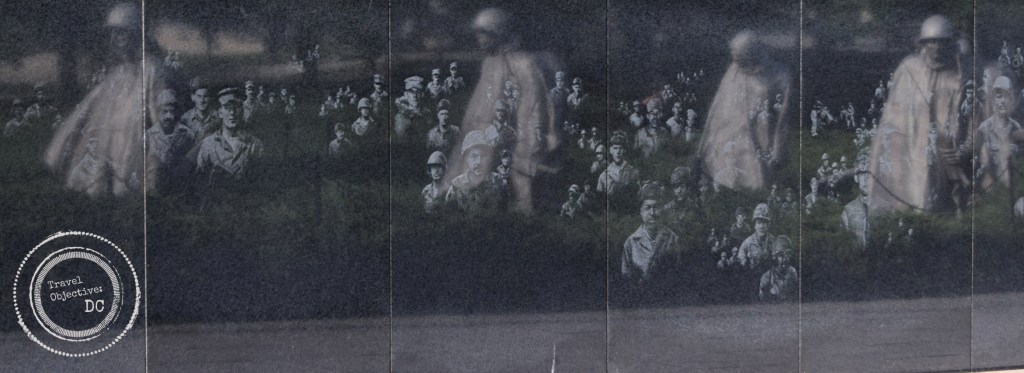
For full effect, the statues should be viewed in conjunction with the Mural Wall, which adds a unique, two dimensional feature to the memorial. The 164-foot long wall is constructed of a highly polished black granite and stands to the statues’ right side. It bears the images of over 2,400 troops and different specialties from each branch of the Armed Forces that supported the infantry during the Korean War. Both the faces of the statues and the visages on the wall are based on actual Korean War veterans, taken from photographs supplied by the National Archives and Records Administration and other renderings. Viewed from a distance, the service member images on the wall resemble the mountains of Korea.  The wall vividly reflects the statues, suggesting 38 servicemen moving in formation and symbolizing the 38th parallel and the 38 months of the war.

On the left side of the statues is the United Nations curb, a stone edge to a paved walkway with the name of the 22 Countries that, like the United States, fought or provided material support in Korea under the auspices of the United Nations.  

An engraving of the the United Nations seal as depicted on the United Nations Curb.

The statues appear to be moving toward an American flag flying from a flag pole next to a reflecting pool shaded by a grove of linden trees. At the base of the flag pole is a small stone with the inscription “Our nation honors her sons and daughters who answered the call to defend a country they never knew and a people they never met.” 

The pool is inscribed with the numbers of casualties sustained during the war by both the United States and the United Nations. The area is known formally as the Pool of Remembrance; the pool and the adjoining benches shaded by linden trees invites quiet contemplation of the war and its costs. 

* * *

For the United States, the Korean War was unlike any other before it. 

Congress made no declaration of war. Rather, the US fought under the auspices of the new United Nations and provided most of the UN combat forces. The Korean War would be more limited, without the general mobilization of American society as was seen in the First and Second World Wars. A new branch of the armed forces, the US Air Force, would organize and conduct air campaigns.  And for the first time since the American Revolution, the war was fought with a racially integrated military. (Notice the 19 statues represent multiple racial and ethnic groups and all four branches of the armed forces).

Statue depicting a US Air Force Air-Ground Controller

It was also fought in a very far away land, not well known to many Americans, to contain the spread of communism, the growth of which in Eastern Europe and China immediately following World War II was seen as a threat to the American democracy and capitalism. 

The Korean War remains with us today. The armistice of 1953 only ended the fighting, but not formally the war. A demilitarized zone marks the current border between the two Koreas. Tensions remain high. Korea is never very far from the headlines or newsfeeds and remains a major focus of US diplomacy and foreign policy. The US is still committed to the defense of South Korea and maintains a force of approximately 24,000 troops in the country. 

Over 7,600 US service members are still listed by the Pentagon as missing in action. The North Korean government periodically returns remains of US service members. In 2018, 55 boxes of remains were presented to US officials and taken to the Defense POW/MIA Accounting Agency in Hawaii for identification.  Potentially, 80 US service members may be identified from these sets of remains. Some already have. One was US Army Corporal Charles S. Lawler, 19, of Traverse City, Michigan.  Corporal Lawler was a member of the 1st Cavalry Division. He was reported missing in action on Nov. 2, 1950, after his unit was attacked near Unsan, North Korea. He was buried in his hometown on July 27, 2019. 

A group photo from the 8225th M*A*S*H*. The concept of forward deployed military hospitals was successfully implemented during the Korean War.

Popular narratives sometime label the Korean War as “the Forgotten War”, which seems misleading. It certainly was never forgotten by the Korean people, nor by the veterans who fought there and certainly not by the families of those who died there. The US military community has not forgotten as there has been a large military presence in Korea for decades. And the 1968 novel M*A*S*H*, about an Army field hospital which became a successful motion picture, then later a very popular television show, continued to remind the American public of the Korean War.

And now for over a quarter century, an exceptional and dignified memorial stands on the National Mall to help us remember. 


Route Recon:

The Korean War Veterans Memorial is located at the western end of the National Mall. It is two miles walking distance from the U.S. Capitol. A paved footpath connects the Korean War Veterans Memorial to the Lincoln Memorial area. The nearest metro stations are Foggy Bottom (23rd St. &I St. NW) and Smithsonian (12th St. & Independence Ave. SW).

Visitor parking is available along Ohio Drive, SW between the Lincoln and Thomas Jefferson Memorials. 

The Korean War Veterans Memorial is accessible 24 hours a day. Some visitors especially like to visit at night or in foggy or rainy weather, when the statues take on a surreal nature. 

There are many online resources regarding the Korean War. A good place to start is the US Army Center for Military History’s Korean War Commemorative Website .   

One Last Note: The Department of Defense (DoD) currently lists the number of US service members killed during the Korean War as 36,574. For many years, the Department of Defense had listed the number as 54,260, which is the number included on the memorial. Later research conducted by DoD determined the higher number included deaths of US service members who died on active duty during the 38 months of the war, although not necessarily as a result of combat operations in Korea. The higher number is included on the memorial as it honors all US service members who served during the Korean War. 

A Place to Pause and Ponder the Marks of War

One of Washington’s newest memorials is also one of its most unique. Dedicated by President Barak Obama on October 5, 2014, the American Veterans Disabled for Life Memorial (AVDLM) stands on a wedge-shaped piece of ground in Southwest Washington, D.C., an island of reverence floating amidst a busy bureaucratic sea.

Unlike other monuments found throughout Washington dedicated to individuals, military units or specific wars, this memorial is dedicated to all current and former members of the Armed Forces who have been changed physically or psychologically by war.

The AVDLM was the brainchild of Lois Pope, a Florida philanthropist who was inspired after meeting a disabled veteran at the Vietnam Veterans Memorial in 1995 and realizing no similar monument exited for American service members disabled by war.


She would ultimately team up with then-U.S. Department of Veterans Affairs Secretary Jesse Brown and Art Wilson, head of the Disabled American Veterans, to spearhead the effort. The three would encounter many challenges and hurdles in building this memorial before realizing their goal, not the least of which was the memorial’s location.

The 1986 Commemorative Works Act provided the National Capital Monuments Commission the authority to approve the sighting for all monuments and memorials on most Federally owned land.

During the review process, the commission found that the AVDLM did not reach the level of prominence necessary to afford it a space on the National Mall. While the AVLDM’s supporters were taken aback by the decision, they selected an alternate location one block south of the Mall, rather than risk a major delay in the project.

A view of the U.S. Botanic Garden Conservatory (and its reflection) from the memorial.

At first glance, the site might seem an odd location for such a monument. It lies between three busy streets–Washington Avenue, 2nd Street and C Street–amid interchange ramps for arterial highways and next to the Headquarters of the Department of Health and Human Services. The Rayburn House Office and other Federal office buildings spread out in the blocks around it. The massive Capitol Power Plant looms large to the south. Pedestrian and vehicle traffic can be heavy in the area.

The U.S. Capitol Dome and the Bartholdi Fountain are both visible from the AVDLM site. The memorial’s planners thought the close proximity of the memorial to the Capitol would remind Congress of their responsibilities regarding war and peace.

After numerous revisions, the final construct combined stone, water, fire, vegetation, and etched glass into multiple design elements which not only mark the physical and psychological impact of war on the veteran, but also the ability of that veteran to emerge from trauma and move forward toward recovery with courage and resolve.

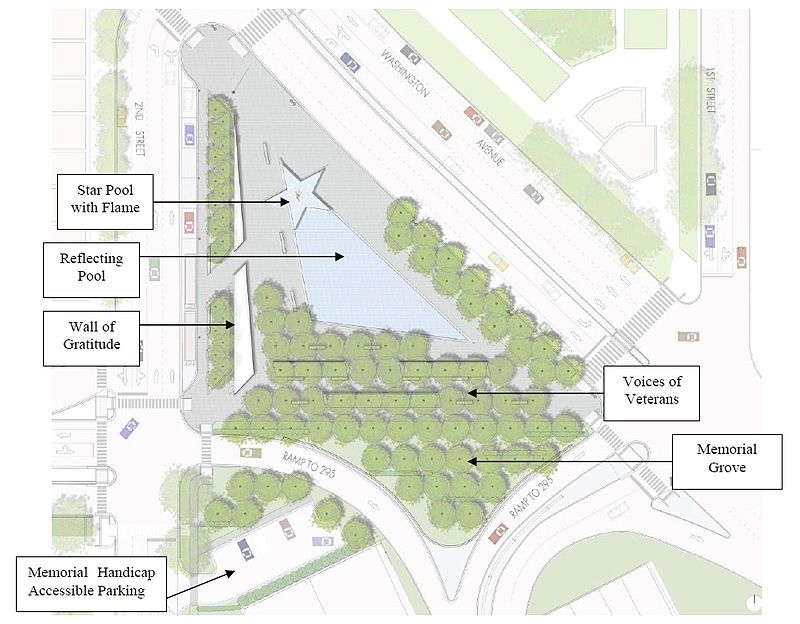
The National Capital Planning Commission’s architectural drawing of the layout of the AVDLM’s final design.  National Capital Planning Commission (June 24, 2010). American Veterans Disabled for Life Memorial, …  NCPC File No. 6179 (Report). Washington, D.C.: National Capital Planning Commission.

The focal point of the memorial is a star-shaped fountain and triangular reflecting pool. At the center of the fountain is a flame produced by the ignition of gas bubbles floating up through the water. The flame of course recalls the sacrifice of wounded veterans and the effect of the flame rising out of the water is quite enthralling. (Unfortunately, during the colder weather months the fountain is drained and there is no flame).

Along the south side of the memorial (cleverly masking the power plant) are three walls composed of 48 glass panels where the true message of the AVDLM is found in etched images and inscriptions of wounded veterans discussing their duty, the impact of their wounds, what it took to recover, and how they moved forward.

The 18 quotes on the walls were selected from over 600 submitted anonymously to a design panel. Interspersed within the walls are four bronze silhouette sculptures which provide additional visual context to the disabled veteran’s path of pride in their service, trauma, recovery and finding new purpose.

Along the western side of the memorial are two large granite walls bearing two more quotes on the burdens of war and military service by George Washington and Dwight D. Eisenhower.

Around the memorial are ginkgo and cypress trees and a variety of ornamental bushes and other plants, which add some greenery to the many stone and glass features. The ginkgo trees turn gold each November and will ultimately grow to form a canopy through the memorial.

A ginkgo tree silhouetted by the Department of Health and Human Services next to the memorial.
A bronze silhoutte sculpture within the glass wall.

Throughout the memorial plaza are a myriad of stone benches, inviting the visitor to sit and spend some time letting the memorial’s elements come together – the burning flame, the trickling water, the thoughts and images of the veterans, the names of Washington and Eisenhower, the Capitol Dome, even the traffic and people passing by – to remind us all that the wounded warrior is much more than the wound.

Disability does not define the disabled veteran.

If you cannot come to Washington DC to visit the AVDLM in person, click here for a virtual tour or check out the American Veterans Disabled for Life Memorial website for a video montage and information about the memorial’s planning and construction.

* * *

The Census Bureau estimates there are approximately 4 million disabled veterans living in the United States today. If after your physical or virtual visit to the AVDLM, you want to lend some of them a hand, there are many organizations who are looking for volunteers with a wide variety of skills to assist in providing professional services, home improvement help, advocacy, fundraising and many other areas.

A few examples include:

  • The Disabled American Veterans (DAV) organization offers a variety of services to disabled veterans and their families and has many volunteer opportunities.
  • The Fisher House Foundation has a network of homes on the grounds of military and VA hospitals for visiting family members of hospitalized service members and veterans. Fisher House operates the Hero Miles Program, using donated frequent flier miles to bring family members to the hospitals for visits.
  • Building Homes for Heroes builds specially modified homes for disabled veterans that help them live independently. The homes are provided at no cost to the veterans.

ROUTE RECON

The AVDLM is located southwest of the U.S. Capitol and south of the U.S. Botanic Gardens. The Street address is 150 Washington Avenue, SW, Washington, DC 20024. The memorial is accessible from the Capitol South and Federal Center Southwest Metro Stations (on the Blue, Orange and Silver lines).  There is very limited street parking in the immediate area.

MESS CALL

There are a number of eating establishments in the blocs to the west of the AVDLM. One locally owned favorite is the 2 Sisters Deli at 400 C Street SW. The deli features tasty and generously sized sandwiches at a reasonable (for DC anyway) price. And the staff is friendly.

75 Years After Pearl Harbor, the Taney Still Serves

What better way to observe the 75th Anniversary of the attack on Pearl Harbor than to visit the last U.S. ship afloat which saw action on that fateful December morning.

The U.S. Coast Guard Cutter Taney is moored about 40 miles north of Washington, D.C. The Taney is part of the Historic Ships in Baltimore, a floating museum of notable ships from our nation’s naval and maritime heritage.

taney_travel-objective-dc_travelobjectivedc-com
U.S. Coast Guard Cutter Taney (WHEC-37)

The Taney (pronounced TAW-ney) was one of seven Coast Guard vessels in the Treasury class of High Endurance Cutters. The Treasury Class would be known for their ability to perform many different types of missions and their many years of service to the Coast Guard. The Taney was built in Philadelphia and launched in 1936. She was assigned to Honolulu from 1936 through 1941 where she undertook missions familiar to today’s Coast Guard: law enforcement, maritime patrols, and search and rescue, among others.

pearl-harbor-poster_travel-objective-dcOn the morning of December 7, 1941, the Taney was moored in Honolulu Harbor, about eight miles away from Pearl Harbor. While not directly attacked that day, she did engage Japanese aircraft in her vicinity.

In the war’s early years, the Taney stayed in the Pacific, conducting maritime patrols, pilot rescues, and counter-submarine operations.

From 1943-1944, the Taney served in the Atlantic theater, performing convoy escort duty between the U.S. and Europe, and engaging German planes in the Mediterranean. In late 1944 the Taney was converted to an Amphibious Command Ship and returned to the Pacific. She was Rear Admiral Calvin Cobb’s flagship at the battle of Okinawa where her crew served with great distinction defending her from more than 250 attacks by Japanese aircraft.

After the war, the Taney returned to peacetime missions: reporting weather conditions, conducting search and rescue missions, and supporting law enforcement operations. From 1946-1972, the Taney was based at Alameda, California.

img_5794The Taney also participated in the Viet Nam War. From 1969-1970, she patrolled the waters off Viet Nam, supporting naval bombardments, preventing enemy resupply operations and providing medical assistance to South Vietnamese nationals.
In 1972, she was transferred to the east coast, continuing her peacetime missions, as well as serving as a training ship for Coast Guard cadets and officer candidates.

The Taney was decommissioned in 1986 and transferred to the City of Baltimore as a museum ship.

After 50 years of service to the Coast Guard, the Taney certainly lived up to her designation as a “High Endurance” cutter.

* * *

Today the Taney is found on Pier 5 of Baltimore’s Inner Harbor. Climb aboard, walk the decks, explore the berths and you get a sense of the rhythm of mid-20th century “Coastie” life.

taney-enlisted-mess_travel-objective-dc

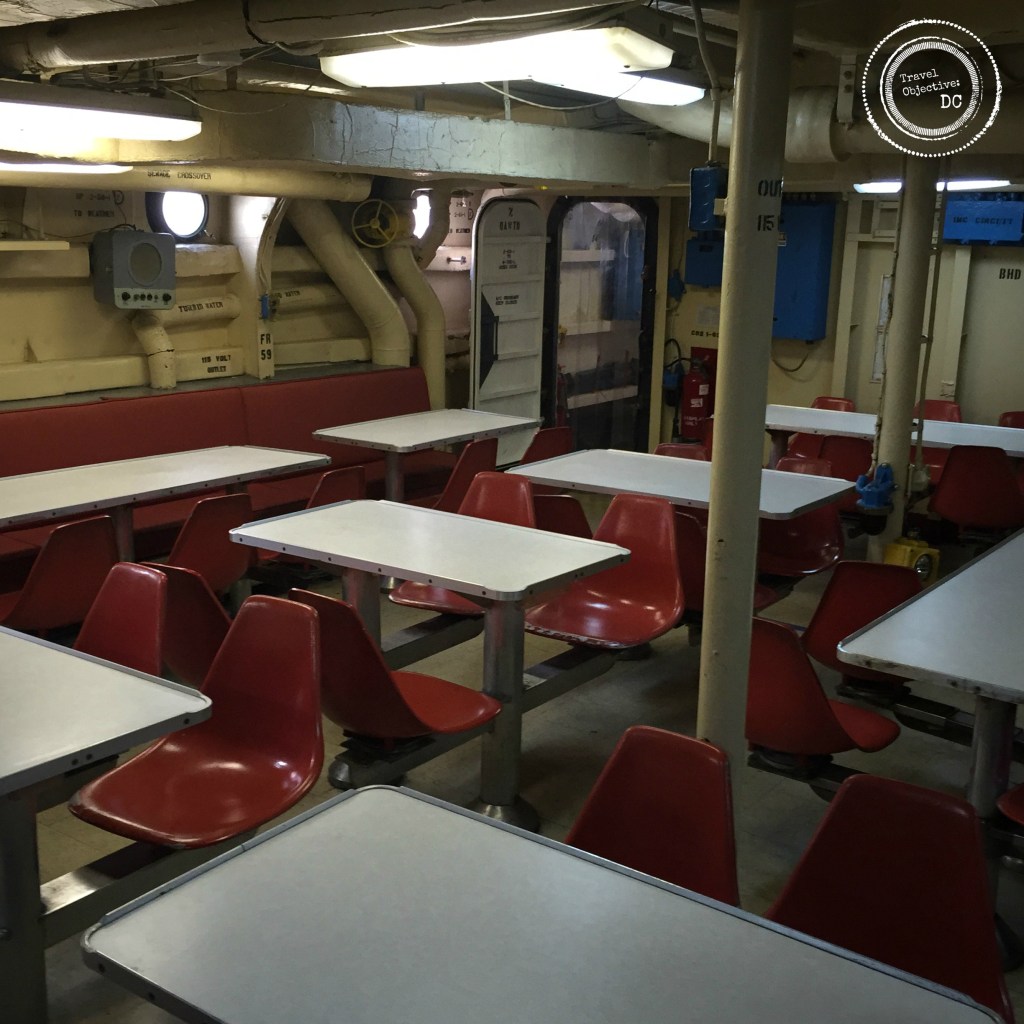
A blue line with arrows painted on the deck guides you through the living quarters, dining areas and work spaces. Placards and actual shipboard notices to the crew, dating from the 1980’s, explain how crewmembers spent their days moving between duty, meals, hygiene and sleep with long hours of routine punctuated by brief periods of white knuckle danger, recreational diversions or just a few peaceful moments to observe a Pacific sunset.

Available space is tight on the 327-foot-long cutter, so privacy was clearly a luxury reserved for the Taney’s senior officers, especially when the size of the crew doubled to over 250 personnel during World War II. There are also special exhibits devoted to the attack at Pearl Harbor and the Taney’s service in Viet Nam.

taney_enlisted-sleeping-quarters_travel-objective-dc

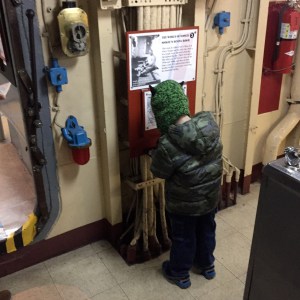
img_5785Younger visitors can learn about the Taney’s Mascot “Soogie”, a dog who sailed on board from 1937 until 1948.

Paw prints on the floor direct kids to information kiosks with details about this Coastie canine and his life at sea.

In recognition of her service at Pearl Harbor, each year on December 7 at 12:00 noon, the Historic Ships in Baltimore hosts a memorial ceremony on board the Taney. The event is free and open to the public.

But any season is a good time of year to visit the Taney and learn her stories. A few hours on board and you can’t help but develop a healthy respect for the ship and the crew members who sailed her through a half century of service to the United States.

taney-in-baltimore-inner-harbor_travel-objective-dc