Navy Pride on Pennsylvania Avenue: The United States Navy Memorial


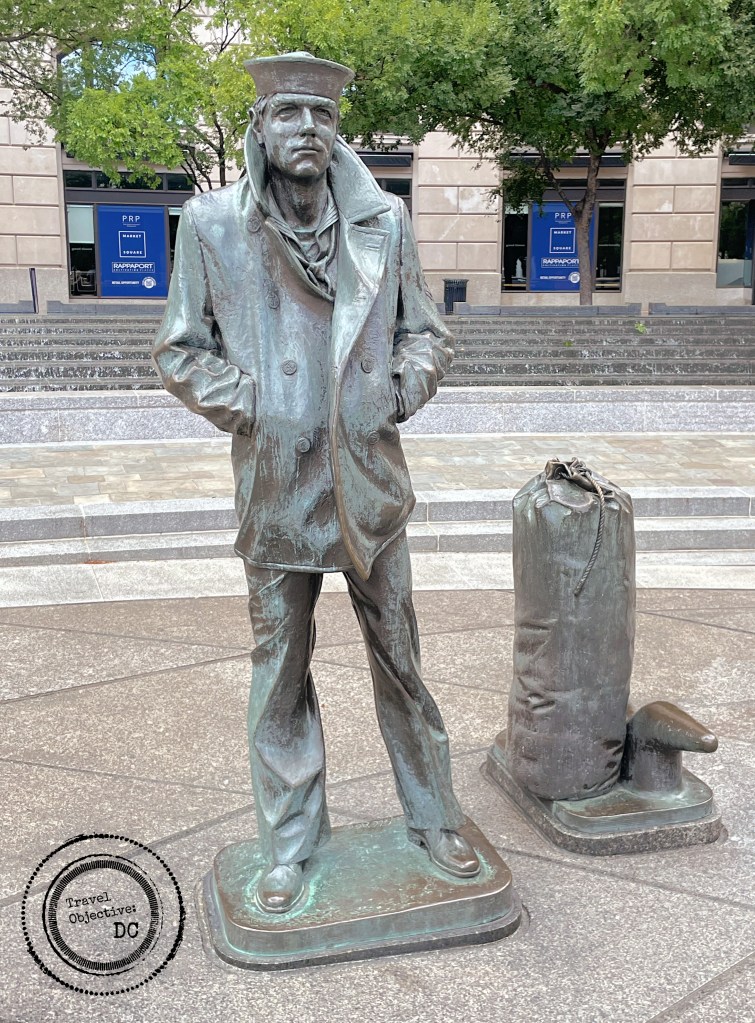
In a large open plaza stands a statue of a solitary figure.

He is a sailor in a dress unform. He stands straight and tall wearing a service “dixie cup” sailor hat. A buttoned up peacoat with a flipped up collar protects him from the chill of the ocean air. His hands are plunged deep into his pockets. His packed sea bag stands by his side. The determined look on his face denotes his readiness to deploy anywhere and perform his duty.

The statue is known as The Lone Sailor and serves as the centerpiece of the US Navy Memorial.

The Lone Sailor Statue at the US Navy Memorial

The Lone Sailor Statue

For centuries, considerable discussion was had regarding a suitable monument paying tribute to the United States Navy. Pierre L’Enfant had included a Memorial Column for the Navy in his original plans for Washington, DC.  Other memorials were built to honor the Navy during specific conflicts, but nothing existed to honor all American sailors. 

This all began to change in the spring of 1977 as Admiral Arleigh Burke urged Navy senior leaders and veterans to get serious by proclaiming: “We have talked long enough about a Navy Memorial, and it’s time we did something about it.”

When Admiral Burke–a distinguished World War II war hero and three-time Chief of Naval Operations–spoke, Navy personnel listened. The Navy Memorial Foundation was quickly organized and Rear Admiral William Thompson was named its first president. Admiral Thompson proved an excellent choice for the job and quickly set to work.

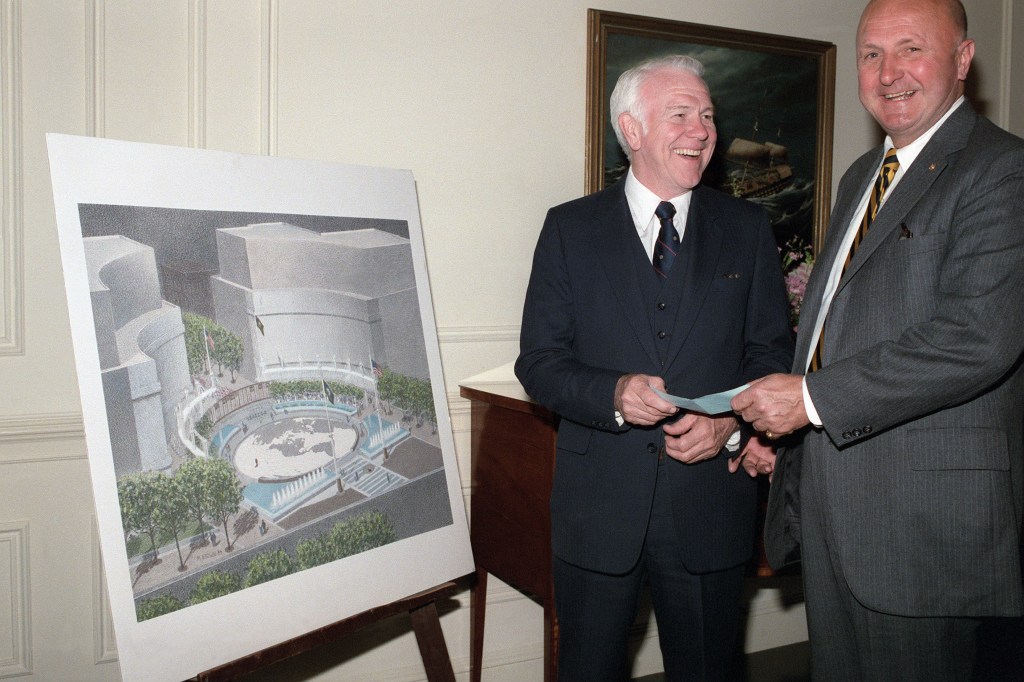
Rear Admiral William Thompson (ret.), on left, receiving a donation for the US Navy Memorial. Note the artist’s rendition of the Memorial.

-Department of Defense Photo

Rear Admiral William Thompson (ret.), on left, receiving a donation for the US Navy Memorial.

He first helped shape the enabling legislation Congress would pass in 1980. He then led the foundation through selecting the memorial’s designers, determining the memorial’s location, raising money and overseeing construction.

Admiral Thompson also helped select the sculptor Stanley Bleifeld to design and sculpt The Lone Sailor Statue. In recognition of Admiral Thompson’s significant contributions to building the memorial, Bleifield included Thompson’s initials on the Lone Sailor’s sea bag. 

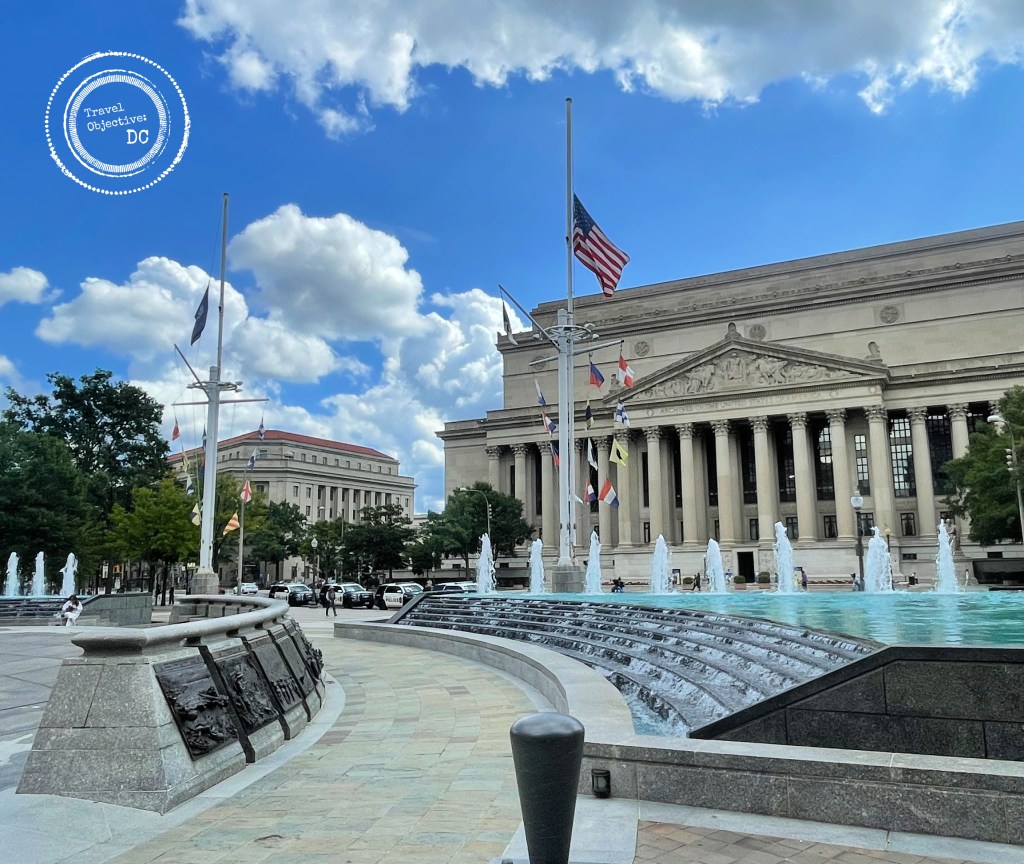
The Navy Memorial Plaza

The Navy Memorial Plaza looking south toward the National Archives

The whole process from the founding of the memorial to its completion stretched to almost a decade. The Navy Memorial was formally dedicated on October 13, 1987 by President Ronald Reagan. He devoted it to all who have served, are serving or will serve in the United States Navy, Marine Corps, Coast Guard and Merchant Marine. 

The memorial is set within a broad circular plaza to the northwest of the intersection between 7th Street and Pennsylvania Avenue. Early designs for the memorial favored a more traditional approach, but they were discarded in favor of a memorial with a more open space resembling a seascape.

The floor or base of the plaza depicts a large world map.  With a diameter of 100 feet, it is said to be the largest map in the world.

Fountains at the US Navy Memorial

A set of fountains at the US Navy Memorial

Fountains skirt the southern perimeter of the map. The water flowing through the fountains comes not from Washington DC’s water supply but is collected from the world’s oceans and the Great Lakes.

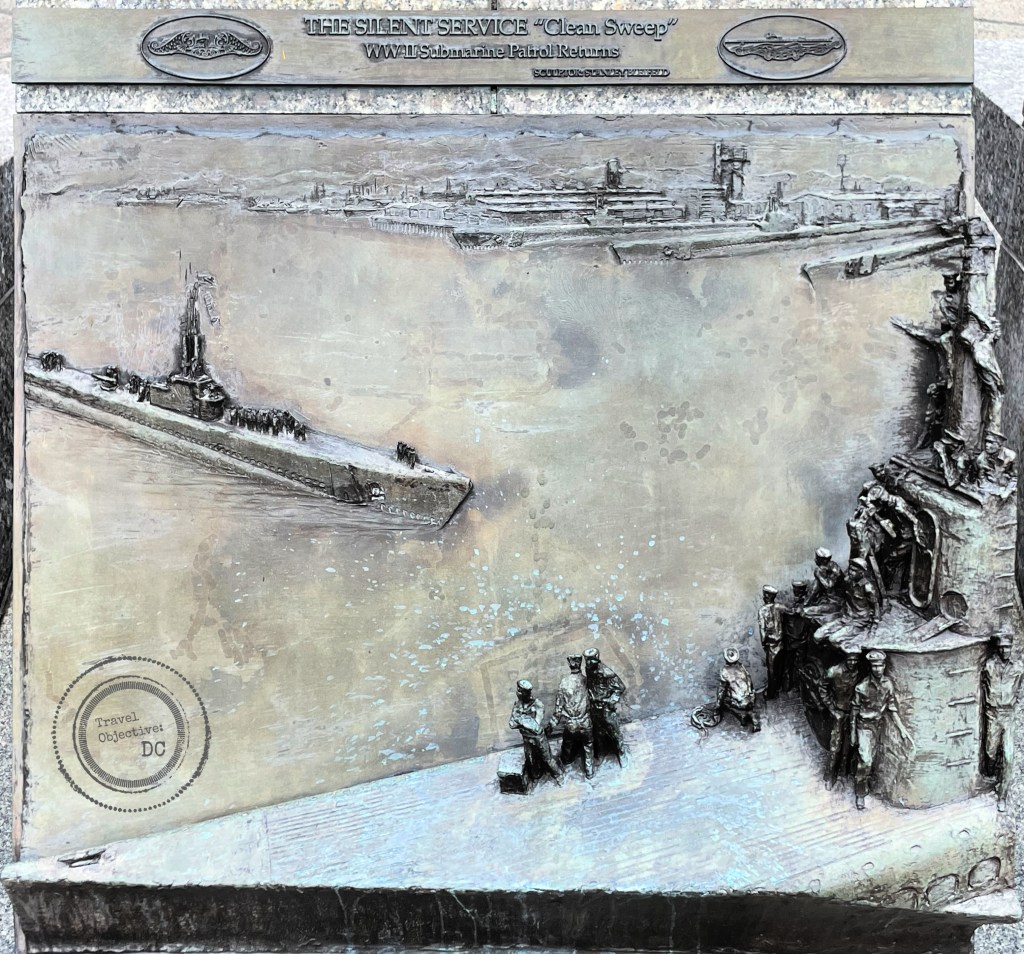
A semicircular wall inside the fountains contains a series of 26 bas-relief figures depicting scenes of Navy history and Navy life as well as the contributions of maritime partners. 

Arrayed around the memorial are quotes about the Navy from sailors at all levels. Six masts fly the flags of the United States, the Navy, Marine Corps, Coast Guard, Merchant Marine and the POW/MIA flag.

Bas Relief sculpture of Navy submarines in World War II.

Bas Relief sculpture of Navy submarines in World War II

Sweeping arches incorporated into the design of two mixed-use commerical buildings suggest a northern perimiter to the memorial, balancing the fountains and sculpture walls on the southern side. The neoclassical design of these buildings seemingly provides a sense of the shore or anchorage to the airy, open plaza.

Amidst all this stands The Lone Sailor. The statue has been so enthusiastically received by the Navy community, there are 18 more Lone Sailor statues across the United States (and one at Utah Beach in Normandy). In each location, the statue reminds the community of the dedication and professionalism of the American sailor. 

Bas Relief Sculpture of Captain John Paul Jones

Bas Relief Sculpture of Captain John Paul Jones

Early in the design phase, the Navy identified a desire to have a “living memorial,” a place where people would gather and return to time and again. The open space makes the memorial a popular venue for summer concerts, reenlistments, promotion ceremonies, wreath layings and reunions.

In keeping with the desire for a living memorial, the Navy Memorial Foundation located a visitor center in one of the adjoining buildings. Part research facility, part musuem and part community center, the visitor center brings the Navy experience alive for the landlubber while instilling pride in all Navy sailors. There are exhibits on the missions of the post 9/11 Navy, multiple Navy leaders, and the important role played by chief petty officers.

The visitor center also houses the Arleigh Burke Theater. In addition to running several short movies on Navy life throughout the day, as well as periodic feature films, the theater hosts guest speaker programs. Visitors can find a variety of mementos from all the US military services at the Ship’s Store gift shop.

A video screen displays the Navy Log.

A video screen displays the Navy Log throughout the day.

There is also a feature known as the Navy Log, an online archive with details of the men and women who have served in all the sea services. There are currently over 750,000 entries. Active members, veterans or their loved ones are invited to add to this number and enter a service member’s information as an ongong tribute to their time in uniform.

As the US Navy observes its 250th Anniversary, the US Navy Memorial is a place for everyone to discover and honor America’s rich naval heritage. Whether you are active, retired, reserve or the relative or friend of someone who has served, the Navy Memorial is an important and worthwhile destination for any visit to Washington, DC.

***

 I can imagine no more rewarding a career. And any man who may be asked in this century what he did to make his life worthwhile, I think can respond with a good deal of pride and satisfaction: ‘I served in the United States Navy.’

President John F. Kennedy

Route Recon

The US Navy Memorial is located at 701 Pennsylvania Ave, NW Washington, DC 20004. 

The Memorial is accessible 24 hours a day.

The Visitor Center is open seven days a week from 9:30 AM to 5:00 PM.

The Navy Memorial hosts numerous events throughout the year. Some events may close the Visitor Center to the public. Be sure to check the Memorial’s website and find additional information about upconing events on the calendar

The closest Metro Station is Archives-Navy Memorial-Penn Quarter on the Green and Yellow Lines.

Parking:
Validated parking is available at PMI Garage, 875 D Street, NW.
Parking can be validated for $13 inside the Ship’s Store, located in the Navy Memorial Visitor Center.

A Moment on Iwo Jima Became a Monument for All Time

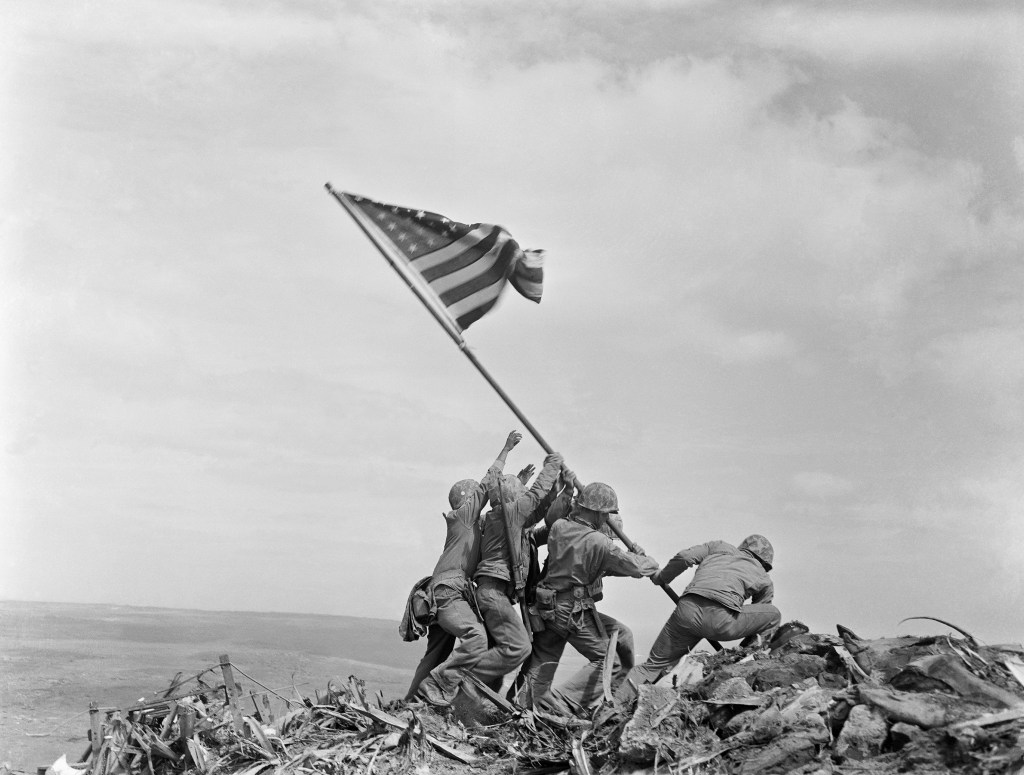
You may not know the name Joe Rosenthal, but you have seen his work. Rosenthal was a photographer for the Associated Press (AP). On the afternoon of February 23, 1945, in 1/400th of a second, Joe Rosenthal took one of the most iconic photographs in American history. Seven decades later, his image of six United States Marines in combat gear raising an American flag still captivates the mind and stirs the soul. 

The photograph inspired a famous sculpture that is now recognized around the world as a symbol of the United States Marines. Known officially as the United States Marine Corps War Memorial, it is dedicated “For the Marine dead of all wars, and their comrades of other services who fell fighting beside them, since the Marine Corps’ founding in 1775”. 

The memorial is located in Arlington Ridge Park, a broad, open green space on the edge of the busy Arlington neighborhood of Rosslyn and in close proximity to Arlington National Cemetery. Situated on high ground overlooking the Potomac River, the park is a natural venue for the memorial.

Upon approaching the memorial, the first impression is of its size.  The entire monument is more than five stories high. The thirty-two foot bronze figures of the Marines stand on a polished, black granite oval base. A green patina on the bronze adds color to the figures’ carefully sculpted fatigue uniforms.  

Around the base of the statue, notable battles fought by United States Marines from the Revolutionary War through the present day are engraved in gold lettering. Fleet Admiral Chester Nimitz’s observation that among those Americans who served on Iwo Jima, “uncommon valor was a common virtue” is prominently inscribed on the west side of the memorial. 

A circular trail around the park features interpretive signs providing background information on the Battle of Iwo Jima, the famous photograph, facts about the statue, and the history and missions of the US Marines.

A miniature statue for the vision impaired included on an interpretive sign near the memorial.

The Marine Corps traces its history back to 1775 when the Continental Congress authorized the recruitment of two battalions of Marines to provide the fledging Continental Navy with a ground operations force.  Since then, the Marines have engaged in every major conflict and a number of expeditionary operations. As the Marine Corps Hymn declares, the Marines have “fought in every time and place…” including some places you might not expect, such as the Civil War’s First Battle of Bull Run and the Battle of Belleau Wood during World War I.   

In the decades before World War II, the Marine Corps developed and refined the doctrines, tactics and training for amphibious landing operations, where Marines would storm ashore from landing craft prepared to fight. Their proficiency in these complicated maneuvers was instrumental to the success of the Allied “island hopping campaign” in World War II’s Pacific theater. In early 1945, the island of Iwo Jima became the next strategic objective. By this time in the war, US B-29 Superfortress bombers could reach the main Japanese islands from airstrips on Guam and Saipan. However, both the airstrips and the B-29 in-flight formations were often attacked by Japanese fighters based on Iwo Jima.

As they prepared, the Marines knew Iwo Jima would be a tough fight. Unlike earlier battles, the Marines would be landing on Japanese territory, not an occupied island. The Imperial Japanese Army had approximately 23,000 soldiers on Iwo Jima, occupying an extensive tunnel and fortification system. 

On February 19, 1945, approximately 70,000 Marines and Navy support personnel landed on Iwo Jima. After days of heavy fighting, Marines of the 2nd Battalion, 28th Marine Regiment made steady progress in their mission to capture Mount Suribachi, a dormant volcano that was the highest point on the island. By the morning of February 23, they reached the summit. 

The first Iwo Jima flag raising. A small flag carried ashore by the 2nd Battalion, 28th Marines is planted atop Mount Suribachi on February 23, 1945.

– Staff Sergeant Louis R. Lowery, USMC

At the top, an American flag was raised so that troops across the island would see the Marines now held the high ground. At the sight of the flag, Marines cheered and Navy ships sounded their horns. 

But the flag was only about 4-feet-long and not quite visible at a distance. A few hours later, an 8-foot-long flag was acquired and sent up to the Marines on Mount Suribachi.  As six Marines quickly planted the second flag, Joe Rosenthal captured the moment for posterity.

Once the flag was raised, the Marines quickly dispersed as fierce fighting continued. Four more weeks of intense combat were yet to come. The landing force sustained 24,053 causalities, roughly one third of those who landed. Three of the men in the photo were among the 6,140 Marines and Navy corpsmen who would lose their lives on Iwo Jima, the deadliest battle ever for the Marine Corps.

But there were instances of great heroism as well. Twenty-seven men were awarded the Medal of Honor for their service at Iwo Jima (about half of them were presented posthumously). 

Joe Rosenthal’s famous photograph of the second flag raising on Iwo Jima.

Joe Rosenthal was carefully balancing himself on some rocks and sandbags as he quickly snapped his famous photograph without using the viewfinder. 

He was unaware of how the picture would turn out as he sent the film to Guam for developing a few hours after taking the photo. The developed pictures crossed the desk of an AP photo editor named John Bodkin. Bodkin’s job was to scan through the photos submitted by his photographers across the Pacific theater for use in American newspapers. Upon seeing Rosenthal’s picture, he knew it was special, proclaiming “Here’s one for all time!”

He immediately arranged to transmit the picture to the AP Headquarters in New York. It arrived in time to be printed on the morning of February 25th in the Sunday editions of newspapers all over the United States. The photograph was an instant sensation. The previous week’s grim news of the terrible combat and heavy casualties on Iwo Jima were now replaced by a picture showing American progress and determination. Rosenthal won the Pulitzer Price for the photo and it would become the main symbol of the 7th US War Loan campaign. 

US Department of the Treasury poster for the 7th War Loan. The campaign would raise over $26 billion during the spring of 1945.

Sculptor Felix W. de Weldon, an artist on active duty with the US Navy, was one of the millions who saw the image. Captivated by the photograph, he began modeling the image in clay, then building a life size representation. 

He proposed building a grand monument based on Rosenthal’s photograph. With the consent of both Congress and the Marine Corps he began working on plaster models from which bronze castings for the statue were made. 

A private fundraising campaign was begun to build the statue based on de Weldon’s work. Over $850,000 was raised from Marines, veterans, and other supporters. He modeled the faces, frames and other features of three men who survived the battle and were believed at the time to be in the photo. He used photographs and information about the fallen Marines to model their images. 

After years of hard work, the memorial was dedicated by President Dwight D. Eisenhower on November 10, 1954.  In 1961, President John F. Kennedy signed a proclamation authorizing the US flag to be flown at the memorial 24 hours a day. 

Shortly after the photo was taken, there were issues with identifying the men in the picture. Rosenthal did not record the names of his subjects and his picture shows no faces. An event that took about ten seconds became a distant memory in the face of the intense fighting on Iwo Jima. The initial efforts to identify the figures lead to unfortunate errors. The first misidentification was corrected in 1947 as Corporal Harlan Block was identified as the Marine planting the flag pole into the ground. For many decades it was believed a Navy Corpsmen named John Bradley and a Marine named Rene Gagnon were in the photograph.

In the 2010’s researchers studying Rosenthal’s and other photographs (there were both Army and Marine Corps photographers present at the time) of the flag raising carefully examined the uniforms and equipment of the flag raisers. They concluded that two different Marines and neither John Bradley nor Rene Gagnon were actually in the photograph. The Marines convened two official Boards of Inquiry, one in 2016 and another in 2019. After thorough examinations of the evidence to include some previously unknown photographs of the second flag raising, the boards concurred.

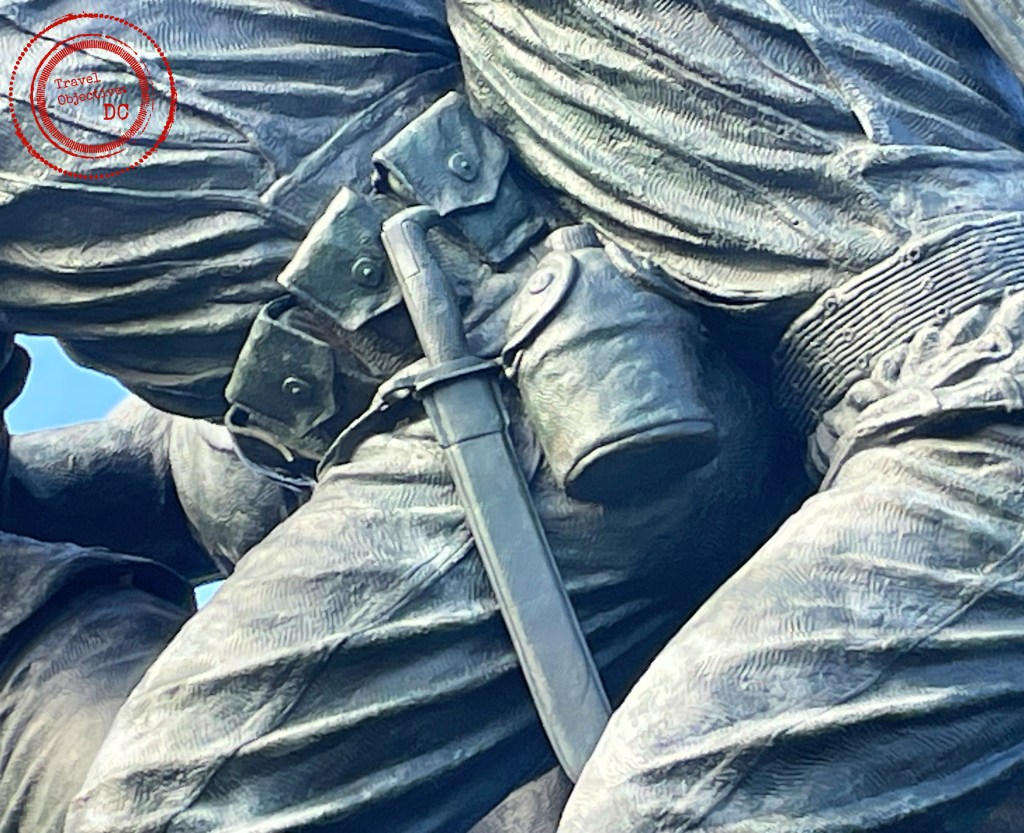
Note the sculptor Felix de Weldon’s precise detail on the Marines’ uniforms and equipment. Given the large size of the statues, the canteen would hold eight gallons of water.

In public statements, the Marines explained the importance of being factually correct, but noted that nothing in the historians’ research nor the boards’ findings diminishes any of the contributions of the Marines and other servicemen who fought on and around Iwo Jima.

Visitors to Washington, DC should include the US Marine Corps War Memorial on their short list of destinations to visit, especially if they have a connection to the Marine Corps. Unlike many other Washington-area landmarks, visiting the Marine Corps Memorial is fairly straightforward. Unless there is a special ceremony, the park is often quiet and peaceful. Free parking is available and the Rosslyn Metro Station is a ten-minute walk away.  

But ease in visiting an iconic sculpture is only one reason. Joe Rosenthal’s photograph and the memorial it inspired gained fame for what their subjects represent: critical values, such as teamwork, dedication and sacrifice. These values made the Marine Corps an effective fighting force throughout its history.

Indeed, these values–like the photograph and the monument–are for all time.

* * *

According to the US Marine Corps, the following six Marines are depicted on the memorial (from right to left):

Corporal Harlon Block, (depicted at the base of the flag pole)

Private First Class Harold Keller

Private First Class Franklin Sousley

Sergeant Michael Strand

Private First Class Harold Schultz

Private First Class Ira Hayes 

* * *

Route Recon

The US Marine Corps War Memorial is located in Arlington Ridge Park. The address is 1000 Marshall Drive, Arlington, VA 22209.

Park Hours are 6:00 AM – Midnight daily. Restrooms are located at the park. 

By Car

From VA 110 south turn right onto Marshall Drive, then follow signs for the US Marine Corps War Memorial.

From US 50 east take the exit for Rosslyn and the Key Bridge. Turn right onto Meade Street at the top of the ramp. Turn left on Marshall Drive, then follow the signs for the US Marine Corps War Memorial.

From US 50 west cross into Virginia on the Roosevelt Bridge and take the exit for Rosslyn and the Key Bridge. Turn left onto Meade Street at the top of the ramp. Turn left on Marshall Drive, then follow the signs for the US Marine Corps War Memorial.

Parking is available at the US Marine Corps War Memorial. Special events may limit parking.

By Metro

The memorial is a 10-15 minute walk from the Rosslyn Metro Station on the Blue Line. 

Arlington National Cemetery 

Arlington Ridge Park adjoins Arlington National Cemetery. Use Arlington National Cemetery’s Ord & Weitzel Gate gate to access the park and the memorial. 

Sunset Parades

On designated Tuesday evenings during the summer, the US Marine Corps holds Sunset Parades at the memorial.  The Sunset Parades are a 45-minute performance featuring the US Marine Band, the United States Marine Drum and Bugle Corps and the Marine Corps Silent Drill Platoon.

Command Reading

Flag of Our Fathers – This book was authored by James Bradley, son of Navy Corpsman Jack Bradley who was believed to be one of the flag raisers in Joe Rosenthal’s famous picture. The younger Bradley set out to write a book telling the life stories of the individuals associated with the flag raising. Published in 2000, long before it was concluded that two of the book’s subjects did not actually take part in the flag raising, the book provides compelling background on the lives of these Marines and gripping accounts of the combat on Iwo Jima. Bradley also provides details on how Joe Rosenthal took the famous photo as well the 7th War Loan fundraising campaign.

Grant Immemorial

Ulysses S Grant Memorial | Washington DC

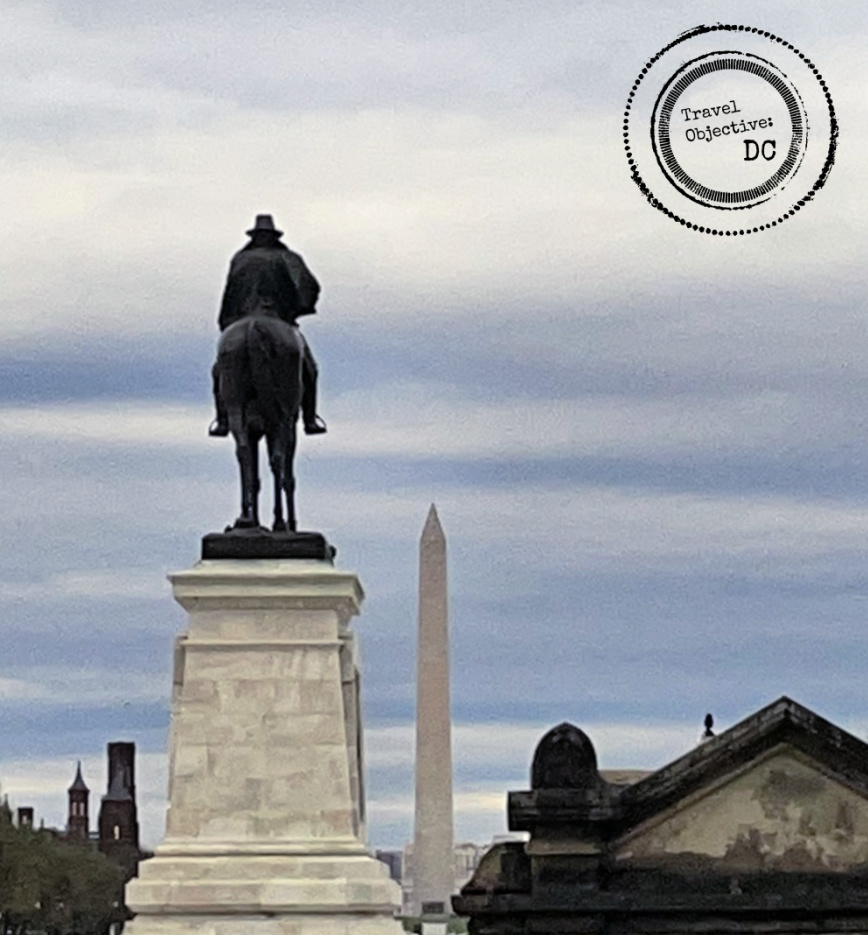
The sculpted face of Ulysses S. Grant looks across the National Mall with dispassionate determination. Around him a battle rages. A cavalry unit charges forward, an artillery detail hurries to emplace a cannon, infantry continue their forward march. Yet Grant, in his simple uniform and campaign hat, sits atop his war horse Cincinnati, looking forward, studying the situation and planning several steps ahead.

Such is the image portrayed in Washington, DC’s memorial dedicated to the Civil War General-In-Chief and 18th President of the United States. The memorial is located in Union Square, a plaza located just west of the U.S. Capitol grounds.

The move to commemorate Grant in Washington, DC began in the decade after his death in 1885, spearheaded by surviving veterans of the Union Army of the Tennessee. In 1902, Congress ultimately selected the ambitious designs of sculptor Henry Merwin Shrady and architect Edward Pierce Casey who envisioned a large multifaceted memorial in bronze and stone. 

A native of New York City and a graduate of Columbia University, Shrady took up art while recuperating from typhoid fever. Although Shrady had no formal training as an artist or sculptor, some of his early works earned him much acclaim. He focused on sculpture and studied anatomy very carefully in order to portray realistic figures in his statues. In 1901, he completed a famous equestrian statue of George Washington located in Brooklyn.

Men and horses advance in the statue entitled Calvary Charge, part of the Ulysses S. Grant Memorial.

After winning the Grant award, he engaged himself even more thoroughly in researching his subjects. He studied New York City Police Department horses. He examined Grant’s death mask. He observed military drills and exercises. He analyzed Civil War uniforms, weaponry and equipment to enhance the detail in his work. He drew upon his father’s recollections as a physician who attended to Grant in his final year. His architect partner, Edward Casey, was a veteran of the New York National Guard and lent some of his military experience to the project.

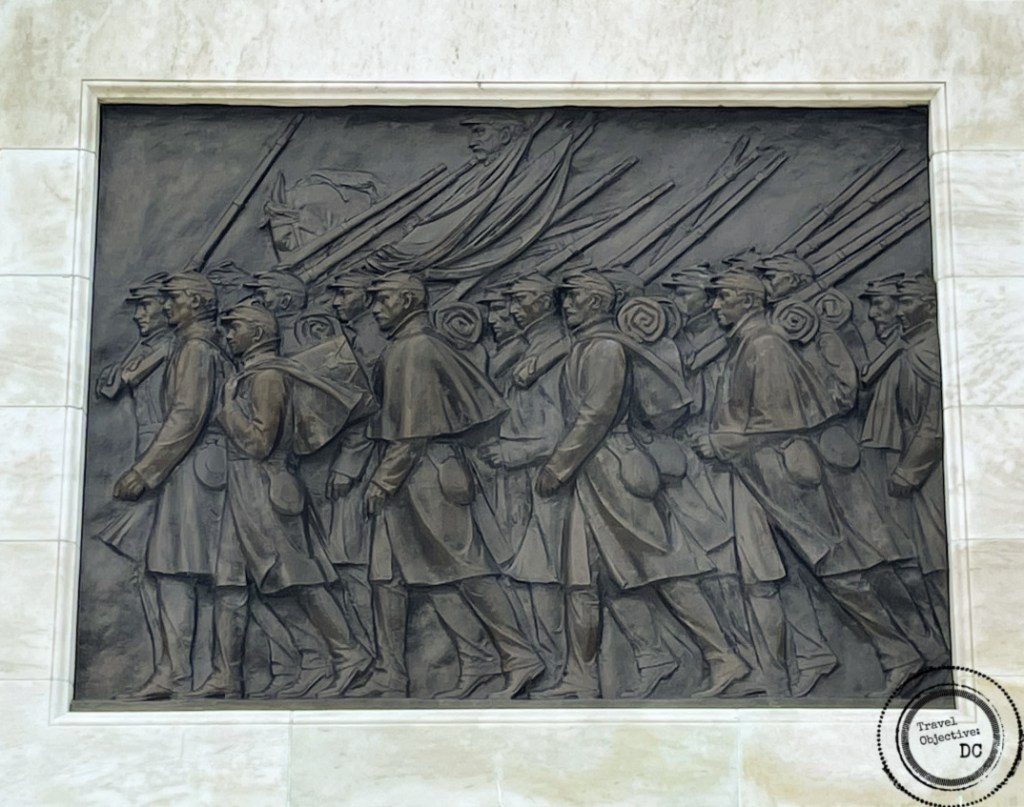
Shrady and Casey’s memorial dominates the Union Square area. The centerpiece statue of Grant, reaching 44 feet high, is one of the largest equestrian statues in the world. Two bronze bas-relief sculptures depicting advancing infantry adorn opposite sides of the statue’s pedestal. Four bronze lions on their own pedestals guard Grant’s statue adding a sense of majesty. The statues and pedestals sit upon a terraced marble platform about 240 feet from end to end. At both sides along that platform are additional bronze sculptures depicting the randomness and chaos of combat. 

An artillery detachment races to place a cannon in Henry Shrady’s statue Artillery at the Ulysses S. Grant memorial.

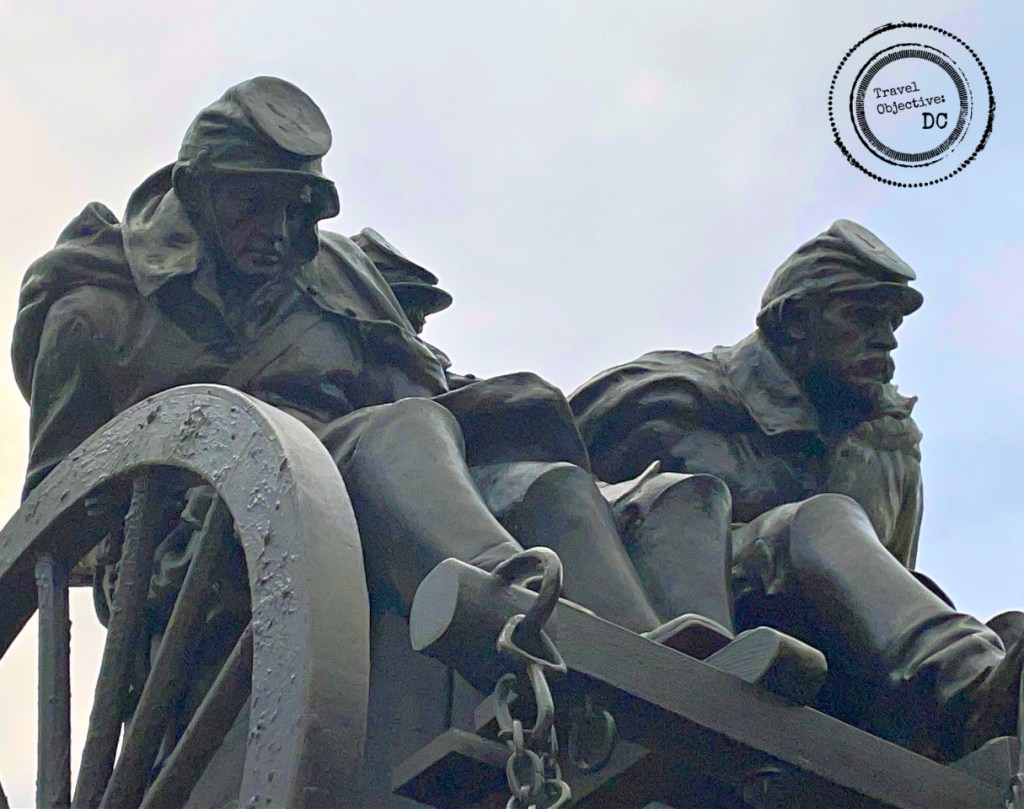
The sculpture known as Artillery presents a team of soldiers and horses racing to position a cannon. The guidon bearer has signaled a turn to the right, yet a bridle on the lead horse has broken and the horse continues to lunge forward. 

At the opposite end of the memorial, the statue entitled Cavalry Charge depicts cavalry troopers on the move.  An officer raises his sword ordering the advance, the buglar sounds the charge, a soldier bears the colors. Yet tragedy is about to strike as a trooper has fallen from his mount and will be trampled. Shrady is said to have portrayed himself as the ill-fated soldier. 

Shrady had worked relentlessly for twenty years on the memorial, undertaking some of the most ambitious and complex sculpting work of the time. He obsessed over every detail of the massive statues, each of which took years to produce and were some of the largest bronze castings of their time. Sadly, Shrady died about two weeks before the final dedication of the statue in April of 1922 commemorating the 100th Anniversary of Grant’s birth.

The face of the fallen trooper in the Cavalry Charge statue, said to be that of the sculptor Henry Shrady. The Grant Memorial project consumed twenty years of Shrady’s life.

Given the interest both Shrady and Grant had in horses, it is not surprising how prominent they are in this memorial. This seems fitting as Grant was an accomplished rider and horseman.

Grant learned to care for and work with horses as a young man growing up in Ohio. His father was a well-connected businessman who secured his eldest son an appointment to West Point. Grant was not especially enthused about attending the military academy, but knew it was likely his best opportunity for a university education. 

Ironically, it was an accident of paperwork at West Point that he got his name Ulysses Simpson Grant. He was born Hiram Ulysses, but his Congressman wrote Ulysses Simpson (his mother’s maiden name) on his appointment documents. When he reported to West Point in 1839, he was told the appointment was for Ulysses Simpson Grant, so he assumed the name, rather than reapplying. 

 He was a capable, but unambitious student who graduated in the middle of his class in 1843.   

Originally thinking he might go on to teach college math, Grant decided on a military career following his service in the Mexican-American War. During the war, Grant was recognized several times for his bravery in combat. He learned some important skills during his service in Mexico, developing a proficiency in military logistics, and witnessing the leadership styles of several commanders, including Zachary Taylor and Winfield Scott. 

Detail of the two artillerymen riding the wagon in the Artillery statue.

After the war, Grant found aspects of the peacetime Army difficult, especially the separation from his family. Unfortunately, he looked for solace in alcohol and developed a reputation as a problem drinker. That reputation followed him his entire life. He resigned his commission in 1854 and unsuccessfully pursued a string of civilian jobs, ultimately going back to work for his father in Galena, Illinois. 

Following the attack at Fort Sumter in April 1861, Grant was determined to return to military service. He sought and received a commission and the command of the 21st Illinois Volunteer Infantry Regiment. He restored discipline and effectively trained the unit to make it combat ready. A promotion to brigadier general followed in August 1861.  

A bronze bas-relief plaque of marching infantry soldiers on the pedestal of the Grant equestrian statue.

In February 1862, Grant led his troops to successful engagements at Fort Henry and Fort Donelson in western Tennessee. His successes gave the Union some badly needed victories. They also gained him the nickname “Unconditional Surrender” Grant, because he demanded his enemies surrender without terms. His actions led to his promotion as a Major General of volunteers and he was appointed commander of the Army of the Tennessee.  

In April 1863, Grant’s army was attacked by Confederate forces; the resulting fight at the Battle of Shiloh made plain the painful truth that a long war awaited both sides. The losses were staggering, a combined 23,000 causalities. But Grant’s deft leadership in sustaining the rebel assault and successfully counterattacking led to a Union victory. Grant received criticism for being unprepared for the Confederate attack; some even calling for his removal.  Lincoln famously responded “I can’t spare this man, he fights.”

After Shiloh, Grant and his Army pushed further south from Tennessee, aiming to take the Mississippi River port city of Vicksburg, a vital logistics hub for the Confederacy. Grant would demonstrate strategic prowess in this campaign, coordinating his troop’s movements with the Navy, splitting his forces to fend off a rebel reinforcement, and ultimately accepting the surrender of Vicksburg and its 30,000 Confederate defenders on July 4, 1863 after a 48-day siege.  

In October 1863, Grant was given command of all Union armies in the West. He moved quickly to break a Confederate siege of a Union Army in Chattanooga, Tennessee. His success led Lincoln to appoint Grant to the rank of Lieutenant General (the first officer to hold this rank since George Washington) and as General-in-Chief of the Armies of the United States in March 1864.

As General-in-Chief, Grant provided Lincoln with a campaign plan for a multiple front operation wherein Federal Armies would pursue the remaining major Confederate formations and degrade the South’s ability to wage war.  

Through the spring of 1864 and into 1865, Grant would accompany General George Meade and the Army of the Potomac, engaging in a brutal campaign which ultimately lead to the surrender of Robert E. Lee at Appomattox, Virginia on April 9, 1865. 

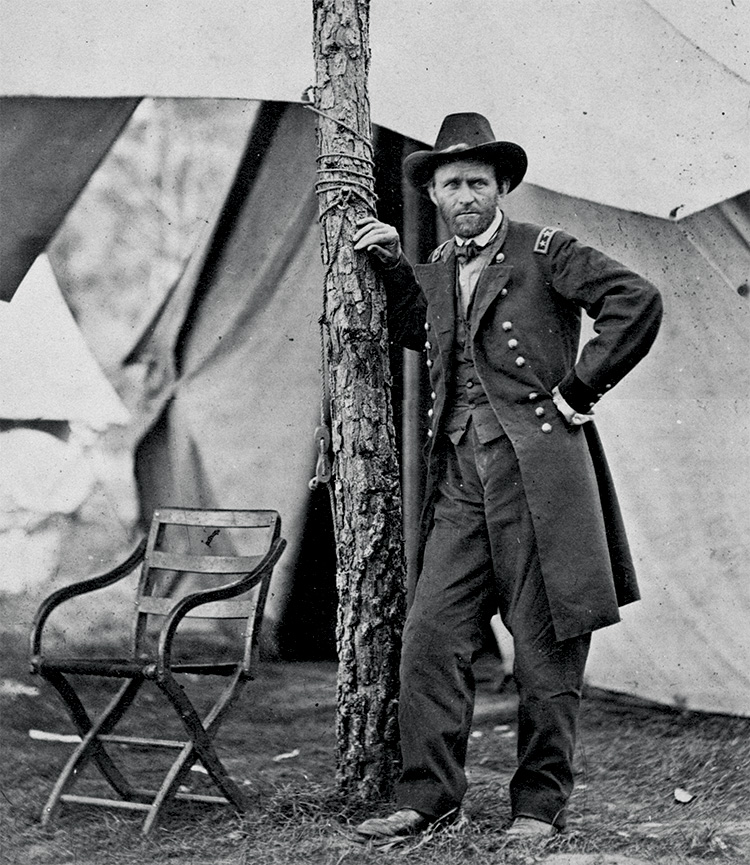
Ulysses S. Grant at his Cold Harbor, Virginia Headquarters in June 1864.

-Civil War Photographs, 1861-1865, Library of Congress, Prints and Photographs Division.

After the war, Grant would serve as Secretary of War under President Andrew Johnson. In 1868, he was elected president and served two terms. Unfortunately for President Grant, although he was personally honest and upright, those around him were not and his administrations were tainted by corruption. Still, there were several notable accomplishments during his administration such as the ratification of the 14th Amendment, passage of early civil rights legislation, establishment of the Department of Justice, and the creation of Yellowstone National Park.

Despite the scandals, Grant remained very popular. Like Washington, he chose not to run for a third term. He left office, and embarked on a grand tour of America and the world. His later years proved quite difficult. An unscrupulous investor took advantage of Grant and he lost much of his money in bad investments. He was diagnosed with throat cancer in 1884. Wanting to leave his wife with sufficient means to support herself, he worked tirelessly up to his death to complete his memoirs.  When the Personal Memoirs of U.S. Grant was finally published, it was a major success, heralded by critics, historians and the public alike.

Grant died on July 23, 1885 in upstate New York. Over a quarter of a million people viewed his funeral train as it traveled down the Hudson River valley to New York City. Tens of thousands of Union Army veterans accompanied Grant’s casket in a procession sometimes seven miles long. Confederate generals Joseph Johnston and Simon Buckner were among his pall bearers. 

For a time, Grant’s legacy suffered from debatable stories related to his drinking, supposed indifference to losing soldiers in combat and scandalous presidency. Over the past several decades though, historians and scholars have more closely examined Grant’s characteristics as a strategic leader, effective manager, and skilled tactician.

Like Grant’s reputation, his memorial in Washington, DC has also undergone refurbishment over the past few years. In 2011, the Architect of the Capitol accepted responsibility for the memorial from the National Park Service and began to restore the statuary and stonework. Signs of corrosion and weathering were removed, the marble and bronze polished, missing or broken features from the statues, such as swords and chains, were replaced. Eight ornate bronze lamps were also installed around the memorial.  

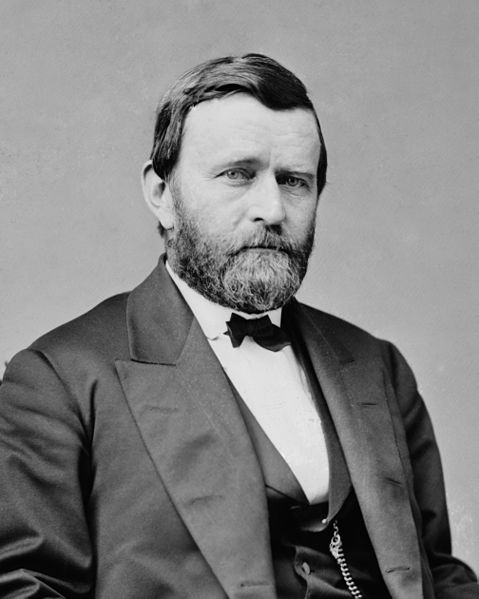
Portrait Photograph of President Ulysses S. Grant, circa 1870

-Matthew Brady; Library of Congress Prints and Photograph’s Division

At the top of that memorial, as the face of General Grant gazes west, he can see the memorial to his wartime president, Abraham Lincoln. Through the Civil War years, Ulysses Grant and Abraham Lincoln developed a close working relationship. The two were westerners with a common touch and similarly humble origins. Lincoln appreciated Grant’s leadership, his willingness to maintain the offense and his sense of responsibility. Grant wrote: “No general could want better backing for the president was a man of great wisdom and moderation.” Now their memorials bookend our National Mall, a fitting testimonial to the president and his general who fought so hard to preserve the Union.

Route Recon

The Ulysses S. Grant Memorial is located along First Street, NW, just to the west of the U.S. Capitol building. The best way to get to the memorial (and the Capitol) is by taking Metro.

Three Metro stops are within walking distance of the memorial and the Capitol:

  • Union Station – Located at First Street, NW, and Massachusetts Avenue.
  • Capitol South – Located at First Street between C and D Streets, SE.
  • Federal Center, SW – Located at the southwest corner of Third and D Streets, SW.

Additional information on riding Metro, is available at the Washington Metropolitan Area Transit Authority.

The DC Circulator, a public bus system with routes through Washington’s downtown area includes stops near the Memorial. Find more information about Circulator busses at www.dccirculator.com.

There is very little public parking available near the Capitol. The nearest public parking facility is at Union Station, to the north of the Capitol. Very limited metered street parking is found along the Mall to the west of the Capitol.

Command Reading List

Many books have been written on Ulysses S. Grant. The below works offer new insights into Grant’s character and leadership.

Grant by Ron Chenow

Noted biographer covers Grant’s entire life and career, from his Ohio childhood through his presidency and beyond.

The Presidency of Ulysses S. Grant by Charles Calhoun

This book by historian Charles Calhoun produced a very comprehensive analysis of the Grant presidency, with detailed research that challenges some of the early criticisms of Grant which are often repeated by historians and biographers.  

The Personal Memoirs of Ulysses S. Grant, edited by John F. Marszalek with David S. Nolan and Louie P. Gallow

Grant’s memoirs were immensely popular when published in 1885. This annotated version provides extensive background and context to Grant’s original writing.

* * *

“Freedom is Not Free” Remembering Why at the Korean War Veterans Memorial


Nineteen figures, dressed in combat uniforms and moving in formation, cut a silent, ghostly silhouette against the seasonal colors of the National Mall.  Tall in stature and gray in color, these figures represent an American infantry unit from the Korean War.  

The statues are the most prominent feature of the Korean War Veterans Memorial. Sitting just to the southeast of the Lincoln Memorial, it is one of the National Mall’s most intriguing sites. 

The Korean War began on June 25, 1950, when North Korean forces of the Korean People’s Army, with the backing of Soviet and Chinese leaders, poured over the 38th parallel, attacking south with the goal of reuniting a divided Korea under the leadership of Kim Il Sung. Within 48 hours, the United States committed air and sea forces to the defense of South Korea. On June 27, the United Nations Security Council passed Resolution 83, calling on “Members of the United Nations furnish such assistance to the Republic of Korea as may be necessary to repel the armed attack…”. 

Fighting would last 38 months, during the years from 1950-1953. United Nations forces were able to repel the initial North Korean invasion. The last two years was largely a stalemate, even though there was fierce fighting and direct engagement between US and Chinese ground troops. An armistice halting the fighting was signed on July 27, 1953 in Panmunjom, Korea.

By the end of hostilities, over 5.8 million Americans served in the US armed forces and 36,574 Americans died as a result of hostile actions in the Korean War theater.  In addition, 103,284 were wounded during the conflict. Losses were especially high among the Korean combatants. Over 162,000 South Korean soldiers and 526,000 North Korean soldiers were killed. Civilian deaths during the Korean War on both sides are estimated at between 2-3 million. 

The details of the Korean War may not be known to many of the visitors, but the memorial vividly weaves together symbolism and imagery to portray the conflict’s sacrifices and significance.  

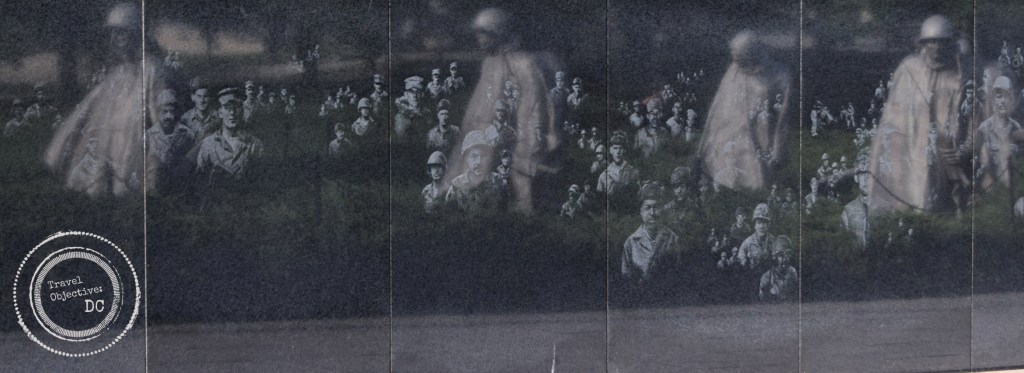
An image of a US Navy nurse from the Mural Wall

For full effect, the statues should be viewed in conjunction with the Mural Wall, which adds a unique, two dimensional feature to the memorial. The 164-foot long wall is constructed of a highly polished black granite and stands to the statues’ right side. It bears the images of over 2,400 troops and different specialties from each branch of the Armed Forces that supported the infantry during the Korean War. Both the faces of the statues and the visages on the wall are based on actual Korean War veterans, taken from photographs supplied by the National Archives and Records Administration and other renderings. Viewed from a distance, the service member images on the wall resemble the mountains of Korea.  The wall vividly reflects the statues, suggesting 38 servicemen moving in formation and symbolizing the 38th parallel and the 38 months of the war.

On the left side of the statues is the United Nations curb, a stone edge to a paved walkway with the name of the 22 Countries that, like the United States, fought or provided material support in Korea under the auspices of the United Nations.  

An engraving of the the United Nations seal as depicted on the United Nations Curb.

The statues appear to be moving toward an American flag flying from a flag pole next to a reflecting pool shaded by a grove of linden trees. At the base of the flag pole is a small stone with the inscription “Our nation honors her sons and daughters who answered the call to defend a country they never knew and a people they never met.” 

The pool is inscribed with the numbers of casualties sustained during the war by both the United States and the United Nations. The area is known formally as the Pool of Remembrance; the pool and the adjoining benches shaded by linden trees invites quiet contemplation of the war and its costs. 

* * *

For the United States, the Korean War was unlike any other before it. 

Congress made no declaration of war. Rather, the US fought under the auspices of the new United Nations and provided most of the UN combat forces. The Korean War would be more limited, without the general mobilization of American society as was seen in the First and Second World Wars. A new branch of the armed forces, the US Air Force, would organize and conduct air campaigns.  And for the first time since the American Revolution, the war was fought with a racially integrated military. (Notice the 19 statues represent multiple racial and ethnic groups and all four branches of the armed forces).

Statue depicting a US Air Force Air-Ground Controller

It was also fought in a very far away land, not well known to many Americans, to contain the spread of communism, the growth of which in Eastern Europe and China immediately following World War II was seen as a threat to the American democracy and capitalism. 

The Korean War remains with us today. The armistice of 1953 only ended the fighting, but not formally the war. A demilitarized zone marks the current border between the two Koreas. Tensions remain high. Korea is never very far from the headlines or newsfeeds and remains a major focus of US diplomacy and foreign policy. The US is still committed to the defense of South Korea and maintains a force of approximately 24,000 troops in the country. 

Over 7,600 US service members are still listed by the Pentagon as missing in action. The North Korean government periodically returns remains of US service members. In 2018, 55 boxes of remains were presented to US officials and taken to the Defense POW/MIA Accounting Agency in Hawaii for identification.  Potentially, 80 US service members may be identified from these sets of remains. Some already have. One was US Army Corporal Charles S. Lawler, 19, of Traverse City, Michigan.  Corporal Lawler was a member of the 1st Cavalry Division. He was reported missing in action on Nov. 2, 1950, after his unit was attacked near Unsan, North Korea. He was buried in his hometown on July 27, 2019. 

A group photo from the 8225th M*A*S*H*. The concept of forward deployed military hospitals was successfully implemented during the Korean War.

Popular narratives sometime label the Korean War as “the Forgotten War”, which seems misleading. It certainly was never forgotten by the Korean people, nor by the veterans who fought there and certainly not by the families of those who died there. The US military community has not forgotten as there has been a large military presence in Korea for decades. And the 1968 novel M*A*S*H*, about an Army field hospital which became a successful motion picture, then later a very popular television show, continued to remind the American public of the Korean War.

And now for over a quarter century, an exceptional and dignified memorial stands on the National Mall to help us remember. 


Route Recon:

The Korean War Veterans Memorial is located at the western end of the National Mall. It is two miles walking distance from the U.S. Capitol. A paved footpath connects the Korean War Veterans Memorial to the Lincoln Memorial area. The nearest metro stations are Foggy Bottom (23rd St. &I St. NW) and Smithsonian (12th St. & Independence Ave. SW).

Visitor parking is available along Ohio Drive, SW between the Lincoln and Thomas Jefferson Memorials. 

The Korean War Veterans Memorial is accessible 24 hours a day. Some visitors especially like to visit at night or in foggy or rainy weather, when the statues take on a surreal nature. 

There are many online resources regarding the Korean War. A good place to start is the US Army Center for Military History’s Korean War Commemorative Website .   

One Last Note: The Department of Defense (DoD) currently lists the number of US service members killed during the Korean War as 36,574. For many years, the Department of Defense had listed the number as 54,260, which is the number included on the memorial. Later research conducted by DoD determined the higher number included deaths of US service members who died on active duty during the 38 months of the war, although not necessarily as a result of combat operations in Korea. The higher number is included on the memorial as it honors all US service members who served during the Korean War.