
Making Marines is the first gallery visitors encounter in their journey through the National Museum of the Marine Corps (NMMC). It describes the 13-week Marine Recruit Training program where young men and women begin their journeys to become United States Marines.
The gallery floor is lined with painted yellow footprints. These footprints demonstrate for the new recruit exactly where to place their feet to stand at the position of attention. Visitors are invited to also place their feet in these yellow figures, literally following in the footsteps of generations of Marines who have gone before.

The yellow footprints at the Marine Corps Recruit Depot Parris Island, South Carolina (July 2004)
-USMC Photo by Lance Corporal Brian Kester
This is one of the main themes of the Marine Corps’s fine museum where the exhibits and displays are designed to immerse the visitor in the Marine Corps’s distinguished history and cherished traditions.
The NMMC opened in 2006 in Triangle, Virginia. The town is located near Marine Corps Base Quantico, about 32 miles south of Washington, DC. The museum is tremendously successful, attracting over 500,000 visitors each year.
Visitor immersion starts upon walking in the front door and entering the open Leatherneck Gallery housed under the uniquely designed roof. Seven restored Marine aircraft are suspended from the ceiling and inspirational quotes regarding the Marine Corps line the walls.

The conical roof of the NMMC with its protruding shaft, reminiscent of the flagpole depicted in the famous photograph of the Iwo Jima flag raising, has been a familiar site to motorists on Interstate 95 in Northern Virginia for the past two decades.
NMMC has expanded steadily through the years, adding new features and displays. In October 2024, two new galleries opened focusing on Iraq and Afghanistan. NMMC now features twelve galleries and two theaters encompassing the Marine Corps’s 250-year history.
Curators and exhibit designers used a wide variety of tools and techniques to tell the Marine Corps’s story. More than one thousand artifacts are on display, including weapons, aircraft, vehicles, uniforms and various pieces of Marine gear. These historic objects are skillfully supplemented by interpretive signage, historic photos, period newsreels, modern videos and films, posters and works of art.
USMC F4U-4 Corsair on display at the National Museum of the Marine Corps
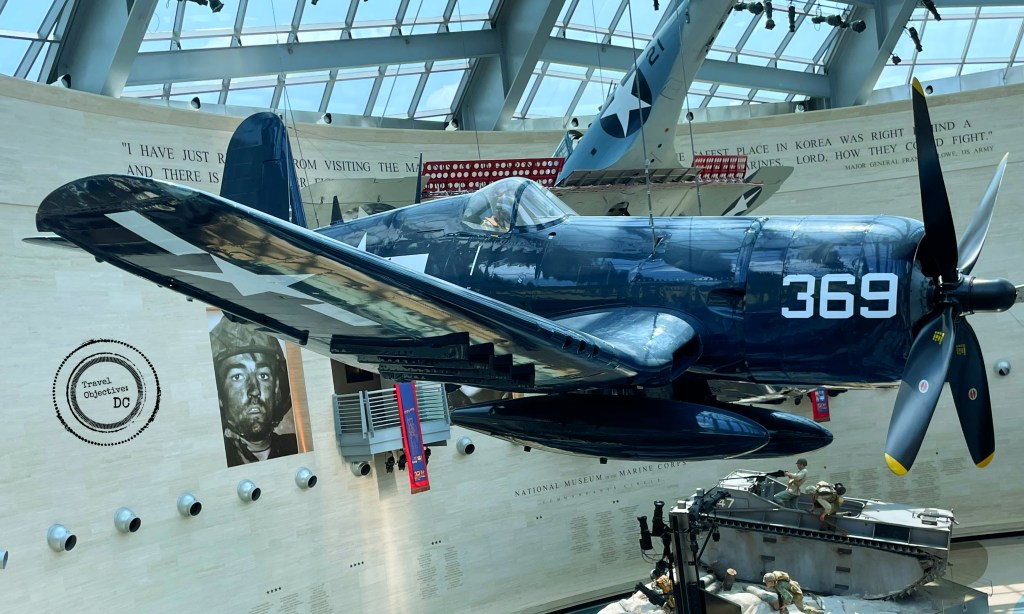
After learning about Marine Recruit Training (vistors can test their marksmanship on a laser rifle range), the Legacy Walk corridor leads to the chronologically arranged historical galleries. The galleries explain the Marine Corps’s role in shaping American history.
On November 10, 1775, Congress directed the raising of two battalions of Continental Marines. From the start, the Marines were designed to be an expeditionary force, accompanying the US Navy on warships and providing a ground-based fighting capability.
Early Marines provided security onboard US Navy ships for the captain and other officers, while also enforcing discipline among the crew. During ship-to-ship combat, Marines were posted on the ships masts and rigging, acting as sharpshooters targeting the opposing captain and crew.

A display showing early Marines positioned on a ship’s mast.
Marines also acted as infantry conducting a raid on Nassau, Bahamas in early 1776 and attacking a barbary pirate fortress in Libya at the Battle of Derna in 1805 (wherein comes the reference to the “Shores of Tripoli” in the Marine Corps Hymn).
Marines fought alongside the US Army in the Mexican War and helped to suppress John Brown’s raid on Harpers Ferry in 1859. A 350-Marine battalion engaged Confederate forces at the first Battle of Bull Run in June 1861.
Through the 19th and early 20th centuries, the Marines performed a number of expeditionary missions in various parts of the world where American interests were deemed threatened. Well-trained Marines were easily deployed and avoided the political ramifications of sending the Army, which could be equated with declaring war on another country.
M1895 Colt Machine Gun in front of The Defense of Peking-1900 by Staff Sergeant John Clymer, USMCR
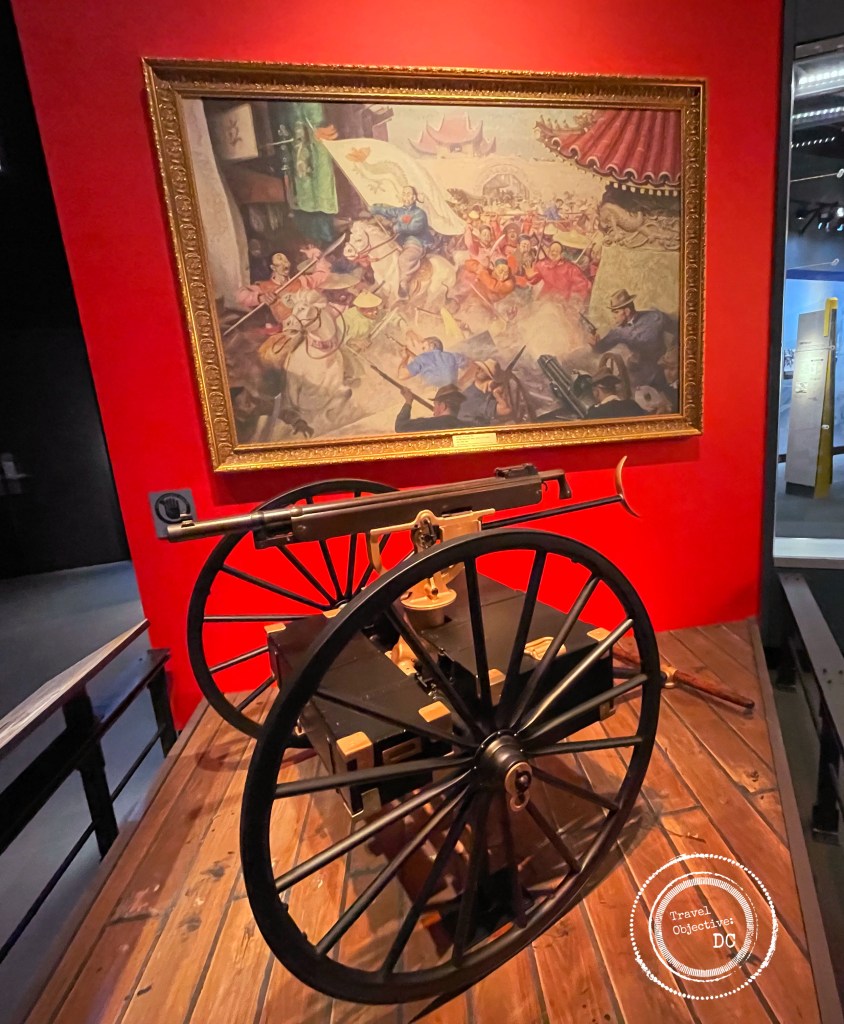
While the decision to deploy Marines may have been easy, the missions were not. Marines were expected to establish order, disarm insurgents and train local military or police forces. The Marines referred to these operations as Small Wars.
Difficult as they were, these deployments were covered extensively by American newspapers at the time and provided a positive portrayal for the Marines to the American public. That narrative grew exponentially for the Marine Corps following the Battle of Belleau Wood in 1918.
To tell the story of of Belleau Wood and later Marine battles, the NMMC galleries covering World War I through today all incorporate large-scale immersive exhibits. Sight, sound and other effects (such as cold air in the Chosin Reservoir exhibit) are combined to draw the visitor into the Marine Corps’s story.
These large immersive scenes are a major feature of the museum.

Life-sized cast figures depicting hand-to- hand combat during World War I
Visitors can step right into the scenes and experience an attack at Belleau Wood, a pre-deployment briefing before the invasion of Iwo Jima, deploying from a CH-46 helicopter at Khe San in Vietnam, and patrolling the streets in Iraq. The scenes convey a potent sense of realism with posted signs advising visitors of the intensity of these exhibits.
In a scene depicting the Battle of Hue, a Navy corpsman treats a Vietnamese girl beside an M50A1 Onos anti-tank vehicle.

To NMMC’s credit, it understands its displays may overwhelm some visitors. In 2024, a restroom was converted into the Respite Room, a quiet, private space away from the galleries.
Decorated in wood tones and calm colors, the room has soundproofing, soothing music and is devoid of any military symbols or references. Museum staff are trained on the best ways to steer visitors to the room as appropriate.
As proud as the Marines are of their heritage, the museum’s displays are not just about the past. In 2020, the Museum opened exhibits on contemporary missions such as Marines performing humanitarian operations, providing security at US embassies, and about the structure and functions of Marine Air Ground Task Forces, the principal organizational unit for today’s Marine Corps forces.
There is also an important display on Marine Corps families, which emphasizes how service in the Marine Corps is a family-wide commitment deserving of the Corps’s continued support and dedication.

Inside the Semper Fidelis Memorial Chapel
While there is much to see, the NMMC experience is not confined to the building. On the museum grounds is the 40-acre Semper Fidelis Memorial Park. A 1.2-mile paved walking trail through this manicured green space is dotted with plaques, sculptures, benches and other features commemorating individual Marines, units and battles, as well as Marine families and broader communities.
The centerpiece of the park is the Semper Fidelis Memorial Chapel, which serves as a quiet place for reflection and community events.
An immersive visit to the NMMC is well worth the investment of several hours to explore its offerings. Those interested in history or who have a connection to the Corps will find it especially intriguing. Young people considering joining the Marine Corps will find it informative. They will leave knowing what Marine Corps service is about and what their leaders will expect from them.
However, the Marine Corps Museum isn’t just for Marines–It’s a museum for everybody.
Any visitor should leave with a good understanding of how the Marines fit uniquely into American history, and what their role is today.

A World War I era US Marine Corps recruiting poster
* * *
Route Recon
The National Museum of the Marine Corps is located at 1775 Semper Fidelis Way, Triangle, VA 22172.
The Museum is open every day from 9:00 AM until 5:00 PM except Thanksgiving and Christmas. Visit the museum’s website for more information about temporary exhibits and special programming.
Triangle, VA is located just off I-95, about 36 miles south of Washington, DC and 76 miles north of Richmond, VA.
From I-95 heading south, take Exit 150A to Route 1 (Richmond Highway); turn right (south) onto Route 1; travel approximately ¼ mile; the Museum’s entrance is on the right.
From I-95 heading north, take Exit 150 (619 East Triangle/Quantico); turn right (south) onto Route 1; travel approximately ¼ mile; the Museum’s entrance is on the right.
Admission is free and there is no charge for parking at the Museum.
Mess Call
There are two dining options at the National Museum of the Marine Corps.
The Devil Dog Diner provides cafeteria service with a selection of hamburgers, hotdogs and chicken sandwiches. It is open 10:00 AM – 4:00 PM daily.
The Tun Tavern is a full-service restaurant with an 18th century colonial atmosphere. It is open 11:00 AM – 4:00 PM daily.
Find the menus for both restaurants on the museum’s concessions webpage.
 Travel Objective DC