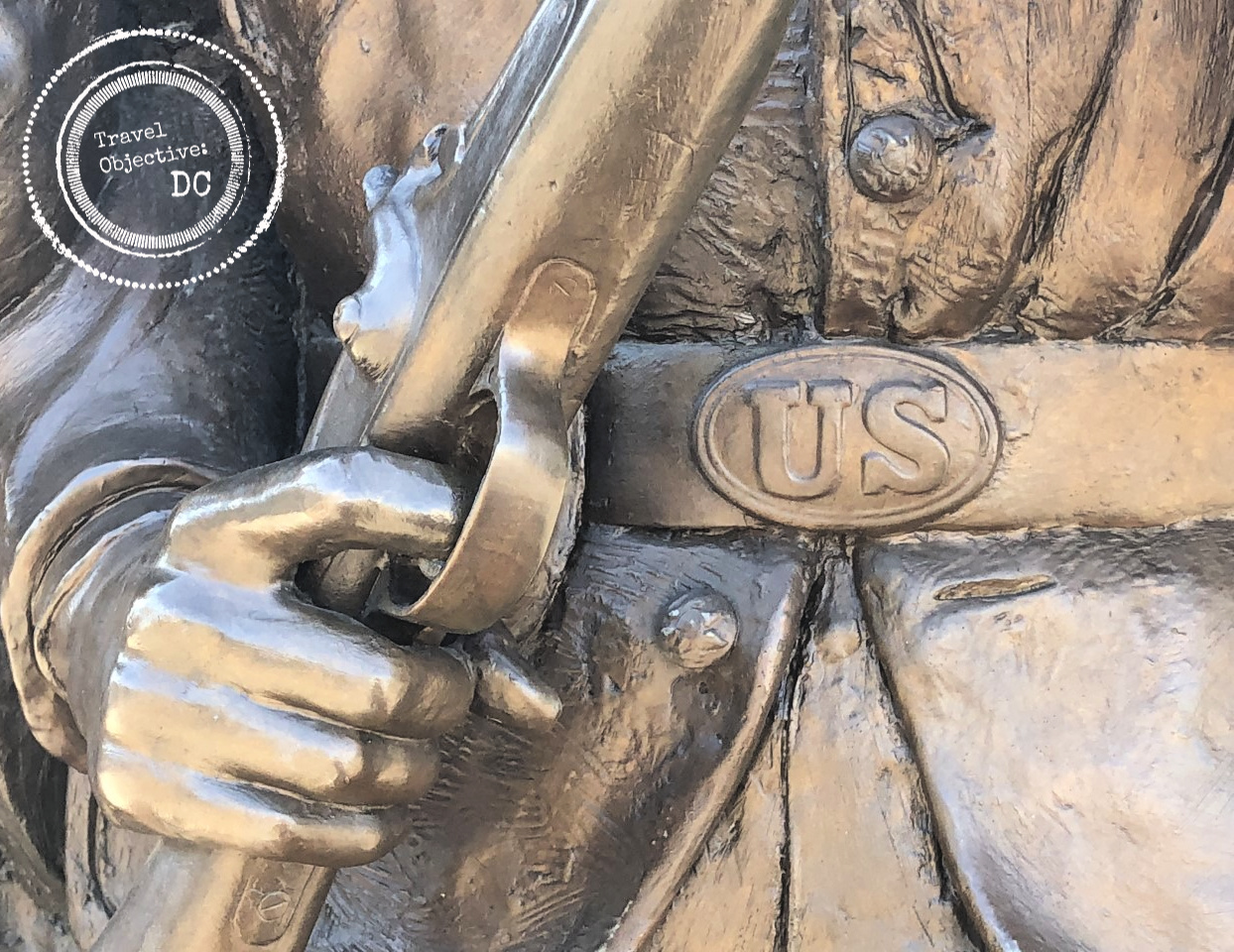
Remembering President James Garfield


Today, few Americans could tell you very much about James Abram Garfield, our 20th President. A few people with an interest in history might recall that Garfield was assassinated early in his presidency by a “disgrunted office seeker”. Professional historians generally rank his shortened presidency as “below average” or do not rank him at all. 

This is rather regrettable as Garfield was a courageous and dedicated leader who died for fighting what he believed in. Fortunately, he has one distinction the vast majority of presidents will never have: his own memorial on the US Capitol grounds. 

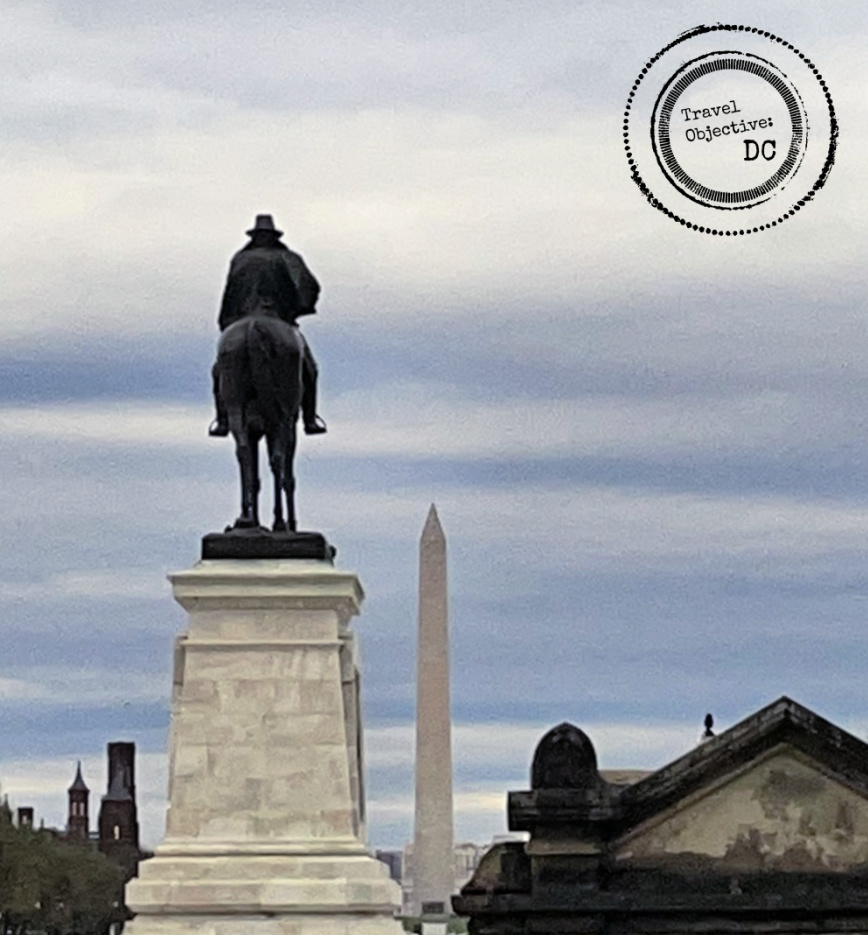
One of three monuments on the west side of the Capitol building adjoining the National Mall–along with the Ulysses S. Grant Memorial and the Peace Monument–Garfield’s monument is located within a traffic circle at the intersection of First Street SW and Maryland Avenue near the US Botanic Garden.

The Garfield Memorial on the west grounds of the US Capitol

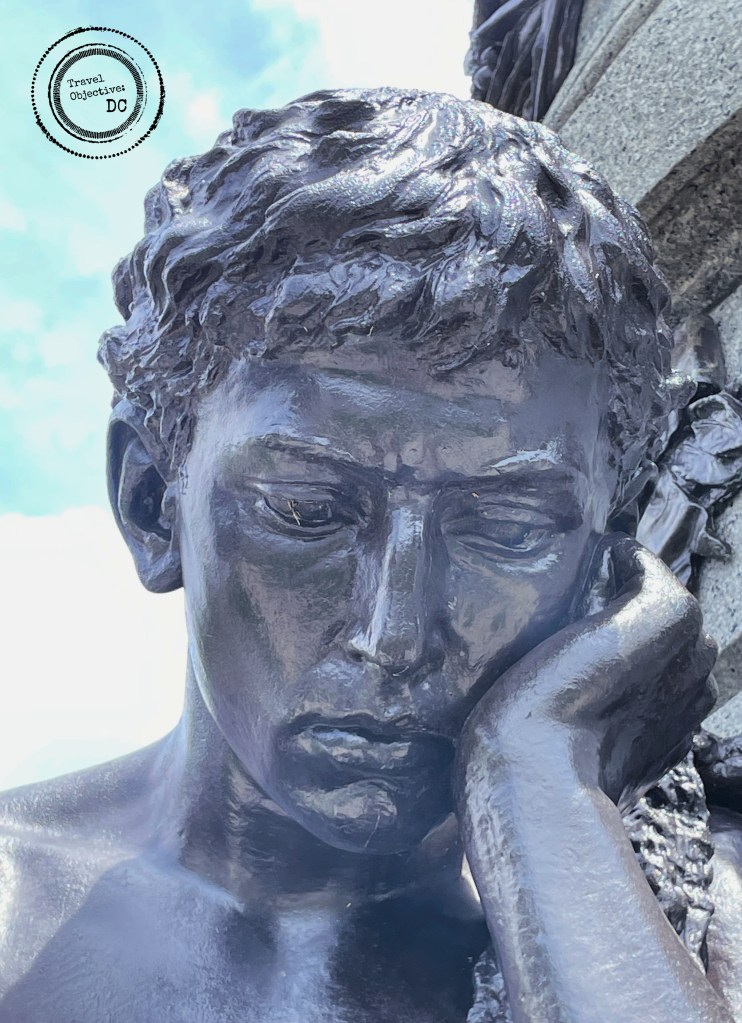
John Quincy Adams Ward, a prominent 19th century sculptor and friend of Garfield designed the monument. Ward depicted Garfield in bronze atop a round, tapered granite pedestal. He is shown giving a speech, grasping a scroll in his left hand and gazing intently at his audience. His foot is placed slightly off the platform and meant to symbolize Garfield as a man of action. At the base of the pedestal are three classical Roman figures representing the key phases of Garfield’s life as a young scholar, military leader and statesman.

Garfield personified the American success story, so much so that renowned author Horatio Alger wrote his biography. Alger published From Canal Boy to President in 1881.  

James Garfield was born in 1831 in a log cabin in northeastern Ohio. His family was poor and his father died when Garfield was a young man. He went to work to support his family, taking a variety of jobs including helping tow canal boats. While recovering from a serious bout of malaria contracted on the canal, Garfield’s mother convinced him to return to school. Garfield was an excellent student with a strong work ethic. He took to his studies and worked his way through the Western Reserve Eclectic Institute as a janitor and school teacher.  After graduation, he became a preacher. Garfield then studied law at Williams College in Williamstown, MA. 

The face of the young scholar figure on the Garfield Monument
Between his jobs as a preacher, teacher and lawyer, Garfield became a skilled orator. He entered politics and was elected to the Ohio State Senate as a Republican in 1860. As the Civil War broke out, Garfield was an abolitionist dedicated to the Union’s cause. He led fundraising and recruitment efforts for Ohio volunteer regiments. 

Eager to enter the Army, Garfield began studying military tactics.

Garfield commanded a Union Army brigade at the Battle of Middle Creek near Prestonsburg, KY in January 1862. Under his steady leadership, Garfield’s troops routed the rebel forces who retreated into Virginia. Although not considered a major battle today, the victory was an important boost to Union morale and brought Garfield widespread recognition. 

After the battle, Garfield was promoted to brigadier general. He was later assigned as Chief of Staff to General William Rosencrans of the Army of the Cumberland. After the decisive Union loss at the Battle of Chickamauga, Ulysses S. Grant relieved Rosencrans of command. Rather than Garfield, Grant appointed George H. Thomas to succeed Rosencrans. Although Garfield was later promoted to Major General, being passed over for the army command led him to consider a return to politics.
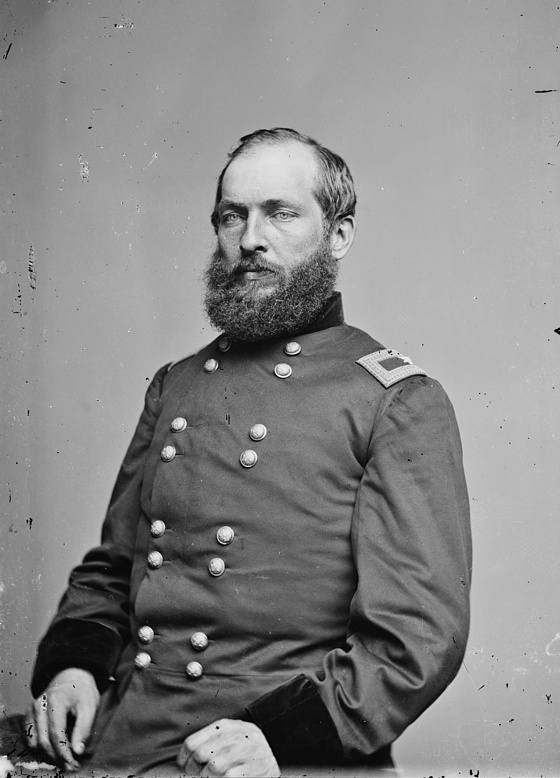
Photograph of James Garfield as Brigadier General

Brigadier General James Garfield, circa 1862

-Retrieved from the Library of Congress

In 1862, Garfield won an election for a seat in the House of Representatives. Garfield would serve nine terms in the House representing his home state of Ohio. While in Congress, Garfield was known for supporting civil rights for African Americans, the gold standard for the US dollar, and improving education for all. He helped establish the Federal Bureau of Education in 1870 to study and enhance educational methods across the country.

Garfield excelled as a Congressman, chairing powerful committees and mastering the nuanced details of legislation, especially on financial matters. At the same time, he was affable, a good conversationalist and considered one of the nicest men in Washington. 

At the deadlocked Republican presidential convention in 1880, Garfield was nominated on the 36th ballot. He defeated his fellow veteran Winfield Scott Hancock in the general election and was sworn in as the 20th President of the United States on March 4, 1881.  (He is the only president to be elected while a serving member of the House).

Republican Campaign Poster from the 1880 Presidential Election

During his presidency, Garfield fought one very significant battle.

His victory in that battle still impacts us today.

It had long been the practice in America that Federal employees were selected based on their demonstrated loyalty to political parties. Senators and representatives from a newly elected president’s party would act as “patrons” and recommend party workers, relatives and financial backers to the administration for government jobs.  

In the 1870’s, the issue of patronage was splitting the Republican party. Many wanted to maintain patronage while others wanted reform. Garfield opposed the patronage system and was a proponent of a professional, apolitical civil service. He knew it would make the Federal government much more efficient, limit corruption, and relieve elected officials from constant demands for jobs.

Garfield staged a showdown with New York’s two powerful Republican senators who were both savvy practitioners of the patronage system. Garfield nominated his own candidate for the important position of customs collector in the Port of New York. The two New York senators resigned in protest fully expecting to be quickly returned to office by the New York legislature. However, during their absence from Washington, Garfield pushed his nomination through the US Senate, embarrassing the two senators.

Sadly, this important victory over patronage directly contributed to Garfield’s death.

On July 2, 1881, Garfield was preparing to board a train at Washington’s Baltimore and Potomac Railroad Station. Suddenly, two shots rang out, striking Garfield in the arm and back.  Garfield’s assailant was Charles Guiteau, who may forever be known in history books as the “disgruntled office seeker”.  

The old Baltimore and Potomac Railroad Station. The station was demolished in 1907 after Union Station was opened. The station was located where the West Building of the National Gallery of Art stands today. [Undated photo]

-Retrieved from the Library of Congress
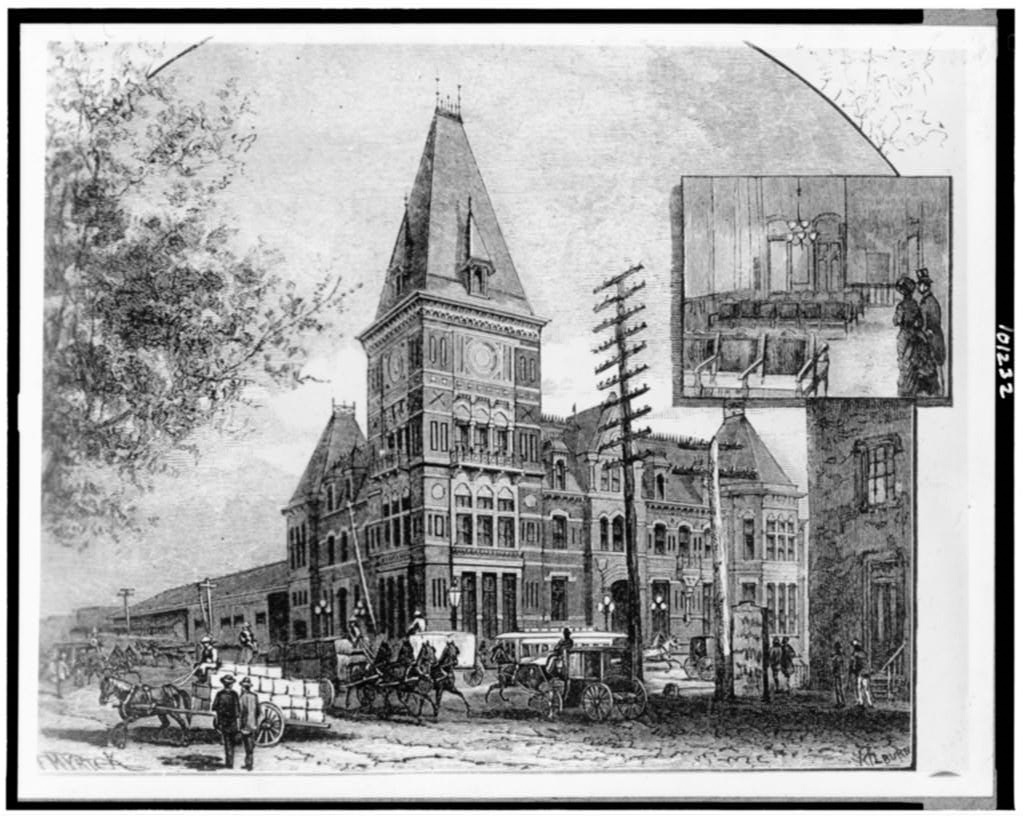
Photograph of the old Baltimore and Potomac Railroad Station in Washington, DC

Guiteau had written, delivered and published a speech supporting Garfield in the election. He thought this entitled him to a consular job at the US Embassy in Paris. While Guiteau had no dislike for Garfield as a person, he believed he would help preserve the patronage system by killing the president. Guiteau was quickly apprehended in the train station. He was later found guilty of murder and executed about 18 months after the shooting. 

The cover of Puck, a 19th century satirical magazine from July 13, 1881 with an image of Garfield's assassin Charles Guiteau

The cover of Puck, a 19th century satirical magazine from July 13, 1881 with an image of Garfield’s assassin Charles Guiteau holding an extortion note.

Garfield would linger on for the next two months. On September 19, 1881, he died from sepsis poisoning, just five and an half months into his presidency.

In the wake of Garfield’s death, Congress passed the Pendleton Act, which established a merit-based system for hiring and promoting Federal employees. The Pendleton Act was signed into law by the new president, Chester A. Arthur, who previously had been a supporter of the patronage system. As a surprise to many, Arthur quickly set about implementing its provisions to reform the civil service. 

The country closely followed Garfield’s deterioration and he was widely mourned after his death. Work then quickly began on building him a suitable memorial. The Society of the Army of the Cumberland, a Union veterans’ organization, formed a fundraising committee and ultimately raised over $28,000. They also successfully lobbied Congress for additional funds for the statue and the pedestal.

The newly unveiled Garfield Memorial was prominently placed on the cover of Harper’s Weekly on May 14, 1887.
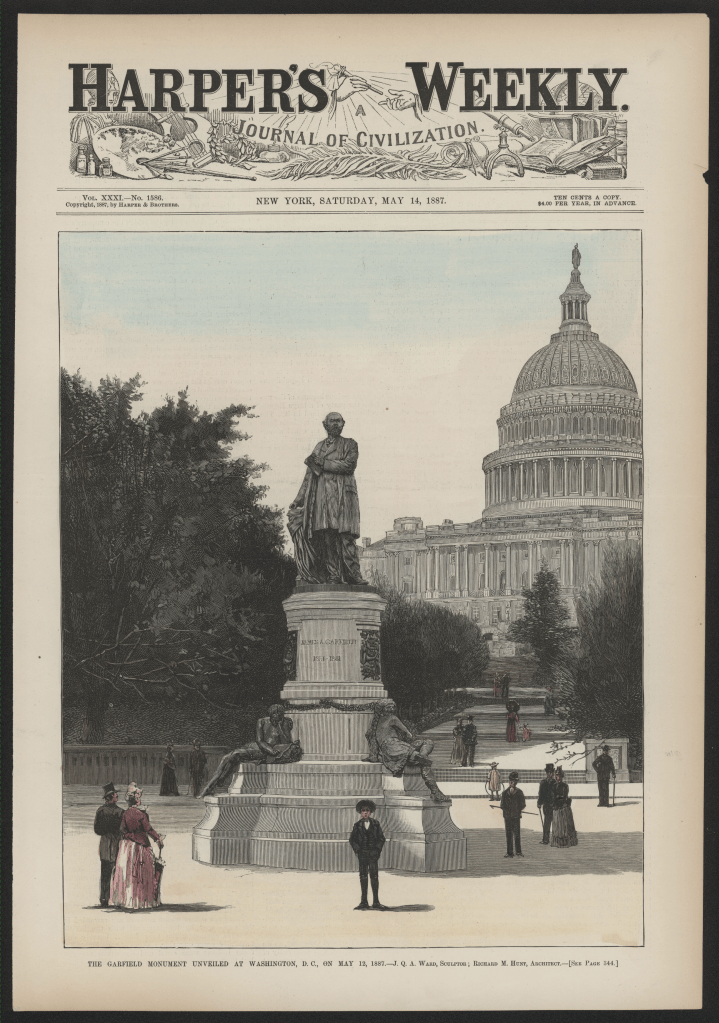
The cover of Harper's Weekly from May 14, 1887.

The memorial was dedicated on May 12, 1887, in a grand ceremony attended by President Grover Cleveland, many senior government officials, military leaders and veterans from the Society of the Army of the Cumberland and the Grand Army of the Republic. Cannon salutes were fired and the US Marine Corps Band played stirring patriotic music.

Today, the Garfield Memorial remains a prominent and visible reminder of the talented, resourceful and considerate man who was our 20th president. 

* * *

Route Recon

The Garfield Memorial is located within a traffic circle at the intersection of First Street SW and Maryland Avenue near the US Botanic Garden.

There is limited street parking nearby near the Botanic Garden.

The closest Metro Station is at L’Enfant Plaza. Exit the station through Entrance A for 7th Street and Maryland Avenue. Follow Maryland Avenue to the northwest, pass the Dwight D. Eisenhower Memorial and the US Botanic Garden.

Military History on the Mall


For the past 250 years, Americans have consistently answered the call to war.  

To answer that call, they often left behind civilian lives, families, and communities. Wars are never fought in a vacuum. With each conflict, there are corresponding impacts on American life and society.

On Veterans Day, 2004, the Smithsonian Institute’s National Musuem of American History, located on the National Mall, opened an ambitious military history exhibit to explore not just battles and campaigns, but rather the many ways wars have physically, culturally and economically shaped America throughout its history.

French cannon

A French four pounder field cannon, a gift to the Americans from the Marquis de Lafayette

Entitled The Price of Freedom, Americans at War, the exhibit was designed to be extensive, occuping over 18,000 square feet and examining 16 conflicts in nine different galleries. Visitors follow a maze-like path through these chronologically arranged galleries, from the French and Indian War through Iraq and Afghanistan.

In designing The Price of Freedom, curators stayed away from displays comprised largely of weapons and uniforms (although there are still plenty of those). Rather, they identified over 800 unique artifacts from the Smithsonian’s extensive collection. Some of the more notable items on display include George Washington’s sword and scabbard, the chairs used by Ulysses S. Grant and Robert E. Lee at Appomattox and a Willys Jeep from World War II.

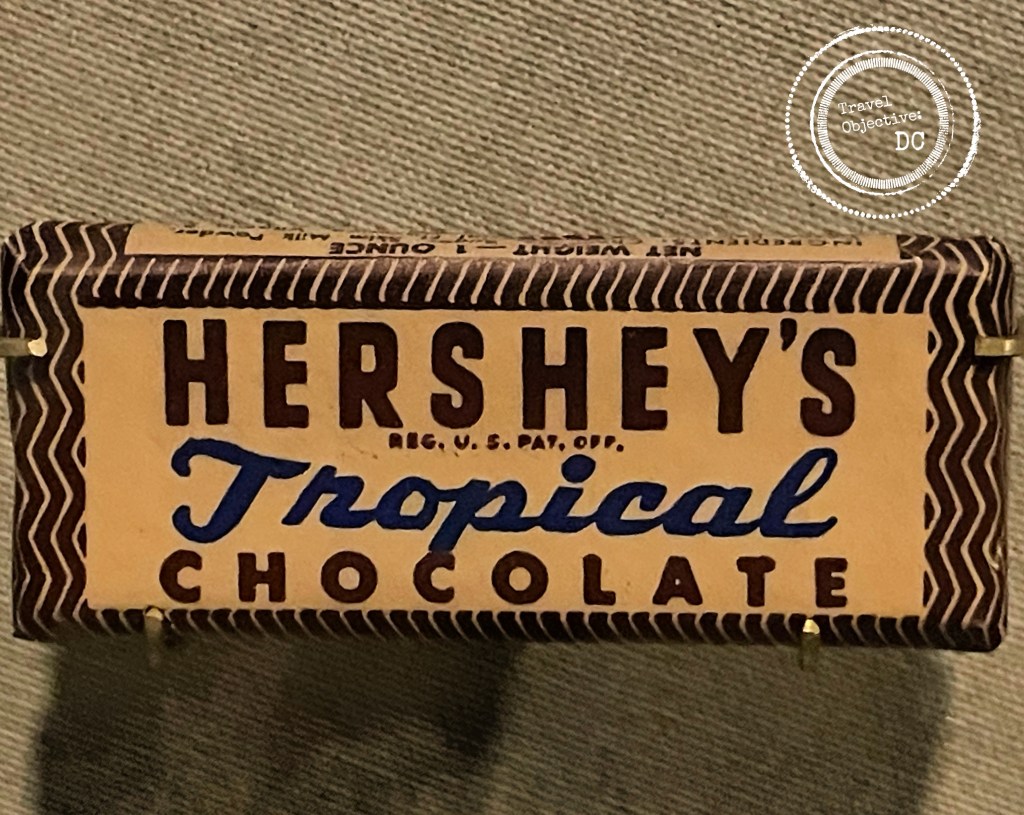
A melt resistant chocolate bar developed by the Hershey Company and provided to US servicemembers in the Pacific Theater during World War II

Hershey's Tropical Chocolate Candy Bar

However, head curator David Allison sought a symmetry in the selection of the artifacts. He wanted to display noteworthy items along with more common articles reflecting the service members and their times, such as rations, books and playing cards.

In addition to the artifacts, exhibit designers use photographs, contemporary illustrations, videos, interactive stations, and other features to help interpret the wartime experience and immerse the musuem visitor in the time. 

The most unique display is in the Vietnam War gallery where 16 different 1960’s-era television sets show contemporary footage and commentary depicting how Americans experienced the Vietnam War at home. The viewing area for the televisions is reminiscent of a mid-century living room, complete with a blocky couch and chair covered in thick clear plastic as your grandmother or aunt might have had. 

1960's era televisions
An array of 1960’s era televisions used in a display in the Vietnam War gallery in the Price of Freedom exhibit at the Smithsonian National American History Musuem

The Revolutionary War, Civil War, World War II and Vietnam War galleries are the largest. These spaces immerse you in the story of the war and how it impacted soldier and civilian alike.

The Wars of Expansion Gallery is smaller, but provides important context and accounts for a series of 19th century conflicts, such as the Battle of Little Bighorn and the Spanish-American War, which may be less familiar to many visitors.

The mix of artifacts and displays broadens the appeal of The Price of Freedom to a wider audience. Those with less interest in military subject matter should still enjoy viewing some of the more unique items while serious students of history are sure to come away having learned something new. 

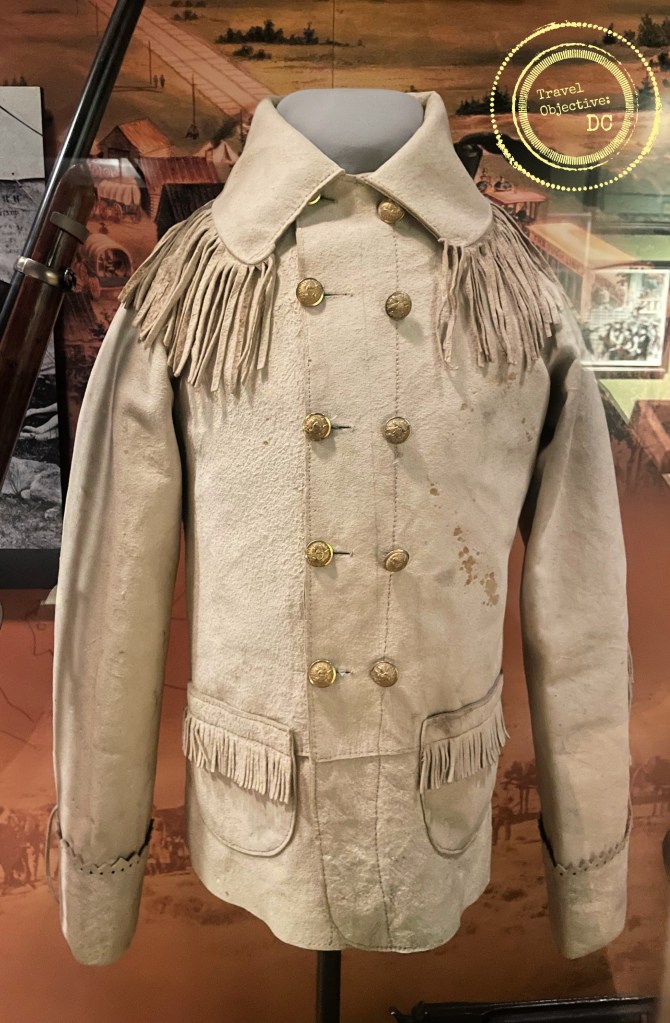
General George Custer’s buckskin coat

Custer's Buckskin Coat

While in most cases The Price of Freedom achieves its aims, there are a few shortcomings. 

Unfortunately, the exhibit space for World War I is too limited. The display misses or minimizes some important themes, such as the rapid expansion of the Army, the mobilization of the American economy, the changing role of women in the military, and the emergence of the United States as a world power. 

The Gulf War display is similarly small, seemingly limited to uniforms worn by Colin Powell and Norman Schwarzkopf. 

There is also an unfinished feel to the exhibition space for the wars in Iraq and Afghanistan. This is understandable as the original exhibit opened in 2004 before those conflicts ended. However, there is space for a more complete examination of both those conflicts than is currently provided. 

Chairs used by Grant and Lee at Appomattox.

The chairs used by Ulysses S. Grant and Robert E. Lee at Appomattox.

At the conclusion of The Price of Freedom is a short film with veterans reflecting on their motivations and sacrifices of their service in the American military. The film concludes with scenes from U.S. military cemeteries showing orderly tombstones and listing the number of interments. 

There are also recurring references to casualites throughout the galleries in keeping with the intent of the exhibit principal funder, Kenneth Behring. He desired the exhibit specifically to recognize the ultimate sacrifices made by American men and women who died in wartime. 

Even with a few flaws, two decades after its opening, the Price of Freedom remains true to its original mission. As America prepares to celebrate its 250th anniverary, this important exhibit gives visitors a thorough synopsis of America’s military heritage and its significant influence on our national character. 

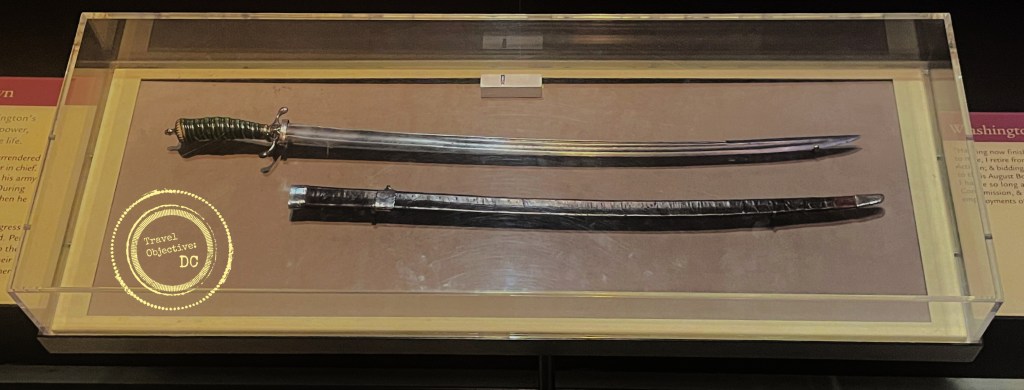
Washington's sword and scabbard
George Washington’s sword and scabbard from the American Revolution

* * *

Route Recon


The Smithsonian National Museum of American History is located at 1300 Constitution Avenue N.W., Washington, D.C. 20560

The nearest Washington DC Metro Stations are Federal Triangle and Smithsonian. Both stations are on the Metro Blue, Orange and Silver lines.

There is no public parking facility for the Smithsonian museums on the National Mall. A limited number of city-operated metered parking spaces along adjoining streets are available.  

The Musuem is open daily (except Christmas Day) from 10:00 AM to 5:30 PM.

Consult the Musuem’s website for more information about other exhibits.

Please note: The Price of Freedom, Americans at War exhibit includes some graphic images of war and casualties.

A guide to the exhibit is available here.

Hancock, the Superb


Statues of military leaders on horseback are a common site in plazas and squares around Washington, DC. While the statues might seem ordinary, the men featured on them are usually not. This is certainly the case with the statue of General Winfield Scott Hancock in the Penn Quarter neighborhood near the Navy Memorial.

It is hard to imagine a military career today as the one experienced by this 19th century Army leader.

As the Union Army was quickly expanding to meet the grim realities of the Civil War, Major General George McClellan, Commander of the Army of the Potomac, promoted his long-time acquaintance Hancock from captain to brigadier general and assigned him to brigade command. 

Hancock would go onto distinguish himself during the war, earning the nickname “Hancock the Superb”. He ultimately served 42 years on active duty and 25 years as a general officer. 

The equestrian statue of Winfield Scott Hancock.
The statue of General Winfield Scott Hancock

In 1896, the equestrian statue was dedicated to Hancock portraying the famous general in his more senior years. But the simple monument does not tell the full story of this highly respected Union Army general.

Hancock hailed from Montgomeryville, Pennsylvania. He was the son of a lawyer in a locally prominent Democratic family. His parents named him after Winfield Scott, the Army’s most senior officer at the time. His name was apt. From an early age, the young Winfield demonstrated a keen interest in military affairs. He could often be found leading young boys in a “youth militia company” on marches through town.

At the age of 16, he was accepted at West Point, graduating in 1844.

Assignments followed in the west and in Mexico during the Mexican-American War. After the war, Hancock often received Quartermaster assignments which taught him important lessons in logistics, organization and how to navigate the Army’s bureaucracy. His affable nature, technical proficiency and dashing good looks earned him an excellent reputation among his soldiers, colleagues and superiors.

Photograph of Winfield Scott Hancock.

A photograph of General Winfield Scott Hancock taken sometime between 1861-1865 by Brady’s National Photographic Portrait Galleries

-Library of Congress

Militarily, Hancock is probably best remembered for his actions as a corps commander in the Union Army of the Potomac at the Battle of Gettysburg in 1863. In the prelude to the fighting, Hancock arranged Union troops in a broad defensive position along high ground south of the town. Once the fighting began in earnest, Hancock led from the front, quickly maneuvering his troops to reinforce positions along the Union line. On the third day of the battle, Hancock was severely wounded in the thigh during Confederate General George Pickett’s famous charge against the Union center. 

Hancock would not leave the field until rebel troops had been repulsed. He would take five months to convalesce and would never completely heal from the wound. 

Early in his career, Hancock became very good friends with a North Carolina-born officer named Lewis Armistead. However, in 1861, while both were stationed in California, they said their good-byes and headed east, destined to fight on different sides. The two faced each other on the final day of Gettysburg when Armistead led a brigade as part of Pickett’s Charge against troops commanded by Hancock. Armistead was fatally wounded during the battle and died two days later. 

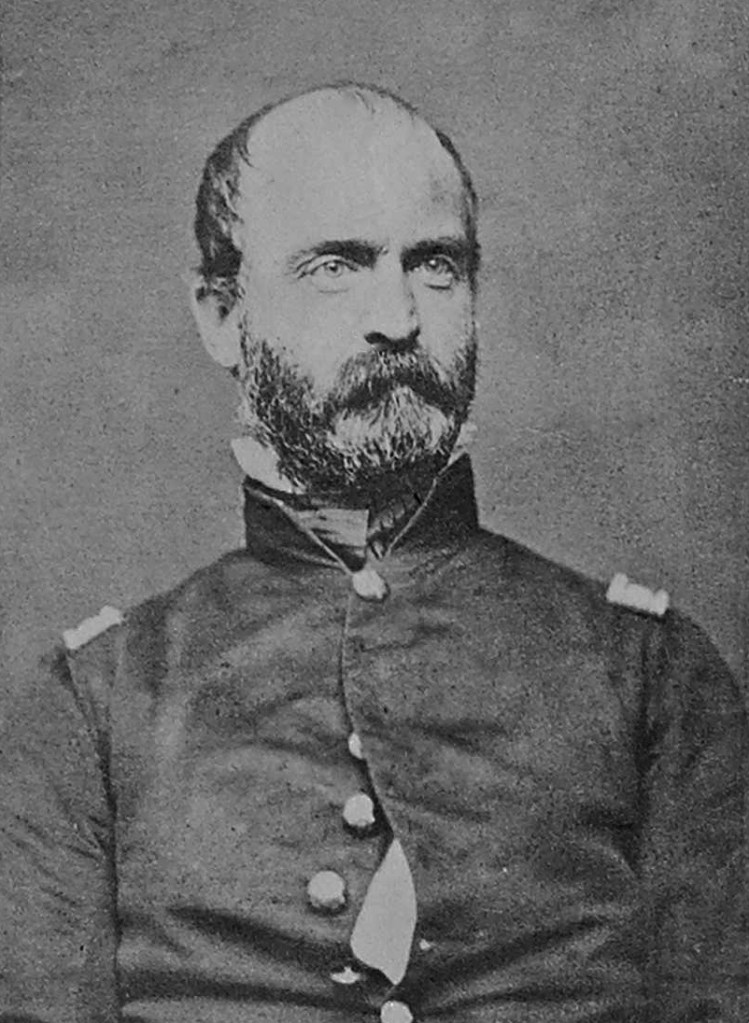
A photograph of Lewis Armistead, taken between 1861 and 1865, by an unknown photographer.

Photograph of Lewis Armistead

Both Hancock and Armistead are portrayed in Michael Shaara’s historical novel The Killer Angels and his son Jeffrey Shaara’s similar novels The Last Full Measure and Gods and Generals, as well as the films Gettysburg (1993) and Gods and Generals (2003).

There is scant historical evidence to support some of the depictions and dialog of the friendship between Armistead and Hancock portrayed in the novels and films. However, Captain John Bingham, an officer on Hancock’s staff, spoke with Armistead before he died. He would later write to Hancock with Armistead’s parting words to him: “Tell General Hancock for me that I have done him and done you all an injury, which I shall regret the longest day I live.” 

In July of 1865, it was Hancock who supervised the execution of several of John Wilkes Booth’s conspirators in the assassination of President Lincoln. He would later be assigned as military governor of Louisiana and Texas during Reconstruction. His Democratic leanings, including his endorsement of the quick return of civil authorities, put him at odds with Republicans in Washington and with his former commander (and later President) Ulysses S. Grant. 

A commemorative  handkerchief featuring the images of Democratic Presidential candidate Winfield Scott Hancock and Vice Presidential candidate William English.

A commemorative handkerchief featuring the images of Democratic Presidential candidate Winfield Scott Hancock and Vice Presidential candidate William English

-Library of Congress

While remaining in the Army, Hancock tested politics several times. After two attempts, he secured the Democratic nomination for president in 1880, but lost to a Republican (and former Union General) James Garfield. 

Hancock died at age 61 in 1886 from an infection and complications of diabetes while serving as Commander of the US Army’s Department of the Atlantic. His death surprised the country as the condition of his health was unknown to most everyone. 

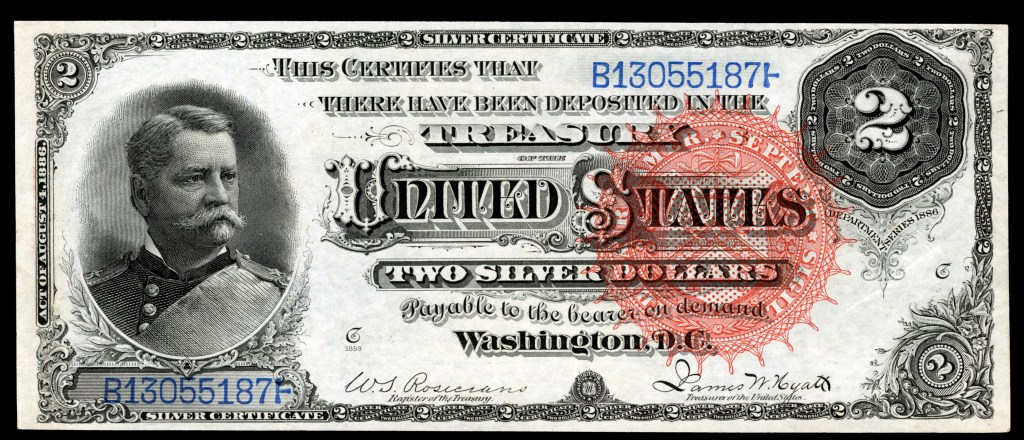
$2 Silver Certificate with portrait of Winfield Scott Hancock.
Following his death, Hancock was placed on the $2 Silver Certificate bill

Tributes to Hancock poured in from military, civic and political leaders from across the country. Perhaps the most stirring came from a political rival and former president, Rutherford B. Hayes:

“If, when we make up our estimate of a public man, conspicuous, as a soldier and in civil life, we are to think first and chiefly of his manhood, his integrity, his purity, his singleness of purpose, and his unselfish devotion, we can say truthfully of Hancock that he was through and through pure gold.”

Hancock’s statue is made of bronze, not gold, but he was the gold standard of an officer and a gentlemen.

* * *

Route Recon

The Statue of Winfield Scott Hancock is located just south of the Archives-Navy Memorial-Penn Quarter Metro Station.
Command Reading

Armistead and Hancock: Behind the Gettysburg Legend of Two Friends at the Turning Point of the Civil War by Tom McMillan. This dual biography of two leading Civil War generals provides new scholarship and analysis of their lives and careers and specifically details their friendship from its earliest days up to the Battle of Gettysburg.
The Grand Army of the Republic: the Legacy Lingers


The latter half of the 18th century saw a heyday for fraternal organizations in the United States. These associations provided their largely male memberships with opportunities to share common cultural, occupational, and religious backgrounds while often hosting social and recreational events for members and their families. 

One of the most prominent and powerful of these organizations was known as the Grand Army of the Republic (GAR). Membership in the GAR was open to all honorably discharged personnel, both officers or enlisted, from the Union Army, Navy, Marine Corps and Revenue Cutter Service (forerunner of the Coast Guard) who served during the Civil War. 

The GAR was founded in 1866 by Dr. Benjamin Stephenson who served as a surgeon with the 14th Illinois Volunteer Infantry Regiment. After the war he established a medical practice in Springfield, Illinois. Working with several veteran colleagues, he helped organize the first GAR post in nearby Decatur. 

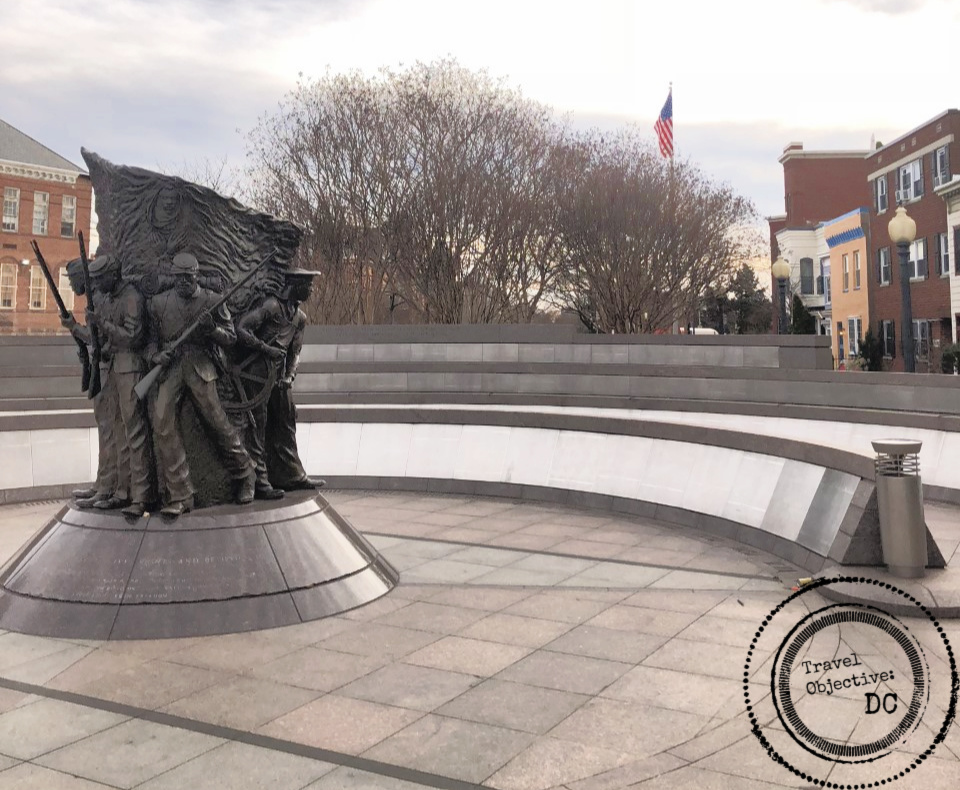
The Grand Army of the Republic memorial in Washington, DC
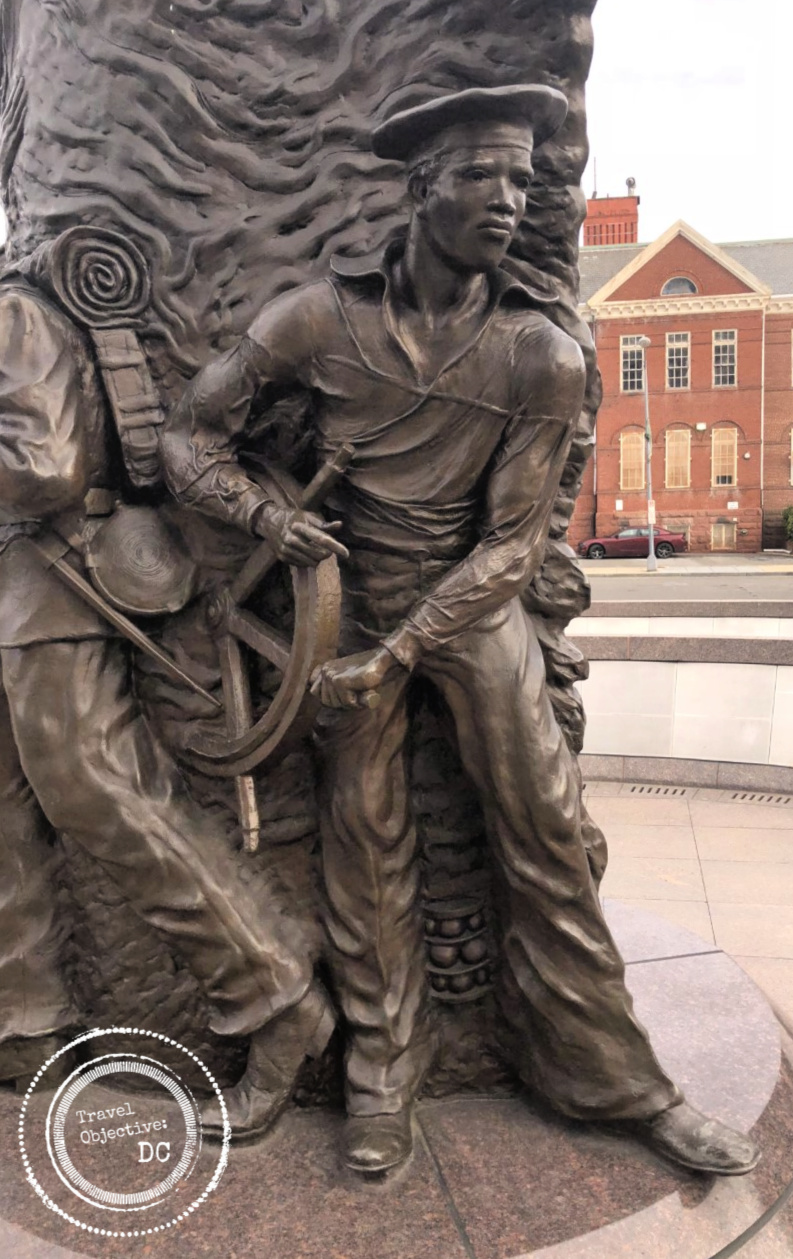
A Union soldier and sailor represent Fraternity on the Grand Army of the Republic memorial at Indiana Plaza.

The GAR Memorial

One of the GAR’s principal activities was building and dedicating monuments to the sacrifices of Union forces and to the work of the GAR itself. As Union veterans aged, the GAR stepped up their efforts to build such memorials. In Washington DC, a GAR monument is located in Indiana Plaza in Washington’s Penn Quarter neighborhood. Several historic buildings frame the plaza and the Archives-Navy Memorial-Penn Quarter Metro Station brings consistent foot traffic to this busy area. 

The GAR Memorial, also known as the Benjamin Stephenson Memorial, is triangularly shaped to reflect the GAR’s motto of Fraternity, Charity and Loyalty. Each side of the 25-foot high sand colored granite block has a bronze sculpture, featuring a weathered green patina. 

The southern facing side reflects Fraternity with a sculpture of a Union soldier and sailor standing side by side. Below the sculpture is an oval image of Dr. Stephenson in his Army uniform, also rendered in bronze, surrounded by a laurel wreath carved into the granite. 

The Northeast side of the Grand Army of the Republic memorial, depicting the statue of Loyalty.

A statue of a woman with a sword and a shield represents Loyalty on the Grand Army of the Republic Memorial.

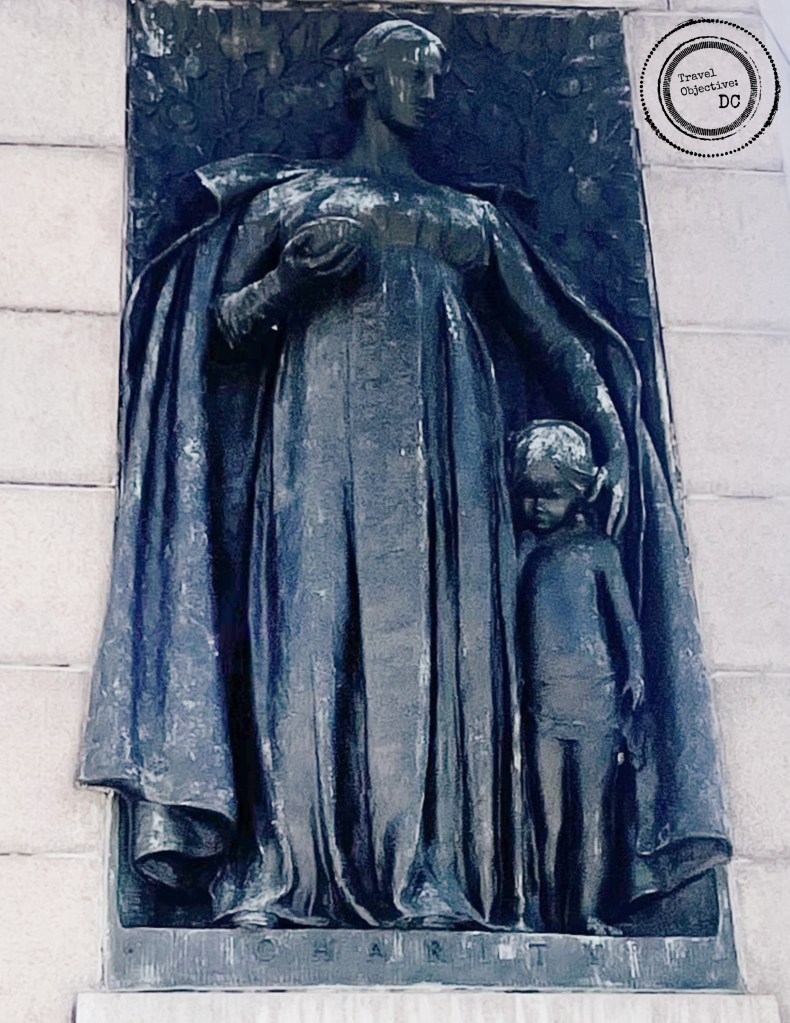
Charity is portrayed on the northwest side by a woman wearing a robe and protecting a young child. Unfortunately, a thick coat of urban grime makes viewing this statue more difficult. Finally, Loyalty is represented on the northeast side by a statue of a woman bearing a sword and holding a shield.

The monument was dedicated on July 2, 1909 in a ceremony attended by President William Howard Taft and hundreds of aging Civil War veterans. The GAR Members in the crowd that day may not have realized it, but they were part of one of America’s earliest and most powerful single-issue advocacy societies.

The Legacy of the GAR

When Dr. Stephens founded the GAR, the original focus was to raise money and organize relief efforts for wounded veterans, as well as surviving widows and children. But in short order the GAR would move to lobbying State and Federal officials for expanded pensions for Union veterans, hiring preferences for government jobs, and the building of veterans homes and hospitals. Membership soared, reaching its peak in 1890, when the GAR boasted more than 400,000 members. 

A woman and small child represent Charity on the Grand Army of the Republic Memorial.

The statue depicting charity on the Grand Army of the Republic Memorial in Washington, DC.

The GAR grew politically prominent and was especially influential within the Republican Party. In the second half of the 19th century, five Republican GAR members were elected to the presidency. Many more GAR members were elected to Congress, governorships and state legislatures. 

One reason the GAR was so politically effective was its formal structure of organized components across the country. State level units were known as departments and local bodies were known as posts. Every state had a department and posts were found in communities nationwide. GAR posts were also found in US territories and international locations. 

The national headquarters, state departments and local posts operated under a common set of by-laws and had an established chain-of-command. Each year from 1868 through 1949, the GAR organized national reunions known as encampments. These encampments were so well attended they grew larger than the political conventions of the day. Encampments were moved from state to state and localities welcomed the gatherings for the positive economic impact they provided. 

The bronze relieve figure of Dr. Benjamin Stephenson, founder of the Grand Army of the Republic.

The bronze relief of Dr. Benjamin Stephenson, founder of the Grand Army of the Republic.


Locally, posts raised money, built memorials, organized commemorations and ceremonially buried deceased veterans. They also assumed important civic functions not always tied to veterans, directing fundraising to local causes, organizing the broader community to address local issues, and sponsoring recreational events open to all. The GAR’s organizational model and many of its practices were later adopted by the Veterans of Foreign Wars (founded in 1899) and the American Legion (founded in 1919) and are still in use today.  

At at time when membership in fraternal organizations was often limited by race, GAR membership was open to all veterans, including the African Americans who fought as U.S. Colored Troops or had enlisted in the other services.

Membership in the GAR was exclusive to veterans and therefore only open to men. However, there were at least three female members: Kady Bromwell, who served along with her husband in two different Rhode Island Infantry Regiments; Sarah Edmond, who disguised herself as a man and fought with the 2nd Michigan Infantry Regiment; and Dr. Mary Edward Walker who served as a Union Army surgeon. 


The GAR formally disbanded in 1956 upon the death of its last member, Albert Woolson. Woolson, whose father had died of his combat wounds, enlisted in the 1st Minnesota Heavy Artillery Company as a drummer boy in 1864. He was about 14 years old the time. After his death, Life magazine ran a seven page story about his life.

While the GAR has been gone for over seventy years, its legacy remains. Many patriotic acts we practice today, such as placing flags on veterans graves, observing Memorial Day each May, standing for the National Anthem and saluting the flag all originated with the GAR. 

While the GAR may only be seen today through its monuments, its boot steps still echo through our stadiums, cemeteries, Legion posts and veterans homes. 

* * *

Route Recon

The memorial is located at Indiana Plaza in the Penn Quarter neighborhood. The small public plaza, located across the street from the Archives-Navy Memorial-Penn Quarter Metro station, is bounded by 7th Street to the west, Indiana Avenue to the north, and Pennsylvania Avenue to the south. 

Understanding Arlington Begins at Arlington House


In the spring of 1864, as the Civil War extended into its third year, the Union Army was suffering staggeringly high casualties. Sadly, the newly created national cemeteries at the Soldiers’ Home in Washington and in Alexandria were reaching capacity. 

The Union Army was going to need additional space to bury its war dead. Major General Montgomery C. Meigs, the Quartermaster General of the Army, knew where he was going to find it. 

Meigs soon directed burials to begin at Arlington, the antebellum plantation of Robert E. Lee and his wife Mary Custis Lee. 

Brevet Major General Montgomery C. Meigs, Quatermaster General of the US Army, 1861-1882.

Only a fraction of the 4 million people who visit Arlington National Cemetery each year make the trek up a winding hill to visit Arlington House. Those who do are rewarded not only with a great view of the National Mall, but a much better sense of how the Lees’ home became America’s preeminent national cemetery.

Arlington House Before the War

The Lees loved life at Arlington. Robert E. Lee wrote “Arlington…where my affection and attachments are more strongly placed that at any other place in the world.”  Mary and Robert married in the front parlor in 1831. While Mary followed her husband on several of his Army assignments, she spent most of her time living and raising the couple’s seven children at Arlington.

Flowers bloom in the main garden

Mary Custis Lee inherited Arlington from her father, George Washington Parke Custis. Parke Custis was the grandson of Martha Washington from her first marriage.  Following the death of Parke Custis’ father, George Washington adopted the young boy and his sister.

Parke Custis revered George Washington and assembled an extensive collection of Washington’s belongings. He intended to display these artifacts in a grand mansion. Construction of the house took sixteen years and was completed in 1818. 

The Greek Revival mansion, with its peaked roof and Roman columns, resembles an ancient temple.  The collection of artifacts and the mansion, built overlooking the new capital, was to be a powerful reminder of the man for his namesake city taking shape below. 

The view of the Lincoln Memorial and Memorial Bridge from Arlington House.

Arlington House Today

The first floor of the main house that the Lees loved so well is open daily for self-guided tours. A $12 million, three-year renovation of the grounds was completed in 2021. Through the project, numerous repairs were made to the interior, artifacts returned to the house, and new interpretive signage installed. 

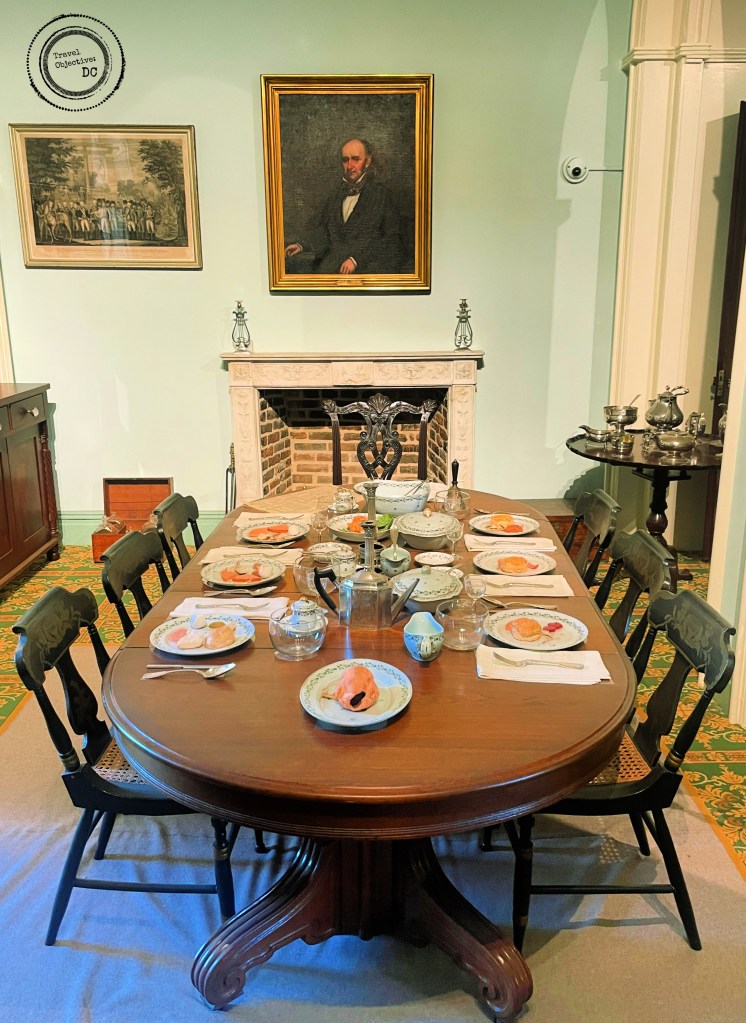
The house is now restored to its pre-war appearance, displaying the lifestyle of wealthy landowners in early 19th century Washington. The rooms are well furnished with some original furniture and accessories from the Lee home. Walls are adorned with original artworks painted by Parke Custis and Mary Lee, both self-taught artists.

In addition to the main house, the grounds also include two buildings containing former slave quarters, two gardens, a bookstore and a museum.

View of the main dining room

From Plantation to Cemetery

In April 1861, while at Arlington, Robert E. Lee made the fateful decision to resign his commission in the US Army ending his career of over thirty years. He would instead serve his native Virginia, which had just seceded from the Union. 

After the Lee family departed Arlington House for Richmond, the US Army moved quickly to take possession of both the house and the strategically important ground it occupied.

Before the war, Montgomery Meigs had served with Lee and the two officers enjoyed a cordial relationship. He was even a guest at Arlington House on several occasions. However, Meigs viewed Lee’s decision to leave the US Army and fight for the Confederacy as treachery.

In June of 1864, Meigs requested 200 acres of the Lee’s Arlington plantation be designated as Arlington National Cemetery.

Although most burials initially occurred in the northeast corner of the estate, Meigs ordered burials on the grounds of Arlington House. As he wrote to Secretary of War Edward Stanton “… the grounds about the mansion are admirably suited for such use.”

Graves of Union Army officers next to the flower garden at Arlington House

Today, the remains of Arlington’s main flower garden are an easy stroll after exiting the house. The pleasant plot of land teems with roses and many other flowering plants. Mary Custis Lee loved her garden and it is no wonder why after admiring the flowers on a summer day while pollinators buzzed and fluttered about.

Yet surrounding the garden are the graves of 45 US Army officers who were killed in battle, a reminder of Meigs’ determination for burials close to Arlington House. 

By the end of the Civil War, over 15,000 Union dead had been buried at the new Arlington National Cemetery. However, Meigs was not yet done. He directed the remains of unidentified soldiers who died near Washington DC to be disinterred for reburial at Arlington. 

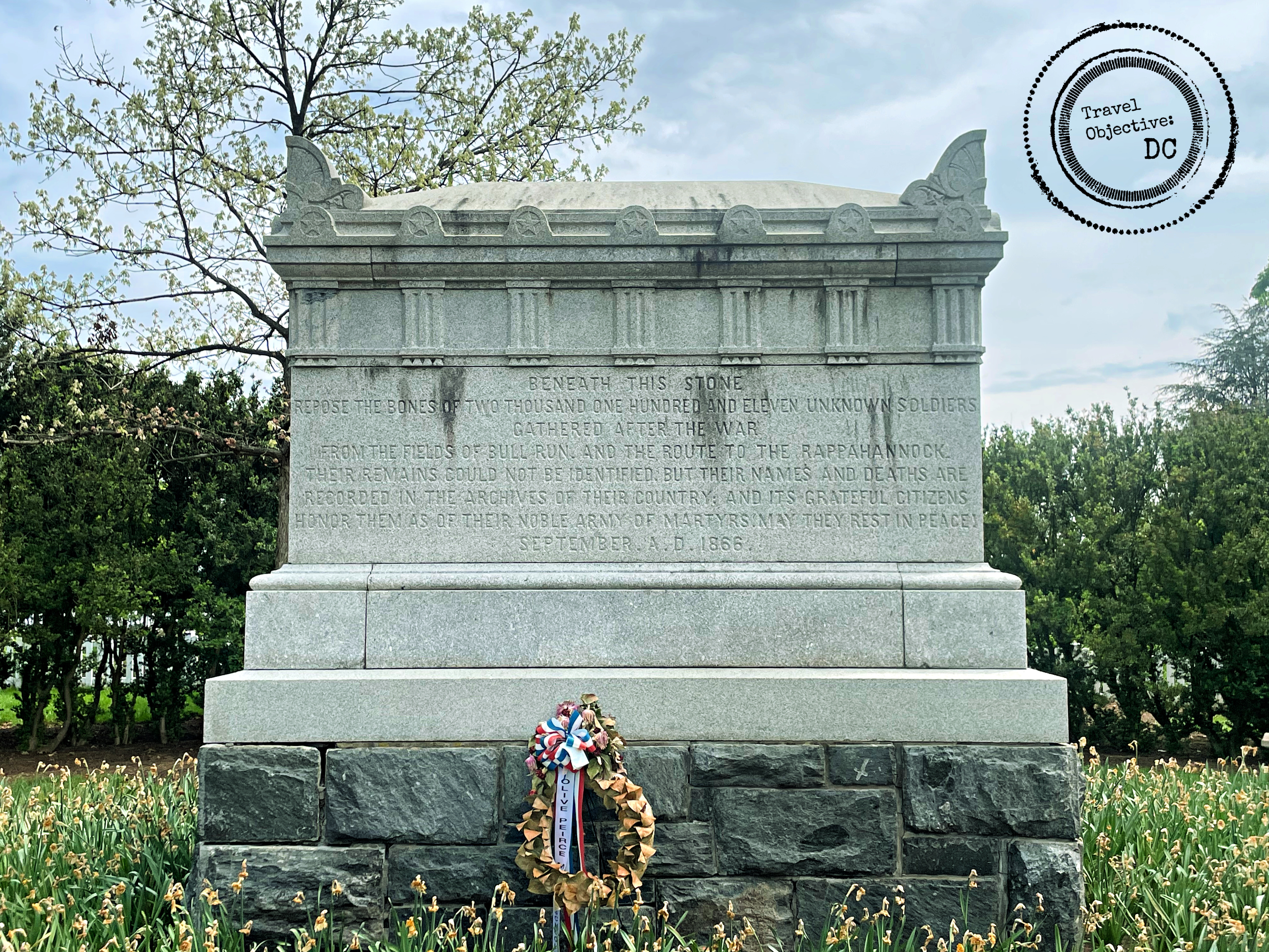
A grove of trees west of the flower garden was selected as the location. On September 16, 1866, the tomb of the Civil War Unknowns was dedicated containing the remains of 2,111 Civil War soldiers. It was the first memorial at Arlington National Cemetery dedicated to unidentified soldiers who died in battle. 

The orginal sarcophagus and the one seen today at the Tomb of the Civil War Unknowns

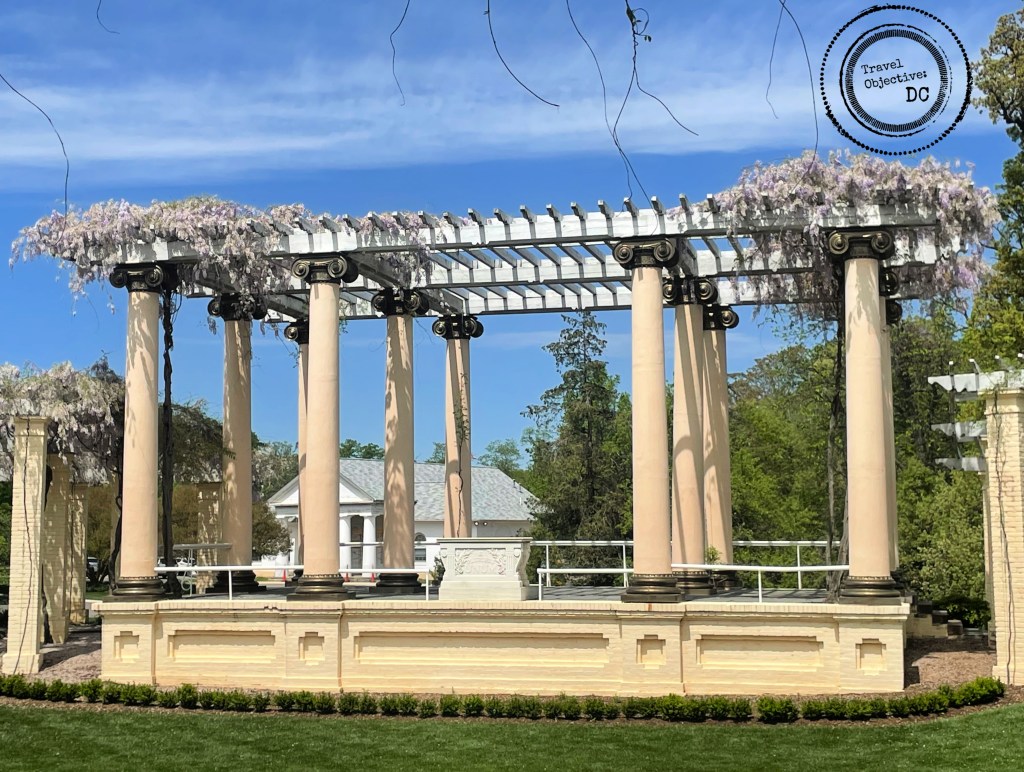
Further to the west, Meigs built what is known today as the Tanner Amphitheater. The elliptical marble colonnade with a lattice roof was designed to host observance ceremonies for Memorial Day. Dedicated in 1873, it was used annually until the current Memorial Amphitheater opened in 1921. 

Additionally in 1873, Congress passed legislation which broadened the burial criteria at national cemeteries to include all honorably discharged Civil War veterans. Through the years, the criteria would expand to include veterans of other wars, as well as spouses and certain family members.

Meigs retired from the Army in 1882 after 46 years of service and over twenty years as the Quartermaster General. Through that time, he stayed very involved in the conditions at Arlington, adding decorative features, improving roads and supervising landscaping.  Wooden grave markers gave way to headstones, and grand ones at that, as a burial ground originally for poor soldiers became the desired final resting place for generals and admirals. 

The stage of the current Tanner Amphitheater at Arlington.

Remembering the Enslaved at Arlington

In 1930s the National Park Service assumed responsibility for Arlington House, while the Army maintained jurisdiction over the cemetery. Through the following decades National Park Service archeologists, researchers and historians have continued to develop a broader picture of life at Arlington.

In the decades leading up to the Civil War, over 100 enslaved people lived and worked on the Arlington plantation.

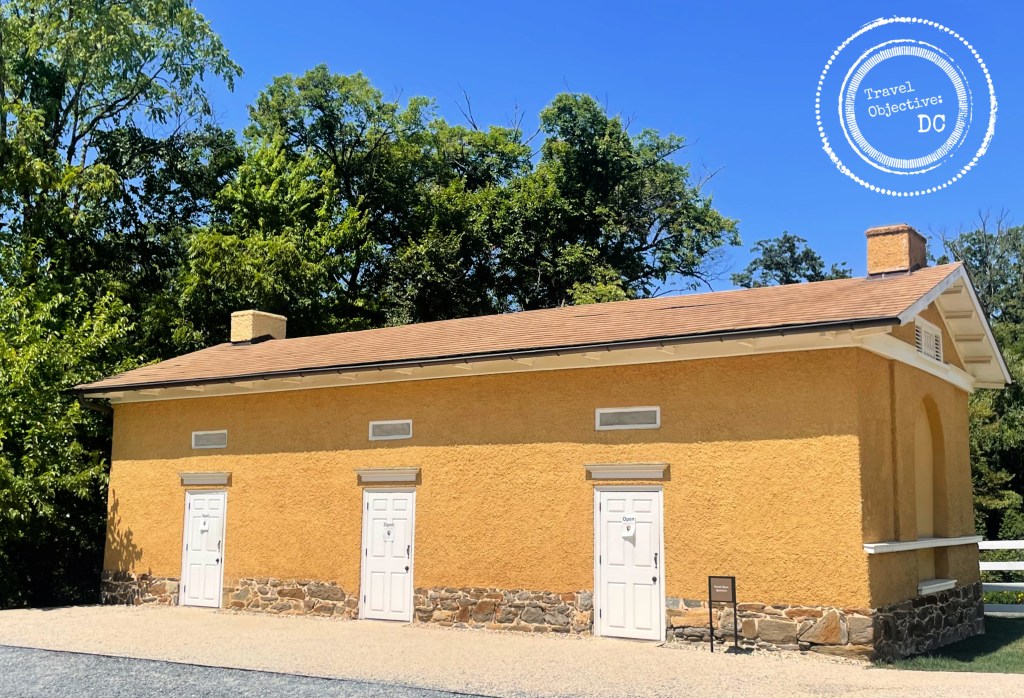
The recent renovation project also restored two surviving slave quarters buildings behind the main house, while archeological and scholarly research provided new details about their daily lives. 

One of the two recently renovated former slave quarters buildings at Arlington House.

Today the former slave quarters contain displays and provide interpretation of the enslaved workers’ lives at Arlington. A looped video playing in a former smokehouse provides the reflections of their descendants over a century later, many of who still live today in the Washington area. The exhibit provides an important alternate narrative to the Custis-Lee stories and experiences of Arlington. 

Final Resting Places

Robert E. Lee never did return to Arlington after he departed in 1861. After the war, he was appointed president of Washington College [now Washington & Lee University] in Lexington, Virginia and served for five years. He died in 1870 and is buried in the University Chapel in Lexington.

Mary Custis Lee returned to Arlington just once, in June of 1873. She was greatly dismayed by what she saw around her former home and would not enter the main house. She wrote a friend how the graves “are planted up to the very door without any regard to common decency…” She died several months after her visit and is buried beside her husband in Lexington. 

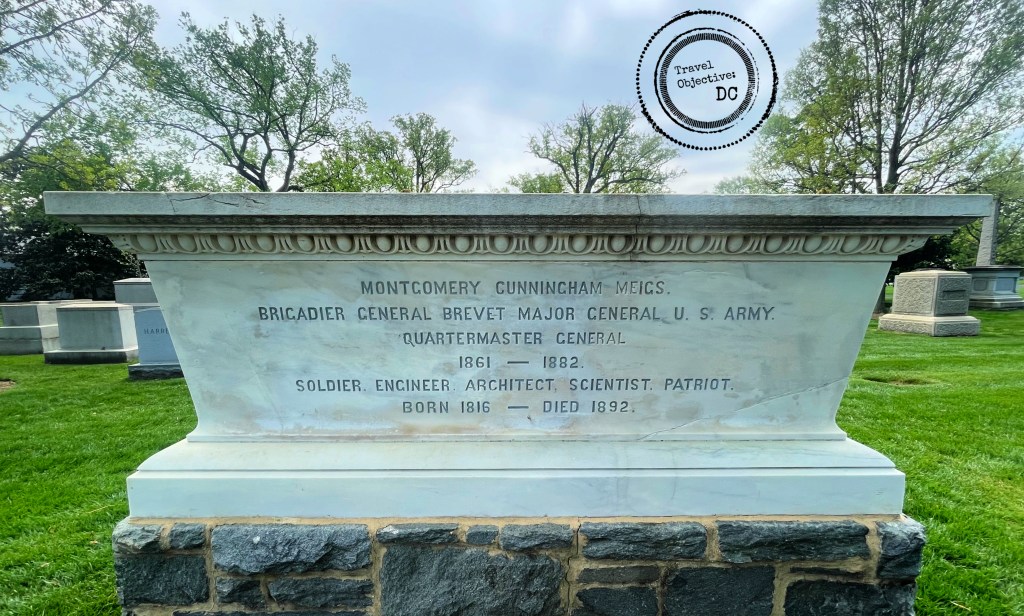
Prior to retiring from the Army, Meigs identified a portion of Arlington where his family would be buried. Upon his death in 1892, he was given a large military funeral in the cemetery he helped establish, with flags, bands and soldiers in dress uniforms, joining his wife, son (who was killed in the Civil War) and father (also a general officer).

The grave of Montgomery C. Meigs

In one of the many ironies in the long history of Arlington, while the Lees are buried some 185 miles away from their home, the Meigs family lies in Section 1, a short walk from Arlington House.

Route Recon

Arlington House is located within the grounds of Arlington National Cemetery. To access the house, visitors must use the main entrance of Arlington National Cemetery at the Welcome Center. Be prepared for a security check. Information on security procedures and prohibited items at Arlington is available here.

In most cases, plan on making a 15-20 minute walk up to Arlington House. Please note that vehicle and bus access through the cemetery is generally not permitted, except for those with vehicle passes to visit a gravesite, or those attending a funeral service. 

An interpretive bus tour service is available at Arlington National Cemetery, which includes a stop at Arlington House. Tour information is available here. Visitors with a valid disability placard may ride the interpretive tour bus at no cost (with one companion). See the main desk in the Welcome Center for more information.

Arlington House is open daily from 9:00 AM until 4:30 PM, except for Thanksgiving, Christmas Day and New Year’s Day. 

To access Arlington National Cemetery by car, follow the driving directions below to Arlington National Cemetery. 

Parking is available at the Arlington National Cemetery parking facility located at the cemetery’s main entrance on Memorial Avenue, next to the Welcome Center. Additional information regarding parking at at this facility is available here

Arlington House is accessible via the Washington DC Metro system on the Blue Line. Take the  Arlington Cemetery subway stop which is a short walk from the Visitor’s Center.  

Command Reading List

On Hollowed Ground, The Story of Arlington National Cemetery by Robert M. Poole

Robert Poole’s history of Arlington traces the cemetery’s evolution from the Custis-Lee family planation to the honored burial site of today. He insightfully traces how the rites, rituals and rhythms of Arlington changed through the years and were impacted by America’s wars from the 19th through 21st century.

Arlington National Cemetery, Shrine of America’s Heroes by James Edward Peters

James Peters work combines a very comprehensive history book and visitor’s guide into a single volume. Now in its 4th edition, the book contains a detailed explanation of Arlington’s early years as a plantation and a cemetery as well as the lives and burial information for over a hundred notable people interred at Arlington.

Driving Directions to Arlington National Cemetery

From Washington:

From Washington, D.C. you can drive to the cemetery by crossing the Memorial Bridge.

From points South (Richmond, VA area)

Take I-95 NORTH towards Washington, D.C. Take exit number 170A, I-395 NORTH toward Washington. Take exit number 8A, VA-27/Washington Blvd. towards VA-244/Columbia Pike. Follow signs to Arlington National Cemetery. Go 3/4 of the way around traffic circle and exit. Park in visitor’s lot next to Visitor’s Center on the left.

From points East (Annapolis, MD area)

Take US-50 WEST towards Washington, D.C. Take I-395 SOUTH. Take exit number 11B, George Washington Memorial Parkway NORTH, towards Arlington National Cemetery. Stay to the left at the fork in the road. Go 3/4 of the way around traffic circle and exit. Park in visitor’s lot next to Visitor’s Center on the left.

From points North (Baltimore, MD area)

Take I-95 SOUTH towards Washington, D.C. I-95 SOUTH becomes Capital Beltway, I-495. Cross Woodrow Wilson Memorial Bridge. Take US-1 North through Alexandria, VA. US-1 becomes Jefferson Davis Highway. At fork stay to the left and merge onto VA-110. Go approximately 1.5 miles. Take Arlington National Cemetery exit. At stop sign, turn left. Park in visitor’s lot next to the Visitor’s Center on the left.

From points Northwest (Frederick, MD area)

Take I-70 EAST to I-270 SOUTH. Merge onto Capital Beltway, I-495 SOUTH towards Northern Virginia. Take exit 43 & 44, VA-193/Georgetown Pike and George Washington Memorial Parkway. Keep right on ramp and take George Washington Memorial Parkway SOUTH approximately 10 miles. Take Arlington National Cemetery exit. At Stop sign, turn left. Park in visitor’s lot next to Visitor’s Center on the left.

From points West (Fairfax County, Loudoun County, Shenandoah Valley, VA area)

Take I-66 EAST to towards Washington, D.C. Take exit 64, Capital Beltway, I-495 SOUTH towards Richmond. Go one exit and merge onto US-50/Arlington Blvd EAST. Follow US-50 approximately 12 miles. Exit onto George Washington Memorial Parkway SOUTH. Take Arlington National Cemetery exit. At Stop sign, turn left. Park in visitor’s lot next to Visitor’s Center on the left.

What’s Peace Got To Do With It?

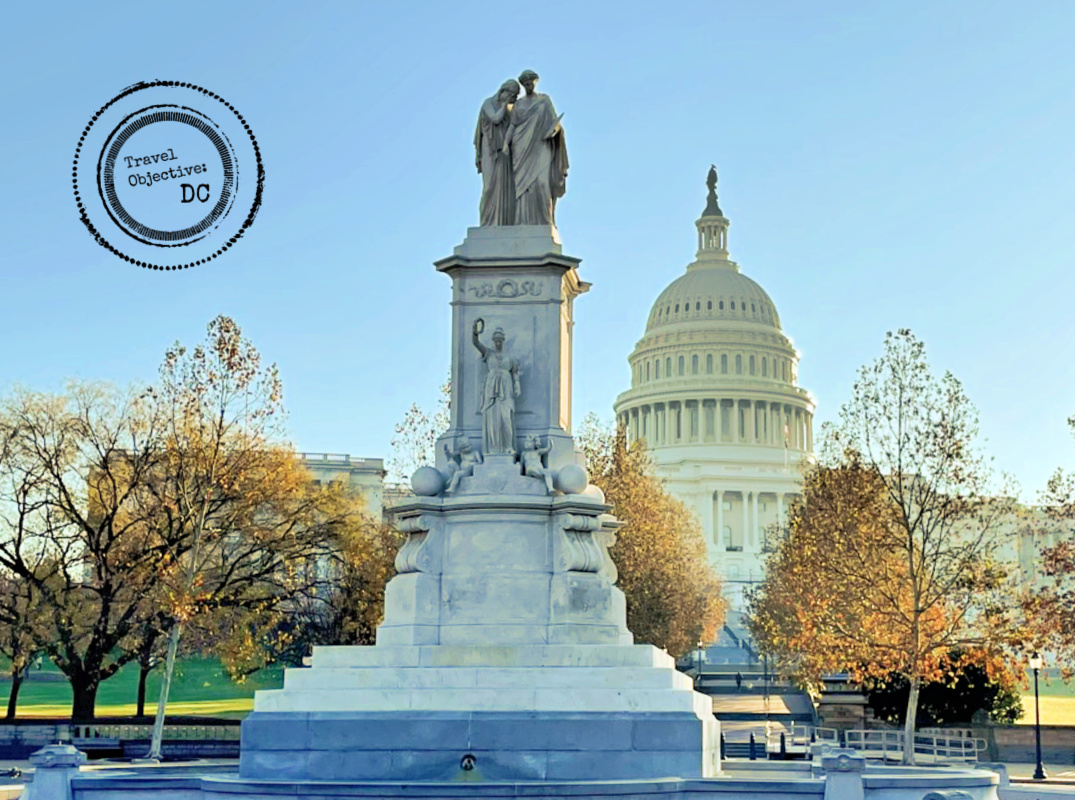
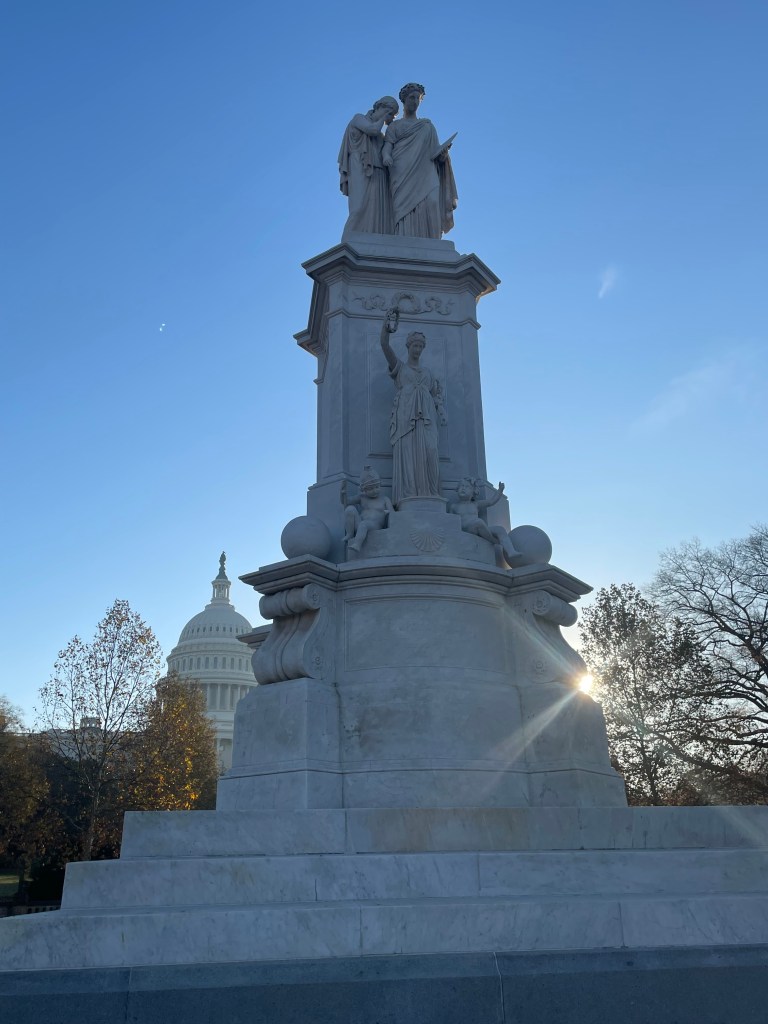
In a city abundant with statues, monuments and memorials, a few stand out for their uniqueness. One of these sits to the northwest of the US Capitol in the middle of a traffic circle formed where Pennsylvania Avenue terminates at First Street, NW. It is one of three pieces of statuary, along with memorials to Ulysses S. Grant and James Garfield, that form a visual connection between the US Capitol Grounds and the National Mall. 

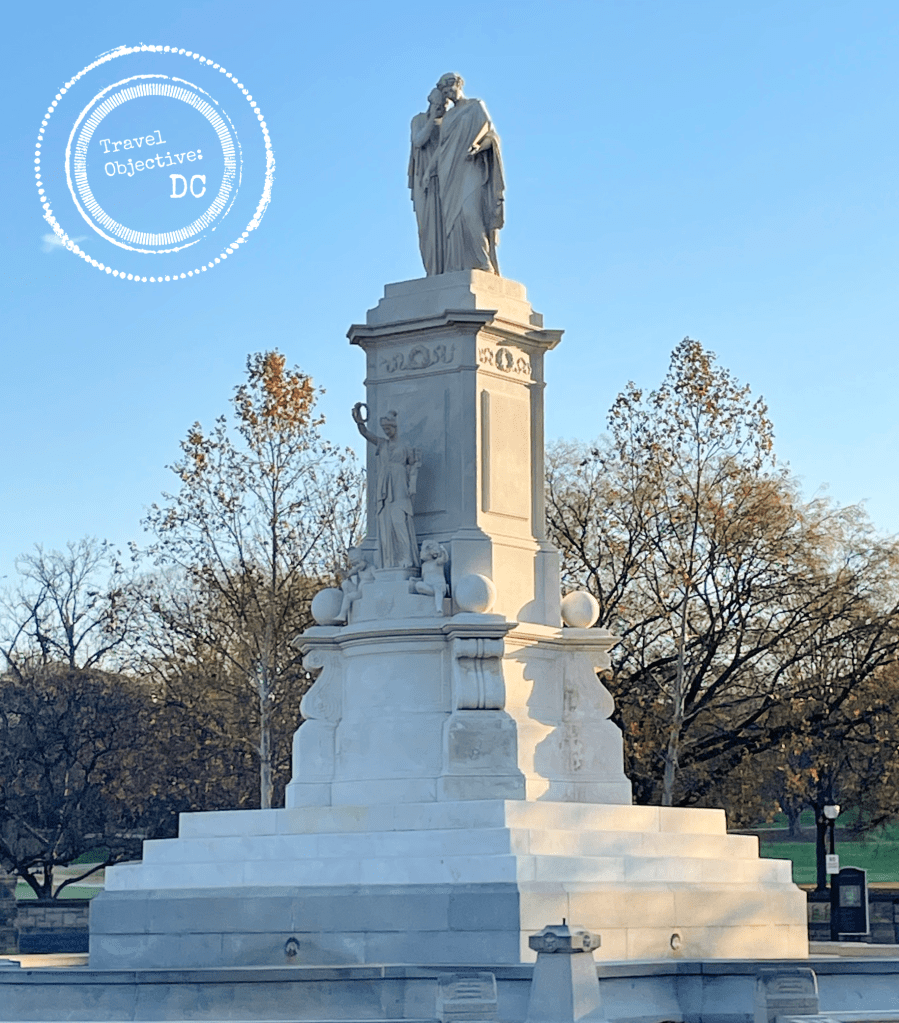
Dedicated to the sailors and Marines who died during the Civil War, the statue is known as the Navy Monument or Peace Monument. Unlike its neighboring statues which feature American statesmen cast in bronze, the Peace Monument mixes a variety of classical figures arrayed around an upright bloc, all captured in Italian marble.

The Peace Monument from the National Mall

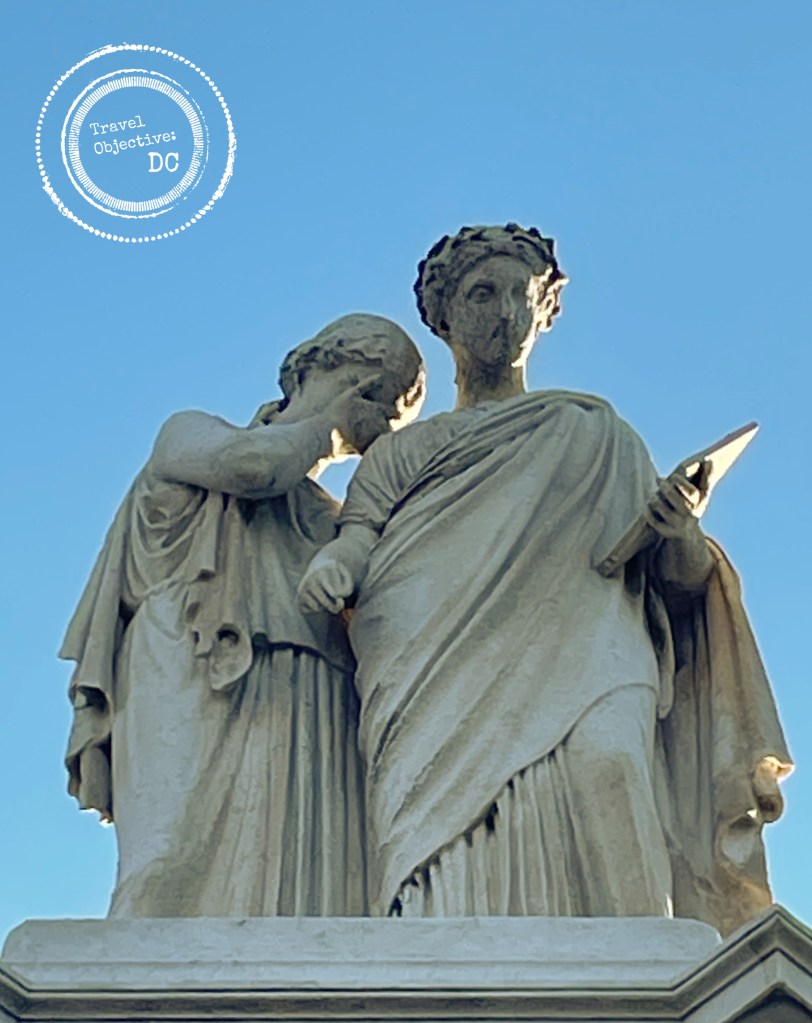
At the top of the 44 foot high monument are two robed figures facing the National Mall to the west. One is Grief, who buries her head in one hand, while resting her other on the shoulder of History, who stands bearing a pen and scroll inscribed with the words: They died that their country might live. 

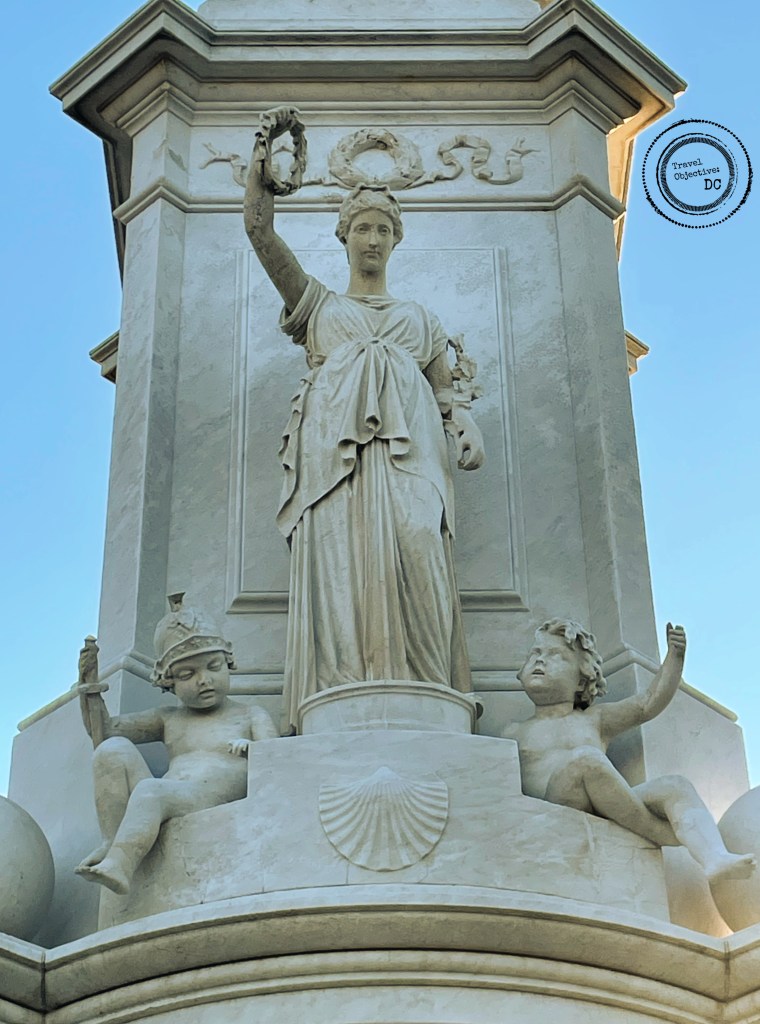
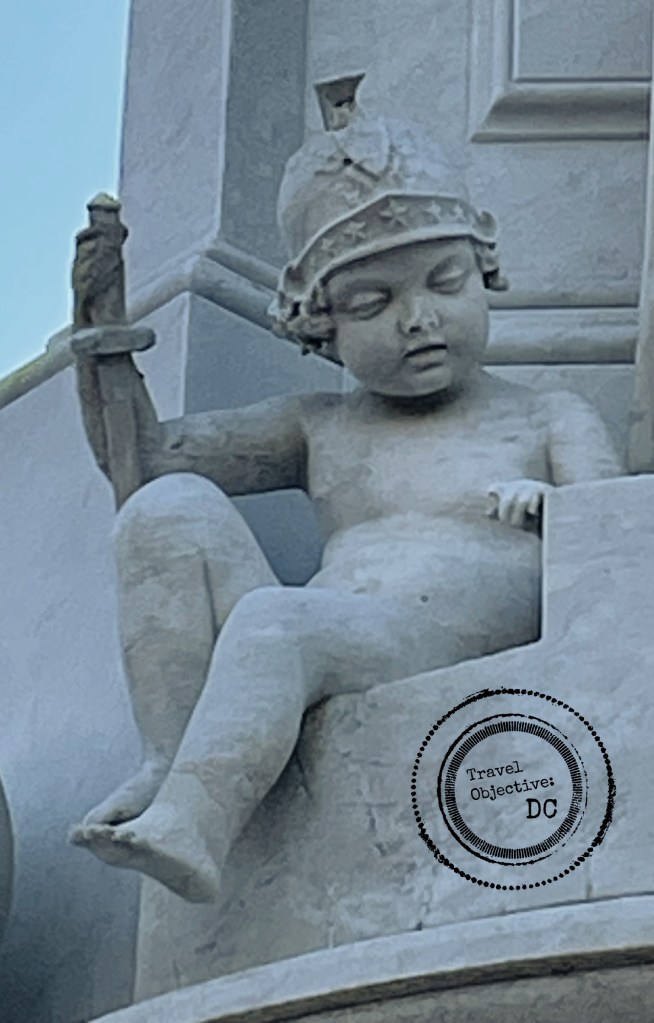
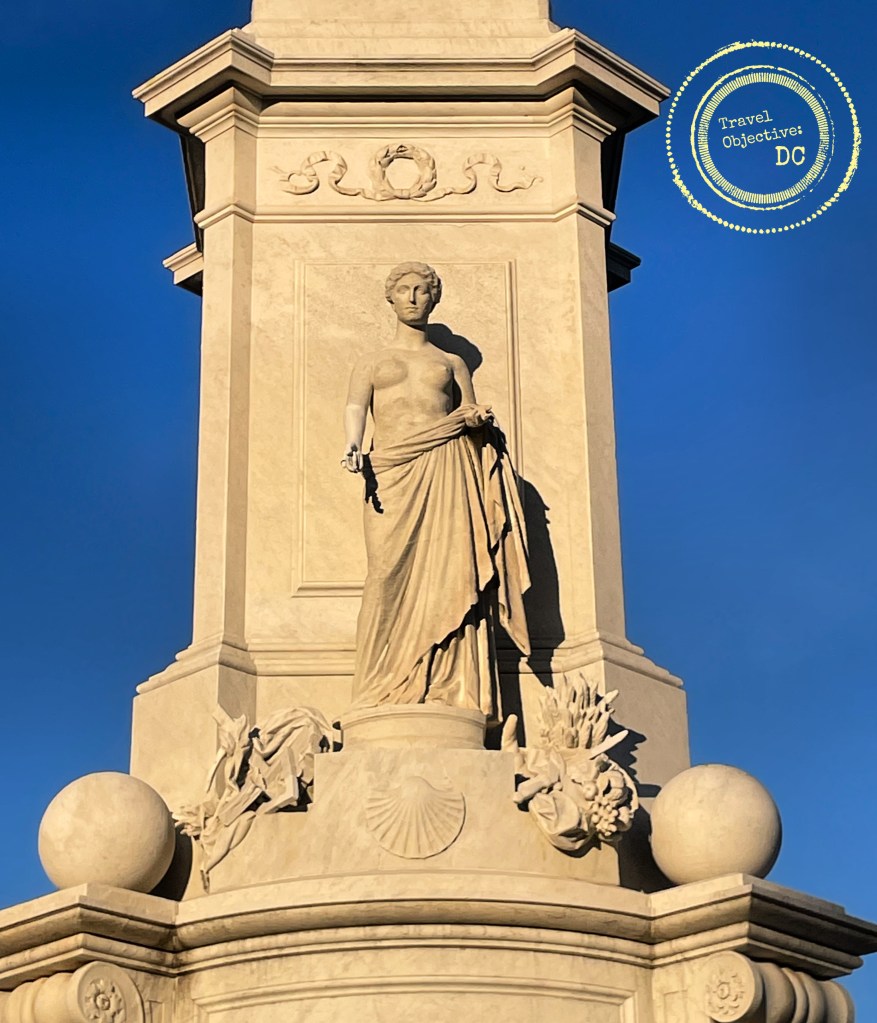
Midway down the monument, Victory holds her laurel high in her right hand, while a very young Mars (the god of war) and Neptune (the god of the sea) sit at her feet.

Victory with Mars and Neptune

On the reverse side of the statue, the figure of Peace looks towards the US Capitol. At her feet are a collection of items symbolic of the benefits of peace. There is a cornucopia and a sickle representing agricultural bounty while a gear and a book represent industry and the pursuit of knowledge. 

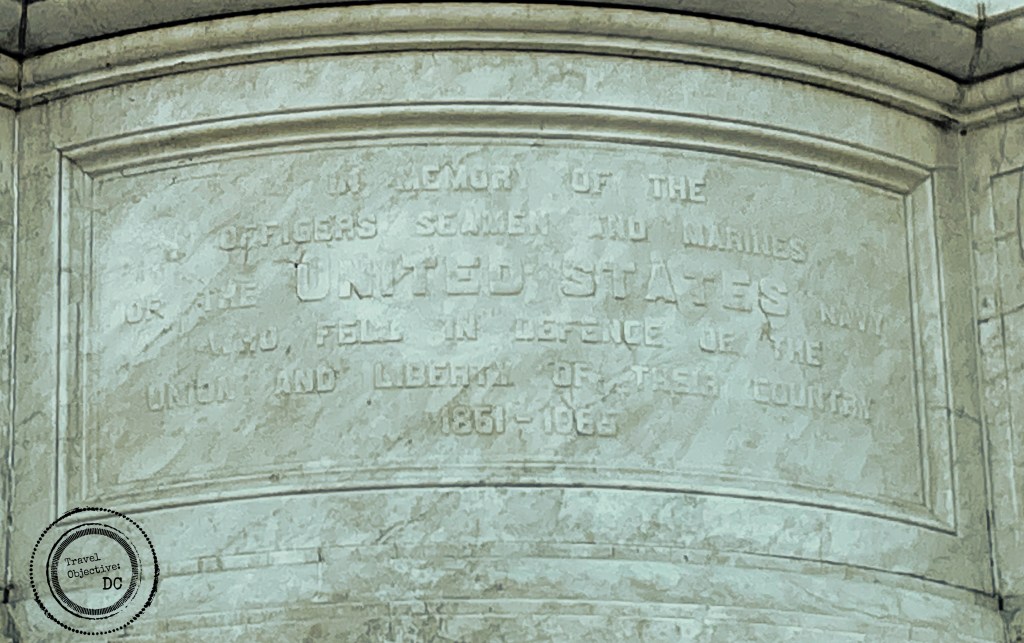
Four large marble spheres on their own bracket-shaped pedestals are found on the corners of the monument along with classical adornments, such as wreaths, scrolling and scallop shells. Below the monument, jets of water shoot into a giant basin. On the west side an inscription reads: In memory of the Officers, Seamen and Marines of the United States Navy who fell in defence [sic] of the Union and liberty of their country, 1861–1865.

While it looks as if it might have been designed by a committee, the statue was the idea of one man: US Navy Admiral David Porter. 

Admiral Porter was the scion of a distinguished naval family. His father, Commodore David Porter, was a hero of the War of 1812 and his adopted brother was David Glasgow Farragut (of “Damn the Torpedos” fame). Admiral Porter first served as a midshipman at age ten under his father. He would serve in the Navy for over sixty years. 

Admiral David Dixon Porter

-Photograph by Mathew Brady, Library of Congress Collection

Porter sketched the original figures of Grief and History as early as 1865, then raised money from private sources for its construction. Porter was likely inspired by his father, who undertook a similar project. Commodore Porter commissioned a statue dedicated to the lives of six naval heroes who died fighting the Barbary Pirates in the early 19th century. At one time this statue was displayed near the US Capitol; it was ultimately moved to the US Naval Academy at Annapolis in 1860.

For his monument, Admiral Porter worked with Franklin Simmons, an accomplished sculptor known for his work in sculpting political and historical figures. Simmons carved the statues at his studio in Rome, working with another team of Italian sculptors to carve the monument’s shaft. He consulted frequently with Admiral Porter on including additional figures and embellishments. 

After its unveiling, an art critic remarked, “Porter knows more about the high seas than high art.”

While that may well have been true, Porter’s conglomeration of figures and mixed symbology seems quite appropriate for a monument to the U.S. Navy during the Civil War.

Close-up of the Statue of Mars. Note the erosion on the fingers of right hand where he grips his sword, and on nose.

In April of 1861, the Navy had but 42 commissioned ships. It needed to expand quickly and it required many new and different types of vessels for the missions it now faced.  Specialized ships were necessary for enforcing President Lincoln’s blockade of Southern ports, defeating the Confederate Navy in open waters, supporting US Army ground operations and patrolling interior rivers. This was also a transitional period as wooden sailing ships gave way to ironclads powered by steam. 

The Navy set about a massive program of refitting current naval vessels, building new ones and acquiring civilian ships, which were converted for military use. By war’s end, the Navy had over over 600 vessels, some very distinct in design and purpose.

During the Civil War, the US Navy also rewrote doctrines focusing on flotilla operations rather than single ship actions, adopted new combat tactics, and revised its command structure. 

Admiral Porter was on the forefront of some of these developments. He commanded a flotilla of ships in the Union capture of New Orleans. He transported Ulysses S. Grant’s army down the Mississippi River prior to the assault on Vicksburg. He also commanded naval forces in the attack on Fort Fisher, North Carolina. After a two-day long bombardment of the fort, Porter contributed a force of sailors and Marines to join US Army soldiers on a multi-pronged ground attack. 

 The Bombardment and Capture of Fort Fisher, N.C. Jany. 15th, 1865. [Published by Currier & Ives, between 1865 and 1872] Library of Congress Collection


While historians devote more attention to land campaigns and the Army’s epic battles, the Navy made significant contributions to the Union victory in the Civil War. During those years, 4,523 sailors lost their lives. The Marine Corps played their role as well, participating in some major land battles, enforcing blockades and conducting patrols along the rivers. During the Civil War, 148 Marines were killed in combat.

After his Civil War service, Porter served as the Superintendent of the US Naval Academy where he implemented a number of reforms to better prepare midshipmen to become naval officers. He originally intended the monument to be placed at Annapolis as was his father’s. However, the Secretary of the Navy at the time disagreed. 

Congress though did approve of the statue being placed near the Capitol. Funds were appropriated for the construction of the monument’s platform and a basin for the fountain, which were made from Maine blue granite.  

The monument was shipped in pieces to Washington in 1876. The next year, the monument was assembled and installed at its current site. The last statue of Peace was added in 1878. A formal dedication ceremony was delayed until the statue was completed. Dolphins were also to be incorporated as were bronze lamps, but these were never added and no formal dedication was ever held.

The Statue of Peace facing the US Capitol.

The statue was built of Italian Carrara marble, which unfortunately has not stood up to the weather or the pollution in Washington, DC. Erosion of the faces on different figures is clearly evident and various features have broken off. For example, the young Neptune is missing his trident.

Additionally, protestors have repeatedly climbed the Peace Monument during demonstrations on the Mall, further damaging the statues. A major restoration effort was made in 1991, where the marble was carefully cleaned, strengthened and missing pieces replaced. Similar work was conducted in 1999 and 2010. 

Close up of the Statues of Grief and History. Note the erosion on History’s face and the missing pen from History’s right hand.

It is easy to be dismissive of the Peace Monument as something antiquated–or not related to peace at all–since it memorializes war dead. Indeed, the monument may not work as “high art”. But the monument’s story is compelling and offers some rich analogies to peace worth considering.

Like this monument’s creation, peace may take a long time. Peace might look different from what you expected. Peace may never be complete. Peace is fragile and needs constant tending.  Peace may not be heralded with a formal ceremony, yet it exists nonetheless. Peace may flabbergast some, but it can endure.

* * *

Route Recon

The Navy Monument or Peace Monument is located within a traffic circle at the intersection of Pennsylvania Avenue and First Street, NW, to the northwest of the US Capitol building. The best way to get to the monument (and the Capitol) is by taking Metro.

Three Metro stops are within walking distance of the memorial and the Capitol:

  • Union Station – Located at First Street, NW, and Massachusetts Avenue.
  • Capitol South – Located at First Street between C and D Streets, SE.
  • Federal Center, SW – Located at the southwest corner of Third and D Streets, SW.

Additional information on riding Metro, is available at the Washington Metropolitan Area Transit Authority.

The DC Circulator, a public bus system with routes through Washington’s downtown area includes stops near the Memorial. Find more information about Circulator busses at www.dccirculator.com.

There is very little public parking available near the Capitol. The nearest public parking facility is at Union Station, to the north of the Capitol. Very limited metered street parking is found along the Mall to the west of the Capitol.

Preservation at Bristoe Station

In Virginia, American Civil War history is never far away.  Battlefields, cemeteries and monuments dot every part of the State. In some communities, population growth encroaches on these historic places and few have any Federal protection as do the battlefields of Manassas or the Wilderness. 

In the 1980’s, development engulfed land in Fairfax County where the Battle of Chantilly was fought in August 1862. A small five acre portion of that battlefield was preserved and can be visited today as Ox Hill Battlefield Park in Fairfax, Virginia. Yet the potential loss of the entire battlefield spurred an organized movement of academics, historians, local governments and private citizens to conserve historic ground. 

Bristoe Station Battlefield Heritage Park is a successful example of this important effort. The park is located in central Prince William County, Virginia, an exurb of Washington, DC, which has seen expansive growth over the past two decades.

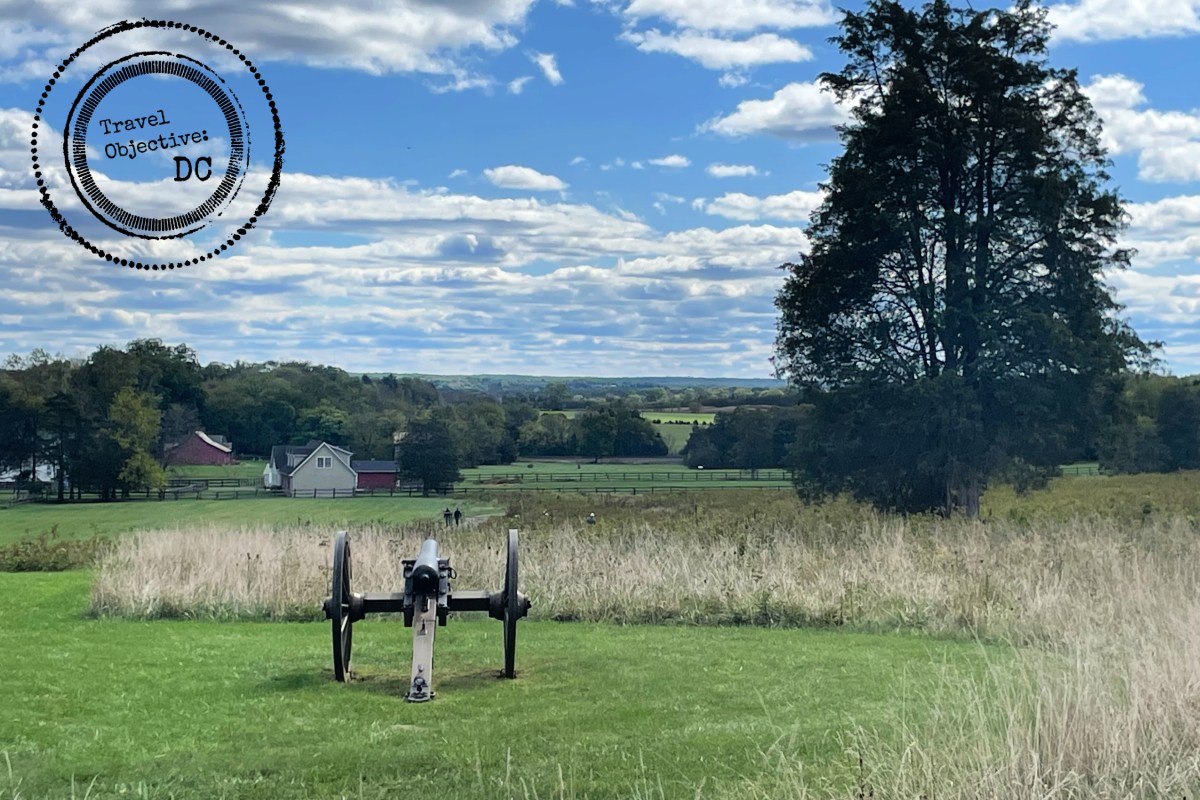
Opened in 2007 after an agreement between a local real estate developer, the county and preservationists, the park’s 144 acres encompass rolling hills, open meadows, and stands of evergreen and hardwood trees. With its sweeping vistas and bucolic setting, a visitor might easily imagine themselves in the 1860’s. 

A wooded section of the 1861-1862 Trail at Bristoe Station Battlefield Heritage Park in Prince William County, Virginia.

Railroad tracks border the park and the sounds of train whistles and rumbling railcars are frequent. Fittingly, it was the railroad that first led the northern and southern armies here. Two interpretive trails through the park tell the stories of the troop encampments and bloody engagements that distinguish the park as a historical site worthy of preservation.

The 1861-1862 Trail 

I arrived at the park on a pleasant Sunday morning. A bright October sun powered its way through high, thin clouds. Only a handful of cars were in the parking lot, yet the trails were busy with joggers, bikers and dog walkers. I started my park tour on the aptly named 1861-1862 Trail. The 1.4 mile trail begins off the parking lot, then moves through some of the park’s wooded areas and grassy fields. 

Interpretive signage is plentiful along the trails at Bristoe Station Heritage Park.

Along the trail, interpretive signs describe how after the First Battle of Bull Run in June 1861, rebel units established large bivouac areas around the town of Manassas Junction. Regiments from Alabama, Mississippi, North Carolina, Tennessee and Virginia all had camps in the vicinity of Bristoe Station. 

Unfortunately, the sanitary conditions of the camps were poor and disease rampant, killing many soldiers. Burial details were constant and the graveyards designated by states as well as by regiments.

The cemetery of the 10th Alabama Infantry Regiment.

A short spur off the main trail leads to the cemetery of the 10th Alabama Infantry Regiment. 

A small memorial stone and an interpretive sign mark the 10th Alabama’s cemetery in an open area, cleared of brush, under some tall deciduous trees. Early records indicate 82 soldiers may be buried here. While the graves of soldiers from other units are undoubtedly in the park, only the confines of this graveyard have been definitively identified. 

Stone marker at the cemetery of the 10th Alabama Infantry Regiment.

Returning to the main trail from the final resting place of the 10th Alabama’s soldiers, I am led towards areas where portions of the Battle of Kettle Run were fought on August 27, 1862.

The battle was a prelude to the Second Battle of Manassas. In July 1862, Robert E. Lee had just defeated Union General George McClellan and his Army of the Potomac in a series of battles defending Richmond, Virginia. Now Lee was ready to lead an offensive campaign. 

Lee ordered Major General Thomas “Stonewall” Jackson to march north and move around the Army of the Potomac’s right flank. Jackson moved towards Manassas Junction, an important transportation hub and Federal supply depot. As part of his plan, Jackson would cut the Union-held railroad lines at the lightly defended Bristoe Station. 

Major General Thomas “Stonewall” Jackson

Bristoe Station was a stop on the Orange and Alexandria Railroad, which was an important link between the bustling port of Alexandria, Virginia and the settlements of the Shenandoah Valley.

Today’s railroad tracks run along the same ground as in the 1860’s. Modern tracks however, run on the surface of the ground, while in the 19th century, they ran through a narrow conduit dug into the ground.

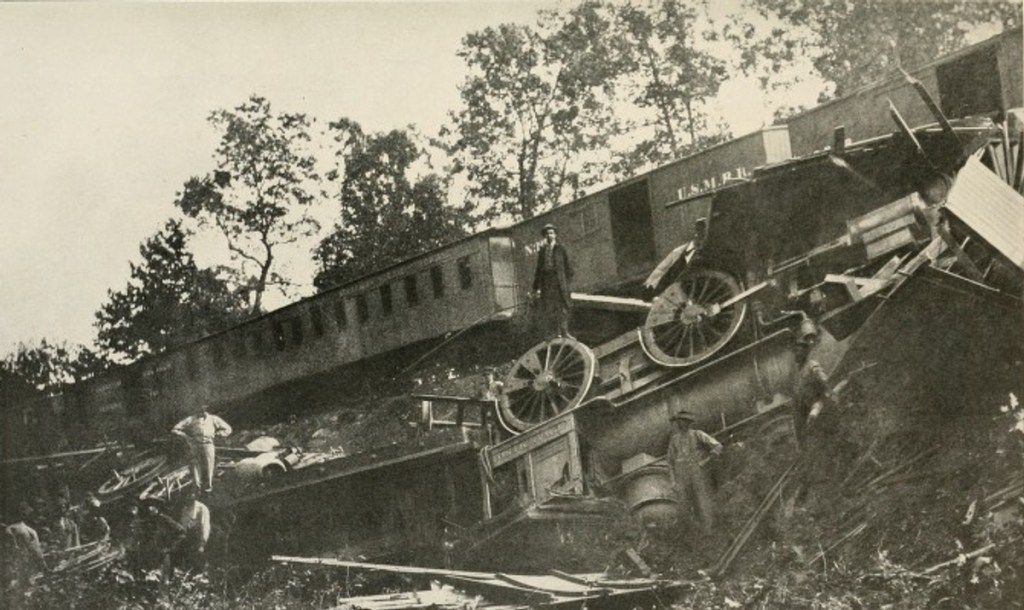
At Bristoe Station, Jackson’s forces quickly overwhelmed a small contingent of Federal troops. The rebels sabotaged several railcars and left them crosswise on the track.  Before departing for Manassas, Jackson ordered a division under Major General Richard Ewell to remain near Bristoe Station and guard against any further Union action.

Train derailed by Confederate cavalry on August 26, 1862 

-By Unknown author – File from The Photographic History of The Civil War in Ten Volumes: Volume Four, The Cavalry. The Review of Reviews Co., New York. 1911

Union division commander Major General Joe Hooker had been ordered to move along the rail lines and retake Bristoe Station. His division engaged Ewell’s in a costly battle that stretched from about 2:00 pm until dusk on August 27th. 

The trail progresses through the open field where regiments from New Jersey, New York, and Pennsylvania engaged Georgians and Louisianans. The momentum switched sides several times through the afternoon. The small, but deadly engagement left 330 Union soldiers dead or wounded, while the Confederates suffered 176 casualties. Ewell had accomplished his mission of delaying Union troops. Having received orders from Jackson, he withdrew his forces after dark and and rejoined Jackson north of Manassas. 

The 1861-1862 Trail crossed the field where the Battle of Kettle Run took place. The battle was the opening engagement of the Second Battle of Bull Run.

A little over a year later, these same two armies would return to Bristoe Station for a final engagement. 

After the Battle of Gettysburg in July of 1863, both the Army of Northern Virginia and the Army of the Potomac returned to central Virginia. As the armies refitted, both sides sent significant forces to bolster counterpart armies in the Western Theater of the war. Knowing his enemy was not at full strength, Lee saw an opportunity to attack and defeat a diminished Union enemy. For five days, beginning on October 9, 1863, Robert E. Lee and his counterpart George Meade fought a series of engagements in Virginia’s Piedmont region. Each time Meade evaded Lee’s traps. 

After several days of chasing Meade’s army, Lee’s Third Corps Commander Lieutenant General Ambrose Powell (A.P.) Hill identified a Union force at a distance and ordered three brigades to attack before the Yankees could once again evade him. 

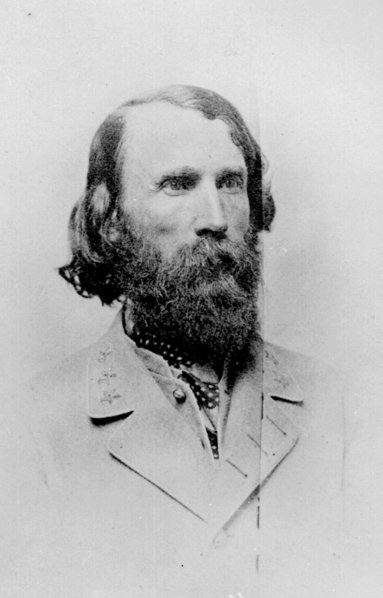
Lieutenant General Ambrose Powell (A.P.) Hill

The 1863 Trail

The second trail, dubbed The 1863 Trail, traces this final action at Bristoe Station on the afternoon of October 14, 1863. The 1.3 mile trail stretches over rolling fields onto a broad grassy slope where a North Carolina brigade commanded by Brigadier General John Cooke attacked the Union line positioned along the railroad tracks. Unfortunately for the Confederates, Hill ordered no reconnaissance mission and did not realize the strength of the Union force. 

After a gallant charge, the brigade was engulfed by heavy artillery and musket fire from well positioned Union troops along the railroad embankment and they hastily retreated back up the slope. 

Subsequent rebel reinforcements could not dislodge the Union line. Under cover of darkness, the Union troops slipped away for more fortified positions around Centreville, Virginia. Although the Southerners commanded the field, the battle had been costly. The Confederates lost 1,400 men who were killed, wounded or captured; men who could not be replaced. Union losses were around 300. Lee had lost his chance to strike an offensive blow against the Army of the Potomac.

“Bury these poor men and let us say no more about it.”

-General Robert E. Lee to Lt. Gen. A.P. Hill

Following the battle, Lee is said to have dismissed Hill’s explanations for the loss saying, “Bury these poor men and let us say no more about it”.

The Bristoe Station Battlefield Heritage Park is maintained by the Prince William County Parks, Recreation, & Tourism, Office of Historic Preservation. Staff members and volunteers offer tours of the park on designated weekends in the spring and summer. The site also hosts periodic reenactments and living history programs. 

While the battles fought at Bristoe Station were not as large nor as well known as other Civil War engagements, they were important pieces of two significant Civil War campaigns. A visit here provides important insights into how the two battles of Bull Run developed and how their outcomes impacted both armies. 

Uniformed reenactors depict a portion of the 1863 Battle of Bristoe Station.

Bristoe Station is a tremendous example of the many benefits of successful preservation efforts. The park allows present and future generations to learn from the past and enjoy a natural setting amongst the tangle of suburban development. 

Although the immediate park is preserved, the pressure to develop near historic sites in Virginia, including Bristoe Staton remains strong. Even now a large project to build data centers and warehouses on neighboring properties where portions of the 1863 battle took place threatens sight lines and will bring increased noise and traffic to the area. 

Preservationists are pursuing a variety of measures to balance development around the park and throughout the region, raising funds to purchase historic properties, filing petitions and engaging with public officials. Success can be elusive, but areas such as Bristoe Station represent an irreplaceable part of our heritage.

So the “third battle” of Bristoe Station–to keep the area’s natural setting–continues.

* * *

Route Recon

The main parking lot for Bristoe Station Battlefield Heritage Park is located at the intersection of Iron Brigade Avenue and 10th Alabama Way, Bristow, Virginia, 20136.

From Interstate 95: Take Rt. 234 North (Exit 152B); travel 7.5 miles and make a left onto Independent Hill Drive. Then make your immediate right onto Rt. 619 (Bristow Road). Travel 7 miles and turn left onto Iron Brigade Unit Avenue. The parking lot is located on your left at the traffic circle.

From Interstate 66: Take Rt. 234 South (Exit 44). Travel 4.5 miles and turn right onto Rt. 28 (Nokesville Road). Travel 1.5 miles and turn left onto Rt. 619 (Bristow Road). Travel .25 miles and turn right onto Iron Brigade Unit Avenue. The parking lot is located on your left at the traffic circle.

The 140+ acre suburban park has more than 2.7 miles of walking and equestrian trails.

NOTE: There are NO restroom facilities at the park. 

Click here for a trail map. 

Guided Tours are offered May-October on the second and fourth weekends of each month. Visit the Prince William County Parks, Recreation and Tourism, Office of Historic Preservation website for more information. 

Prince William County has curated a driving tour of regional landmarks related to the entire Bristoe Station Campaign of October 1863. Visit the website for more information. 

Grant Immemorial

Ulysses S Grant Memorial | Washington DC

The sculpted face of Ulysses S. Grant looks across the National Mall with dispassionate determination. Around him a battle rages. A cavalry unit charges forward, an artillery detail hurries to emplace a cannon, infantry continue their forward march. Yet Grant, in his simple uniform and campaign hat, sits atop his war horse Cincinnati, looking forward, studying the situation and planning several steps ahead.

Such is the image portrayed in Washington, DC’s memorial dedicated to the Civil War General-In-Chief and 18th President of the United States. The memorial is located in Union Square, a plaza located just west of the U.S. Capitol grounds.

The move to commemorate Grant in Washington, DC began in the decade after his death in 1885, spearheaded by surviving veterans of the Union Army of the Tennessee. In 1902, Congress ultimately selected the ambitious designs of sculptor Henry Merwin Shrady and architect Edward Pierce Casey who envisioned a large multifaceted memorial in bronze and stone. 

A native of New York City and a graduate of Columbia University, Shrady took up art while recuperating from typhoid fever. Although Shrady had no formal training as an artist or sculptor, some of his early works earned him much acclaim. He focused on sculpture and studied anatomy very carefully in order to portray realistic figures in his statues. In 1901, he completed a famous equestrian statue of George Washington located in Brooklyn.

Men and horses advance in the statue entitled Calvary Charge, part of the Ulysses S. Grant Memorial.

After winning the Grant award, he engaged himself even more thoroughly in researching his subjects. He studied New York City Police Department horses. He examined Grant’s death mask. He observed military drills and exercises. He analyzed Civil War uniforms, weaponry and equipment to enhance the detail in his work. He drew upon his father’s recollections as a physician who attended to Grant in his final year. His architect partner, Edward Casey, was a veteran of the New York National Guard and lent some of his military experience to the project.

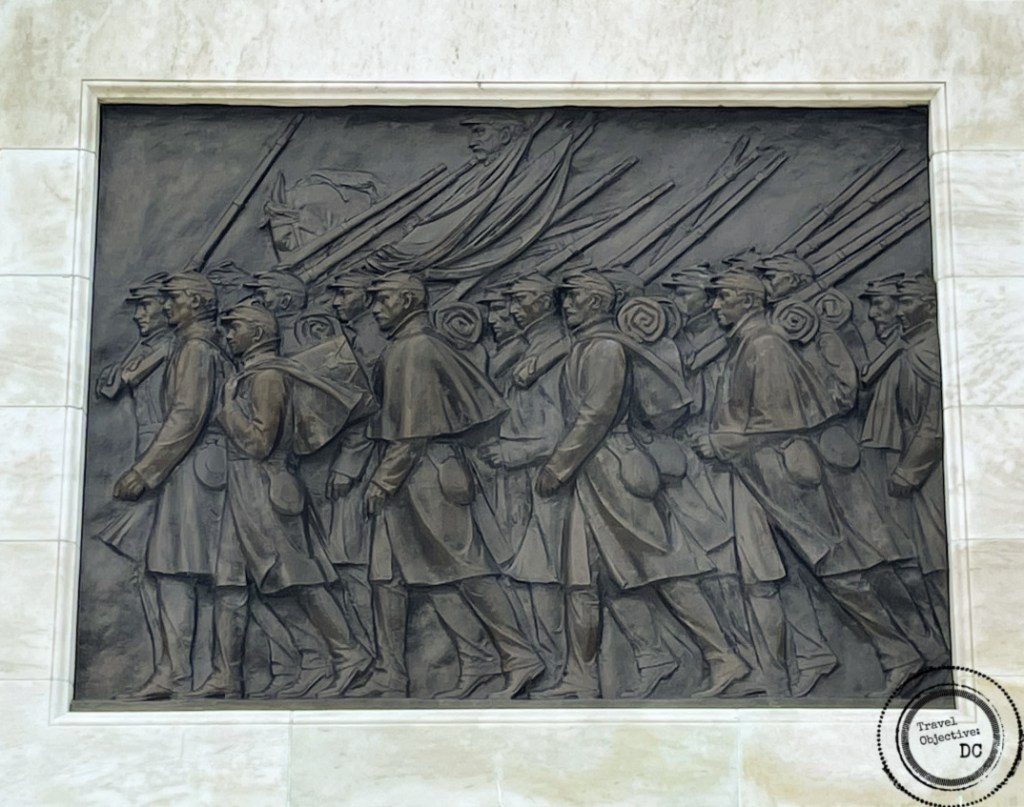
Shrady and Casey’s memorial dominates the Union Square area. The centerpiece statue of Grant, reaching 44 feet high, is one of the largest equestrian statues in the world. Two bronze bas-relief sculptures depicting advancing infantry adorn opposite sides of the statue’s pedestal. Four bronze lions on their own pedestals guard Grant’s statue adding a sense of majesty. The statues and pedestals sit upon a terraced marble platform about 240 feet from end to end. At both sides along that platform are additional bronze sculptures depicting the randomness and chaos of combat. 

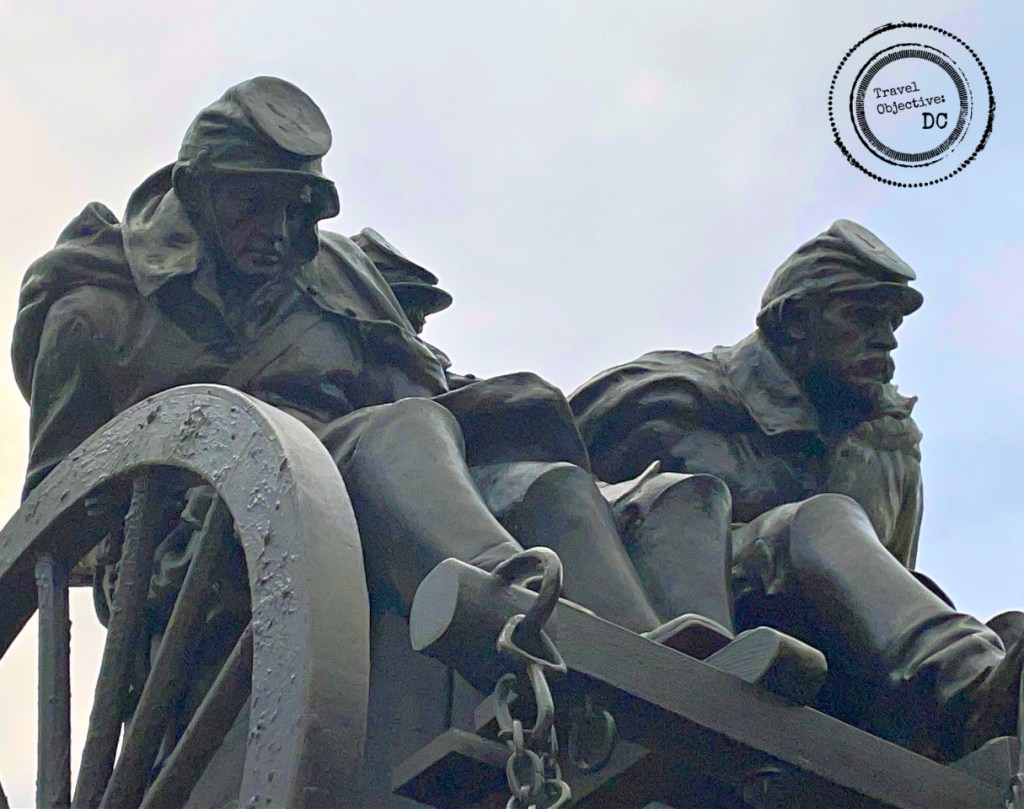
An artillery detachment races to place a cannon in Henry Shrady’s statue Artillery at the Ulysses S. Grant memorial.

The sculpture known as Artillery presents a team of soldiers and horses racing to position a cannon. The guidon bearer has signaled a turn to the right, yet a bridle on the lead horse has broken and the horse continues to lunge forward. 

At the opposite end of the memorial, the statue entitled Cavalry Charge depicts cavalry troopers on the move.  An officer raises his sword ordering the advance, the buglar sounds the charge, a soldier bears the colors. Yet tragedy is about to strike as a trooper has fallen from his mount and will be trampled. Shrady is said to have portrayed himself as the ill-fated soldier. 

Shrady had worked relentlessly for twenty years on the memorial, undertaking some of the most ambitious and complex sculpting work of the time. He obsessed over every detail of the massive statues, each of which took years to produce and were some of the largest bronze castings of their time. Sadly, Shrady died about two weeks before the final dedication of the statue in April of 1922 commemorating the 100th Anniversary of Grant’s birth.

The face of the fallen trooper in the Cavalry Charge statue, said to be that of the sculptor Henry Shrady. The Grant Memorial project consumed twenty years of Shrady’s life.

Given the interest both Shrady and Grant had in horses, it is not surprising how prominent they are in this memorial. This seems fitting as Grant was an accomplished rider and horseman.

Grant learned to care for and work with horses as a young man growing up in Ohio. His father was a well-connected businessman who secured his eldest son an appointment to West Point. Grant was not especially enthused about attending the military academy, but knew it was likely his best opportunity for a university education. 

Ironically, it was an accident of paperwork at West Point that he got his name Ulysses Simpson Grant. He was born Hiram Ulysses, but his Congressman wrote Ulysses Simpson (his mother’s maiden name) on his appointment documents. When he reported to West Point in 1839, he was told the appointment was for Ulysses Simpson Grant, so he assumed the name, rather than reapplying. 

 He was a capable, but unambitious student who graduated in the middle of his class in 1843.   

Originally thinking he might go on to teach college math, Grant decided on a military career following his service in the Mexican-American War. During the war, Grant was recognized several times for his bravery in combat. He learned some important skills during his service in Mexico, developing a proficiency in military logistics, and witnessing the leadership styles of several commanders, including Zachary Taylor and Winfield Scott. 

Detail of the two artillerymen riding the wagon in the Artillery statue.

After the war, Grant found aspects of the peacetime Army difficult, especially the separation from his family. Unfortunately, he looked for solace in alcohol and developed a reputation as a problem drinker. That reputation followed him his entire life. He resigned his commission in 1854 and unsuccessfully pursued a string of civilian jobs, ultimately going back to work for his father in Galena, Illinois. 

Following the attack at Fort Sumter in April 1861, Grant was determined to return to military service. He sought and received a commission and the command of the 21st Illinois Volunteer Infantry Regiment. He restored discipline and effectively trained the unit to make it combat ready. A promotion to brigadier general followed in August 1861.  

A bronze bas-relief plaque of marching infantry soldiers on the pedestal of the Grant equestrian statue.

In February 1862, Grant led his troops to successful engagements at Fort Henry and Fort Donelson in western Tennessee. His successes gave the Union some badly needed victories. They also gained him the nickname “Unconditional Surrender” Grant, because he demanded his enemies surrender without terms. His actions led to his promotion as a Major General of volunteers and he was appointed commander of the Army of the Tennessee.  

In April 1863, Grant’s army was attacked by Confederate forces; the resulting fight at the Battle of Shiloh made plain the painful truth that a long war awaited both sides. The losses were staggering, a combined 23,000 causalities. But Grant’s deft leadership in sustaining the rebel assault and successfully counterattacking led to a Union victory. Grant received criticism for being unprepared for the Confederate attack; some even calling for his removal.  Lincoln famously responded “I can’t spare this man, he fights.”

After Shiloh, Grant and his Army pushed further south from Tennessee, aiming to take the Mississippi River port city of Vicksburg, a vital logistics hub for the Confederacy. Grant would demonstrate strategic prowess in this campaign, coordinating his troop’s movements with the Navy, splitting his forces to fend off a rebel reinforcement, and ultimately accepting the surrender of Vicksburg and its 30,000 Confederate defenders on July 4, 1863 after a 48-day siege.  

In October 1863, Grant was given command of all Union armies in the West. He moved quickly to break a Confederate siege of a Union Army in Chattanooga, Tennessee. His success led Lincoln to appoint Grant to the rank of Lieutenant General (the first officer to hold this rank since George Washington) and as General-in-Chief of the Armies of the United States in March 1864.

As General-in-Chief, Grant provided Lincoln with a campaign plan for a multiple front operation wherein Federal Armies would pursue the remaining major Confederate formations and degrade the South’s ability to wage war.  

Through the spring of 1864 and into 1865, Grant would accompany General George Meade and the Army of the Potomac, engaging in a brutal campaign which ultimately lead to the surrender of Robert E. Lee at Appomattox, Virginia on April 9, 1865. 

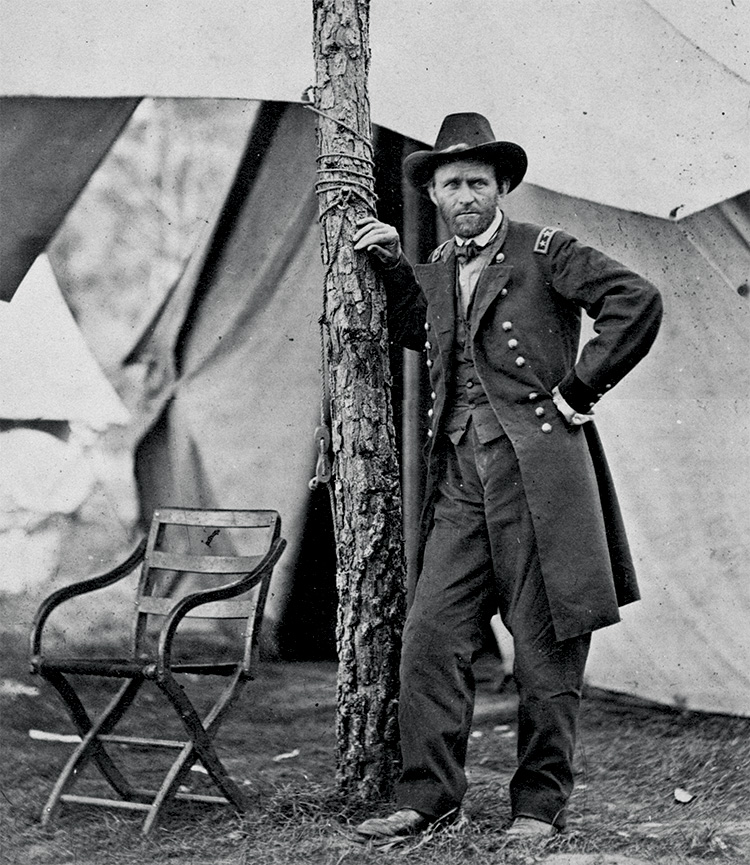
Ulysses S. Grant at his Cold Harbor, Virginia Headquarters in June 1864.

-Civil War Photographs, 1861-1865, Library of Congress, Prints and Photographs Division.

After the war, Grant would serve as Secretary of War under President Andrew Johnson. In 1868, he was elected president and served two terms. Unfortunately for President Grant, although he was personally honest and upright, those around him were not and his administrations were tainted by corruption. Still, there were several notable accomplishments during his administration such as the ratification of the 14th Amendment, passage of early civil rights legislation, establishment of the Department of Justice, and the creation of Yellowstone National Park.

Despite the scandals, Grant remained very popular. Like Washington, he chose not to run for a third term. He left office, and embarked on a grand tour of America and the world. His later years proved quite difficult. An unscrupulous investor took advantage of Grant and he lost much of his money in bad investments. He was diagnosed with throat cancer in 1884. Wanting to leave his wife with sufficient means to support herself, he worked tirelessly up to his death to complete his memoirs.  When the Personal Memoirs of U.S. Grant was finally published, it was a major success, heralded by critics, historians and the public alike.

Grant died on July 23, 1885 in upstate New York. Over a quarter of a million people viewed his funeral train as it traveled down the Hudson River valley to New York City. Tens of thousands of Union Army veterans accompanied Grant’s casket in a procession sometimes seven miles long. Confederate generals Joseph Johnston and Simon Buckner were among his pall bearers. 

For a time, Grant’s legacy suffered from debatable stories related to his drinking, supposed indifference to losing soldiers in combat and scandalous presidency. Over the past several decades though, historians and scholars have more closely examined Grant’s characteristics as a strategic leader, effective manager, and skilled tactician.

Like Grant’s reputation, his memorial in Washington, DC has also undergone refurbishment over the past few years. In 2011, the Architect of the Capitol accepted responsibility for the memorial from the National Park Service and began to restore the statuary and stonework. Signs of corrosion and weathering were removed, the marble and bronze polished, missing or broken features from the statues, such as swords and chains, were replaced. Eight ornate bronze lamps were also installed around the memorial.  

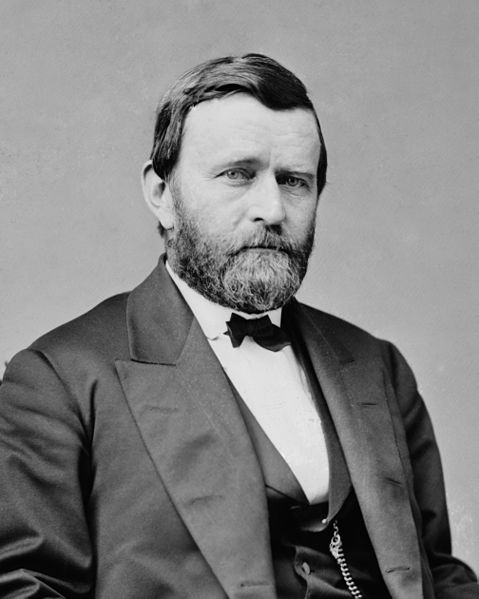
Portrait Photograph of President Ulysses S. Grant, circa 1870

-Matthew Brady; Library of Congress Prints and Photograph’s Division

At the top of that memorial, as the face of General Grant gazes west, he can see the memorial to his wartime president, Abraham Lincoln. Through the Civil War years, Ulysses Grant and Abraham Lincoln developed a close working relationship. The two were westerners with a common touch and similarly humble origins. Lincoln appreciated Grant’s leadership, his willingness to maintain the offense and his sense of responsibility. Grant wrote: “No general could want better backing for the president was a man of great wisdom and moderation.” Now their memorials bookend our National Mall, a fitting testimonial to the president and his general who fought so hard to preserve the Union.

Route Recon

The Ulysses S. Grant Memorial is located along First Street, NW, just to the west of the U.S. Capitol building. The best way to get to the memorial (and the Capitol) is by taking Metro.

Three Metro stops are within walking distance of the memorial and the Capitol:

  • Union Station – Located at First Street, NW, and Massachusetts Avenue.
  • Capitol South – Located at First Street between C and D Streets, SE.
  • Federal Center, SW – Located at the southwest corner of Third and D Streets, SW.

Additional information on riding Metro, is available at the Washington Metropolitan Area Transit Authority.

The DC Circulator, a public bus system with routes through Washington’s downtown area includes stops near the Memorial. Find more information about Circulator busses at www.dccirculator.com.

There is very little public parking available near the Capitol. The nearest public parking facility is at Union Station, to the north of the Capitol. Very limited metered street parking is found along the Mall to the west of the Capitol.

Command Reading List

Many books have been written on Ulysses S. Grant. The below works offer new insights into Grant’s character and leadership.

Grant by Ron Chenow

Noted biographer covers Grant’s entire life and career, from his Ohio childhood through his presidency and beyond.

The Presidency of Ulysses S. Grant by Charles Calhoun

This book by historian Charles Calhoun produced a very comprehensive analysis of the Grant presidency, with detailed research that challenges some of the early criticisms of Grant which are often repeated by historians and biographers.  

The Personal Memoirs of Ulysses S. Grant, edited by John F. Marszalek with David S. Nolan and Louie P. Gallow

Grant’s memoirs were immensely popular when published in 1885. This annotated version provides extensive background and context to Grant’s original writing.

* * *

Fort Ward, the Mission Continues

Six Civil War reproduction cannons stand as silent sentinels over the Fort Ward Museum and Historic Site, an open and inviting space in Alexandria, Virginia, Washington, DC’s neighbor to the south. The site, located in Alexandria’s Seminary Hill neighborhood, was originally conceived as a Civil War era preservation project. Today, Fort Ward is embracing over 150 years of history, from the Civil War through the Civil Rights era, for this prominent and storied Virginia city.

Fort Ward’s origins are found in the days following the rebel victory at Manassas in July of 1861.  U.S. Government leaders quickly realized the Federal capital was in a precarious situation. Bordered on one side by Virginia, now enemy territory, and the other by Maryland, a slave holding state, Washington, D.C had almost no physical defenses to rely on.

Cannon - Fort Ward - Alexandria VA - Civil War defenses

The Army appointed one of its leading engineers and an expert on coast artillery, John Barnard, to design a robust defensive system along the high grounds surrounding Washington to guard strategic waterways, roads, railways and bridges. By the end of the war, Barnard’s extensive efforts lead to the construction of 68 forts and 93 gun batteries bristling with over 800 cannons and connected by various roads and trenches. Fort Ward is one of the best preserved examples of Washington’s Civil War defenses.  

Construction of Fort Ward began in July 1861 and was completed about two months later to protect the main approaches into Alexandria. The fort was named for U.S. Navy Commander James H. Ward, the first U.S. Navy officer killed in action during the Civil War.

Civil War re-enactors - Washington DC - Civil War sites
Fort Ward hosts multiple living history events throughout the year.

Fort Ward was built as a bastion fort, meaning the walls were designed at angles to provide interlocking fields of fire from inside the fort. Like most of the other fortifications, Fort Ward was constructed primarily of readily available dirt which was much better at withstanding artillery and rifle fire than brick, stone or wooden logs.  The earthen walls were approximately 20 feet high and 12 feet thick. The fort was expanded several times during the war. Ultimately, Fort Ward had five bastions with emplacements for 36 guns and a final perimeter almost half a mile long.  

A trench ran along that perimeter, a final obstacle for any attackers who might make it through the cannon fire. Units from Connecticut, New York, Pennsylvania and Ohio garrisoned the fort, usually numbering between three to four hundred men at a time.

Alexandria VA - Fort Ward - park - Civil War

The trench or dry moat surrounding the earthen bastion walls presented one more obstacle for any attacking forces.

Just after Virginia seceded from the Union in April 1861, the Union Army moved quickly to occupy Alexandria.  The city soon became a hotbed of Federal activity. Given its port and railroad connections, Alexandria became a logistical center. Troops and supplies would flow through the city. Wounded were transported to Alexandria for treatment and recovery. The city was filled with Army camps, warehouses, supply depots, hospitals and other official activities. This substantial U.S. Government presence attracted African Americans from around Virginia and beyond. Referred to at the time as “contraband,” these men and women came seeking freedom from slavery. They found paid employment at these Federal facilities, including Fort Ward. Many men enlisted in the U.S. Colored Troops regiments and went to fight.

At war’s end, when the Army left Fort Ward, several African American families remained. They purchased property and began building homes, churches and a school. Over four generations, the African American community continued to grow in its own neighborhood known as “The Fort”. The nearby Virginia Theological Seminary (which gives the current neighborhood its name) and Episcopal High School employed many of The Fort’s residents.

In the 1950s, the City of Alexandria began planning for the restoration of the original Fort Ward and the creation of today’s park space. Unfortunately, this work would lead to the resettlement of The Fort neighborhood. The city bought or appropriated the land compelling the families living there to move on. Archeological excavations of the original Fort Ward began in 1961. Renovations of several portions of the fort followed as part of the Civil War centennial.  The park was formally opened to the public in May of 1964.   

Fort Ward Museum, Alexandria, Virginia
The Fort Ward Museum, designed with a board and batten style commonly used around Washington during the Civil War period.

For a chronological view of Fort Ward, a visit today is best begun in the museum, housed in a reproduction two-story building modeled after a period Army headquarters building.  Museum curators have assembled an impressive collection of weapons, uniforms, documents, photographs, medical instruments, folk art, and other implements of military life to tell the stories behind the Civil War defenses of Washington, the history of Fort Ward, conditions in Alexandria at the time and the lives and duties of Union Army officers and soldiers.  A scale model of the original Fort Ward orients the visitor to its Civil War era layout and appearance.

The museum’s upper floor houses a research library containing a trove of historic materials as well as more contemporary documents and publications on the Union forts defending Washington, DC and other Civil War topics. The museum periodically organizes living history events, hosting Civil War reenactors at Fort Ward to enhance visitors’ understanding of the way soldiers and civilians lived their wartime lives.

Civil War - Officers Quarters - Hut
The Officer’s Hut provides a glimpse into how officers lived at Fort Ward.

Adjacent to the museum is a reproduction officer’s hut. Huts such as these were built to provide housing for Fort Ward’s commissioned officers. Peer through the windows and see the furnishings and accoutrements illustrative of how these officers lived at the time.

The museum and officers’ hut buildings are located on grounds outside of the original fortifications in what was a support area where troop barracks and living quarters were located, and administrative and logistical functions performed. 

Fort Ward - main gate - Alexandria, VA
The reproduction main gate at Fort Ward.

Pass through the reproduction entrance gate to the fort’s original grounds and follow the trail to see what the reconstructed northwest bastion would have looked like in 1864. One of the more heavily armed strongholds of the original Fort Ward as it overlooked the busy Leesburg Pike (today’s State Route 7), the restored northwest bastion includes six gun emplacements along with the magazine and a filling room for ammunition.  

After visiting the reconstructed fort area, a path circles through the larger park with open green space, picnic areas, and an amphitheater. Along the way, descriptive signage explains aspects of The Fort neighborhood and the people who lived there. Existing features of the old neighborhood are emphasized, including several surviving grave sites.  

The Fort - Clara Adams - Gravesite

Clara Adams, a longtime leader in The Fort neighborhood, is buried on the grounds of the historic site. Among her many contributions, she donated land for the community’s African American School.

The City of Alexandria continues to expand the interpretation of Fort Ward’s history for today’s Alexandria residents and visitors alike. A series of interviews with former Fort residents provide compelling first-person accounts of life in and around The Fort. These interviews started in the early 1990’s and continue today. An archeological dig concluding around 2014 used ground radars to clarify the boundaries of known grave sites, identify previously unknown grave sites and unearth additional artifacts. The city also has plans and designs for new interpretive signage and markers, a Fort neighborhood exhibit to the museum, historic home floor plan displays from The Fort neighborhood, and other interpretive tools and techniques to more completely convey the multi-layered story of Fort Ward.

Fort Ward is unique among Washington, DC area historic landmarks and a worthy addition to any DC itinerary. It preserves an essential element of Civil War history, namely the defenses of Washington, while also examining the complex social and cultural impacts of that period on life in Alexandria over the century that followed. As important, its 45 acres of leafy parkland are a pleasant place for locals and visitors alike to spend a sunny afternoon.

Northwest Bastion - Fort Ward - Alexandria, VA
Reproduction cannons at the restored Northwest Bastion

Route Recon:

The Fort Ward Museum and Historic Site is located at:

4301 West Braddock Road
Alexandria, Virginia 22304

Phone: 703.746.4848

Fort Ward is approximately six miles south of Washington, D.C. Free parking is available for cars and buses.

From Washington, DC: Follow signs to Interstate 395 (I-395) south to Richmond. Take the Seminary Road East exit. At the fifth traffic light (at Alexandria Hospital) turn left onto North Howard Street. Follow North Howard to its intersection with West Braddock Road and turn right. The Museum entrance is on the left.

From Old Town Alexandria: Follow King Street west to Alexandria City High School, turn right on Kenwood Avenue. Turn left on West Braddock Road, and proceed about a mile. The Museum entrance is on the right. 

From I-95/I-495 (Capital Beltway): Follow road signs to I-395 North. Take the Seminary Road East exit. At the fifth traffic light (at Alexandria Hospital) turn left onto North Howard Street. Follow North Howard to its intersection with West Braddock Road and turn right. The Museum entrance is on the left.

From Dulles Airport: Take Dulles Access Road East to I-495 North (Capital Beltway). Follow road signs to I-395 North. Take the Seminary Road East exit. At the fifth traffic light (at Alexandria Hospital) turn left onto North Howard Street. Follow North Howard to its intersection with West Braddock Road and turn right. The Museum entrance is on the left.


By Metro Rail, then Bus: Take the Yellow or Blue Line to King Street Station. The AT5 DASH Bus  www.dashbus.com to Landmark stops in front of Fort Ward. Call (703) 370-DASH for bus schedules and information.

By Amtrak or Virginia Railway Express: Walk across the street from the Alexandria Union Station to the King Street Metro Station to take the AT5 DASH Bus.  

More information about Fort Ward and how to plan your trip can be found at the Fort Ward Museum and Historic Site website.  

“Better Soldiers Never Shouldered a Musket”

So said US Army Major General Benjamin Butler after observing the keen proficiency in marching and drilling demonstrated by a unit of newly enlisted soldiers of African descent. It was mid-1862 and Butler was organizing the 1st Louisiana Native Guards, one of the first regiment of African American soldiers that would serve in the Union Army.

Butler at the time was on the leading edge of change. When the Civil War began in April 1861, the Militia Act of 1792 prohibited men of African descent from serving in the US Army. As it became clearer to military and political leaders that this war would not be a short one, this exclusion was seriously reconsidered.   

African American Civil War Museum| Frederick Douglas| Men of Color|
1863 Recruitment Poster. The poster was endorsed by Frederick Douglas and other African American leaders, encouraging men of African descent to enlist.

In the summer of 1862, Congress passed two laws, the Second Confiscation Act and the Militia Act of 1862, which would create the legal framework for receiving certain freed slaves and others of African descent into the Army. President Lincoln’s Emancipation Proclamation, signed on January 1, 1863, further expanded and clarified their roles in military service. The War Department began actively preparing to receive African Americans into the Army. Recruitment was slow at first, then grew steadily as African American community leaders encouraged action. 

African American Civil War Museum | Washington DC | Travel Objective DC| U Street| Vermont Avenue

Today, this service is commemorated at the African American Civil War Museum and Memorial in Washington, DC.  This year the museum marks 20 years of chronicling the story of how African Americans, both slaves and freemen, took up arms and discharged their duties with dignity during the Civil War.  

The museum and memorial are located along Washington, DC’s famous U Street corridor, the traditional center for African American culture in Northwest Washington. Today the corridor is revitalizing with new stores, restaurants, clubs and other development complimenting such historic landmarks as the famed Howard Theater.  In 2011, the museum moved into the auditorium of the Grimke School, formerly a neighborhood school built in 1907 and named for a prominent African American family.  

African American Civil War Museum| Vermont Avenue| U Street
Life sized banners greet visitors to the museum.

The entrance to the museum is tucked away down an alley lined with banners depicting the military duties African Americans performed. Once inside, a succession of display panels along with select artifacts trace the history of Africans and their descendants in early America, their military experiences during the American Revolution and War of 1812, and ultimately, their service in the Civil War.

As recruitment steadily grew, the War Department established the Bureau of Colored Troops in May of 1863 to provide the administrative support necessary to induct, equip and train the soldiers, who would serve in separate units from whites. Ultimately, about 178,000 men of African descent enlisted and 175 U.S. Colored Troops (USCT) regiments were formed, comprising 10% of the Union Army. USCT regiments also included mixed race individuals, Hispanics, and Native Americans. White officers generally filled the leadership ranks of these units, although some regiments did have African American officers at the company level. The Bureau of Colored Troops established guidelines and panels to identify and select USCT officers; those with advanced education and prior military experience were especially recruited. 

United States Colored Troops| Training Manual| Infantry Tactics|
Title page of a training manual on infantry tactics developed for US Colored Troops units.

USCT units often performed non-combat missions – referred to as “fatigue duty”- such as digging trenches, building bridges, and cutting new roads. Since many USCT soldiers were Southerners and possessed a specialized knowledge of local geography, USCT units were sometimes given scouting and reconnaissance missions. When they were assigned to combat, USCT regiments won praise for their gallantry. More prominent engagements for USCT regiments include Fort Wagner (as depicted in the movie Glory), the Siege of Petersburg, Virginia and the Battle of Nashville. At Vicksburg, General Ulysses S. Grant wrote of his USCT soldiers “All that have been tried have fought bravely.”

Unlike the Army, the Militia Act of 1792 did not apply to the Navy which had long enlisted sailors of African descent. During the Civil War, approximately 19,000 African American sailors served throughout the Union Navy, generally aboard the same ships as white sailors.

African American Civil War Memorial| African American Sailor| U Street| U Street Metro
A US Navy Sailor depicted on the African American Civil War Memorial. 

The individual gallantry demonstrated by soldiers and sailors of African descent was recognized by many unit commanders. The museum introduces 18 soldiers and two sailors who won the Medal of Honor during Civil War combat.

African American Civil War Museum| John Lawson

One is Navy Landsman John Lawson.

While serving aboard the USS Hartford at the Battle of Mobile Bay, Landsman Lawson was “Wounded in the leg and thrown violently against the side of the ship when an enemy shell killed or wounded the 6-man crew as the shell whipped on the berth deck, Lawson, upon regaining his composure, promptly returned to his station and, although urged to go below for treatment, steadfastly continued his duties…”.

At war’s end, some USCT regiments were disbanded, but many were assigned to occupation duty. As the Regular Army was reorganized, four regiments of African American soldiers were ultimately established and maintained. Members of those regiments, the 24th and 25th Infantry, and 9th and 10th Cavalry, would become renown as “the Buffalo Soldiers”. 

While the museum’s current space in the former school’s auditorium is rather confining, a recently announced redevelopment of the Grimke School building will provide a larger 10,000-12,000 square foot area into which the museum will expand.  The new space will allow for the display of additional artifacts, two new exhibits and a theater. This news is undoubtedly welcome for the museum’s staff, patrons and visitors. 

African American Civil War Memorial| U Street| Vermont Avenue| U Street Metro
The African American Civil War Memorial. The metal panels wrapping around the sculpture contain the names of those who served in USCT regiments. 

Across the street from the museum placed in a wide stone plaza is a bronze statue entitled The Spirit of Freedom by sculptor Ed Hamilton. The statue depicts three Union soldiers and one sailor of African descent on one side and an African American soldier with his family on the other. The statue was completed in 1997. Curved metal panels, inscribed with the names of the 209,145 officers and soldiers who served in USCT units, encircle the sculpture to one side. 

A visit to the African American Civil War Museum and Memorial provides a compelling introduction to how USCT soldiers went from slaves and civilians to a professional force, fighting for their freedom, their rights and for the Union. They not only changed the tide of the Union war effort, but also secured a lasting place for African Americans in the US military. Today, African Americans comprise approximately 18% of the ranks of the US Armed Forces. Their continued service is a legacy of the US Colored Troops and their naval counterparts. 

African American Civil War Memorial| U Street| U Street Metro| Vermont Avenue| Frederick Douglas

The courage displayed by soldiers and sailors of African descent during the Civil War played a critical role in African Americans gaining new rights. As the abolitionist Frederick Douglass wrote: “Once let the black man get upon his person the brass letter, “U.S”., let him get an eagle on his button, and a musket on his shoulder and bullets in his pocket, there is no power on earth that can deny that he has earned the right to citizenship”. 

***

Route Recon:

The African American Civil War Museum is located at 1925 Vermont Avenue, NW in Washington, DC, near the intersection with U Street. The hours are Monday from 1000 to 1700, Tuesday – Friday 1000 to 1830, Saturday 1000 to 1600 and Sundays 1200 to 1600. Admission is free. There is limited street parking near the museum. Visit the African American Civil War Museum website for more information.

The museum and memorial are easily accessible from Metro. Use the 10th Street exit from the U Street/African American Civil War Memorial/Cardozo station on the Green and Yellow lines. The memorial plaza is at the top of the escalator. 

Mess Call:

Bens| Bens Chili Bowl| Half Smoke| U Street|

Ben’s Chili Bowl

Just two blocks down U Street from the museum and memorial is Ben’s Chili Bowl, a local favorite since 1958. Ben’s has seen some challenging times as an eatery, to include the riots following Martin Luther King’s assassination in 1968 and the construction of Metro in the 70s. Yet it has persevered and today proudly serves their signature dish, the half-smoke sandwich, to celebrities, politicians and locals alike. There are a variety of other menu items as well such as burgers and vegetarian chili. (Note: They do not accept credit cards, but there is an ATM on premises).

 Ben’s Chili Bowl

1213 U Street, NW (between 12th and 13th Street)

Monday-Thursday: Breakfast: 0600-1045; Lunch/Dinner: 1045-0200 

Friday: Breakfast: 0600-1045; Lunch/Dinner 1045-0400

Saturday: Breakfast: 0700-1045; Lunch/Dinner 1045-0400

Sunday: 1100-0000