Understanding Arlington Begins at Arlington House


In the spring of 1864, as the Civil War extended into its third year, the Union Army was suffering staggeringly high casualties. Sadly, the newly created national cemeteries at the Soldiers’ Home in Washington and in Alexandria were reaching capacity. 

The Union Army was going to need additional space to bury its war dead. Major General Montgomery C. Meigs, the Quartermaster General of the Army, knew where he was going to find it. 

Meigs soon directed burials to begin at Arlington, the antebellum plantation of Robert E. Lee and his wife Mary Custis Lee. 

Brevet Major General Montgomery C. Meigs, Quatermaster General of the US Army, 1861-1882.

Only a fraction of the 4 million people who visit Arlington National Cemetery each year make the trek up a winding hill to visit Arlington House. Those who do are rewarded not only with a great view of the National Mall, but a much better sense of how the Lees’ home became America’s preeminent national cemetery.

Arlington House Before the War

The Lees loved life at Arlington. Robert E. Lee wrote “Arlington…where my affection and attachments are more strongly placed that at any other place in the world.”  Mary and Robert married in the front parlor in 1831. While Mary followed her husband on several of his Army assignments, she spent most of her time living and raising the couple’s seven children at Arlington.

Flowers bloom in the main garden

Mary Custis Lee inherited Arlington from her father, George Washington Parke Custis. Parke Custis was the grandson of Martha Washington from her first marriage.  Following the death of Parke Custis’ father, George Washington adopted the young boy and his sister.

Parke Custis revered George Washington and assembled an extensive collection of Washington’s belongings. He intended to display these artifacts in a grand mansion. Construction of the house took sixteen years and was completed in 1818. 

The Greek Revival mansion, with its peaked roof and Roman columns, resembles an ancient temple.  The collection of artifacts and the mansion, built overlooking the new capital, was to be a powerful reminder of the man for his namesake city taking shape below. 

The view of the Lincoln Memorial and Memorial Bridge from Arlington House.

Arlington House Today

The first floor of the main house that the Lees loved so well is open daily for self-guided tours. A $12 million, three-year renovation of the grounds was completed in 2021. Through the project, numerous repairs were made to the interior, artifacts returned to the house, and new interpretive signage installed. 

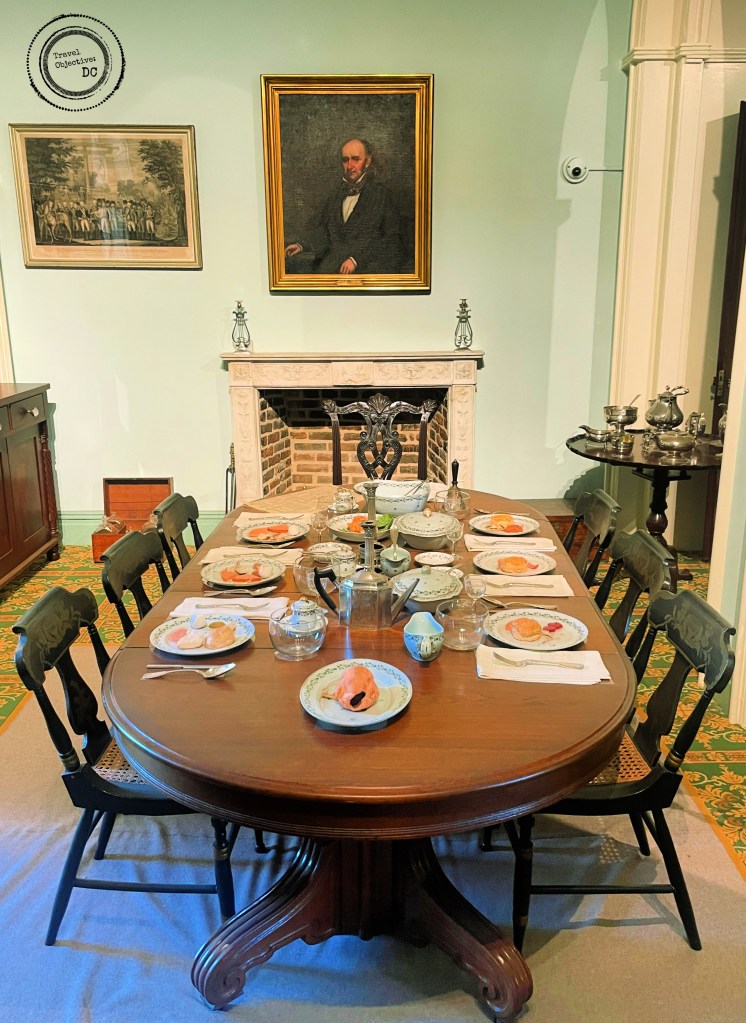
The house is now restored to its pre-war appearance, displaying the lifestyle of wealthy landowners in early 19th century Washington. The rooms are well furnished with some original furniture and accessories from the Lee home. Walls are adorned with original artworks painted by Parke Custis and Mary Lee, both self-taught artists.

In addition to the main house, the grounds also include two buildings containing former slave quarters, two gardens, a bookstore and a museum.

View of the main dining room
From Plantation to Cemetery

In April 1861, while at Arlington, Robert E. Lee made the fateful decision to resign his commission in the US Army ending his career of over thirty years. He would instead serve his native Virginia, which had just seceded from the Union. 

After the Lee family departed Arlington House for Richmond, the US Army moved quickly to take possession of both the house and the strategically important ground it occupied.

Before the war, Montgomery Meigs had served with Lee and the two officers enjoyed a cordial relationship. He was even a guest at Arlington House on several occasions. However, Meigs viewed Lee’s decision to leave the US Army and fight for the Confederacy as treachery.

In June of 1864, Meigs requested 200 acres of the Lee’s Arlington plantation be designated as Arlington National Cemetery.

Although most burials initially occurred in the northeast corner of the estate, Meigs ordered burials on the grounds of Arlington House. As he wrote to Secretary of War Edward Stanton “… the grounds about the mansion are admirably suited for such use.”

Graves of Union Army officers next to the flower garden at Arlington House

Today, the remains of Arlington’s main flower garden are an easy stroll after exiting the house. The pleasant plot of land teems with roses and many other flowering plants. Mary Custis Lee loved her garden and it is no wonder why after admiring the flowers on a summer day while pollinators buzzed and fluttered about.

Yet surrounding the garden are the graves of 45 US Army officers who were killed in battle, a reminder of Meigs’ determination for burials close to Arlington House. 

By the end of the Civil War, over 15,000 Union dead had been buried at the new Arlington National Cemetery. However, Meigs was not yet done. He directed the remains of unidentified soldiers who died near Washington DC to be disinterred for reburial at Arlington. 

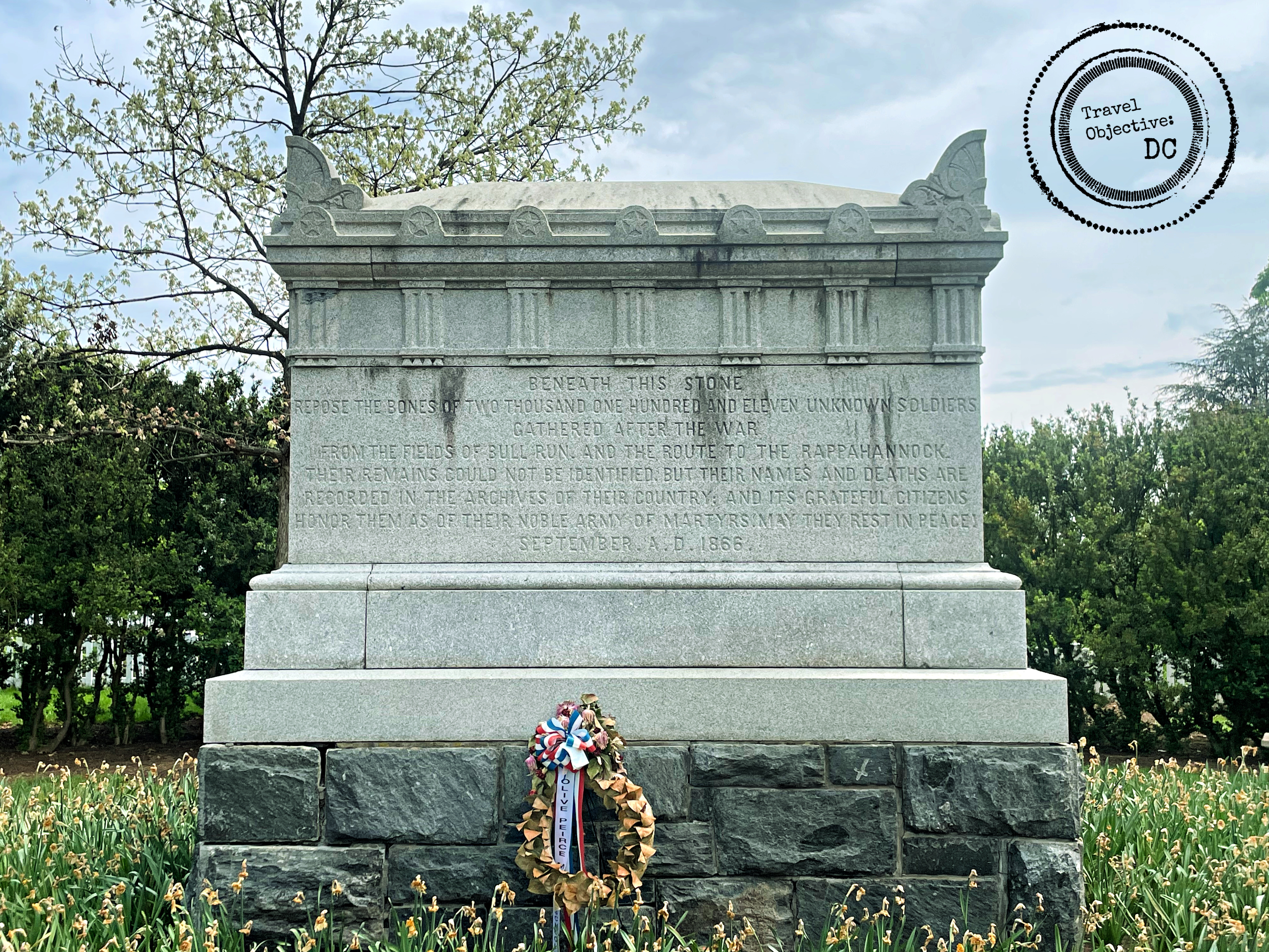
A grove of trees west of the flower garden was selected as the location. On September 16, 1866, the tomb of the Civil War Unknowns was dedicated containing the remains of 2,111 Civil War soldiers. It was the first memorial at Arlington National Cemetery dedicated to unidentified soldiers who died in battle. 

The orginal sarcophagus and the one seen today at the Tomb of the Civil War Unknowns

Further to the west, Meigs built what is known today as the Tanner Amphitheater. The elliptical marble colonnade with a lattice roof was designed to host observance ceremonies for Memorial Day. Dedicated in 1873, it was used annually until the current Memorial Amphitheater opened in 1921. 

Additionally in 1873, Congress passed legislation which broadened the burial criteria at national cemeteries to include all honorably discharged Civil War veterans. Through the years, the criteria would expand to include veterans of other wars, as well as spouses and certain family members.

Meigs retired from the Army in 1882 after 46 years of service and over twenty years as the Quartermaster General. Through that time, he stayed very involved in the conditions at Arlington, adding decorative features, improving roads and supervising landscaping.  Wooden grave markers gave way to headstones, and grand ones at that, as a burial ground originally for poor soldiers became the desired final resting place for generals and admirals. 
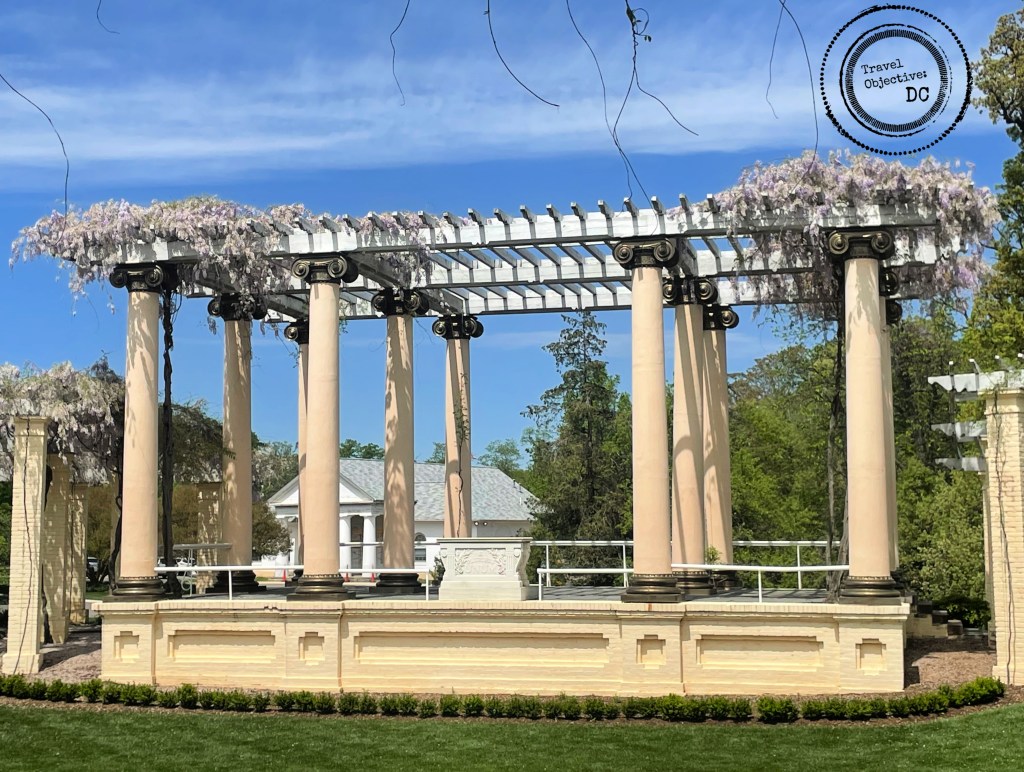
The stage of the current Tanner Amphitheater at Arlington.

Remembering the Enslaved at Arlington

In 1930s the National Park Service assumed responsibility for Arlington House, while the Army maintained jurisdiction over the cemetery. Through the following decades National Park Service archeologists, researchers and historians have continued to develop a broader picture of life at Arlington.

In the decades leading up to the Civil War, over 100 enslaved people lived and worked on the Arlington plantation.

The recent renovation project also restored two surviving slave quarters buildings behind the main house, while archeological and scholarly research provided new details about their daily lives. 
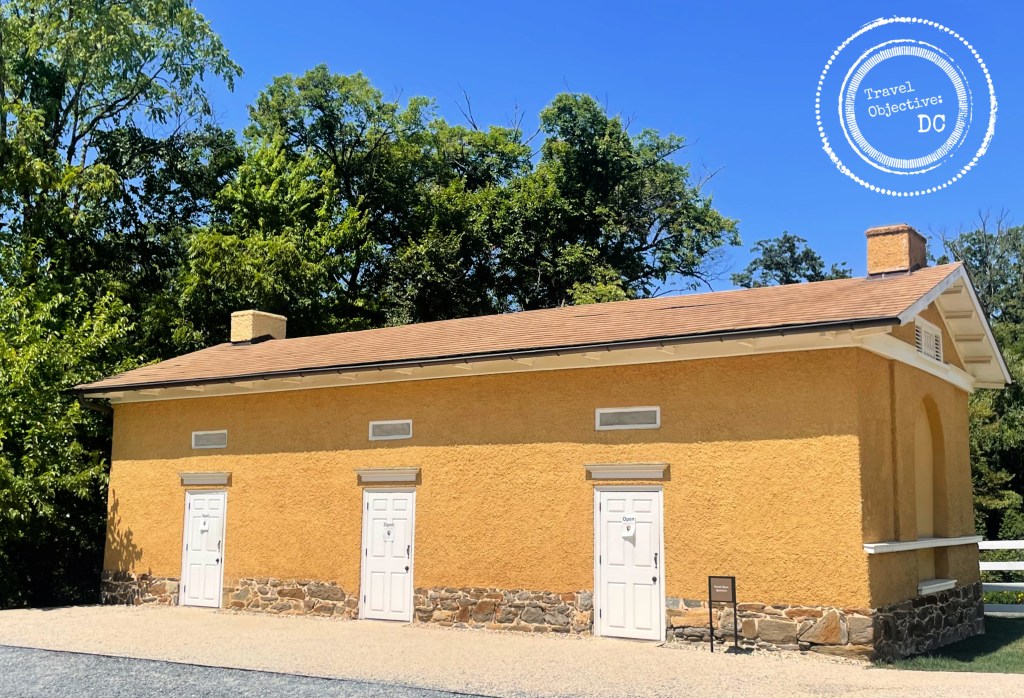
One of the two recently renovated former slave quarters buildings at Arlington House.

Today the former slave quarters contain displays and provide interpretation of the enslaved workers’ lives at Arlington. A looped video playing in a former smokehouse provides the reflections of their descendants over a century later, many of who still live today in the Washington area. The exhibit provides an important alternate narrative to the Custis-Lee stories and experiences of Arlington. 

Final Resting Places

Robert E. Lee never did return to Arlington after he departed in 1861. After the war, he was appointed president of Washington College [now Washington & Lee University] in Lexington, Virginia and served for five years. He died in 1870 and is buried in the University Chapel in Lexington.

Mary Custis Lee returned to Arlington just once, in June of 1873. She was greatly dismayed by what she saw around her former home and would not enter the main house. She wrote a friend how the graves “are planted up to the very door without any regard to common decency…” She died several months after her visit and is buried beside her husband in Lexington. 

Prior to retiring from the Army, Meigs identified a portion of Arlington where his family would be buried. Upon his death in 1892, he was given a large military funeral in the cemetery he helped establish, with flags, bands and soldiers in dress uniforms, joining his wife, son (who was killed in the Civil War) and father (also a general officer).
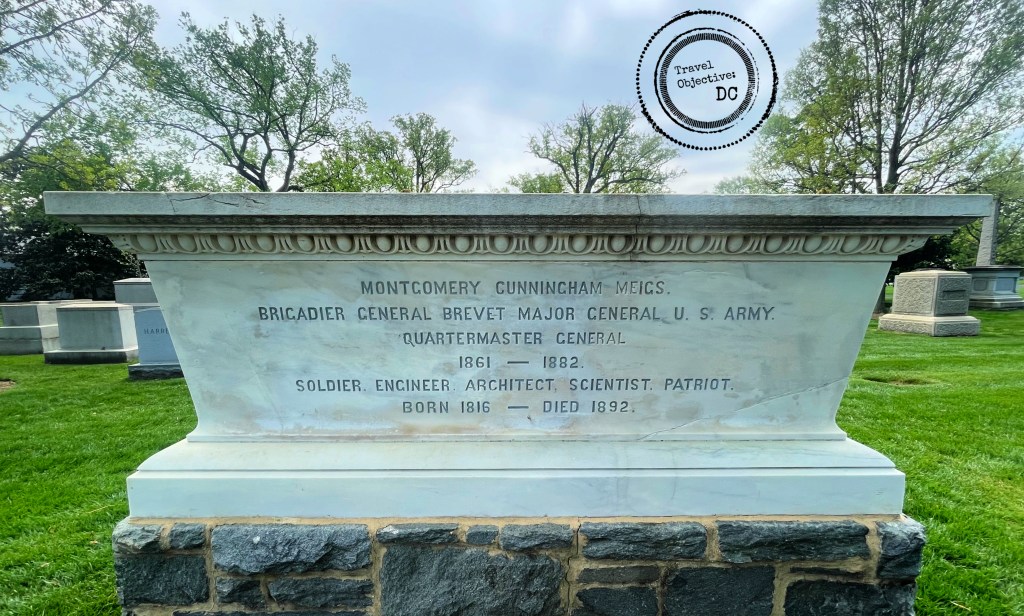
The grave of Montgomery C. Meigs

In one of the many ironies in the long history of Arlington, while the Lees are buried some 185 miles away from their home, the Meigs family lies in Section 1, a short walk from Arlington House.

Route Recon

Arlington House is located within the grounds of Arlington National Cemetery. To access the house, visitors must use the main entrance of Arlington National Cemetery at the Welcome Center. Be prepared for a security check. Information on security procedures and prohibited items at Arlington is available here.

In most cases, plan on making a 15-20 minute walk up to Arlington House. Please note that vehicle and bus access through the cemetery is generally not permitted, except for those with vehicle passes to visit a gravesite, or those attending a funeral service. 

An interpretive bus tour service is available at Arlington National Cemetery, which includes a stop at Arlington House. Tour information is available here. Visitors with a valid disability placard may ride the interpretive tour bus at no cost (with one companion). See the main desk in the Welcome Center for more information.

Arlington House is open daily from 9:00 AM until 4:30 PM, except for Thanksgiving, Christmas Day and New Year’s Day. 

To access Arlington National Cemetery by car, follow the driving directions below to Arlington National Cemetery. 

Parking is available at the Arlington National Cemetery parking facility located at the cemetery’s main entrance on Memorial Avenue, next to the Welcome Center. Additional information regarding parking at at this facility is available here

Arlington House is accessible via the Washington DC Metro system on the Blue Line. Take the  Arlington Cemetery subway stop which is a short walk from the Visitor’s Center.  

Command Reading List

On Hollowed Ground, The Story of Arlington National Cemetery by Robert M. Poole

Robert Poole’s history of Arlington traces the cemetery’s evolution from the Custis-Lee family planation to the honored burial site of today. He insightfully traces how the rites, rituals and rhythms of Arlington changed through the years and were impacted by America’s wars from the 19th through 21st century.

Arlington National Cemetery, Shrine of America’s Heroes by James Edward Peters

James Peters work combines a very comprehensive history book and visitor’s guide into a single volume. Now in its 4th edition, the book contains a detailed explanation of Arlington’s early years as a plantation and a cemetery as well as the lives and burial information for over a hundred notable people interred at Arlington.

Driving Directions to Arlington National Cemetery

From Washington:

From Washington, D.C. you can drive to the cemetery by crossing the Memorial Bridge.

From points South (Richmond, VA area)

Take I-95 NORTH towards Washington, D.C. Take exit number 170A, I-395 NORTH toward Washington. Take exit number 8A, VA-27/Washington Blvd. towards VA-244/Columbia Pike. Follow signs to Arlington National Cemetery. Go 3/4 of the way around traffic circle and exit. Park in visitor’s lot next to Visitor’s Center on the left.

From points East (Annapolis, MD area)

Take US-50 WEST towards Washington, D.C. Take I-395 SOUTH. Take exit number 11B, George Washington Memorial Parkway NORTH, towards Arlington National Cemetery. Stay to the left at the fork in the road. Go 3/4 of the way around traffic circle and exit. Park in visitor’s lot next to Visitor’s Center on the left.

From points North (Baltimore, MD area)

Take I-95 SOUTH towards Washington, D.C. I-95 SOUTH becomes Capital Beltway, I-495. Cross Woodrow Wilson Memorial Bridge. Take US-1 North through Alexandria, VA. US-1 becomes Jefferson Davis Highway. At fork stay to the left and merge onto VA-110. Go approximately 1.5 miles. Take Arlington National Cemetery exit. At stop sign, turn left. Park in visitor’s lot next to the Visitor’s Center on the left.

From points Northwest (Frederick, MD area)

Take I-70 EAST to I-270 SOUTH. Merge onto Capital Beltway, I-495 SOUTH towards Northern Virginia. Take exit 43 & 44, VA-193/Georgetown Pike and George Washington Memorial Parkway. Keep right on ramp and take George Washington Memorial Parkway SOUTH approximately 10 miles. Take Arlington National Cemetery exit. At Stop sign, turn left. Park in visitor’s lot next to Visitor’s Center on the left.

From points West (Fairfax County, Loudoun County, Shenandoah Valley, VA area)

Take I-66 EAST to towards Washington, D.C. Take exit 64, Capital Beltway, I-495 SOUTH towards Richmond. Go one exit and merge onto US-50/Arlington Blvd EAST. Follow US-50 approximately 12 miles. Exit onto George Washington Memorial Parkway SOUTH. Take Arlington National Cemetery exit. At Stop sign, turn left. Park in visitor’s lot next to Visitor’s Center on the left.

Keeping Alexandria National Cemetery “A Sacred Grove”

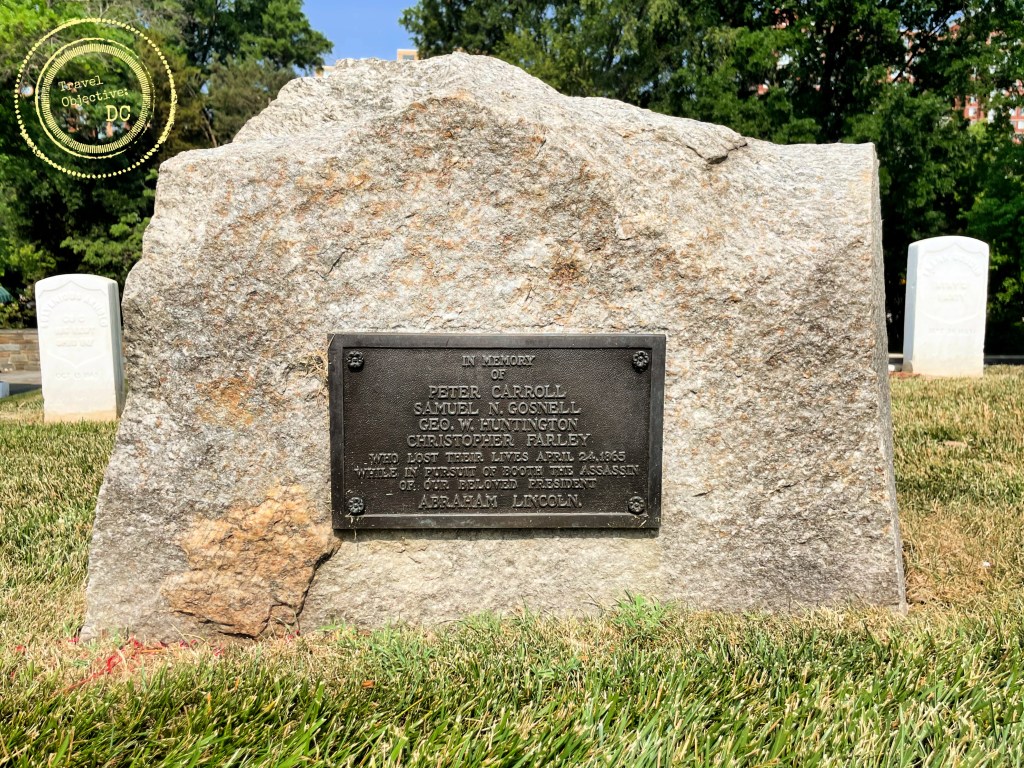
In late April 1865, a manhunt was underway across the Mid-Atlantic for John Wilkes Booth. To prevent President Lincoln’s assassin from crossing the Potomac River into Virginia, the US Army’s Quartermaster Department contracted a coal barge, the Black Diamond to augment a larger river flotilla hunting for Booth.   

In the very early morning of April 24, the Black Diamond tragically collided with another private vessel, Massachusetts, which was contracted to transport soldiers from Alexandria, Virginia to Fort Monroe in the Hampton Roads area. Eighty-seven men were lost. This included four civilian firefighters employed by the Quartermaster Department who had volunteered to help crew the Black Diamond on its important mission. As they died in service to their country, the four civilians from Alexandria, Virginia, were conferred the honor of being buried alongside deceased Union soldiers in a new type of burial ground, the Alexandria National Cemetery. 

Today, the Alexandria National Cemetery is found within the Wilkes Street Cemetery Complex, an expansive 82-acre area encompassing over a dozen different community cemeteries in Old Town Alexandria. A red sandstone wall, stately iron gate and nearly uniform white stone gravestones arrayed in neat lines distinguish this cemetery from its neighbors.  

While national cemeteries are not unique to the United States, for over one hundred fifty years our government has devoted significant resources and attention to the dignified burial of its war dead and  military veterans. The advent of national cemeteries in the United States came at the beginning of the Civil War as the need for the Federal Government to maintain its own cemeteries became apparent. Large numbers of men were quickly joining the Army’s ranks. Equally fast, the terrible cost of war was realized. Soldiers were lost in battles or died of combat related wounds. Diseases and accidents killed even more. Past practices of local burials in private cemeteries or returning soldiers’ remains to families were no longer feasible. 

As a first step, in September 1861 the Quartermaster Department recorded where soldiers were being buried and provided wooden grave markers.  In July 1862, Congress directed the president to acquire appropriate grounds for “a national cemetery for the soldiers who shall die in the service of the country”. 

The Alexandria National Cemetery was established in 1862, two years before Arlington National Cemetery.

The early cemeteries were established near Army camps and training centers.  At the time, Alexandria was an important logistical hub, supply depot, and training area for the Union Army. The city also anchored the southern defenses of Washington, DC, (as seen today at nearby Fort Ward Museum and Historic Site) and operated multiple Union Army hospitals around the city. In 1862, the Army established a cemetery on four acres of local land already accommodating other graveyards, one of the first fourteen national cemeteries. Sadly, the cemetery filled quickly, even after a small expansion. By 1864, the Army began looking for other grounds for burials in the Washington area, leading to the establishment of today’s well known Arlington National Cemetery. 

Following the war, the Quartermaster Department began a massive multiyear project for identifying, excavating and reinterring soldier’s remains in additional newly established national cemeteries. By 1871, there were approximately 300,000 reinternments into more than 70 national cemeteries across the United States. This was the first time any nation undertook such an effort to bury its war dead. At first, only those who died on active service were allowed burial in a national cemetery. However, Civil War veterans wanted to be buried with their deceased comrades and Congress ultimately authorized burials for all honorably discharged veterans. 

Successive Congressional legislation authorized funds for marble headstones, walls, gates and structures to be built on cemetery grounds in an effort to keep the cemeteries simple yet stately. The famous landscape architect Frederick Law Olmsted recommended a national cemetery be kept modest with “permanent dignity and tranquility … a sacred grove”. 

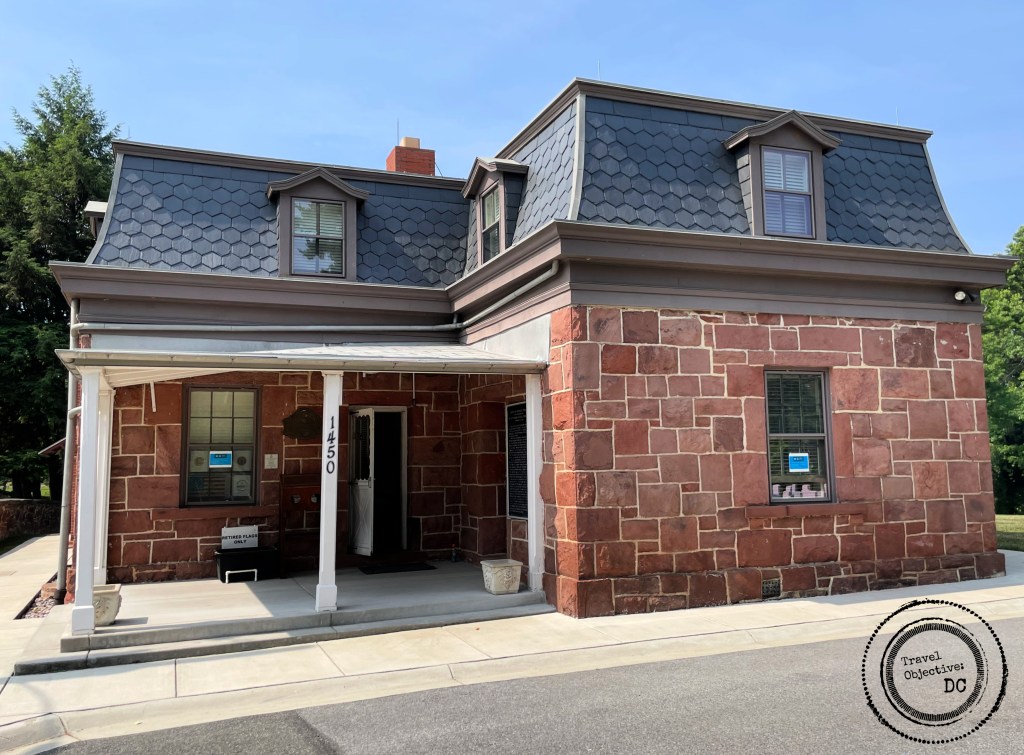
Today, the Alexandria National Cemetery remains a fine example of an early national cemetery aligning with Olmstead’s vision. Despite the cemetery’s urban location, it remains a quiet setting, save for airplanes coming and going from Reagan National Airport. A handsome brownstone building stands to the left of the main entrance marked by the ornate cast-iron gate found at the end of Wilkes Avenue.

The lodge was originally built as a cemetery superintendent’s home and office.

The building is based upon a design by architect Edward Clark and approved by Montgomery Miegs, the Quartermaster General of the Army during the Civil War. The design became known as the “Miegs Plan” and the buildings were intended for use as a superintendent’s home and office. Clark designed these lodges in the French Second Empire style using locally quarried Seneca sandstone to resemble other fashionable dwellings and office buildings built during this time. 

Only about twenty of these structures remain in national cemeteries today. The building currently houses office space and meeting rooms. A paper bound directory on the building’s porch assists visitors in locating specific graves. A redbrick annex at the back of the building is a converted restroom from the 1880s. 

Approximately 4,000 white stone markers spread out in orderly rows over the carefully manicured acres. The cemetery is currently closed to new internments (save for veterans or family members to be buried in an existing grave).

A paved roadway circumvents a central flagpole, flying the US flag. The graves of the four civilian firefighters who perished aboard the Black Diamond lie near the flagpole; a granite monument to their memory was added in 1922. 

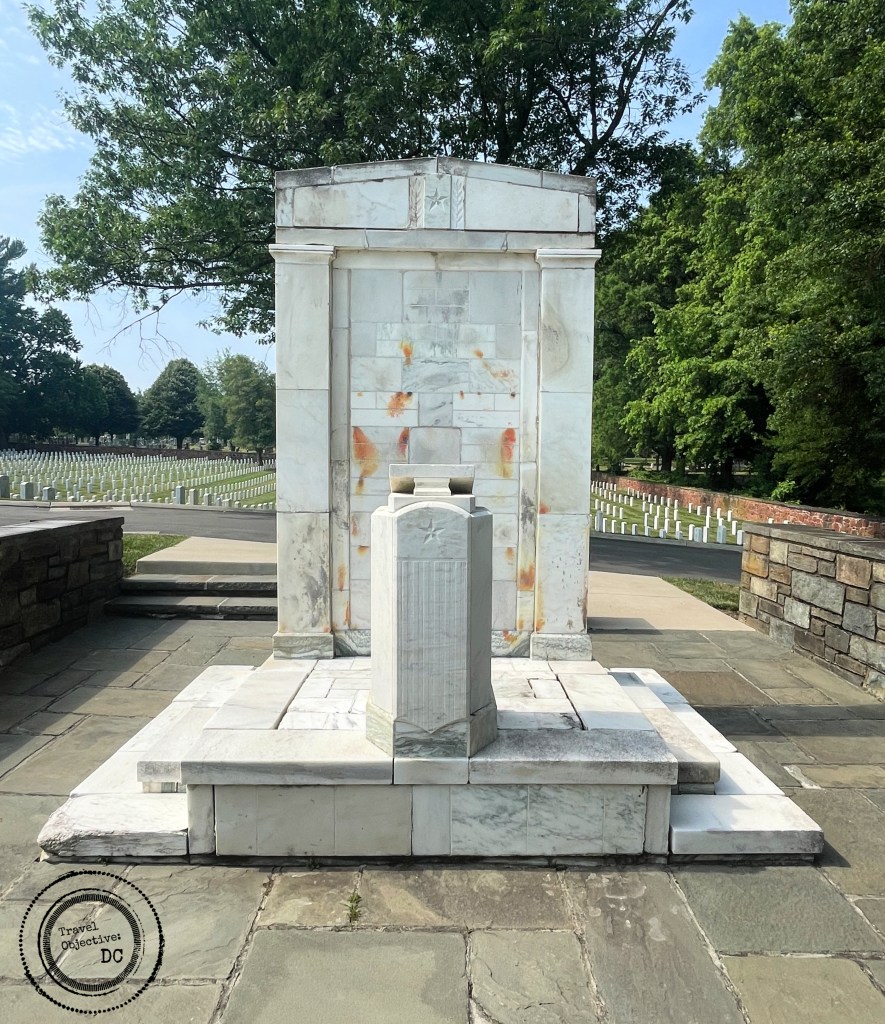
A marble platform with a podium and seating area replaced an older cast iron version in the 1940s. Meant for internment ceremonies, it is often used today for Memorial Day services. It is a convenient spot for pausing and contemplating the stories and sacrifices of those buried around you.  After spending some time on the grounds, it is clear that while the Alexandria National Cemetery is not as large nor renowned as its regional neighbor in Arlington, it is still a very active civic space for the people of Alexandria.

The Marble Rostrum

The grounds are perpetually cared for and remain neat and tidy. Walkers, joggers and bikers respectfully traverse the grounds, sometimes personally cleaning and tending to the stones. Visitors seek out specific graves, paying respects and leaving the occasional memento. Veterans groups meet at the lodge, planning their activities. Each Memorial Day, US flags are dutifully placed on the graves. Each December, evergreen wreaths grace the headstones. 

Through successive wars, the American custom continues of providing war dead, veterans and certain family members with a dignified burial in well-arranged cemeteries. Much of this work is done through volunteers who devote time and energy to enhance their community’s national cemetery. You can help keep this tradition alive and ensure your local national cemetery remains and active part of the community.

There are currently 171 national cemeteries in the United States and its territories managed by various federal agencies. All of them welcome volunteers to maintain these “sacred groves” as dignified and respectful burial grounds. Duties vary by location and range from administrative support, attending funerals, planning events and grounds work.

Volunteering At A National Cemetery

Of the 171 national cemeteries in the United States and its territories, 151 are administered by the Department of Veterans Affairs, 14 are managed by the National Park Service, and two by the Department of the Army. Internationally, 26 national cemeteries are managed by the American Battlefield Monuments Commission. 

More information on volunteering at national cemeteries can be found here:

Visit individual NPS National Cemetery websites for specific volunteer information.

ANC routinely looks for volunteers to collect wreaths following the the annual Wreaths Across America observance. Check the ANC website each December for more information. Other volunteer opportunities may occur through the year.

Route Recon

By car:

The Alexandria National Cemetery is located at 1450 Wilkes Street in Alexandria, Virginia. The gates to the cemetery are located at the end of Wilkes Street. 

There is parking along Wilkes Street. 

By public transportation:

The closest Washington DC area Metro Stop is King Street Metro Station. Take the DASH Bus #31 towards Braddock Road Metro. Exit the bus at the corner of King Street and Fayette Street. The cemetery gates are a .6 mile walk from this bus stop. Walk south on Fayette Street, then make a right onto Wilkes Street. The cemetery is at the end of the street. 

Alternatively, take the King Street Trolly from the King Street Metro Station. Disembark at West and King Streets. Walk one block east on King to Payne Street. Walk four blocks south on South Payne Street to Wilkes Street. Make a right on Wilkes Street. The cemetery is at the end of the street.

While at Arlington, “Remember the Maine!”

“Remember the Maine, to Hell with Spain” became a rallying cry for war in the spring of 1898. As a simmering independence movement in Cuba was becoming increasingly violent that January, President William McKinley sent the USS Maine to Havana to watch after American lives as well as political and business interests. Tensions between the United States and Spain had been growing over independence movements in Cuba, Puerto Rico and the Philippines; McKinley was hoping for a peaceful resolution.

The USS Maine circa 1895-1898

-US Naval History and Heritage Command Photograph

However, it was not to be. The Maine arrived in Havana on January 25th with approximately 26 officers, 290 sailors and 39 Marines on board. Just after the bugle call Taps on February 15th, an explosion detonated the five tons of gunpowder charges for the Maine’s large guns. The forward section of the ship, containing the enlisted men’s quarters, blew apart. An estimated 266 men died either during the explosion or in the days afterward.

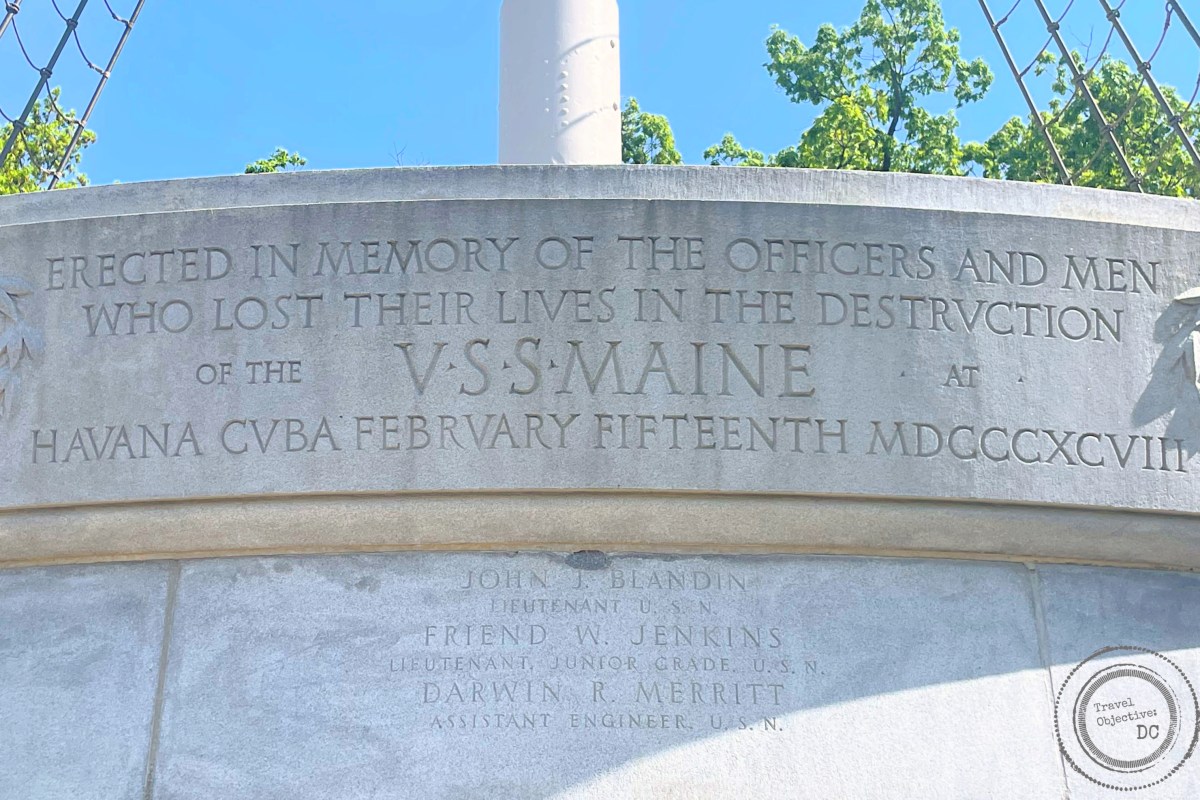
The USS Maine Memorial at Arlington National Cemetery

How the explosion occurred was not immediately apparent. Several different investigations and reviews could not concur on a definitive cause. Though the combustion of coal dust was one possibility, several prominent newspapers of the time blamed a Spanish naval mine. A vocal element of the population was ready to use force against Spain and Congress declared war on April 25th. The war would end quickly and favorably for the United States as Spain ceded Guam, Puerto Rico and the Philippines. 

Even with the war’s prompt conclusion, America did not forget about the Maine. In 1899, the remains of 165 sailors who died in the explosion were exhumed from a Cuban graveyard and reinterred at Arlington National Cemetery.  In 1912, the Army Corps of Engineers recovered the twisted remains of the Maine’s hull from Havana Harbor and towed her further away from the Cuban coast. After recovering an additional 66 bodies, the Maine was then scuttled in deeper waters while Taps played and escort ships offered a 21-gun salute. The ship’s masts were salvaged and the main mast sent to Arlington National Cemetery. 

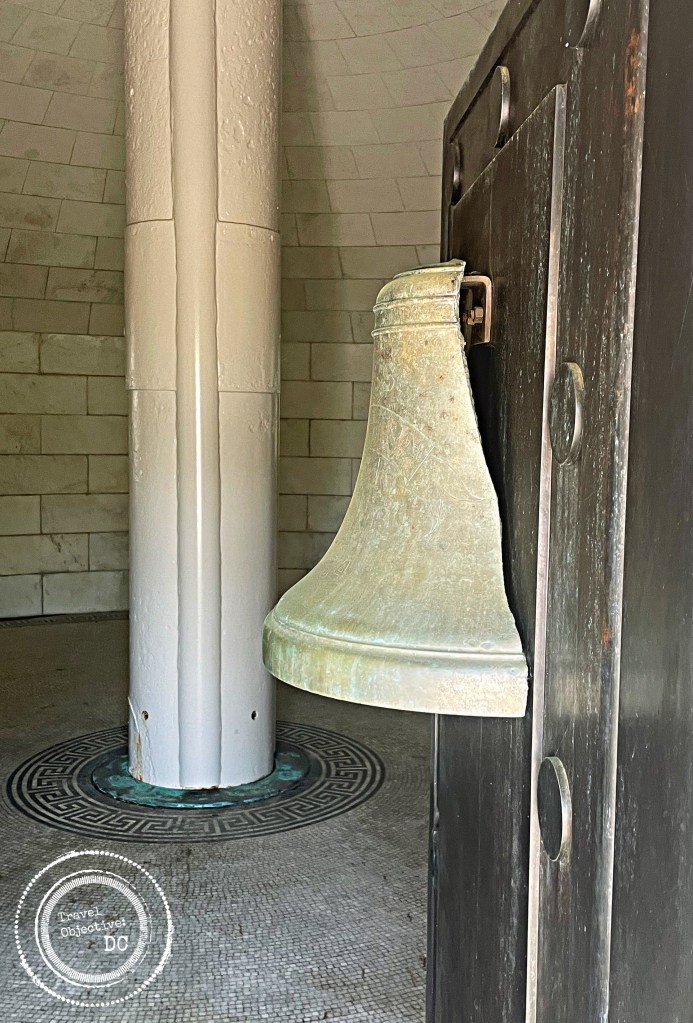
The mast of the USS Maine passes through the stone structure and is embedded into the floor. A surviving piece of the ship’s bell is hung on the front door.

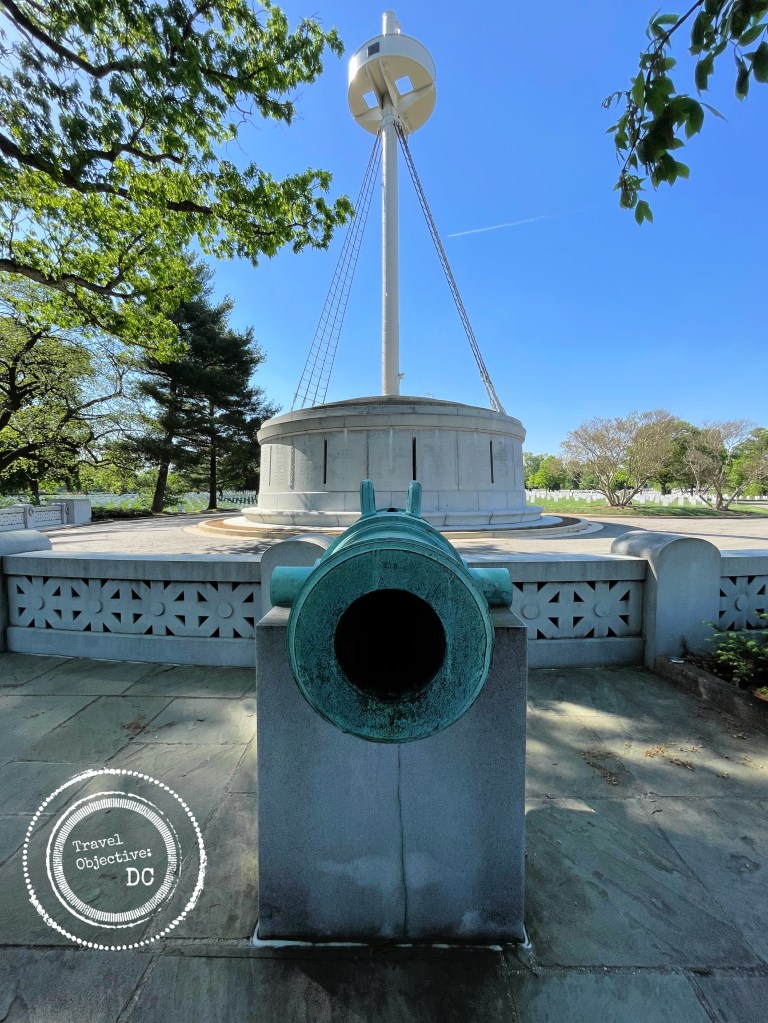
Efforts to build a memorial to the Maine began shortly after the explosion and about twenty monuments or special exhibits of the ship’s artifacts exist around the United States. President Woodrow Wilson dedicated the current memorial at Arlington National Cemetery in 1915, adjoining the burial site of the USS Maine sailors. The centerpiece of the memorial is a circular stone structure, 90 feet in diameter, built around the ship’s main mast. The shape of the structure suggests the warship’s gun turret, but it also has served as a temporary mausoleum. Rigging extends from the top of the structure up to a crow’s next atop the mast. On the circumference of the building are names and ratings of the sailors who died in the explosion. The front door of the structure holds a piece of the ship’s bell, which was broken in half during the explosion. 

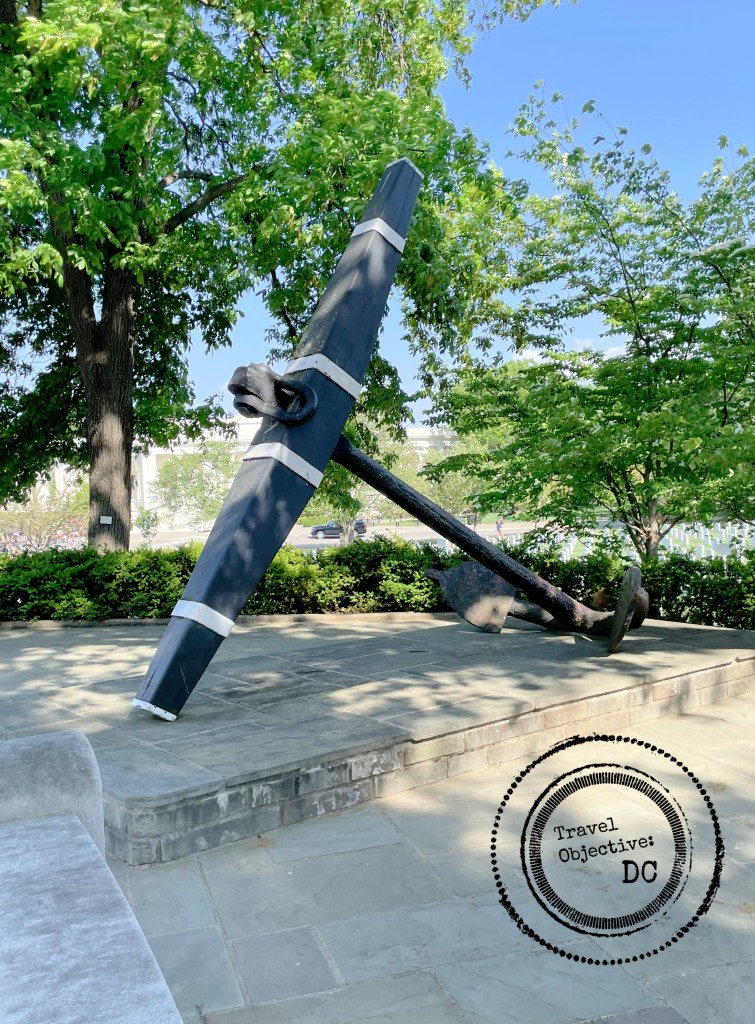
A paved lane encircles the memorial. To the east is an anchor made specifically for the memorial but resembling the anchor onboard the Maine.  Positioned along the back of the memorial are two bronze Spanish mortars, cast in the 1700s and captured by Admiral George Dewey in the Philippines during the Spanish–American War. 

The replica anchor was the centerpiece of an earlier memorial to the USS Maine. It weighs about two tons.

Most auspiciously, in the twelve decades since that fateful February night, the USS Maine is still not forgotten. There have been periodic reinvestigations and new studies into the cause of her sinking, reexamining the available evidence and using modern technologies and computer simulations. In 2000, a marine exploration firm unexpectedly came upon her wreck at a depth of 4,000 feet. Yet a definitive cause of the explosion remains elusive.

Next to the USS Maine Memorial, Section 24 at Arlington National Cemetery contains the graves of 229 sailors lost on the USS Maine.

Fortunately, any visitor to Arlington National Cemetery can also “Remember the Maine”. A short walk from the Tomb of the Unknown Soldier will lead to the USS Maine memorial.  Observe the neatly organized graves and note the names along the memorial’s wall.

Their sacrifice endures.  

* * *

Route Recon

Arlington National Cemetery is open daily from 8:00 am to 5:00 pm. 

Arlington National Cemetery is located across the Potomac River from Washington, D.C. at the end of Memorial Avenue, which extends from Memorial Bridge. Arlington is accessible from the major roadways in the D.C. area: Interstate 95, the Capital Beltway (I-495), and the George Washington Memorial Parkway.

Parking: A parking garage is located near the cemetery’s entrance on Memorial Avenue.

Metro: Arlington Cemetery station is stop on the Washington Metropolitan Area Transit Authority Blue Line.

Both the Parking Garage and Metro station are a short walk from the Welcome Center. Please note there is a 100% security check for visitors entering the cemetery.

The USS Maine Memorial is located to the west of the Tomb of the Unknown Soldier and the Memorial Amphitheater. You can view a map of Arlington National Cemetery here.

Marking “An ever famous American Victory”

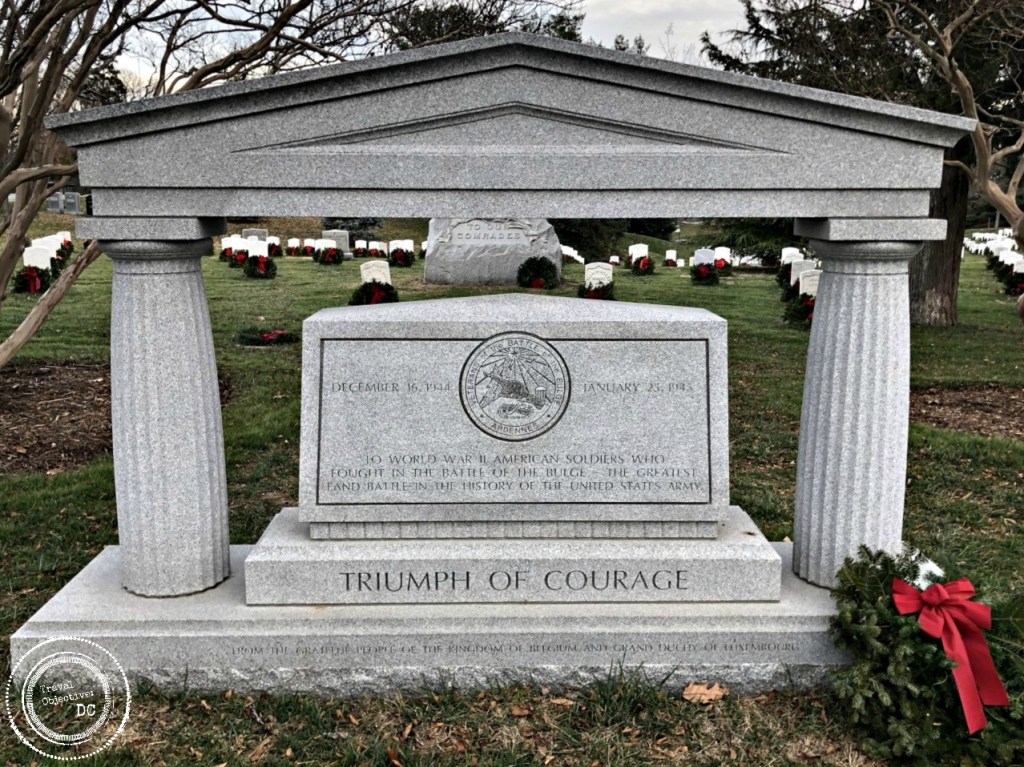
Dotted across the pristine grounds of Arlington National Cemetery are dozens of commemorative monuments and memorials recognizing individuals, military units, wars, battles and other historical events. On a quiet corner, not far from the Tomb of the Unknowns, stands a chest-high memorial to what Winston Churchill described as “undoubtedly, the greatest American battle of the war.”

Churchill spoke those words to the British House of Commons on January 18, 1945, a month and two days after an attack by German forces caught Allied armies by surprise. The protrusion in the lines caused by the limited German advance gave this campaign its prevalent name: The Battle of the Bulge. 

The Battle of the Bulge Memorial is designed in Greek temple style, with a pitched top supported by a Doric column on each side. The monument is built of white Vermont granite. It bears the inscription “Triumph of Courage” and is dedicated to “World War II American Soldiers who fought in the Battle of the Bulge, the Greatest Land Battle in the History of the United States Army”.  

The Battle of the Bulge, known more formally as the Ardennes Counteroffensive, was Hitler’s last major attack in Western Europe, a final gambit to stop the Allies steady advance from the west which had begun after the Normandy invasion.

His plan was risky.

A massive force of 45 divisions would attack through the Ardennes Forest of southeastern Belgium, Northeastern France and Luxembourg against exhausted and unprepared Allied troops.  German forces would then push northwest and retake the port of Antwerp, Belgium, denying its use as a vital supply link to the Allies quickly advancing armies.  

This would be a blitzkrieg attack, relying on surprise, speed, and captured Allied fuel to be successful. Hitler’s ultimate goal was to divide and encircle the US 12thand British 21stArmy Groups, then force a negotiated peace on his terms. 

The famous “Bulge” in the lines is depicted on this map from American Military History, Volume II, Chapter 5, published by the US Army Center for Military History

While Hitler’s senior advisors counseled against the attack, Hitler judged the Americans unable to withstand the massive blow he envisioned and he ordered the attack to proceed. 

Before dawn on December 16, the German launched a three pronged attack along a 40-mile corridor with over 250,000 troops.  Rainy, foggy weather covered the attack and kept Allied planes on the ground. At first, the assault moved quickly. Initially the Germans encountered American units either diminished from earlier combat operations or newly deployed and untested. Advancing German forces cut off and surrounded many US units, including the 106th and 28th Divisions. While the Germans captured over 8,000 prisoners, they also met determined resistance which began to slow their advance. 

Shoulder Insignia of the 106th Infantry Division The 106th Division’s 422nd and 423rd Infantry Regiments were encircled and captured during the initial German attack on 16 December. The remnants of the division were able to join other US units in the successful and heroic defense of St. Vith, an Ardennes City with several key road junctions.

One example that has become part of American military lore is the experience of the 101st Airborne Division, which was centered on the Belgium town of Bastogne. The 101st Airborne was rushed to Bastogne arriving on 19 December to relieve other American forces and help defend the city.  Bastogne was the junction of seven roads which traversed the Ardennes and was vital to the German advance, making the 101st’s mission of holding the town critical.

Shoulder Insignia of the 101st Airborne Division – The 101st received its “Airborne” designation in 1942. In addition to its service during the Battle of the Bulge, the division fought with great distinction during the Normandy invasion, Operation Market Gardens and in the liberation of the Netherlands. 

Soon surrounded by German forces and running low on ammunition, food and other supplies, the 101st withstood continued German attacks. When a German commander demanded the surrender of the American defenders of Bastogne, the acting division commander, Brigadier General Anthony McAuliffe famously replied “Nuts” in a written response.  The 101stwould hold their position until December 26th, when the US 4thArmored Division broke through the German lines and provided necessary relief.  

Brigadier General Anthony McAuliffe, acting 101st Division Commander at Bastogne – US Army Photo

While the Germans took the Allies by surprise and achieved some initial success, they did not meet their objective of retaking Antwerp nor dividing the allies and forcing a settlement. Tenacious defenses by American units denied access to key transit routes through the Ardennes, slowing the German assault. Clearer weather allowed Allied air forces to return to the skies. The advance was ultimately blocked and Allied armies began maneuvering in order to launch counterattacks against the salient in the lines. Meeting ever stiffer resistance and lacking fuel, German forces withdrew back toward their original positions by January 25th. Through it all, the Germans sustained critical equipment and manpower losses they could not replace while only delaying the Allied advance east by about 6 weeks. 

The victory came at a tremendous cost to the US Army.  The Allies would commit over 700,000 troops to countering this German advance, approximately 610,000 were US soldiers. The US Army sustained over 89,000 casualties during the fighting, including 19,000 killed during combat.  These were the highest American losses for a single operation during World War II.  

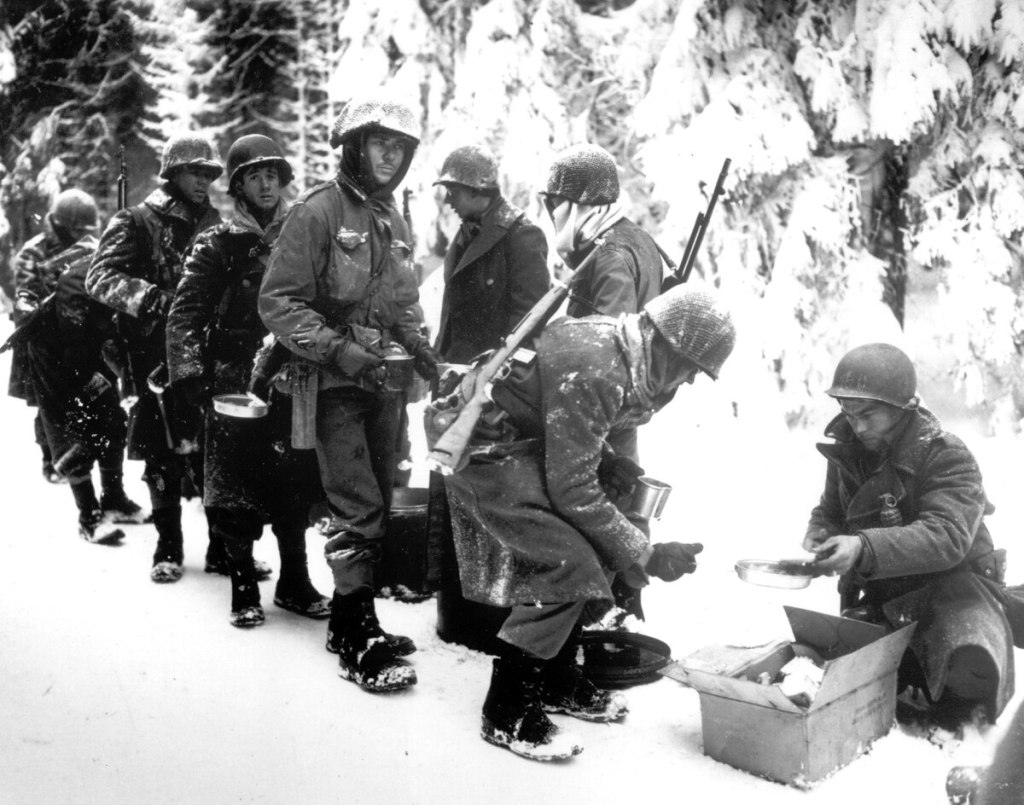
Soldiers of the 347th U.S. Infantry Regiment, 87th Infantry Division, receive rations in La Roche, Belgium in this January 13, 1945 US Army photo. Note the soldiers’ heavy winter weather gear. The winter of 1944-1945 was one of the coldest on record. 

In 1981, several veterans of the battle founded the Veterans of the Battle of the Bulge® to perpetuate the memory of the sacrifices involved during the battle and to preserve historical information about it. The group was instrumental in building the Battle of the Bulge Memorial, lobbying Congress to authorize its location in Arlington National Cemetery, raising funds from the Governments of Belgium and Luxembourg for its construction and organizing its dedication in 2006. 

Today, this veterans group is known as the Battle of the Bulge Association® and remains active in commemorating the battle and honoring the sacrifices of the brave men and woman who secured victory.

The newsletter archives available online contain a treasure trove of firsthand accounts of the battle submitted by members through the years. These vivid narratives convey the courage, tenacity and ingenuity of American soldiers which were indispensable in securing what Churchill would predict would be “an ever famous American Victory”….

Arlington National Cemetery: Tomb of the Unknown Soldier and the Argonne Cross

Tomb of the Unknown Soldier

The best known memorial of World War I in the Washington area is the Tomb of the Unknown Soldier at Arlington National Cemetery. Following World War I, many countries adopted the practice of burying the unidentified remains of one solider in a place of high honor. Congress approved the burial of an unidentified American soldier in 1921 in the plaza of the new Memorial Amphitheater.

On Memorial Day of that year, four caskets containing remains of unidentified soldiers were exhumed from American cemeteries in France and brought to the City Hall in Chalons-en-Champagne in northeast France. There, on October 21, Army Sergeant Edward Younger, a highly decorated combat veteran, selected the casket that would come to rest in Arlington.

The casket was transported back to the United States, and after lying in state at the Capitol, the unknown soldier was buried on November 11, 1921. Five years later, Congress authorized the marble structure we see today at the Tomb, which was ultimately completed in 1931. Since July 2, 1937, the Tomb has been under 24 hour guard by U.S. Army soldiers. Today, a special platoon of the 3rd U.S. Infantry Regiment guards the Tomb.

tomb-of-the-unknown-soldier_guard_arlington-cemetery_travel-objective-dc

Sections 18, 19, 34 and the Argonne Cross

Because of the large number of American deaths overseas in World War I (approximately 116,000), the U.S. Government was faced with a critical decision in the immediate aftermath of the war: What would be done with the remains of America’s fallen soldiers? Would they be permanently interred in Europe or would the remains be brought back to the United States for burial?

Some believed it was best for the soldiers to be buried in Europe–among the comrades they fought with and in the countries they died defending. But ultimately, public sentiment favored giving the soldiers’ families the option of returning the remains to the United States.

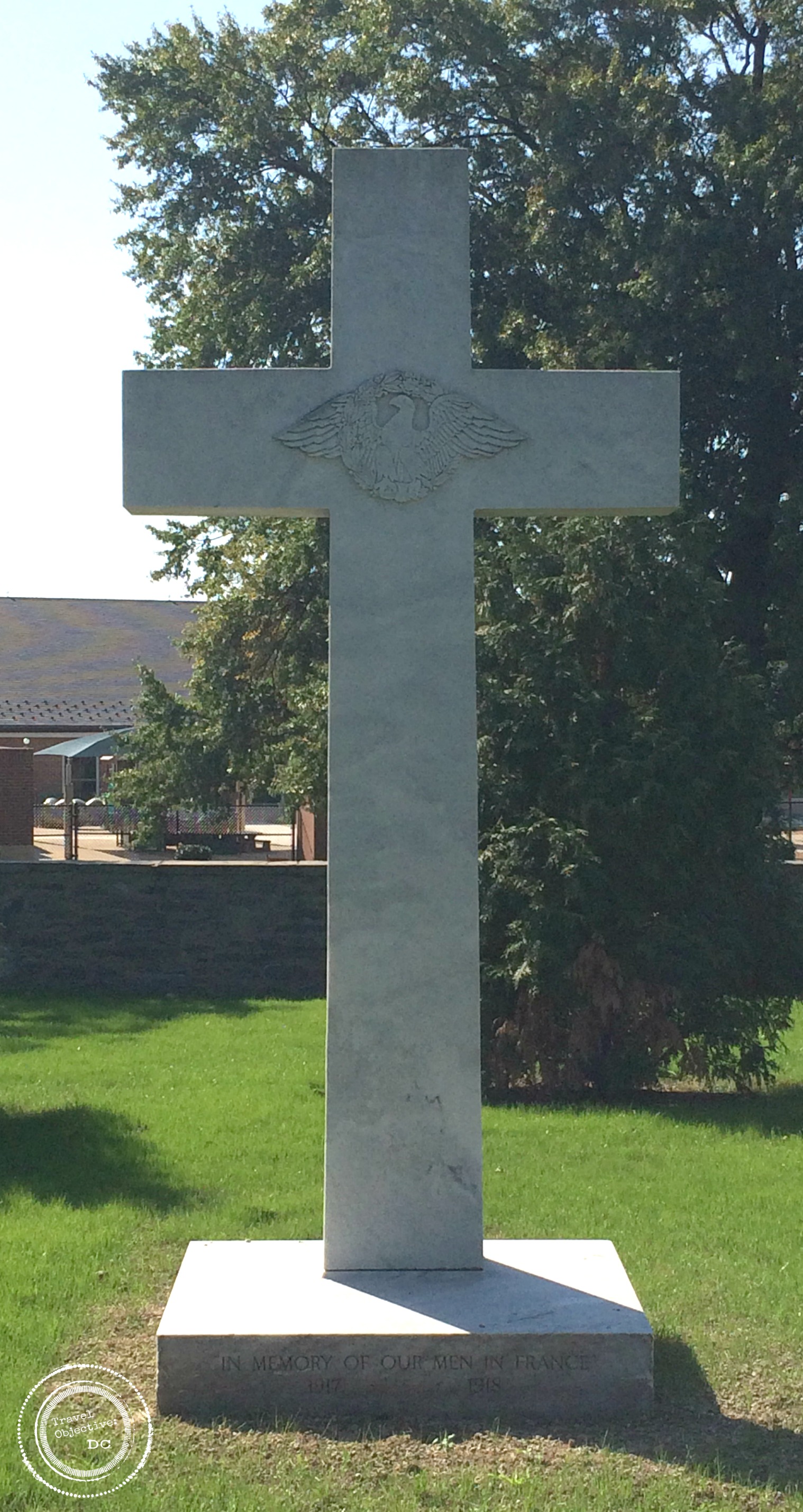
Eventually, 46,000 remains were repatriated. Over 5,000 would be buried in Arlington National Cemetery, many in Sections 18 and 19. Also found in Section 18 is the Argonne Cross which commemorates the principal American offensive of World War I, the Meuse-Argonne Campaign.

argonne-cross_logo

This was the largest offensive in U.S. military history, involving 1.2 million troops. It lasted 47 days beginning on September 26, 1918 and ending with the armistice on November 11.  The battle cost 26,277 American lives. The cross was erected in 1923 after many of the burials of World War I soldiers at Arlington.

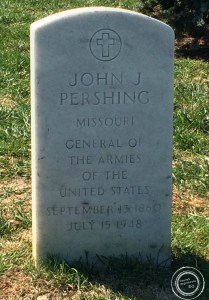
gen-pershing-headstone_travel-objective-dcThe commander of the American Expeditionary Force, General of the Armies* John J. Pershing is also buried in Arlington, in adjoining Section 34 on a hill overlooking the men he commanded. A simple, government issued headstone marks his grave, alongside a spruce tree, placed in 1989 by the No Greater Love organization in memory of all Americans who died in World War I.

* Through much of its history, the highest rank in the U.S. Army, outside of the time of major wars, has been a two star major general. During World War I, Congress authorized the appointment of three star lieutenant generals and four star generals to be granted temporarily. John J. Pershing was promoted to general in October 1917. In 1919, by Congressional directive, the rank of General of the Armies was formally established and General Pershing became the first person to hold the rank.


* * *

ROUTE RECON

Arlington National Cemetery is located in Virginia across the Potomac River from Washington, D.C. The cemetery is at the end of Memorial Avenue, which extends west from the Lincoln Memorial, across the Memorial Bridge. Memorial Avenue intersects with the George Washington Memorial Parkway, just west of the Memorial Bridge. Arlington Cemetery is accessible from the major highways in the area such as Interstate 95, Interstate 395, the Capital Beltway (I-495), and the Baltimore-Washington Parkway (I-295). There is paid parking on site.

METRO: There is also a stop for Arlington National Cemetery along the Washington Metropolitan Area Transit Authority (Metro) Blue Line.

A Century Later, We Can Still Remember

Every year since 1918, the United States has observed the 11th hour of the 11th day of the 11th month in a special way. As many high school history students can tell you, this was the effective time and day of the armistice which ended World War I.

As significant as it was, World War I does not resonate in the American psyche as does World War II or the Civil War. But it is hard to overstate its impact. World War I ushered in a completely new type of war, marked by huge armies, massive causality rates, multiple theaters of operation, the mobilization of national economies and the application of modern, industrial technologies to warfare.

tomb-of-the-unknown-soldier_arlington-cemetery_travel-objective-dc
A soldier from the 3rd U.S. Infantry Regiment guards the Tomb of the Unknown Soldier.

The first widespread and tactically significant use of aircraft, submarines, tanks, machine guns and chemical weapons occurred in World War I. Though fought a century ago, the impact of World War I remains with us today. Balkan civil wars, the status of Northern Ireland and much of the ethnic conflict in the Middle East can all be traced directly to World War I and its settlement.

April 2017 marks the 100th anniversary of the United States entry into World War I. The war greatly changed America. The United States greatly expanded its armed forces to fight the conflict. By the war’s end, there were over 4 million troops under arms.

gen-pershing-statue_travel-objective-dc
Statue of General John Pershing

America emerged from World War I as an economic,political and military power. Washington, DC grew quickly and many temporary buildings were erected for government workers busy building up the armed services and managing aspects of the economy.

Few traces of those changes can be seen today but there are important memorials to the soldiers who fought in the war. The centennial of America’s entry into the “Great War” provides a suitable occasion to visit these landmarks and honor those who served.

This month Travel Objective: DC highlights a few World War I landmarks that are accessible from downtown Washington and easily added to most visitors’ itineraries. We organized the landmarks by geography for convenient trip planning. Please click on the links below for more information, including a Route Recon for how to get there.

ARLINGTON NATIONAL CEMETERY

  • Tomb of the Unknown Soldier
  • Sections 18, 19, 34 and the Argonne Cross

NATIONAL MALL

  • District of Columbia War Memorial

WHITE HOUSE VICINITY

  • First Division Monument
  • Second Division Memorial
  • Pershing Park

If you are interested in learning more about the U. S. experience in the “the Great War,” visit the website of the United States World War I Centennial Commission. The commission was founded by Congress in 2013 to educate Americans about the war and to organize and promote various commemorative activities. You can learn more about the proposed National World War I memorial, review historical information and even sign up to volunteer in your community. It would be a fitting tribute to all those men and women, soldiers and civilians, who answered the country’s call a century ago.