Cleared for Takeoff at the Steven F. Udvar-Hazy Center

The sliding glass doors retract and beckon you inside.  Passing the metal detectors, navy blue jacketed security officers nod a quiet greeting. Walk through a cavernous entryway and on to a balcony overlooking the massive Boeing Hanger. On the gallery floor the world’s fastest jet powered aircraft, the SR-71 Blackbird stares back at you, sleek and silent.  On the left, the toothy grin nose art of a P-40 Kitty Hawk welcomes you while an F4U Corsair dips its bent wing in a friendly gesture as if to say, “We’re glad you’re here, but you better get started. There is a lot to see!” Indeed, within the Steven F. Udvar-Hazy Center’s hangers are the products and byproducts of over two hundred years of aviation history. 

For anyone interested in aviation and space exploration, it doesn’t get much better than this.

For most visitors to the Washington DC area, the Smithsonian Institute’s National Air and Space Museum is synonymous with the building on the National Mall.  Currently undergoing renovation, that museum building can only hold a small portion of the Smithsonian Institute’s massive collection of artifacts and materials related to aviation and space travel. 

A US Coast Guard Sikorsky HH-52A Seaguard Helicopter

The Steven F. Udvar-Hazy Center is the other main component of the Smithsonian Institute’s National Air and Space Museum. Located in Chantilly, Virginia, it adjoins Washington Dulles International Airport. Conceived as additional space for the display of the Smithsonian’s extensive collection of aviation and space travel artifacts, it opened to the public in 2003. Between the National Air and Space Museum’s building on the National Mall and the Udvar-Hazy Center, approximately 80 percent large aircraft and spacecraft from the Smithsonian’s holdings are on display.

The center’s namesake Steven F. Udvar-Hazy is a Hungarian-born immigrant who came to the United States in 1958. A lifelong lover of aviation, Udvar-Hazy eventually became chairman of the International Lease Finance Corporation, one of the world’s largest aircraft leasing firms. He donated $66 million of his personal fortune to the Smithsonian for the purposes of building this impressive facility with its three main galleries: the Boeing Aviation Hanger, the James McDonnell Space Hanger and the Mary Barker Engen Restoration Hanger.  

The Boeing Gallery boasts nearly 200 aircraft in a space comparable to the flight deck on a Nimitz-class aircraft carrier.  Curators very carefully arranged the aircraft to maximize the available display space within the hanger. Organized into collections, the aircraft are situated either on the hanger floor or suspended from the ceiling. Balconies on multiple levels help visitors to see the meticulously restored aircraft up close.

The Air France Concorde FA, within the south side of the Boeing Hanger at the Udvar-Hazy Center.

The Udvar-Hazy Center features tours most days. Over 60 to 90 minutes, the volunteer docents lead visitors around the World War I fighters and reconnaissance aircraft, inter-war trainers and prototypes, Allies and Axis aircraft from World War II, early passenger airliners, experimental aircraft, general aviation planes, Cold War jets, helicopters and more. Some of the highlights of the collection include:

SR-71 Blackbird – The SR-71 is the fastest jet engine propelled aircraft. First flown in 1964, the operational performance and technological sophistication of the Blackbird is still impressive today. The centerpiece of the Boeing Gallery, the SR-71 Blackbird on display logged about 2,800 hours of flight time over 24 years. The U.S. Air Force donated this Blackbird to the Smithsonian. On its final flight, the Blackbird set a speed record flying from Los Angeles to Washington-Dulles International Airport in 1 hour, 4 minutes, and 20 seconds (about 2,124 miles per hour) 

B-29 Enola Gay – The Boeing B-29 Superfortress was first conceived in the 1930s as bomber with a greater range and capacity than the B-17. The B-29’s extended range of about 4,000 miles when loaded made it especially suitable for use in the Pacific Theater during World War II. On August 6, 1945, the Enola Gay dropped the first atomic bomb on Hiroshima, Japan.  
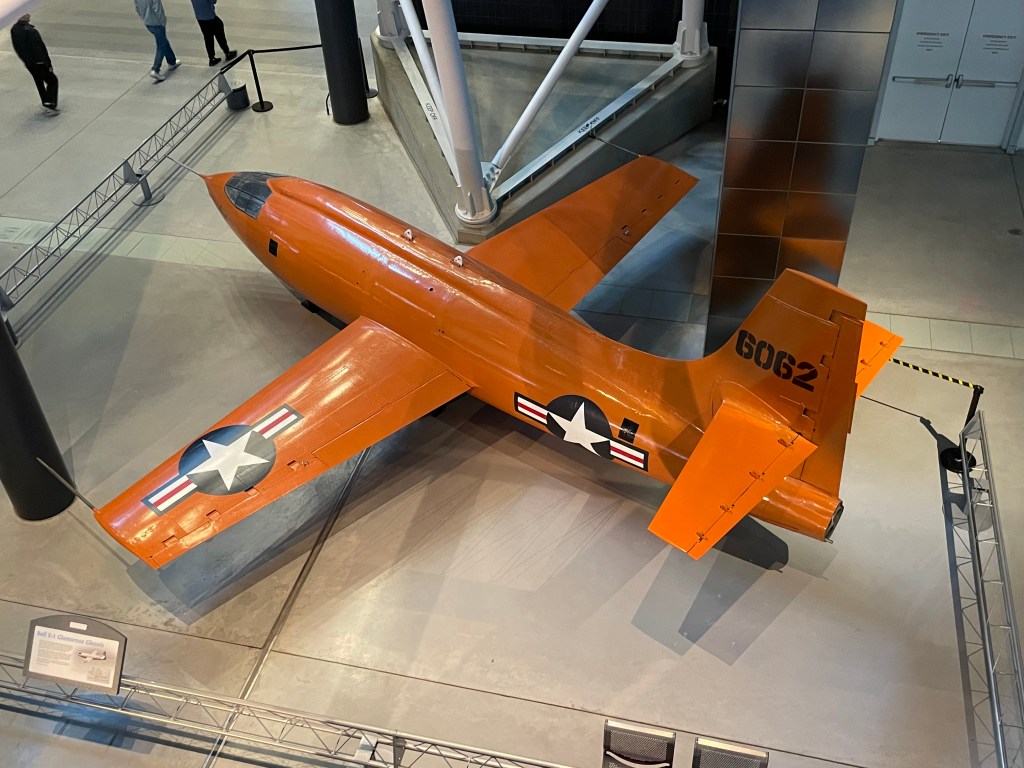
The Bell X-1 Glamorous Glennis

Bell X-1 Glamorous Glennis – On October 14, 1947, Captain Chuck Yaeger became the first person to fly faster than the speed of sound after he was drop launched in the X-1 from a B-29 Superfortress. He named the aircraft after his wife. 

F-14 D Tomcat – A naval fighter aircraft, this plane became well known to moviegoers following the release of the 1986 film Top Gun. 

Boeing 367-80 – The Boeing four-engine jet powered aircraft was the prototype for the US Air Force’s KC-135 tanker and the Boeing 707 jetliner. 

Concorde – The first supersonic airliner, the Concorde was flown by both Air France and British Air, serving customers willing to pay a premium for a faster flight. Unfortunately, higher fuel prices made the very sophisticated aircraft too expensive to operate. This Air France Fox Alpha Concorde on display was donated to the Smithsonian Institute on June 12, 2003 after its final flight from Paris to Dulles International Airport. 

The Space Shuttle Orbiter Discovery

Compared to the Boeing Aviation Hanger, the McDonnell Space Hanger, arrayed with satellites, rockets, probes and other cosmic equipment seems less crowded. However, one artifact stands out from all the rest, the Space Shuttle Orbiter Discovery.  Space shuttles were a unique reusable spacecraft, designed to take off like a rocket, land back on earth like a glider, and carry a variety of payloads. Discovery was the workhorse of the shuttle fleet, flying 39 missions and logging 365 days in space during its service life between 1984 and 2011.    

Displaying aircraft and space equipment is but one mission of the National Air and Space Museum. Before anything is placed into a hanger or gallery, museum preservationists painstakingly restore the aircraft and prepare it for its new life in the museum. Much of this refurbishment work is conducted in the Mary Baker Engen Restoration Hangar.

The large open hanger space accommodates several restoration projects at a time. An observation area on the mezzanine above the hanger floor allows visitors to watch the restorers at work.  One major restoration project currently underway in the hanger is on a Martin B-26B medium bomber from World War II named Flak-Bait. This bomber flew more than 200 missions over Germany from August 1943 until April 1945, more than any other American plane.
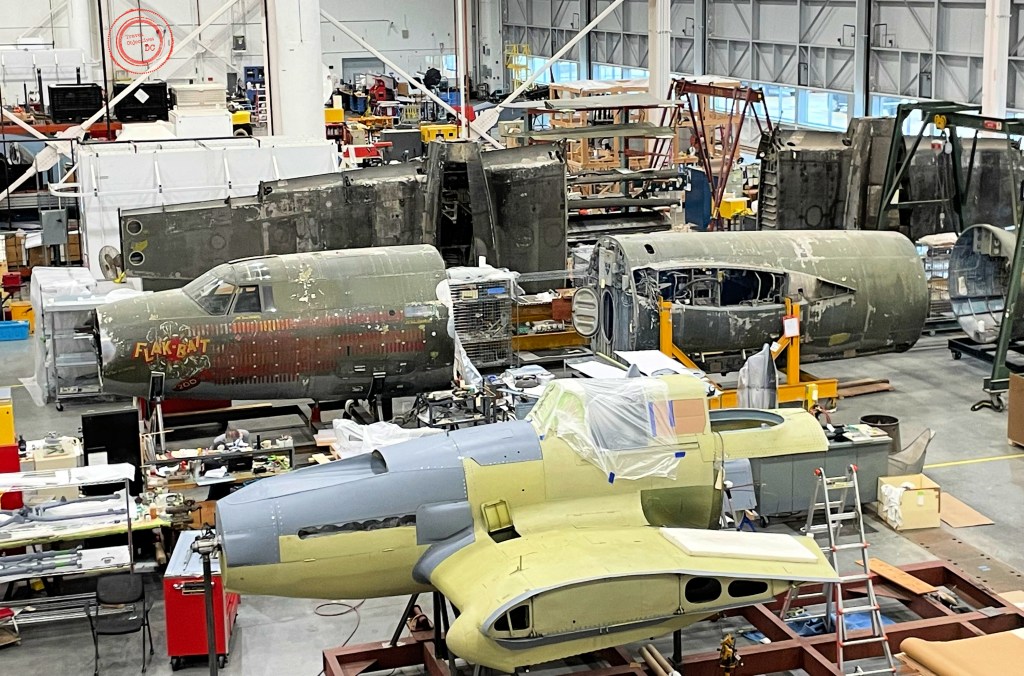
The Martin B-26B Bomber Flak-Bait holds the record for the number of bombing missions survived in World War II.

As captivating as they are, the Udvar-Hazy Center offers a few additional activities beyond just looking at the restored air and space craft. 

Observation Tower – The Donald Engen Observation Tower provides a commanding view of the area, including the main operational runways at Washington Dulles International Airport. Watch the planes take off and land throughout the day. The tower also includes a quick lesson in the functioning of the air traffic control system, adding some helpful context to the highly choreographed movement of aircraft through the region’s airspace.  

Simulators – After viewing so many exciting aircraft, a collection of simulators provides the realistic feeling of taking to the skies and beyond.  

Theater – The Airbus IMAX Theater at Udvar-Hazy, the largest in Northern Virginia, shows a combination of current Hollywood releases as well as documentaries on different aspects of aviation and space exploration.

Additionally, the Smithsonian maintains a regular schedule of educational programs, lectures, and events for young people, such as the annual Air & Scare held the Saturday before Halloween. 

The B-29 Superfortresss Enola Gay.

After a visit, it is easy to understand why the Udvar-Hazy Center is one of the top destinations not only in the Washington, DC area, but in all of Virginia. The building is expansive, easy to navigate and the exhibits are tantalizing to the eye with multiple legendary air and spacecraft on display. Beyond the artifacts, other aviation related activities are available to expand your understanding of flight and helpful staff are available to answer questions. For admirers of aviation, adventure or innovation, there are few better places (on the ground) to spend a day than the Steven F. Udvar-Hazy Center

* * *

Route Recon

The Steven F. Udvar-Hazy Center is located just south of Washington Dulles International Airport, along Virginia Route 28 in Chantilly, Virginia. 

The address is: 14390 Air and Space Museum Parkway, Chantilly, VA 20151

By car:

From Washington, DC, and points south: Take Interstate 66 West to Route 28 North (Exit 53B): Travel on Route 28 North for 5.3 miles. Exit at Air and Space Museum Parkway and follow the signs to the Udvar-Hazy Center.

From Washington, DC, and points north: Take Interstate 495 West (the Capital Beltway) to the Dulles Toll Road West (Virginia Route 267). Exit the toll road at Route 28 South (Exit 9A) and travel south 3.5 miles. Exit at Air and Space Museum Parkway and follow the signs to the Udvar-Hazy Center.

NOTE: Online mapping apps may direct you to enter the Udvar-Hazy Center from US Route 50. This is not a public entrance. You must enter from Virginia Route 28. 

Admission to the museum is free, but parking costs $15 before 4:00 pm. Free parking is available for all cars arriving after 4:00 pm.  Vehicles dropping off or picking up visitors are not charged if staying less than 30 minutes. 

By Bus: 

From Washington Dulles International Airport to the Udvar-Hazy Center in VA:

From Ground Transportation bay #5E (lower level exit #6), take Fairfax Connector No. 983 one stop to Steven F. Udvar-Hazy Center. Buses run every 25 minutes during peak times and every hour during non-peak times and weekends. Bus fares paid with SmarTrip card or cash. Bus drivers do not carry change. The bus ride from Dulles Airport takes approximately 25 minutes. 

By Metro: 

Take Metro Silver Line to Innovation Center station. 

Fairfax Connector provides connecting bus service from the Silver Line’s Innovation Center Metro station. More information is available on the Fairfax Connector No. 983 website Buses run every 25 minutes during peak times and every hour during non-peak times and weekends. Trips between Innovation Center and the Udvar-Hazy Center take about 12-15 minutes.

Exit bus at Steven F. Udvar-Hazy Center stop.

Plan for an approximately 1 hour and 35 minute trip from Washington, DC to the Udvar-Hazy Center using Metro. 

Mess Call

Shake Shack restaurant provides onsite dining at the Udvar-Hazy Center. The Shake Shack is open from 11:00 am to 5:00 pm daily. The restaurant serves burgers, hot dogs, chicken sandwiches, fries, frozen custard, shakes, and coffee. There are two shakes exclusive to the museum, the Constellation Crunch Concrete and Out of This World Shake. Additionally, pre-packaged salads and sandwiches are available from an automated vendor kiosk. 

Something is Missing at the National Air and Space Museum

It was August 1961 in the hot California desert. Jacqueline Cochran was strapped into her Northrop T-38A Talon, flying a nine mile closed loop aeronautical course. She was followed by Chuck Yeager, flying an F-100. Cochran kept the aircraft in perfect alignment around the course and topped out at 844 miles per hour, setting a new speed record for that distance. That was only one of the eight speed records the fifty-five year old Cochran would set that summer.

Cochran was no stranger to flying records. She set her first speed record in 1937 and won a number of airplane races prior to World War II. In 1943, General of the Air Force Harold “Hap” Arnold appointed Cochran the first director of the Women Airforce Service Pilots (WASPs). In 1953, she was the first woman to break the sound barrier. The T-38A she flew now hangs in the Smithsonian Institute’s “new” National Air and Space Museum (NASM). 

Northrop T-38A Talon | Jacqueline Cochran | airspeed record | National Air and Space Museum | Washington DC

The Northrop T-38A Talon flown by Jacqueline Cochran.

Since its opening on the National Mall in 1976, the NASM has been a stop for many visitors to Washington, DC. It is easy to understand why. Even for those only marginally interested in space or aviation, the museum is full of interesting artifacts and displays. The original Wright Flyer, the Spirit of St. Louis, and Neil Armstrong’s spacesuit are but a few of the items that provide not only a sense of pride in American innovation, but also in humanity’s ongoing exploration of the heavens.

In 2018, the NASM began an historic seven-year, $250 million renovation focusing on creating a more immersive and enjoyable experience. The Smithsonian holds the world’s largest collection of artifacts related to aviation and space exploration, and the renovation includes over 1,400 new items for public display.  Through this process, all the museum’s galleries are due for renovation, redesign or complete replacement.

The NASM reopened to the public on October 14, 2022 with eight new or redesigned galleries on the west end of the museum’s building. While there are certainly some interesting exhibits and displays, the museum is still a work in progress.

Wright Brothers | Wright Flyer | first airplane | Air and Space Museum
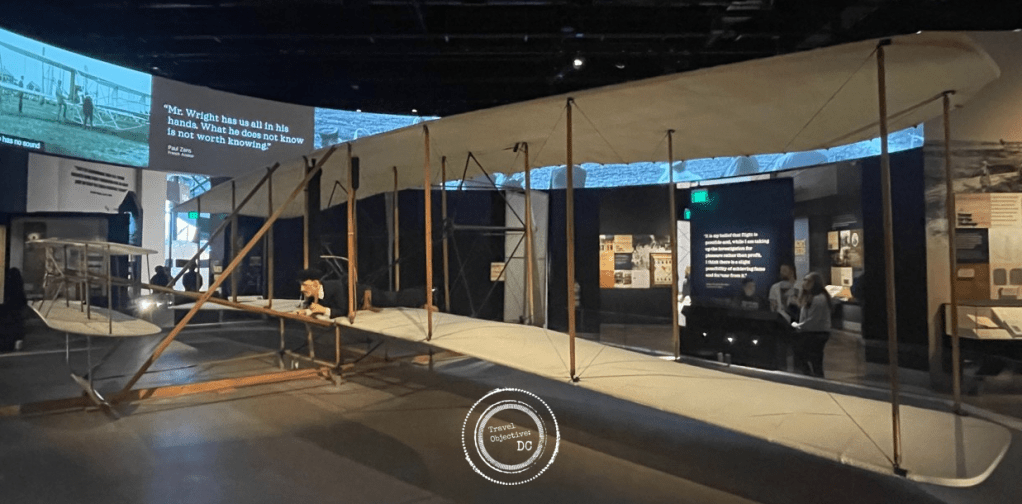
The Wright Flyer on display in the Wright Brothers gallery.

What Galleries Are Now Open?

The Wright Brothers – The centerpiece of the gallery devoted to Orville and Wilbur Wright remains the Wright Flyer, the brothers’ heavier than air machine which first took flight on December 17, 1903 in Kitty Hawk, North Carolina. The redesigned gallery adds further details to their lives before and after they achieved fame as inventors of the airplane.  There are leaflets from their printing business, tools from their bicycle shop, early models, experimental aircraft parts and furnishings from their cabin in North Carolina.

Early Flight – Following their successful flight, the Wright Brothers led many others in continued experimentation on early aircraft. A budding aviation community took hold around the world as the human passion for flying grew. The gallery highlights this earliest period of aviation innovation.

America by Air – In 1918, the U.S. Government formally initiated airmail service, a decision that led to the commercial passenger aviation industry. The America by Air gallery tracks air travel in the United States from the early days of open cockpits to the deregulated, post-9/11 era we know today.

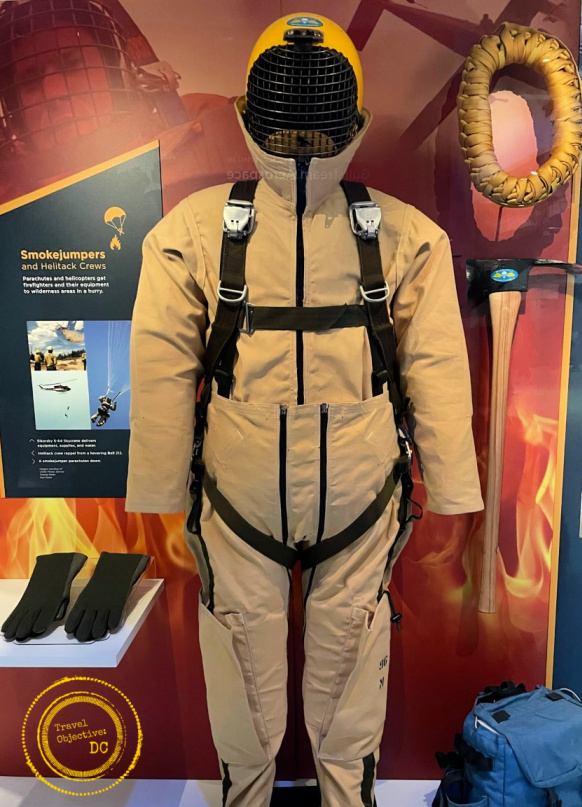
A smokejumper’s protective suit and other gear on display in the Why We Fly gallery.

Smokejumper protective suit | National Air and Space Museum | NASM | Washington DC

Why We Fly – About 80% of aircraft in the United States are considered General Aviation, meaning they are not connected to scheduled passenger service, the military or the Federal government. Why We Fly exhibits reflect the great diversity of this sector. Medical flights, crop dusting, aerial firefighting and humanitarian response are all included.

Nation of Speed – A collaborative effort with the Smithsonian’s National Museum of American History, Nation of Speed presents the American experience of the desire to move faster in the air, on the water and over land with the technology and machines that made it possible.

Destination Moon – Some of the Smithsonian Institute’s most iconic artifacts are found in Destination Moon, which traces the history of the US lunar programs and missions.

Exploring the Planets – Beyond the moonshots of the 1960s and 1970s, this gallery explores current space exploration programs and future plans for exploring our solar system.

Apollo 11 Command Module Columbia | moon landing return vehicle | Neil Armstrong | Buzz Aldrin | Michael Collins | NASM Washington DC

The Apollo 11 Command Module Columbia. The command module was the living quarters and return vehicle for Neil Armstrong, Buzz Aldrin and Michael Collins.

One World Connected – Explores how the advancements of aircraft, satellites and technology have revolutionized communications, navigation, weather forecasting and other aspects of life on earth.

Mixed Results

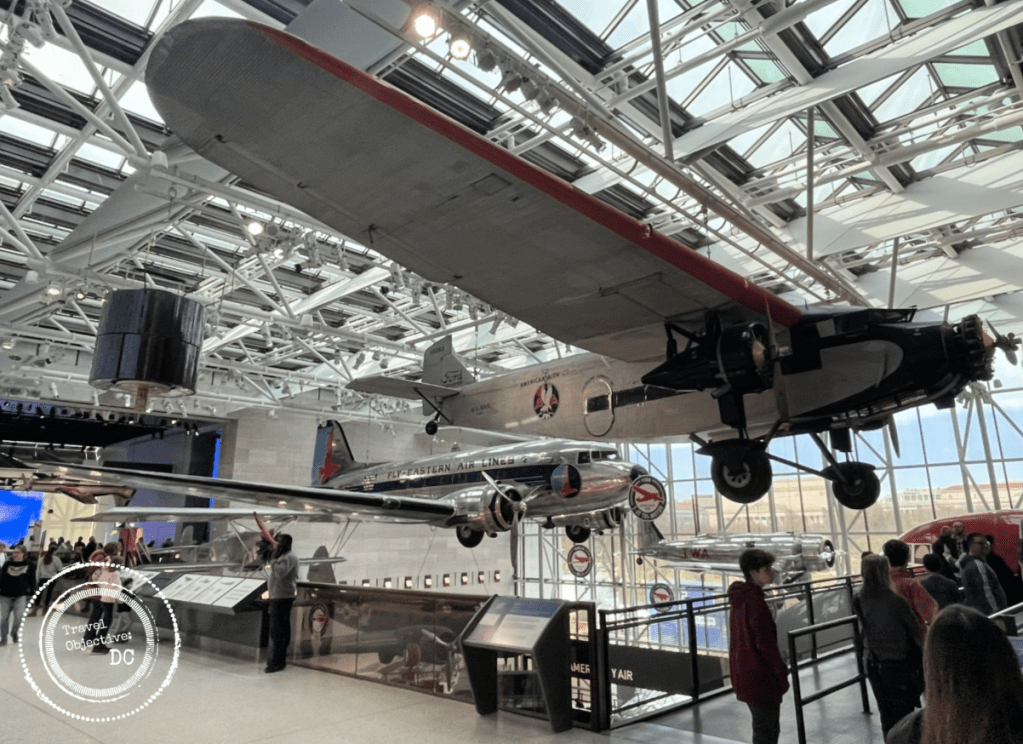
It is quite evident tremendous effort went into the design (or redesign) of these galleries, but the results seem mixed. On the positive side, the new features in the Wright Brothers gallery fill in more details on the lives of the two brothers, making them seem more human, while still maintaining their iconic stature. America by Air provides ample details and activities telling the story of commercial passenger aviation in America. The shiny and brightly painted early airliners suspended above the displays add a sense of majesty to the storytelling below. 

Ford-5 Tri-Motor | Douglas DC-3 | airplanes on display at National Air and Space Museum | Washington DC tourism | Smithsonian Institute
A Ford-5 Tri-Motor and a Douglas DC-3 above the American by Air gallery.

Within Destination Moon, the artifacts and displays are now neatly and chronologically arranged allowing visitors to walk through the decades of manned lunar exploration. Along the way, they get a sense of the dedication of the people involved, the power of the rocket engines, and at the same time, reckoning how all this was accomplished with less technology than the cellphones in our pockets today.

However, the Nation of Speed gallery is much more suited to the Smithsonian’s National Museum of American History. For some reason, profiles of early pilots and aviation record holders are notably absent with most of the artifacts related to auto or motorcycle racing. 

Exploring the Planets is understandably lighter on artifacts (many are still in use or irretrievable) and there are indeed some interesting examples of the Mars rovers. However, other displays simply describe the current scientific understanding of the other planets seeming more akin to a science fair rather than the immersive experience NASM’s renovation was to bring about.

The One World Connected gallery celebrates the interconnected life on planet Earth in this 21st Century. Yet the exhibits do not mention much about the the limits nor downsides of the technology that brought us this interconnectivity, such as cyber crime, disinformation or political polarization, and how we can overcome them.   

An early Global Positioning System (GPS) unit circa 1993 from the Magellan Corporation on display in the One World Connected gallery.

Smithsonian Institute | GPS on display at NASM

What’s Missing?

Notably absent from the eight renovated galleries are newly restored and presented aircraft, which is rather confounding as the Smithsonian prides itself on its collection of historically significant aircraft. My 11-year-old son summed it up best when he said: “There aren’t any cool planes to look at.”

Most of the aircraft on display were previously viewable before NASM started the renovations. Military aircraft are especially lacking. Aside from Jacqueline Cochran’s T-38A, the only other prominent military aircraft is the Wright Military Flyer, a two-seat observation aircraft built by the Wright Brothers and purchased by the US Army in 1909. 

Closed are galleries that previously included aircraft from both world wars, Legend, Memory and the Great War in the Air and WWII: Sea-Air Operations (featuring a reproduction of a carrier hanger deck from WWII). In their absence, a lone Rebel Alliance X-wing Starfighter from the movie Star Wars hangs suspended from the ceiling over one of the walkways, with little accompanying information.

Jacqueline Cochran | Jackie Cochran | female pilot | Women Airforce Service Pilots WASPS | aviation record holder

Jacqueline Cochran (circa 1943) in her Women Airforce Service Pilots uniform. When she died in 1980, Cochran held more speed, distance and altitude flying records than any other pilot.

What is also missing, with the exception of the Wright Brothers, Jacqueline Cochran and the astronauts, are the profiles of humans who took to the skies and to space, pushing themselves and their equipment to the limits to accomplish something for us all. Indeed, the redesign seems to remove the human element in aviation and space exploration, replacing it with technology and process. One leaves NASM better informed, but not inspired.

What’s Next?

These are hopefully just temporary drawbacks. NASM’s renovation is set for completion in 2025. Approximately fifteen more galleries are still under renovation. Publicly available information on the new galleries seems scarce, but one new gallery entitled Pioneers of Aviation will feature the iconic Spirt of St. Louis. Another will depict aerial combat and tactics during World War II with the North American P-51, Grumman Wildcat and Messerschmitt 109 on display. Perhaps the X-wing Starfighter suggests a Star Wars or space fantasy gallery is in the works?

Star Wars X-Wing Starfighter on display at Smithsonian
A Rebel Alliance X-Wing Starfighter from the Star Wars movies

In the meantime, those with a serious interest in military aircraft should visit the Smithsonian Institute’s Steven F. Udvar-Hazy Center in Chantilly, VA near Washington Dulles International Airport instead. At this 17-acre facility, military and civilian aircraft from World War I until today, as well as space equipment, are on display. 

* * *

Route Recon

The Smithsonian Institute’s National Air and Space Museum is located on the National Mall bordered by Independence Avenue, Jefferson Drive, and 4th and 7th Streets, SW. The entrance is on the south side of the building along Independence Avenue. You cannot access the museum from the north side along the National Mall.

Parking – Very limited metered street parking is available around the museum. Parking is available in several commercial parking lots in the neighborhood.

Public Transportation

Metrorail – The closest Metro station is L’Enfant Plaza, along the blue, orange, silver, and green lines. From the L’Enfant Plaza Station, take the exit for Maryland Avenue and 7th Street.

Metrobus – Bus stops are located on Independence Avenue, SW, and along 7th Street, SW. Visit the Washington Metropolitan Area Transit Authority for more information.

Circulator Bus – The National Mall Circulator Loop bus provides easy access around the National Mall and convenient connections to other Circulator buses for visits to uptown sites. The NASM is a short walk from the Jefferson Drive and 7th Street SW stop on the National Mall route, or the D Street SW and 7th Street SW stop on the Eastern Market – L’Enfant Plaza route.

Bicycle Sharing – Capital Bikeshare  is metro DC’s bicycle sharing service. There are Bikeshare stations around the National Mall. There is Bikeshare station on 4th Street, just south of the intersection with Independence Avenue.

Intel Brief

Free timed tickets are required for entry into NASM. Tickets can be acquired through the NASM website. Ticket holders will line up near the Independence Avenue entrance prior to their entrance time. The line can become quite long, but it moves quickly once ticket holders are allowed to enter the building.    

NASM is not currently offering guided tours for individual parties. Tours are available for school groups of 10 or more and adult groups of 20 or more. Tours should be requested 3 weeks in advance. Reservation and group visit information is available at NASMs Group Tours webpage.

Mess Call

The Mars Café is located on the “Launch Pad” (lower level) It is open daily from 10:00 am to 5:00 pm. The café has a coffee bar and sells sandwiches, salads, and pastries.  There are only twenty five tables currently available so seating is challenging at mid-day.

Celebrating 70 Years of “Aiming High” at the U.S. Air Force Memorial

September 2017 marks the 70th Anniversary of the United States Air Force, which was formally established as a separate military service by the National Security Act of 1947. Previously, various ground-based air reconnaissance, combat and support units had existed as part of the U.S. Army.

Flags
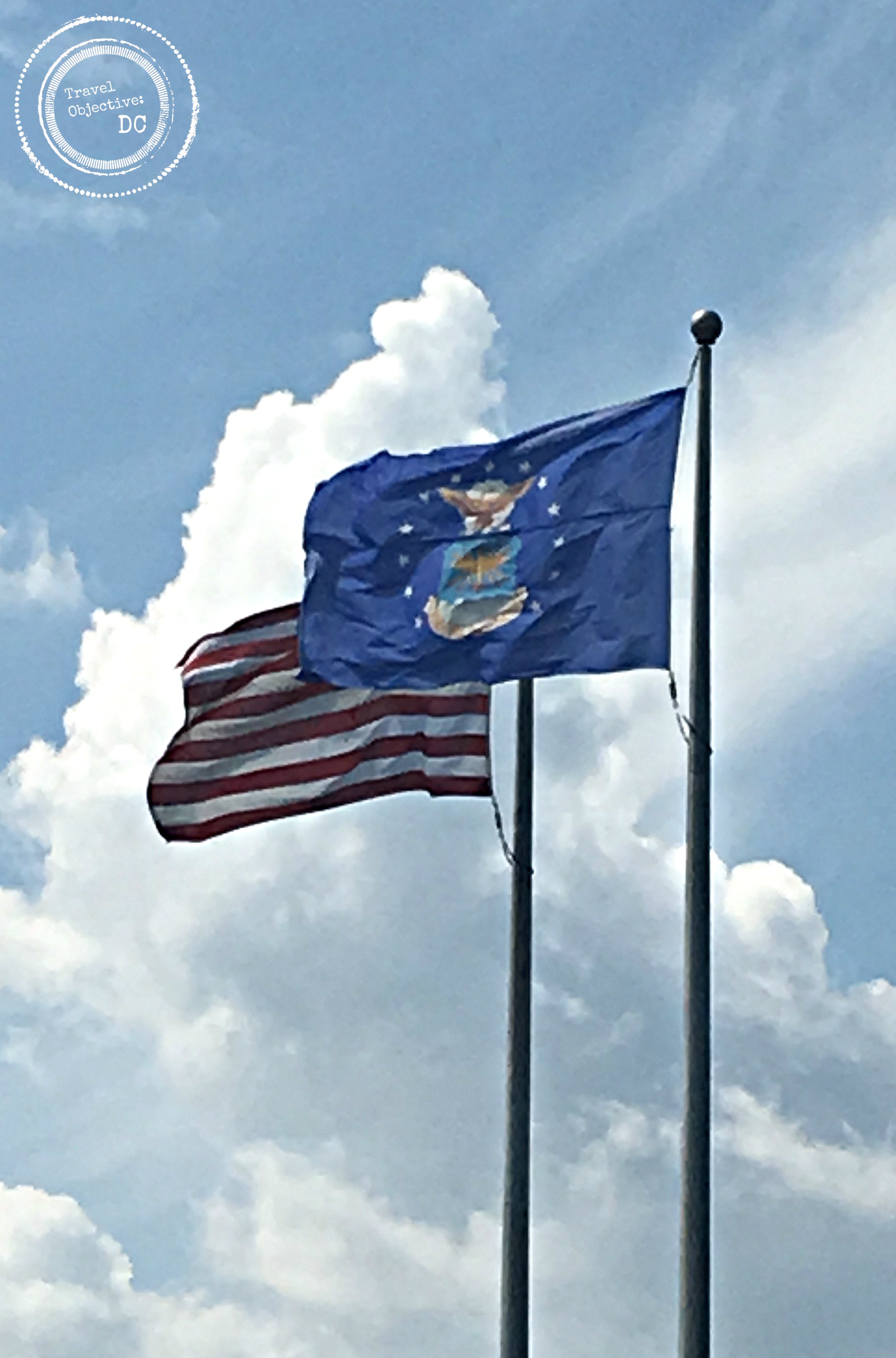
The U.S. Air Force celebrates its 70th Anniversary in 2017.

What better way to mark the 70th Anniversary of the Air Force than to visit the Air Force Memorial?

Given the relative young age of the Air Force (compared to Army, Navy and Marine Corps, which were all established in 1775), it is rather understandable that for most of its existence, the Air Force had no memorial of its own.

In 1991, leaders of two Air Force veterans’ organizations began an effort to build a memorial to those who served in the Air Force and its predecessor organizations.

The memorial sits in Arlington, Virginia along a high ridge adjoining Interstate 395, the main southern arterial into Washington, D.C. With views of the Potomac River, Pentagon, and other official buildings spread out below, this location fittingly evokes the aerial nature of the Air Force mission. Arriving and departing aircraft from nearby Reagan National Airport add to the effect.

View with flags 2
Official Washington as seen from the U.S. Air Force Memorial.

Architect James Ingo Freed, (who also designed Washington’s Holocaust Museum) studied how to use the physical location to capture the essence of the Air Force and the dedication of the men and women who have served in its ranks. The resulting venue is sleek and streamlined, with minimal adornment and flourish, as if inspired by a modern aircraft.

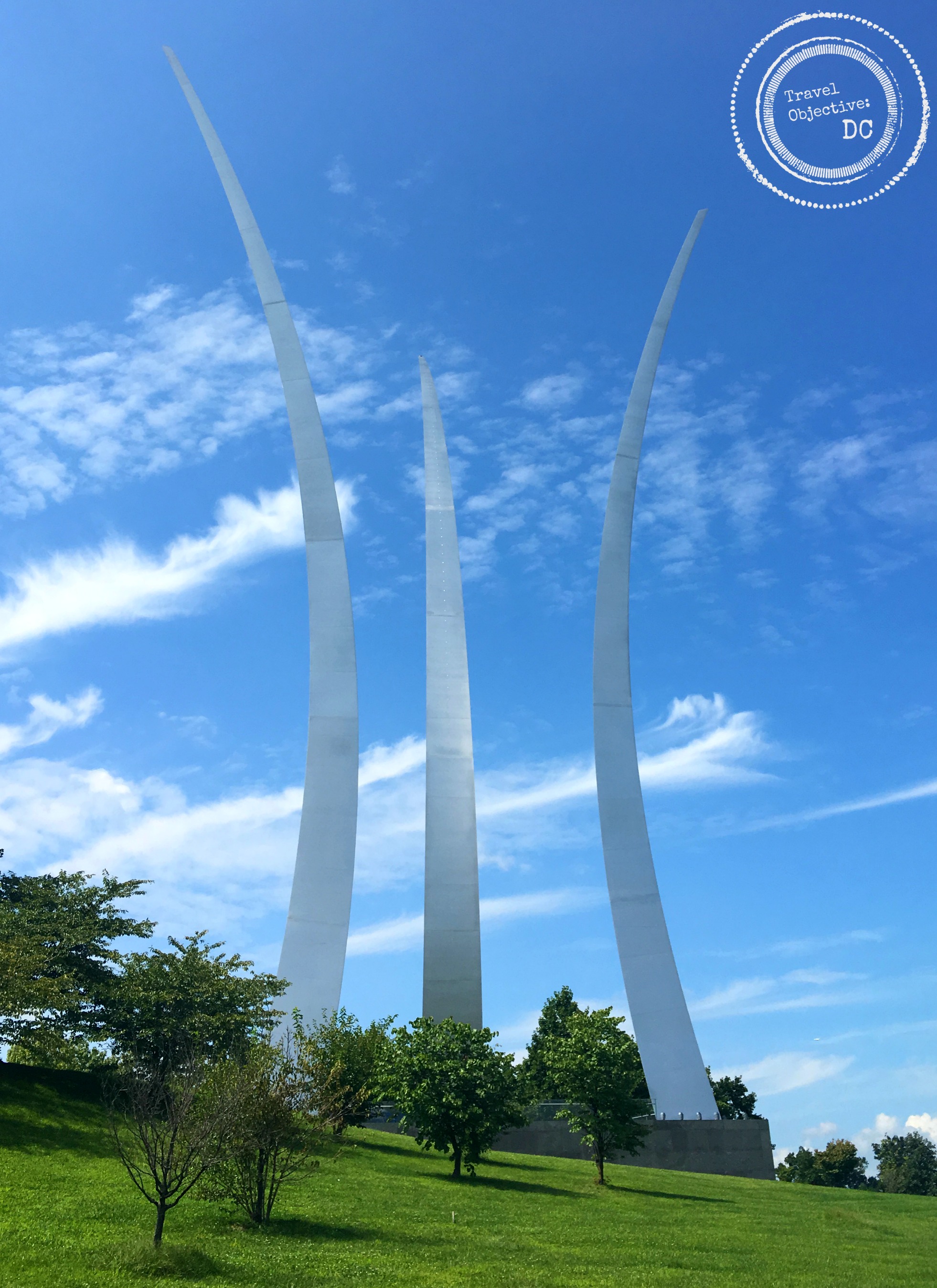
The most prominent feature of the memorial is three vertical, arc shaped steel spires, meant to evoke the image of soaring flight. The spires are arranged in a triangular pattern with the highest reaching up to 270 feet.

Spires from hill
The Air Force Memorial’s most prominent feature, three steel spires reaching skyward.

N/A
The U.S. Air Force “Thunderbirds” perform the High Bomb Burst maneuver.  (U.S. Air Force photo/Staff Sgt. Larry E. Reid Jr.)

The spires are also reminiscent of a contrail pattern formed by the U.S. Air Force Thunderbird Air Demonstration Squadron as they perform their “breaking bomb” maneuver. The lack of a fourth spire alludes to the “missing man” formation, used by Air Force flying units at funerals and other events to mark the loss of a comrade. Given their height and prominence, the spires have also added an additional landmark to the Washington, D.C. skyline.

Just to the west of the spires is a wide walkway connecting two highly polished granite inscription walls. The northern wall lists Air Force Medal of Honor winners. In front of it is a small glass contemplation wall to remember our airmen who are no longer present.

Commemoration Wall
Mementos left at the base of the memorial’s contemplation wall

Airman
The visage of one airman from the honor guard sculpture.

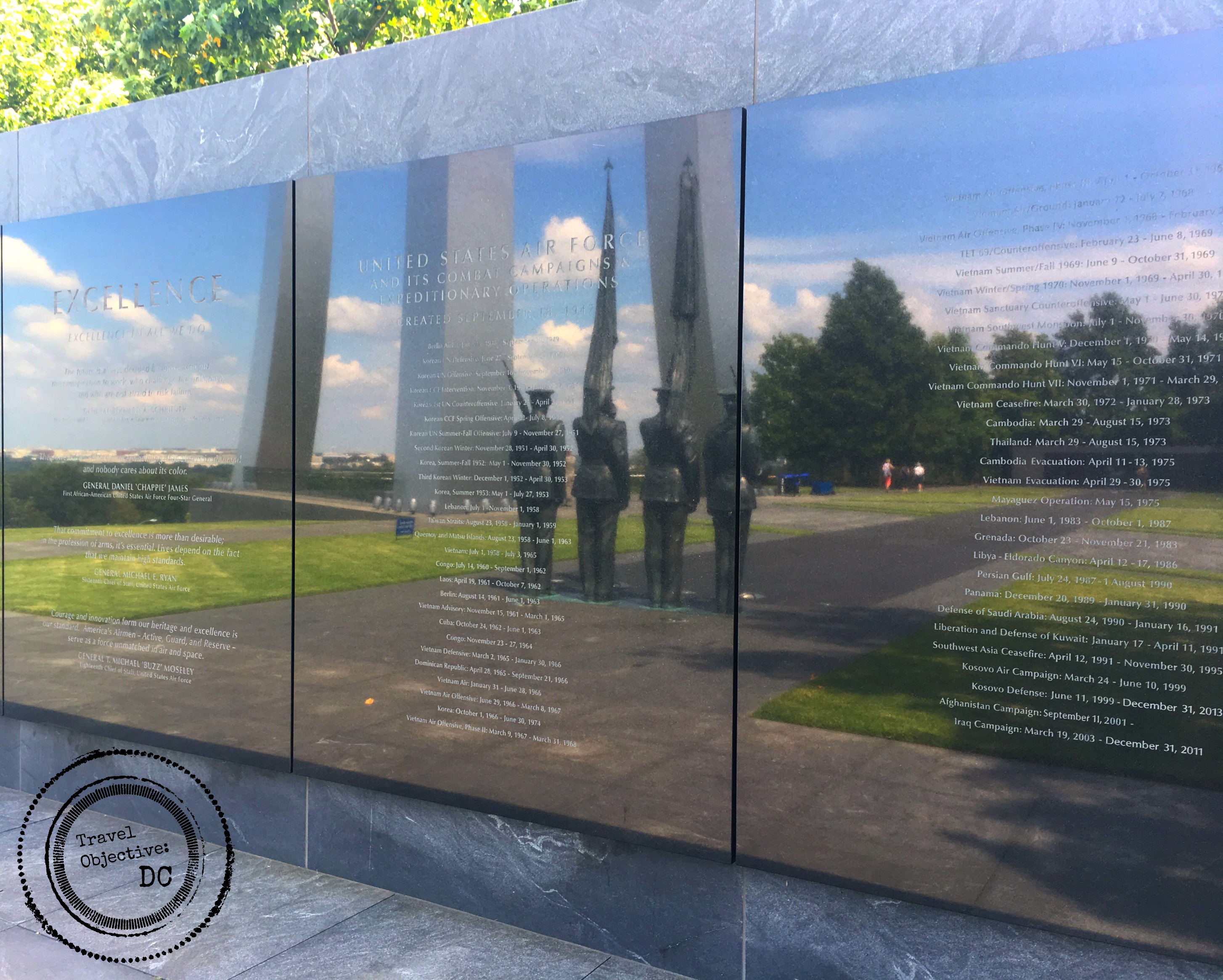
On the opposite southern wall are displayed the Air Force’s core values:

Integrity first,

Service before self,

Excellence in all we do

In front of the southern wall is a sculpture of a four-member Air Force honor guard, keeping watch over the Memorial and adding a human element to the lofty arches and inspired words.

The colors of the Memorial’s features are muted, again like a modern aircraft, metallic spires, polished dark granite walls, gray statues, and the glass contemplation wall. The only other prominent color is green, from the manicured lawn and the trees ringing the parking lot.

HG in Wall
The honor guard sculpture and spires reflected in the southern inscription wall.

Woman and FlagsWhile most aspects of the memorial are clearly visible, one is not: silence.

A certain stillness permeates the venue, bringing a sense of quiet to a busy corner of Arlington. Given this setting, along with the views, designs and significance of the memorial to members of the Air Force, it is a common location for promotions, concerts and other special ceremonies, so you may be sharing your visit with larger gatherings and even the Air Force Band.

(You can check event calendar for a listing of special events at the memorial.)

Some visitors, upon seeing the Memorial for the first time, remark about its unique designs and features and how they are relevant to the Air Force experience. President George W. Bush addressed this in his remarks at the memorial’s dedication on October 14, 2006.

He said: “A soldier can walk the battlefields where he once fought, a Marine can walk the beaches he once stormed; but an airman can never visit the patch of sky he raced across on a mission to defend freedom. And so, it’s fitting that…the men and women of the Air Force will have this memorial, a place here on the ground that recognizes their achievements and sacrifices in the skies above”.

Spires and Sky

The U.S. Air Force Memorial is located at 1 Air Force Memorial Drive, Arlington, VA, 22204. The memorial is free and open every day but December 25. Daily hours of operation from October 1 through March 31 are 8:00 AM – 8:00 PM and from April 1 through September 30 are 9:00 AM – 9:00 PM.

* * *

Route Recon

The Air Force Memorial is easily reached by car, from the Pentagon or Pentagon City Metro stations or bus. From Visit the Air Force District of Washington Website for more information.

* * *

Mess Call

The nearby Pentagon City neighborhood has a wide variety of dining options. Pentagon City is located about 1 mile from the Air Force Memorial. When exiting the Memorial, take a left onto Columbia Pike. At the first intersection, take a right on Joyce Street and cross underneath I-395 and you will enter Pentagon City. Take a left on Army-Navy Drive and you will see several parking garages on your right.

Experience the Great War Above the Trenches at the National Air and Space Museum

The list of ‘Must Sees” for most Washington, DC visitors includes the National Air and Space Museum (NASM). It is one of the city’s most visited attractions, welcoming over 6 million people each year. It is easy to understand why. It is near the Mall, admission is free and the extensive collection of all things that fly attracts people of all ages. There are literally thousands of items on display, as well as a planetarium, an IMAX movie theater and flight simulators.

Some of the best military-themed exhibits within easy walking distance of the Mall can be found at NASM. In 1991, NASM opened Legend, Memory and the Great War in the Air examining the budding role of aviation during the First World War. The exhibit contrasts the romanticized view of the experiences of World War I pilots with the starker reality of combat aviation. The exhibit entices you to enter with a bright red movie theater façade, complete with flashing marquee and similarly colored Pfalz D.XII fighter aircraft suspended overhead.

pfalz
This Pfalz D.XIII Fighter is painted bright red for its Hollywood movie role.

Inside the theater, a short, looped film explains how Hollywood adapted stories of World War I pilots for American audiences. Nearby a child’s bedroom exhibit features books, games and toys from the post-war period celebrating the glory, bravery and derring-do of World War I flying aces.

Turn the corner and a somber reality sets in.

The lighting fades and the sounds of combat emerge. Ground combat and life in the trenches are portrayed. The focus shifts to a more detailed examination of the roles pilots and aircraft would play during the war as observers, fighters, bombers, and conducting photo reconnaissance missions. Three early battles in the war, Tannenburg, the Marne and the Somme are briefly examined where the warring parties learned both the great potential and many pitfalls of deploying aircraft into combat.

During the Battle of Tannenburg and the Battle of the Marne, respective German and French commanders successfully countered enemy troop movements detected by aerial observation. During the Somme however, the British learned the limits of using aerial observation. While pilots could detect troop movements, they would not assess the morale, or the level of training of the enemy units detected below. British commanders also experienced the difficulties of coordinating simultaneous air and ground operations.

albatross
Albatross D.Va Fighter – The German military built over 4,800 Albatross fighters of all types during World War I. Only two are known to exist today. This Albatross D.Va fighter on display and one other at the Australian War Museum in Canberra.

For the aviation enthusiast, the highlights of the exhibit are likely the Smithsonian’s restored vintage WWI aircraft. In addition to the Pfalz D.XII fighter, other German aircraft include an Albatross D.Va, and Fokker D.VII fighters. There is a Sopwith 7F.1 Snipe fighter from the United Kingdom and a French Voisin Type 8 bomber.

fokker-dvii
Fokker D.VII fighter – Two mannequins representing a pilot and ground crewman inspect the Fokker D.VII fighter. Developed to counter more advanced Allied fighter aircraft, the Fokker D.VII fighter was introduced to front line squadrons in April 1918. Some historians and aviation experts considered the Fokker D.VII to be one of the best fighter aircraft of World War I. The plane was so highly regarded the final Armistice required the Germans to surrender all Fokker D.VII fighters.

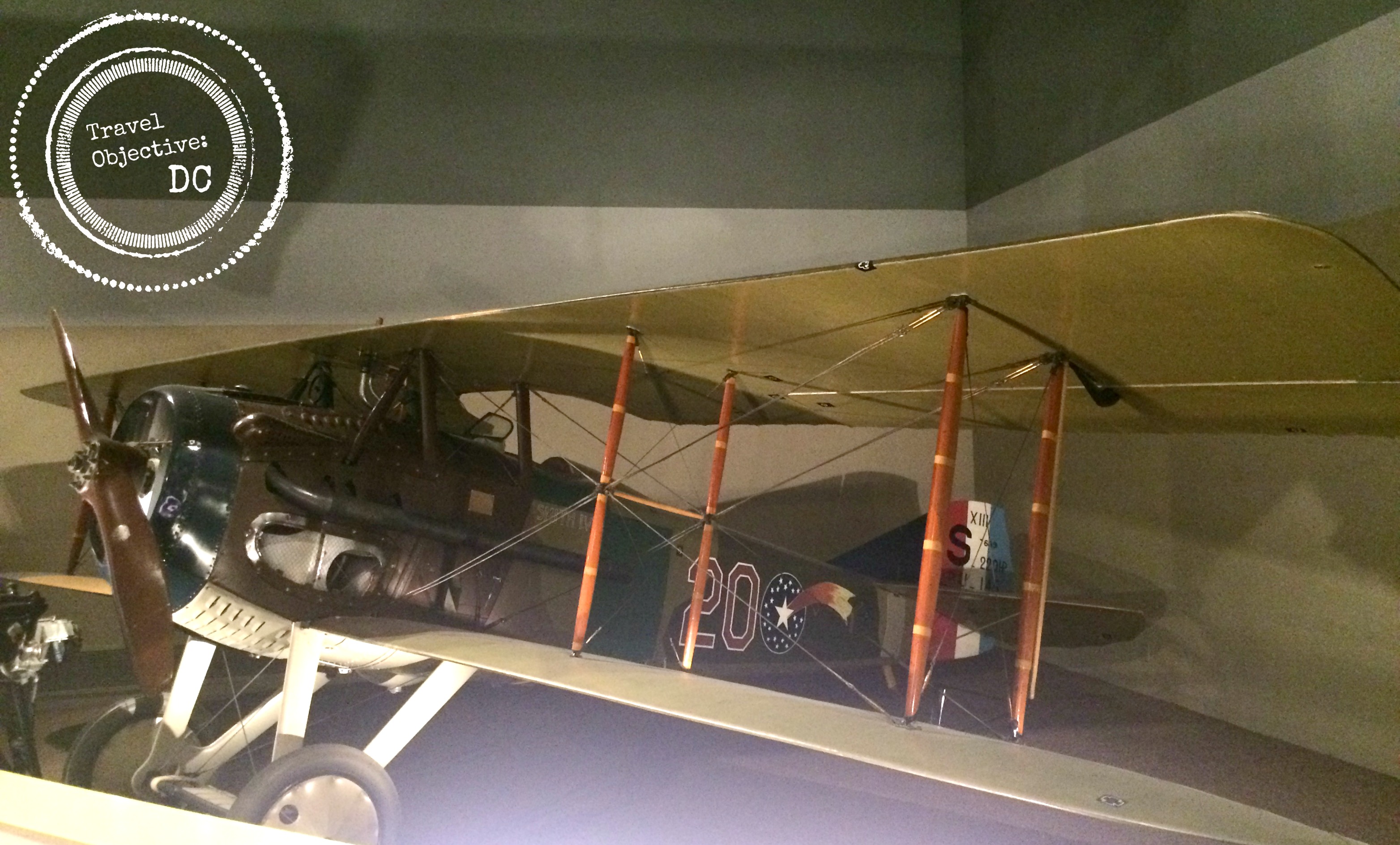
There is also a SPAD XIII fighter. This French made aircraft was known for its sturdiness and ability to perform during dog fights. Multiple air services flew the SPAD XIII’s because of its excellent reputation and performance. In addition to the French, it was flown by the British, Italians, Belgians and Russians.

spad-xiii
The SAPD XIII Fighter. The number “20” on the side is the aircraft’s identification number, assigned by the aero squadron.

As the U.S. entered World War I with no combat ready aircraft, the SPAD XIII was also used by U.S. fighter squadrons of the American Expeditionary Force. The SPAD XIII on display was assigned to the 22nd Aero Squadron of the U.S. Army Air Service.

It was piloted by Lieutenant A. Raymond Brooks who named the aircraft “Smith IV” after his sweetheart’s alma mater. Lt. Brooks won one of his six aerial victories in Smith IV; other squadron pilots achieved additional victories. After being sent to the United States for a Liberty Bond tour in 1918, Smith IV was transferred to the Smithsonian Institution in 1919.

There are no American made aircraft in the World War I exhibit, but a de Havilland DH-4, manufactured by the Dayton-Wright Airplane Company can be found in the “Looking at Earth” exhibit, downstairs in Gallery 107.

dh4
De Havilland DH-4. This U.S. made bomber and observation aircraft would continue to serve the U.S. Government many years after the war.

As the U.S. was preparing to enter the war, the military began looking at various Allied aircraft designs that might be adapted and built in the U.S. The DH-4 was modeled after the British de Havilland bomber and the DH-4 would serve the U.S. Army Air Service in the same capacity. The first models began conducting combat missions in August of 1918.

The DH-4 on display was a prototype, flying many flights and experiments to test the aircraft’s design. Although it never saw combat, this DH-4 is fitted with the standard military compliment of combat equipment: six 25 lb Mark II bombs, two DeRam DR-4 cameras, two fixed, forward-firing .30-caliber Marlin machine guns, and the observer’s position is armed with two flexible .30-caliber Lewis machine guns.

dh4-mannequin
SMILE! A mannequin demonstrates one role of the de Havilland DH-4, as a photo reconnaissance aircraft.

Because the NASM is such a popular destination, it can become very crowded in the spring and summer. Planning ahead can save you some valuable time. Use the “Visit” section of the NASM website to see what is currently on display, learn about the day’s special programs, get helpful tips, and buy tickets in advance for any of the IMAX movies or the planetarium. It is important to remember visitors must pass through metal detectors to enter the NASM and certain items are prohibited.

If the NASM Mall location leaves you wanting to see more about aircraft and space exploration, the NASM has a second complex, the Steven F. Udvar-Hazy Center, located about 28 miles from downtown Washington near Dulles International Airport. Several Smithsonian Institution museums, including NASM, offer extended hours during the spring and summer. You can find more information at: http://www.si.edu/visit/hours#ExtendedHours

* * *

ROUTE RECON

The NASM is located at the intersection of Independence Avenue and 6th Street, Southwest. There is no onsite parking, but there are several commercial lots nearby. The nearest Washington Metro stations are the L’Enfant Plaza Station on the Yellow and Green Lines and the Smithsonian Station on the Blue and Orange lines. Both stations are about a two block walk to the NASM.

MESS CALL

The Wright Place Food Court offers a variety of fast food meal options from Boston Market, Donatos Pizza and McDonald’s.