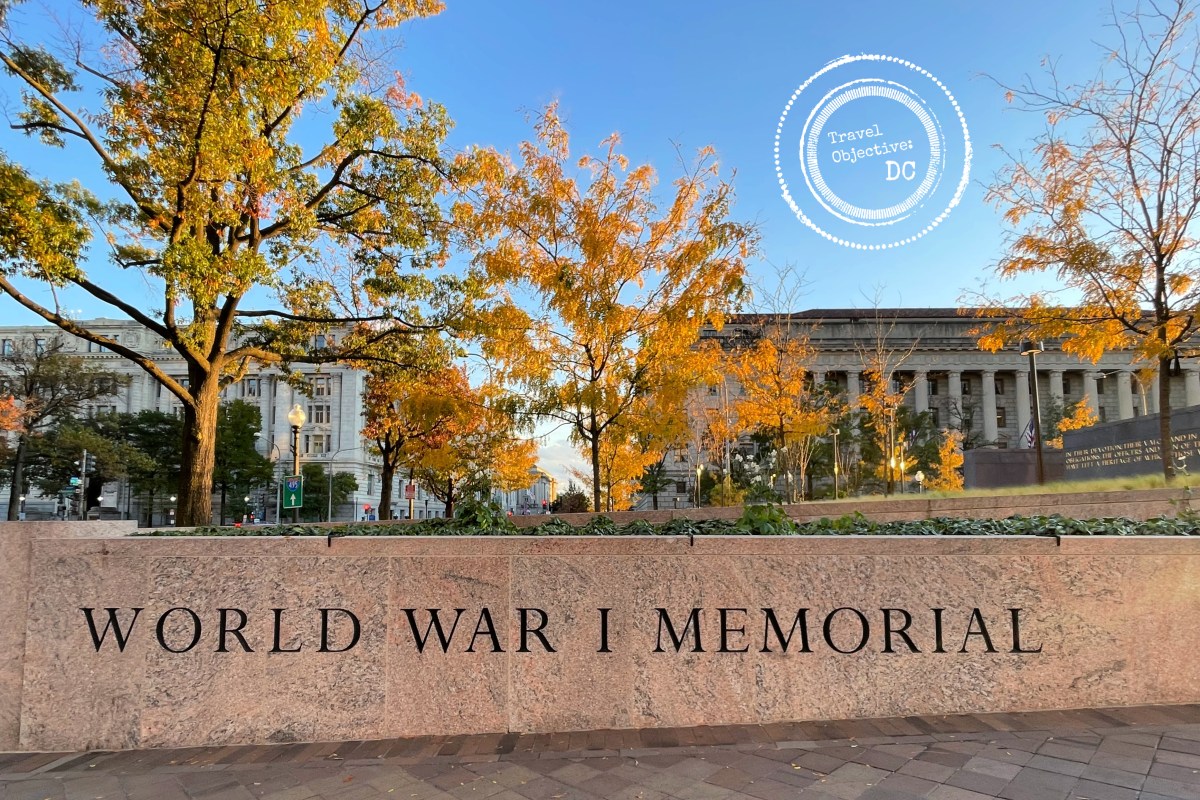
Each day, shortly before 5:00 pm, an individual in a First World War U.S. Army “Doughboy” uniform exits the stately Willard Hotel and crosses Pennsylvania Avenue, bound for the Washington DC area’s newest memorial, the National World War I Memorial.
The Doughboy carries a bugle, and positions themselves under the memorial’s flagpole. Precisely at 5:00 o’clock, the bugler plays the mournful notes of Taps. The bugle notes echo through the plaza inviting all who hear to pause and remember the 4.7 million American men and women who fought in World War I and especially the estimated 126,000 Americans who gave their lives in the “war to end all wars”.

A bugler in his World War I uniform
In a bit of irony, for over a century there has not been a national memorial in the capital city to World War I. There are other important World War I monuments in and around Washington, but not a single, focused and comprehensive national memorial to the war that shaped so much of the 20th century and America’s role within it. Yet that changed in 2021 when a partially constructed memorial was dedicated and opened to the public. Three years later, the final and dramatic piece of the memorial was installed capping a years long effort and bringing Washington, DC’s National World War I Memorial to fruition.
Pershing Park
The National WWI Memorial is located in what was formerly known as Pershing Park, a parcel of land originally laid out as part of the redevelopment of Pennsylvania Avenue in the 1970s. Located between 14th and 15th Streets and Pennsylvania Avenue, the park was dedicated to General of the Armies John J. Pershing and the American Expeditionary Force (AEF) and formally opened in 1981.
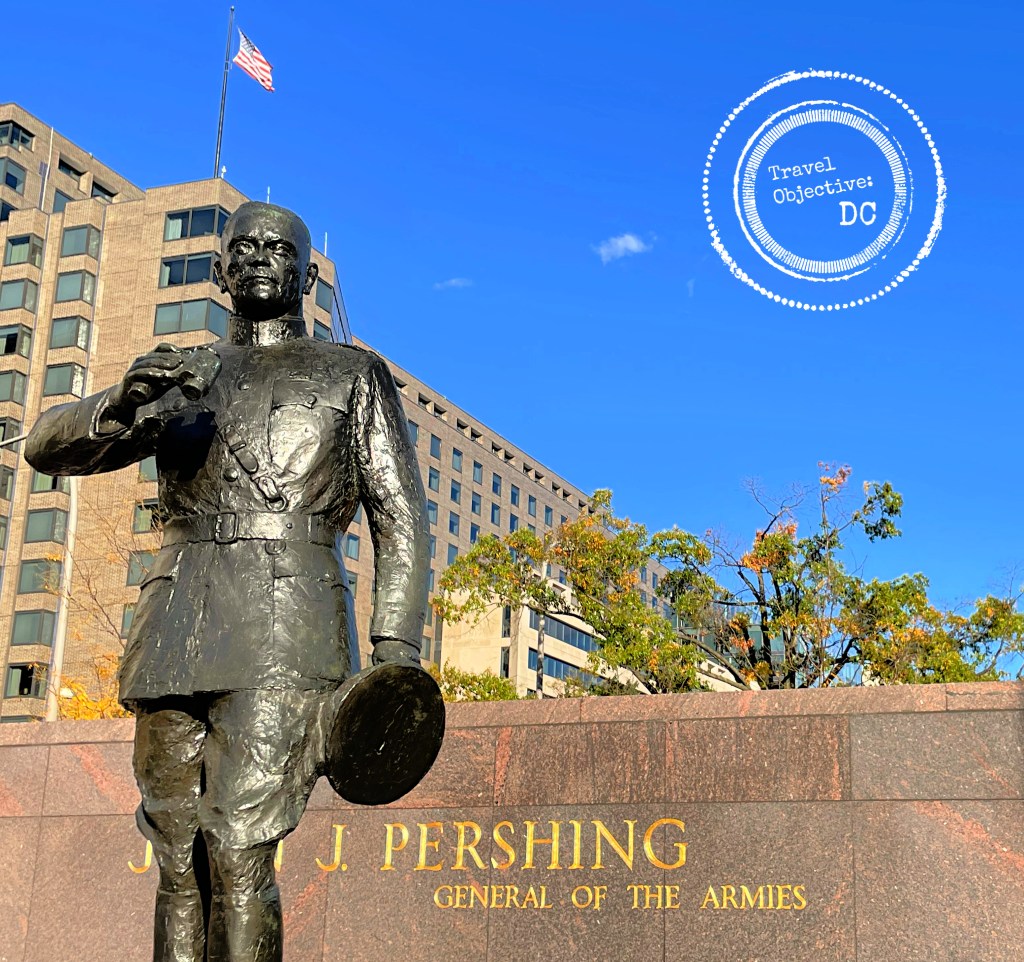
The park featured an eight-foot-tall statue of Pershing standing straight and surveilling the horizon with his binoculars in hand. A wall perpendicular to the statue displayed maps and details of the AEF’s operations in Europe.
The statue of General of the Armies John J. Pershing at the National World I Memorial
Also included were a fountain that could be converted to a skating rink during the winter months, a glass concession stand and sitting areas. Abundant landscaping was added to provide a natural setting within a busy urban corridor. Earthen berms covered with grass surrounded the park on three sides, shielding the grounds from traffic noise.
Unfortunately, maintenance funds for the park’s unique features were scarce. Some aspects of the park fell into disrepair, trash accumulated and the landscaping neglected.
However, when the World War I Centennial Commission went in search of a venue for a national memorial to World War I in the nation’s capital, it ultimately decided on a redesigned Pershing Park as the best location.
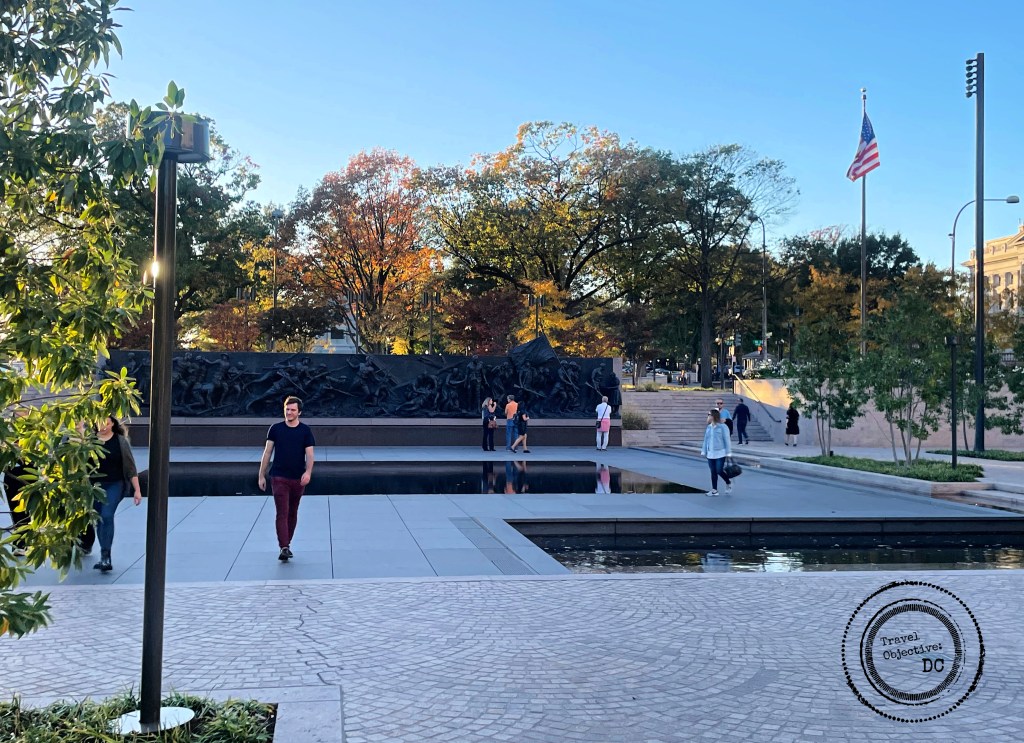
Visitors walk through an open plaza at the National World War I Memorial.
With the clock ticking on the 100th Anniversary of the armistice, the commission expedited the truly lengthy process for approving new landmarks in Washington. The approach was not without controversy. Community and architectural groups grew concerned the new designs abandoned the original intent of an open green space in the middle of the city.
Ultimately, in 2016, a design submitted by architect Joseph Weishaar was selected. His approach was to use the existing footprint of the 1.76 acre park situated in a busy downtown area just southeast of the White House. Weishaar retained Pershing’s statue, the AEF Wall and the earthen berms but planned new features that expanded the interpretation of World War I.
One new addition is known as the belvedere, a raised, enclosed circular area located near the northeastern entrance of the park. The belvedere serves as the memorial’s orientation center. Interpretive signage installed along the interior of the wall familiarizes the visitor to “the Great War” and the roles played by American forces. The belvedere’s elevation provides clear lines of sight to the memorial’s features.
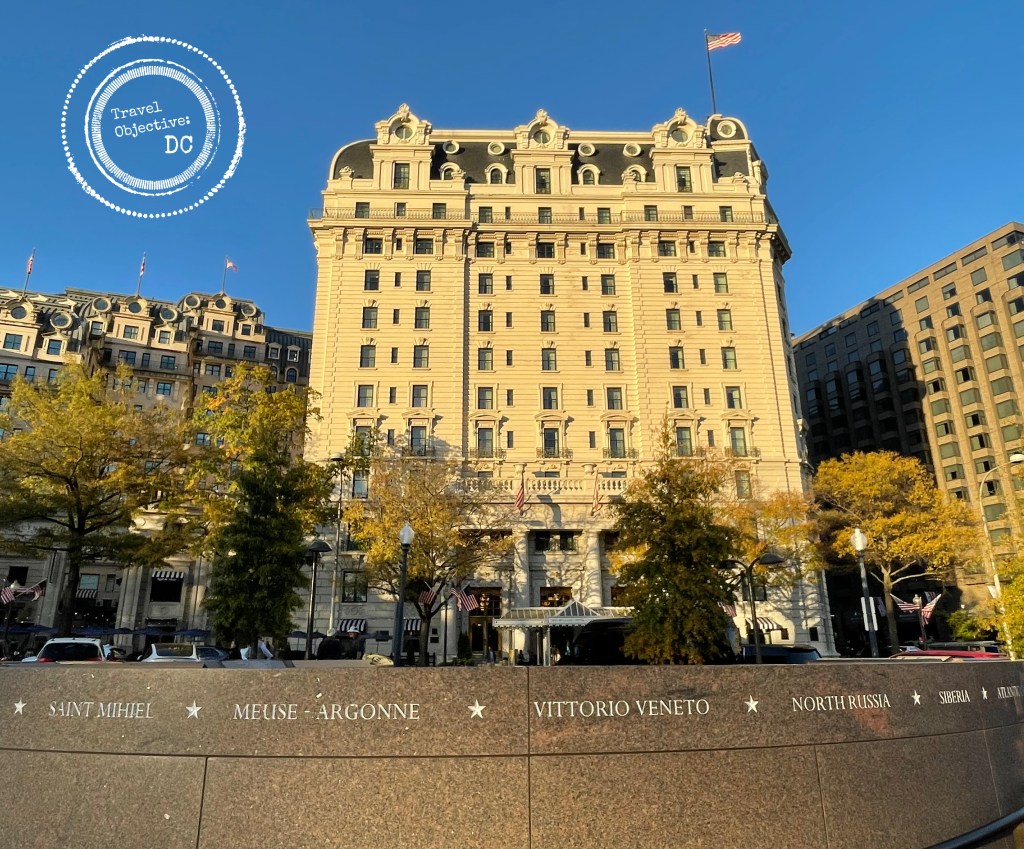
The circular wall of the belvedere is inscribed with the campaign names of the First World War. In the background is the Willard Hotel.
A Soldier’s Journey
Across the plaza from the belvedere, over a shallow reflection pool is the most prominent aspect of the the new memorial, a large relief sculpture entitled A Soldier’s Journey by Sabine Howard. The sculpture’s installation in September of 2024 completes the National World War I Memorial.
The sculpture stretches 58-feet long and includes 38 separate statues. Designed to be viewed from left to right, the sculpture tells the story of an American soldier’s experience across a series of tableaus.
Howard and his team followed a meticulous process beginning with over 12,000 drawings and photographs of models in various poses, which he used to create foam models. These foam models were then covered in clay so accurately that every uniform crease, garment wrinkle, weapon detail, and facial expression were painstakingly rendered. The clay-covered models were then used to create the molds in which the bronze statues were cast.

Howard used combat veterans as his models, believing their faces would more accurately portray the effects of war. All the uniforms and equipment used by the models were century-old artifacts, not reproductions. Through this extensive detail, Howard invites the viewer into the story.
The effort took about eight years to complete.
The story begins with the soldier receiving his helmet from his young daughter. He then joins fellow soldiers as they march off. The next scene shows them charging at the enemy through no-mans land. The costs of war, both physical and psychological, are shown next as nurses comfort the afflicted while our soldier looks blankly at the viewer with a harrowing gaze.
In a dramatic scene from the sculpture entitled the Ordeal, American soldiers charge the enemy.

The soldier then returns home as part of a victory parade. In the last scene, the soldier hands the helmet back to his daughter. Rather than depicting a joyous scene, this one is foreboding. The soldier has a look of deep resolve on his face. The daughter stares into the helmet, wearing a troubled expression. She represents the Greatest Generation, who would soon take up the mantle once again and fight another war.
Howard’s work is powerful and thought provoking, but the story told through the sculpture is a familiar one. With some changes to the uniforms and equipment, the story could be about any war.
This was Howard’s desired effect. He wanted a sculpture that asks the questions any war memorial should ask: Was it worth it? What did we gain? What did we lose? What did we learn?
Other Features
On the reverse of the sculpture wall, water gently cascades over an inscription taken from a haunting poem entitled The Young Soldiers Do Not Speak by Archibald MacLeash. MacLeash’s poem is written from the perspective of deceased soldiers who tell the living that it is up to the them to give meaning to the lives the soldiers lost. MacLeash was a veteran of the First World War who became a noted writer, poet and editor. President Roosevelt appointed MacLeash as the Librarian of Congress in 1939. He wrote a poem in 1940 in honor of the Library of Congress staff who died in World War I.
“We were young, they say, we have died, remember us”
– From The Young Soldiers Do Not Speak by Archibald MacLeash
A unique aspect of the memorial are the circular benches arrayed around the southern and western edges of the memorial plaza. Unlike similar war memorials in Washington, the inclusion of these sitting areas provides an appointed space available for rest and reflection, a gathering spot for friends or even an area for discussion about World War I. Trees and ornamental grasses around the memorial plaza provide a peaceful sense to aid in reflection.
Additionally, the live playing of Taps daily adds a human element to the stone and bronze of the memorial. The daily bugler initiative is coordinated by the Doughboy Foundation. Through the foundation’s website, members of the public can sponsor each day’s rendition in remembrance of an individual. The name of the day’s honoree and the scheduled bugler can be learned by scanning a QR code on a sign near the memorial’s flagpole.
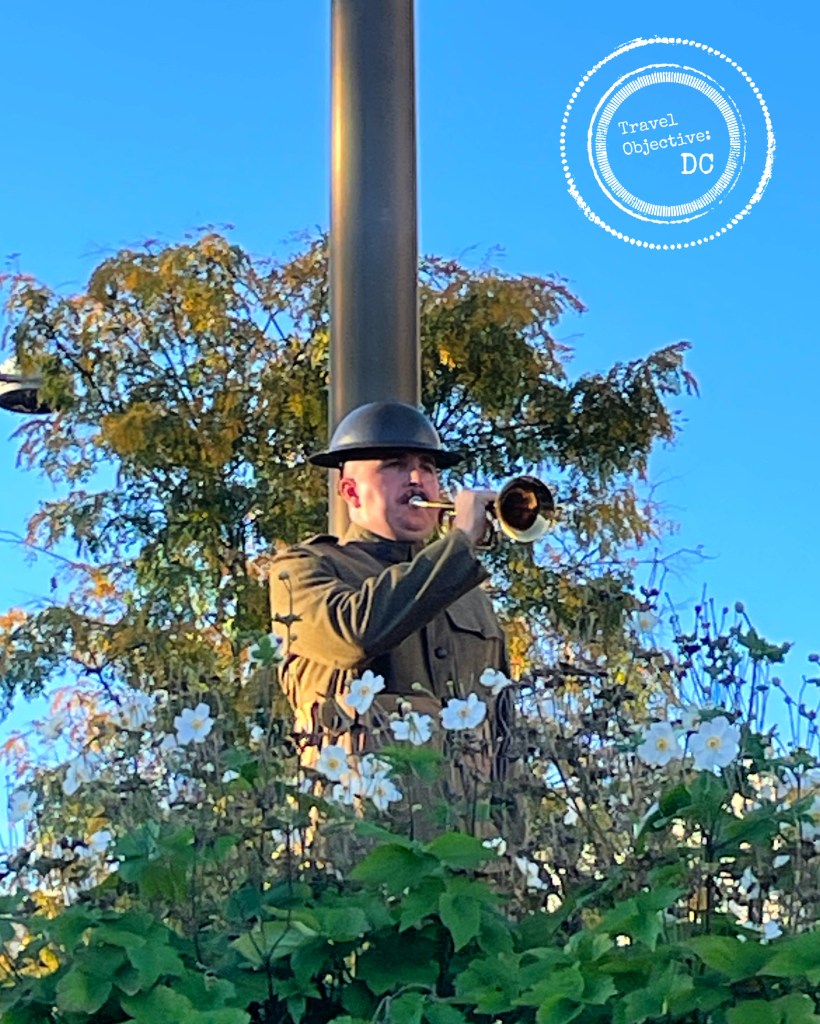
Taps is sounded daily at the National World War I Memorial.
The evolution of Pershing Park into Washington DC’s National World War I Memorial has brought new life and purpose into this downtown space. The area is now more inviting and interesting, drawing more people in to learn about the American role in World War I and to remember those who fought and died.
At the dedication ceremony for the sculpture, Architect Joseph Weishaar remarked: “We don’t build memorials for the dead. They are for the living. We build them to protect and preserve our memories and our stories.”
While it seems so long ago, World War I continues to impact issues of the 21st century, such as the geopolitical situations of Eastern Europe and the Middle East, the immigration system we know today, defense spending, women’s rights, and the role of America on the world stage to name only a few.
However, as World War I moves deeper into history, maintaining the stories and learning its lessons becomes imperative. For if we lose them, we lose a big piece of who we are.
Route Recon
The World War I Memorial is accessible 24 hours a day, seven days a week. The memorial is located in downtown Washington, DC between the intersections of 14th and 15th Streets Northwest and Pennsylvania Avenue.
The closest Metro Station is Federal Triangle, located about three blocks away on the Blue, Orange and Silver Lines. Metro Center Station on the Red Line is located about flour blocks away to the north.
 Travel Objective DC