Revisiting the War Above the Trenches at the National Air and Space Musuem

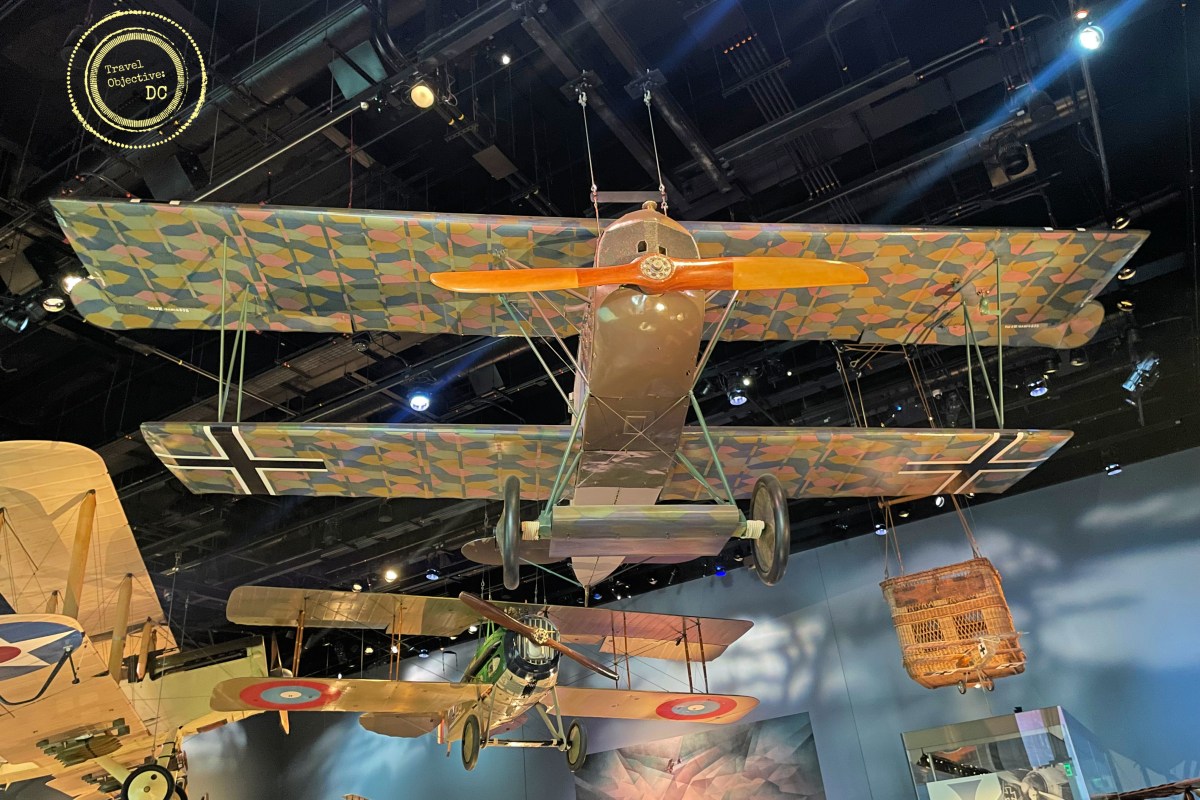
A German Fokker D.VII Fighter

Lieutenant Arthur Raymond Brooks, US Army Air Service, knew he was in for a fight.

In the skies above Mars-la-Tour, France on September 14, 1918, Brooks and his squadron of six SPAD XIII fighters encountered four squadrons of German Fokker D.VIIs. As the fighter planes engaged each other, Brooks flew directly into German machine gun fire. He then quickly pulled away from his main formation with eight German fighters in pursuit. 

Brooks next used all the maneuver capabilities the SPAD could provide to avoid being caught in a Fokker’s line of fire. He did barrel rolls. He flew in loops. He quickly climbed, then rapidly dove.  

As the melee continued, Brooks fired on multiple Fokkers as they all weaved through the sky, downing two. German fire shattered his windshield and damaged one of his two machine guns. His SPAD was riddled with bullet holes.  Yet he stayed in the fight. Brooks anecdotally shot down four German fighters that day (although he was only credited with two) and was awarded the Distinguished Service Cross for his actions.
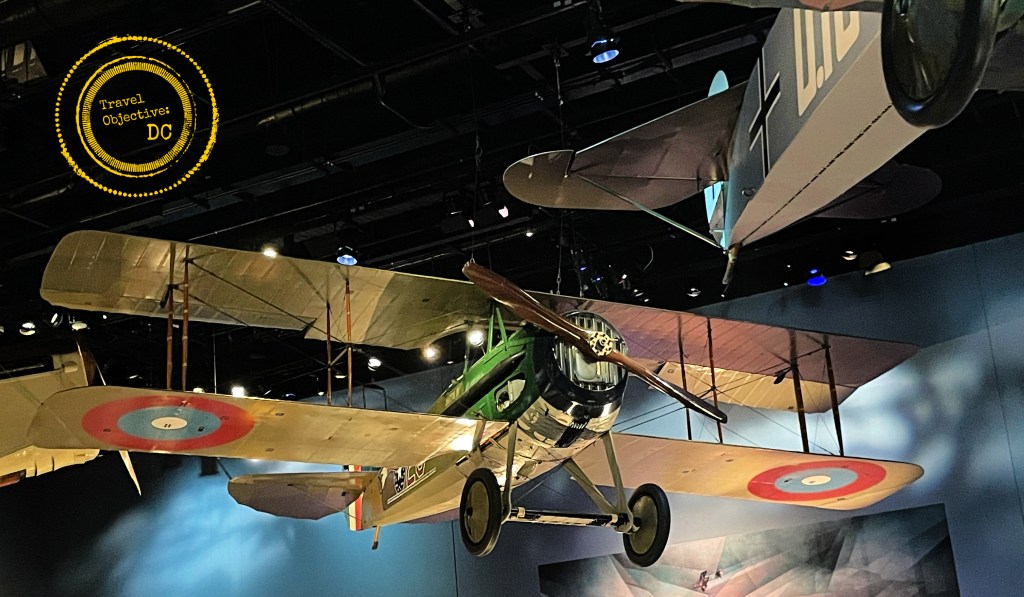
A SPAD XIII Fighter at the National Air and Space Musuem

The SPAD XIII FighterBuilt by the Société Pour L’Aviation et ses Dérivés (SPAD) company, the SPAD XIII was preferred by French aces. The US Army Air Service also flew SPADs. Ray Brooks flew this SPAD in October 1918.

Ray Brooks is just one pilot whose aerial exploits are recounted in the Smithsonian Institute’s National Air and Space Museum’s (NASM’s) redesigned World War I aviation exhibit entitled World War I, the Birth of Military Aviation.

This is NASM’s third exhibit dedicated to the aircraft and aerial warfare of the First World War.  The earlier exhibit, entitled Legend, Memory and the Great War in the Air, closed in 2018 as NASM prepared for a musuem-wide refurbishment. The new iteration explores the twin themes of how “the Great War” defined the on-going nature of military aviation as well as the remarkable experiences of World War I aviators.

There is much to see in the new gallery, but the meticulously restored World War I aircraft are the main attraction. Many of the World War I airplanes previously displayed are back. Greeting you from overhead as you enter the exhibit hall are the French Voisin Type 8 nighttime bomber and the German Albatross D.VA, a fighter that debuted in 1917. Other aircraft include the Fokker D.VII German fighter, Ray Brooks’ SPAD XIII fighter and the DH-4 Liberty Plane.

A German Albatross D.Va Fighter – These fighters were introducted in 1917.
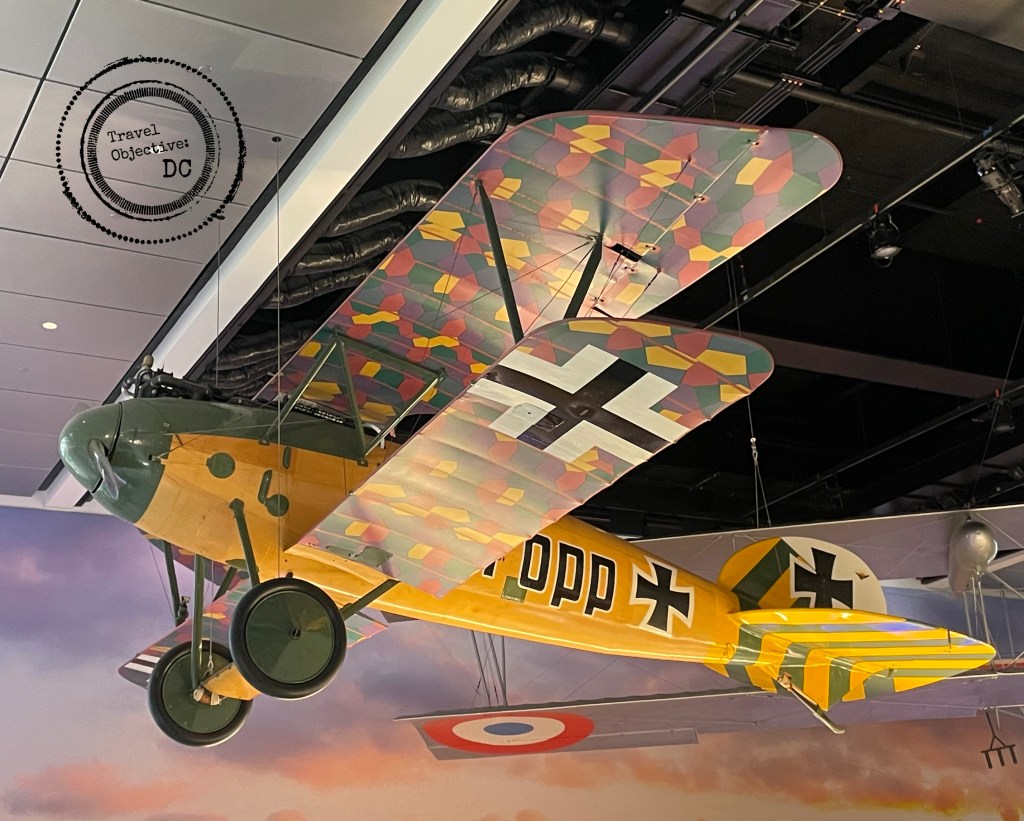
A German Albatross D.Va Fighter at the National AIr and Space Musuem

The latest exhibit occupies a smaller footprint than its predecessor, but NASM’s designers have filled the space with a wide range of intriguing artifacts, vintage aircraft, airplane models and other displays. 

The exhibit timeline from 1914 through the post-war period is arranged in a counterclockwise manner around a beautifully restored Sopwith F.1 Camel (the last surviving Camel fighter produced by the Sopwith Aviation Company).  Once a pilot mastered the British-made aircraft’s finicky controls, the Camel was a highly versatile fighter. It is credited with downing more enemy aircraft than any other Allied plane.

Unlike other aircraft on display, the Sopwith Camel is placed on the floor making it the easiest to see and admire.

Adjoining the Camel is a large movie screen surrounded by a tent-like frame, suggesting an early aerial hanger. A four-part narrated film plays on a loop showing period aircraft in flight. The film provides a wonderful sense of motion to these beautiful but otherwise static aircraft.
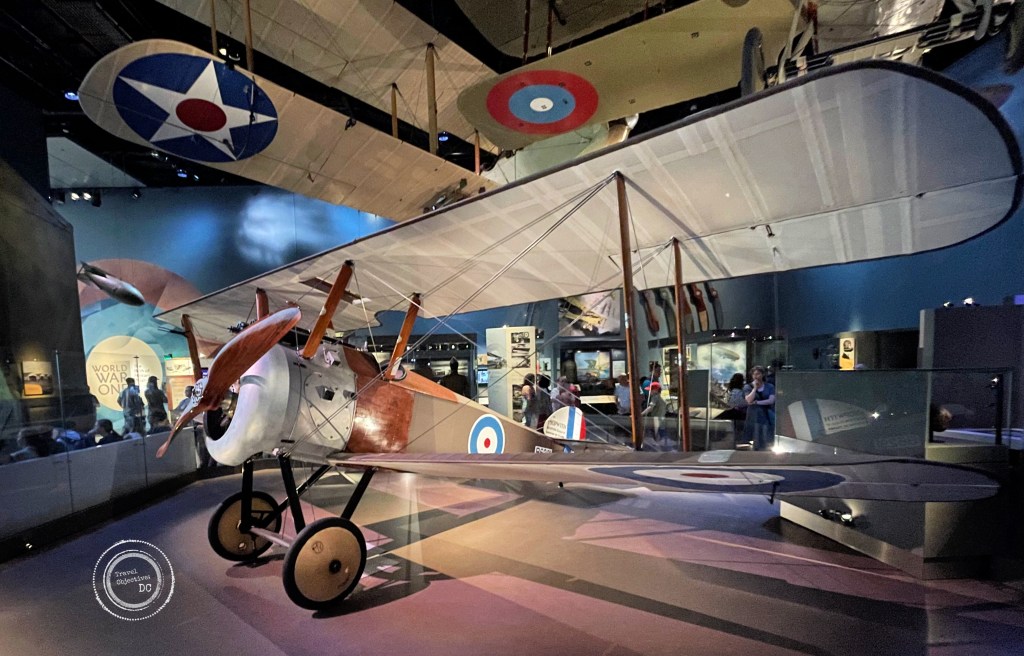
A Sopwith F.1 Camel at the National Air and Space Musuem

The Sopwith F.1 CamelThis aircraft is the last surviving F.1 Camel built by the UK’s Sopwith Aviation Company.

Through the war years, three distinct types of military aircraft evolved–reconnaissance planes, fighters and bombers–reflecting the three original mission areas of military aviation.

To battlefield commanders, the airplanes’ most critical function was reconnaissance and observation. Trench warfare had ended the traditional scouting role of horse cavalry, but aircraft could find, fix and observe the enemy from above. Reconnaissance aircraft were built to direct artillery fire, track troop deployment, assess damage and relay messages over long distances. Planes were fitted with cameras and communications equipment, essentially becoming the commanders’ eyes and ears. Pilots and observers risked their lives to take photographs, which were now an important element of military planning.

A Kodak A-2 Oblique Aerial Camera. A 4″x5″ glass plate was changed out each time a picture was taken.
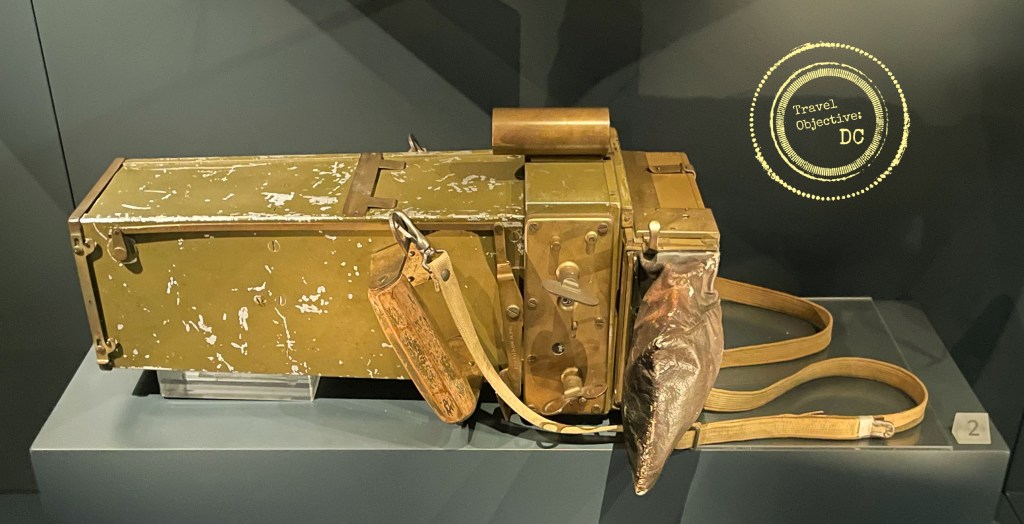
A Kodak A-2 Oblique Aerial Camera at the National Air and Space Musuem

Fighter aircraft were first developed to protect the reconnaissance planes. Ultimately, the fighters would engage each other to control the airspace over the trenches. Later in the war, Britain and Germany formed special fighter squadrons to directly attack troops on the ground.

Airships also conducted reconnaissance as well as bombing missions. However, their large size and slow speed made them susceptible to attack by fighters. They were generally replaced on bombing missions with specialized aircraft capable of flying further and higher while carrying heavier bomb loads.

 A German aviation insignia

Cross insignia from a German airship – This design was the official emblem of the German Air Service until mid-1918.

World War I gave rise to the military aviator as a distinct specialty. Some aviators, especially pursuit (later called fighter) pilots, took on a mythic status in their home countries.  Flying high above the mud and blood of the trenches, these pilots were heirs to the chivalrous legacy of knights in armor. Pilots were written about in newspapers, appeared on magazine covers and made public appearances.

Prominent pilots included in the exhibit include Eddie Rickenbacker (America’s most decorated WWI ace), Manfred von Richtofen (The Red Barron), Eugene Bullard (African-American pilot flying for the French), Raol Lufbrey (a French-American ace), and Snoopy. (OK, Snoopy was not a real pilot, but he does have his own display, which is, of course, by the Sopwith Camel).

Among all the aircraft and artifacts, there are many interactive features as well. You can use a light table to analyze period photo imagery from a reconnaissance aircraft, learn how a synchronizer allowed machine gun bullets to miss propeller blades, and take the controls of a Sopwith Camel to experience the sounds of this highly maneuverable fighter. An immersive exhibit on trench warfare at first seems rather two dimensional. However, a look through trench periscopes provides some basic context on the infantryman’s view of aviation.

Snoopy first imagined himself flying his doghouse in 1965. Through the comic pages, as well as books, games, cartoons, and toys, Snoopy has been a consistent reminder of World War I aviation.

A collecton of artifacts celebrating Snoopy, the World War I ace.

At the beginning of the war in the Summer of 1914, the airplane was still a novel invention, a little more than a decade old. Very few aircraft were designed for any military purposes. As the war progressed, rudimentary flying machines quickly became faster, more maneuverable and better armed.

Airplanes were also needed on a large scale. Over 215,000 aircraft were built between 1914 to 1918. A myriad of new products were developed or adapted for use in aviation such as specialized cameras, radios, and aerial bombs. Many items first developed in World War I are still used in modern aviation, like the artificial horizon instrument, flight suits, and oxygen masks to name just a few. This sudden and sustained demand for combat aircraft and accessories gave rise to a new industry filled with highly skilled workers, an industry we rely on today.  

A collection of World War I aircraft propellers

American, British and French propellers

Although World War I ended over a century ago, its impact is still very much felt today. World War I, the Birth of Military Aviation provides valuable insight into an important but not altogether well understood period in the history of aviation. The gallery’s opening is also an important and welcome step toward the completion of NASM’s comprehensive, multi-year renovation.

* * *

Route Recon

The Smithsonian Institute’s National Air and Space Museum (NASM) is located on the National Mall bordered by Independence Avenue, Jefferson Drive, and 4th and 7th Streets, SW. The entrance is on the north side of the building facing the National Mall. You cannot access the museum from the south side along Independence Avenue. Free timed tickets are required for entry into NASM. Tickets can be acquired through the NASM website. Ticket holders will line up near the entrance on the Mall side of the Museum building prior to their entrance time. Entry prior to the time on the ticket is not allowed, but ticket holders can enter after the ticket time.

Parking – Very limited metered street parking is available around the museum. Parking is available in several commercial parking lots in the neighborhood.

Public Transportation

Metrorail – The closest Metro station is L’Enfant Plaza, along the blue, orange, silver, and green lines. From the L’Enfant Plaza Station, take the exit for Maryland Avenue and 7th Street.

Metrobus – Bus stops are located on Independence Avenue, SW, and along 7th Street, SW. Visit the Washington Metropolitan Area Transit Authority for more information.

Command Reading

Capt. Arthur Ray Brooks, America’s Quiet Ace of W.W.I by Walter A. Musciano – Originally published in 1963, Musciano’s concise work provides a brief overview of Brooks’ life with some straightforward accounts of World War I aerial combat. It also includes an interesting assortment of historic World War I photographs of Brooks and his fellow aviators as well as detailed informaton on the aircraft Brooks flew.

Cleared for Takeoff at the Steven F. Udvar-Hazy Center

The sliding glass doors retract and beckon you inside.  Passing the metal detectors, navy blue jacketed security officers nod a quiet greeting. Walk through a cavernous entryway and on to a balcony overlooking the massive Boeing Hanger. On the gallery floor the world’s fastest jet powered aircraft, the SR-71 Blackbird stares back at you, sleek and silent.  On the left, the toothy grin nose art of a P-40 Kitty Hawk welcomes you while an F4U Corsair dips its bent wing in a friendly gesture as if to say, “We’re glad you’re here, but you better get started. There is a lot to see!” Indeed, within the Steven F. Udvar-Hazy Center’s hangers are the products and byproducts of over two hundred years of aviation history. 

For anyone interested in aviation and space exploration, it doesn’t get much better than this.

For most visitors to the Washington DC area, the Smithsonian Institute’s National Air and Space Museum is synonymous with the building on the National Mall.  Currently undergoing renovation, that museum building can only hold a small portion of the Smithsonian Institute’s massive collection of artifacts and materials related to aviation and space travel. 

A US Coast Guard Sikorsky HH-52A Seaguard Helicopter

The Steven F. Udvar-Hazy Center is the other main component of the Smithsonian Institute’s National Air and Space Museum. Located in Chantilly, Virginia, it adjoins Washington Dulles International Airport. Conceived as additional space for the display of the Smithsonian’s extensive collection of aviation and space travel artifacts, it opened to the public in 2003. Between the National Air and Space Museum’s building on the National Mall and the Udvar-Hazy Center, approximately 80 percent large aircraft and spacecraft from the Smithsonian’s holdings are on display.

The center’s namesake Steven F. Udvar-Hazy is a Hungarian-born immigrant who came to the United States in 1958. A lifelong lover of aviation, Udvar-Hazy eventually became chairman of the International Lease Finance Corporation, one of the world’s largest aircraft leasing firms. He donated $66 million of his personal fortune to the Smithsonian for the purposes of building this impressive facility with its three main galleries: the Boeing Aviation Hanger, the James McDonnell Space Hanger and the Mary Barker Engen Restoration Hanger.  

The Boeing Gallery boasts nearly 200 aircraft in a space comparable to the flight deck on a Nimitz-class aircraft carrier.  Curators very carefully arranged the aircraft to maximize the available display space within the hanger. Organized into collections, the aircraft are situated either on the hanger floor or suspended from the ceiling. Balconies on multiple levels help visitors to see the meticulously restored aircraft up close.

The Air France Concorde FA, within the south side of the Boeing Hanger at the Udvar-Hazy Center.

The Udvar-Hazy Center features tours most days. Over 60 to 90 minutes, the volunteer docents lead visitors around the World War I fighters and reconnaissance aircraft, inter-war trainers and prototypes, Allies and Axis aircraft from World War II, early passenger airliners, experimental aircraft, general aviation planes, Cold War jets, helicopters and more. Some of the highlights of the collection include:

SR-71 Blackbird – The SR-71 is the fastest jet engine propelled aircraft. First flown in 1964, the operational performance and technological sophistication of the Blackbird is still impressive today. The centerpiece of the Boeing Gallery, the SR-71 Blackbird on display logged about 2,800 hours of flight time over 24 years. The U.S. Air Force donated this Blackbird to the Smithsonian. On its final flight, the Blackbird set a speed record flying from Los Angeles to Washington-Dulles International Airport in 1 hour, 4 minutes, and 20 seconds (about 2,124 miles per hour) 

B-29 Enola Gay – The Boeing B-29 Superfortress was first conceived in the 1930s as bomber with a greater range and capacity than the B-17. The B-29’s extended range of about 4,000 miles when loaded made it especially suitable for use in the Pacific Theater during World War II. On August 6, 1945, the Enola Gay dropped the first atomic bomb on Hiroshima, Japan.  

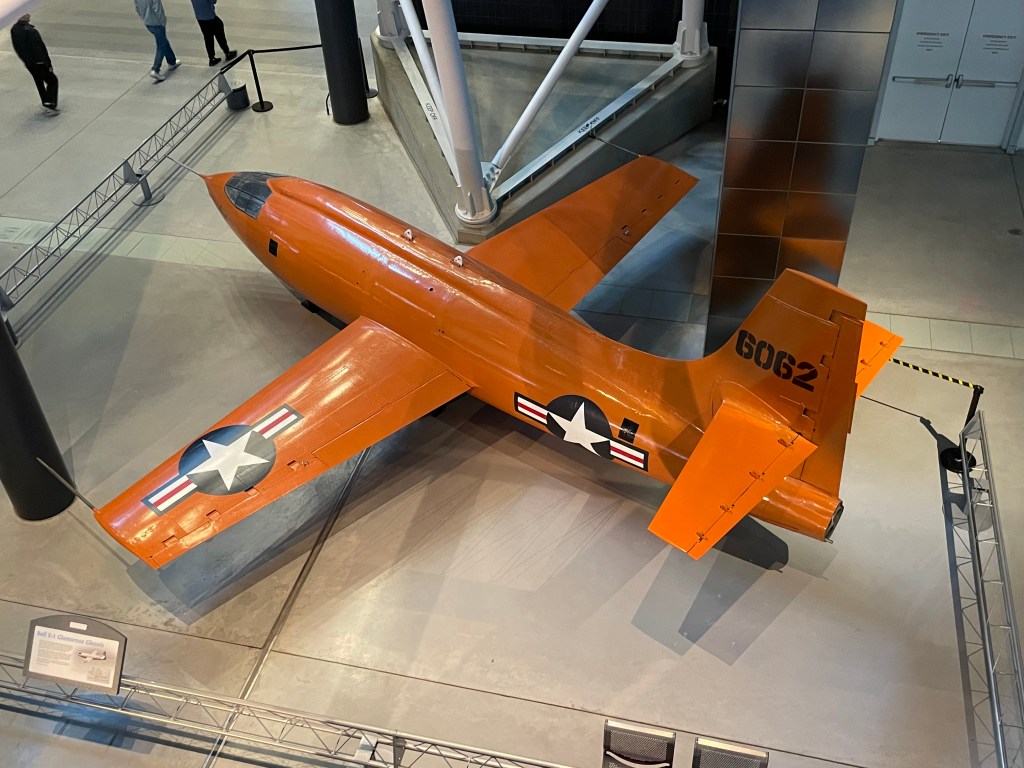
The Bell X-1 Glamorous Glennis

Bell X-1 Glamorous Glennis – On October 14, 1947, Captain Chuck Yaeger became the first person to fly faster than the speed of sound after he was drop launched in the X-1 from a B-29 Superfortress. He named the aircraft after his wife. 

F-14 D Tomcat – A naval fighter aircraft, this plane became well known to moviegoers following the release of the 1986 film Top Gun. 

Boeing 367-80 – The Boeing four-engine jet powered aircraft was the prototype for the US Air Force’s KC-135 tanker and the Boeing 707 jetliner. 

Concorde – The first supersonic airliner, the Concorde was flown by both Air France and British Air, serving customers willing to pay a premium for a faster flight. Unfortunately, higher fuel prices made the very sophisticated aircraft too expensive to operate. This Air France Fox Alpha Concorde on display was donated to the Smithsonian Institute on June 12, 2003 after its final flight from Paris to Dulles International Airport. 

The Space Shuttle Orbiter Discovery

Compared to the Boeing Aviation Hanger, the McDonnell Space Hanger, arrayed with satellites, rockets, probes and other cosmic equipment seems less crowded. However, one artifact stands out from all the rest, the Space Shuttle Orbiter Discovery.  Space shuttles were a unique reusable spacecraft, designed to take off like a rocket, land back on earth like a glider, and carry a variety of payloads. Discovery was the workhorse of the shuttle fleet, flying 39 missions and logging 365 days in space during its service life between 1984 and 2011.    

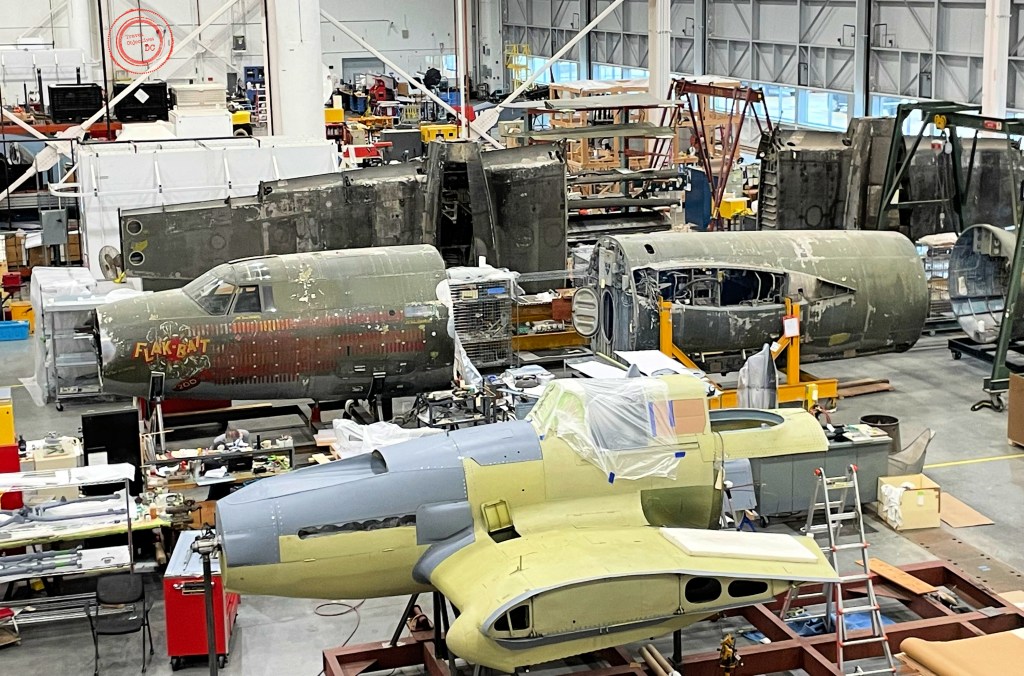
Displaying aircraft and space equipment is but one mission of the National Air and Space Museum. Before anything is placed into a hanger or gallery, museum preservationists painstakingly restore the aircraft and prepare it for its new life in the museum. Much of this refurbishment work is conducted in the Mary Baker Engen Restoration Hangar.

The large open hanger space accommodates several restoration projects at a time. An observation area on the mezzanine above the hanger floor allows visitors to watch the restorers at work.  One major restoration project currently underway in the hanger is on a Martin B-26B medium bomber from World War II named Flak-Bait. This bomber flew more than 200 missions over Germany from August 1943 until April 1945, more than any other American plane.

The Martin B-26B Bomber Flak-Bait holds the record for the number of bombing missions survived in World War II.

As captivating as they are, the Udvar-Hazy Center offers a few additional activities beyond just looking at the restored air and space craft. 

Observation Tower – The Donald Engen Observation Tower provides a commanding view of the area, including the main operational runways at Washington Dulles International Airport. Watch the planes take off and land throughout the day. The tower also includes a quick lesson in the functioning of the air traffic control system, adding some helpful context to the highly choreographed movement of aircraft through the region’s airspace.  

Simulators – After viewing so many exciting aircraft, a collection of simulators provides the realistic feeling of taking to the skies and beyond.  

Theater – The Airbus IMAX Theater at Udvar-Hazy, the largest in Northern Virginia, shows a combination of current Hollywood releases as well as documentaries on different aspects of aviation and space exploration.

Additionally, the Smithsonian maintains a regular schedule of educational programs, lectures, and events for young people, such as the annual Air & Scare held the Saturday before Halloween. 

The B-29 Superfortresss Enola Gay.

After a visit, it is easy to understand why the Udvar-Hazy Center is one of the top destinations not only in the Washington, DC area, but in all of Virginia. The building is expansive, easy to navigate and the exhibits are tantalizing to the eye with multiple legendary air and spacecraft on display. Beyond the artifacts, other aviation related activities are available to expand your understanding of flight and helpful staff are available to answer questions. For admirers of aviation, adventure or innovation, there are few better places (on the ground) to spend a day than the Steven F. Udvar-Hazy Center

* * *

Route Recon

The Steven F. Udvar-Hazy Center is located just south of Washington Dulles International Airport, along Virginia Route 28 in Chantilly, Virginia. 

The address is: 14390 Air and Space Museum Parkway, Chantilly, VA 20151

By car:

From Washington, DC, and points south: Take Interstate 66 West to Route 28 North (Exit 53B): Travel on Route 28 North for 5.3 miles. Exit at Air and Space Museum Parkway and follow the signs to the Udvar-Hazy Center.

From Washington, DC, and points north: Take Interstate 495 West (the Capital Beltway) to the Dulles Toll Road West (Virginia Route 267). Exit the toll road at Route 28 South (Exit 9A) and travel south 3.5 miles. Exit at Air and Space Museum Parkway and follow the signs to the Udvar-Hazy Center.

NOTE: Online mapping apps may direct you to enter the Udvar-Hazy Center from US Route 50. This is not a public entrance. You must enter from Virginia Route 28. 

Admission to the museum is free, but parking costs $15 before 4:00 pm. Free parking is available for all cars arriving after 4:00 pm.  Vehicles dropping off or picking up visitors are not charged if staying less than 30 minutes. 

By Bus: 

From Washington Dulles International Airport to the Udvar-Hazy Center in VA:

From Ground Transportation bay #5E (lower level exit #6), take Fairfax Connector No. 983 one stop to Steven F. Udvar-Hazy Center. Buses run every 25 minutes during peak times and every hour during non-peak times and weekends. Bus fares paid with SmarTrip card or cash. Bus drivers do not carry change. The bus ride from Dulles Airport takes approximately 25 minutes. 

By Metro: 

Take Metro Silver Line to Innovation Center station. 

Fairfax Connector provides connecting bus service from the Silver Line’s Innovation Center Metro station. More information is available on the Fairfax Connector No. 983 website Buses run every 25 minutes during peak times and every hour during non-peak times and weekends. Trips between Innovation Center and the Udvar-Hazy Center take about 12-15 minutes.

Exit bus at Steven F. Udvar-Hazy Center stop.

Plan for an approximately 1 hour and 35 minute trip from Washington, DC to the Udvar-Hazy Center using Metro. 

Mess Call

Shake Shack restaurant provides onsite dining at the Udvar-Hazy Center. The Shake Shack is open from 11:00 am to 5:00 pm daily. The restaurant serves burgers, hot dogs, chicken sandwiches, fries, frozen custard, shakes, and coffee. There are two shakes exclusive to the museum, the Constellation Crunch Concrete and Out of This World Shake. Additionally, pre-packaged salads and sandwiches are available from an automated vendor kiosk.