
In the spring of 1864, as the Civil War extended into its third year, the Union Army was suffering staggeringly high casualties. Sadly, the newly created national cemeteries at the Soldiers’ Home in Washington and in Alexandria were reaching capacity.
The Union Army was going to need additional space to bury its war dead. Major General Montgomery C. Meigs, the Quartermaster General of the Army, knew where he was going to find it.
Meigs soon directed burials to begin at Arlington, the antebellum plantation of Robert E. Lee and his wife Mary Custis Lee.

Brevet Major General Montgomery C. Meigs, Quatermaster General of the US Army, 1861-1882.
Only a fraction of the 4 million people who visit Arlington National Cemetery each year make the trek up a winding hill to visit Arlington House. Those who do are rewarded not only with a great view of the National Mall, but a much better sense of how the Lees’ home became America’s preeminent national cemetery.
Arlington House Before the War
The Lees loved life at Arlington. Robert E. Lee wrote “Arlington…where my affection and attachments are more strongly placed that at any other place in the world.” Mary and Robert married in the front parlor in 1831. While Mary followed her husband on several of his Army assignments, she spent most of her time living and raising the couple’s seven children at Arlington.
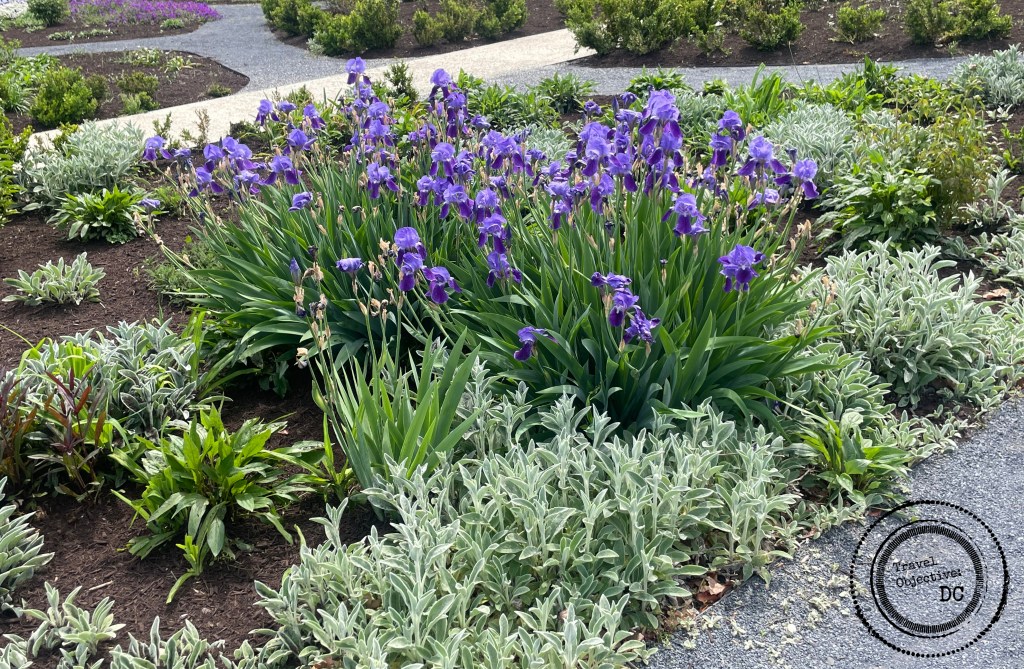
Flowers bloom in the main garden
Mary Custis Lee inherited Arlington from her father, George Washington Parke Custis. Parke Custis was the grandson of Martha Washington from her first marriage. Following the death of Parke Custis’ father, George Washington adopted the young boy and his sister.
Parke Custis revered George Washington and assembled an extensive collection of Washington’s belongings. He intended to display these artifacts in a grand mansion. Construction of the house took sixteen years and was completed in 1818.
The Greek Revival mansion, with its peaked roof and Roman columns, resembles an ancient temple. The collection of artifacts and the mansion, built overlooking the new capital, was to be a powerful reminder of the man for his namesake city taking shape below.

Arlington House Today
The first floor of the main house that the Lees loved so well is open daily for self-guided tours. A $12 million, three-year renovation of the grounds was completed in 2021. Through the project, numerous repairs were made to the interior, artifacts returned to the house, and new interpretive signage installed.
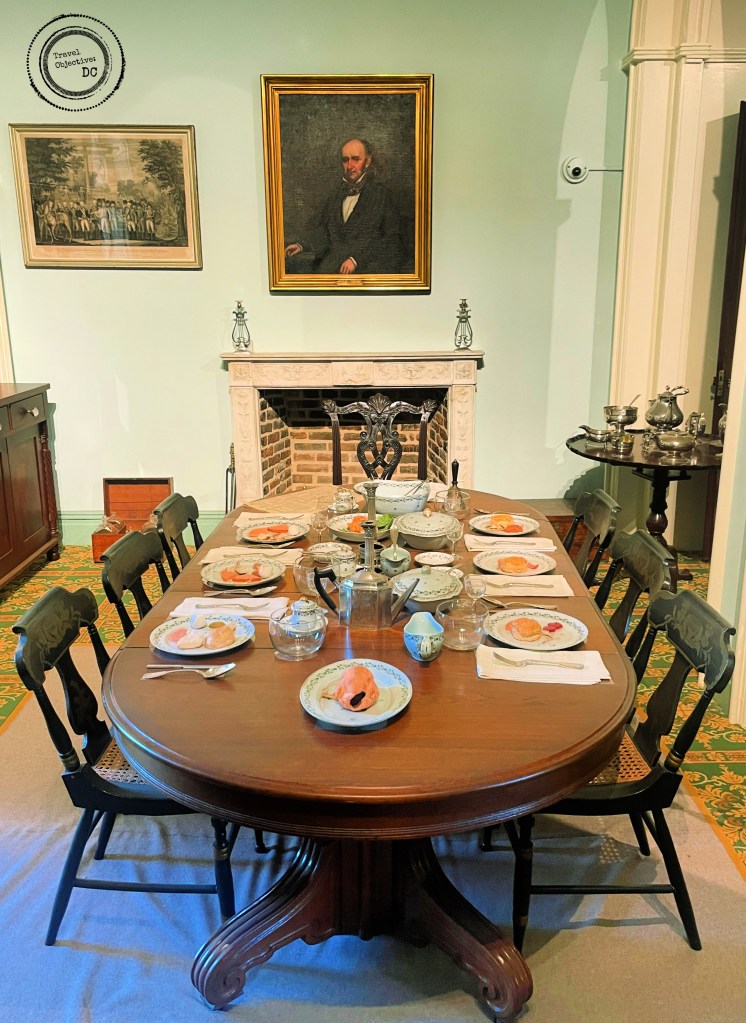
The house is now restored to its pre-war appearance, displaying the lifestyle of wealthy landowners in early 19th century Washington. The rooms are well furnished with some original furniture and accessories from the Lee home. Walls are adorned with original artworks painted by Parke Custis and Mary Lee, both self-taught artists.
In addition to the main house, the grounds also include two buildings containing former slave quarters, two gardens, a bookstore and a museum.
View of the main dining room
From Plantation to Cemetery
In April 1861, while at Arlington, Robert E. Lee made the fateful decision to resign his commission in the US Army ending his career of over thirty years. He would instead serve his native Virginia, which had just seceded from the Union.
After the Lee family departed Arlington House for Richmond, the US Army moved quickly to take possession of both the house and the strategically important ground it occupied.
Before the war, Montgomery Meigs had served with Lee and the two officers enjoyed a cordial relationship. He was even a guest at Arlington House on several occasions. However, Meigs viewed Lee’s decision to leave the US Army and fight for the Confederacy as treachery.
In June of 1864, Meigs requested 200 acres of the Lee’s Arlington plantation be designated as Arlington National Cemetery.
Although most burials initially occurred in the northeast corner of the estate, Meigs ordered burials on the grounds of Arlington House. As he wrote to Secretary of War Edward Stanton “… the grounds about the mansion are admirably suited for such use.”

Today, the remains of Arlington’s main flower garden are an easy stroll after exiting the house. The pleasant plot of land teems with roses and many other flowering plants. Mary Custis Lee loved her garden and it is no wonder why after admiring the flowers on a summer day while pollinators buzzed and fluttered about.
Yet surrounding the garden are the graves of 45 US Army officers who were killed in battle, a reminder of Meigs’ determination for burials close to Arlington House.
By the end of the Civil War, over 15,000 Union dead had been buried at the new Arlington National Cemetery. However, Meigs was not yet done. He directed the remains of unidentified soldiers who died near Washington DC to be disinterred for reburial at Arlington.
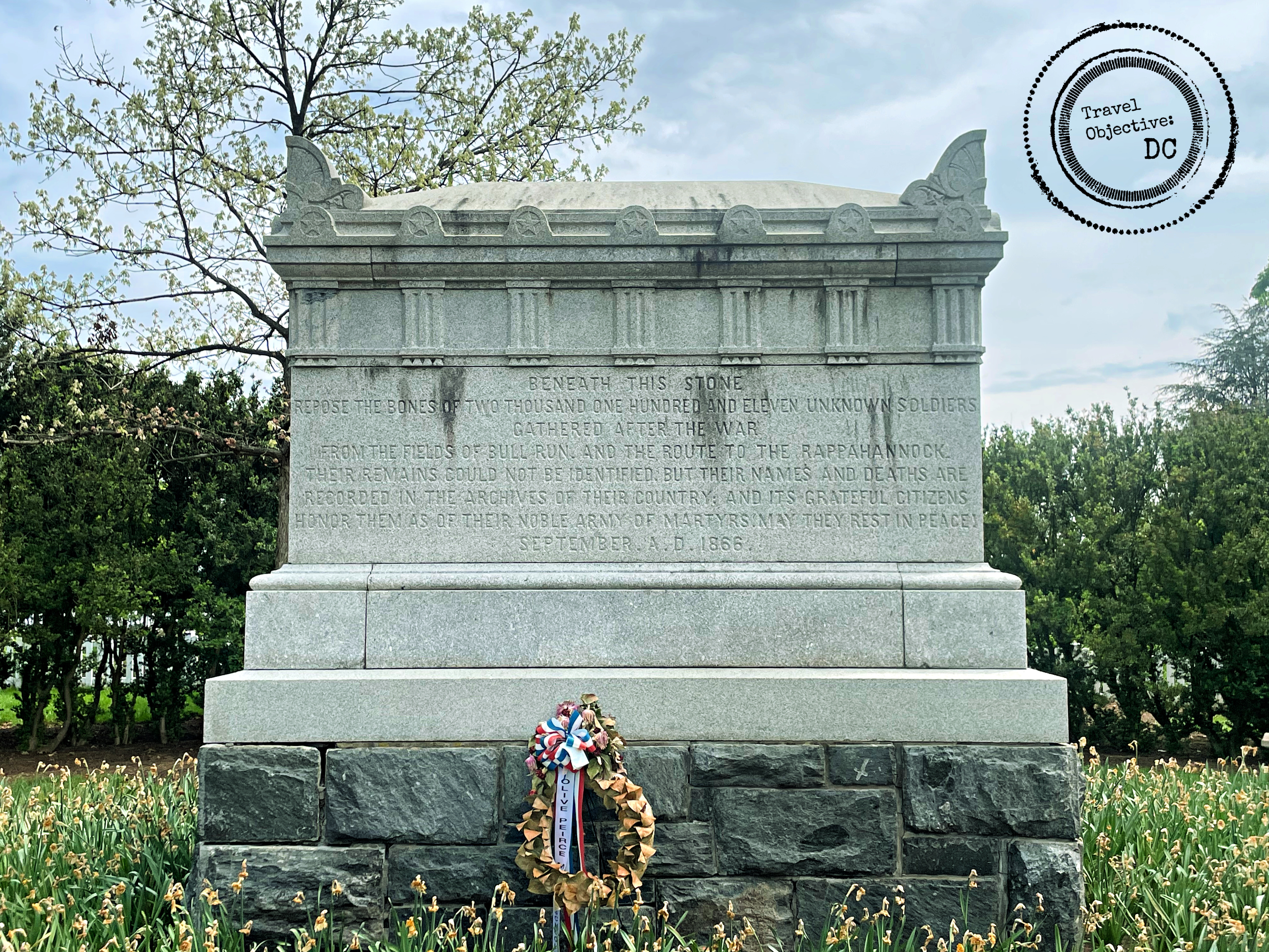
A grove of trees west of the flower garden was selected as the location. On September 16, 1866, the tomb of the Civil War Unknowns was dedicated containing the remains of 2,111 Civil War soldiers. It was the first memorial at Arlington National Cemetery dedicated to unidentified soldiers who died in battle.

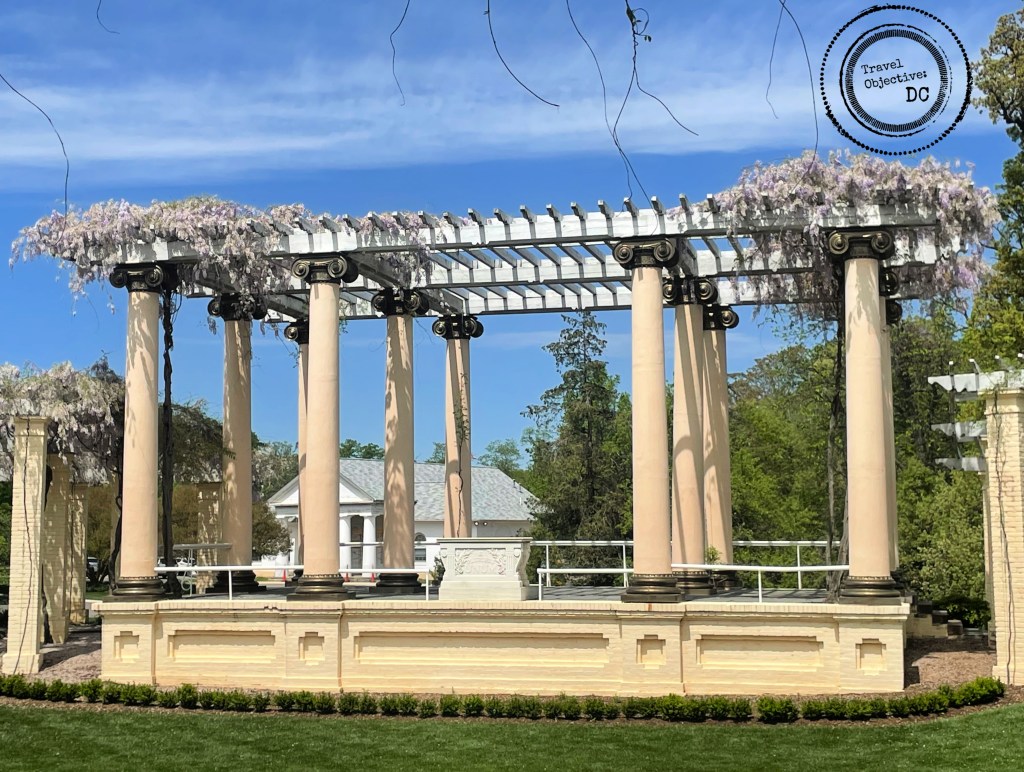
Further to the west, Meigs built what is known today as the Tanner Amphitheater. The elliptical marble colonnade with a lattice roof was designed to host observance ceremonies for Memorial Day. Dedicated in 1873, it was used annually until the current Memorial Amphitheater opened in 1921.
Additionally in 1873, Congress passed legislation which broadened the burial criteria at national cemeteries to include all honorably discharged Civil War veterans. Through the years, the criteria would expand to include veterans of other wars, as well as spouses and certain family members.
Meigs retired from the Army in 1882 after 46 years of service and over twenty years as the Quartermaster General. Through that time, he stayed very involved in the conditions at Arlington, adding decorative features, improving roads and supervising landscaping. Wooden grave markers gave way to headstones, and grand ones at that, as a burial ground originally for poor soldiers became the desired final resting place for generals and admirals.
Remembering the Enslaved at Arlington
In 1930s the National Park Service assumed responsibility for Arlington House, while the Army maintained jurisdiction over the cemetery. Through the following decades National Park Service archeologists, researchers and historians have continued to develop a broader picture of life at Arlington.
In the decades leading up to the Civil War, over 100 enslaved people lived and worked on the Arlington plantation.
The recent renovation project also restored two surviving slave quarters buildings behind the main house, while archeological and scholarly research provided new details about their daily lives.
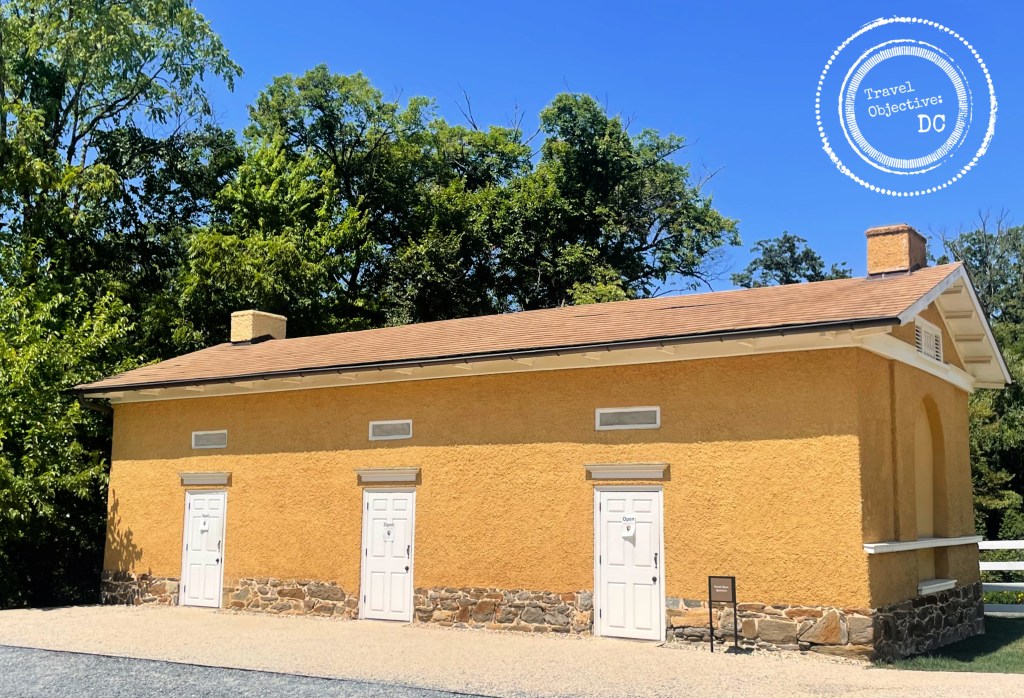
One of the two recently renovated former slave quarters buildings at Arlington House.
Today the former slave quarters contain displays and provide interpretation of the enslaved workers’ lives at Arlington. A looped video playing in a former smokehouse provides the reflections of their descendants over a century later, many of who still live today in the Washington area. The exhibit provides an important alternate narrative to the Custis-Lee stories and experiences of Arlington.
Final Resting Places
Robert E. Lee never did return to Arlington after he departed in 1861. After the war, he was appointed president of Washington College [now Washington & Lee University] in Lexington, Virginia and served for five years. He died in 1870 and is buried in the University Chapel in Lexington.
Mary Custis Lee returned to Arlington just once, in June of 1873. She was greatly dismayed by what she saw around her former home and would not enter the main house. She wrote a friend how the graves “are planted up to the very door without any regard to common decency…” She died several months after her visit and is buried beside her husband in Lexington.
Prior to retiring from the Army, Meigs identified a portion of Arlington where his family would be buried. Upon his death in 1892, he was given a large military funeral in the cemetery he helped establish, with flags, bands and soldiers in dress uniforms, joining his wife, son (who was killed in the Civil War) and father (also a general officer).
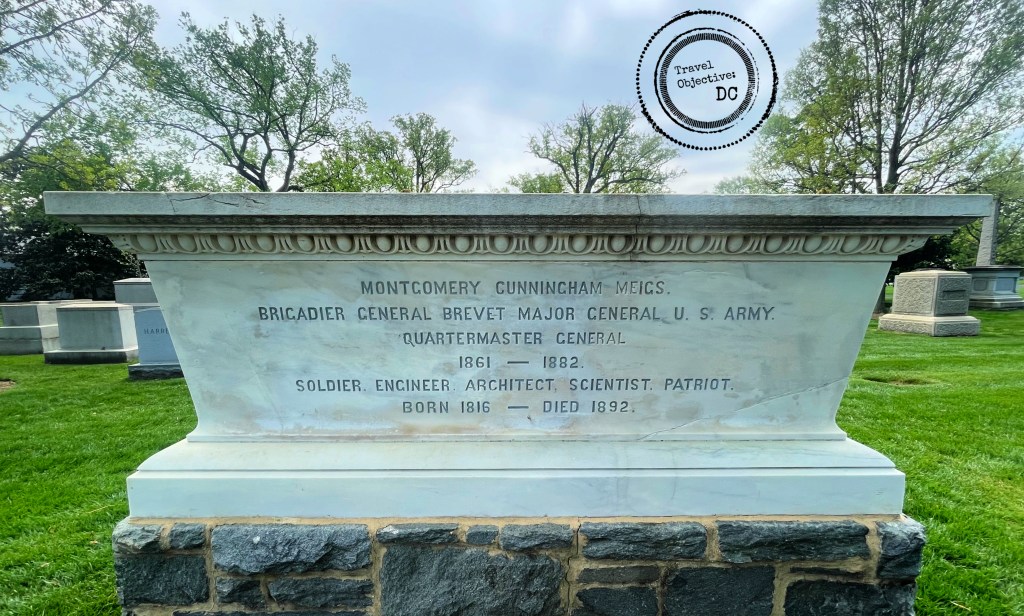
In one of the many ironies in the long history of Arlington, while the Lees are buried some 185 miles away from their home, the Meigs family lies in Section 1, a short walk from Arlington House.
Route Recon
Arlington House is located within the grounds of Arlington National Cemetery. To access the house, visitors must use the main entrance of Arlington National Cemetery at the Welcome Center. Be prepared for a security check. Information on security procedures and prohibited items at Arlington is available here.
In most cases, plan on making a 15-20 minute walk up to Arlington House. Please note that vehicle and bus access through the cemetery is generally not permitted, except for those with vehicle passes to visit a gravesite, or those attending a funeral service.
An interpretive bus tour service is available at Arlington National Cemetery, which includes a stop at Arlington House. Tour information is available here. Visitors with a valid disability placard may ride the interpretive tour bus at no cost (with one companion). See the main desk in the Welcome Center for more information.
Arlington House is open daily from 9:00 AM until 4:30 PM, except for Thanksgiving, Christmas Day and New Year’s Day.
To access Arlington National Cemetery by car, follow the driving directions below to Arlington National Cemetery.
Parking is available at the Arlington National Cemetery parking facility located at the cemetery’s main entrance on Memorial Avenue, next to the Welcome Center. Additional information regarding parking at at this facility is available here.
Arlington House is accessible via the Washington DC Metro system on the Blue Line. Take the Arlington Cemetery subway stop which is a short walk from the Visitor’s Center.
Command Reading List
On Hollowed Ground, The Story of Arlington National Cemetery by Robert M. Poole
Robert Poole’s history of Arlington traces the cemetery’s evolution from the Custis-Lee family planation to the honored burial site of today. He insightfully traces how the rites, rituals and rhythms of Arlington changed through the years and were impacted by America’s wars from the 19th through 21st century.
Arlington National Cemetery, Shrine of America’s Heroes by James Edward Peters
James Peters work combines a very comprehensive history book and visitor’s guide into a single volume. Now in its 4th edition, the book contains a detailed explanation of Arlington’s early years as a plantation and a cemetery as well as the lives and burial information for over a hundred notable people interred at Arlington.
Driving Directions to Arlington National Cemetery
From Washington:
From Washington, D.C. you can drive to the cemetery by crossing the Memorial Bridge.
From points South (Richmond, VA area)
Take I-95 NORTH towards Washington, D.C. Take exit number 170A, I-395 NORTH toward Washington. Take exit number 8A, VA-27/Washington Blvd. towards VA-244/Columbia Pike. Follow signs to Arlington National Cemetery. Go 3/4 of the way around traffic circle and exit. Park in visitor’s lot next to Visitor’s Center on the left.
From points East (Annapolis, MD area)
Take US-50 WEST towards Washington, D.C. Take I-395 SOUTH. Take exit number 11B, George Washington Memorial Parkway NORTH, towards Arlington National Cemetery. Stay to the left at the fork in the road. Go 3/4 of the way around traffic circle and exit. Park in visitor’s lot next to Visitor’s Center on the left.
From points North (Baltimore, MD area)
Take I-95 SOUTH towards Washington, D.C. I-95 SOUTH becomes Capital Beltway, I-495. Cross Woodrow Wilson Memorial Bridge. Take US-1 North through Alexandria, VA. US-1 becomes Jefferson Davis Highway. At fork stay to the left and merge onto VA-110. Go approximately 1.5 miles. Take Arlington National Cemetery exit. At stop sign, turn left. Park in visitor’s lot next to the Visitor’s Center on the left.
From points Northwest (Frederick, MD area)
Take I-70 EAST to I-270 SOUTH. Merge onto Capital Beltway, I-495 SOUTH towards Northern Virginia. Take exit 43 & 44, VA-193/Georgetown Pike and George Washington Memorial Parkway. Keep right on ramp and take George Washington Memorial Parkway SOUTH approximately 10 miles. Take Arlington National Cemetery exit. At Stop sign, turn left. Park in visitor’s lot next to Visitor’s Center on the left.
From points West (Fairfax County, Loudoun County, Shenandoah Valley, VA area)
Take I-66 EAST to towards Washington, D.C. Take exit 64, Capital Beltway, I-495 SOUTH towards Richmond. Go one exit and merge onto US-50/Arlington Blvd EAST. Follow US-50 approximately 12 miles. Exit onto George Washington Memorial Parkway SOUTH. Take Arlington National Cemetery exit. At Stop sign, turn left. Park in visitor’s lot next to Visitor’s Center on the left.
 Travel Objective DC