
Are you heading to Washington, DC this summer rather than the beaches at Normandy, but still want to commemorate the D-Day anniversary? Then save time for a visit to the National Museum of the US Army at Ft. Belvoir, VA for a very unique and compelling temporary exhibit entitled Freedom From Above.
This highly interactive experience uses advanced technology combining powerful, realistic imagery with key background information, allowing the viewer to develop a broader perspective than might be possible using a map or book, or viewing a movie or single artifact.
As the title suggests, the exhibit focuses on the experience of US airborne forces on June 6, 1944.
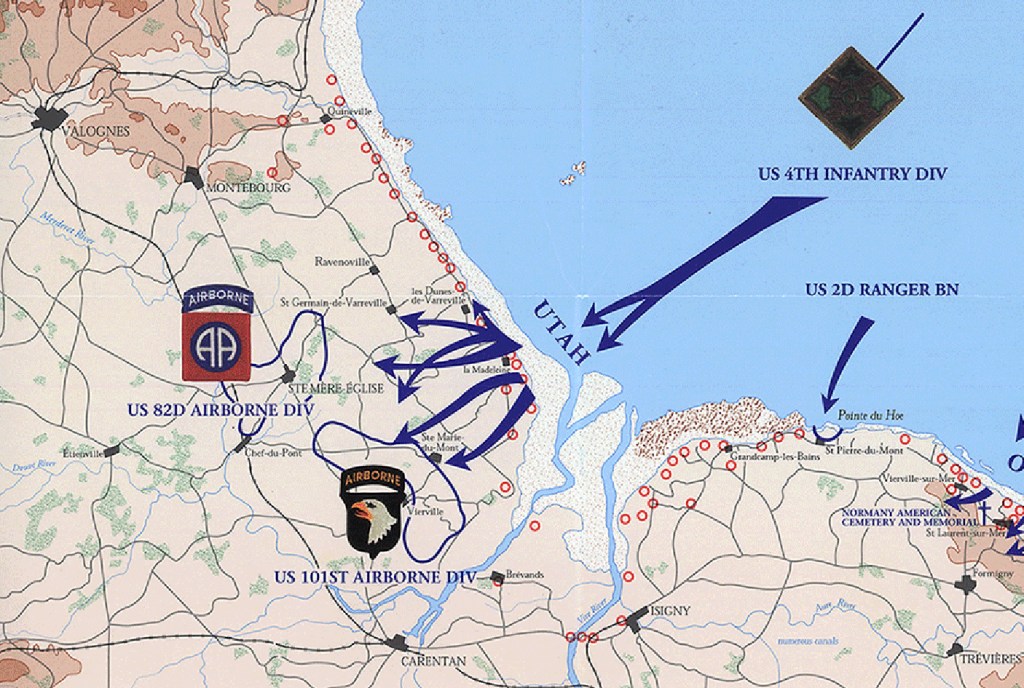
Detail of Utah Beach Area from US Army Center for Military History D-Day Commemorative Map
Early on D-Day morning, paratroopers from the 82nd and 101st Airborne Divisions deployed to areas to the rear of Utah Beach. Their mission was to secure road junctions, bridges and causeways behind Utah to facilitate the ground forces breakout from the beach, as well as to hinder German reinforcements from reaching the area. Poor weather conditions, anti-aircraft fire and confusion often lead to the paratroopers jumping far from their designated drop zones. Some paratroopers drowned landing in flooded fields or were shot after being caught on trees or buildings.
Yet they rallied.
Over the next few days, the airborne troops reestablished some unit cohesion, engaged the German defenders and were able to achieve some important mission objectives.
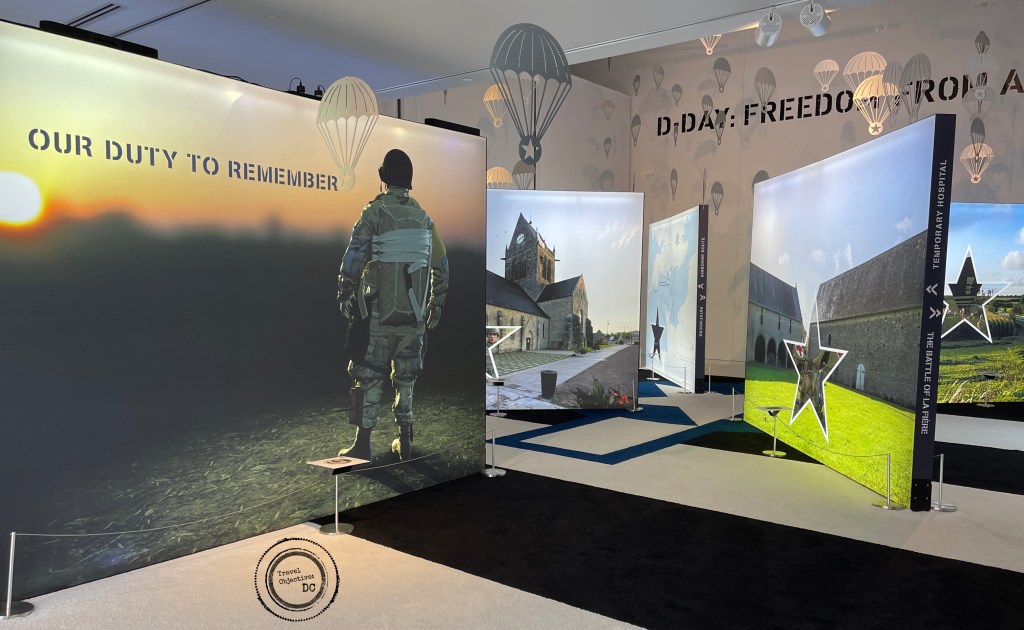
Freedom From Above exhibit space
Through the Freedom From Above exhibit, visitors encounter 16 large screens depicting images and scenery related to the paratroopers’ final preparations, transport, deployment and initial operations in Normandy. Visitors experience each scene with a small tablet computer called a Histopad.
By using the Histopad to scan an image on a small platform adjacent to each large screen, visitors access the details, imagery and stories contained within the scene. Links embedded in the scene provide the viewer with additional details regarding people, objects or images portrayed on the Histopad’s screen.
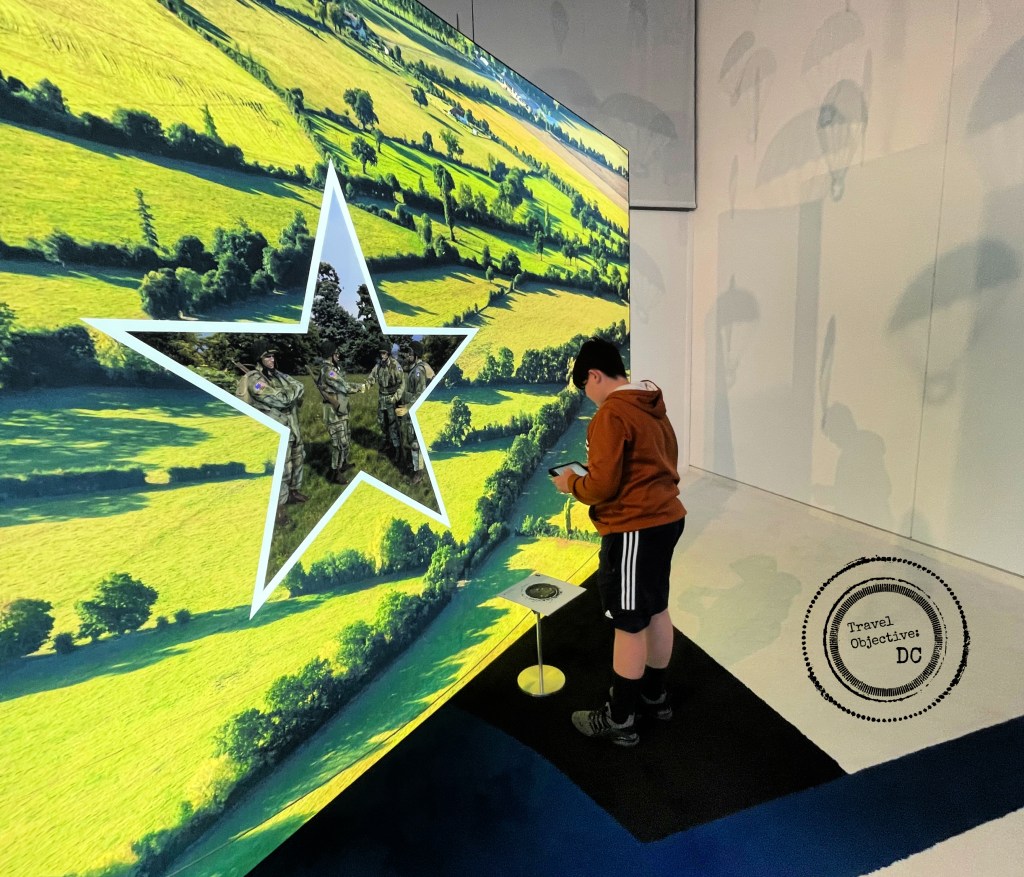
Using the Histopad, a visitor unlocks the historical details and stories contained in the scene in front of them.
By turning completely around with the Histopad, the viewer gets a 360 degree perspective on the scene. Several of the scenes have a time travel scale, allowing the viewer to compare what an area looked like in 1944 to the same area today. Other scenes are more informational, depicting aircraft cockpits, the large (and heavy) amount of equipment a paratrooper carried and the routes the planes flew from bases in the United Kingdom into Normandy.
The exhibit designers have embedded a digital relic hunt within the scenes. Find the ten relics, spread over the sixteen scenes and, after providing an email address, you can receive a special relic collectors certificate. It’s important to remember the Histopad allows you multiple vantage points within a scene. If you are relic hunting, be sure to look all around.

Successful digital relic collectors can earn a certificate.
The historic scenes begin in the briefing room housed in a Quonset hut on an airbase in England. Here paratroopers of the 101st Airborne Division received their pre-deployment briefing. Around the room are short benches arranged in neat rows, and the walls are covered in flags, informational posters, signs and official notices. Visitors can open a field desk and explore its contents. (Hint: You might find a relic there.)
Additional scenes include well known events as well as planned operations such as Pathfinders marking a drop zone, glider aircraft deploying troops and heavy equipment, and a field hospital.
One scene is dedicated to the landing of Private John M. Steele of the 82nd Airborne Division at the village of Sainte-Mère-Église. Steele’s experience was prominently included in the 1962 film The Longest Day. Just after midnight Steele and his “stick” (a squad of Airborne soldiers jumping from an airplane) began landing in and around the center of the town. Steele’s parachute was caught on the Church’s steeple and he was suspended for two hours. He was eventually captured by German soldiers, but managed to escape four days later.
Steele survived the war and became a local celebrity in the town. A replica of him and his parachute hang on the church today.

The stanchion with the photograph and story of Private John M. Steele, whose parachute was caught on the steeple of the church at Sainte-Mère-Église.
The Histopad provides a simulated view of how the town might have looked to Steele as he descended. Unfortunately, German soldiers were already on the town square that morning and many of Steele’s fellow stick members were quickly caught or killed as they landed.
Although not as well known as landings and liberation of Sainte-Mère-Église, the battle at the La Fière bridge was an important, but costly victory for the 82nd Airborne in the days following the landings. The bridge was one of the principle objectives for the 82nd Airborne troops.
By holding the bridge as well as eastern and western banks of the river it spanned, the paratroopers would allow ground forces on Utah Beach to quickly move inland while forestalling a wider German counterattack on American landing forces. Elements of 82nd engaged in an intense battle with German defenders over four days to capture and hold the bridge. The Histopad provides detailed information about the troop deployments around the bridge and allows the viewer to see up close some of the equipment used in the fight.
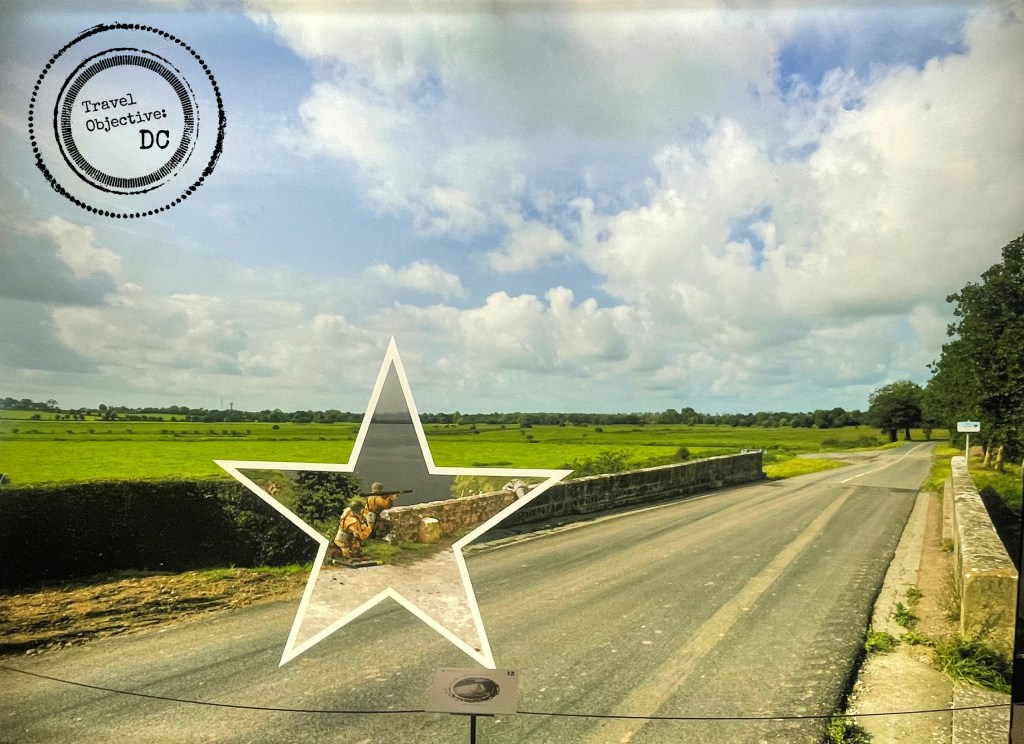
The Freedom From Above exhibit scene depicting the bridge at La Fière.
In addition to the interactive experiences, stationary displays tell the unique stories of ten paratroopers who fought bravely on D-Day. These soldier stanchions include an image of the soldiers along with an excerpt of their story. Small images on the stanchions are also scannable, leading to a visual depiction of the soldier’s experiences, along with additional biographical information and, in some cases, period news footage.
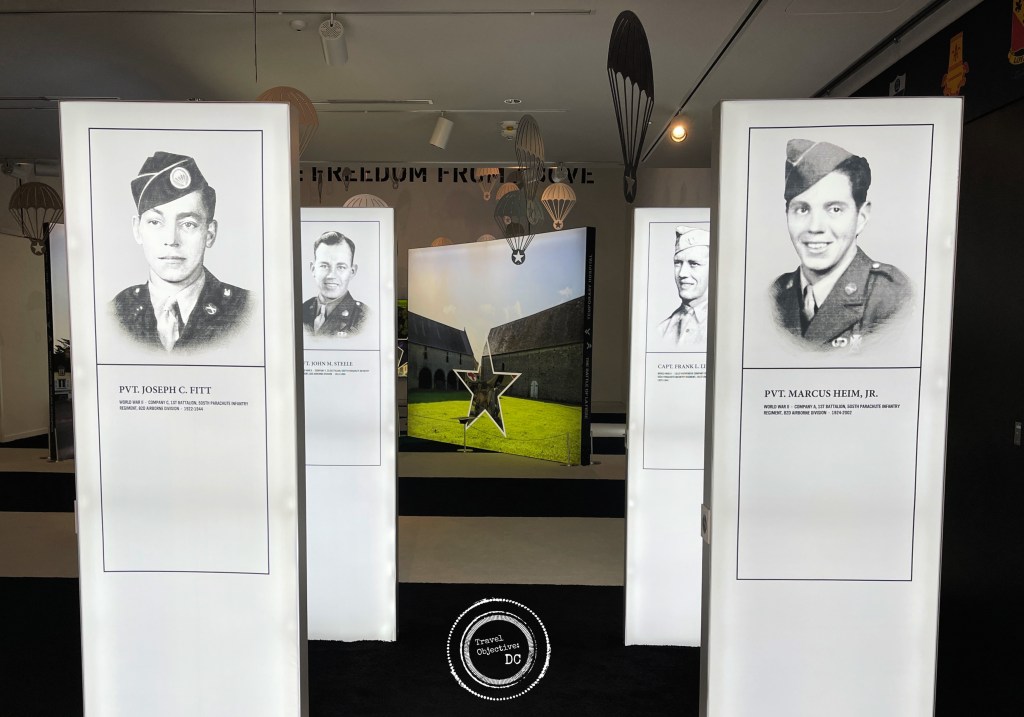
Soldier stanchions with the images and details of D-Day paratroopers.
While the augmented reality of the exhibit is engaging, the National Museum of the US Army added a very moving feature to the exhibit. Only four Medals of Honor were awarded for heroic actions on June 6th, each to a US Army soldier. All four medals are on display together and each soldier’s story is presented at the entrance to the exhibit. This lends a sobering reminder of the courage and sacrifices made by all the Allied soldiers on D-Day.
To complete the D-Day experience at the museum, visitors should certainly visit the Global War gallery on the first floor. The gallery’s World War II displays contain a number of artifacts from D-Day as well as equipment used by airborne forces during the war.
The largest artifact is an LCVP, (Landing Craft, Vehicle, Personnel), also known as a Higgins Boat. Andrew Higgins was a successful manufacturer of small maritime craft built to operate in marshes or swamps. He designed this type of landing craft with a very shallow draft, enabling it to operate in only two feet of water. The front ramp would drop down allowing up to 36 soldiers in combat gear to literally “hit the beach” then return to a ship for more men. The Higgins Boat was also widely used in both the Atlantic and Pacific Theaters. More than 23,000 Higgins Boats were produced, but fewer than a dozen are known to exist today.
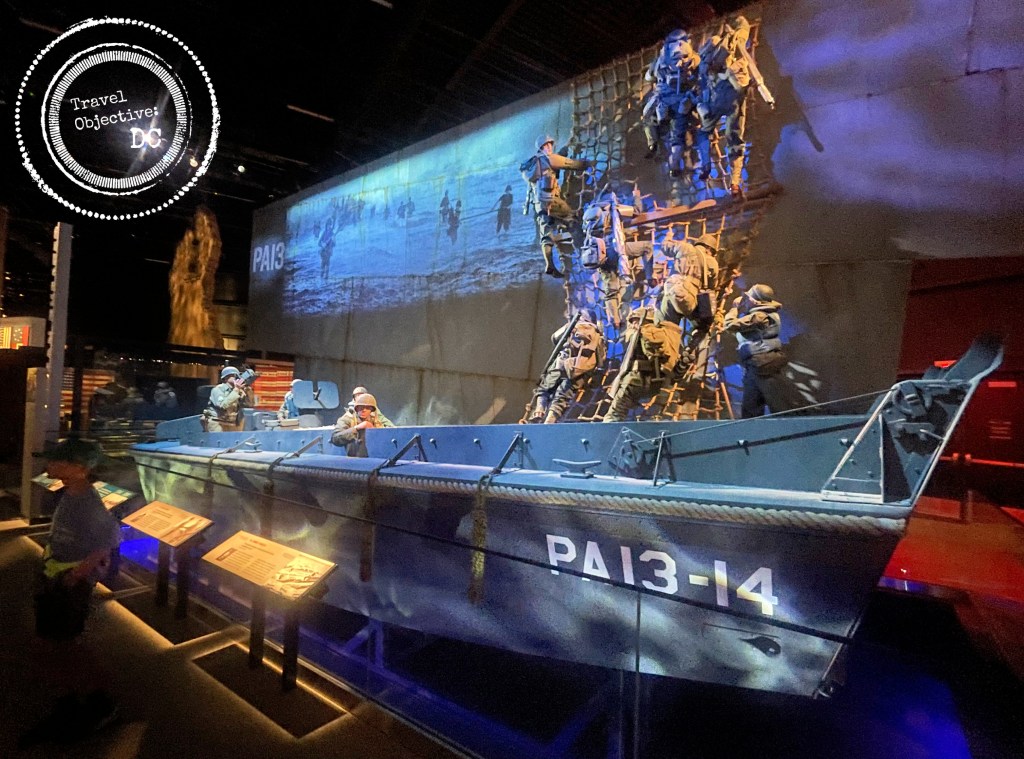
The display scene at the museum shows soldiers being loaded onto the Higgins Boat before it heads to shore.
Given their sheer size and scope–over 150,000 troops, 5,000 ships and 11,000 aircraft were involved–the Allied landings on D-Day continue to captivate the mind even eight decades later. The National Museum of the US Army has prepared an impressive exhibit dedicated to the D-Day experience. While the Histopad and augmented reality are no substitute for a visit to France, visitors to Freedom From Above will take away a deeper sense of the paratroopers’ courage and sacrifice at Normandy.
NOTE: Freedom From Above at the National Museum of the United States Army is open until November 15, 2024.
Route Recon
The National Museum of the United States Army is located at 1775 Liberty Drive, Fort Belvoir, VA, 22060
The museum is located on a publicly accessible portion of Fort Belvoir. Parking is free.
The museum is free, but tickets are required. Access tickets here.
Download a map with written directions here.
Traveling by car:
From Washington (traveling south)
Follow Interstate 395 South toward Richmond, Va. Merge onto Interstate 95 South. Take exit 166A toward VA-286 South/Fairfax County Parkway. Continue for 2.5 miles and turn left onto Liberty Drive.
From Baltimore (traveling south)
Follow MD-295 South, Baltimore-Washington Parkway. Exit onto Interstate 495 South/Interstate 95 South toward Richmond Va./Andrews Air Force Base. Follow signs for Interstate 95 South toward Richmond, Va. Take exit 166A toward VA-286 South/Fairfax County Parkway. Continue for 2.5 miles and turn left onto Liberty Drive.
From Richmond (traveling north)
Follow Interstate 95 North toward Washington. Take exit 166A toward VA-286 South/Fairfax County Parkway. Continue for 2.5 miles and turn left onto Liberty Drive.
Traveling by Bus:
The Fairfax Connector bus service travels to the Museum via two different routes:
Route 171 : Weekends ONLY
Route 334 : Monday – Friday ONLY
Please check the Fairfax County Website for the most current bus schedules.
Traveling by Metro:
The Franconia-Springfield Metro Station, on Metro’s blue line, is the closest station to the Museum. From the metro station, take Fairfax County Connector Bus Route 334 on weekdays or Route 171 on weekends to the museum.
Mess Call
The Museum Café is open daily from 9:00 – 4:00 pm. The Café provides daily grill service for breakfast and lunch as well as a variety of grab and go items.
 Travel Objective DC