
For the past 250 years, Americans have consistently answered the call to war.
To answer that call, they often left behind civilian lives, families, and communities. Wars are never fought in a vacuum. With each conflict, there are corresponding impacts on American life and society.
On Veterans Day, 2004, the Smithsonian Institute’s National Musuem of American History, located on the National Mall, opened an ambitious military history exhibit to explore not just battles and campaigns, but rather the many ways wars have physically, culturally and economically shaped America throughout its history.

A French four pounder field cannon, a gift to the Americans from the Marquis de Lafayette
Entitled The Price of Freedom, Americans at War, the exhibit was designed to be extensive, occuping over 18,000 square feet and examining 16 conflicts in nine different galleries. Visitors follow a maze-like path through these chronologically arranged galleries, from the French and Indian War through Iraq and Afghanistan.
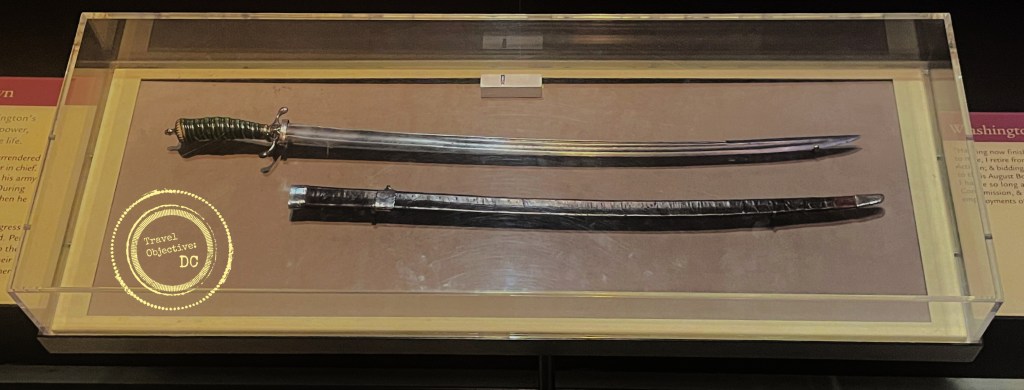
In designing The Price of Freedom, curators stayed away from displays comprised largely of weapons and uniforms (although there are still plenty of those). Rather, they identified over 800 unique artifacts from the Smithsonian’s extensive collection. Some of the more notable items on display include George Washington’s sword and scabbard, the chairs used by Ulysses S. Grant and Robert E. Lee at Appomattox and a Willys Jeep from World War II.
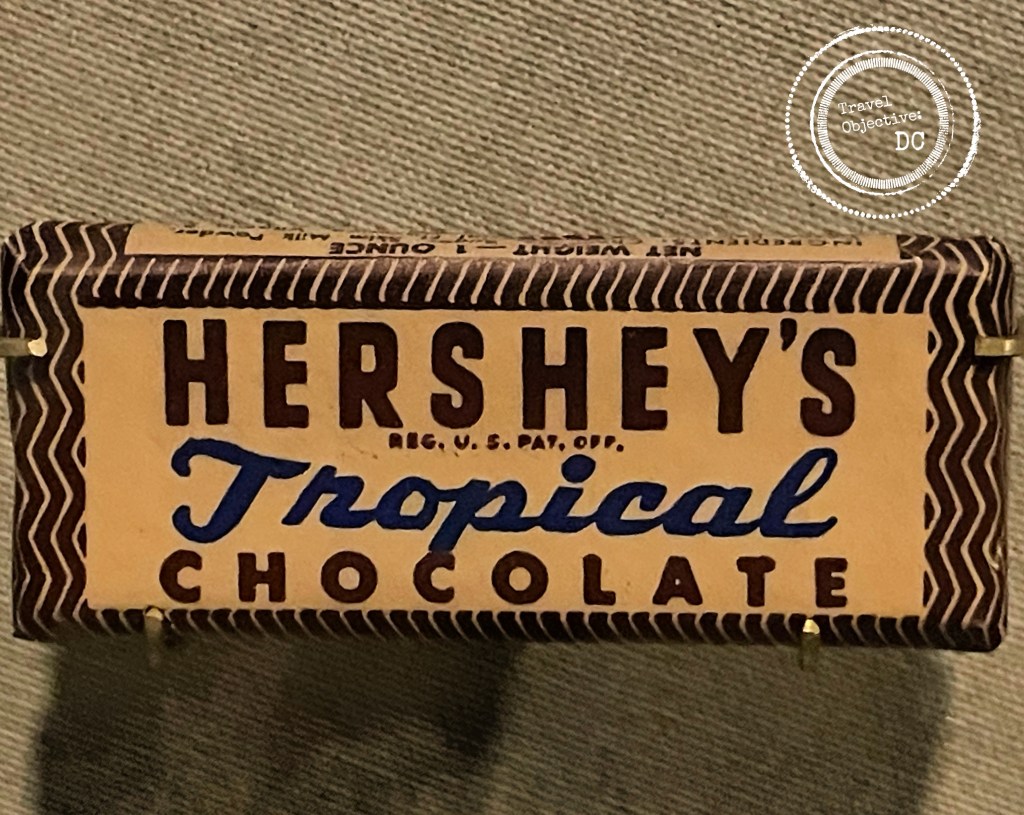
A melt resistant chocolate bar developed by the Hershey Company and provided to US servicemembers in the Pacific Theater during World War II
However, head curator David Allison sought a symmetry in the selection of the artifacts. He wanted to display noteworthy items along with more common articles reflecting the service members and their times, such as rations, books and playing cards.
In addition to the artifacts, exhibit designers use photographs, contemporary illustrations, videos, interactive stations, and other features to help interpret the wartime experience and immerse the musuem visitor in the time.
The most unique display is in the Vietnam War gallery where 16 different 1960’s-era television sets show contemporary footage and commentary depicting how Americans experienced the Vietnam War at home. The viewing area for the televisions is reminiscent of a mid-century living room, complete with a blocky couch and chair covered in thick clear plastic as your grandmother or aunt might have had.

The Revolutionary War, Civil War, World War II and Vietnam War galleries are the largest. These spaces immerse you in the story of the war and how it impacted soldier and civilian alike.
The Wars of Expansion Gallery is smaller, but provides important context and accounts for a series of 19th century conflicts, such as the Battle of Little Bighorn and the Spanish-American War, which may be less familiar to many visitors.
The mix of artifacts and displays broadens the appeal of The Price of Freedom to a wider audience. Those with less interest in military subject matter should still enjoy viewing some of the more unique items while serious students of history are sure to come away having learned something new.
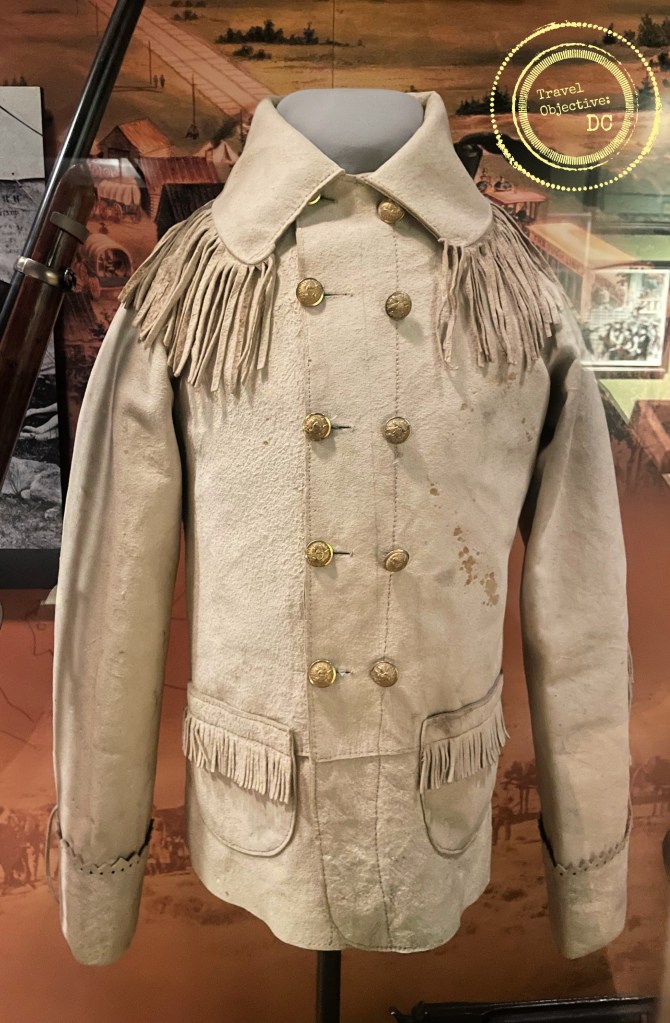
General George Custer’s buckskin coat
While in most cases The Price of Freedom achieves its aims, there are a few shortcomings.
Unfortunately, the exhibit space for World War I is too limited. The display misses or minimizes some important themes, such as the rapid expansion of the Army, the mobilization of the American economy, the changing role of women in the military, and the emergence of the United States as a world power.
The Gulf War display is similarly small, seemingly limited to uniforms worn by Colin Powell and Norman Schwarzkopf.
There is also an unfinished feel to the exhibition space for the wars in Iraq and Afghanistan. This is understandable as the original exhibit opened in 2004 before those conflicts ended. However, there is space for a more complete examination of both those conflicts than is currently provided.

The chairs used by Ulysses S. Grant and Robert E. Lee at Appomattox.
At the conclusion of The Price of Freedom is a short film with veterans reflecting on their motivations and sacrifices of their service in the American military. The film concludes with scenes from U.S. military cemeteries showing orderly tombstones and listing the number of interments.
There are also recurring references to casualites throughout the galleries in keeping with the intent of the exhibit principal funder, Kenneth Behring. He desired the exhibit specifically to recognize the ultimate sacrifices made by American men and women who died in wartime.
Even with a few flaws, two decades after its opening, the Price of Freedom remains true to its original mission. As America prepares to celebrate its 250th anniverary, this important exhibit gives visitors a thorough synopsis of America’s military heritage and its significant influence on our national character.
* * *
Route Recon
The Smithsonian National Museum of American History is located at 1300 Constitution Avenue N.W., Washington, D.C. 20560
The nearest Washington DC Metro Stations are Federal Triangle and Smithsonian. Both stations are on the Metro Blue, Orange and Silver lines.
There is no public parking facility for the Smithsonian museums on the National Mall. A limited number of city-operated metered parking spaces along adjoining streets are available.
The Musuem is open daily (except Christmas Day) from 10:00 AM to 5:30 PM.
Consult the Musuem’s website for more information about other exhibits.
Please note: The Price of Freedom, Americans at War exhibit includes some graphic images of war and casualties.
A guide to the exhibit is available here.




 Travel Objective DC