Logan’s Legacy

The heavily mustachioed bronze visage of Major General John Alexander Logan gazes down upon his namesake park and traffic circle in Northwest Washington, DC.

Logan Circle sits at the confluence of four busy thoroughfares. Enclosed within the circle is a popular and well-tended 1.8 acre park with ample benches shaded by oak trees and dotted by interpretive signage. 

These landmarks ensure Logan’s name is familiar to many Washington-area residents. Unfortunately, few may know his story, which is replete with service to our country. 

Photograph of John A. Logan, circa 1880.

John Alexander Logan, circa 1880

-Dewitt C. Pratt, Photographer; Photo Courtesy of the Library of Congress

During the Civil War, Logan was considered a “political general”. He began his political career as a Democrat in the Illinois legislature, aligning himself closely with the state’s leading political figure at the time, Stephen Douglas. Representing a district in southern Illinois, he strongly supported the enactment and enforcement of fugitive slave laws.

In 1858, he was elected to the US House of Representatives. After the firing on Fort Sumter and the succession of several Southern states, however, Logan used his tremendous oratorical skills both in Congress and in communities across his home region to promote the importance of a strong Union.

In June of 1861, while still a member of Congress, Logan attached himself as a civilian volunteer with a Michigan regiment and saw combat at the First Battle of Bull Run. In the aftermath of the battle, he eluded rebel fire while retrieving and caring for the wounded. Now determined to fight for a Union victory, he returned to his district in Illinois, raised a volunteer regiment and was appointed its colonel. 

John Logan's equistrian statue in Logan Circle Park in Washington, DC.
Statue of John A. Logan in Logan Circle Park

Unlike many of his contemporary politicans who donned military uniforms, Logan distinguished himself on the battlefield as a troop commander and tactical leader. He led his troops to victories in multiple battles, including Fort Donelson, Vicksburg, and Atlanta, and was seriously wounded on several occasions. He rose to the rank of Major General of Volunteers and briefly commanded the Union Army of the Tennessee. 

Logan inspired tremendous loyalty and dedication in his soldiers. His colleague General Mortimer Leggett said of Logan: He … seemed to have the power to call out of the men every particle of fight that was in them.

After the war, Logan returned to Congress. Switching parties, he was elected to three more terms in the House of Representatives and three terms in the Senate, representing Illinois as a Republican. His views on race seemed to switch as well. During this period, he was a strident advocate for African American rights and urged passage of the 14th and 15th Amendments. 

Bas-relief sculpture of John Logan’s swearing in as a United States Senator from his statue in Logan Circle Park

Bas-relief sculpture of John Logan's swearing in as a United States Senator from his statue in Logan Circle Park

He was also an early supporter of women’s suffrage, backed public education for all, and worked tirelessly to secure greater pensions and other benefits for veterans. 

Logan was considered by many Republicans as a potential presidential candidate. In 1884, he unsuccessfully ran for Vice President on the Republican ticket headed by James G. Blaine of Maine, losing to Grover Cleveland and Thomas Hendricks. 

His veterans advocacy led to his selection as the National Commander of the Grand Army of the Republic (GAR), the powerful Union veterans’ organization. It is here that Logan left his best known mark on American culture. In 1868, Logan directed GAR posts nationwide to decorate the graves of Union war veterans on May 30 when an abudance of flowers would be in bloom. 
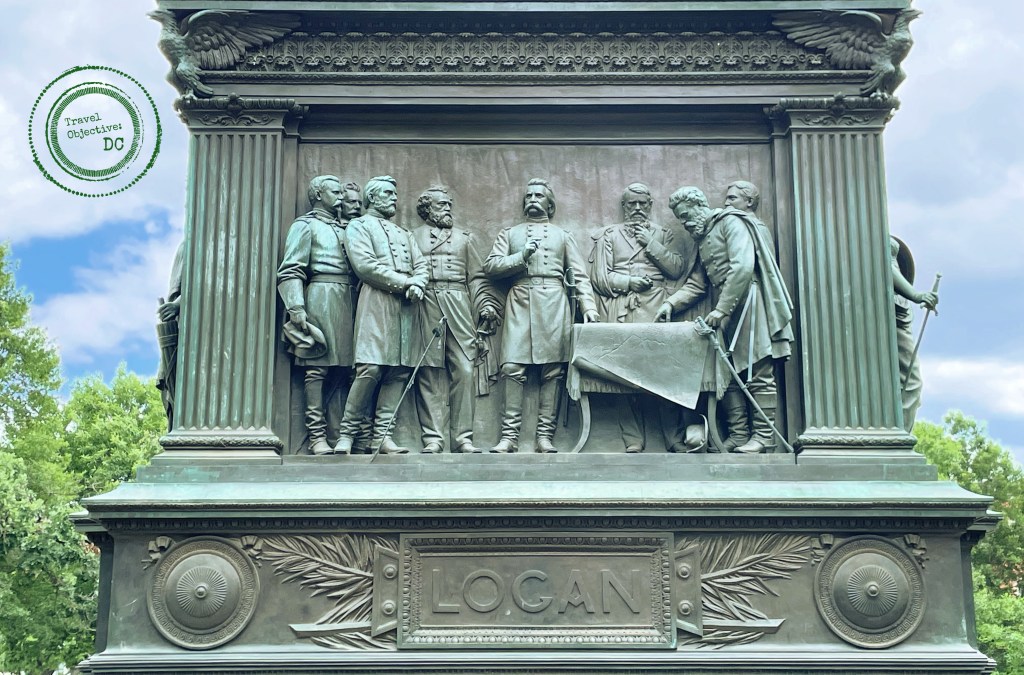
Bas-relief sculpture of John Logan conferring with fellow officers from his statue in Logan Circle Park

Bas-relief sculpture of John Logan conferring with fellow officers from his statue in Logan Circle Park

While decorating the graves of Civil War soliders was already occurring in both the North and the South, Logan’s order to the GAR expanded the practice nationwide and set a definitive date for its observance. 

In his order, Logan stressed the importance of veterans adopting and continuing this practice as he wrote: If other eyes grow dull and other hands slack, and other hearts cold in the solemn trust, ours shall keep it well as long as the light and warmth of life remains in us. 

GAR Posts readily adopted the order and organized community observances, which continued to grow in size and scope. In 1938, Congress designated Decoration Day as a national holiday on May 30.  After World War II, the term Memorial slowly replaced Decoration in the name for the day. In 1967, Congress officially changed the name of the holiday to Memorial Day. Four years later, Congress adjusted the date of Memorial Day to the last Monday in May. 

Bas-relief sculpture of Peace from John Logan’s statue in Logan Circle Park

Bas-relief sculpture of Peace from John Logan's statue in Logan Circle Park

After Logan’s death in 1886, the Society of the Army of the Tennessee led the effort to commemorate his service to the country as both soldier and statesman. Sculptor Franklin Simmons, who designed the Peace Memorial, was selected to craft a bronze equestrian statue. Logan’s figure appears atop the 25-foot-high bronze statue with bronze bas-relief panels on each side. Facing north and south are figures representing War and Peace, respectively. 

Along the eastern and western sides of the base are events from Logan’s life. Facing east is a portrayal of Logan conferring with fellow officers, while Logan’s swearing in as a US senator looks toward the west. Initially, these two images caused a minor uproar as the public realized they were factually inaccurate until Logan’s widow, Mary, explained these depictions were intended to be more illustrative rather than representing distinct historical events.   

The statue was dedicated in a grand ceremony led by President William McKinley in 1901. A large circular park known as Iowa Circle was selected as the location of the statue as Logan and his family had lived nearby. The area was emerging in the 1880’s as a fashionable middle-class neighborhood. Congress officially changed the name to Logan Circle in 1930.  While the late 20th century was a difficult time for the neighborhood, today Logan Circle is known as a trendy, gentrified area with popular restaurants, theaters and many rehabilitated historic properties. 
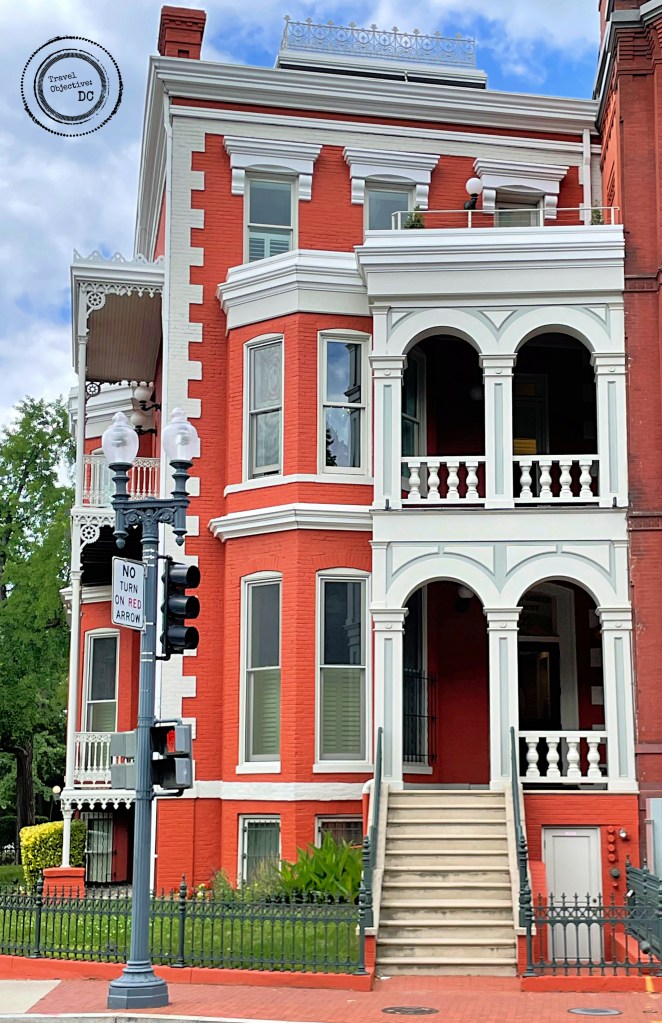
John Logan's post-war home at 4 Logan Circle NW in Washington, DC

John Logan’s post-war home at 4 Logan Circle NW in Washington, DC

Washington, DC is not alone in naming landmarks after John Logan. Across the country, there are counties, schools, plazas, a junior college, a former military post and even a national cemetery all named for John Logan.

While he might be best remembered for his contribution to creating Memorial Day, his real legacy is one of leadership and service to our country.  Whether on the battlefield, in the halls of Congress, or across Illinois, John Logan was a dedicated public servent who fought hard for a stronger country and better society. 

Route Recon

Logan Circle is located at the intersection of 13th Street, P Street, Rhode Island Avenue and Vermont Avenue in Northwest Washington.

The nearest Metro Station is Mount Vernon Square/Convention Center on the Green and Yellow Lines. It is a 15-minute walk from the station to Logan Circle.

There is street parking in the area.
The Grand Army of the Republic: the Legacy Lingers


The latter half of the 18th century saw a heyday for fraternal organizations in the United States. These associations provided their largely male memberships with opportunities to share common cultural, occupational, and religious backgrounds while often hosting social and recreational events for members and their families. 

One of the most prominent and powerful of these organizations was known as the Grand Army of the Republic (GAR). Membership in the GAR was open to all honorably discharged personnel, both officers or enlisted, from the Union Army, Navy, Marine Corps and Revenue Cutter Service (forerunner of the Coast Guard) who served during the Civil War. 

The GAR was founded in 1866 by Dr. Benjamin Stephenson who served as a surgeon with the 14th Illinois Volunteer Infantry Regiment. After the war he established a medical practice in Springfield, Illinois. Working with several veteran colleagues, he helped organize the first GAR post in nearby Decatur. 

The Grand Army of the Republic memorial in Washington, DC
A Union soldier and sailor represent Fraternity on the Grand Army of the Republic memorial at Indiana Plaza.

The GAR Memorial

One of the GAR’s principal activities was building and dedicating monuments to the sacrifices of Union forces and to the work of the GAR itself. As Union veterans aged, the GAR stepped up their efforts to build such memorials. In Washington DC, a GAR monument is located in Indiana Plaza in Washington’s Penn Quarter neighborhood. Several historic buildings frame the plaza and the Archives-Navy Memorial-Penn Quarter Metro Station brings consistent foot traffic to this busy area. 

The GAR Memorial, also known as the Benjamin Stephenson Memorial, is triangularly shaped to reflect the GAR’s motto of Fraternity, Charity and Loyalty. Each side of the 25-foot high sand colored granite block has a bronze sculpture, featuring a weathered green patina. 

The southern facing side reflects Fraternity with a sculpture of a Union soldier and sailor standing side by side. Below the sculpture is an oval image of Dr. Stephenson in his Army uniform, also rendered in bronze, surrounded by a laurel wreath carved into the granite. 

The Northeast side of the Grand Army of the Republic memorial, depicting the statue of Loyalty.

A statue of a woman with a sword and a shield represents Loyalty on the Grand Army of the Republic Memorial.

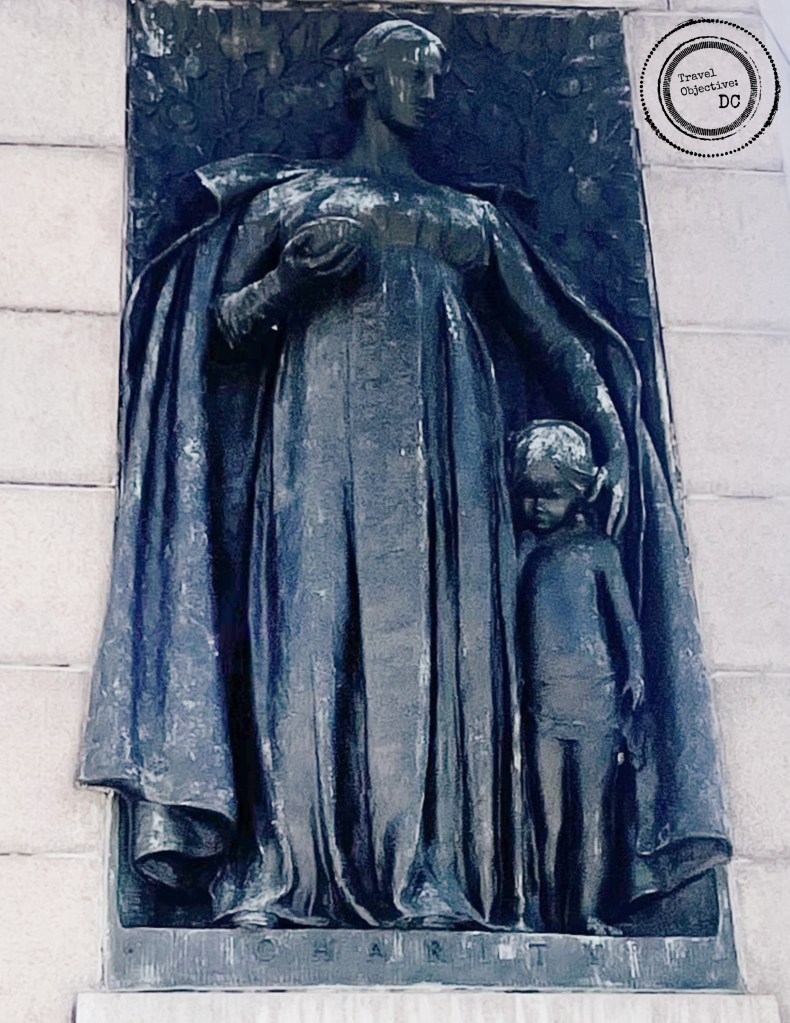
Charity is portrayed on the northwest side by a woman wearing a robe and protecting a young child. Unfortunately, a thick coat of urban grime makes viewing this statue more difficult. Finally, Loyalty is represented on the northeast side by a statue of a woman bearing a sword and holding a shield.

The monument was dedicated on July 2, 1909 in a ceremony attended by President William Howard Taft and hundreds of aging Civil War veterans. The GAR Members in the crowd that day may not have realized it, but they were part of one of America’s earliest and most powerful single-issue advocacy societies.

The Legacy of the GAR

When Dr. Stephens founded the GAR, the original focus was to raise money and organize relief efforts for wounded veterans, as well as surviving widows and children. But in short order the GAR would move to lobbying State and Federal officials for expanded pensions for Union veterans, hiring preferences for government jobs, and the building of veterans homes and hospitals. Membership soared, reaching its peak in 1890, when the GAR boasted more than 400,000 members. 

A woman and small child represent Charity on the Grand Army of the Republic Memorial.

The statue depicting charity on the Grand Army of the Republic Memorial in Washington, DC.

The GAR grew politically prominent and was especially influential within the Republican Party. In the second half of the 19th century, five Republican GAR members were elected to the presidency. Many more GAR members were elected to Congress, governorships and state legislatures. 

One reason the GAR was so politically effective was its formal structure of organized components across the country. State level units were known as departments and local bodies were known as posts. Every state had a department and posts were found in communities nationwide. GAR posts were also found in US territories and international locations. 

The national headquarters, state departments and local posts operated under a common set of by-laws and had an established chain-of-command. Each year from 1868 through 1949, the GAR organized national reunions known as encampments. These encampments were so well attended they grew larger than the political conventions of the day. Encampments were moved from state to state and localities welcomed the gatherings for the positive economic impact they provided. 

The bronze relieve figure of Dr. Benjamin Stephenson, founder of the Grand Army of the Republic.

The bronze relief of Dr. Benjamin Stephenson, founder of the Grand Army of the Republic.


Locally, posts raised money, built memorials, organized commemorations and ceremonially buried deceased veterans. They also assumed important civic functions not always tied to veterans, directing fundraising to local causes, organizing the broader community to address local issues, and sponsoring recreational events open to all. The GAR’s organizational model and many of its practices were later adopted by the Veterans of Foreign Wars (founded in 1899) and the American Legion (founded in 1919) and are still in use today.  

At at time when membership in fraternal organizations was often limited by race, GAR membership was open to all veterans, including the African Americans who fought as U.S. Colored Troops or had enlisted in the other services.

Membership in the GAR was exclusive to veterans and therefore only open to men. However, there were at least three female members: Kady Bromwell, who served along with her husband in two different Rhode Island Infantry Regiments; Sarah Edmond, who disguised herself as a man and fought with the 2nd Michigan Infantry Regiment; and Dr. Mary Edward Walker who served as a Union Army surgeon. 


The GAR formally disbanded in 1956 upon the death of its last member, Albert Woolson. Woolson, whose father had died of his combat wounds, enlisted in the 1st Minnesota Heavy Artillery Company as a drummer boy in 1864. He was about 14 years old the time. After his death, Life magazine ran a seven page story about his life.

While the GAR has been gone for over seventy years, its legacy remains. Many patriotic acts we practice today, such as placing flags on veterans graves, observing Memorial Day each May, standing for the National Anthem and saluting the flag all originated with the GAR. 

While the GAR may only be seen today through its monuments, its boot steps still echo through our stadiums, cemeteries, Legion posts and veterans homes. 

* * *

Route Recon

The memorial is located at Indiana Plaza in the Penn Quarter neighborhood. The small public plaza, located across the street from the Archives-Navy Memorial-Penn Quarter Metro station, is bounded by 7th Street to the west, Indiana Avenue to the north, and Pennsylvania Avenue to the south.