
Statues of military leaders on horseback are a common site in plazas and squares around Washington, DC. While the statues might seem ordinary, the men featured on them are usually not. This is certainly the case with the statue of General Winfield Scott Hancock in the Penn Quarter neighborhood near the Navy Memorial.
It is hard to imagine a military career today as the one experienced by this 19th century Army leader.
As the Union Army was quickly expanding to meet the grim realities of the Civil War, Major General George McClellan, Commander of the Army of the Potomac, promoted his long-time acquaintance Hancock from captain to brigadier general and assigned him to brigade command.
Hancock would go onto distinguish himself during the war, earning the nickname “Hancock the Superb”. He ultimately served 42 years on active duty and 25 years as a general officer.

In 1896, the equestrian statue was dedicated to Hancock portraying the famous general in his more senior years. But the simple monument does not tell the full story of this highly respected Union Army general.
Hancock hailed from Montgomeryville, Pennsylvania. He was the son of a lawyer in a locally prominent Democratic family. His parents named him after Winfield Scott, the Army’s most senior officer at the time. His name was apt. From an early age, the young Winfield demonstrated a keen interest in military affairs. He could often be found leading young boys in a “youth militia company” on marches through town.
At the age of 16, he was accepted at West Point, graduating in 1844.
Assignments followed in the west and in Mexico during the Mexican-American War. After the war, Hancock often received Quartermaster assignments which taught him important lessons in logistics, organization and how to navigate the Army’s bureaucracy. His affable nature, technical proficiency and dashing good looks earned him an excellent reputation among his soldiers, colleagues and superiors.

A photograph of General Winfield Scott Hancock taken sometime between 1861-1865 by Brady’s National Photographic Portrait Galleries
-Library of Congress
Militarily, Hancock is probably best remembered for his actions as a corps commander in the Union Army of the Potomac at the Battle of Gettysburg in 1863. In the prelude to the fighting, Hancock arranged Union troops in a broad defensive position along high ground south of the town. Once the fighting began in earnest, Hancock led from the front, quickly maneuvering his troops to reinforce positions along the Union line. On the third day of the battle, Hancock was severely wounded in the thigh during Confederate General George Pickett’s famous charge against the Union center.
Hancock would not leave the field until rebel troops had been repulsed. He would take five months to convalesce and would never completely heal from the wound.
Early in his career, Hancock became very good friends with a North Carolina-born officer named Lewis Armistead. However, in 1861, while both were stationed in California, they said their good-byes and headed east, destined to fight on different sides. The two faced each other on the final day of Gettysburg when Armistead led a brigade as part of Pickett’s Charge against troops commanded by Hancock. Armistead was fatally wounded during the battle and died two days later.
A photograph of Lewis Armistead, taken between 1861 and 1865, by an unknown photographer.
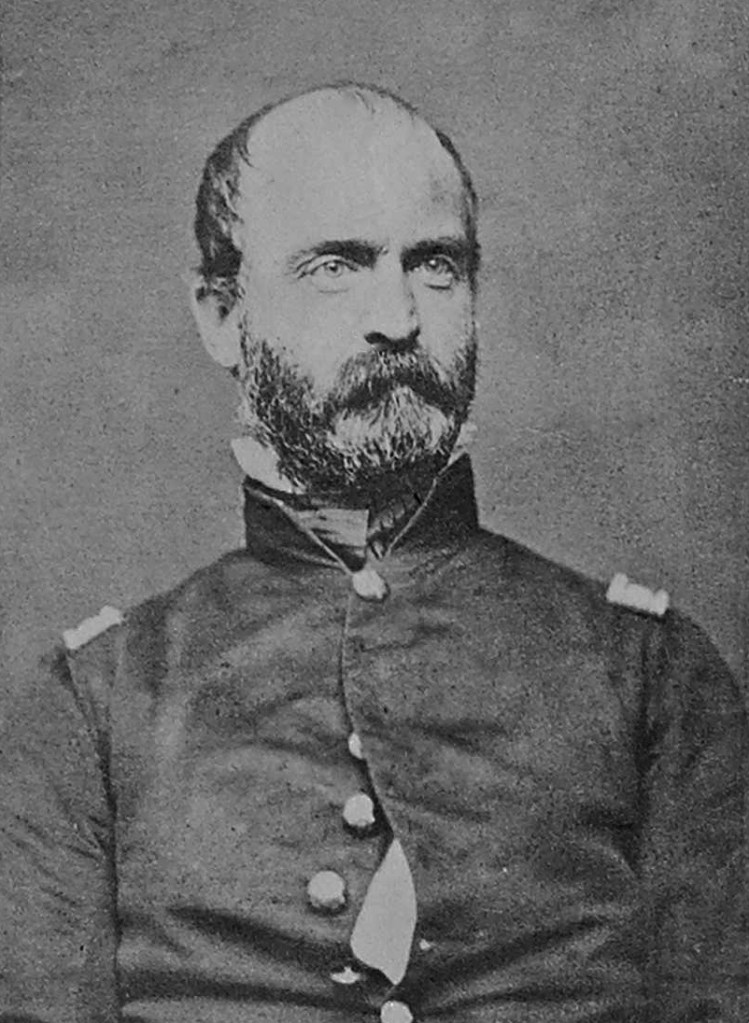
Both Hancock and Armistead are portrayed in Michael Shaara’s historical novel The Killer Angels and his son Jeffrey Shaara’s similar novels The Last Full Measure and Gods and Generals, as well as the films Gettysburg (1993) and Gods and Generals (2003).
There is scant historical evidence to support some of the depictions and dialog of the friendship between Armistead and Hancock portrayed in the novels and films. However, Captain John Bingham, an officer on Hancock’s staff, spoke with Armistead before he died. He would later write to Hancock with Armistead’s parting words to him: “Tell General Hancock for me that I have done him and done you all an injury, which I shall regret the longest day I live.”
In July of 1865, it was Hancock who supervised the execution of several of John Wilkes Booth’s conspirators in the assassination of President Lincoln. He would later be assigned as military governor of Louisiana and Texas during Reconstruction. His Democratic leanings, including his endorsement of the quick return of civil authorities, put him at odds with Republicans in Washington and with his former commander (and later President) Ulysses S. Grant.

A commemorative handkerchief featuring the images of Democratic Presidential candidate Winfield Scott Hancock and Vice Presidential candidate William English
-Library of Congress
While remaining in the Army, Hancock tested politics several times. After two attempts, he secured the Democratic nomination for president in 1880, but lost to a Republican (and former Union General) James Garfield.
Hancock died at age 61 in 1886 from an infection and complications of diabetes while serving as Commander of the US Army’s Department of the Atlantic. His death surprised the country as the condition of his health was unknown to most everyone.
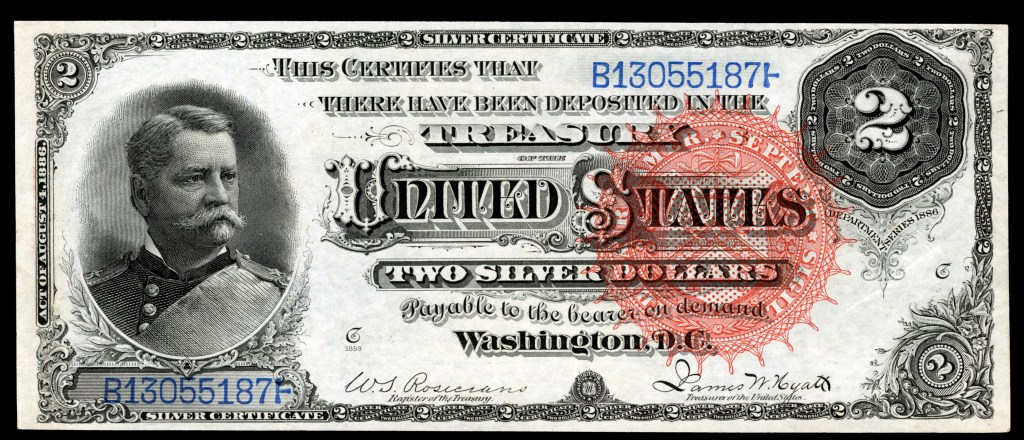
Tributes to Hancock poured in from military, civic and political leaders from across the country. Perhaps the most stirring came from a political rival and former president, Rutherford B. Hayes:
“If, when we make up our estimate of a public man, conspicuous, as a soldier and in civil life, we are to think first and chiefly of his manhood, his integrity, his purity, his singleness of purpose, and his unselfish devotion, we can say truthfully of Hancock that he was through and through pure gold.”
Hancock’s statue is made of bronze, not gold, but he was the gold standard of an officer and a gentlemen.
* * *
Route Recon
The Statue of Winfield Scott Hancock is located just south of the Archives-Navy Memorial-Penn Quarter Metro Station.
Command Reading
Armistead and Hancock: Behind the Gettysburg Legend of Two Friends at the Turning Point of the Civil War by Tom McMillan. This dual biography of two leading Civil War generals provides new scholarship and analysis of their lives and careers and specifically details their friendship from its earliest days up to the Battle of Gettysburg.
 Travel Objective DC