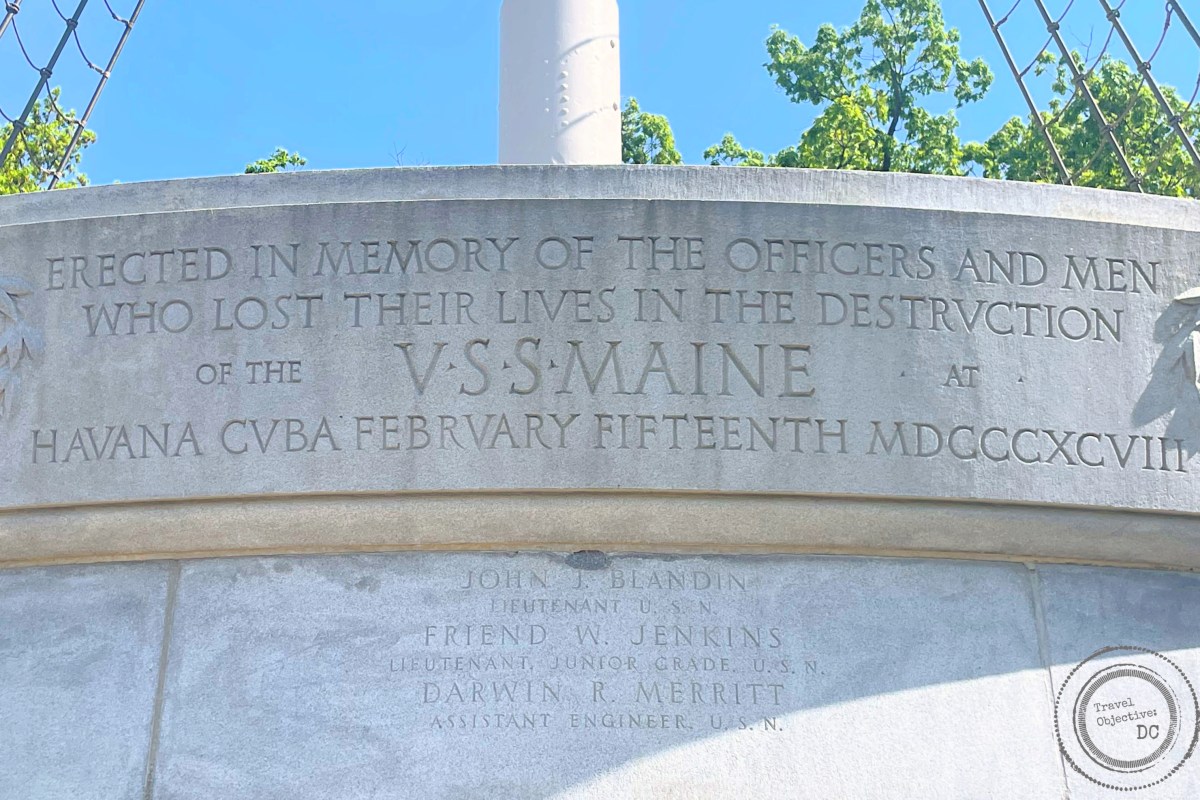
“Remember the Maine, to Hell with Spain” became a rallying cry for war in the spring of 1898. As a simmering independence movement in Cuba was becoming increasingly violent that January, President William McKinley sent the USS Maine to Havana to watch after American lives as well as political and business interests. Tensions between the United States and Spain had been growing over independence movements in Cuba, Puerto Rico and the Philippines; McKinley was hoping for a peaceful resolution.

The USS Maine circa 1895-1898
-US Naval History and Heritage Command Photograph
However, it was not to be. The Maine arrived in Havana on January 25th with approximately 26 officers, 290 sailors and 39 Marines on board. Just after the bugle call Taps on February 15th, an explosion detonated the five tons of gunpowder charges for the Maine’s large guns. The forward section of the ship, containing the enlisted men’s quarters, blew apart. An estimated 266 men died either during the explosion or in the days afterward.
The USS Maine Memorial at Arlington National Cemetery

How the explosion occurred was not immediately apparent. Several different investigations and reviews could not concur on a definitive cause. Though the combustion of coal dust was one possibility, several prominent newspapers of the time blamed a Spanish naval mine. A vocal element of the population was ready to use force against Spain and Congress declared war on April 25th. The war would end quickly and favorably for the United States as Spain ceded Guam, Puerto Rico and the Philippines.
Even with the war’s prompt conclusion, America did not forget about the Maine. In 1899, the remains of 165 sailors who died in the explosion were exhumed from a Cuban graveyard and reinterred at Arlington National Cemetery. In 1912, the Army Corps of Engineers recovered the twisted remains of the Maine’s hull from Havana Harbor and towed her further away from the Cuban coast. After recovering an additional 66 bodies, the Maine was then scuttled in deeper waters while Taps played and escort ships offered a 21-gun salute. The ship’s masts were salvaged and the main mast sent to Arlington National Cemetery.
The mast of the USS Maine passes through the stone structure and is embedded into the floor. A surviving piece of the ship’s bell is hung on the front door.
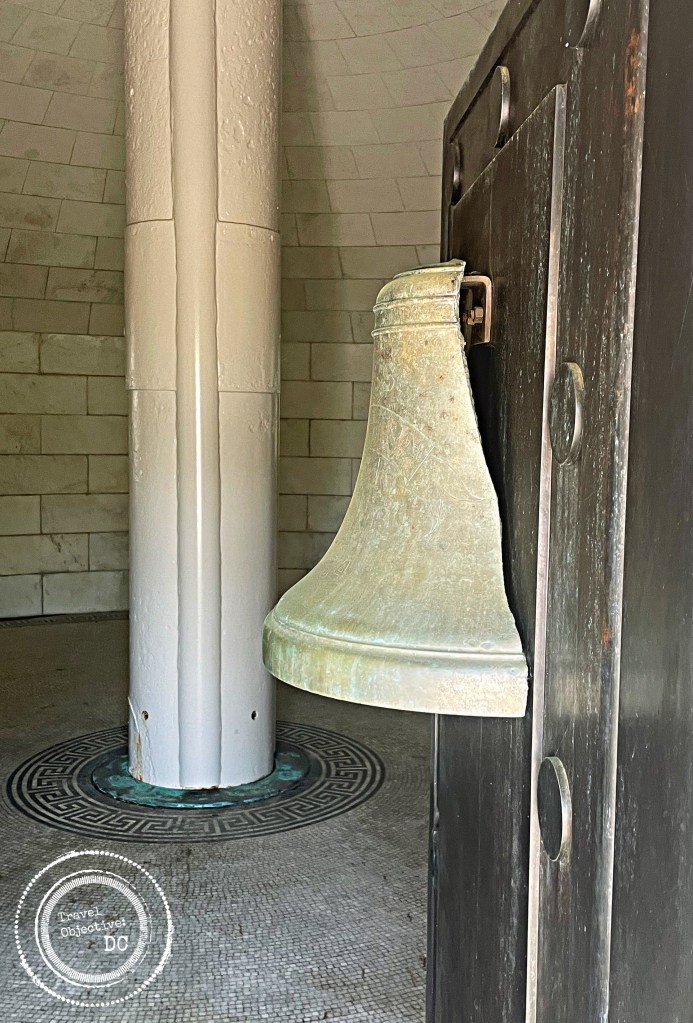
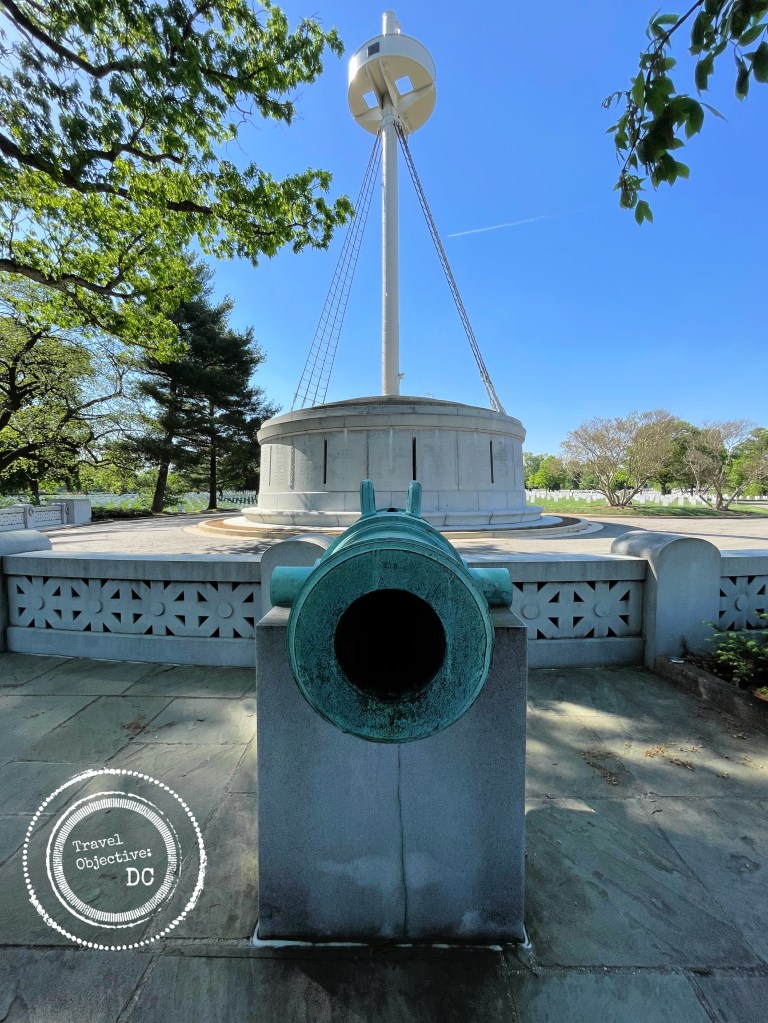
Efforts to build a memorial to the Maine began shortly after the explosion and about twenty monuments or special exhibits of the ship’s artifacts exist around the United States. President Woodrow Wilson dedicated the current memorial at Arlington National Cemetery in 1915, adjoining the burial site of the USS Maine sailors. The centerpiece of the memorial is a circular stone structure, 90 feet in diameter, built around the ship’s main mast. The shape of the structure suggests the warship’s gun turret, but it also has served as a temporary mausoleum. Rigging extends from the top of the structure up to a crow’s next atop the mast. On the circumference of the building are names and ratings of the sailors who died in the explosion. The front door of the structure holds a piece of the ship’s bell, which was broken in half during the explosion.
A paved lane encircles the memorial. To the east is an anchor made specifically for the memorial but resembling the anchor onboard the Maine. Positioned along the back of the memorial are two bronze Spanish mortars, cast in the 1700s and captured by Admiral George Dewey in the Philippines during the Spanish–American War.
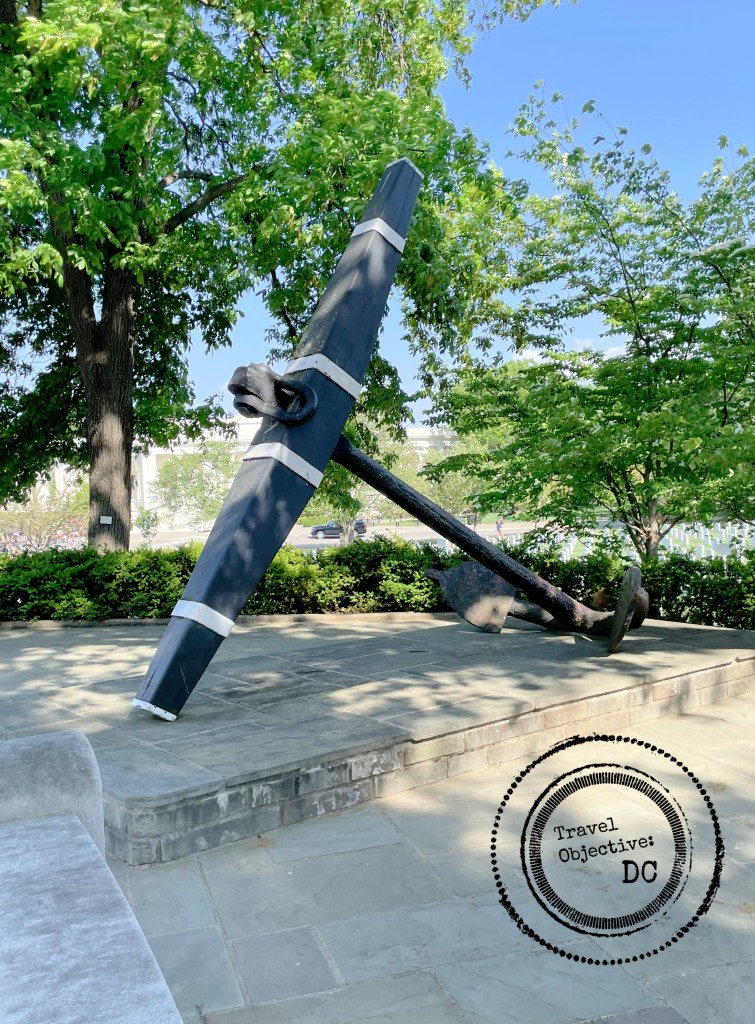
The replica anchor was the centerpiece of an earlier memorial to the USS Maine. It weighs about two tons.
Most auspiciously, in the twelve decades since that fateful February night, the USS Maine is still not forgotten. There have been periodic reinvestigations and new studies into the cause of her sinking, reexamining the available evidence and using modern technologies and computer simulations. In 2000, a marine exploration firm unexpectedly came upon her wreck at a depth of 4,000 feet. Yet a definitive cause of the explosion remains elusive.
Next to the USS Maine Memorial, Section 24 at Arlington National Cemetery contains the graves of 229 sailors lost on the USS Maine.

Fortunately, any visitor to Arlington National Cemetery can also “Remember the Maine”. A short walk from the Tomb of the Unknown Soldier will lead to the USS Maine memorial. Observe the neatly organized graves and note the names along the memorial’s wall.
Their sacrifice endures.
* * *
Route Recon
Arlington National Cemetery is open daily from 8:00 am to 5:00 pm.
Arlington National Cemetery is located across the Potomac River from Washington, D.C. at the end of Memorial Avenue, which extends from Memorial Bridge. Arlington is accessible from the major roadways in the D.C. area: Interstate 95, the Capital Beltway (I-495), and the George Washington Memorial Parkway.
Parking: A parking garage is located near the cemetery’s entrance on Memorial Avenue.
Metro: Arlington Cemetery station is stop on the Washington Metropolitan Area Transit Authority Blue Line.
Both the Parking Garage and Metro station are a short walk from the Welcome Center. Please note there is a 100% security check for visitors entering the cemetery.
The USS Maine Memorial is located to the west of the Tomb of the Unknown Soldier and the Memorial Amphitheater. You can view a map of Arlington National Cemetery here.
 Travel Objective DC